1
Introduction to data interoperability
Environmental data for applications Seminar
23 Sept, 2015
Ville Kotovirta
VTT Technical Research Centre of Finland Ltd
2
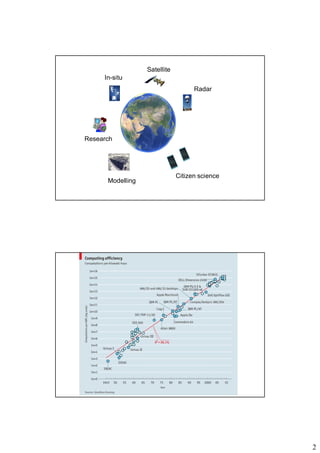
Satellite
Radar
In-situ
Modelling
Citizen science
Research
3
201519801950
Amount of
environmental
data
Amount of
interoperable
data
Amount of
data in use
201519801950
Amount of
environmental
data
Amount of
interoperable
data
Amount of
data in use
Big data
gap
Interoperability
gap
4
Currently visible data value
of known sources and uses
Potential data value -
currently hidden because
data are not known and
cannot be accessed
824/09/2015
Data fragmentation
Fragmentation in technology
Different sensors are based on different technology, different
data formats are used
Fragmentation in data quality
Various data quality requirements
Fragmentation in space and time
Different sensors and models have different spatial and temporal
resolutions
Fragmentation in semantics
Different organisations, different countries, different disciplines
use different semantics for data
Fragmentation in data politics
differing views on how the data should be shared
The need for interoperability is not taken into account when systems
are designed and built
As a result, it is too expensive for users to use the data
5
0
5000
10000
15000
20000
25000
30000
35000
40000
45000
1880 1900 1920 1940 1960 1980 2000 2020
Gross World Product (GWD) vs. CO2
Real GWP ($ billions)
CO2 emissions
(Teragrams)
https://en.wikipedia.org/wiki/Gross_world_product https://en.wikipedia.org/wiki/Global_warming#/media/File:Tr
endsGlobalEmissions.png
6
1124/09/2015
Anatomy of environmental problems
Environmental externalities – producers or consumers have
unintended external (indirect) effects on other producers or/and
consumers
Consumers cannot take environmental consequences of complex
production systems into account
reliable and understandable information does not exist
information cannot be accessed and valuated when choices
are made
More powerful environmental monitoring and information
processing are needed to solve environmental problems!
1101011
10010010011
10100101001
10100100100
100101001001
1100101
Interoperability
Managing,
processing,
modelling
Tailoring
Challenges of environmental monitoring
Measurement QC
Data
value
Representation Business
7
• Data inventory
• OGC, Inspire, API’s
• New sensor technology
• Sensor network control
• Citizen science
1101011
10010010011
10100101001
10100100100
100101001001
1100101
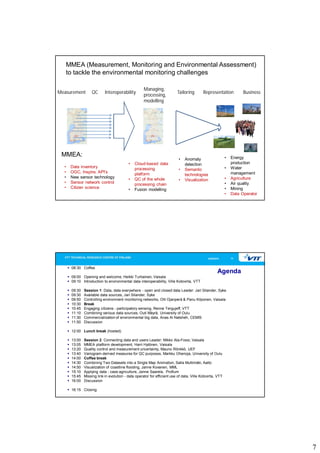
MMEA (Measurement, Monitoring and Environmental Assessment)
to tackle the environmental monitoring challenges
• Cloud-based data
processing
platform
• QC of the whole
processing chain
• Fusion modelling
• Anomaly
detection
• Semantic
technologies
• Visualization
• Energy
production
• Water
management
• Agriculture
• Air quality
• Mining
• Data Operator
MMEA:
Interoperability
Managing,
processing,
modelling
TailoringMeasurement QC Representation Business
1424/09/2015
08:30 Coffee
09:00 Opening and welcome, Heikki Turtiainen, Vaisala
09:10 Introduction to environmental data interoperability, Ville Kotovirta, VTT
09:30 Session 1: Data, data everywhere - open and closed data Leader: Jari Silander, Syke
09:30 Available data sources, Jari Silander, Syke
09:50 Controlling environment monitoring networks, Olli Ojanperä & Panu Kilponen, Vaisala
10:30 Break
10:45 Engaging citizens - participatory sensing, Renne Tergujeff, VTT
11:10 Combining various data sources, Outi Mäyrä, University of Oulu
11:30 Commercialization of environmental big data, Anas Al Natsheh, CEMIS
11:50 Discussion
12:00 Lunch break (hosted)
13:00 Session 2: Connecting data and users Leader: Mikko Ala-Fossi, Vaisala
13:05 MMEA platform development, Harri Hytönen, Vaisala
13:20 Quality control and measurement uncertainty, Mauno Rönkkö, UEF
13:40 Variogram-derived measures for QC purposes, Markku Ohenoja, University of Oulu
14:00 Coffee break
14:30 Combining Two Datasets into a Single Map Animation, Salla Multimäki, Aalto
14:50 Visualization of coastline flooding, Janne Kovanen, MML
15:10 Applying data - case agriculture, Janne Saarela, Profium
15:45 Missing link in evolution - data operator for efficient use of data, Ville Kotovirta, VTT
16:00 Discussion
16:15 Closing
Agenda

Introduction to data interoperability

  • 1.
    1 Introduction to datainteroperability Environmental data for applications Seminar 23 Sept, 2015 Ville Kotovirta VTT Technical Research Centre of Finland Ltd
  • 2.
  • 3.
    3 201519801950 Amount of environmental data Amount of interoperable data Amountof data in use 201519801950 Amount of environmental data Amount of interoperable data Amount of data in use Big data gap Interoperability gap
  • 4.
    4 Currently visible datavalue of known sources and uses Potential data value - currently hidden because data are not known and cannot be accessed 824/09/2015 Data fragmentation Fragmentation in technology Different sensors are based on different technology, different data formats are used Fragmentation in data quality Various data quality requirements Fragmentation in space and time Different sensors and models have different spatial and temporal resolutions Fragmentation in semantics Different organisations, different countries, different disciplines use different semantics for data Fragmentation in data politics differing views on how the data should be shared The need for interoperability is not taken into account when systems are designed and built As a result, it is too expensive for users to use the data
  • 5.
    5 0 5000 10000 15000 20000 25000 30000 35000 40000 45000 1880 1900 19201940 1960 1980 2000 2020 Gross World Product (GWD) vs. CO2 Real GWP ($ billions) CO2 emissions (Teragrams) https://en.wikipedia.org/wiki/Gross_world_product https://en.wikipedia.org/wiki/Global_warming#/media/File:Tr endsGlobalEmissions.png
  • 6.
    6 1124/09/2015 Anatomy of environmentalproblems Environmental externalities – producers or consumers have unintended external (indirect) effects on other producers or/and consumers Consumers cannot take environmental consequences of complex production systems into account reliable and understandable information does not exist information cannot be accessed and valuated when choices are made More powerful environmental monitoring and information processing are needed to solve environmental problems! 1101011 10010010011 10100101001 10100100100 100101001001 1100101 Interoperability Managing, processing, modelling Tailoring Challenges of environmental monitoring Measurement QC Data value Representation Business
  • 7.
    7 • Data inventory •OGC, Inspire, API’s • New sensor technology • Sensor network control • Citizen science 1101011 10010010011 10100101001 10100100100 100101001001 1100101 MMEA (Measurement, Monitoring and Environmental Assessment) to tackle the environmental monitoring challenges • Cloud-based data processing platform • QC of the whole processing chain • Fusion modelling • Anomaly detection • Semantic technologies • Visualization • Energy production • Water management • Agriculture • Air quality • Mining • Data Operator MMEA: Interoperability Managing, processing, modelling TailoringMeasurement QC Representation Business 1424/09/2015 08:30 Coffee 09:00 Opening and welcome, Heikki Turtiainen, Vaisala 09:10 Introduction to environmental data interoperability, Ville Kotovirta, VTT 09:30 Session 1: Data, data everywhere - open and closed data Leader: Jari Silander, Syke 09:30 Available data sources, Jari Silander, Syke 09:50 Controlling environment monitoring networks, Olli Ojanperä & Panu Kilponen, Vaisala 10:30 Break 10:45 Engaging citizens - participatory sensing, Renne Tergujeff, VTT 11:10 Combining various data sources, Outi Mäyrä, University of Oulu 11:30 Commercialization of environmental big data, Anas Al Natsheh, CEMIS 11:50 Discussion 12:00 Lunch break (hosted) 13:00 Session 2: Connecting data and users Leader: Mikko Ala-Fossi, Vaisala 13:05 MMEA platform development, Harri Hytönen, Vaisala 13:20 Quality control and measurement uncertainty, Mauno Rönkkö, UEF 13:40 Variogram-derived measures for QC purposes, Markku Ohenoja, University of Oulu 14:00 Coffee break 14:30 Combining Two Datasets into a Single Map Animation, Salla Multimäki, Aalto 14:50 Visualization of coastline flooding, Janne Kovanen, MML 15:10 Applying data - case agriculture, Janne Saarela, Profium 15:45 Missing link in evolution - data operator for efficient use of data, Ville Kotovirta, VTT 16:00 Discussion 16:15 Closing Agenda