DATA INFORMATION
 Data is the collection of individual
statistics,facts or items of information which
may be in form of unprocessed or processed,
structured or unstructured.
 Example: Each student’s mark is one piece of
data
 Data is not always meaningful.
 The Data is independent of the information.
 Data is or raw data is not enough to make a
decision.
 Information is data which is processed,
organized, and structured.
 Example: The average mark of class is
information that can be derived from given
data
 Information is always meaningful.
 Information is dependent on data.
 Information is easier to reproduce if lost.
 The information is sufficient to help make a
decision in the respective context.
Submitted by Subhamita K
How Data is useful for us
 To make informed decisions
 Find the solutions to problems
 Improve people’s lives
 For better understanding
 For improving processes
 For understanding behaviour – To understand customer’s needs
Submitted by Subhamita K
What is Big Data
 Big data refers to data that is so large, fast or complex that it's difficult or
impossible to process using traditional methods. The act of accessing and storing
large amounts of information for analytics has been around for a long time
Submitted by Subhamita K
Difference between Structured, Semi-
structured and Unstructured data
 Big Data includes huge volume, high velocity, and extensible variety of data.
These are 3 types: Structured data, Semi-structured data, and Unstructured data.
 Structured data –
Structured data is data whose elements are addressable for effective analysis. It
has been organized into a formatted repository that is typically a database. It
concerns all data which can be stored in database SQL in a table with rows and
columns. They have relational keys and can easily be mapped into pre-designed
fields. Today, those data are most processed in the development and simplest way
to manage information. Example: Relational data.
Submitted by Subhamita K
Difference between Structured, Semi-
structured and Unstructured data
 Semi-Structured data –
Semi-structured data is information that does not reside in a relational database but
that has some organizational properties that make it easier to analyze. With some
processes, you can store them in the relation database (it could be very hard for some
kind of semi-structured data), but Semi-structured exist to ease space. Example: XML
data.
 Unstructured data –
Unstructured data is a data which is not organized in a predefined manner or does not
have a predefined data model, thus it is not a good fit for a mainstream relational
database. So for Unstructured data, there are alternative platforms for storing and
managing, it is increasingly prevalent in IT systems and is used by organizations in a
variety of business intelligence and analytics applications. Example: Word, PDF, Text,
Media logs.
Submitted by Subhamita K
what are qualitative and quantitative
data?
 Qualitative data is descriptive in nature, expressed in terms of language rather
than numerical values.
 Quantitative data refers to any information that can be quantified, counted or
measured, and given a numerical value.
Submitted by Subhamita K
what is the different V’s in big data?
 Big data is a collection of data from many different sources and is often described
by five characteristics: volume, value, variety, velocity, and veracity.
Submitted by Subhamita K
Name some popular tools used in big
data?
Some popular tools are:
 Apache Spark.
 Apache Hadoop.
 Apache Flink.
 Google Cloud Platform.
 MongoDB.
 Sisense.
 RapidMiner.
Submitted by Subhamita K
what are different types of data ? Explain.
 Data is defined as a systematic record corresponding to a specific quantity. Basically,
data can be summarized as a set of facts and figures which can be used to serve a
specific usage or purpose. For instance, data can be used as a survey or an analysis.
Data in a systematic and organized form is referred to as information. In addition to
this, the source of data primary or secondary is also an essential factor.
 Types of Data
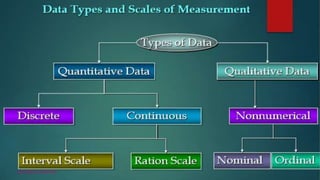
 There are the following types of known forms of data:
Submitted by Subhamita K
what are different types of data ? Explain.
Qualitative Data
 Qualitative data is used to represent some characteristics or attributes of the data. The facts
and figures depicted by the qualitative data cannot be computed. These properties reflect
observable attributes. These are non-numerical in nature. The qualitative data characteristics
are exploratory on a larger end than being conclusive in nature. For instance, data on
attributes such as honesty, loyalty, wisdom, and creativity for a set of persons defined can be
considered as qualitative data
 Examples:
• Attitudes of people to a political system.
• Music and art
• Intelligence
• Beauty of a person
Submitted by Subhamita K
what are different types of data ? Explain.
Nominal Data
 Nominal data is a sub-category belonging to one of the types of qualitative information. Also known as
the nominal scale, it is used to label the variables without providing the numerical value for them.
Nominal data attributes can’t either be ordered or measured. The nominal data can be both qualitative
and quantitative in nature. For instance, some of the nominal data attributes are letters, symbols or
gender, etc.
 Examples:
• Gender (Women, Men)
• Eye color (Blue, Green, Brown)
• Hair color (Blonde, Brown, Brunette, Red, etc..)
• Marital status (Married, Single)
• Religion (Muslim, Hindu, Christian)
Submitted by Subhamita K
what are different types of data ? Explain.
Ordinal Data
 Ordinal data/variable is the specific type of data that follows a natural order. The
difference between the data values is not determined in the case of nominal data. For
instance, ordinal data variable is mostly found in surveys, economics, questionnaires,
and finance operations.
• Feedback is recorded in the form of ratings from 1-10.
• Education level: elementary school, high school, college.
• Economic status: low, medium, and high.
• Letter grades: A, B, C, and etc..
• Customer level of satisfaction: very satisfied, satisfied, neutral, dissatisfied, very
dissatisfied.
Submitted by Subhamita K
what are different types of data ? Explain.
Quantitative Data
 Quantitative data can be measured and is not just observable. The measurement of
data is numerically recorded and represented. Calculations and interpretations can
then be performed on the obtained results. Numerical data is indicated by quantitative
data. For instance, data can be recorded about how many users found a product
satisfactory in terms of the collected rating, and therefore, an overall product review
can be generated.
 Examples:
• Daily temperature
• Price
• Weights
• Income
Submitted by Subhamita K
what are different types of data ? Explain.
Discrete Data
 Discrete data refers to the data values which can only attain certain specific values.
Discrete data can’t attain a range of values. Discrete data can be represented using
bar charts. For instance, ratings of a product made by the users can only be in
discrete numbers.
 Examples:
• The number of students in a class,
• The number of chips in a bag,
• The number of stars in the sky
Submitted by Subhamita K
what are different types of data ? Explain.
Continuous Data
 It can contain values between a certain range that is within the highest and lowest values. The
corresponding difference between the highest and lowest value of these intervals can be termed
as the range of data. Continuous data can be tabulated in what is called a frequency distribution.
The frequency distribution table can be computed for the range type of data. It can also be
depicted using histograms. For example, the heights of the students in the class can be largely
varying in nature, therefore, they can be divided into ranges to summarise the data.
 Examples:
• Height and weight of a student,
• Daily temperature recordings of a place
• Wind speed measurement
Submitted by Subhamita K

Introduction to Data (1).pptx

  • 1.
    DATA INFORMATION  Datais the collection of individual statistics,facts or items of information which may be in form of unprocessed or processed, structured or unstructured.  Example: Each student’s mark is one piece of data  Data is not always meaningful.  The Data is independent of the information.  Data is or raw data is not enough to make a decision.  Information is data which is processed, organized, and structured.  Example: The average mark of class is information that can be derived from given data  Information is always meaningful.  Information is dependent on data.  Information is easier to reproduce if lost.  The information is sufficient to help make a decision in the respective context. Submitted by Subhamita K
  • 2.
    How Data isuseful for us  To make informed decisions  Find the solutions to problems  Improve people’s lives  For better understanding  For improving processes  For understanding behaviour – To understand customer’s needs Submitted by Subhamita K
  • 3.
    What is BigData  Big data refers to data that is so large, fast or complex that it's difficult or impossible to process using traditional methods. The act of accessing and storing large amounts of information for analytics has been around for a long time Submitted by Subhamita K
  • 4.
    Difference between Structured,Semi- structured and Unstructured data  Big Data includes huge volume, high velocity, and extensible variety of data. These are 3 types: Structured data, Semi-structured data, and Unstructured data.  Structured data – Structured data is data whose elements are addressable for effective analysis. It has been organized into a formatted repository that is typically a database. It concerns all data which can be stored in database SQL in a table with rows and columns. They have relational keys and can easily be mapped into pre-designed fields. Today, those data are most processed in the development and simplest way to manage information. Example: Relational data. Submitted by Subhamita K
  • 5.
    Difference between Structured,Semi- structured and Unstructured data  Semi-Structured data – Semi-structured data is information that does not reside in a relational database but that has some organizational properties that make it easier to analyze. With some processes, you can store them in the relation database (it could be very hard for some kind of semi-structured data), but Semi-structured exist to ease space. Example: XML data.  Unstructured data – Unstructured data is a data which is not organized in a predefined manner or does not have a predefined data model, thus it is not a good fit for a mainstream relational database. So for Unstructured data, there are alternative platforms for storing and managing, it is increasingly prevalent in IT systems and is used by organizations in a variety of business intelligence and analytics applications. Example: Word, PDF, Text, Media logs. Submitted by Subhamita K
  • 6.
    what are qualitativeand quantitative data?  Qualitative data is descriptive in nature, expressed in terms of language rather than numerical values.  Quantitative data refers to any information that can be quantified, counted or measured, and given a numerical value. Submitted by Subhamita K
  • 7.
    what is thedifferent V’s in big data?  Big data is a collection of data from many different sources and is often described by five characteristics: volume, value, variety, velocity, and veracity. Submitted by Subhamita K
  • 8.
    Name some populartools used in big data? Some popular tools are:  Apache Spark.  Apache Hadoop.  Apache Flink.  Google Cloud Platform.  MongoDB.  Sisense.  RapidMiner. Submitted by Subhamita K
  • 9.
    what are differenttypes of data ? Explain.  Data is defined as a systematic record corresponding to a specific quantity. Basically, data can be summarized as a set of facts and figures which can be used to serve a specific usage or purpose. For instance, data can be used as a survey or an analysis. Data in a systematic and organized form is referred to as information. In addition to this, the source of data primary or secondary is also an essential factor.  Types of Data  There are the following types of known forms of data: Submitted by Subhamita K
  • 10.
  • 11.
    what are differenttypes of data ? Explain. Qualitative Data  Qualitative data is used to represent some characteristics or attributes of the data. The facts and figures depicted by the qualitative data cannot be computed. These properties reflect observable attributes. These are non-numerical in nature. The qualitative data characteristics are exploratory on a larger end than being conclusive in nature. For instance, data on attributes such as honesty, loyalty, wisdom, and creativity for a set of persons defined can be considered as qualitative data  Examples: • Attitudes of people to a political system. • Music and art • Intelligence • Beauty of a person Submitted by Subhamita K
  • 12.
    what are differenttypes of data ? Explain. Nominal Data  Nominal data is a sub-category belonging to one of the types of qualitative information. Also known as the nominal scale, it is used to label the variables without providing the numerical value for them. Nominal data attributes can’t either be ordered or measured. The nominal data can be both qualitative and quantitative in nature. For instance, some of the nominal data attributes are letters, symbols or gender, etc.  Examples: • Gender (Women, Men) • Eye color (Blue, Green, Brown) • Hair color (Blonde, Brown, Brunette, Red, etc..) • Marital status (Married, Single) • Religion (Muslim, Hindu, Christian) Submitted by Subhamita K
  • 13.
    what are differenttypes of data ? Explain. Ordinal Data  Ordinal data/variable is the specific type of data that follows a natural order. The difference between the data values is not determined in the case of nominal data. For instance, ordinal data variable is mostly found in surveys, economics, questionnaires, and finance operations. • Feedback is recorded in the form of ratings from 1-10. • Education level: elementary school, high school, college. • Economic status: low, medium, and high. • Letter grades: A, B, C, and etc.. • Customer level of satisfaction: very satisfied, satisfied, neutral, dissatisfied, very dissatisfied. Submitted by Subhamita K
  • 14.
    what are differenttypes of data ? Explain. Quantitative Data  Quantitative data can be measured and is not just observable. The measurement of data is numerically recorded and represented. Calculations and interpretations can then be performed on the obtained results. Numerical data is indicated by quantitative data. For instance, data can be recorded about how many users found a product satisfactory in terms of the collected rating, and therefore, an overall product review can be generated.  Examples: • Daily temperature • Price • Weights • Income Submitted by Subhamita K
  • 15.
    what are differenttypes of data ? Explain. Discrete Data  Discrete data refers to the data values which can only attain certain specific values. Discrete data can’t attain a range of values. Discrete data can be represented using bar charts. For instance, ratings of a product made by the users can only be in discrete numbers.  Examples: • The number of students in a class, • The number of chips in a bag, • The number of stars in the sky Submitted by Subhamita K
  • 16.
    what are differenttypes of data ? Explain. Continuous Data  It can contain values between a certain range that is within the highest and lowest values. The corresponding difference between the highest and lowest value of these intervals can be termed as the range of data. Continuous data can be tabulated in what is called a frequency distribution. The frequency distribution table can be computed for the range type of data. It can also be depicted using histograms. For example, the heights of the students in the class can be largely varying in nature, therefore, they can be divided into ranges to summarise the data.  Examples: • Height and weight of a student, • Daily temperature recordings of a place • Wind speed measurement Submitted by Subhamita K