Big Data
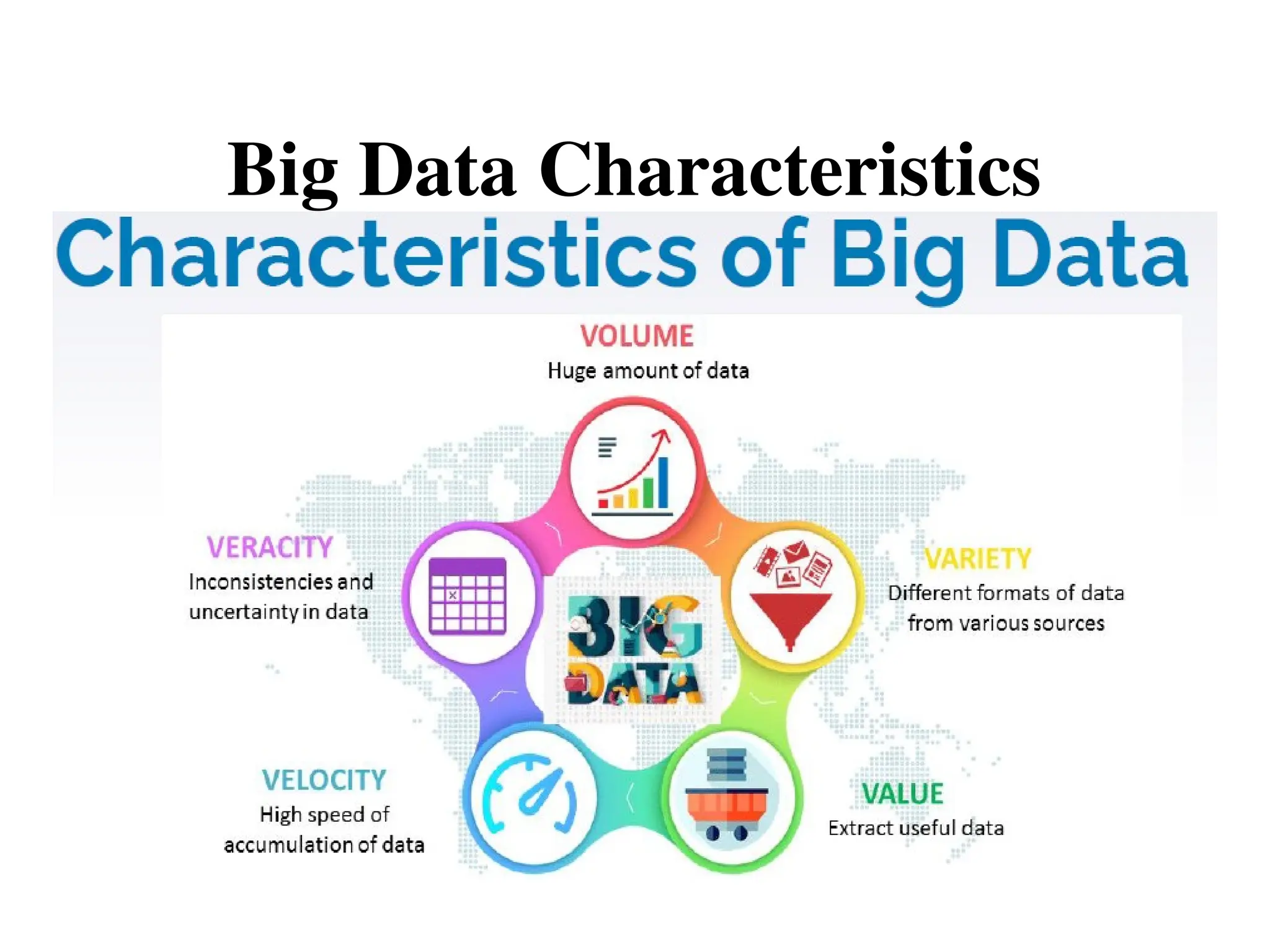
• BigData is a collection of data that is huge
in volume, yet growing exponentially with
time. It is a data with so large size and
complexity that none of traditional data
management tools can store it or process it
efficiently. Big data is also a data but with
huge size.
UNIT ‐ I
2.
Introduction to bigdata:
Big data analytics is the use of advanced analytic
techniques against very large, diverse big data sets that
include structured, semi-structured and unstructured
data, from different sources, and in different sizes from
terabytes to zettabytes.
What is Data?
Data is defined as individual facts, such as numbers,
words, measurements, observations or just descriptions
of things.
For example, data might include individual prices,
weights, addresses, ages, names, temperatures, dates,
or distances.
7.
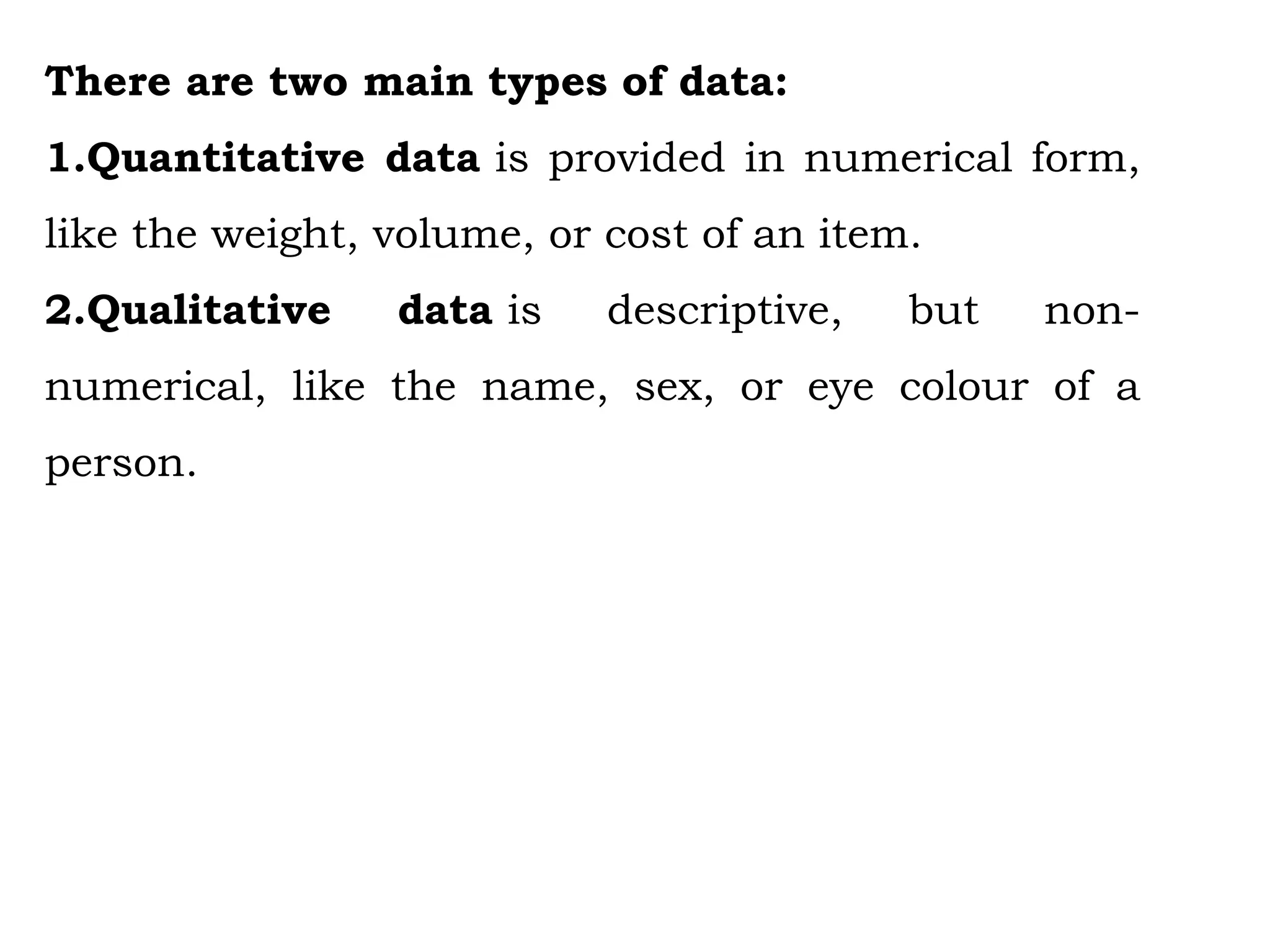
There are twomain types of data:
1.Quantitative data is provided in numerical form,
like the weight, volume, or cost of an item.
2.Qualitative data is descriptive, but non-
numerical, like the name, sex, or eye colour of a
person.
8.
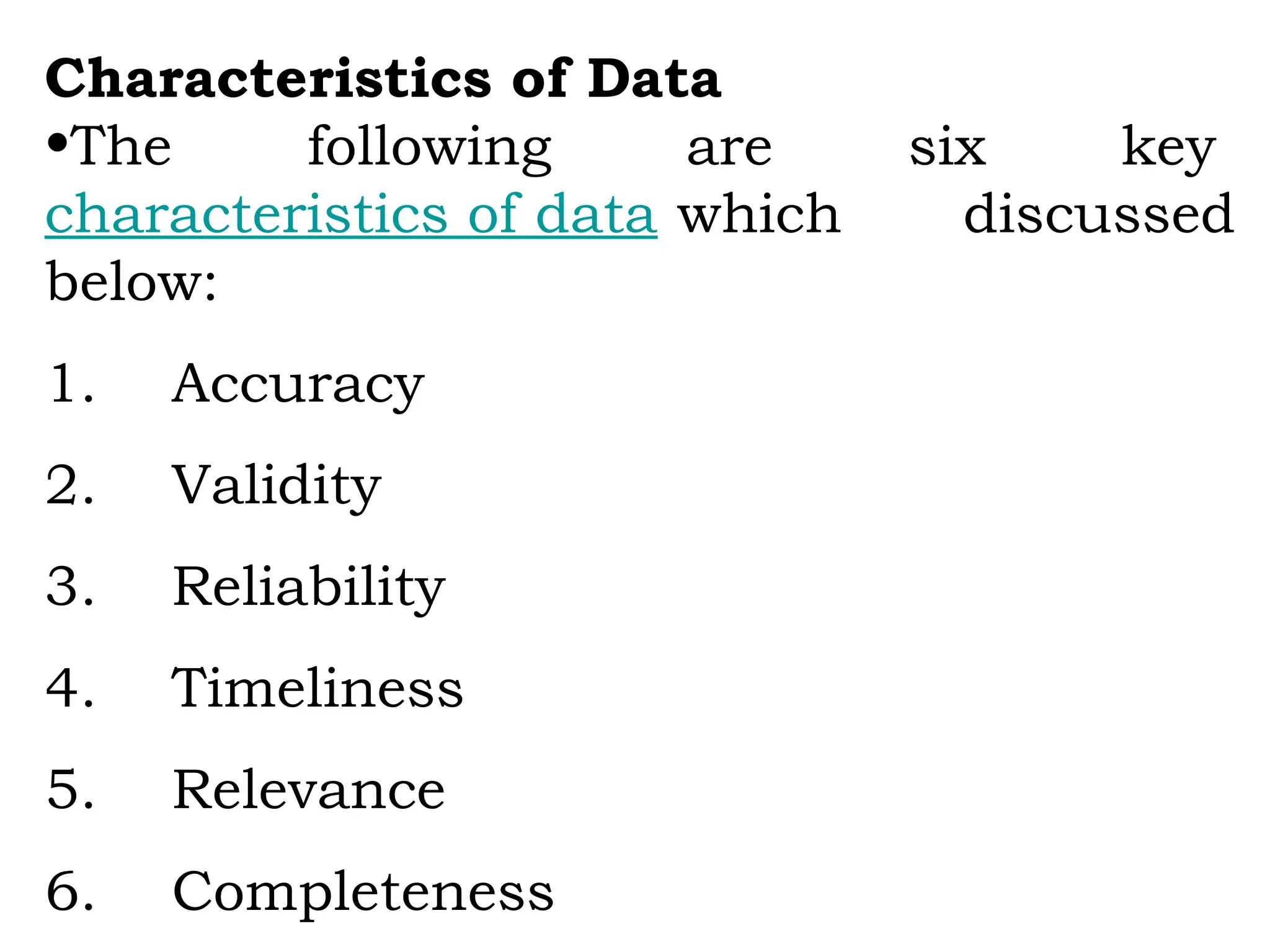
Characteristics of Data
•Thefollowing are six key
characteristics of data which discussed
below:
1. Accuracy
2. Validity
3. Reliability
4. Timeliness
5. Relevance
6. Completeness
9.
Types of DigitalData:
Structured
Unstructured
Semi Structured Data
10.
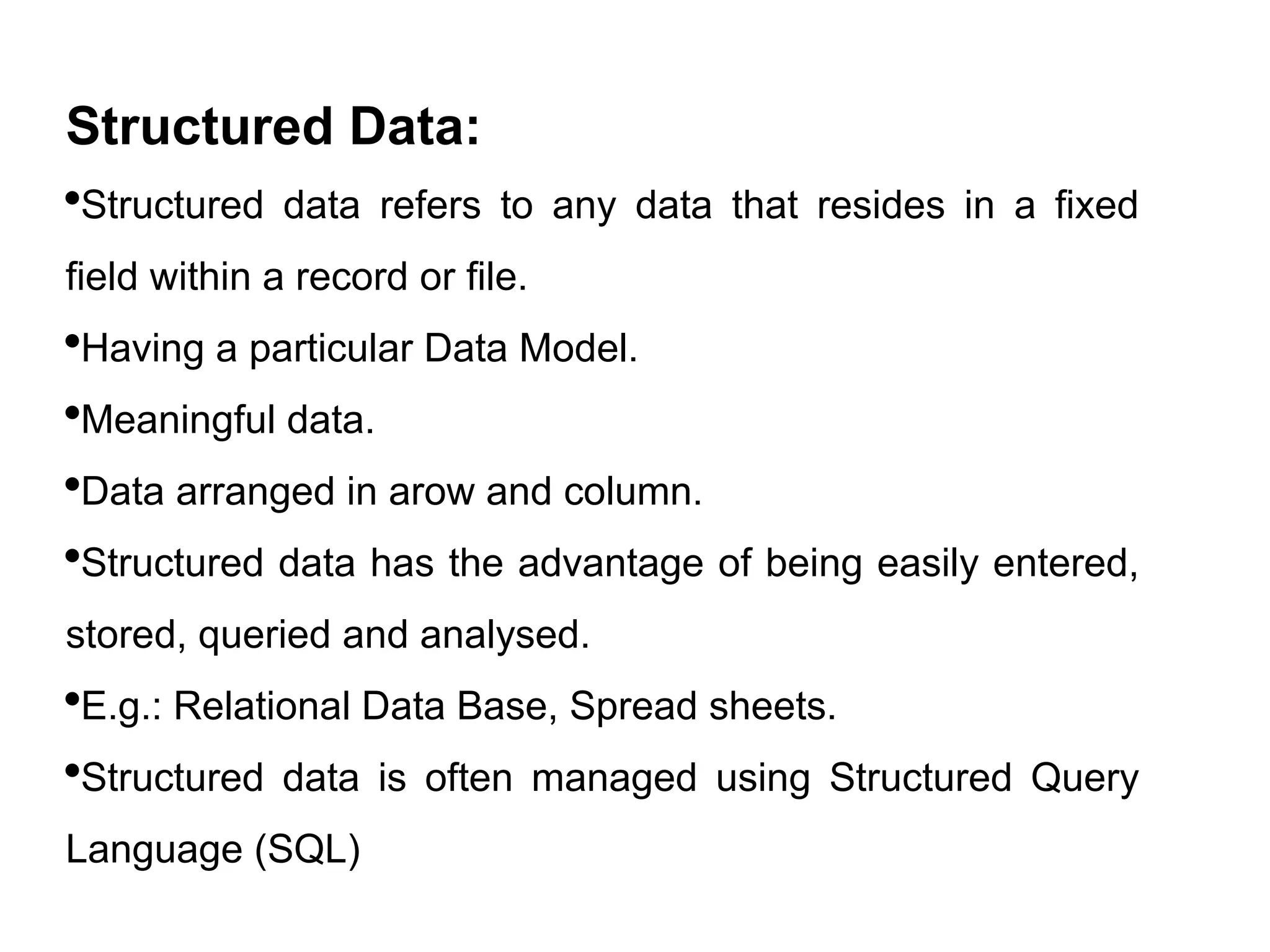
Structured Data:
Structured datarefers to any data that resides in a fixed
field within a record or file.
Having a particular Data Model.
Meaningful data.
Data arranged in arow and column.
Structured data has the advantage of being easily entered,
stored, queried and analysed.
E.g.: Relational Data Base, Spread sheets.
Structured data is often managed using Structured Query
Language (SQL)
11.
Sources of StructuredData:
SQL Databases
Spreadsheets such as Excel
OLTP Systems
Online forms
Sensors such as GPS or RFID tags
Network and Web server logs
Medical devices
12.
• Advantages ofStructured Data:
Easy to understand and use: Structured data has a well-defined schema or data
model, making it easy to understand and use. This allows for easy data retrieval,
analysis, and reporting.
Consistency: The well-defined structure of structured data ensures consistency and
accuracy in the data, making it easier to compare and analyze data across different
sources.
Efficient storage and retrieval: Structured data is typically stored in relationa
databases, which are designed to efficiently store and retrieve large amounts of
data. This makes it easy to access and process data quickly.
Enhanced data security: Structured data can be more easily secured than
unstructured or semi-structured data, as access to the data can be controlled
through database security protocols.
Clear data lineage: Structured data typically has a clear lineage or history, making it
easy to track changes and ensure data quality.
13.
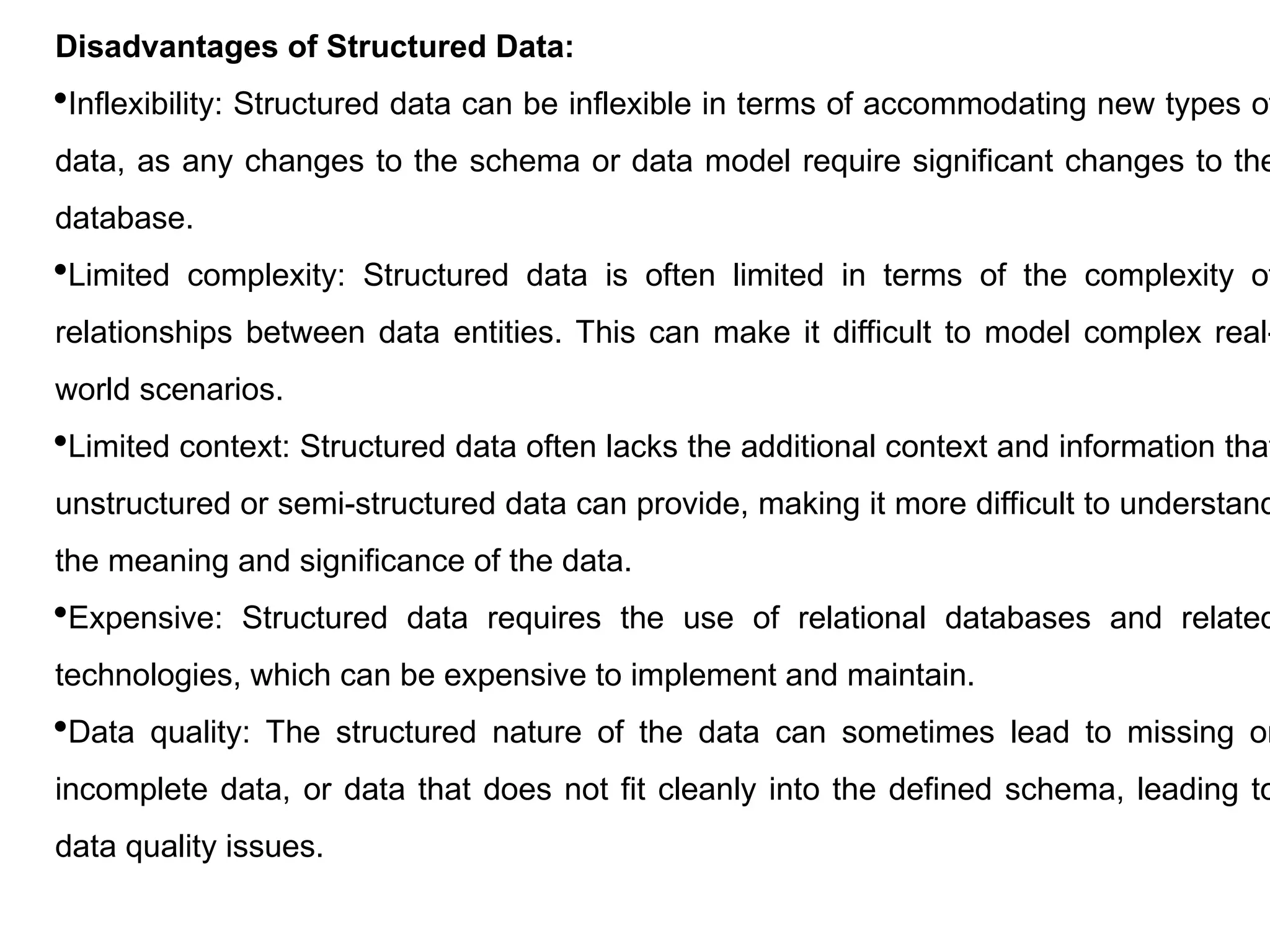
Disadvantages of StructuredData:
Inflexibility: Structured data can be inflexible in terms of accommodating new types of
data, as any changes to the schema or data model require significant changes to the
database.
Limited complexity: Structured data is often limited in terms of the complexity of
relationships between data entities. This can make it difficult to model complex real-
world scenarios.
Limited context: Structured data often lacks the additional context and information that
unstructured or semi-structured data can provide, making it more difficult to understand
the meaning and significance of the data.
Expensive: Structured data requires the use of relational databases and related
technologies, which can be expensive to implement and maintain.
Data quality: The structured nature of the data can sometimes lead to missing or
incomplete data, or data that does not fit cleanly into the defined schema, leading to
data quality issues.
14.
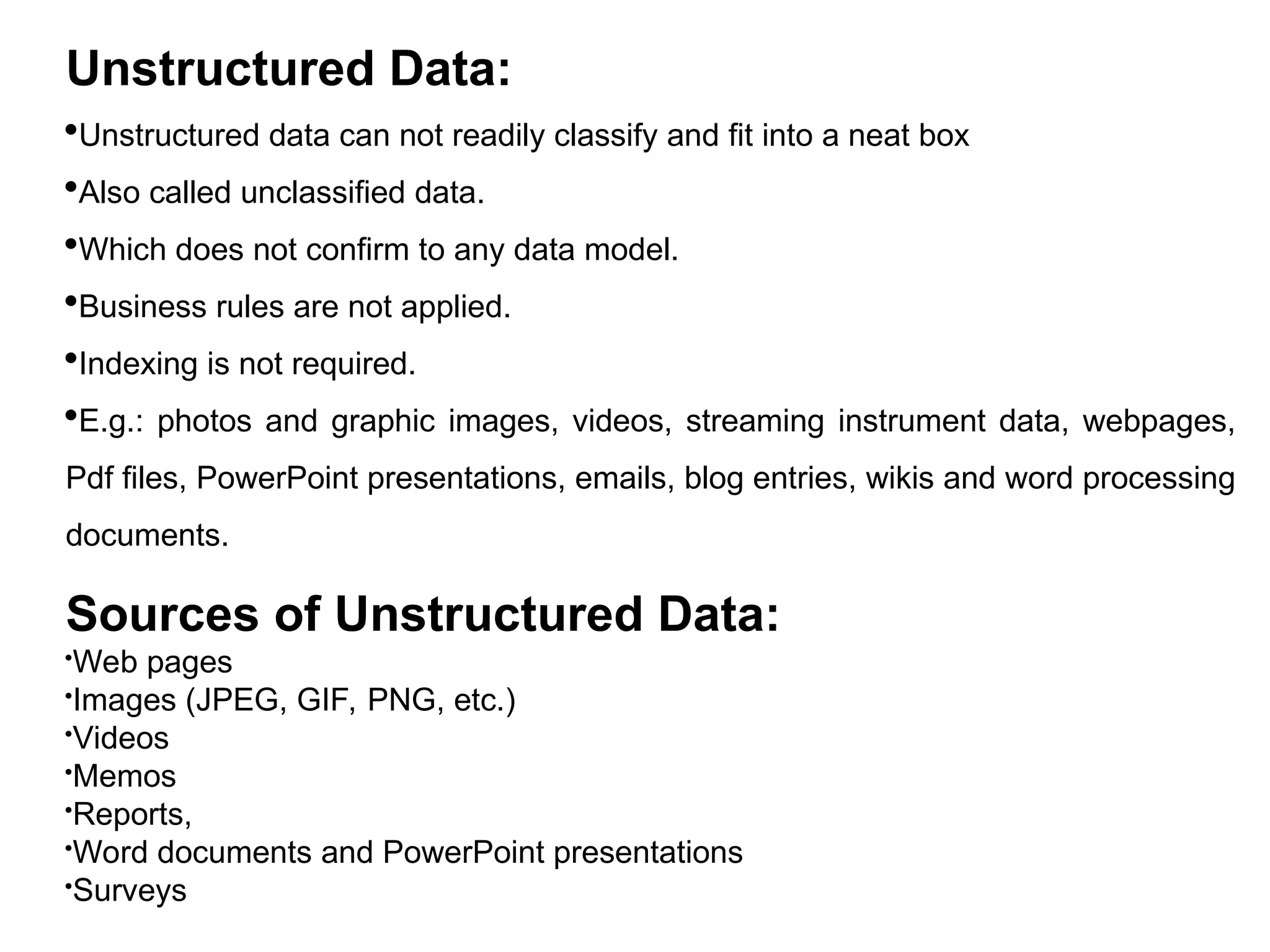
Unstructured Data:
Unstructured datacan not readily classify and fit into a neat box
Also called unclassified data.
Which does not confirm to any data model.
Business rules are not applied.
Indexing is not required.
E.g.: photos and graphic images, videos, streaming instrument data, webpages,
Pdf files, PowerPoint presentations, emails, blog entries, wikis and word processing
documents.
Sources of Unstructured Data:
Web pages
Images (JPEG, GIF, PNG, etc.)
Videos
Memos
Reports,
Word documents and PowerPoint presentations
Surveys
15.
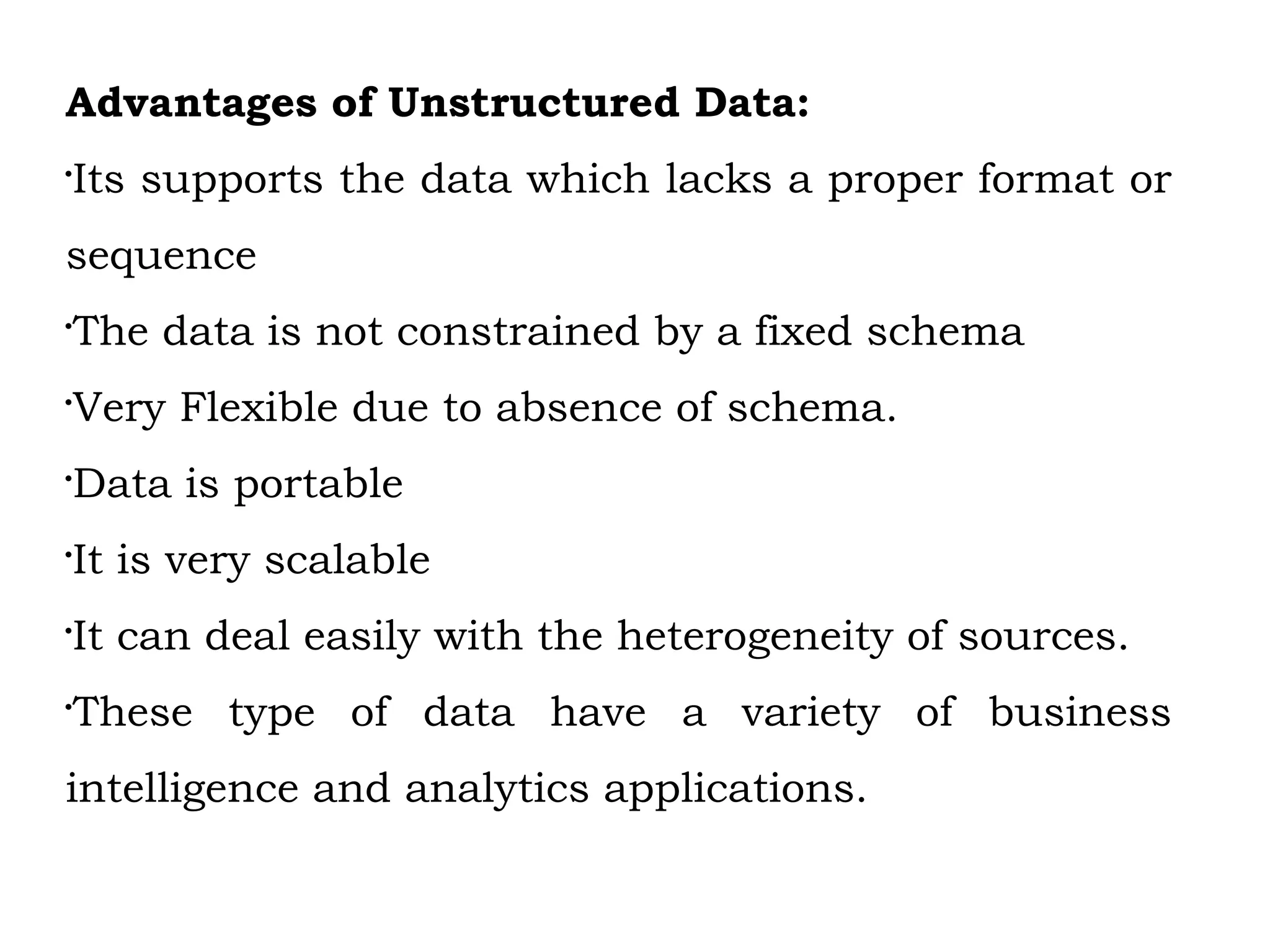
Advantages of UnstructuredData:
Its supports the data which lacks a proper format or
sequence
The data is not constrained by a fixed schema
Very Flexible due to absence of schema.
Data is portable
It is very scalable
It can deal easily with the heterogeneity of sources.
These type of data have a variety of business
intelligence and analytics applications.
16.
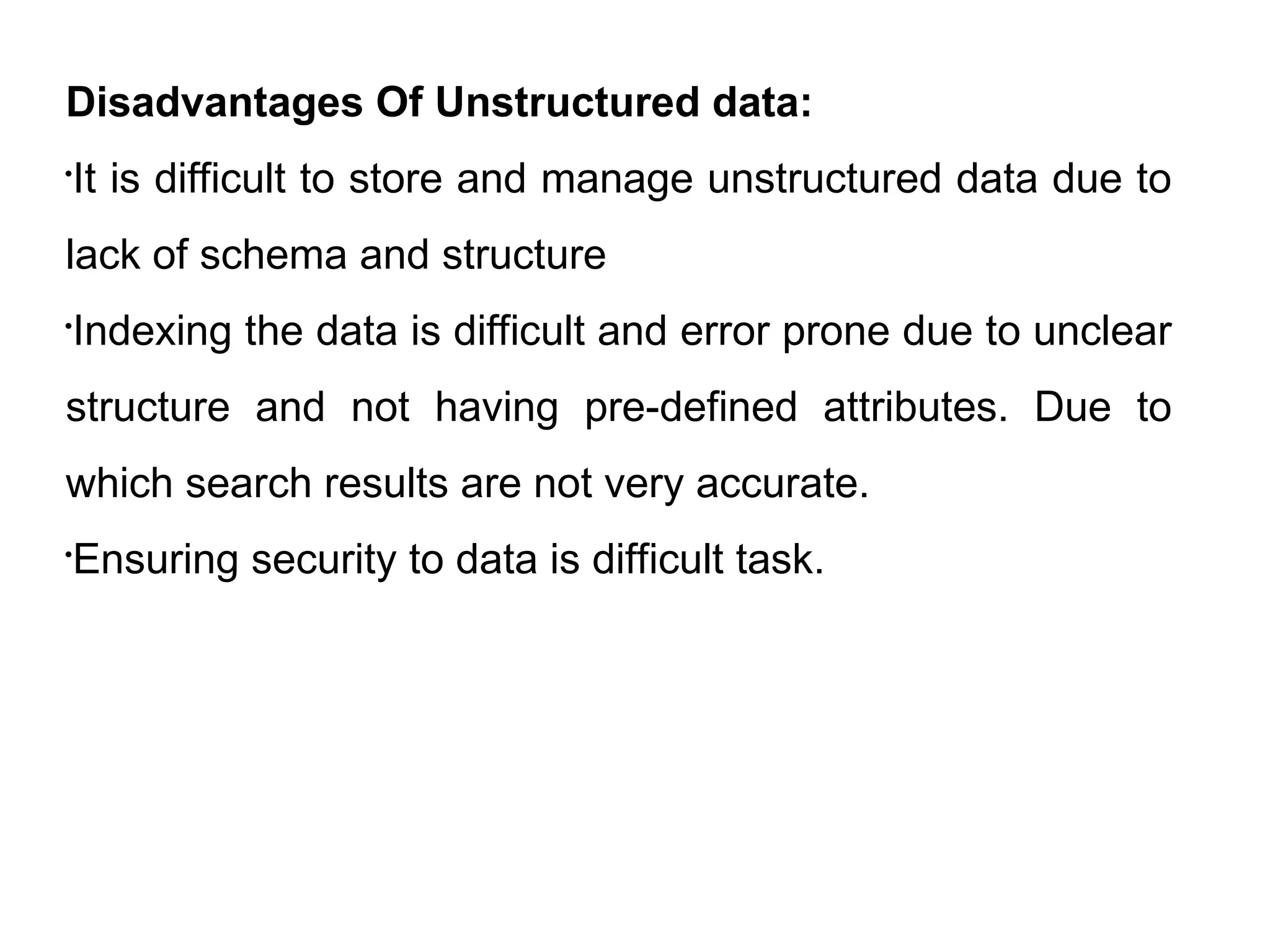
Disadvantages Of Unstructureddata:
It is difficult to store and manage unstructured data due to
lack of schema and structure
Indexing the data is difficult and error prone due to unclear
structure and not having pre-defined attributes. Due to
which search results are not very accurate.
Ensuring security to data is difficult task.
17.
Semi structured Data:
Self-describingdata.
Metadata (Data about data).
Also called quiz data: data in between structured and semi structured.
It is a type of structured data but not followed data model.
Data which does not have rigid structure.
E.g.: E-mails, word processing software.
XML and other markup language are often used to manage semi structured
data.
Sources of semi-structured Data:
E-mails
XML and other markup languages
Binary executables
TCP/IP packets
Zipped files
Integration of data from different sources
Web pages
18.
New York StockExchange :
The New York Stock Exchange is an example of Big Data
that generates about one terabyte of new trade data per day.
19.
Social Media:
The statisticshows that 500+terabytes of new data get
ingested into the databases of social media
site Facebook, every day. This data is mainly
generated in terms of photo and video uploads,
message exchanges, putting comments etc.
20.
Jet engine :Asingle Jet engine can generate 10+terabytes of
data in 30 minutes of flight time. With many thousand flights
per day, generation of data reaches up to many Petabytes.
21.
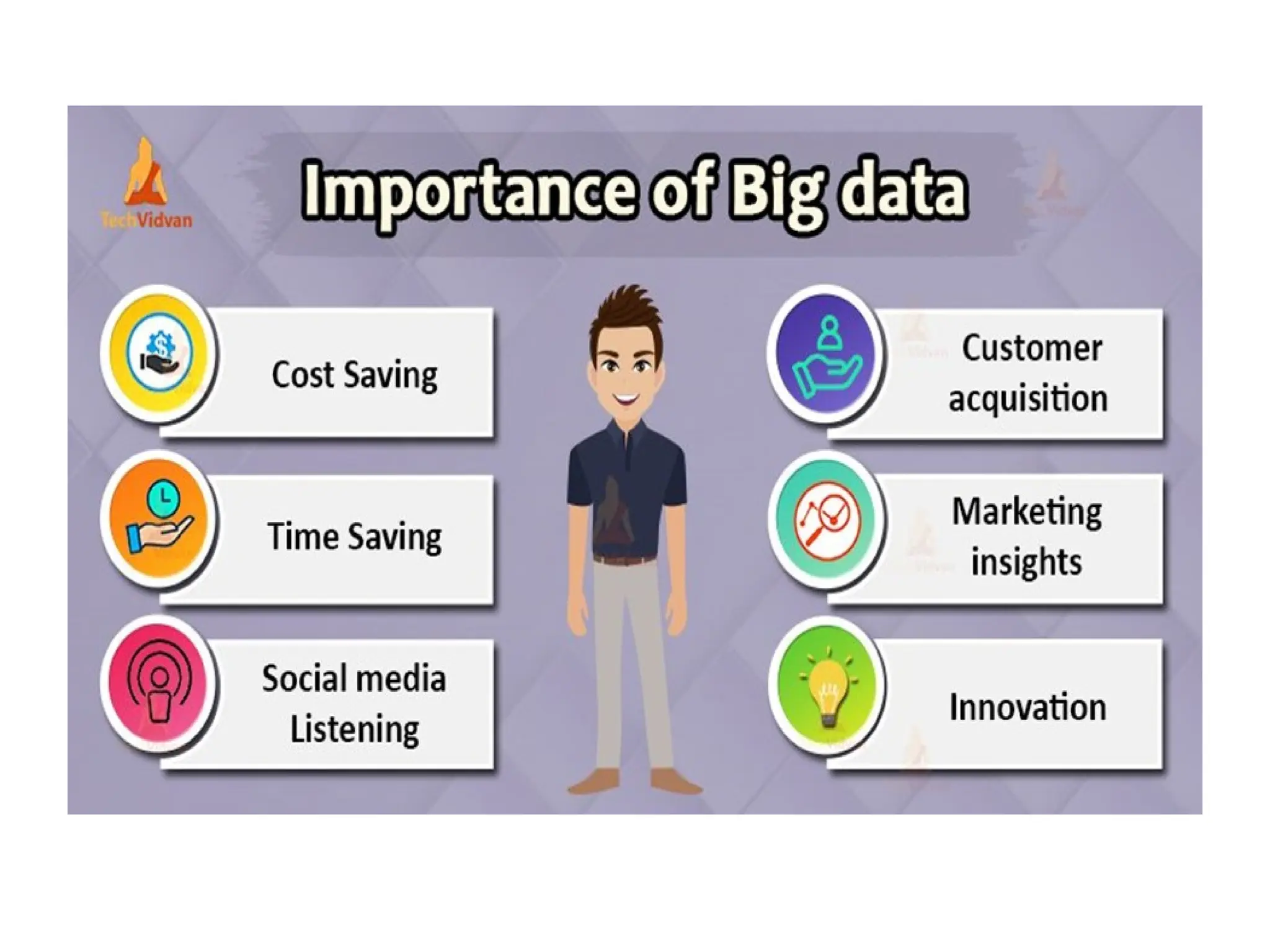
Why Big Data?
•BigData initiatives were rated as “extremely important” to 93% of companies.
Leveraging a Big Data analytics solution helps organizations to unlock the
strategic values and take full advantage of their assets.
•It helps organizations:
To understand Where, When and Why their customers buy
Protect the company’s client base with improved loyalty programs
Seizing cross-selling and upselling opportunities
Provide targeted promotional information
Optimize Workforce planning and operations
Improve inefficiencies in the company’s supply chain
Predict market trends
Predict future needs
Make companies more innovative and competitive
It helps companies to discover new sources of revenue
•
Challenges of BigData
Managing massive amounts of data
Integrating data from multiple sources
Ensuring data quality
Keeping data secure
Selecting the right big data tools
Scaling systems and costs efficiently
Lack of skilled data professionals
25.
What is BusinessIntelligence?
• BI(Business Intelligence) is a set of processes, architectures, and
technologies that convert raw data into meaningful information
that drives profitable business actions. It is a suite of software
and services to transform data into actionable intelligence and
knowledge.
• BI has a direct impact on organization’s strategic, tactical and
operational business decisions.
• BI supports fact-based decision making using historical data
rather than assumptions and gut feeling.
• BI tools perform data analysis and create reports, summaries,
dashboards, maps, graphs, and charts to provide users with
detailed intelligence about the nature of the business.
26.
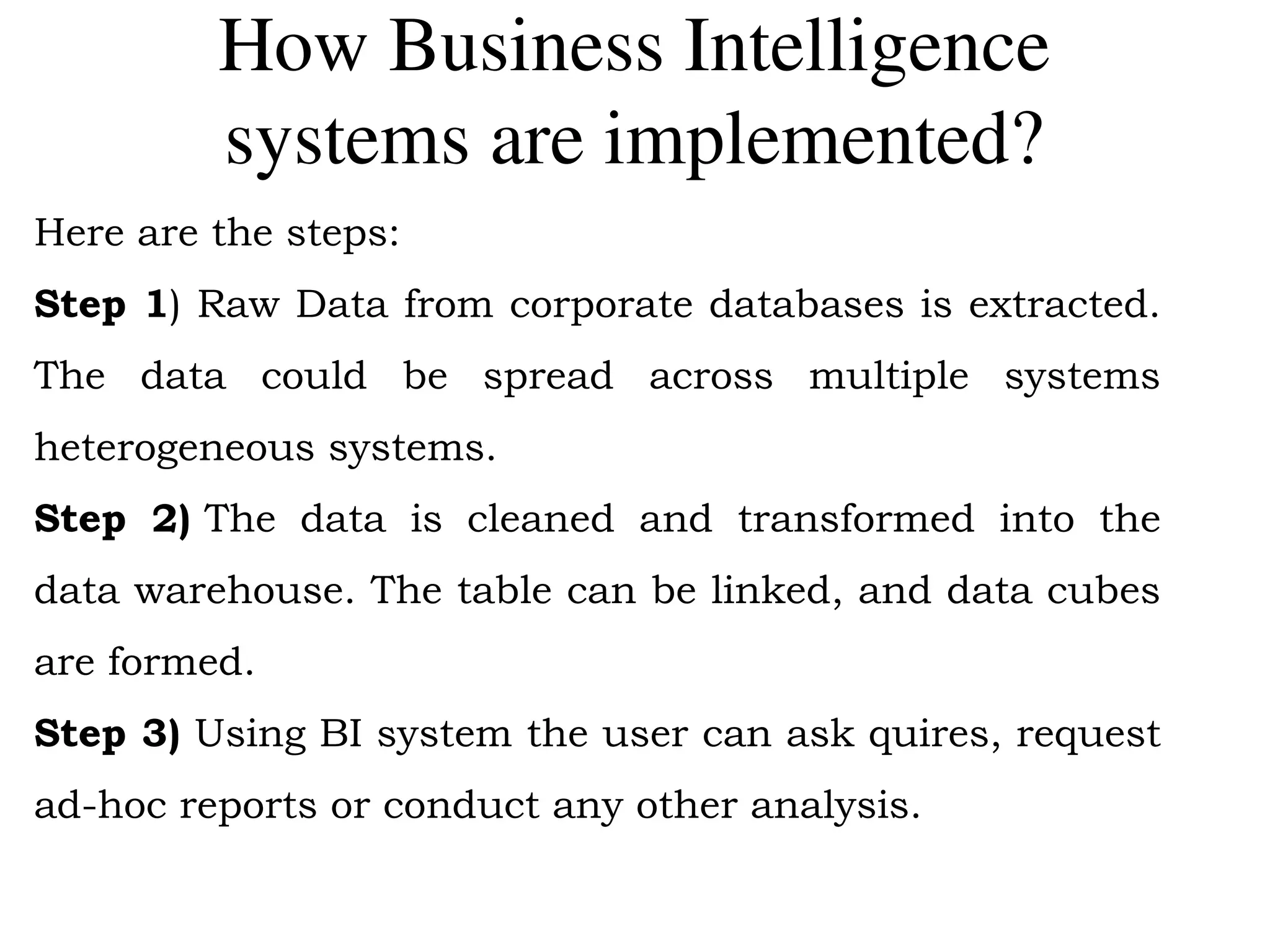
How Business Intelligence
systemsare implemented?
Here are the steps:
Step 1) Raw Data from corporate databases is extracted.
The data could be spread across multiple systems
heterogeneous systems.
Step 2) The data is cleaned and transformed into the
data warehouse. The table can be linked, and data cubes
are formed.
Step 3) Using BI system the user can ask quires, request
ad-hoc reports or conduct any other analysis.
27.
Advantages of Business
Intelligence
•Boost productivity
• To improve visibility
• Fix Accountability
• It gives a bird’s eye view
• It streamlines business processes
• It allows for easy analytics.


![[DSC Europe 25] Marija Vlajkovic & Andrea Radonjanin - Integration of AI tool...](https://cdn.slidesharecdn.com/ss_thumbnails/qf1jrglttoc3bm8s3aop-final-integration-of-ai-tools-251208151905-394f3a6a-thumbnail.jpg?width=640&height=640&fit=bounds)
![[DSC Europe 25] Vid Stimac - Policy Parsimony: Between Oversimplifying and Ov...](https://cdn.slidesharecdn.com/ss_thumbnails/eqlepagzqp2rhg3gbluh-dsc-stimac-251120-251205090438-059e7f54-thumbnail.jpg?width=640&height=640&fit=bounds)
![[DSC Europe 25] Vladimir Jelic - The AI-Driven Security Shift From Reactive D...](https://cdn.slidesharecdn.com/ss_thumbnails/6g5gj25mtjwayniqem1t-6-251209104645-7a5a5fc6-thumbnail.jpg?width=640&height=640&fit=bounds)
![[DSC Europe 25] Dragan Vucic - Building the Learning Organization - How AI Tr...](https://cdn.slidesharecdn.com/ss_thumbnails/8brigo2sbu6qur6gxrra-7-251205085715-6ae07d24-thumbnail.jpg?width=640&height=640&fit=bounds)
![[DSC Europe 25] Andy Cotgreave - Nothing is new in analytics.pptx](https://cdn.slidesharecdn.com/ss_thumbnails/mba4vzcurvoh5lfrd5zw-6-251205194645-341bbbbe-thumbnail.jpg?width=640&height=640&fit=bounds)

![[DSC Europe 25] Kaja Kandare - LLM as a judge.pptx](https://cdn.slidesharecdn.com/ss_thumbnails/arxyccaxsdsd1ba99wjw-7-251212104007-2b4e3f64-thumbnail.jpg?width=640&height=640&fit=bounds)
![[DSC Europe 25] Imai Jen-La Plante - The New Generation: AI and the Future of...](https://cdn.slidesharecdn.com/ss_thumbnails/kxi8t2l5rggivgcenyba-1-jenlaplante-dsc-251208152532-d1e076c2-thumbnail.jpg?width=640&height=640&fit=bounds)

![[DSC Europe 25] Milan Zdravkovic - The road less traveled in District Heating...](https://cdn.slidesharecdn.com/ss_thumbnails/nfaboniqwsz4ucyctnmy-2-milan-zdravkovic-dsc2025-the-road-less-traveled-in-district-heating-operation-251208151905-f56388a5-thumbnail.jpg?width=640&height=640&fit=bounds)


![[DSC Europe 25] Dusan Pavlov - There Is No Spoon: Inferring Vision from Neura...](https://cdn.slidesharecdn.com/ss_thumbnails/wg0v1umoqjm4nnbd3p0v-there-is-no-spoon-251205085715-6d81d6c5-thumbnail.jpg?width=640&height=640&fit=bounds)
![[DSC Europe 25] Dragana Ilic - AI for Big Data in Astronomy.pptx](https://cdn.slidesharecdn.com/ss_thumbnails/8palya86qaatvjhva1ms-2-dragana-ilic-ai-ilic-251208151906-652b819c-thumbnail.jpg?width=640&height=640&fit=bounds)

![[DSC Europe 25] Max Talanov - Non digital NNs.pptx](https://cdn.slidesharecdn.com/ss_thumbnails/wif8tr3gtua74qvtopke-non-digital-nns-251205090438-26b0eea6-thumbnail.jpg?width=640&height=640&fit=bounds)