 Computer A computer is an electronic
device, operating under the control of
instructions stored in its own memory that
can accept data (input), process the data
according to specified rules, produce
information (output), and store the
information for future use
 Computer Components Any kind of
computers consists of HARDWARE AND
SOFTWARE.
 Computer hardware is the collection of physical
elements that constitutes a computer system.
Computer hardware refers to the physical parts
or components of a computer such as the
monitor, mouse, keyboard, computer data
storage, hard drive disk (HDD), system unit
(graphic cards, sound cards, memory,
motherboard and chips), etc. all of which are
physical objects that can be touched.
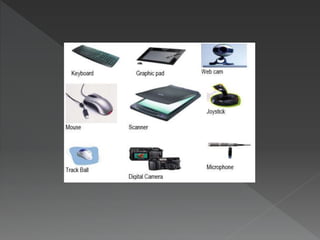
 Input device is any peripheral (piece of
computer hardware equipment to provide
data and control signals to an information
processing system such as a computer or
other information appliance. Input device
Translate data from form that humans
understand to one that the computer can
work with. Most common are keyboard and
mouse
 A CPU is brain of a computer. It is
responsible for all functions and processes.
Regarding computing power, the CPU is the
most important element of a computer
system.
 RAM: Random Access Memory (RAM) is a memory scheme
within the computer system responsible for storing data on a
temporary basis, so that it can be promptly accessed by the
processor as and when needed. It is volatile in nature, which
means that data will be erased once supply to the storage
device is turned off. RAM stores data randomly and the
processor accesses these data randomly from the RAM storage.
RAM is considered "random access" because you can access
any memory cell directly if you know the row and column that
intersect at that cell.
 ROM (Read Only Memory): ROM is a permanent form of
storage. ROM stays active regardless of whether power supply
to it is turned on or off. ROM devices do not allow data stored on
them to be modified.
 Stores data and programs permanently, its
retained after the power is turned off
 Hard drive (HD): A hard disk is part of a unit, often called a "disk drive," "hard drive,"
or "hard disk drive," that store and provides relatively quick access to large amounts
of data on an electromagnetically charged surface or set of surfaces.
 Optical Disk: an optical disc drive (ODD) is a disk drive that uses laser light as part
of the process of reading or writing data to or from optical discs. Some drives can
only read from discs, but recent drives are commonly both readers and recorders,
also called burners or writers. Compact discs, DVDs, and Blu-ray discs are common
types of optical media which can be read and recorded by such drives. Optical drive
is the generic name; drives are usually described as "CD" "DVD", or "Bluray",
followed by "drive", "writer", etc. There are three main types of optical media: CD,
DVD, and Blu-ray disc. CDs can store up to 700 megabytes (MB) of data and DVDs
can store up to 8.4 GB of data. Blu-ray discs, which are the newest type of optical
media, can store up to 50 GB of data. This storage capacity is a clear advantage
over the floppy disk storage media (a magnetic media), which only has a capacity of
1.44 MB.
 Flash Disk A storage module made of flash memory chips. A Flash disks have no
mechanical platters or access arms, but the term "disk" is used because the data
are accessed as if they were on a hard drive. The disk storage structure is
emulated.
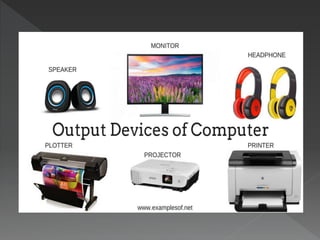
 An output device is any piece of computer
hardware equipment used to communicate
the results of data processing carried out by
an information processing system (such as a
computer) which converts the electronically
generated information into humanreadable
form.
 Software Software is a generic term for
organized collections of computer data and
instructions, often broken into two major
categories: system software that provides
the basic nontask-specific functions of the
computer, and application software which is
used by users to accomplish specific tasks.
 System software is responsible for controlling, integrating, and
managing the individual hardware components of a computer system
so that other software and the users of the system see it as a
functional unit without having to be concerned with the low-level details
such as transferring data from memory to disk, or rendering text onto a
display. Generally, system software consists of an operating system
and some fundamental utilities such as disk formatters, file managers,
display managers, text editors, user authentication (login) and
management tools, and networking and device control software.
 Application software is used to accomplish specific tasks other than
just running the computer system. Application software may consist of
a single program, such as an image viewer; a small collection of
programs (often called a software package) that work closely together
to accomplish a task, such as a spreadsheet or text processing
system; a larger collection (often called a software suite) of related but
independent programs and packages that have a common user
interface or shared data format, such as Microsoft Office, which
consists of closely integrated word processor, spreadsheet, database,
etc.; or a software system, such as a database management system,
which is a collection of fundamental programs that may provide some
service to a variety of other independent applications.
Introduction to Computers

Introduction to Computers

  • 2.
     Computer Acomputer is an electronic device, operating under the control of instructions stored in its own memory that can accept data (input), process the data according to specified rules, produce information (output), and store the information for future use
  • 3.
     Computer ComponentsAny kind of computers consists of HARDWARE AND SOFTWARE.
  • 4.
     Computer hardwareis the collection of physical elements that constitutes a computer system. Computer hardware refers to the physical parts or components of a computer such as the monitor, mouse, keyboard, computer data storage, hard drive disk (HDD), system unit (graphic cards, sound cards, memory, motherboard and chips), etc. all of which are physical objects that can be touched.
  • 5.
     Input deviceis any peripheral (piece of computer hardware equipment to provide data and control signals to an information processing system such as a computer or other information appliance. Input device Translate data from form that humans understand to one that the computer can work with. Most common are keyboard and mouse
  • 7.
     A CPUis brain of a computer. It is responsible for all functions and processes. Regarding computing power, the CPU is the most important element of a computer system.
  • 8.
     RAM: RandomAccess Memory (RAM) is a memory scheme within the computer system responsible for storing data on a temporary basis, so that it can be promptly accessed by the processor as and when needed. It is volatile in nature, which means that data will be erased once supply to the storage device is turned off. RAM stores data randomly and the processor accesses these data randomly from the RAM storage. RAM is considered "random access" because you can access any memory cell directly if you know the row and column that intersect at that cell.  ROM (Read Only Memory): ROM is a permanent form of storage. ROM stays active regardless of whether power supply to it is turned on or off. ROM devices do not allow data stored on them to be modified.
  • 9.
     Stores dataand programs permanently, its retained after the power is turned off
  • 10.
     Hard drive(HD): A hard disk is part of a unit, often called a "disk drive," "hard drive," or "hard disk drive," that store and provides relatively quick access to large amounts of data on an electromagnetically charged surface or set of surfaces.  Optical Disk: an optical disc drive (ODD) is a disk drive that uses laser light as part of the process of reading or writing data to or from optical discs. Some drives can only read from discs, but recent drives are commonly both readers and recorders, also called burners or writers. Compact discs, DVDs, and Blu-ray discs are common types of optical media which can be read and recorded by such drives. Optical drive is the generic name; drives are usually described as "CD" "DVD", or "Bluray", followed by "drive", "writer", etc. There are three main types of optical media: CD, DVD, and Blu-ray disc. CDs can store up to 700 megabytes (MB) of data and DVDs can store up to 8.4 GB of data. Blu-ray discs, which are the newest type of optical media, can store up to 50 GB of data. This storage capacity is a clear advantage over the floppy disk storage media (a magnetic media), which only has a capacity of 1.44 MB.  Flash Disk A storage module made of flash memory chips. A Flash disks have no mechanical platters or access arms, but the term "disk" is used because the data are accessed as if they were on a hard drive. The disk storage structure is emulated.
  • 11.
     An outputdevice is any piece of computer hardware equipment used to communicate the results of data processing carried out by an information processing system (such as a computer) which converts the electronically generated information into humanreadable form.
  • 13.
     Software Softwareis a generic term for organized collections of computer data and instructions, often broken into two major categories: system software that provides the basic nontask-specific functions of the computer, and application software which is used by users to accomplish specific tasks.
  • 15.
     System softwareis responsible for controlling, integrating, and managing the individual hardware components of a computer system so that other software and the users of the system see it as a functional unit without having to be concerned with the low-level details such as transferring data from memory to disk, or rendering text onto a display. Generally, system software consists of an operating system and some fundamental utilities such as disk formatters, file managers, display managers, text editors, user authentication (login) and management tools, and networking and device control software.  Application software is used to accomplish specific tasks other than just running the computer system. Application software may consist of a single program, such as an image viewer; a small collection of programs (often called a software package) that work closely together to accomplish a task, such as a spreadsheet or text processing system; a larger collection (often called a software suite) of related but independent programs and packages that have a common user interface or shared data format, such as Microsoft Office, which consists of closely integrated word processor, spreadsheet, database, etc.; or a software system, such as a database management system, which is a collection of fundamental programs that may provide some service to a variety of other independent applications.