Chapter 1
Introduction to Computer
A computer is an electronic device, operating
under the control of instructions stored in its
own memory that can accept data (input),
process the data according to specified rules,
produce information (output), and store the
information for future use.
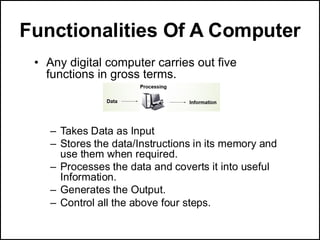
Functionalities Of A Computer
• Any digital computer carries out five
functions in gross terms.
– Takes Data as Input
– Stores the data/Instructions in its memory and
use them when required.
– Processes the data and coverts it into useful
Information.
– Generates the Output.
– Control all the above four steps.
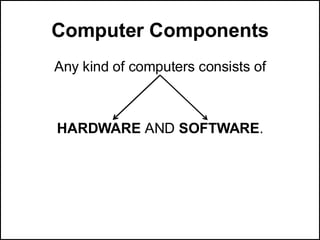
Computer Components
Any kind of computers consists of
HARDWARE AND SOFTWARE.
Hardware
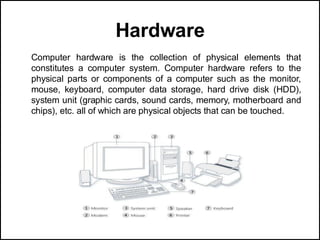
Computer hardware is the collection of physical elements that
constitutes a computer system. Computer hardware refers to the
physical parts or components of a computer such as the monitor,
mouse, keyboard, computer data storage, hard drive disk (HDD),
system unit (graphic cards, sound cards, memory, motherboard and
chips), etc. all of which are physical objects that can be touched.
Input Devices
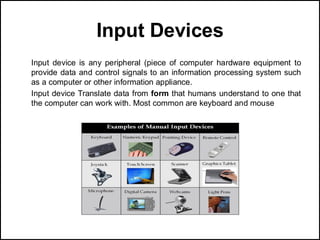
Input device is any peripheral (piece of computer hardware equipment to
provide data and control signals to an information processing system such
as a computer or other information appliance.
Input device Translate data from form that humans understand to one that
the computer can work with. Most common are keyboard and mouse
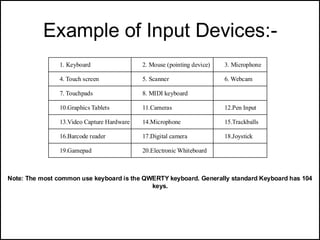
Example of Input Devices:-
1. Keyboard 2. Mouse (pointing device) 3. Microphone
4. Touch screen 5. Scanner 6. Webcam
7. Touchpads 8. MIDI keyboard
10.Graphics Tablets 11.Cameras 12.Pen Input
13.Video Capture Hardware 14.Microphone 15.Trackballs
16.Barcode reader 17.Digital camera 18.Joystick
19.Gamepad 20.Electronic Whiteboard
Note: The most common use keyboard is the QWERTY keyboard. Generally standard Keyboard has 104
keys.
Central Processing Unit (CPU)
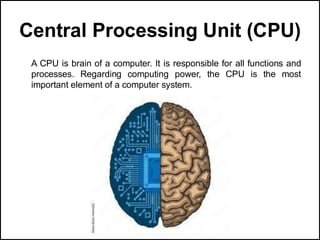
A CPU is brain of a computer. It is responsible for all functions and
processes. Regarding computing power, the CPU is the most
important element of a computer system.
Central Processing Unit (CPU)
The CPU is comprised of three main parts :
1. Arithmetic Logic Unit (ALU): Executes all arithmetic and logical operations.
Arithmetic calculations like as addition, subtraction, multiplication and
division. Logical operation like compare numbers, letters, or special
characters
2. Control Unit (CU): controls and co-ordinates computer components.
– Read the code for the next instruction to be executed.
– Increment the program counter so it points to the next instruction.
– Read whatever data the instruction requires from cells in memory.
– Provide the necessary data to an ALU or register.
– If the instruction requires an ALU or specialized hardware to complete, instruct the
hardware to perform the requested operation.
3. Registers :Stores the data that is to be executed next, "very fast storage
area".
Primary Memory
• RAM: Random Access Memory (RAM) is a memory scheme within
the computer system responsible for storing data on a temporary
basis, so that it can be promptly accessed by the processor as and
when needed. It is volatile in nature, which means that data will be
erased once supply to the storage device is turned off. RAM stores
data randomly and the processor accesses these data randomly
from the RAM storage. RAM is considered "random access"
because you can access any memory cell directly if you know the
row and column that intersect at that cell.
• ROM (Read Only Memory): ROM is a permanent form of storage.
ROM stays active regardless of whether power supply to it is turned
on or off. ROM devices do not allow data stored on them to be
modified.
Secondary Memory
• Stores data and programs permanently: its retained after the power is
turned off
• Hard drive (HD): A hard disk is part of a unit, often called a "disk drive,"
"hard drive," or "hard disk drive," that store and provides relatively quick
access to large amounts of data on an electromagnetically charged surface
or set of surfaces.
• Optical Disk: an optical disc drive (ODD) is a disk drive that uses laser light
as part of the process of reading or writing data to or from optical discs.
Some drives can only read from discs, but recent drives are commonly
both readers and recorders, also called burners or writers. Compact discs,
DVDs, and Blu-ray discs are common types of optical media which can be
read and recorded by such drives. Optical drive is the generic name; drives
are usually described as "CD" "DVD", or "Bluray", followed by "drive",
"writer", etc. There are three main types of optical media: CD, DVD, and
Blu-ray disc. CDs can store up to 700 megabytes (MB) of data and DVDs
can store up to 8.4 GB of data. Blu-ray discs, which are the newest type of
optical media, can store up to 50 GB of data. This storage capacity is a
clear advantage over the floppy disk storage media (a magnetic media),
which only has a capacity of 1.44 MB.
Secondary Memory
Flash Disk
A storage module made of flash memory chips. A Flash disks have no
mechanical platters or access arms, but the term "disk" is used because the
data are accessed as if they were on a hard drive. The disk storage
structure is emulated.
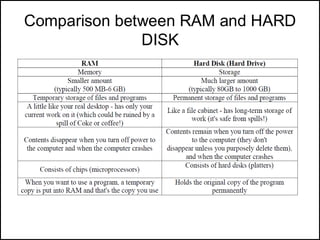
Comparison between RAM and HARD
DISK
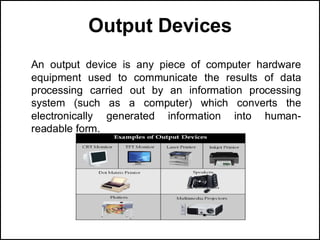
Output Devices
An output device is any piece of computer hardware
equipment used to communicate the results of data
processing carried out by an information processing
system (such as a computer) which converts the
electronically generated information into human-
readable form.
Software
Software is a generic term for organized collections of computer
data and instructions, often broken into two major categories:
1. system software that provides the basic non- task-specific functions
of the computer, and
2. application software which is used by users to accomplish specific
tasks.
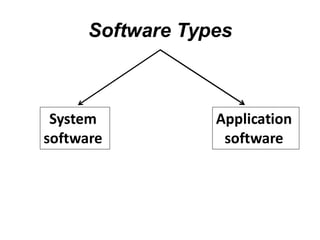
Software Types
System
software
Application
software
System software
System software is responsible for controlling, integrating, and
managing the individual hardware components of a computer
system so that other software and the users of the system see it as
a functional unit without having to be concerned with the low-level
details such as transferring data from memory to disk, or rendering
text onto a display.
Generally, system software consists of an operating system and
some fundamental utilities such as disk formatters, file managers,
display managers, text editors, user authentication (login) and
management tools, and networking and device control software.
Application software
Application software is used to accomplish specific tasks other
than just running the computer system.
Application software may consist of a single program, such as an
image viewer; a small collection of programs (often called a software
package) that work closely together to accomplish a task, such as a
spreadsheet or text processing system;
a larger collection (often called a software suite) of related but
independent programs and packages that have a common user
interface or shared data format, such as Microsoft Office, which
consists of closely integrated word processor, spreadsheet,
database, etc.;
or a software system, such as a database management system,
which is a collection of fundamental programs that may provide
some service to a variety of other independent applications.
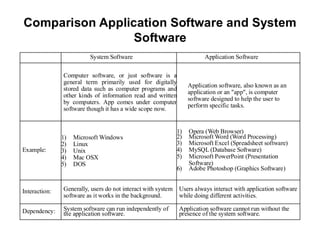
Comparison Application Software and System
Software
System Software Application Software
Computer software, or just software is a
general term primarily used for digitally
stored data such as computer programs and
other kinds of information read and written
by computers. App comes under computer
software though it has a wide scope now.
Application software, also known as an
application or an "app", is computer
software designed to help the user to
perform specific tasks.
Example:
1) Microsoft Windows
2) Linux
3) Unix
4) Mac OSX
5) DOS
1) Opera (Web Browser)
2) Microsoft Word (Word Processing)
3) Microsoft Excel (Spreadsheet software)
4) MySQL (Database Software)
5) Microsoft PowerPoint (Presentation
Software)
6) Adobe Photoshop (Graphics Software)
Interaction: Generally, users do not interact with system
software as it works in the background.
Users always interact with application software
while doing different activities.
Dependency: System software can run independently of
the application software.
Application software cannot run without the
presence of the system software.
Unit of Measurements
Storage measurements: The basic unit used in computer data storage
is called a bit (binary digit). Computers use these little bits, which are
composed of ones and zeros, to do things and talk to other computers.
All your files, for instance, are kept in the computer as binary files and
translated into words and pictures by the software (which is also ones
and zeros). This two number system, is called a “binary number system”
since it has only two numbers in it. The decimal number system in
contrast has ten unique digits, zero through nine.
Characteristics of Computers
• Speed: Performs calculations at incredible speeds.
• Accuracy : High precision and error-free operations.
• Multitasking: Ability to execute multiple tasks simultaneously.
• Storage: Capable of storing vast amounts of data.
• Automation: Operates without manual intervention once
programmed.
• Networking: Enables global data sharing and
communication.
• Versatility: Applicable in diverse fields and industries.
History of Computers
• Ancient Devices: Abacus, Antikythera
Mechanism.
• 1642: Pascal’s Mechanical Calculator.
• 1837: Charles Babbage’s Analytical
Engine.
• 1940s: First electronic computers (ENIAC).
• 1970s: Emergence of personal computers
(PCs).
Generations of Computers
First Generation (1940-1956):
Used vacuum tubes; examples: ENIAC,
UNIVAC.
Large, expensive, and heat-intensive.
• Second Generation (1956-1963):
Used transistors; smaller, faster, and cost-
efficient.
Generations of Computers
Third Generation (1964-1971):
Used integrated circuits (ICs); improved
speed and reduced size.
Fourth Generation (1971-Present):
Based on microprocessors; development of
personal computers.
Generations of Computers
Fifth Generation (Future):
Focus on Artificial Intelligence (AI) and
Robotics; supercomputers.
Classification of Computers
By Size:
Supercomputers:
- Most powerful; used for weather forecasting, scientific simulations.
Mainframe Computers:
- Large-scale transaction processing (e.g., banking systems).
Minicomputers :
- Mid-sized; used in manufacturing control systems.
Microcomputers:
- Personal computers like laptops and desktops.
Classification of Computers
By Purpose:
General-purpose Computers:
- Versatile; used for various tasks (e.g., office
work, gaming).
Special-purpose Computers:
- Designed for specific tasks (e.g., gaming
consoles, ATMs).
Classification of Computers
By Data Handling:
Analog Computers:
- Process continuous data.
Digital Computers:
- Process binary data.
Hybrid Computers:
- Combine analog and digital features.
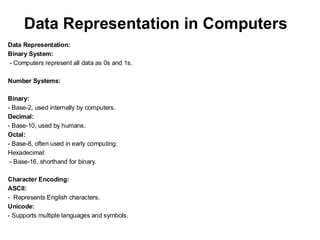
Data Representation in Computers
Data Representation:
Binary System:
- Computers represent all data as 0s and 1s.
Number Systems:
Binary:
- Base-2, used internally by computers.
Decimal:
- Base-10, used by humans.
Octal:
- Base-8, often used in early computing.
Hexadecimal:
- Base-16, shorthand for binary.
Character Encoding:
ASCII:
- Represents English characters.
Unicode:
- Supports multiple languages and symbols.
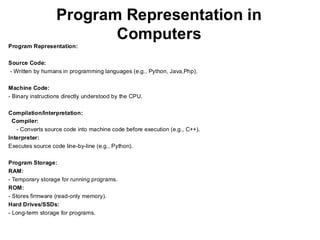
Program Representation in
Computers
Program Representation:
Source Code:
- Written by humans in programming languages (e.g., Python, Java,Php).
Machine Code:
- Binary instructions directly understood by the CPU.
Compilation/Interpretation:
Compiler:
- Converts source code into machine code before execution (e.g., C++).
Interpreter:
Executes source code line-by-line (e.g., Python).
Program Storage:
RAM:
- Temporary storage for running programs.
ROM:
- Stores firmware (read-only memory).
Hard Drives/SSDs:
- Long-term storage for programs.
Applications of Computers
Applications in Various Fields:
Education:
- Online learning platforms (e.g., Coursera, Khan Academy).
- Virtual simulations and practical training tools.
Healthcare:
- Managing patient records.
- Diagnostic imaging tools like X-rays and MRIs.
Business:
- Inventory management and automated accounting.
- Customer Relationship Management (CRM) systems.
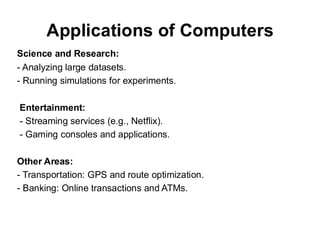
Applications of Computers
Science and Research:
- Analyzing large datasets.
- Running simulations for experiments.
Entertainment:
- Streaming services (e.g., Netflix).
- Gaming consoles and applications.
Other Areas:
- Transportation: GPS and route optimization.
- Banking: Online transactions and ATMs.

Chapter 1.pdf erre334444433443344444443r

  • 1.
  • 2.
    Introduction to Computer Acomputer is an electronic device, operating under the control of instructions stored in its own memory that can accept data (input), process the data according to specified rules, produce information (output), and store the information for future use.
  • 3.
    Functionalities Of AComputer • Any digital computer carries out five functions in gross terms. – Takes Data as Input – Stores the data/Instructions in its memory and use them when required. – Processes the data and coverts it into useful Information. – Generates the Output. – Control all the above four steps.
  • 4.
    Computer Components Any kindof computers consists of HARDWARE AND SOFTWARE.
  • 5.
    Hardware Computer hardware isthe collection of physical elements that constitutes a computer system. Computer hardware refers to the physical parts or components of a computer such as the monitor, mouse, keyboard, computer data storage, hard drive disk (HDD), system unit (graphic cards, sound cards, memory, motherboard and chips), etc. all of which are physical objects that can be touched.
  • 6.
    Input Devices Input deviceis any peripheral (piece of computer hardware equipment to provide data and control signals to an information processing system such as a computer or other information appliance. Input device Translate data from form that humans understand to one that the computer can work with. Most common are keyboard and mouse
  • 7.
    Example of InputDevices:- 1. Keyboard 2. Mouse (pointing device) 3. Microphone 4. Touch screen 5. Scanner 6. Webcam 7. Touchpads 8. MIDI keyboard 10.Graphics Tablets 11.Cameras 12.Pen Input 13.Video Capture Hardware 14.Microphone 15.Trackballs 16.Barcode reader 17.Digital camera 18.Joystick 19.Gamepad 20.Electronic Whiteboard Note: The most common use keyboard is the QWERTY keyboard. Generally standard Keyboard has 104 keys.
  • 8.
    Central Processing Unit(CPU) A CPU is brain of a computer. It is responsible for all functions and processes. Regarding computing power, the CPU is the most important element of a computer system.
  • 9.
    Central Processing Unit(CPU) The CPU is comprised of three main parts : 1. Arithmetic Logic Unit (ALU): Executes all arithmetic and logical operations. Arithmetic calculations like as addition, subtraction, multiplication and division. Logical operation like compare numbers, letters, or special characters 2. Control Unit (CU): controls and co-ordinates computer components. – Read the code for the next instruction to be executed. – Increment the program counter so it points to the next instruction. – Read whatever data the instruction requires from cells in memory. – Provide the necessary data to an ALU or register. – If the instruction requires an ALU or specialized hardware to complete, instruct the hardware to perform the requested operation. 3. Registers :Stores the data that is to be executed next, "very fast storage area".
  • 10.
    Primary Memory • RAM:Random Access Memory (RAM) is a memory scheme within the computer system responsible for storing data on a temporary basis, so that it can be promptly accessed by the processor as and when needed. It is volatile in nature, which means that data will be erased once supply to the storage device is turned off. RAM stores data randomly and the processor accesses these data randomly from the RAM storage. RAM is considered "random access" because you can access any memory cell directly if you know the row and column that intersect at that cell. • ROM (Read Only Memory): ROM is a permanent form of storage. ROM stays active regardless of whether power supply to it is turned on or off. ROM devices do not allow data stored on them to be modified.
  • 11.
    Secondary Memory • Storesdata and programs permanently: its retained after the power is turned off • Hard drive (HD): A hard disk is part of a unit, often called a "disk drive," "hard drive," or "hard disk drive," that store and provides relatively quick access to large amounts of data on an electromagnetically charged surface or set of surfaces. • Optical Disk: an optical disc drive (ODD) is a disk drive that uses laser light as part of the process of reading or writing data to or from optical discs. Some drives can only read from discs, but recent drives are commonly both readers and recorders, also called burners or writers. Compact discs, DVDs, and Blu-ray discs are common types of optical media which can be read and recorded by such drives. Optical drive is the generic name; drives are usually described as "CD" "DVD", or "Bluray", followed by "drive", "writer", etc. There are three main types of optical media: CD, DVD, and Blu-ray disc. CDs can store up to 700 megabytes (MB) of data and DVDs can store up to 8.4 GB of data. Blu-ray discs, which are the newest type of optical media, can store up to 50 GB of data. This storage capacity is a clear advantage over the floppy disk storage media (a magnetic media), which only has a capacity of 1.44 MB.
  • 12.
    Secondary Memory Flash Disk Astorage module made of flash memory chips. A Flash disks have no mechanical platters or access arms, but the term "disk" is used because the data are accessed as if they were on a hard drive. The disk storage structure is emulated.
  • 13.
  • 14.
    Output Devices An outputdevice is any piece of computer hardware equipment used to communicate the results of data processing carried out by an information processing system (such as a computer) which converts the electronically generated information into human- readable form.
  • 15.
    Software Software is ageneric term for organized collections of computer data and instructions, often broken into two major categories: 1. system software that provides the basic non- task-specific functions of the computer, and 2. application software which is used by users to accomplish specific tasks.
  • 16.
  • 17.
    System software System softwareis responsible for controlling, integrating, and managing the individual hardware components of a computer system so that other software and the users of the system see it as a functional unit without having to be concerned with the low-level details such as transferring data from memory to disk, or rendering text onto a display. Generally, system software consists of an operating system and some fundamental utilities such as disk formatters, file managers, display managers, text editors, user authentication (login) and management tools, and networking and device control software.
  • 18.
    Application software Application softwareis used to accomplish specific tasks other than just running the computer system. Application software may consist of a single program, such as an image viewer; a small collection of programs (often called a software package) that work closely together to accomplish a task, such as a spreadsheet or text processing system; a larger collection (often called a software suite) of related but independent programs and packages that have a common user interface or shared data format, such as Microsoft Office, which consists of closely integrated word processor, spreadsheet, database, etc.; or a software system, such as a database management system, which is a collection of fundamental programs that may provide some service to a variety of other independent applications.
  • 19.
    Comparison Application Softwareand System Software System Software Application Software Computer software, or just software is a general term primarily used for digitally stored data such as computer programs and other kinds of information read and written by computers. App comes under computer software though it has a wide scope now. Application software, also known as an application or an "app", is computer software designed to help the user to perform specific tasks. Example: 1) Microsoft Windows 2) Linux 3) Unix 4) Mac OSX 5) DOS 1) Opera (Web Browser) 2) Microsoft Word (Word Processing) 3) Microsoft Excel (Spreadsheet software) 4) MySQL (Database Software) 5) Microsoft PowerPoint (Presentation Software) 6) Adobe Photoshop (Graphics Software) Interaction: Generally, users do not interact with system software as it works in the background. Users always interact with application software while doing different activities. Dependency: System software can run independently of the application software. Application software cannot run without the presence of the system software.
  • 20.
    Unit of Measurements Storagemeasurements: The basic unit used in computer data storage is called a bit (binary digit). Computers use these little bits, which are composed of ones and zeros, to do things and talk to other computers. All your files, for instance, are kept in the computer as binary files and translated into words and pictures by the software (which is also ones and zeros). This two number system, is called a “binary number system” since it has only two numbers in it. The decimal number system in contrast has ten unique digits, zero through nine.
  • 21.
    Characteristics of Computers •Speed: Performs calculations at incredible speeds. • Accuracy : High precision and error-free operations. • Multitasking: Ability to execute multiple tasks simultaneously. • Storage: Capable of storing vast amounts of data. • Automation: Operates without manual intervention once programmed. • Networking: Enables global data sharing and communication. • Versatility: Applicable in diverse fields and industries.
  • 22.
    History of Computers •Ancient Devices: Abacus, Antikythera Mechanism. • 1642: Pascal’s Mechanical Calculator. • 1837: Charles Babbage’s Analytical Engine. • 1940s: First electronic computers (ENIAC). • 1970s: Emergence of personal computers (PCs).
  • 23.
    Generations of Computers FirstGeneration (1940-1956): Used vacuum tubes; examples: ENIAC, UNIVAC. Large, expensive, and heat-intensive. • Second Generation (1956-1963): Used transistors; smaller, faster, and cost- efficient.
  • 24.
    Generations of Computers ThirdGeneration (1964-1971): Used integrated circuits (ICs); improved speed and reduced size. Fourth Generation (1971-Present): Based on microprocessors; development of personal computers.
  • 25.
    Generations of Computers FifthGeneration (Future): Focus on Artificial Intelligence (AI) and Robotics; supercomputers.
  • 26.
    Classification of Computers BySize: Supercomputers: - Most powerful; used for weather forecasting, scientific simulations. Mainframe Computers: - Large-scale transaction processing (e.g., banking systems). Minicomputers : - Mid-sized; used in manufacturing control systems. Microcomputers: - Personal computers like laptops and desktops.
  • 27.
    Classification of Computers ByPurpose: General-purpose Computers: - Versatile; used for various tasks (e.g., office work, gaming). Special-purpose Computers: - Designed for specific tasks (e.g., gaming consoles, ATMs).
  • 28.
    Classification of Computers ByData Handling: Analog Computers: - Process continuous data. Digital Computers: - Process binary data. Hybrid Computers: - Combine analog and digital features.
  • 29.
    Data Representation inComputers Data Representation: Binary System: - Computers represent all data as 0s and 1s. Number Systems: Binary: - Base-2, used internally by computers. Decimal: - Base-10, used by humans. Octal: - Base-8, often used in early computing. Hexadecimal: - Base-16, shorthand for binary. Character Encoding: ASCII: - Represents English characters. Unicode: - Supports multiple languages and symbols.
  • 30.
    Program Representation in Computers ProgramRepresentation: Source Code: - Written by humans in programming languages (e.g., Python, Java,Php). Machine Code: - Binary instructions directly understood by the CPU. Compilation/Interpretation: Compiler: - Converts source code into machine code before execution (e.g., C++). Interpreter: Executes source code line-by-line (e.g., Python). Program Storage: RAM: - Temporary storage for running programs. ROM: - Stores firmware (read-only memory). Hard Drives/SSDs: - Long-term storage for programs.
  • 31.
    Applications of Computers Applicationsin Various Fields: Education: - Online learning platforms (e.g., Coursera, Khan Academy). - Virtual simulations and practical training tools. Healthcare: - Managing patient records. - Diagnostic imaging tools like X-rays and MRIs. Business: - Inventory management and automated accounting. - Customer Relationship Management (CRM) systems.
  • 32.
    Applications of Computers Scienceand Research: - Analyzing large datasets. - Running simulations for experiments. Entertainment: - Streaming services (e.g., Netflix). - Gaming consoles and applications. Other Areas: - Transportation: GPS and route optimization. - Banking: Online transactions and ATMs.