SRM & DAMAGE ASSESMENT
Bilal Abbasi
WHEN????
5/11/2022
WHY????
HOW????
OBJECTIVE
• Introduction to SRM
• Identification of different type of damages
• Understand the importance of damage mapping and report
• Study of some typical damage assessments
Aircraft Structure Design
• External loads acting on an airplane in flight, landing, take-off, on ground condition
must be known before designing the structure of aircraft.
• In general the magnitude of the air forces on an airplane depends on the velocity of the
airplane and acceleration.
• For civil aircraft the magnitude of these accelerations (load factors), is defined by the
regulation (+ 2.5g, -1g: Flight envelop).
Aircraft General Loading
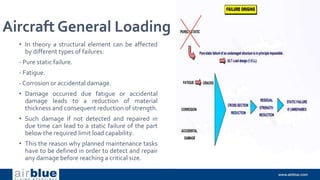
• In theory a structural element can be affected
by different types of failures:
- Pure static failure.
- Fatigue.
- Corrosion or accidental damage.
• Damage occurred due fatigue or accidental
damage leads to a reduction of material
thickness and consequent reduction of strength.
• Such damage if not detected and repaired in
due time can lead to a static failure of the part
below the required limit load capability.
• This the reason why planned maintenance tasks
have to be defined in order to detect and repair
any damage before reaching a critical size.
STRUCTURE DAMAGES
WHAT IS DAMAGE?
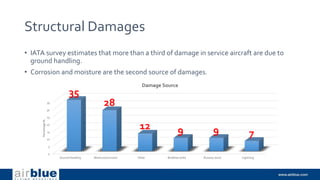
Structural Damages
• IATA survey estimates that more than a third of damage in service aircraft are due to
ground handling.
• Corrosion and moisture are the second source of damages.
0
5
10
15
20
25
30
35
Ground Handling Moisture/corrosion Other Bird/Hail strike Runway stone Lightning
35
28
12 9 9 7
Percentage
%
Damage Source
Type of Structural Damages
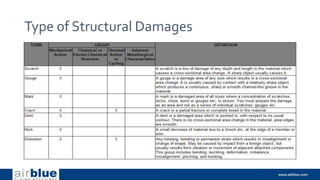
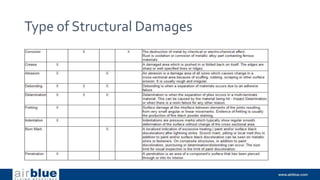
• The type of damage on metallic and composite structures are described in SRM 51-11-
00 chapter dealing with damage classification.
• Table defines the type of damage and cause of damages.
• Chapter 51-11-00 will help to classify damages, helping to know the origin of the
damage.
• Chapter 51-77-10 will give guideline to inspect and asses composites damages.
Type of Structural Damages
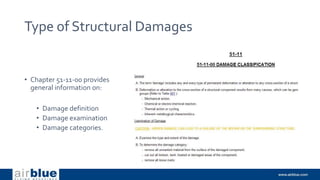
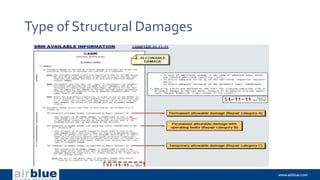
• Chapter 51-11-00 provides
general information on:
• Damage definition
• Damage examination
• Damage categories.
Type of Structural Damages
Type of Damages
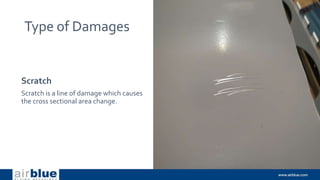
Scratch
Scratch is a line of damage which causes
the cross sectional area change.
Type of Damages
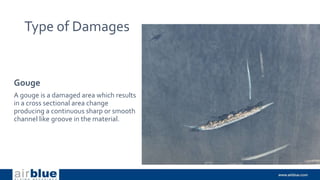
Gouge
A gouge is a damaged area which results
in a cross sectional area change
producing a continuous sharp or smooth
channel like groove in the material.
Type of Damages
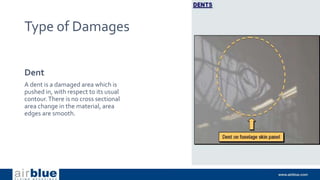
Dent
A dent is a damaged area which is
pushed in, with respect to its usual
contour.There is no cross sectional
area change in the material, area
edges are smooth.
Type of Damages
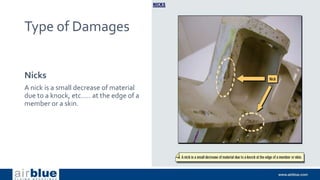
Nicks
A nick is a small decrease of material
due to a knock, etc.…. at the edge of a
member or a skin.
Type of Damages
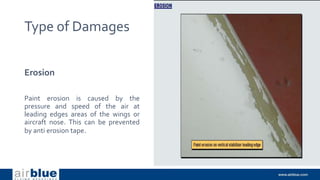
Erosion
Paint erosion is caused by the
pressure and speed of the air at
leading edges areas of the wings or
aircraft nose. This can be prevented
by anti erosion tape.
Type of Damages
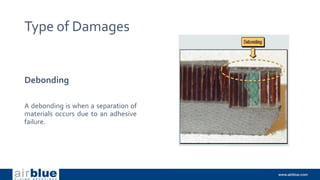
Debonding
A debonding is when a separation of
materials occurs due to an adhesive
failure.
Type of Damages
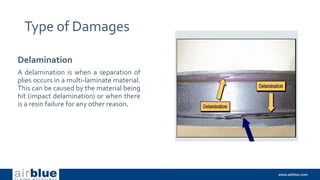
Delamination
A delamination is when a separation of
plies occurs in a multi-laminate material.
This can be caused by the material being
hit (impact delamination) or when there
is a resin failure for any other reason.
Why is fuselage frame station X=0 forward of the aircraft
nose?
STUCTURE REPAIR MANUAL
GENERAL
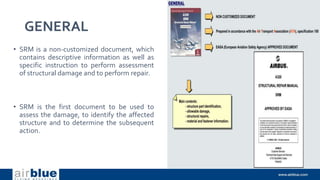
• SRM is a non-customized document, which
contains descriptive information as well as
specific instruction to perform assessment
of structural damage and to perform repair.
• SRM is the first document to be used to
assess the damage, to identify the affected
structure and to determine the subsequent
action.
GENERAL
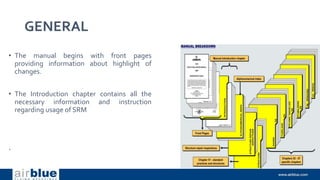
• The manual begins with front pages
providing information about highlight of
changes.
• The Introduction chapter contains all the
necessary information and instruction
regarding usage of SRM
.
GENERAL
The material presented in this manual is divided into seven chapters
under the following headings: -
• Structures
• General
• Doors
• Fuselage
• Nacelles/Pylons
• Stabilizers
• Windows
• Wings
GENERAL-ACCESSTO AIRN@V REPAIR
GENERAL- SUPPORTINGTOOLS
Offline Access Online Access
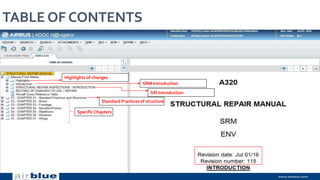
TABLE OF CONTENTS
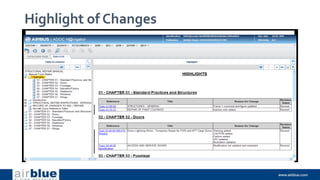
Highlights of changes
SRM Introduction
SRI Introduction
Specific Chapters
Standard Practices of structure
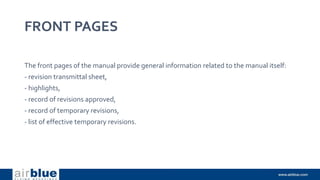
FRONT PAGES
The front pages of the manual provide general information related to the manual itself:
- revision transmittal sheet,
- highlights,
- record of revisions approved,
- record of temporary revisions,
- list of effective temporary revisions.
Highlight of Changes
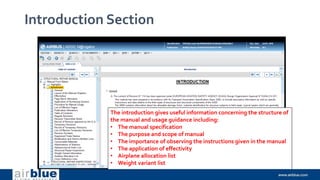
Introduction Section
The introduction gives useful information concerning the structure of
the manual and usage guidance including:
• The manual specification
• The purpose and scope of manual
• The importance of observing the instructions given in the manual
• The application of effectivity
• Airplane allocation list
• Weight variant list
SRI Introduction
• The SRI give all necessary inspection instructions for allowable damage limits/repairs.
• It provides the airlines with information to integrate inspections to their own
maintenance program.
• It is the operator’s responsibility to ensure the record and to monitor all relevant
inspection instruction.
SRI Introduction
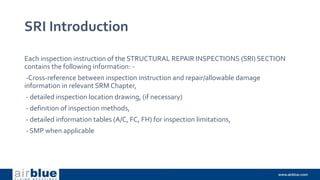
Each inspection instruction of the STRUCTURAL REPAIR INSPECTIONS (SRI) SECTION
contains the following information: -
-Cross-reference between inspection instruction and repair/allowable damage
information in relevant SRM Chapter,
- detailed inspection location drawing, (if necessary)
- definition of inspection methods,
- detailed information tables (A/C, FC, FH) for inspection limitations,
- SMP when applicable
STRUCTURAL INSPECTION INTRODUCTION
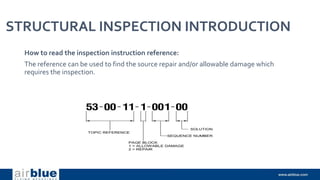
How to read the inspection instruction reference:
The reference can be used to find the source repair and/or allowable damage which
requires the inspection.
MANUAL GENERAL USAGE PROCESS
For the efficient use of this manual the following procedure is recommended.
Step 1
Determine damage classification.
(a) Using the manual chapter index, locate the chapter which refers to the damaged part.
(a) Locate the section, which refers to the damaged part in theTable of Contents.
(b) In the relevant Chapter refer to the topic 'Allowable Damage'.
MANUAL GENERAL USAGE PROCESS
Step 2
Identify damaged part in the manual.
(a) Locate the section and subsection which refers to the damaged part in theTable of
Contents.
(b) Refer to the figure reference at section, subsection level.
(c) Locate the relevant figure, identify the damaged component and refer to the relevant
Identification Data.
MANUAL GENERAL USAGE PROCESS
Step 3
Determine Repair Procedure.
(a) In the Identification Key to Figure for the part concerned refer to the 'ACTION OR
REPAIR' column and determine whether the part has a reference to a Repair within the
manual, either in the Chapter concerned or in another Chapter.
(b) In the event of major Structural Damage, the necessary replacement parts can be
ordered by means of the Structural Spare Parts Identification.This Identification includes
illustrations of all Structural parts. Structural spare parts may be ordered.
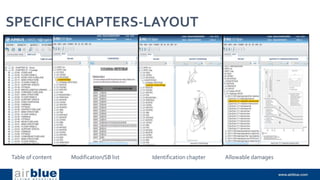
SPECIFIC CHAPTERS-LAYOUT
Table of content Modification/SB list Identification chapter Allowable damages
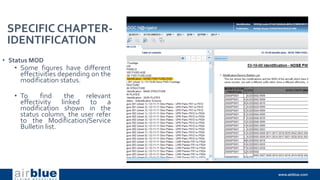
SPECIFIC CHAPTER-
IDENTIFICATION
• Status MOD
• Some figures have different
effectivities depending on the
modification status.
• To find the relevant
effectivity linked to a
modification shown in the
status column, the user refer
to the Modification/Service
Bulletin list.
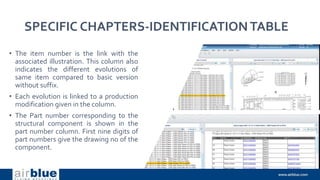
SPECIFIC CHAPTERS-IDENTIFICATIONTABLE
• The item number is the link with the
associated illustration. This column also
indicates the different evolutions of
same item compared to basic version
without suffix.
• Each evolution is linked to a production
modification given in the column.
• The Part number corresponding to the
structural component is shown in the
part number column. First nine digits of
part numbers give the drawing no of the
component.
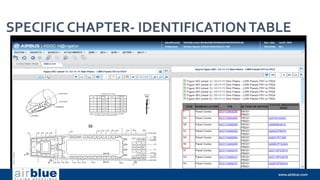
SPECIFIC CHAPTER- IDENTIFICATIONTABLE
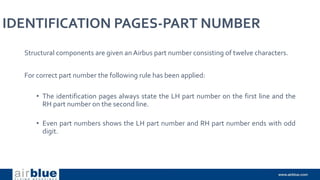
IDENTIFICATION PAGES-PART NUMBER
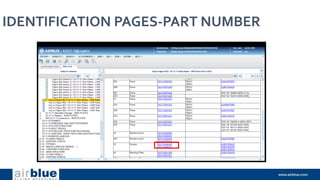
Structural components are given an Airbus part number consisting of twelve characters.
For correct part number the following rule has been applied:
• The identification pages always state the LH part number on the first line and the
RH part number on the second line.
• Even part numbers shows the LH part number and RH part number ends with odd
digit.
IDENTIFICATION PAGES-PART NUMBER
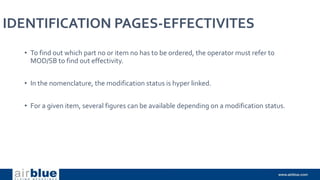
IDENTIFICATION PAGES-EFFECTIVITES
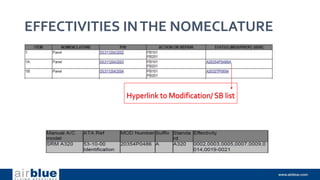
• To find out which part no or item no has to be ordered, the operator must refer to
MOD/SB to find out effectivity.
• In the nomenclature, the modification status is hyper linked.
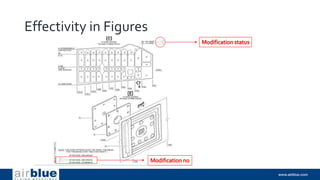
• For a given item, several figures can be available depending on a modification status.
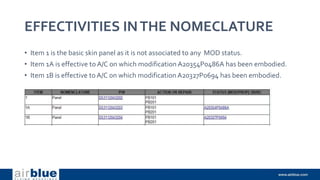
EFFECTIVITIES INTHE NOMECLATURE
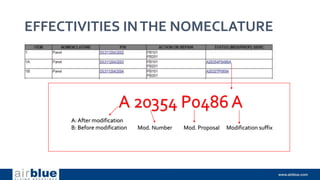
• Item 1 is the basic skin panel as it is not associated to any MOD status.
• Item 1A is effective to A/C on which modification A20354P0486A has been embodied.
• Item 1B is effective to A/C on which modification A20327P0694 has been embodied.
EFFECTIVITIES INTHE NOMECLATURE
A: After modification
B: Before modification Mod. Number Mod. Proposal Modification suffix
EFFECTIVITIES INTHE NOMECLATURE
Effectivity in Figures
ALLOWABLE DAMAGE
ALLOWABLE DAMAGES
• The information to be found within allowable damage enables the operator to define
whether a damaged airplane may be returned into service without repair.
• An allowable damage permitted has no significant effect on the strength or fatigue life
of the structure, which must still be capable of fulfilling its function.
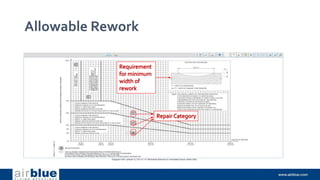
• Allowable damage may require minimal rework such as cleanup or drilling of stop holes.
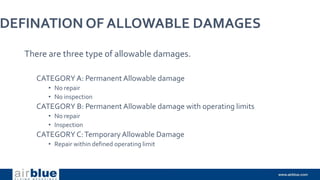
DEFINATION OF ALLOWABLE DAMAGES
There are three type of allowable damages.
CATEGORY A: Permanent Allowable damage
• No repair
• No inspection
CATEGORY B: Permanent Allowable damage with operating limits
• No repair
• Inspection
CATEGORY C:TemporaryAllowable Damage
• Repair within defined operating limit
DENT-ALLOWABLE DAMAGE READING
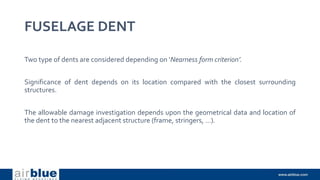
FUSELAGE DENT
Two type of dents are considered depending on ‘Nearness form criterion’.
Significance of dent depends on its location compared with the closest surrounding
structures.
The allowable damage investigation depends upon the geometrical data and location of
the dent to the nearest adjacent structure (frame, stringers, …).
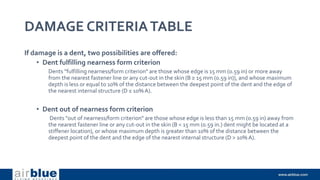
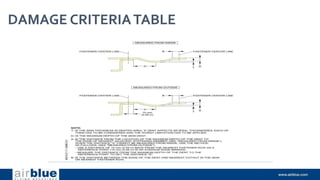
DAMAGE CRITERIATABLE
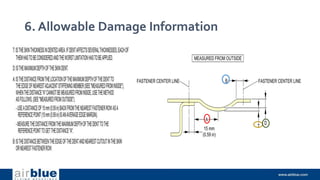
If damage is a dent, two possibilities are offered:
• Dent fulfilling nearness form criterion
Dents "fulfilling nearness/form criterion" are those whose edge is 15 mm (0.59 in) or more away
from the nearest fastener line or any cut-out in the skin (B ≥ 15 mm (0.59 in)), and whose maximum
depth is less or equal to 10% of the distance between the deepest point of the dent and the edge of
the nearest internal structure (D ≤ 10% A).
• Dent out of nearness form criterion
Dents "out of nearness/form criterion" are those whose edge is less than 15 mm (0.59 in) away from
the nearest fastener line or any cut-out in the skin (B < 15 mm (0.59 in.) dent might be located at a
stiffener location), or whose maximum depth is greater than 10% of the distance between the
deepest point of the dent and the edge of the nearest internal structure (D > 10% A).
DAMAGE CRITERIATABLE
SCRATCHES-ALLOWABLE DAMAGE READING
WHY IS IT NECESSARYTO REMOVE
SCRATCHES????
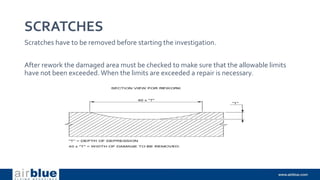
SCRATCHES
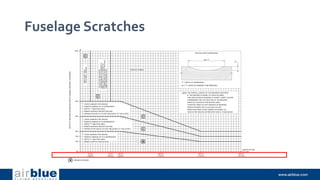
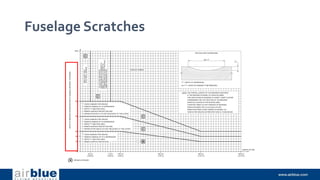
Scratches have to be removed before starting the investigation.
After rework the damaged area must be checked to make sure that the allowable limits
have not been exceeded. When the limits are exceeded a repair is necessary.
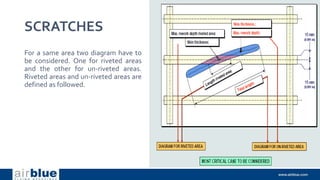
SCRATCHES
For a same area two diagram have to
be considered. One for riveted areas
and the other for un-riveted areas.
Riveted areas and un-riveted areas are
defined as followed.
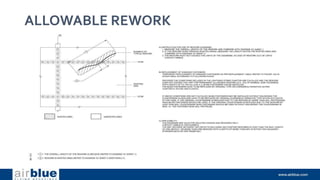
ALLOWABLE REWORK
Fuselage Scratches
Fuselage Scratches
Allowable Rework
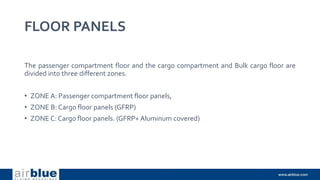
FLOOR PANELS
FLOOR PANELS
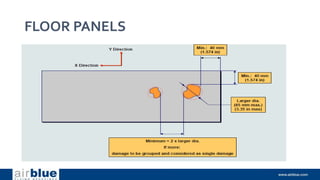
Cargo and Cabin floor panels are made up of composite material.
Two type of damages can occur on floor panels.
• Perforation damage
This is when the floor panel is hit by a object and damage is usually caused to the
upper or lower skin and the honeycomb core.
• Non Perforation damage
This is when the floor panel is hit by a object and damage and damage is usually
caused to the honeycomb core.
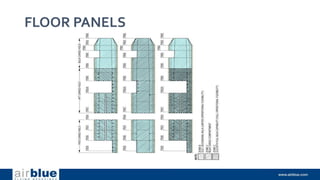
FLOOR PANELS
The passenger compartment floor and the cargo compartment and Bulk cargo floor are
divided into three different zones.
• ZONE A: Passenger compartment floor panels,
• ZONE B: Cargo floor panels (GFRP)
• ZONE C: Cargo floor panels. (GFRP+ Aluminum covered)
FLOOR PANELS
FLOOR PANELS
DAMAGE ASSESMENT
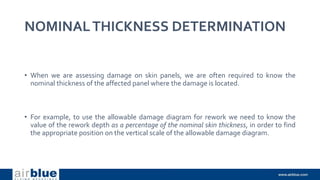
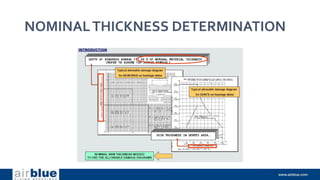
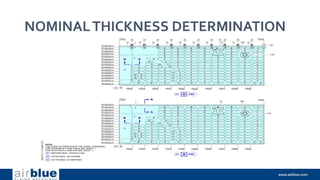
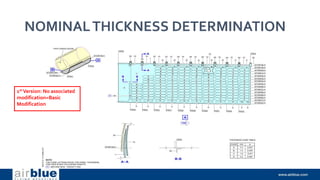
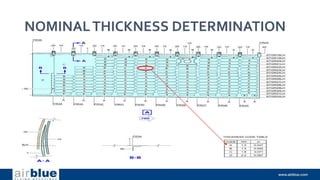
NOMINALTHICKNESS DETERMINATION
• When we are assessing damage on skin panels, we are often required to know the
nominal thickness of the affected panel where the damage is located.
• For example, to use the allowable damage diagram for rework we need to know the
value of the rework depth as a percentage of the nominal skin thickness, in order to find
the appropriate position on the vertical scale of the allowable damage diagram.
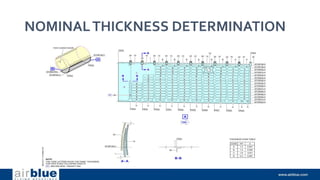
NOMINALTHICKNESS DETERMINATION
1st Version: No associated
modification=Basic
Modification
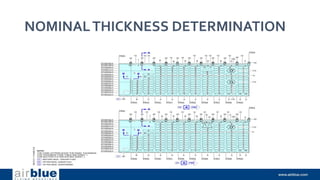
NOMINALTHICKNESS DETERMINATION
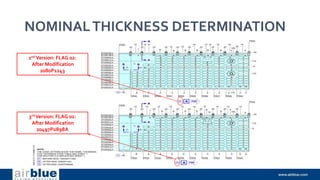
2nd Version: FLAG 02:
After Modification
2080P1243
3rd Version: FLAG 02:
After Modification
20497P0898A
NOMINALTHICKNESS DETERMINATION
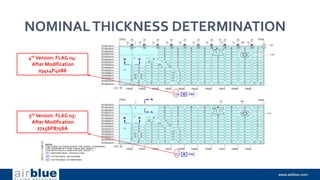
4th Version: FLAG 04:
After Modification
25414P4088
5th Version: FLAG 05:
After Modification
27156P8756A
NOMINALTHICKNESS DETERMINATION
DAMAGE MAPPING
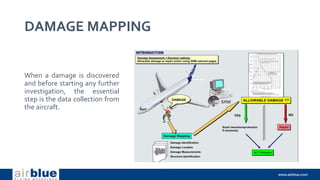
DAMAGE MAPPING
When a damage is discovered
and before starting any further
investigation, the essential
step is the data collection from
the aircraft.
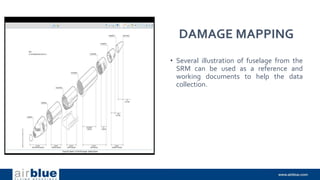
DAMAGE MAPPING
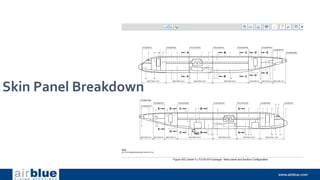
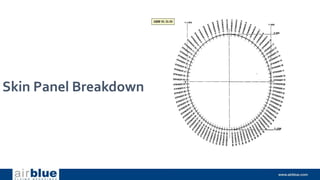
• Several illustration of fuselage from the
SRM can be used as a reference and
working documents to help the data
collection.
DAMAGE MAPPING
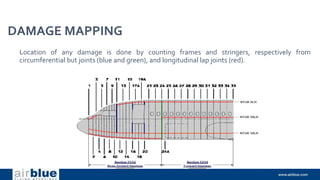
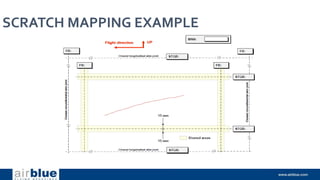
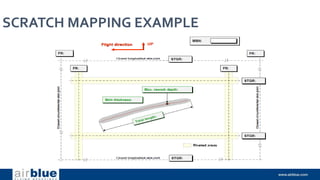
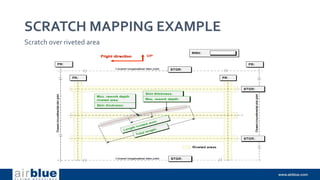
Location of any damage is done by counting frames and stringers, respectively from
circumferential but joints (blue and green), and longitudinal lap joints (red).
Skin Panel Breakdown
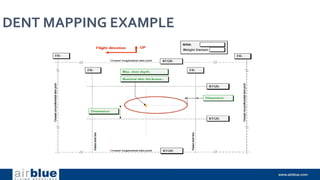
DENT MAPPING EXAMPLE
SCRATCH MAPPING EXAMPLE
Scratch over riveted area
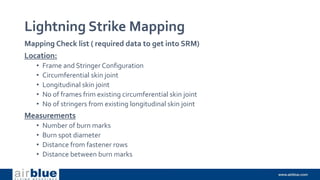
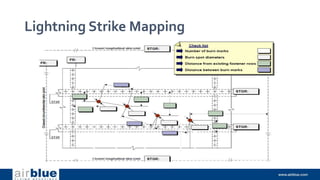
Lightning Strike Mapping
Example
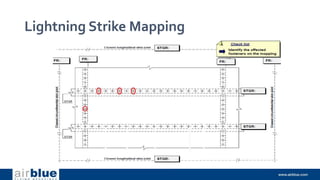
Lightning Strike Mapping
Mapping Check list ( required data to get into SRM)
Location:
• Frame and Stringer Configuration
• Circumferential skin joint
• Longitudinal skin joint
• No of frames frim existing circumferential skin joint
• No of stringers from existing longitudinal skin joint
Measurements
• Number of burn marks
• Burn spot diameter
• Distance from fastener rows
• Distance between burn marks
Lightning Strike Mapping
DAMAGE ASSESSMENT
EXAMPLE 1
DAMAGE ASSESSMENT
Damage assessment is basically the decision making process.
Following steps to be followed for the assessment of damage.
1. Damage Identification
2. DamageGeographical Location
3. Damage Measurements
4. Detailed location
5. Structure Identification
6. Allowable damage information
7. Allowable damage usage
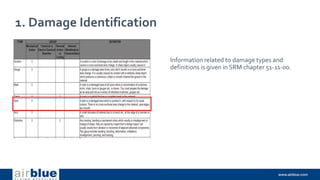
1. Damage Identification
Information related to damage types and
definitions is given in SRM chapter 51-11-00.
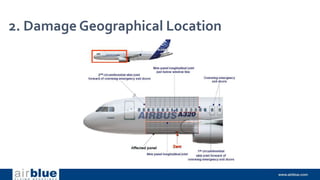
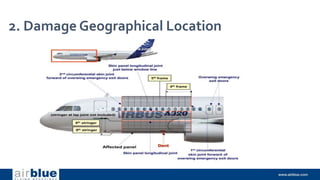
2. Damage Geographical Location
Record the necessary information regarding location from Aircraft before starting the SRM investigation.
Following information is required for geographical location.
1. Stringer no identification
2. Frame no identification
2. Damage Geographical Location
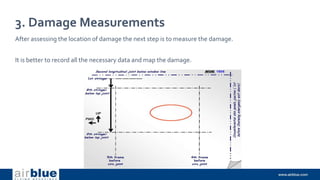
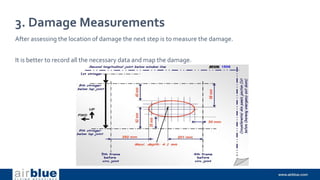
3. Damage Measurements
After assessing the location of damage the next step is to measure the damage.
It is better to record all the necessary data and map the damage.
3. Damage Measurements
After assessing the location of damage the next step is to measure the damage.
It is better to record all the necessary data and map the damage.
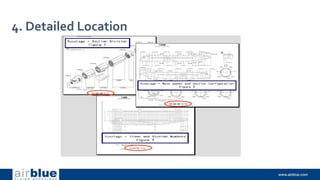
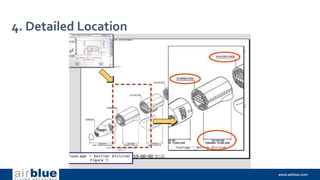
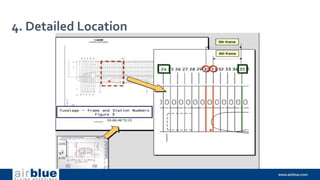
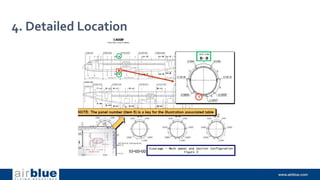
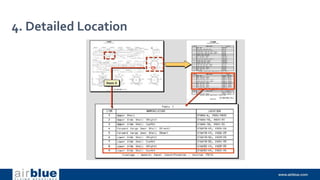
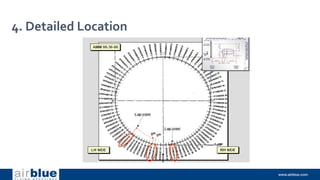
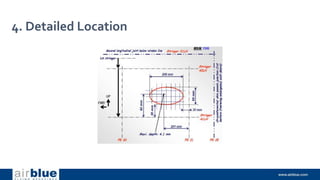
4. Detailed Location
Using the data collected from Aircraft ( geographical location and damage dimensions), SRM is to be
used to refine the damage location.
SRM chapter 53-00-00 provides several illustration to be used to locate the damage.
After getting the information from SRM finalize the mapping with frame and stringer numbers.
4. Detailed Location
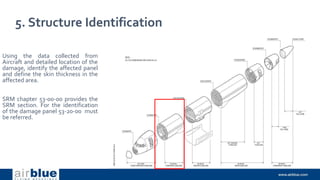
5. Structure Identification
Using the data collected from
Aircraft and detailed location of the
damage, identify the affected panel
and define the skin thickness in the
affected area.
SRM chapter 53-00-00 provides the
SRM section. For the identification
of the damage panel 53-20-00 must
be referred.
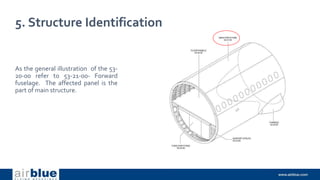
5. Structure Identification
As the general illustration of the 53-
20-00 refer to 53-21-00- Forward
fuselage. The affected panel is the
part of main structure.
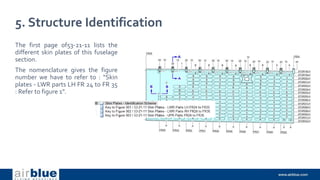
5. Structure Identification
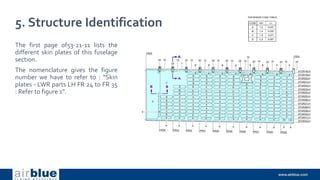
The first page of53-21-11 lists the
different skin plates of this fuselage
section.
The nomenclature gives the figure
number we have to refer to : “Skin
plates - LWR parts LH FR 24 to FR 35
: Refer to figure 1”.
5. Structure Identification
The first page of53-21-11 lists the
different skin plates of this fuselage
section.
The nomenclature gives the figure
number we have to refer to : “Skin
plates - LWR parts LH FR 24 to FR 35
: Refer to figure 1”.
6. Allowable Damage Information
Using the data concerning the damaged panel, we can start the allowable damage
selection and reading.
To start the damage assessment refer to the Allowable damage section of the relevant
chapter/section (53-21-11), and start to read carefully the procedure.
Pay a particular attention to the WARNING and CAUTION.
The weight variant to be taken into account for the affected A/C has to be known before
starting the assessment.
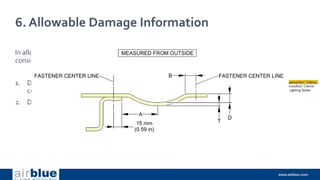
6. Allowable Damage Information
In allowable damage, two cases are
considered for dents.
1. Dent fulfilling the nearness/ form
criterion
2. Dent out of nearness/form criterion.
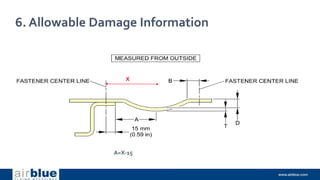
6. Allowable Damage Information
X
A=X-15
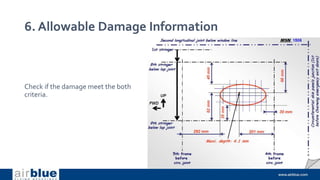
6. Allowable Damage Information
Check if the damage meet the both
criteria.
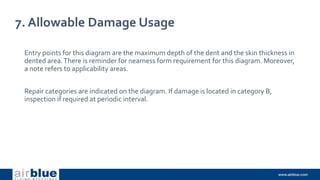
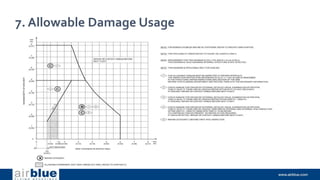
7. Allowable Damage Usage
Entry points for this diagram are the maximum depth of the dent and the skin thickness in
dented area.There is reminder for nearness form requirement for this diagram. Moreover,
a note refers to applicability areas.
Repair categories are indicated on the diagram. If damage is located in category B,
inspection if required at periodic interval.
7. Allowable Damage Usage
MEASUREMENTS OF SOME
OTHER PRONE DAMAGE
AREAS ON ABQ FLEET
1. WING PARTS
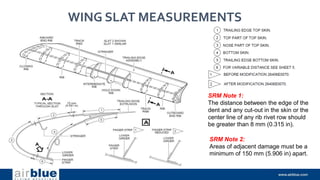
WING SLAT MEASUREMENTS
SRM Note 1:
The distance between the edge of the
dent and any cut-out in the skin or the
center line of any rib rivet row should
be greater than 8 mm (0.315 in).
SRM Note 2:
Areas of adjacent damage must be a
minimum of 150 mm (5.906 in) apart.
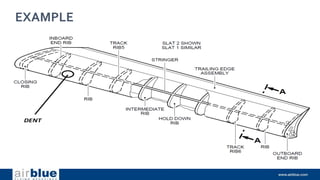
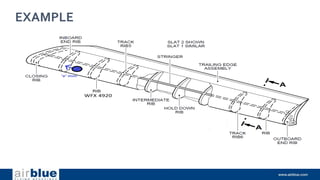
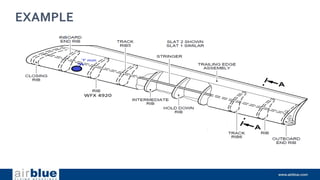
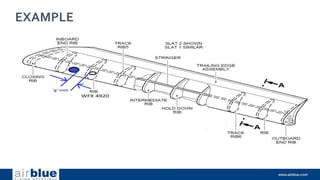
EXAMPLE
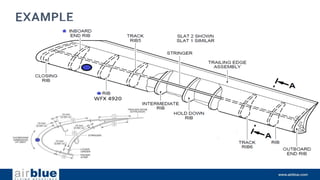
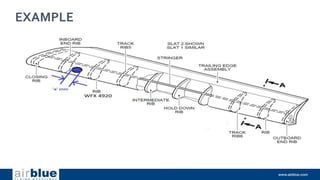
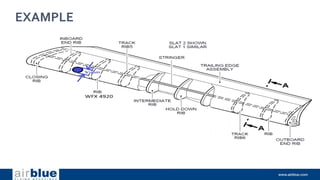
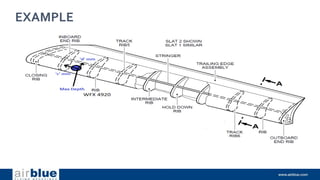
INFORMATION REQUIRED FROM L.M
• Exact Location of Dent [i.e. On Nose part ofTop Skin between Inboard End Rib and
Rib (WFX 4920)]
• Length (SpanWise)
• Width
• Max depth with distance from nearest Rib (i.e. Inboard End Rib) and nearest Rivet Line
parallel to Slat Span (i.e. Stringer)
• Distance between Dent Edge to Closest Rib (i.e. Inboard End Rib)
• Distance between Dent Edge and Center of Stringer Rivet Line
• Min distance of Dent from adjacent Damage / Repair
EXAMPLE
INFORMATION REQUIRED FROM L.M
• Exact Location of Dent [i.e. On Nose part ofTop Skin between Inboard End Rib and Rib
(WFX 4920)]
• Length (Span Wise)
• Width
• Max depth with distance from nearest Rib (i.e. Inboard End Rib) and nearest Rivet Line
parallel to Slat Span (i.e. Stringer)
• Distance between Dent Edge to Closest Rib (i.e. Inboard End Rib)
• Distance between Dent Edge and Center of Stringer Rivet Line
• Min distance of Dent from adjacent Damage / Repair
EXAMPLE
INFORMATION REQUIRED FROM L.M
• Exact Location of Dent [i.e. On Nose part ofTop Skin between Inboard End Rib and Rib
(WFX 4920)]
• Length (SpanWise)
• Width
• Max depth with distance from nearest Rib (i.e. Inboard End Rib) and nearest Rivet Line
parallel to Slat Span (i.e. Stringer)
• Distance between Dent Edge to Closest Rib (i.e. Inboard End Rib)
• Distance between Dent Edge and Center of Stringer Rivet Line
• Min distance of Dent from adjacent Damage / Repair
EXAMPLE
INFORMATION REQUIRED FROM L.M
• Exact Location of Dent [i.e. On Nose part ofTop Skin between Inboard End Rib and Rib
(WFX 4920)]
• Length (SpanWise)
• Width
• Max depth with distance from nearest Rib (i.e. Inboard End Rib) and nearest Rivet
Line parallel to Slat Span (i.e. Stringer)
• Distance between Dent Edge to Closest Rib (i.e. Inboard End Rib)
• Distance between Dent Edge and Center of Stringer Rivet Line
• Min distance of Dent from adjacent Damage / Repair
EXAMPLE
INFORMATION REQUIRED FROM L.M
• Exact Location of Dent [i.e. On Nose part ofTop Skin between Inboard End Rib and Rib
(WFX 4920)]
• Length (SpanWise)
• Width
• Max depth with distance from nearest Rib (i.e. Inboard End Rib) and nearest Rivet Line
parallel to Slat Span (i.e. Stringer)
• Distance between Dent Edge to Closest Rib (i.e. Inboard End Rib)
• Distance between Dent Edge and Center of Stringer Rivet Line
• Min distance of Dent from adjacent Damage / Repair
EXAMPLE
INFORMATION REQUIRED FROM L.M
• Exact Location of Dent [i.e. On Nose part ofTop Skin between Inboard End Rib and Rib
(WFX 4920)]
• Length (SpanWise)
• Width
• Max depth with distance from nearest Rib (i.e. Inboard End Rib) and nearest Rivet Line
parallel to Slat Span (i.e. Stringer)
• Distance between Dent Edge to Closest Rib (i.e. Inboard End Rib)
• Distance between Dent Edge and Center of Stringer Rivet Line
• Min distance of Dent from adjacent Damage / Repair
EXAMPLE
INFORMATION REQUIRED FROM L.M
• Exact Location of Dent [i.e. On Nose part ofTop Skin between Inboard End Rib and Rib
(WFX 4920)]
• Length (SpanWise)
• Width
• Max depth with distance from nearest Rib (i.e. Inboard End Rib) and nearest Rivet Line
parallel to Slat Span (i.e. Stringer)
• Distance between Dent Edge to Closest Rib (i.e. Inboard End Rib)
• Distance between Dent Edge and Center of Stringer Rivet Line
• Min distance of Dent from adjacent Damage / Repair
EXAMPLE
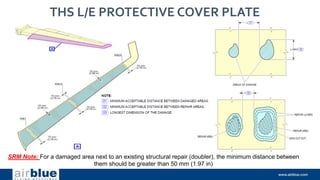
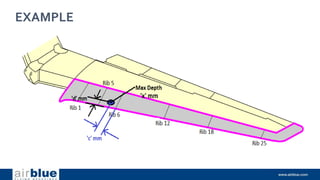
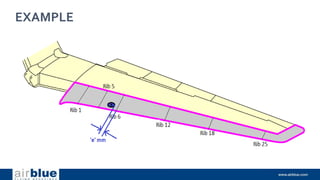
2.THS L/E PROTECTIVE
COVER PLATE
THS L/E PROTECTIVE COVER PLATE
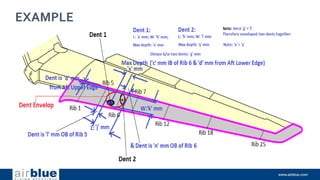
SRM Note: For a damaged area next to an existing structural repair (doubler), the minimum distance between
them should be greater than 50 mm (1.97 in)
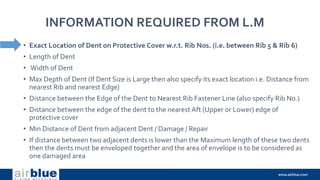
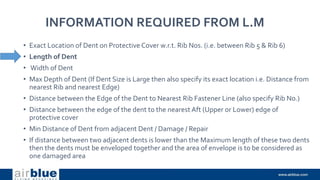
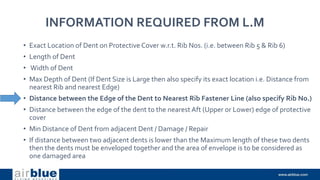
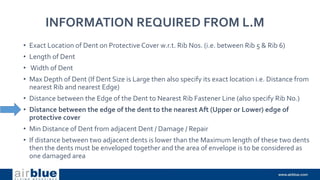
INFORMATION REQUIRED FROM L.M
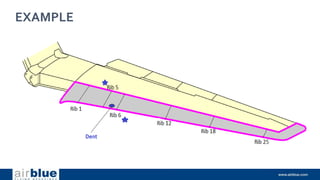
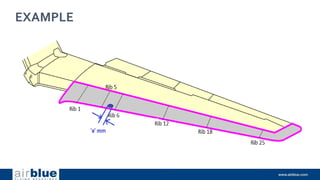
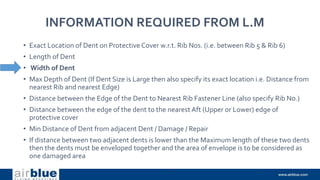
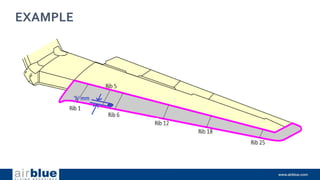
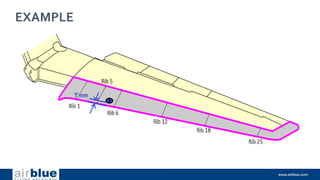
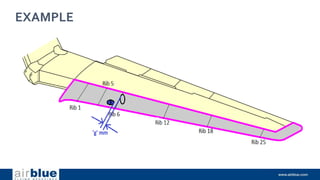
• Exact Location of Dent on Protective Cover w.r.t. Rib Nos. (i.e. between Rib 5 & Rib 6)
• Length of Dent
• Width of Dent
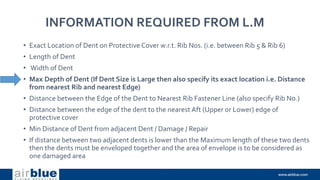
• Max Depth of Dent (If Dent Size is Large then also specify its exact location i.e. Distance from
nearest Rib and nearest Edge)
• Distance between the Edge of the Dent to Nearest Rib Fastener Line (also specify Rib No.)
• Distance between the edge of the dent to the nearest Aft (Upper or Lower) edge of
protective cover
• Min Distance of Dent from adjacent Dent / Damage / Repair
• If distance between two adjacent dents is lower than the Maximum length of these two dents
then the dents must be enveloped together and the area of envelope is to be considered as
one damaged area
EXAMPLE
INFORMATION REQUIRED FROM L.M
• Exact Location of Dent on Protective Cover w.r.t. Rib Nos. (i.e. between Rib 5 & Rib 6)
• Length of Dent
• Width of Dent
• Max Depth of Dent (If Dent Size is Large then also specify its exact location i.e. Distance from
nearest Rib and nearest Edge)
• Distance between the Edge of the Dent to Nearest Rib Fastener Line (also specify Rib No.)
• Distance between the edge of the dent to the nearest Aft (Upper or Lower) edge of
protective cover
• Min Distance of Dent from adjacent Dent / Damage / Repair
• If distance between two adjacent dents is lower than the Maximum length of these two dents
then the dents must be enveloped together and the area of envelope is to be considered as
one damaged area
EXAMPLE
INFORMATION REQUIRED FROM L.M
• Exact Location of Dent on Protective Cover w.r.t. Rib Nos. (i.e. between Rib 5 & Rib 6)
• Length of Dent
• Width of Dent
• Max Depth of Dent (If Dent Size is Large then also specify its exact location i.e. Distance from
nearest Rib and nearest Edge)
• Distance between the Edge of the Dent to Nearest Rib Fastener Line (also specify Rib No.)
• Distance between the edge of the dent to the nearest Aft (Upper or Lower) edge of
protective cover
• Min Distance of Dent from adjacent Dent / Damage / Repair
• If distance between two adjacent dents is lower than the Maximum length of these two dents
then the dents must be enveloped together and the area of envelope is to be considered as
one damaged area
EXAMPLE
INFORMATION REQUIRED FROM L.M
• Exact Location of Dent on Protective Cover w.r.t. Rib Nos. (i.e. between Rib 5 & Rib 6)
• Length of Dent
• Width of Dent
• Max Depth of Dent (If Dent Size is Large then also specify its exact location i.e. Distance
from nearest Rib and nearest Edge)
• Distance between the Edge of the Dent to Nearest Rib Fastener Line (also specify Rib No.)
• Distance between the edge of the dent to the nearest Aft (Upper or Lower) edge of
protective cover
• Min Distance of Dent from adjacent Dent / Damage / Repair
• If distance between two adjacent dents is lower than the Maximum length of these two dents
then the dents must be enveloped together and the area of envelope is to be considered as
one damaged area
EXAMPLE
INFORMATION REQUIRED FROM L.M
• Exact Location of Dent on Protective Cover w.r.t. Rib Nos. (i.e. between Rib 5 & Rib 6)
• Length of Dent
• Width of Dent
• Max Depth of Dent (If Dent Size is Large then also specify its exact location i.e. Distance from
nearest Rib and nearest Edge)
• Distance between the Edge of the Dent to Nearest Rib Fastener Line (also specify Rib No.)
• Distance between the edge of the dent to the nearest Aft (Upper or Lower) edge of protective
cover
• Min Distance of Dent from adjacent Dent / Damage / Repair
• If distance between two adjacent dents is lower than the Maximum length of these two dents
then the dents must be enveloped together and the area of envelope is to be considered as
one damaged area
EXAMPLE
INFORMATION REQUIRED FROM L.M
• Exact Location of Dent on Protective Cover w.r.t. Rib Nos. (i.e. between Rib 5 & Rib 6)
• Length of Dent
• Width of Dent
• Max Depth of Dent (If Dent Size is Large then also specify its exact location i.e. Distance from
nearest Rib and nearest Edge)
• Distance between the Edge of the Dent to Nearest Rib Fastener Line (also specify Rib No.)
• Distance between the edge of the dent to the nearest Aft (Upper or Lower) edge of
protective cover
• Min Distance of Dent from adjacent Dent / Damage / Repair
• If distance between two adjacent dents is lower than the Maximum length of these two dents
then the dents must be enveloped together and the area of envelope is to be considered as
one damaged area
EXAMPLE
INFORMATION REQUIRED FROM L.M
• Exact Location of Dent on Protective Cover w.r.t. Rib Nos. (i.e. between Rib 5 & Rib 6)
• Length of Dent
• Width of Dent
• Max Depth of Dent (If Dent Size is Large then also specify its exact location i.e. Distance from
nearest Rib and nearest Edge)
• Distance between the Edge of the Dent to Nearest Rib Fastener Line (also specify Rib No.)
• Distance between the edge of the dent to the nearest Aft (Upper or Lower) edge of
protective cover
• Min Distance of Dent from adjacent Dent / Damage / Repair
• If distance between two adjacent dents is lower than the Maximum length of these two dents
then the dents must be enveloped together and the area of envelope is to be considered as
one damaged area
EXAMPLE
INFORMATION REQUIRED FROM L.M
• Exact Location of Dent on Protective Cover w.r.t. Rib Nos. (i.e. between Rib 5 & Rib 6)
• Length of Dent
• Width of Dent
• Max Depth of Dent (If Dent Size is Large then also specify its exact location i.e. Distance from
nearest Rib and nearest Edge)
• Distance between the Edge of the Dent to Nearest Rib Fastener Line (also specify Rib No.)
• Distance between the edge of the dent to the nearest Aft (Upper or Lower) edge of
protective cover
• Min Distance of Dent from adjacent Dent / Damage / Repair
• If distance between two adjacent dents is lower than the Maximum length of these two
dents then the dents must be enveloped together and the area of envelope is to be
considered as one damaged area
EXAMPLE
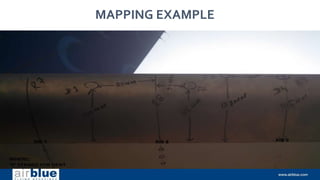
MAPPING EXAMPLE
3. ENGINE FAN BLADE L/E
BLENDING
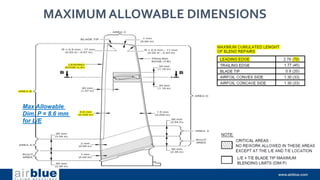
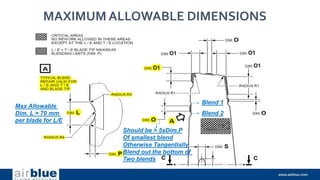
MAXIMUM ALLOWABLE DIMENSIONS
Max Allowable
Dim. P = 8.6 mm
for L/E
MAXIMUM ALLOWABLE DIMENSIONS
Max Allowable
Dim. L = 70 mm
per blade for L/E
Should be > 5xDim.P
Of smallest blend
Otherwise Tangentially
Blend out the bottom of
Two blends
Blend 1
Blend 2
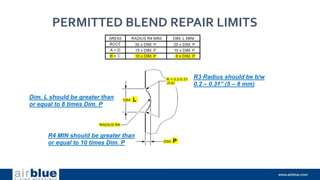
PERMITTED BLEND REPAIR LIMITS
Dim. L should be greater than
or equal to 8 times Dim. P
R4 MIN should be greater than
or equal to 10 times Dim. P
R3 Radius should be b/w
0.2 – 0.31’’ (5 – 8 mm)
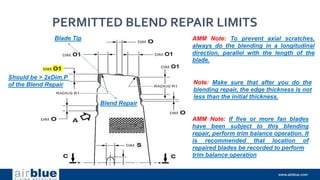
PERMITTED BLEND REPAIR LIMITS
Blend Repair
Blade Tip
Should be > 2xDim.P
of the Blend Repair
AMM Note: To prevent axial scratches,
always do the blending in a longitudinal
direction, parallel with the length of the
blade.
AMM Note: If five or more fan blades
have been subject to this blending
repair, perform trim balance operation. It
is recommended that location of
repaired blades be recorded to perform
trim balance operation
Note: Make sure that after you do the
blending repair, the edge thickness is not
less than the initial thickness.
Exercise 1
Exercise 2
Any Question?

A320 Structure Training.pptx

  • 1.
    SRM & DAMAGEASSESMENT Bilal Abbasi
  • 2.
  • 3.
  • 4.
  • 6.
    OBJECTIVE • Introduction toSRM • Identification of different type of damages • Understand the importance of damage mapping and report • Study of some typical damage assessments
  • 7.
    Aircraft Structure Design •External loads acting on an airplane in flight, landing, take-off, on ground condition must be known before designing the structure of aircraft. • In general the magnitude of the air forces on an airplane depends on the velocity of the airplane and acceleration. • For civil aircraft the magnitude of these accelerations (load factors), is defined by the regulation (+ 2.5g, -1g: Flight envelop).
  • 8.
    Aircraft General Loading •In theory a structural element can be affected by different types of failures: - Pure static failure. - Fatigue. - Corrosion or accidental damage. • Damage occurred due fatigue or accidental damage leads to a reduction of material thickness and consequent reduction of strength. • Such damage if not detected and repaired in due time can lead to a static failure of the part below the required limit load capability. • This the reason why planned maintenance tasks have to be defined in order to detect and repair any damage before reaching a critical size.
  • 9.
  • 10.
  • 11.
    Structural Damages • IATAsurvey estimates that more than a third of damage in service aircraft are due to ground handling. • Corrosion and moisture are the second source of damages. 0 5 10 15 20 25 30 35 Ground Handling Moisture/corrosion Other Bird/Hail strike Runway stone Lightning 35 28 12 9 9 7 Percentage % Damage Source
  • 12.
    Type of StructuralDamages • The type of damage on metallic and composite structures are described in SRM 51-11- 00 chapter dealing with damage classification. • Table defines the type of damage and cause of damages. • Chapter 51-11-00 will help to classify damages, helping to know the origin of the damage. • Chapter 51-77-10 will give guideline to inspect and asses composites damages.
  • 13.
    Type of StructuralDamages • Chapter 51-11-00 provides general information on: • Damage definition • Damage examination • Damage categories.
  • 14.
  • 15.
  • 16.
  • 17.
    Type of Damages Scratch Scratchis a line of damage which causes the cross sectional area change.
  • 18.
    Type of Damages Gouge Agouge is a damaged area which results in a cross sectional area change producing a continuous sharp or smooth channel like groove in the material.
  • 19.
    Type of Damages Dent Adent is a damaged area which is pushed in, with respect to its usual contour.There is no cross sectional area change in the material, area edges are smooth.
  • 20.
    Type of Damages Nicks Anick is a small decrease of material due to a knock, etc.…. at the edge of a member or a skin.
  • 21.
    Type of Damages Erosion Painterosion is caused by the pressure and speed of the air at leading edges areas of the wings or aircraft nose. This can be prevented by anti erosion tape.
  • 22.
    Type of Damages Debonding Adebonding is when a separation of materials occurs due to an adhesive failure.
  • 23.
    Type of Damages Delamination Adelamination is when a separation of plies occurs in a multi-laminate material. This can be caused by the material being hit (impact delamination) or when there is a resin failure for any other reason.
  • 24.
    Why is fuselageframe station X=0 forward of the aircraft nose?
  • 25.
  • 26.
    GENERAL • SRM isa non-customized document, which contains descriptive information as well as specific instruction to perform assessment of structural damage and to perform repair. • SRM is the first document to be used to assess the damage, to identify the affected structure and to determine the subsequent action.
  • 27.
    GENERAL • The manualbegins with front pages providing information about highlight of changes. • The Introduction chapter contains all the necessary information and instruction regarding usage of SRM .
  • 28.
    GENERAL The material presentedin this manual is divided into seven chapters under the following headings: - • Structures • General • Doors • Fuselage • Nacelles/Pylons • Stabilizers • Windows • Wings
  • 29.
  • 30.
  • 31.
    TABLE OF CONTENTS Highlightsof changes SRM Introduction SRI Introduction Specific Chapters Standard Practices of structure
  • 32.
    FRONT PAGES The frontpages of the manual provide general information related to the manual itself: - revision transmittal sheet, - highlights, - record of revisions approved, - record of temporary revisions, - list of effective temporary revisions.
  • 33.
  • 34.
    Introduction Section The introductiongives useful information concerning the structure of the manual and usage guidance including: • The manual specification • The purpose and scope of manual • The importance of observing the instructions given in the manual • The application of effectivity • Airplane allocation list • Weight variant list
  • 35.
    SRI Introduction • TheSRI give all necessary inspection instructions for allowable damage limits/repairs. • It provides the airlines with information to integrate inspections to their own maintenance program. • It is the operator’s responsibility to ensure the record and to monitor all relevant inspection instruction.
  • 36.
    SRI Introduction Each inspectioninstruction of the STRUCTURAL REPAIR INSPECTIONS (SRI) SECTION contains the following information: - -Cross-reference between inspection instruction and repair/allowable damage information in relevant SRM Chapter, - detailed inspection location drawing, (if necessary) - definition of inspection methods, - detailed information tables (A/C, FC, FH) for inspection limitations, - SMP when applicable
  • 37.
    STRUCTURAL INSPECTION INTRODUCTION Howto read the inspection instruction reference: The reference can be used to find the source repair and/or allowable damage which requires the inspection.
  • 38.
    MANUAL GENERAL USAGEPROCESS For the efficient use of this manual the following procedure is recommended. Step 1 Determine damage classification. (a) Using the manual chapter index, locate the chapter which refers to the damaged part. (a) Locate the section, which refers to the damaged part in theTable of Contents. (b) In the relevant Chapter refer to the topic 'Allowable Damage'.
  • 39.
    MANUAL GENERAL USAGEPROCESS Step 2 Identify damaged part in the manual. (a) Locate the section and subsection which refers to the damaged part in theTable of Contents. (b) Refer to the figure reference at section, subsection level. (c) Locate the relevant figure, identify the damaged component and refer to the relevant Identification Data.
  • 40.
    MANUAL GENERAL USAGEPROCESS Step 3 Determine Repair Procedure. (a) In the Identification Key to Figure for the part concerned refer to the 'ACTION OR REPAIR' column and determine whether the part has a reference to a Repair within the manual, either in the Chapter concerned or in another Chapter. (b) In the event of major Structural Damage, the necessary replacement parts can be ordered by means of the Structural Spare Parts Identification.This Identification includes illustrations of all Structural parts. Structural spare parts may be ordered.
  • 41.
    SPECIFIC CHAPTERS-LAYOUT Table ofcontent Modification/SB list Identification chapter Allowable damages
  • 42.
    SPECIFIC CHAPTER- IDENTIFICATION • StatusMOD • Some figures have different effectivities depending on the modification status. • To find the relevant effectivity linked to a modification shown in the status column, the user refer to the Modification/Service Bulletin list.
  • 43.
    SPECIFIC CHAPTERS-IDENTIFICATIONTABLE • Theitem number is the link with the associated illustration. This column also indicates the different evolutions of same item compared to basic version without suffix. • Each evolution is linked to a production modification given in the column. • The Part number corresponding to the structural component is shown in the part number column. First nine digits of part numbers give the drawing no of the component.
  • 44.
  • 45.
    IDENTIFICATION PAGES-PART NUMBER Structuralcomponents are given an Airbus part number consisting of twelve characters. For correct part number the following rule has been applied: • The identification pages always state the LH part number on the first line and the RH part number on the second line. • Even part numbers shows the LH part number and RH part number ends with odd digit.
  • 46.
  • 47.
    IDENTIFICATION PAGES-EFFECTIVITES • Tofind out which part no or item no has to be ordered, the operator must refer to MOD/SB to find out effectivity. • In the nomenclature, the modification status is hyper linked. • For a given item, several figures can be available depending on a modification status.
  • 48.
    EFFECTIVITIES INTHE NOMECLATURE •Item 1 is the basic skin panel as it is not associated to any MOD status. • Item 1A is effective to A/C on which modification A20354P0486A has been embodied. • Item 1B is effective to A/C on which modification A20327P0694 has been embodied.
  • 49.
    EFFECTIVITIES INTHE NOMECLATURE A:After modification B: Before modification Mod. Number Mod. Proposal Modification suffix
  • 50.
  • 51.
  • 52.
  • 53.
    ALLOWABLE DAMAGES • Theinformation to be found within allowable damage enables the operator to define whether a damaged airplane may be returned into service without repair. • An allowable damage permitted has no significant effect on the strength or fatigue life of the structure, which must still be capable of fulfilling its function. • Allowable damage may require minimal rework such as cleanup or drilling of stop holes.
  • 54.
    DEFINATION OF ALLOWABLEDAMAGES There are three type of allowable damages. CATEGORY A: Permanent Allowable damage • No repair • No inspection CATEGORY B: Permanent Allowable damage with operating limits • No repair • Inspection CATEGORY C:TemporaryAllowable Damage • Repair within defined operating limit
  • 55.
  • 56.
    FUSELAGE DENT Two typeof dents are considered depending on ‘Nearness form criterion’. Significance of dent depends on its location compared with the closest surrounding structures. The allowable damage investigation depends upon the geometrical data and location of the dent to the nearest adjacent structure (frame, stringers, …).
  • 57.
    DAMAGE CRITERIATABLE If damageis a dent, two possibilities are offered: • Dent fulfilling nearness form criterion Dents "fulfilling nearness/form criterion" are those whose edge is 15 mm (0.59 in) or more away from the nearest fastener line or any cut-out in the skin (B ≥ 15 mm (0.59 in)), and whose maximum depth is less or equal to 10% of the distance between the deepest point of the dent and the edge of the nearest internal structure (D ≤ 10% A). • Dent out of nearness form criterion Dents "out of nearness/form criterion" are those whose edge is less than 15 mm (0.59 in) away from the nearest fastener line or any cut-out in the skin (B < 15 mm (0.59 in.) dent might be located at a stiffener location), or whose maximum depth is greater than 10% of the distance between the deepest point of the dent and the edge of the nearest internal structure (D > 10% A).
  • 58.
  • 59.
  • 60.
    WHY IS ITNECESSARYTO REMOVE SCRATCHES????
  • 61.
    SCRATCHES Scratches have tobe removed before starting the investigation. After rework the damaged area must be checked to make sure that the allowable limits have not been exceeded. When the limits are exceeded a repair is necessary.
  • 62.
    SCRATCHES For a samearea two diagram have to be considered. One for riveted areas and the other for un-riveted areas. Riveted areas and un-riveted areas are defined as followed.
  • 63.
  • 64.
  • 65.
  • 66.
  • 67.
  • 68.
    FLOOR PANELS Cargo andCabin floor panels are made up of composite material. Two type of damages can occur on floor panels. • Perforation damage This is when the floor panel is hit by a object and damage is usually caused to the upper or lower skin and the honeycomb core. • Non Perforation damage This is when the floor panel is hit by a object and damage and damage is usually caused to the honeycomb core.
  • 69.
    FLOOR PANELS The passengercompartment floor and the cargo compartment and Bulk cargo floor are divided into three different zones. • ZONE A: Passenger compartment floor panels, • ZONE B: Cargo floor panels (GFRP) • ZONE C: Cargo floor panels. (GFRP+ Aluminum covered)
  • 70.
  • 71.
  • 72.
  • 73.
  • 74.
    NOMINALTHICKNESS DETERMINATION • Whenwe are assessing damage on skin panels, we are often required to know the nominal thickness of the affected panel where the damage is located. • For example, to use the allowable damage diagram for rework we need to know the value of the rework depth as a percentage of the nominal skin thickness, in order to find the appropriate position on the vertical scale of the allowable damage diagram.
  • 75.
  • 76.
  • 77.
  • 78.
  • 79.
    NOMINALTHICKNESS DETERMINATION 1st Version:No associated modification=Basic Modification
  • 80.
    NOMINALTHICKNESS DETERMINATION 2nd Version:FLAG 02: After Modification 2080P1243 3rd Version: FLAG 02: After Modification 20497P0898A
  • 81.
    NOMINALTHICKNESS DETERMINATION 4th Version:FLAG 04: After Modification 25414P4088 5th Version: FLAG 05: After Modification 27156P8756A
  • 82.
  • 83.
  • 84.
    DAMAGE MAPPING When adamage is discovered and before starting any further investigation, the essential step is the data collection from the aircraft.
  • 85.
    DAMAGE MAPPING • Severalillustration of fuselage from the SRM can be used as a reference and working documents to help the data collection.
  • 86.
    DAMAGE MAPPING Location ofany damage is done by counting frames and stringers, respectively from circumferential but joints (blue and green), and longitudinal lap joints (red).
  • 87.
  • 88.
  • 89.
  • 90.
  • 91.
  • 92.
  • 93.
  • 94.
  • 95.
  • 96.
    Lightning Strike Mapping MappingCheck list ( required data to get into SRM) Location: • Frame and Stringer Configuration • Circumferential skin joint • Longitudinal skin joint • No of frames frim existing circumferential skin joint • No of stringers from existing longitudinal skin joint Measurements • Number of burn marks • Burn spot diameter • Distance from fastener rows • Distance between burn marks
  • 97.
  • 98.
  • 99.
  • 100.
    DAMAGE ASSESSMENT Damage assessmentis basically the decision making process. Following steps to be followed for the assessment of damage. 1. Damage Identification 2. DamageGeographical Location 3. Damage Measurements 4. Detailed location 5. Structure Identification 6. Allowable damage information 7. Allowable damage usage
  • 101.
    1. Damage Identification Informationrelated to damage types and definitions is given in SRM chapter 51-11-00.
  • 102.
    2. Damage GeographicalLocation Record the necessary information regarding location from Aircraft before starting the SRM investigation. Following information is required for geographical location. 1. Stringer no identification 2. Frame no identification
  • 103.
  • 104.
  • 105.
    3. Damage Measurements Afterassessing the location of damage the next step is to measure the damage. It is better to record all the necessary data and map the damage.
  • 106.
    3. Damage Measurements Afterassessing the location of damage the next step is to measure the damage. It is better to record all the necessary data and map the damage.
  • 107.
    4. Detailed Location Usingthe data collected from Aircraft ( geographical location and damage dimensions), SRM is to be used to refine the damage location. SRM chapter 53-00-00 provides several illustration to be used to locate the damage. After getting the information from SRM finalize the mapping with frame and stringer numbers.
  • 108.
  • 109.
  • 110.
  • 111.
  • 112.
  • 113.
  • 114.
  • 115.
    5. Structure Identification Usingthe data collected from Aircraft and detailed location of the damage, identify the affected panel and define the skin thickness in the affected area. SRM chapter 53-00-00 provides the SRM section. For the identification of the damage panel 53-20-00 must be referred.
  • 116.
    5. Structure Identification Asthe general illustration of the 53- 20-00 refer to 53-21-00- Forward fuselage. The affected panel is the part of main structure.
  • 117.
    5. Structure Identification Thefirst page of53-21-11 lists the different skin plates of this fuselage section. The nomenclature gives the figure number we have to refer to : “Skin plates - LWR parts LH FR 24 to FR 35 : Refer to figure 1”.
  • 118.
    5. Structure Identification Thefirst page of53-21-11 lists the different skin plates of this fuselage section. The nomenclature gives the figure number we have to refer to : “Skin plates - LWR parts LH FR 24 to FR 35 : Refer to figure 1”.
  • 119.
    6. Allowable DamageInformation Using the data concerning the damaged panel, we can start the allowable damage selection and reading. To start the damage assessment refer to the Allowable damage section of the relevant chapter/section (53-21-11), and start to read carefully the procedure. Pay a particular attention to the WARNING and CAUTION. The weight variant to be taken into account for the affected A/C has to be known before starting the assessment.
  • 120.
    6. Allowable DamageInformation In allowable damage, two cases are considered for dents. 1. Dent fulfilling the nearness/ form criterion 2. Dent out of nearness/form criterion.
  • 121.
    6. Allowable DamageInformation X A=X-15
  • 122.
  • 123.
    6. Allowable DamageInformation Check if the damage meet the both criteria.
  • 124.
    7. Allowable DamageUsage Entry points for this diagram are the maximum depth of the dent and the skin thickness in dented area.There is reminder for nearness form requirement for this diagram. Moreover, a note refers to applicability areas. Repair categories are indicated on the diagram. If damage is located in category B, inspection if required at periodic interval.
  • 125.
  • 126.
    MEASUREMENTS OF SOME OTHERPRONE DAMAGE AREAS ON ABQ FLEET
  • 127.
  • 128.
    WING SLAT MEASUREMENTS SRMNote 1: The distance between the edge of the dent and any cut-out in the skin or the center line of any rib rivet row should be greater than 8 mm (0.315 in). SRM Note 2: Areas of adjacent damage must be a minimum of 150 mm (5.906 in) apart.
  • 129.
  • 130.
    INFORMATION REQUIRED FROML.M • Exact Location of Dent [i.e. On Nose part ofTop Skin between Inboard End Rib and Rib (WFX 4920)] • Length (SpanWise) • Width • Max depth with distance from nearest Rib (i.e. Inboard End Rib) and nearest Rivet Line parallel to Slat Span (i.e. Stringer) • Distance between Dent Edge to Closest Rib (i.e. Inboard End Rib) • Distance between Dent Edge and Center of Stringer Rivet Line • Min distance of Dent from adjacent Damage / Repair
  • 131.
  • 132.
    INFORMATION REQUIRED FROML.M • Exact Location of Dent [i.e. On Nose part ofTop Skin between Inboard End Rib and Rib (WFX 4920)] • Length (Span Wise) • Width • Max depth with distance from nearest Rib (i.e. Inboard End Rib) and nearest Rivet Line parallel to Slat Span (i.e. Stringer) • Distance between Dent Edge to Closest Rib (i.e. Inboard End Rib) • Distance between Dent Edge and Center of Stringer Rivet Line • Min distance of Dent from adjacent Damage / Repair
  • 133.
  • 134.
    INFORMATION REQUIRED FROML.M • Exact Location of Dent [i.e. On Nose part ofTop Skin between Inboard End Rib and Rib (WFX 4920)] • Length (SpanWise) • Width • Max depth with distance from nearest Rib (i.e. Inboard End Rib) and nearest Rivet Line parallel to Slat Span (i.e. Stringer) • Distance between Dent Edge to Closest Rib (i.e. Inboard End Rib) • Distance between Dent Edge and Center of Stringer Rivet Line • Min distance of Dent from adjacent Damage / Repair
  • 135.
  • 136.
    INFORMATION REQUIRED FROML.M • Exact Location of Dent [i.e. On Nose part ofTop Skin between Inboard End Rib and Rib (WFX 4920)] • Length (SpanWise) • Width • Max depth with distance from nearest Rib (i.e. Inboard End Rib) and nearest Rivet Line parallel to Slat Span (i.e. Stringer) • Distance between Dent Edge to Closest Rib (i.e. Inboard End Rib) • Distance between Dent Edge and Center of Stringer Rivet Line • Min distance of Dent from adjacent Damage / Repair
  • 137.
  • 138.
    INFORMATION REQUIRED FROML.M • Exact Location of Dent [i.e. On Nose part ofTop Skin between Inboard End Rib and Rib (WFX 4920)] • Length (SpanWise) • Width • Max depth with distance from nearest Rib (i.e. Inboard End Rib) and nearest Rivet Line parallel to Slat Span (i.e. Stringer) • Distance between Dent Edge to Closest Rib (i.e. Inboard End Rib) • Distance between Dent Edge and Center of Stringer Rivet Line • Min distance of Dent from adjacent Damage / Repair
  • 139.
  • 140.
    INFORMATION REQUIRED FROML.M • Exact Location of Dent [i.e. On Nose part ofTop Skin between Inboard End Rib and Rib (WFX 4920)] • Length (SpanWise) • Width • Max depth with distance from nearest Rib (i.e. Inboard End Rib) and nearest Rivet Line parallel to Slat Span (i.e. Stringer) • Distance between Dent Edge to Closest Rib (i.e. Inboard End Rib) • Distance between Dent Edge and Center of Stringer Rivet Line • Min distance of Dent from adjacent Damage / Repair
  • 141.
  • 142.
    INFORMATION REQUIRED FROML.M • Exact Location of Dent [i.e. On Nose part ofTop Skin between Inboard End Rib and Rib (WFX 4920)] • Length (SpanWise) • Width • Max depth with distance from nearest Rib (i.e. Inboard End Rib) and nearest Rivet Line parallel to Slat Span (i.e. Stringer) • Distance between Dent Edge to Closest Rib (i.e. Inboard End Rib) • Distance between Dent Edge and Center of Stringer Rivet Line • Min distance of Dent from adjacent Damage / Repair
  • 143.
  • 144.
  • 145.
    THS L/E PROTECTIVECOVER PLATE SRM Note: For a damaged area next to an existing structural repair (doubler), the minimum distance between them should be greater than 50 mm (1.97 in)
  • 146.
    INFORMATION REQUIRED FROML.M • Exact Location of Dent on Protective Cover w.r.t. Rib Nos. (i.e. between Rib 5 & Rib 6) • Length of Dent • Width of Dent • Max Depth of Dent (If Dent Size is Large then also specify its exact location i.e. Distance from nearest Rib and nearest Edge) • Distance between the Edge of the Dent to Nearest Rib Fastener Line (also specify Rib No.) • Distance between the edge of the dent to the nearest Aft (Upper or Lower) edge of protective cover • Min Distance of Dent from adjacent Dent / Damage / Repair • If distance between two adjacent dents is lower than the Maximum length of these two dents then the dents must be enveloped together and the area of envelope is to be considered as one damaged area
  • 147.
  • 148.
    INFORMATION REQUIRED FROML.M • Exact Location of Dent on Protective Cover w.r.t. Rib Nos. (i.e. between Rib 5 & Rib 6) • Length of Dent • Width of Dent • Max Depth of Dent (If Dent Size is Large then also specify its exact location i.e. Distance from nearest Rib and nearest Edge) • Distance between the Edge of the Dent to Nearest Rib Fastener Line (also specify Rib No.) • Distance between the edge of the dent to the nearest Aft (Upper or Lower) edge of protective cover • Min Distance of Dent from adjacent Dent / Damage / Repair • If distance between two adjacent dents is lower than the Maximum length of these two dents then the dents must be enveloped together and the area of envelope is to be considered as one damaged area
  • 149.
  • 150.
    INFORMATION REQUIRED FROML.M • Exact Location of Dent on Protective Cover w.r.t. Rib Nos. (i.e. between Rib 5 & Rib 6) • Length of Dent • Width of Dent • Max Depth of Dent (If Dent Size is Large then also specify its exact location i.e. Distance from nearest Rib and nearest Edge) • Distance between the Edge of the Dent to Nearest Rib Fastener Line (also specify Rib No.) • Distance between the edge of the dent to the nearest Aft (Upper or Lower) edge of protective cover • Min Distance of Dent from adjacent Dent / Damage / Repair • If distance between two adjacent dents is lower than the Maximum length of these two dents then the dents must be enveloped together and the area of envelope is to be considered as one damaged area
  • 151.
  • 152.
    INFORMATION REQUIRED FROML.M • Exact Location of Dent on Protective Cover w.r.t. Rib Nos. (i.e. between Rib 5 & Rib 6) • Length of Dent • Width of Dent • Max Depth of Dent (If Dent Size is Large then also specify its exact location i.e. Distance from nearest Rib and nearest Edge) • Distance between the Edge of the Dent to Nearest Rib Fastener Line (also specify Rib No.) • Distance between the edge of the dent to the nearest Aft (Upper or Lower) edge of protective cover • Min Distance of Dent from adjacent Dent / Damage / Repair • If distance between two adjacent dents is lower than the Maximum length of these two dents then the dents must be enveloped together and the area of envelope is to be considered as one damaged area
  • 153.
  • 154.
    INFORMATION REQUIRED FROML.M • Exact Location of Dent on Protective Cover w.r.t. Rib Nos. (i.e. between Rib 5 & Rib 6) • Length of Dent • Width of Dent • Max Depth of Dent (If Dent Size is Large then also specify its exact location i.e. Distance from nearest Rib and nearest Edge) • Distance between the Edge of the Dent to Nearest Rib Fastener Line (also specify Rib No.) • Distance between the edge of the dent to the nearest Aft (Upper or Lower) edge of protective cover • Min Distance of Dent from adjacent Dent / Damage / Repair • If distance between two adjacent dents is lower than the Maximum length of these two dents then the dents must be enveloped together and the area of envelope is to be considered as one damaged area
  • 155.
  • 156.
    INFORMATION REQUIRED FROML.M • Exact Location of Dent on Protective Cover w.r.t. Rib Nos. (i.e. between Rib 5 & Rib 6) • Length of Dent • Width of Dent • Max Depth of Dent (If Dent Size is Large then also specify its exact location i.e. Distance from nearest Rib and nearest Edge) • Distance between the Edge of the Dent to Nearest Rib Fastener Line (also specify Rib No.) • Distance between the edge of the dent to the nearest Aft (Upper or Lower) edge of protective cover • Min Distance of Dent from adjacent Dent / Damage / Repair • If distance between two adjacent dents is lower than the Maximum length of these two dents then the dents must be enveloped together and the area of envelope is to be considered as one damaged area
  • 157.
  • 158.
    INFORMATION REQUIRED FROML.M • Exact Location of Dent on Protective Cover w.r.t. Rib Nos. (i.e. between Rib 5 & Rib 6) • Length of Dent • Width of Dent • Max Depth of Dent (If Dent Size is Large then also specify its exact location i.e. Distance from nearest Rib and nearest Edge) • Distance between the Edge of the Dent to Nearest Rib Fastener Line (also specify Rib No.) • Distance between the edge of the dent to the nearest Aft (Upper or Lower) edge of protective cover • Min Distance of Dent from adjacent Dent / Damage / Repair • If distance between two adjacent dents is lower than the Maximum length of these two dents then the dents must be enveloped together and the area of envelope is to be considered as one damaged area
  • 159.
  • 160.
    INFORMATION REQUIRED FROML.M • Exact Location of Dent on Protective Cover w.r.t. Rib Nos. (i.e. between Rib 5 & Rib 6) • Length of Dent • Width of Dent • Max Depth of Dent (If Dent Size is Large then also specify its exact location i.e. Distance from nearest Rib and nearest Edge) • Distance between the Edge of the Dent to Nearest Rib Fastener Line (also specify Rib No.) • Distance between the edge of the dent to the nearest Aft (Upper or Lower) edge of protective cover • Min Distance of Dent from adjacent Dent / Damage / Repair • If distance between two adjacent dents is lower than the Maximum length of these two dents then the dents must be enveloped together and the area of envelope is to be considered as one damaged area
  • 161.
  • 162.
  • 163.
    3. ENGINE FANBLADE L/E BLENDING
  • 164.
    MAXIMUM ALLOWABLE DIMENSIONS MaxAllowable Dim. P = 8.6 mm for L/E
  • 165.
    MAXIMUM ALLOWABLE DIMENSIONS MaxAllowable Dim. L = 70 mm per blade for L/E Should be > 5xDim.P Of smallest blend Otherwise Tangentially Blend out the bottom of Two blends Blend 1 Blend 2
  • 166.
    PERMITTED BLEND REPAIRLIMITS Dim. L should be greater than or equal to 8 times Dim. P R4 MIN should be greater than or equal to 10 times Dim. P R3 Radius should be b/w 0.2 – 0.31’’ (5 – 8 mm)
  • 167.
    PERMITTED BLEND REPAIRLIMITS Blend Repair Blade Tip Should be > 2xDim.P of the Blend Repair AMM Note: To prevent axial scratches, always do the blending in a longitudinal direction, parallel with the length of the blade. AMM Note: If five or more fan blades have been subject to this blending repair, perform trim balance operation. It is recommended that location of repaired blades be recorded to perform trim balance operation Note: Make sure that after you do the blending repair, the edge thickness is not less than the initial thickness.
  • 168.
  • 169.
  • 170.

Editor's Notes