ADVANCED
CONTROL SYSTEM
P R O C E S S C O N T R O L A N D I N S T R U M E N TAT I O N
B Y
A N G E L Y N N
A N G E L E N A
Y U N U S
L O R E T TA
V I M A L A N
INTRODUCTION
Advanced control comes into
play from the level of basic
control through that of
process optimization.
Advanced systems provide
generalized models that
automate regulatory and
constraint control as well as
process optimization.
ON-OFF
CONTROLLER
N A M E : A N G E L Y N N G R A C E J O S E P H
I D : 1 1 0 3 1 4 2 0 1 9
ON OFF CONTROLLERS
Also known as
bang-bang
controllers and
uses hysteresis.
Simple type of
feedback
controllers.
Used to control
temperature.
A thermostat
controlling a
heater is a
common example.
ON OFF CONTROLLERS
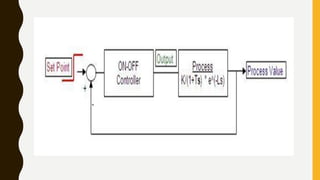
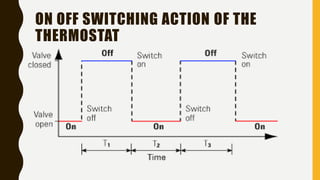
The output causes change in process variable.
Hence due to effect of output, the process variable again starts
changing but in reverse direction.
When it crosses the preset level, the output valve of the system is
again fully open to give 100% output.
This cycle of closing and opening of output valve continues till the
said on-off control system is in operation.
WATER TANK USING TEMPERATURE
CONTROL
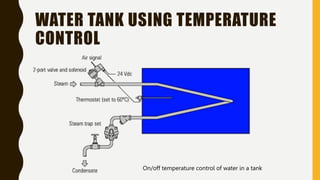
On/off temperature control of water in a tank
WATER TANK USING TEMPERATURE
CONTROL
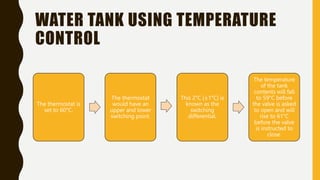
The thermostat is
set to 60°C.
The thermostat
would have an
upper and lower
switching point.
This 2°C (±1°C) is
known as the
switching
differential.
The temperature
of the tank
contents will fall
to 59°C before
the valve is asked
to open and will
rise to 61°C
before the valve
is instructed to
close.
ON OFF SWITCHING ACTION OF THE
THERMOSTAT
ON OFF SWITCHING ACTION OF THE
THERMOSTAT
ON OFF SWITCHING ACTION OF THE
THERMOSTAT
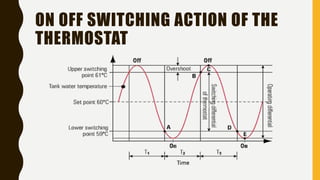
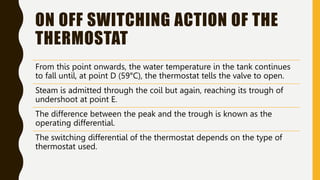
From this point onwards, the water temperature in the tank continues
to fall until, at point D (59°C), the thermostat tells the valve to open.
Steam is admitted through the coil but again, reaching its trough of
undershoot at point E.
The difference between the peak and the trough is known as the
operating differential.
The switching differential of the thermostat depends on the type of
thermostat used.
ON OFF CONTROLLER
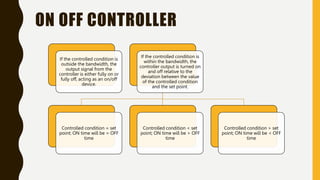
If the controlled condition is
outside the bandwidth, the
output signal from the
controller is either fully on or
fully off, acting as an on/off
device.
If the controlled condition is
within the bandwidth, the
controller output is turned on
and off relative to the
deviation between the value
of the controlled condition
and the set point.
Controlled condition = set
point; ON time will be = OFF
time
Controlled condition < set
point; ON time will be > OFF
time
Controlled condition > set
point; ON time will be < OFF
time
FAN CONTROLLING SCHEME OF
TRANSFORMER COOLING SYSTEM.
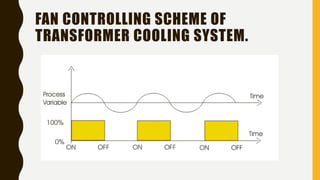
When transformer runs with such a load, the temperature of the electrical power
transformer rises beyond the preset value .
As the cooling fans run, the forced air decreases the temperature of the
transformer.
When the temperature (process variable) comes down below a preset value, the
control switch of fans trip and fans stop supplying forced air to the transformer.
Again when during rising, the temperature crosses the preset value, the fans
again start rotating to cool down the transformer.
FAN CONTROLLING SCHEME OF
TRANSFORMER COOLING SYSTEM.
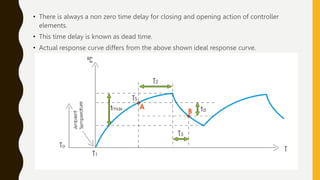
• There is always a non zero time delay for closing and opening action of controller
elements.
• This time delay is known as dead time.
• Actual response curve differs from the above shown ideal response curve.
ADVANTAGES & DISADVANTAGES
Advantages
• It is simple and very low cost.
• This is why it is frequently found on domestic type
applications such as central heating boilers and heater fans.
Disadvantage
• The operating differential might fall outside the control
tolerance required by the process.
FEED-FORWARD
CONTROL SYSTEM
N A M E : A N G E L E N A R A N I F R A N C I S
I D : 1 0 0 0 0 3 2
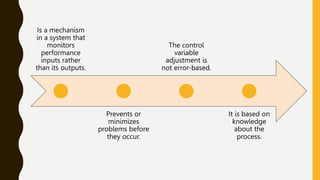
Is a mechanism
in a system that
monitors
performance
inputs rather
than its outputs.
Prevents or
minimizes
problems before
they occur.
The control
variable
adjustment is
not error-based.
It is based on
knowledge
about the
process.
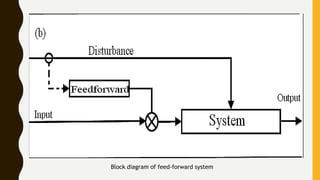
Block diagram of feed-forward system
ADVANTAGES
Takes corrective
action before the
process is upset.
Does not affect
system stability.
Theoretically
capable of
“perfect control”.
DISADVANTAGES
Requires more
knowledge of
the process to
be controlled.
Disturbance
must be
measured.
APPLICATIONS
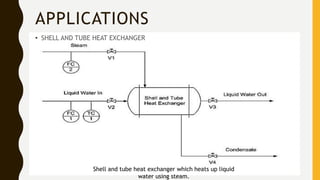
• SHELL AND TUBE HEAT EXCHANGER
Shell and tube heat exchanger which heats up liquid
water using steam.
APPLICATIONS
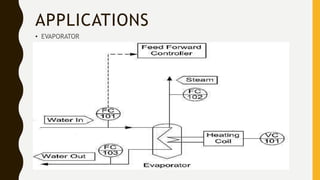
• EVAPORATOR
FEEDBACK CONTROL
SYSTEM
N A M E : A N G E L E N A R A N I F R A N C I S
I D : 1 0 0 0 0 3 2
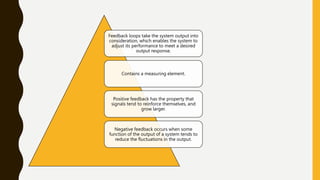
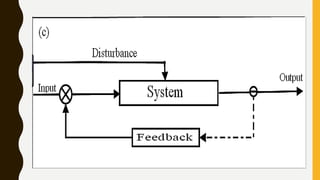
Feedback loops take the system output into
consideration, which enables the system to
adjust its performance to meet a desired
output response.
Contains a measuring element.
Positive feedback has the property that
signals tend to reinforce themselves, and
grow larger.
Negative feedback occurs when some
function of the output of a system tends to
reduce the fluctuations in the output.
ADVANTAGES
Corrective
action occurs
regardless of
the source
and type of
disturbances.
Requires little
knowledge
about the
process (A
process
model is not
necessary).
DISADVANTAGES
Takes no
corrective
action until a
deviation in
the controlled
variable
occurs.
Incapable of
correcting a
deviation from
set point at
the time of its
detection.
For frequent
and severe
disturbances,
process may
not settle out.
Theoretically
not capable of
achieving
“perfect
control.”
APPLICATIONS
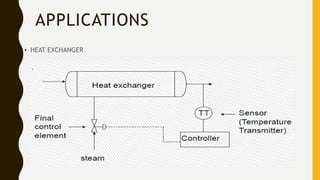
• HEAT EXCHANGER
APPLICATIONS
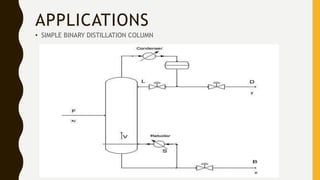
• SIMPLE BINARY DISTILLATION COLUMN
APPLICATIONS
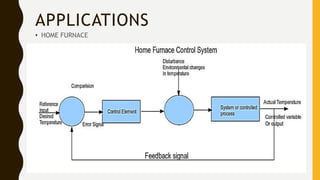
• HOME FURNACE
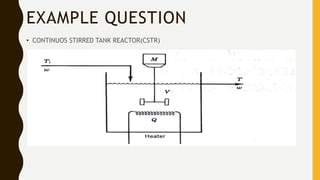
EXAMPLE QUESTION
• CONTINUOS STIRRED TANK REACTOR(CSTR)
RATIO CONTROL
N A M E : M U H A M M A D Y U N U S
I D :
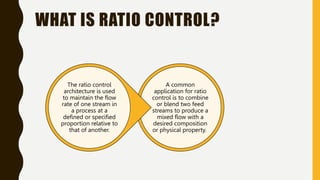
WHAT IS RATIO CONTROL?
A common
application for ratio
control is to combine
or blend two feed
streams to produce a
mixed flow with a
desired composition
or physical property.
The ratio control
architecture is used
to maintain the flow
rate of one stream in
a process at a
defined or specified
proportion relative to
that of another.
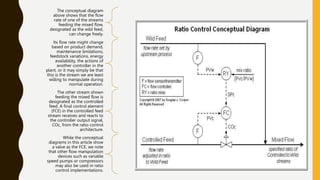
The conceptual diagram
above shows that the flow
rate of one of the streams
feeding the mixed flow,
designated as the wild feed,
can change freely.
Its flow rate might change
based on product demand,
maintenance limitations,
feedstock variations, energy
availability, the actions of
another controller in the
plant, or it may simply be that
this is the stream we are least
willing to manipulate during
normal operation.
The other stream shown
feeding the mixed flow is
designated as the controlled
feed. A final control element
(FCE) in the controlled feed
stream receives and reacts to
the controller output signal,
COc, from the ratio control
architecture.
While the conceptual
diagrams in this article show
a valve as the FCE, we note
that other flow manipulation
devices such as variable
speed pumps or compressors
may also be used in ratio
control implementations.
RELAYS IN THE RATIO ARCHITECTURE
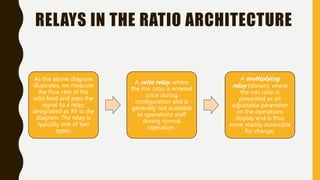
As the above diagram
illustrates, we measure
the flow rate of the
wild feed and pass the
signal to a relay,
designated as RY in the
diagram. The relay is
typically one of two
types:
A ratio relay, where
the mix ratio is entered
once during
configuration and is
generally not available
to operations staff
during normal
operation.
A multiplying
relay (shown), where
the mix ratio is
presented as an
adjustable parameter
on the operations
display and is thus
more readily accessible
for change.
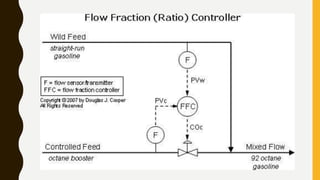
FLOW FRACTION (RATIO) CONTROLLER
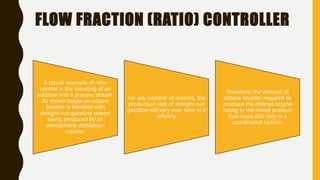
A classic example of ratio
control is the blending of an
additive into a process stream.
As shown below an octane
booster is blended with
straight-run gasoline stream
being produced by an
atmospheric distillation
column.
For any number of reasons, the
production rate of straight-run
gasoline will vary over time in a
refinery.
Therefore, the amount of
octane booster required to
produce the desired octane
rating in the mixed product
flow must also vary in a
coordinated fashion.
Rather than using a relay, we present an
alternative ratio control architecture based on a
flow fraction controller (FFC).
The FFC is essentially a “pure” ratio controller in
that it receives the wild feed and controlled
feed signals directly as inputs.
A ratio set point value is entered into the FCC,
along with tuning parameters and other values
required for any controller implementation.
RATIO RELAY OR FLOW FRACTION
CONTROLLER
The flow fraction (ratio) controller is a preconfigured option in many modern computer based DCS or
advanced PLCcontrol systems.
It provides exactly the same functionality as the ratio relay combined with a single-input single-output controller
as discussed above.
The choice of using a relay or an FFC is a practical matter.
The entered ratio multiplier value in a relay is not a readily accessible parameter. It therefore requires a greater
level of permission and access to adjust.
Consequently, the use of the ratio relay has the advantage (or disadvantage depending on the application) of
requiring a higher level of authorization before a change can be made to the ratio multiplier.
ADAPTIVE
CONTROLLER
N A M E : M A R I A L O R E T T A L A W R E N C E
I D : 1 0 0 0 3 3 9
WHAT IS AN ADAPTIVE CONTROLLER?
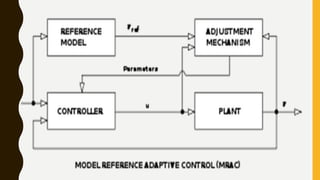
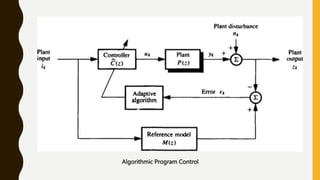
Adaptive control is the
control method utilized by a
controller which must adjust
to a controlled system with
parameters which change,
or are at first uncertain.
For instance, as an airplane
flies, its mass will gradually
diminish as a consequence
of fuel utilization; a control
law is required that adjusts
to such evolving conditions.
Algorithmic Program Control
ADAPTIVE CONTROL IN PHOSPHATE
INDUSTRY
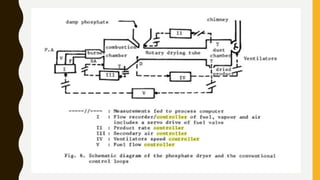
Main Control
Objective:
To keep the moisture content of
the dried phosphate close to a
constant desired value, and at
the same time to minimize the
energy consumption, despite
feed flow rate variations and
variable moisture content of the
damp phosphate.
The drying
process is non-
linear in nature.
TYPES OF CONTROLLERS
PID with
Gain
Scheduling:
Gain scheduling is a PID
enhancement that facilitates
the control of a process with
gains and time constants that
vary according to the current
value of the process variable.
TYPES OF CONTROLLERS
Autotuner:
• An autotuner is often a PID controller where the control
parameters are automatically tuned only at commissioning. I.e. a
sequence of step responses or a relay type of control in order to
find an appropriate parameter setting.
TYPES OF CONTROLLERS
Adaptive
PID:
A controller which adjusts the
PID parameters continuously
and automatically while the
process is running. The
tuning is done systematically
as when needed.
TYPES OF CONTROLLERS
General
Adaptive
Regulators:
The can operate with as many as
20 regulator parameters. The large
number of regulator parameters
means that, in addition to the PID
functions, it automatically
performs compensation for time
delays, complex dynamics, process
disturbances and feed-forward
control.
APPLICATIONS
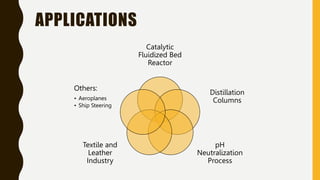
Catalytic
Fluidized Bed
Reactor
Distillation
Columns
pH
Neutralization
Process
Textile and
Leather
Industry
Others:
• Aeroplanes
• Ship Steering
ADVANTAGES & DISADVANTAGES
Advantages:
• Parameters can be
changed quickly in
response to changes in
plant dynamics
• Very easy to apply
Disadvantages:
• The design required for
its implementation is
enormous.
CASCADE
CONTROL
NAME : VIMALAN RAVICHANDRAN
ID : 1000335
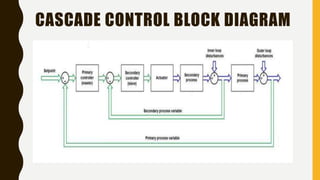
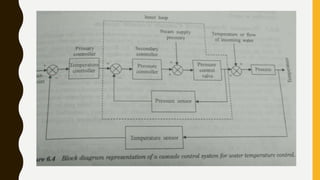
CASCADE CONTROL BLOCK DIAGRAM
INTRODUCTION
The simplest cascade control scheme involves two control loops that use two
measurement signals to control one primary variable.
In such a control system, the output of the primary controller determines the set point
for the secondary controller.
The output of the secondary controller is used to adjust the control variable.
Generally, the secondary controller changes quickly while the primary controller
changes slowly.
Once cascade control is implemented, disturbances from rapid changes of the
secondary controller will not affect the primary controller. [ Extracted from : Wikipedia ]
In a double loop cascade system, the action of the secondary loop
on the process should be faster than that of the primary loop.
This ensures that the changes made by the primary output will be
reflected quickly in the process and observed when the primary
control variable is next measured.
There must
be a clear
relationship
between the
measured
variables of
the primary
and
secondary
loops.
The
secondary
loop must
have
influence
over the
primary loop.
Response
period of the
primary loop
has to be at
least 4 times
larger than
the response
period of the
secondary
loop.
The major
disturbance
to the system
should act in
the primary
loop.
The primary
loop should
be able to
have a large
gain, Kc.
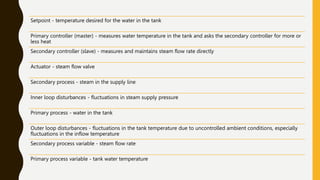
Setpoint - temperature desired for the water in the tank
Primary controller (master) - measures water temperature in the tank and asks the secondary controller for more or
less heat
Secondary controller (slave) - measures and maintains steam flow rate directly
Actuator - steam flow valve
Secondary process - steam in the supply line
Inner loop disturbances - fluctuations in steam supply pressure
Primary process - water in the tank
Outer loop disturbances - fluctuations in the tank temperature due to uncontrolled ambient conditions, especially
fluctuations in the inflow temperature
Secondary process variable - steam flow rate
Primary process variable - tank water temperature
In the water heater example, the tank temperature controller would be primary since it defines
the setpoint that the steam flow controller is required to achieve. The water in the tank, the
tank temperature, the steam, and the steam flow rate would be the primary process, the
primary process variable, the secondary process, and the secondary process variable,
respectively (refer to the Cascade Control Block Diagram). The valve that the steam flow
controller uses to maintain the steam flow rate serves as the actuator which acts directly on
the secondary process and indirectly on the primary process.[ Extracted from : controleng.com
]
ADVANTAGES
The secondary
controller can
correct the
disturbance
affecting the
secondary variable ,
before a
pronounced
influence is felt by
the secondary
variable.
Closing the control
loop around the
secondary part of
the process reduces
the phase lag seen
by the primary
controller, resulting
in increased speed
of response
DISADVANTAGES
The extra sensor
and controller
tend to increase
the overall
equipment costs.
Cascade control
systems are also
more complex
than single-
measurement
controllers,
requiring twice
as much tuning.
REFERENCES
• K. S. Narendra and A. M. Annaswamy, Stable Adaptive Systems. Englewood Cliffs, NJ:
Prentice Hall, 1989; Dover Publications, 2004.
• S. Sastry and M. Bodson, Adaptive Control: Stability, Convergence and Robustness. Prentice
Hall, 1989.
• http://www.hindawi.com/journals/jcse/2012/827353/
• http://www.pages.drexel.edu/~kws23/tutorials/MRAC/MRAC.html
• https://www.linkedin.com/pulse/fundamentals-cascade-control-hamzeh-ahmadi
• https://controls.engin.umich.edu/wiki/index.php/CascadeControl
• http://www.controleng.com/single-article/fundamentals-of-cascade-
control/bcedad6518aec409f583ba6bc9b72854.html
• http://newton.ex.ac.uk/teaching/CDHW/Feedback/ControlTypes.html#OnOffCtl
• https://www.quora.com/What-is-a-bang-bang-controller
• http://newton.ex.ac.uk/teaching/CDHW/Feedback/Technical-Info.html
THANK YOU

introduction to advanced control systems

  • 1.
    ADVANCED CONTROL SYSTEM P RO C E S S C O N T R O L A N D I N S T R U M E N TAT I O N B Y A N G E L Y N N A N G E L E N A Y U N U S L O R E T TA V I M A L A N
  • 2.
    INTRODUCTION Advanced control comesinto play from the level of basic control through that of process optimization. Advanced systems provide generalized models that automate regulatory and constraint control as well as process optimization.
  • 3.
    ON-OFF CONTROLLER N A ME : A N G E L Y N N G R A C E J O S E P H I D : 1 1 0 3 1 4 2 0 1 9
  • 4.
    ON OFF CONTROLLERS Alsoknown as bang-bang controllers and uses hysteresis. Simple type of feedback controllers. Used to control temperature. A thermostat controlling a heater is a common example.
  • 5.
    ON OFF CONTROLLERS Theoutput causes change in process variable. Hence due to effect of output, the process variable again starts changing but in reverse direction. When it crosses the preset level, the output valve of the system is again fully open to give 100% output. This cycle of closing and opening of output valve continues till the said on-off control system is in operation.
  • 7.
    WATER TANK USINGTEMPERATURE CONTROL On/off temperature control of water in a tank
  • 8.
    WATER TANK USINGTEMPERATURE CONTROL The thermostat is set to 60°C. The thermostat would have an upper and lower switching point. This 2°C (±1°C) is known as the switching differential. The temperature of the tank contents will fall to 59°C before the valve is asked to open and will rise to 61°C before the valve is instructed to close.
  • 9.
    ON OFF SWITCHINGACTION OF THE THERMOSTAT
  • 10.
    ON OFF SWITCHINGACTION OF THE THERMOSTAT
  • 11.
    ON OFF SWITCHINGACTION OF THE THERMOSTAT From this point onwards, the water temperature in the tank continues to fall until, at point D (59°C), the thermostat tells the valve to open. Steam is admitted through the coil but again, reaching its trough of undershoot at point E. The difference between the peak and the trough is known as the operating differential. The switching differential of the thermostat depends on the type of thermostat used.
  • 12.
    ON OFF CONTROLLER Ifthe controlled condition is outside the bandwidth, the output signal from the controller is either fully on or fully off, acting as an on/off device. If the controlled condition is within the bandwidth, the controller output is turned on and off relative to the deviation between the value of the controlled condition and the set point. Controlled condition = set point; ON time will be = OFF time Controlled condition < set point; ON time will be > OFF time Controlled condition > set point; ON time will be < OFF time
  • 13.
    FAN CONTROLLING SCHEMEOF TRANSFORMER COOLING SYSTEM. When transformer runs with such a load, the temperature of the electrical power transformer rises beyond the preset value . As the cooling fans run, the forced air decreases the temperature of the transformer. When the temperature (process variable) comes down below a preset value, the control switch of fans trip and fans stop supplying forced air to the transformer. Again when during rising, the temperature crosses the preset value, the fans again start rotating to cool down the transformer.
  • 14.
    FAN CONTROLLING SCHEMEOF TRANSFORMER COOLING SYSTEM.
  • 15.
    • There isalways a non zero time delay for closing and opening action of controller elements. • This time delay is known as dead time. • Actual response curve differs from the above shown ideal response curve.
  • 16.
    ADVANTAGES & DISADVANTAGES Advantages •It is simple and very low cost. • This is why it is frequently found on domestic type applications such as central heating boilers and heater fans. Disadvantage • The operating differential might fall outside the control tolerance required by the process.
  • 17.
    FEED-FORWARD CONTROL SYSTEM N AM E : A N G E L E N A R A N I F R A N C I S I D : 1 0 0 0 0 3 2
  • 18.
    Is a mechanism ina system that monitors performance inputs rather than its outputs. Prevents or minimizes problems before they occur. The control variable adjustment is not error-based. It is based on knowledge about the process.
  • 19.
    Block diagram offeed-forward system
  • 20.
    ADVANTAGES Takes corrective action beforethe process is upset. Does not affect system stability. Theoretically capable of “perfect control”.
  • 21.
    DISADVANTAGES Requires more knowledge of theprocess to be controlled. Disturbance must be measured.
  • 22.
    APPLICATIONS • SHELL ANDTUBE HEAT EXCHANGER Shell and tube heat exchanger which heats up liquid water using steam.
  • 23.
  • 24.
    FEEDBACK CONTROL SYSTEM N AM E : A N G E L E N A R A N I F R A N C I S I D : 1 0 0 0 0 3 2
  • 25.
    Feedback loops takethe system output into consideration, which enables the system to adjust its performance to meet a desired output response. Contains a measuring element. Positive feedback has the property that signals tend to reinforce themselves, and grow larger. Negative feedback occurs when some function of the output of a system tends to reduce the fluctuations in the output.
  • 27.
    ADVANTAGES Corrective action occurs regardless of thesource and type of disturbances. Requires little knowledge about the process (A process model is not necessary).
  • 28.
    DISADVANTAGES Takes no corrective action untila deviation in the controlled variable occurs. Incapable of correcting a deviation from set point at the time of its detection. For frequent and severe disturbances, process may not settle out. Theoretically not capable of achieving “perfect control.”
  • 29.
  • 30.
    APPLICATIONS • SIMPLE BINARYDISTILLATION COLUMN
  • 31.
  • 32.
    EXAMPLE QUESTION • CONTINUOSSTIRRED TANK REACTOR(CSTR)
  • 33.
    RATIO CONTROL N AM E : M U H A M M A D Y U N U S I D :
  • 34.
    WHAT IS RATIOCONTROL? A common application for ratio control is to combine or blend two feed streams to produce a mixed flow with a desired composition or physical property. The ratio control architecture is used to maintain the flow rate of one stream in a process at a defined or specified proportion relative to that of another.
  • 35.
    The conceptual diagram aboveshows that the flow rate of one of the streams feeding the mixed flow, designated as the wild feed, can change freely. Its flow rate might change based on product demand, maintenance limitations, feedstock variations, energy availability, the actions of another controller in the plant, or it may simply be that this is the stream we are least willing to manipulate during normal operation. The other stream shown feeding the mixed flow is designated as the controlled feed. A final control element (FCE) in the controlled feed stream receives and reacts to the controller output signal, COc, from the ratio control architecture. While the conceptual diagrams in this article show a valve as the FCE, we note that other flow manipulation devices such as variable speed pumps or compressors may also be used in ratio control implementations.
  • 36.
    RELAYS IN THERATIO ARCHITECTURE As the above diagram illustrates, we measure the flow rate of the wild feed and pass the signal to a relay, designated as RY in the diagram. The relay is typically one of two types: A ratio relay, where the mix ratio is entered once during configuration and is generally not available to operations staff during normal operation. A multiplying relay (shown), where the mix ratio is presented as an adjustable parameter on the operations display and is thus more readily accessible for change.
  • 37.
    FLOW FRACTION (RATIO)CONTROLLER A classic example of ratio control is the blending of an additive into a process stream. As shown below an octane booster is blended with straight-run gasoline stream being produced by an atmospheric distillation column. For any number of reasons, the production rate of straight-run gasoline will vary over time in a refinery. Therefore, the amount of octane booster required to produce the desired octane rating in the mixed product flow must also vary in a coordinated fashion.
  • 39.
    Rather than usinga relay, we present an alternative ratio control architecture based on a flow fraction controller (FFC). The FFC is essentially a “pure” ratio controller in that it receives the wild feed and controlled feed signals directly as inputs. A ratio set point value is entered into the FCC, along with tuning parameters and other values required for any controller implementation.
  • 40.
    RATIO RELAY ORFLOW FRACTION CONTROLLER The flow fraction (ratio) controller is a preconfigured option in many modern computer based DCS or advanced PLCcontrol systems. It provides exactly the same functionality as the ratio relay combined with a single-input single-output controller as discussed above. The choice of using a relay or an FFC is a practical matter. The entered ratio multiplier value in a relay is not a readily accessible parameter. It therefore requires a greater level of permission and access to adjust. Consequently, the use of the ratio relay has the advantage (or disadvantage depending on the application) of requiring a higher level of authorization before a change can be made to the ratio multiplier.
  • 41.
    ADAPTIVE CONTROLLER N A ME : M A R I A L O R E T T A L A W R E N C E I D : 1 0 0 0 3 3 9
  • 42.
    WHAT IS ANADAPTIVE CONTROLLER? Adaptive control is the control method utilized by a controller which must adjust to a controlled system with parameters which change, or are at first uncertain. For instance, as an airplane flies, its mass will gradually diminish as a consequence of fuel utilization; a control law is required that adjusts to such evolving conditions.
  • 44.
  • 45.
    ADAPTIVE CONTROL INPHOSPHATE INDUSTRY Main Control Objective: To keep the moisture content of the dried phosphate close to a constant desired value, and at the same time to minimize the energy consumption, despite feed flow rate variations and variable moisture content of the damp phosphate. The drying process is non- linear in nature.
  • 47.
    TYPES OF CONTROLLERS PIDwith Gain Scheduling: Gain scheduling is a PID enhancement that facilitates the control of a process with gains and time constants that vary according to the current value of the process variable.
  • 48.
    TYPES OF CONTROLLERS Autotuner: •An autotuner is often a PID controller where the control parameters are automatically tuned only at commissioning. I.e. a sequence of step responses or a relay type of control in order to find an appropriate parameter setting.
  • 49.
    TYPES OF CONTROLLERS Adaptive PID: Acontroller which adjusts the PID parameters continuously and automatically while the process is running. The tuning is done systematically as when needed.
  • 50.
    TYPES OF CONTROLLERS General Adaptive Regulators: Thecan operate with as many as 20 regulator parameters. The large number of regulator parameters means that, in addition to the PID functions, it automatically performs compensation for time delays, complex dynamics, process disturbances and feed-forward control.
  • 51.
  • 52.
    ADVANTAGES & DISADVANTAGES Advantages: •Parameters can be changed quickly in response to changes in plant dynamics • Very easy to apply Disadvantages: • The design required for its implementation is enormous.
  • 53.
    CASCADE CONTROL NAME : VIMALANRAVICHANDRAN ID : 1000335
  • 54.
  • 55.
    INTRODUCTION The simplest cascadecontrol scheme involves two control loops that use two measurement signals to control one primary variable. In such a control system, the output of the primary controller determines the set point for the secondary controller. The output of the secondary controller is used to adjust the control variable. Generally, the secondary controller changes quickly while the primary controller changes slowly. Once cascade control is implemented, disturbances from rapid changes of the secondary controller will not affect the primary controller. [ Extracted from : Wikipedia ]
  • 56.
    In a doubleloop cascade system, the action of the secondary loop on the process should be faster than that of the primary loop. This ensures that the changes made by the primary output will be reflected quickly in the process and observed when the primary control variable is next measured.
  • 57.
    There must be aclear relationship between the measured variables of the primary and secondary loops. The secondary loop must have influence over the primary loop. Response period of the primary loop has to be at least 4 times larger than the response period of the secondary loop. The major disturbance to the system should act in the primary loop. The primary loop should be able to have a large gain, Kc.
  • 59.
    Setpoint - temperaturedesired for the water in the tank Primary controller (master) - measures water temperature in the tank and asks the secondary controller for more or less heat Secondary controller (slave) - measures and maintains steam flow rate directly Actuator - steam flow valve Secondary process - steam in the supply line Inner loop disturbances - fluctuations in steam supply pressure Primary process - water in the tank Outer loop disturbances - fluctuations in the tank temperature due to uncontrolled ambient conditions, especially fluctuations in the inflow temperature Secondary process variable - steam flow rate Primary process variable - tank water temperature
  • 60.
    In the waterheater example, the tank temperature controller would be primary since it defines the setpoint that the steam flow controller is required to achieve. The water in the tank, the tank temperature, the steam, and the steam flow rate would be the primary process, the primary process variable, the secondary process, and the secondary process variable, respectively (refer to the Cascade Control Block Diagram). The valve that the steam flow controller uses to maintain the steam flow rate serves as the actuator which acts directly on the secondary process and indirectly on the primary process.[ Extracted from : controleng.com ]
  • 61.
    ADVANTAGES The secondary controller can correctthe disturbance affecting the secondary variable , before a pronounced influence is felt by the secondary variable. Closing the control loop around the secondary part of the process reduces the phase lag seen by the primary controller, resulting in increased speed of response
  • 62.
    DISADVANTAGES The extra sensor andcontroller tend to increase the overall equipment costs. Cascade control systems are also more complex than single- measurement controllers, requiring twice as much tuning.
  • 63.
    REFERENCES • K. S.Narendra and A. M. Annaswamy, Stable Adaptive Systems. Englewood Cliffs, NJ: Prentice Hall, 1989; Dover Publications, 2004. • S. Sastry and M. Bodson, Adaptive Control: Stability, Convergence and Robustness. Prentice Hall, 1989. • http://www.hindawi.com/journals/jcse/2012/827353/ • http://www.pages.drexel.edu/~kws23/tutorials/MRAC/MRAC.html • https://www.linkedin.com/pulse/fundamentals-cascade-control-hamzeh-ahmadi • https://controls.engin.umich.edu/wiki/index.php/CascadeControl • http://www.controleng.com/single-article/fundamentals-of-cascade- control/bcedad6518aec409f583ba6bc9b72854.html • http://newton.ex.ac.uk/teaching/CDHW/Feedback/ControlTypes.html#OnOffCtl • https://www.quora.com/What-is-a-bang-bang-controller • http://newton.ex.ac.uk/teaching/CDHW/Feedback/Technical-Info.html
  • 64.

Editor's Notes

  • #3 In regulatory control single loop feedback improvements such as feedforward, cascade control can be used to supplement PID algorithms. Time delay compensation techniques can also be applied to compensate for long delays permitting tighter control. At the level of constraint control, multivariable techniques can be used. Instead of having the operators manually adjust control units for specific variables,
  • #5 3- Commonly encountered in thermostats… in many electrical devices Hysteresis- In control systems, hysteresis can be used to filter signals so that the output reacts less rapidly than it otherwise would, by taking recent history into account. For example, athermostat controlling a heater may switch the heater on when the temperature drops below A, but not turn it off until the temperature rises above B. (For instance, if one wishes to maintain a temperature of 20 °C then one might set the thermostat to turn the heater on when the temperature drops to below 18 °C and off when the temperature exceeds 22 °C.) The thermostat is a system. Its input is the temperature and its output is the heater state. The heater is either off or on, with no in-between state. The output of the thermostat to the heater depends on whether the temperature is falling or rising. The thermostat has hysteresis. It prevents frequent switching on and off of the heater. Similarly, a pressure switch can be designed to exhibit hysteresis, with pressure set-points substituted for temperature thresholds.
  • #6 1. …. Generally in on off control system, 2…… During this change, when process variable crosses certain predetermined level, the output valve of the system is immediately closed and output is suddenly reduced to 0%. 3. As there is no output, the process variable again starts changing in its normal direction. ….
  • #7 Sometimes, the control element has only two position either it is fully closed or fully open. This control element does not operate at any intermediate position, i.e. partly open or partly closed position. The control system made for controlling such elements, is known as on off control theory. In this control system, when process variable changes and crosses certain preset level, the output valve of the system is suddenly fully opened and gives 100% output.
  • #9 1- …, which is the required temperature of the water in the tank. Logic dictates that if the switching point were actually at 60°C the system would never operate properly, because the valve would not know whether to be open or closed at 60°C. From then on it could open and shut rapidly, causing wear. 2- …This is essential to prevent over-rapid cycling. In this case the upper switching point might be 61°C (the point at which the thermostat tells the valve to shut) and the lower switching point might be 59°C (the point when the valve is told to open). Thus there is an in-built switching difference in the thermostat of ±1°C about the 60°C set point. 3- … (This will vary between thermostats. A diagram of the switching action of the thermostat would look like the graph shown in Figure 5.2.2.
  • #11 Tank temperature versus time
  • #12 2. …. it takes time to have an effect and the water temperature continues to fall for a while…… However, controllers are available that provide a proportioning time control, in which it is possible to alter the ratio of the 'on' time to the 'off' time to control the controlled condition. This proportioning action occurs within a selected bandwidth around the set point; the set point being the bandwidth mid point. 5. …such as the tank, its contents, the heat transfer characteristics of the coil, the rate at which heat is transferred to the thermostat, and so on.
  • #13 Essentially, with on/off control, there are upper and lower switching limits, and the valve is either fully open or fully closed - there is no intermediate state. The ratio of on of time is 'on' time to 'off' time is 1:1. … 1. 2. … that is, the 'on' time equals the 'off' time.. If the controlled condition is below the set point, the 'on' time will be longer than the 'off' time, whilst if above the set point, the 'off' time will be longer, relative to the deviation within the bandwidth. whilst if above the set point, the 'off' time will be longer, relative to the deviation within the bandwidth. By contrast, in the case of space heating there are often large storage capacities (a large area to heat or cool that will respond to temperature change slowly) and slight variation in the desired value is acceptable. In many cases on/off control is quite appropriate for this type of application
  • #14 A very common example of on-off control theory is … 1. …at which the cooling fans start rotating with their full capacity. 2. …The forced air ((output of the cooling system) 3. . After that, as there is no cooling effect of fans, the temperature of the transformer again starts rising due to load.
  • #15 Theoretically, we assume that there is no lag in the control equipment. That means, there is no time delay for on and off operation of control equipment. With this assumption if we draw series of operations of an ideal on off control system, we will get the graph given below.
  • #16 1 But in practical on off cOntrol, ./.. 3. Because of this time delay the ,… Let us try to draw actual response curve of an on off control system.
  • #17 Disadvantages 1. … For example, on a food production line, where the taste and repeatability of taste is determined by precise temperature control, on/off control could well be unsuitable.
  • #48 A PID controller continuously calculates an error value as the difference between a measured process variable and a desired set point. The controller attempts to minimize the error over time by adjustment of a control variable, such as the position of a control valve, a damper, or the power supplied to a heating element, to a new value determined by a weighted sum: denote the coefficients for the proportional, integral, and derivative terms, respectively (sometimes denoted P, I, and D). In this model P accounts for present values of the error (e.g. if the error is large and positive, the control variable will be large and negative), I accounts for past values of the error (e.g. if the output is not sufficient to reduce the size of the error, the control variable will accumulate over time, causing the controller to apply a stronger action), and D accounts for possible future values of the error, based on its current rate of change.