Coordinating
Climate-Resilient
Development
Climate Change
Adaptation and the
NAP Process
Climate
Change
Adaptation:
A global
view
• Paris Agreement (2015)
established a global goal for
adaptation
• Many countries have included
adaptation information in their
Nationally Determined
Contributions (NDCs)
• Countries will now need to submit
adaptation communications
• UNFCCC process has established
that developed countries will
support developing countries in
their adaptation efforts
Why is
adaptation
a priority?
• Climate change is a threat to
sustainable development
• It affects the lives, livelihoods and
potential of individual women and
men, particularly the most
vulnerable
• It has implications for important
economic sectors
• It has negative effects on
ecosystems
• Even with ambitious action on
mitigation, some adaptation will be
required
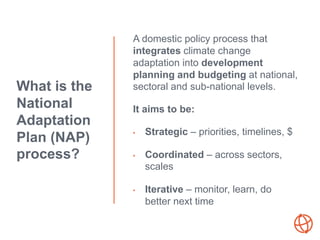
What is the
National
Adaptation
Plan (NAP)
process?
A domestic policy process that
integrates climate change
adaptation into development
planning and budgeting at national,
sectoral and sub-national levels.
It aims to be:
• Strategic – priorities, timelines, $
• Coordinated – across sectors,
scales
• Iterative – monitor, learn, do
better next time
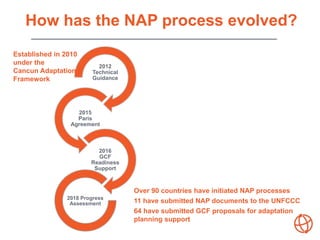
How has the NAP process evolved?
2012
Technical
Guidance
2015
Paris
Agreement
2016
GCF
Readiness
Support
2018 Progress
Assessment
Established in 2010
under the
Cancun Adaptation
Framework
Over 90 countries have initiated NAP processes
11 have submitted NAP documents to the UNFCCC
64 have submitted GCF proposals for adaptation
planning support
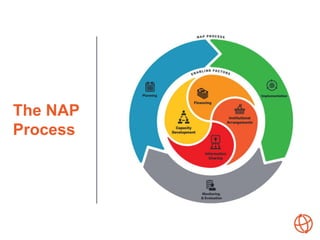
The NAP
Process
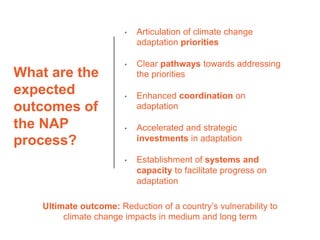
What are the
expected
outcomes of
the NAP
process?
• Articulation of climate change
adaptation priorities
• Clear pathways towards addressing
the priorities
• Enhanced coordination on
adaptation
• Accelerated and strategic
investments in adaptation
• Establishment of systems and
capacity to facilitate progress on
adaptation
Ultimate outcome: Reduction of a country’s vulnerability to
climate change impacts in medium and long term
What’s new
about the
NAP
process?
• Shifting away from short-term,
project-based approach towards a
strategic planning process
• Recognition that adaptation is a
continuous, iterative process
• Links adaptation planning to
sustainable development
planning
• Emphasis on integration of
climate change across sectors and
levels
What makes
a NAP
process
effective?
• Country driven
• Participatory and transparent
• Gender-responsive
• Takes into consideration vulnerable
groups, communities and
ecosystems
• Based on best available science
and, as appropriate, traditional and
indigenous knowledge
• Oriented towards
institutionalization and
implementation of adaptation
What are the
benefits of
the NAP
process?
• Process: allows for learning and
increased ambition over time
• Opportunity to operationalize other
commitments (NDCs, SDGs)
• Platform and framework for engaging
adaptation stakeholders
• Government, research, civil society,
private sector
• Recognizes cross-sectoral and multi-
level nature of adaptation
• Facilitates access to adaptation
finance
www.napglobalnetwork.org
Twitter: @NAP_Network

Climate Change Adaptation and the NAP Process

  • 1.
  • 2.
    Climate Change Adaptation: A global view • ParisAgreement (2015) established a global goal for adaptation • Many countries have included adaptation information in their Nationally Determined Contributions (NDCs) • Countries will now need to submit adaptation communications • UNFCCC process has established that developed countries will support developing countries in their adaptation efforts
  • 3.
    Why is adaptation a priority? •Climate change is a threat to sustainable development • It affects the lives, livelihoods and potential of individual women and men, particularly the most vulnerable • It has implications for important economic sectors • It has negative effects on ecosystems • Even with ambitious action on mitigation, some adaptation will be required
  • 4.
    What is the National Adaptation Plan(NAP) process? A domestic policy process that integrates climate change adaptation into development planning and budgeting at national, sectoral and sub-national levels. It aims to be: • Strategic – priorities, timelines, $ • Coordinated – across sectors, scales • Iterative – monitor, learn, do better next time
  • 5.
    How has theNAP process evolved? 2012 Technical Guidance 2015 Paris Agreement 2016 GCF Readiness Support 2018 Progress Assessment Established in 2010 under the Cancun Adaptation Framework Over 90 countries have initiated NAP processes 11 have submitted NAP documents to the UNFCCC 64 have submitted GCF proposals for adaptation planning support
  • 6.
  • 7.
    What are the expected outcomesof the NAP process? • Articulation of climate change adaptation priorities • Clear pathways towards addressing the priorities • Enhanced coordination on adaptation • Accelerated and strategic investments in adaptation • Establishment of systems and capacity to facilitate progress on adaptation Ultimate outcome: Reduction of a country’s vulnerability to climate change impacts in medium and long term
  • 8.
    What’s new about the NAP process? •Shifting away from short-term, project-based approach towards a strategic planning process • Recognition that adaptation is a continuous, iterative process • Links adaptation planning to sustainable development planning • Emphasis on integration of climate change across sectors and levels
  • 9.
    What makes a NAP process effective? •Country driven • Participatory and transparent • Gender-responsive • Takes into consideration vulnerable groups, communities and ecosystems • Based on best available science and, as appropriate, traditional and indigenous knowledge • Oriented towards institutionalization and implementation of adaptation
  • 10.
    What are the benefitsof the NAP process? • Process: allows for learning and increased ambition over time • Opportunity to operationalize other commitments (NDCs, SDGs) • Platform and framework for engaging adaptation stakeholders • Government, research, civil society, private sector • Recognizes cross-sectoral and multi- level nature of adaptation • Facilitates access to adaptation finance
  • 11.