Nature is foundational:To our health and
well-being, our economies, our livelihoods,
and our cultures.
NbS and EbA offer an opportunity to
link adaptation, mitigation, and
biodiversity and ecosystem protection at
the local and national levels.
Ecosystems play a crucial role in both
adaptation to climate change and building
resilience by supporting livelihoods and
providing vital ecosystem services, including
flood protection and climate regulation.
All NAP documents include one or more
actions related to protecting, conserving,
restoring, sustainably using, and managing
natural ecosystems in their NAP
documents.
3.
How does theNAP process matter in upscaling NbS?
Embedding NbS in
NAPs as priority
measures can lead
to more financial
and political
support for these
types of solutions.
NbS will be more
sustainable and
effectives when
integrated into
long-term planning
processes as part
of a larger
adaptation plan.
NAPs provide a
strategic framework
for mainstreaming,
mandating, and
scaling up NbS.
The NAP process
provides an
important
opportunity to
raise awareness
about NbS and
integrate it into
subnational and
local planning
scales.
4.
Five ways countriesscale up
NbS via NAP processes
• Generate detailed information and data about the
climate risks and vulnerabilities that ecosystems face
due to climate change.
• Emphasize the role of ecosystems in livelihoods,
socioeconomic development and vulnerability reduction.
• Focus attention on the links between the climate and
biodiversity crises and the importance of EbA/NbS to
address both in simultaneously.
• Identify EbA as a foundational adaptation response in
NAPs.
• Deliver EbA holistically across sectors and levels of
government.
5.
8 Good Practices
•Highlight ecosystems' role in reducing vulnerability.
• Use ecosystem-level approaches for risk
assessments.
• Adopt cross-sectoral integration of EbA/NbS
solutions.
• Consider inclusion of EbA/NbS to meet multiple
global policy commitments.
• Ensure participatory and inclusive planning,
considering gender and vulnerable groups.
• Engage subnational governments for local
implementation.
• Commit to long-term investment and resource
allocation.
• Build an evidence base for EbA/NbS through
monitoring, evaluation and learning.
6.
Good practice for
integratingNbS into
NAP processes
Good practice 1: Emphasize
the role of ecosystems in
vulnerability reduction for
people, their livelihoods, and
socioeconomic development.
Good practice 2: Take an
ecosystem-level approach to
assessing vulnerability and
risks using the best available
science, as well as Indigenous
and Traditional Knowledge.
For example, Timor-Leste’s National Adaptation Plan
(NAP) places EbA at the centre of its goal to build “a
climate resilient development trajectory for the
country and its people”
For example, Fiji’s NAP describes in detail the
anticipated impacts of climate change on
ecosystems and the natural resources they provide.
A 2017 Climate Vulnerability Assessment (CVA)
prepared by the Government of Fiji was a key
document informing the development of the NAP.
7.
Good practice for
integratingNbS into
NAP processes
Good practice 3: Adopt an
integrated approach that
considers ecosystems across all
sectors in the NAP process.
Good practice 4: Embrace
global policy alignment by
considering synergies with
other relevant international
commitments that NbS
solutions contribute to.
For example, Timor Leste’s NAP prioritizes EbA as a
guiding principle for implementation, allowing for an
integrated approach to adaptation planning and cross-
sectoral coordination to “maximize synergies between
environmental conservation and rehabilitation efforts
and the NAP process”
For example, Fiji’s NAP explicitly recognized the NAP as a
complementary vehicle that can support the
implementation of the National Biodiversity Strategy and
Action Plan along with its associated targets.
8.
Good practice for
integratingNbS into
NAP processes
Good practice 5: Make use of
the participatory and inclusive
nature of the NAP process to
design the most appropriate
and effective NbS solutions.
Good practice 6: Use the NAP
process to engage subnational
and local level governments in
the design and implementation
of regional and local NbS
solutions.
For example, Timor Leste’s NAP embraces a participatory
and inclusive adaptation approach through community-
based actions, robust youth engagement, and strong
demographic, gender, and social inclusion
considerations and places the traditional customary rule
—Tarabandu—at the centre of its local engagement and
implementation strategy.
For example, Fiji’s NAP underscores vertical integration as
an important opportunity to integrate EbA to adaptation.
It will help deliver ecosystem services equitably and
enhance participation in—and the inclusivity of—the
decision-making and development planning processes by
linking community-based adaptation to national
planning.
9.
Good practice for
integratingNbS into
NAP processes
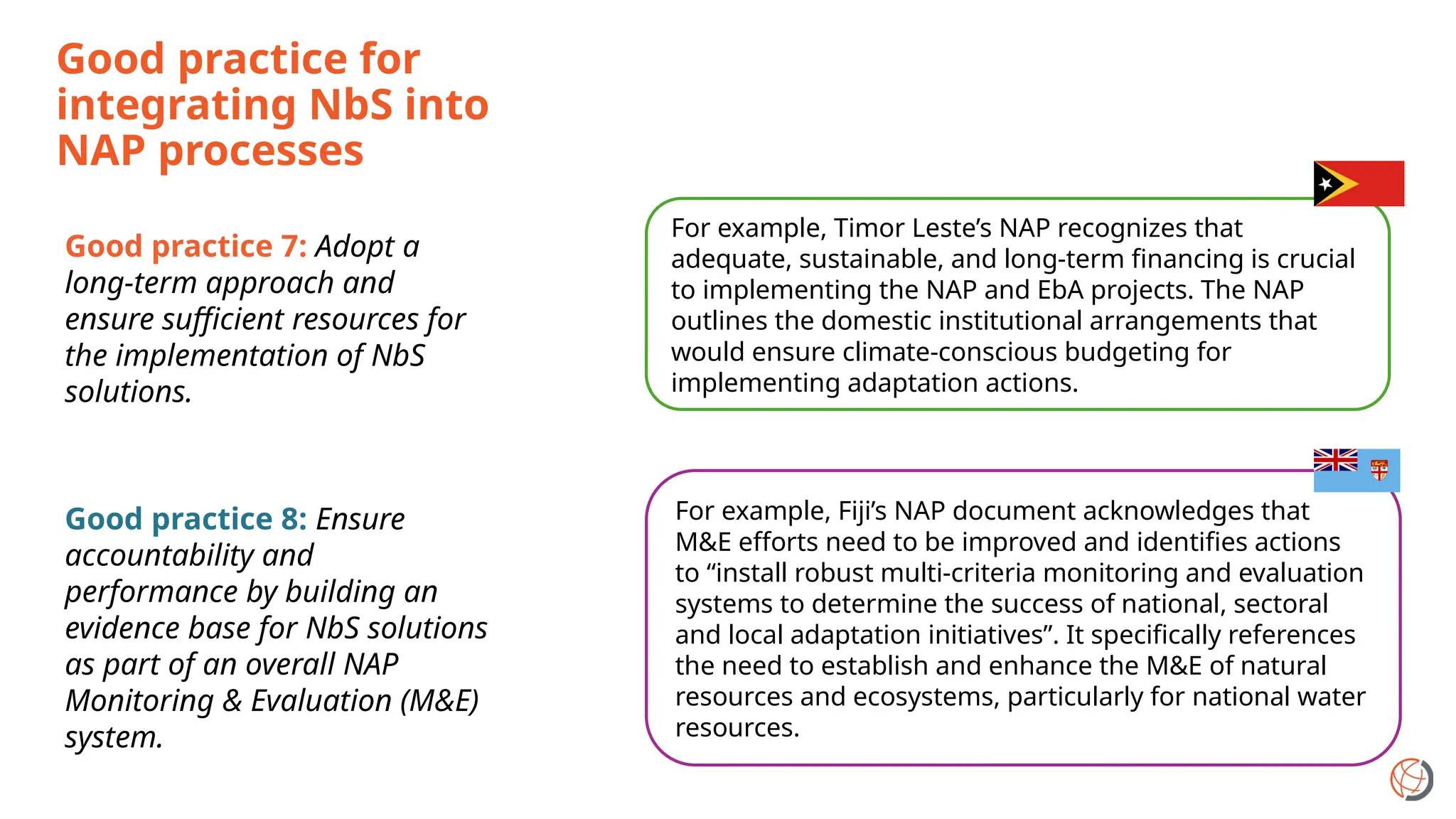
Good practice 7: Adopt a
long-term approach and
ensure sufficient resources for
the implementation of NbS
solutions.
Good practice 8: Ensure
accountability and
performance by building an
evidence base for NbS solutions
as part of an overall NAP
Monitoring & Evaluation (M&E)
system.
For example, Timor Leste’s NAP recognizes that
adequate, sustainable, and long-term financing is crucial
to implementing the NAP and EbA projects. The NAP
outlines the domestic institutional arrangements that
would ensure climate-conscious budgeting for
implementing adaptation actions.
For example, Fiji’s NAP document acknowledges that
M&E efforts need to be improved and identifies actions
to “install robust multi-criteria monitoring and evaluation
systems to determine the success of national, sectoral
and local adaptation initiatives”. It specifically references
the need to establish and enhance the M&E of natural
resources and ecosystems, particularly for national water
resources.
#2 Building on the earlier presentation on the review of NbS in NAPs - all countries include one or more actions related to protecting, conserving, restoring, sustainably using, and managing natural ecosystems in their NAP documents.
This is due to countries recognizing:
Ecosystems and the goods and services they deliver are the basis for key economic sectors which provide livelihood support to millions of people globally, particularly in rural communities. In particular agricultural, freshwater, and coastal ecosystems.
NbS and EbA solutions offer an opportunity to link adaptation, mitigation, and biodiversity and ecosystem protection at a national level. Many NbS and EbA measures deliver co-benefits for sustainable development
Ecosystems play a crucial role in both adaptation to climate change and building resilience by providing vital ecosystem services. These services, such as water purification, flood protection, and climate regulation, help communities cope with the impacts of climate change and prepare for future hazards.
#3 How can the NAP process support upscaling NBS?
Like many other adaptation options, NbS and EbA will be more sustainable and effectives when integrated into long-term planning processes as part of a larger adaptation plan.
NAPs provide a strategic framework for mainstreaming, mandating, and scaling up EbA. NAPs are developed with input and commitments from multiple sectors, providing opportunities for embedding EbA across different sectoral priorities.
The NAP process provides an important opportunity to raise awareness about EbA and integrate it into subnational and local planning scales, ideally using a landscape approach.
Embedding EbA and NbS in NAPs as priority measures can lead to more financial support for these types of measures.
#4 Five ways countries scale up EbA and NbS via NAP processes
Provide detailed information and data about the climate risks and vulnerabilities their ecosystems face due to climate change.
Emphasize the role of ecosystems in livelihoods, socioeconomic development and vulnerability reduction.
Drawing direct links between the climate and biodiversity crises and the importance of EbA/NbS to address both in simultaneously.
Using EbA as a central or foundational adaptation response in NAPs (e.g. priority sector, guiding principle)
Engage multiple levels of government and different sectors to deliver EbA holistically.
#5 The review of NAP documents highlighted that the NAP process provides a strategic mechanism to upscale and mainstream EbA and NbS solutions at the national level and across sectors. The NAP Global Network aimed to summarize “good practices” for integrating ecosystems and EbA/ NbS solutions in the NAP process based on observations from the review of existing NAP documents and existing NAP guidance produced by other institutions and organizations.