Finance for National
AdaptationPlan (NAP)
Processes
WEBINAR
What Can We Learn from Countries’
NAPs?
29th
July 2025
Hellen Agor Yayra, Lensational trainee, Ghana (2021)
2.
Help countries learnfrom
each other through South-
South peer learning and
exchange.
Over 900people from
83 countries have
participated in peer
learning and exchanges.
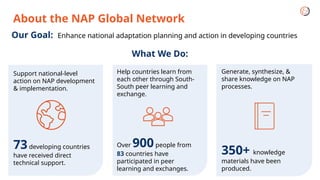
About the NAP Global Network
What We Do:
Support national-level
action on NAP development
& implementation.
73developing countries
have received direct
technical support
.
Generate, synthesize, &
share knowledge on NAP
processes.
350+ knowledge
materials have been
produced.
Our Goal: Enhance national adaptation planning and action in developing countries
3.
Speakers
Maribel Hernandez
Senior PolicyAdvisor,
Adaptation Finance,
NAP Global Network
Moderator
Christian Ledwell
Knowledge
Manager,
NAP Global
Network
Thomas Lerenten
Lelekoitien
Deputy Director for Climate
Change Adaptation,
Ministry of Environment and
Forestry, Kenya
Objectives
• Share keytakeaways from our
review of 59 multi-sector NAP
documents through a financial
lens
• Highlight good practices and
challenges in financing
adaptation
• Discuss recommendations for
strengthening finance in NAP
processes
Fibi Afloe, Lensational trainee, Ghana (2021)
6.
Methodology
• Review of59 multi-sector NAP
documents submitted to UNFCCC by
Feb 2025
• Keyword analysis using MAXQDA
• Qualitative insights from NAP Global
Network’s country support
Key Areas of Focus:
• Finance in NAP documents
• Prioritization & Costing
• Sources and instruments
• Budget integration
• Barriers and next steps
7.
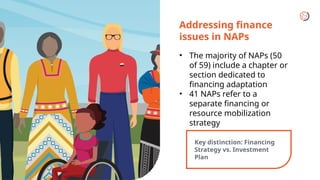
Addressing finance
issues inNAPs
• The majority of NAPs (50
of 59) include a chapter or
section dedicated to
financing adaptation
• 41 NAPs refer to a
separate financing or
resource mobilization
strategy
Key distinction: Financing
Strategy vs. Investment
Plan
8.
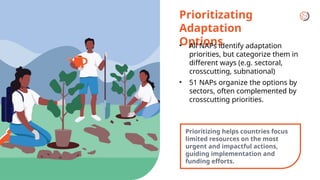
Prioritizating
Adaptation
Options
• All NAPsidentify adaptation
priorities, but categorize them in
different ways (e.g. sectoral,
crosscutting, subnational)
• 51 NAPs organize the options by
sectors, often complemented by
crosscutting priorities.
Prioritizing helps countries focus
limited resources on the most
urgent and impactful actions,
guiding implementation and
funding efforts.
9.
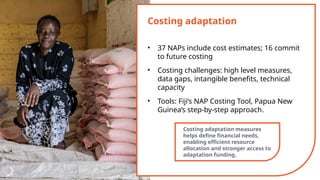
Costing adaptation
• 37NAPs include cost estimates; 16 commit
to future costing
• Costing challenges: high level measures,
data gaps, intangible benefits, technical
capacity
• Tools: Fiji’s NAP Costing Tool, Papua New
Guinea’s step-by-step approach.
Costing adaptation measures
helps define financial needs,
enabling efficient resource
allocation and stronger access to
adaptation funding.
10.
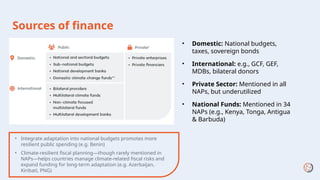
Sources of finance
•Domestic: National budgets,
taxes, sovereign bonds
• International: e.g., GCF, GEF,
MDBs, bilateral donors
• Private Sector: Mentioned in all
NAPs, but underutilized
• National Funds: Mentioned in 34
NAPs (e.g., Kenya, Tonga, Antigua
& Barbuda)
• Integrate adaptation into national budgets promotes more
resilient public spending (e.g. Benin)
• Climate-resilient fiscal planning—though rarely mentioned in
NAPs—helps countries manage climate-related fiscal risks and
expand funding for long-term adaptation (e.g. Azerbaijan,
Kiribati, PNG)
11.
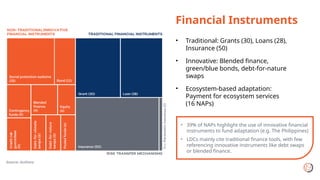
Financial Instruments
• Traditional:Grants (30), Loans (28),
Insurance (50)
• Innovative: Blended finance,
green/blue bonds, debt-for-nature
swaps
• Ecosystem-based adaptation:
Payment for ecosystem services
(16 NAPs)
• 39% of NAPs highlight the use of innovative financial
instruments to fund adaptation (e.g. The Philippines)
• LDCs mainly cite traditional finance tools, with few
referencing innovative instruments like debt swaps
or blended finance.
12.
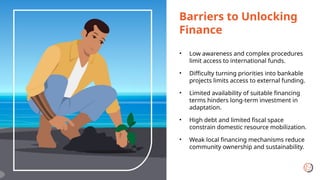
Barriers to Unlocking
Finance
•Low awareness and complex procedures
limit access to international funds.
• Difficulty turning priorities into bankable
projects limits access to external funding.
• Limited availability of suitable financing
terms hinders long-term investment in
adaptation.
• High debt and limited fiscal space
constrain domestic resource mobilization.
• Weak local financing mechanisms reduce
community ownership and sustainability.
13.
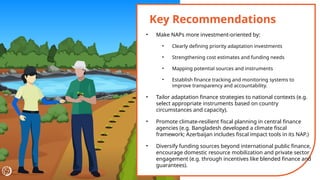
Key Recommendations
• MakeNAPs more investment-oriented by:
• Clearly defining priority adaptation investments
• Strengthening cost estimates and funding needs
• Mapping potential sources and instruments
• Establish finance tracking and monitoring systems to
improve transparency and accountability.
• Tailor adaptation finance strategies to national contexts (e.g.
select appropriate instruments based on country
circumstances and capacity).
• Promote climate-resilient fiscal planning in central finance
agencies (e.g. Bangladesh developed a climate fiscal
framework; Azerbaijan includes fiscal impact tools in its NAP.)
• Diversify funding sources beyond international public finance,
encourage domestic resource mobilization and private sector
engagement (e.g. through incentives like blended finance and
guarantees).
14.
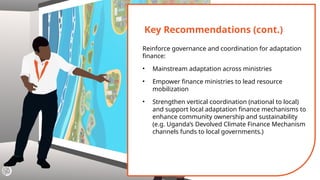
Key Recommendations (cont.)
Reinforcegovernance and coordination for adaptation
finance:
• Mainstream adaptation across ministries
• Empower finance ministries to lead resource
mobilization
• Strengthen vertical coordination (national to local)
and support local adaptation finance mechanisms to
enhance community ownership and sustainability
(e.g. Uganda’s Devolved Climate Finance Mechanism
channels funds to local governments.)
15.
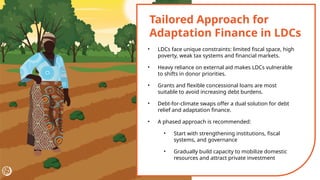
Tailored Approach for
AdaptationFinance in LDCs
• LDCs face unique constraints: limited fiscal space, high
poverty, weak tax systems and financial markets.
• Heavy reliance on external aid makes LDCs vulnerable
to shifts in donor priorities.
• Grants and flexible concessional loans are most
suitable to avoid increasing debt burdens.
• Debt-for-climate swaps offer a dual solution for debt
relief and adaptation finance.
• A phased approach is recommended:
• Start with strengthening institutions, fiscal
systems, and governance
• Gradually build capacity to mobilize domestic
resources and attract private investment
16.
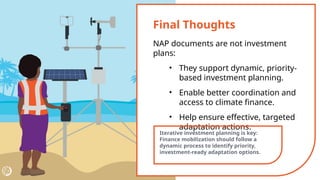
Final Thoughts
NAP documentsare not investment
plans:
• They support dynamic, priority-
based investment planning.
• Enable better coordination and
access to climate finance.
• Help ensure effective, targeted
adaptation actions.
Iterative investment planning is key:
Finance mobilization should follow a
dynamic process to identify priority,
investment-ready adaptation options.
17.
Thomas Lerenten
XXXX,
XXX,
XXX, XXX
ThomasLerenten
Lelekoitien
Deputy Director for Climate
Change Adaptation, Climate
Change Directorate,
Ministry of Environment,
Climate Change, and
Forestry, Kenya
18.
Kenya’s Approach toNational and Subnational
Finance for Climate Change Adaptation
Thomas Lerenten Lelekoitien
Deputy Director - Climate Change Adaptation, Climate Change Directorate
Ministry of Environment, Climate Change and Forestry
Republic of Kenya
Nairobi, Kenya | July 29, 2025
Kenya’s NAP 2015-2030
•Kenya deposited its NAP at the UNFCCC NAP central in
2016
• The NAP establishes high-level adaptation actions in 20
planning sectors over a 15-year time frame.
• Provides guidance to national and country governments
on priority actions for integration
• The Climate Change Act (2016) requires the
development of a National Climate Change Action
Plan (NCCAP) every five years
• NCCAP 2018–2022 prioritizes adaptation, and sets out
priority actions to deliver on the Kenya National
Adaptation Plan 2015–2030 (NAP) and NDC for the five-
year period.
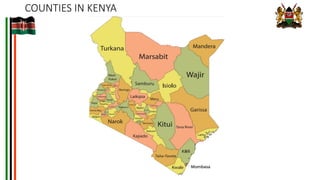
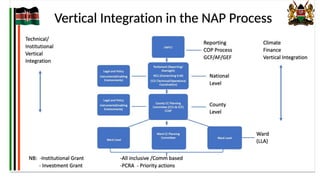
• PCRA and CCAP – Feed into the NCCAP - County level
21.
Subnational adaptation finance
•Kenya County Climate Change Fund (CCCF)
mechanism piloted in five
counties: devolved finance mechanisms
under the authority of county government
to mainstream adaptation into local planning
and budgets
• This scaled up by Financing Locally-Led
Climate Action (FLLoCA) Program: aims to
deliver locally led climate resilience actions
linked to national priorities
22.
Operationalization of theCounty Climate
Change Financing - FLLoCA
• Donors; WB, Governments of Sweden, Denmark, the Kingdom of Netherlands,
Germany and Kenya
• Funds flow; National Partners - Investment Project Financing (IPF)- support
county delivery of program, Counties; based on Performance for Results (PforR) -
92% of funds
• The PforR component has two Disbursement Linked Indicators (DLIs);
• Participating counties that meet Minimum Access conditions for County
Readiness and Institutional support Grant
• Participating counties that meet Minimum Performance conditions for County
Climate Resilience Investment Grant
• These DLIs are based on achievement of minimum conditions after which the
counties would access both County Climate Institutional Grant (CCIG) and the
County Climate Resilience Investment Grant (CCRIG).
23.
The attainment ofthese performance measures determines how much each county will
receive for the two DLIs. To access the County Climate Institutional Support (CCIS) Grant of the
Program, the Minimum Assess Condition (MACs) included;
(i) The county has opted into the Program by signing a FLLoCA Participation Agreement
(PA);
(ii) The county has opened a special purpose account (SPA) (to receive the CCIS and County
Climate Resilience Investment (CCRI) Grant;
(iii) Governor-designated County Executive Committee Member (CECM) in charge of
climate change has been appointed; and,
(iv) Governor-approved work plan and budget for use of the CCIS Grant are available
For this DLI, counties were to receive USD 100,000 for the first 3 years.
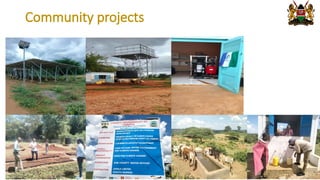
The counties utilized these funds to;
- set out the climate change units,
- develop requisite climate change policies and regulations,
- setting up and capacity building the county and ward climate change planning
committees among other institutional strengthening activities.
24.
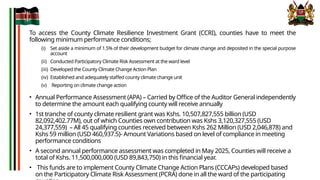
To access theCounty Climate Resilience Investment Grant (CCRI), counties have to meet the
following minimum performance conditions;
(i) Set aside a minimum of 1.5% of their development budget for climate change and deposited in the special purpose
account
(ii) Conducted Participatory Climate Risk Assessment at the ward level
(iii) Developed the County Climate Change Action Plan
(iv) Established and adequately staffed county climate change unit
(v) Reporting on climate change action
• Annual Performance Assessment (APA) – Carried by Office of the Auditor General independently
to determine the amount each qualifying county will receive annually
• 1st tranche of county climate resilient grant was Kshs. 10,507,827,555 billion (USD
82,092,402.77M), out of which Counties own contribution was Kshs 3,120,327,555 (USD
24,377,559) – All 45 qualifying counties received between Kshs 262 Million (USD 2,046,878) and
Kshs 59 million (USD 460,937.5)- Amount Variations based on level of compliance in meeting
performance conditions
• A second annual performance assessment was completed in May 2025, Counties will receive a
total of Kshs. 11,500,000,000 (USD 89,843,750) in this financial year.
• This funds are to implement County Climate Change Action Plans (CCCAPs) developed based
on the Participatory Climate Risk Assessment (PCRA) done in all the ward of the participating
Challenges
• Inadequate capacities– CCU and ward level
• Development Vs climate change smart community
projects
• Poor absorption of funds – long procurement
processes
• Delay in disbursement of funds
• Inadequate financial resources to support
implementation
• Effective coordination at sub national level
#27 The shift from the MRV+ to annual progress report was advised by learning experience from the first NCCAP approach
Confirm the name of the first mrv ie performance ect