Cardiovascular diseases (CVDs) are the leading cause of death globally, taking an estimated 17.9 million lives each year. CVDs are a group of disorders of the heart and blood vessels and include coronary heart disease, cerebrovascular disease, rheumatic heart disease and other conditions.
Cardiovascular System
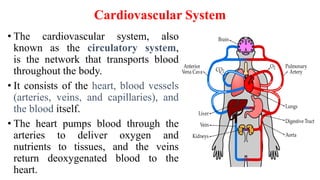
• Thecardiovascular system, also
known as the circulatory system,
is the network that transports blood
throughout the body.
• It consists of the heart, blood vessels
(arteries, veins, and capillaries), and
the blood itself.
• The heart pumps blood through the
arteries to deliver oxygen and
nutrients to tissues, and the veins
return deoxygenated blood to the
heart.
3.
Cardiovascular Diseases
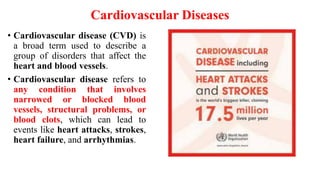
• Cardiovasculardisease (CVD) is
a broad term used to describe a
group of disorders that affect the
heart and blood vessels.
• Cardiovascular disease refers to
any condition that involves
narrowed or blocked blood
vessels, structural problems, or
blood clots, which can lead to
events like heart attacks, strokes,
heart failure, and arrhythmias.
4.
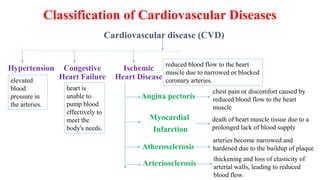
Classification of CardiovascularDiseases
Hypertension
Cardiovascular disease (CVD)
Congestive
Heart Failure
Ischemic
Heart Disease
Angina pectoris
Myocardial
Infarction
Atherosclerosis
Arteriosclerosis
elevated
blood
pressure in
the arteries.
heart is
unable to
pump blood
effectively to
meet the
body's needs.
reduced blood flow to the heart
muscle due to narrowed or blocked
coronary arteries.
chest pain or discomfort caused by
reduced blood flow to the heart
muscle
death of heart muscle tissue due to a
prolonged lack of blood supply
arteries become narrowed and
hardened due to the buildup of plaque
thickening and loss of elasticity of
arterial walls, leading to reduced
blood flow.
5.
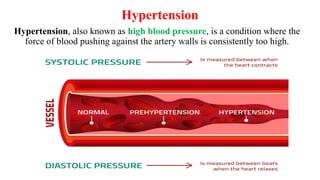
Hypertension
Hypertension, also knownas high blood pressure, is a condition where the
force of blood pushing against the artery walls is consistently too high.
7.
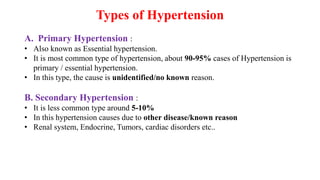
Types of Hypertension
A.Primary Hypertension :
• Also known as Essential hypertension.
• It is most common type of hypertension, about 90-95% cases of Hypertension is
primary / essential hypertension.
• In this type, the cause is unidentified/no known reason.
B. Secondary Hypertension :
• It is less common type around 5-10%
• In this hypertension causes due to other disease/known reason
• Renal system, Endocrine, Tumors, cardiac disorders etc..
8.
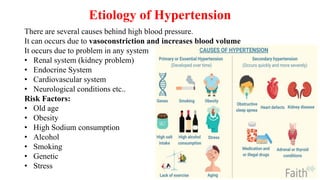
Etiology of Hypertension
Thereare several causes behind high blood pressure.
It can occurs due to vasoconstriction and increases blood volume
It occurs due to problem in any system
• Renal system (kidney problem)
• Endocrine System
• Cardiovascular system
• Neurological conditions etc..
Risk Factors:
• Old age
• Obesity
• High Sodium consumption
• Alcohol
• Smoking
• Genetic
• Stress
9.
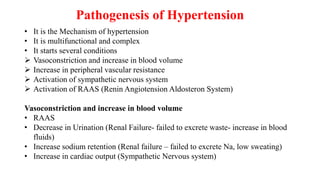
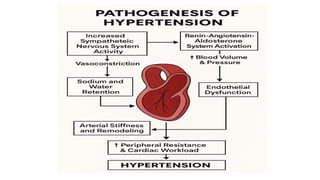
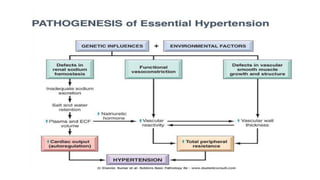
Pathogenesis of Hypertension
•It is the Mechanism of hypertension
• It is multifunctional and complex
• It starts several conditions
Vasoconstriction and increase in blood volume
Increase in peripheral vascular resistance
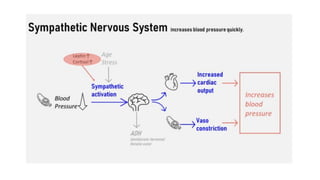
Activation of sympathetic nervous system
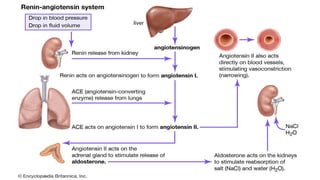
Activation of RAAS (Renin Angiotension Aldosteron System)
Vasoconstriction and increase in blood volume
• RAAS
• Decrease in Urination (Renal Failure- failed to excrete waste- increase in blood
fluids)
• Increase sodium retention (Renal failure – failed to excrete Na, low sweating)
• Increase in cardiac output (Sympathetic Nervous system)
Complications of Hypertension
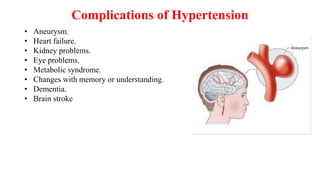
•Aneurysm.
• Heart failure.
• Kidney problems.
• Eye problems.
• Metabolic syndrome.
• Changes with memory or understanding.
• Dementia.
• Brain stroke
16.
Management/ Treatment ofHypertension
Lifestyle changes can help lowers high blood pressure. This includes
• Eating a healthy, low salt diet
• Maintain a healthy weight
• Being physically active
• Quit smoking, tobacco , alcohol
• Reducing and managing stress
• Enough sleep
17.
Management/ Treatment ofHypertension
Medications/ Treatment:
•Diuretics:
Help the body eliminate excess salt and water, reducing blood volume and blood pressure.
Ex. Thiazide, furosemide, etc.
•ACE inhibitors and ARBs:
Block hormones that narrow blood vessels, relaxing them and lowering blood pressure.
Ex. Captopril, enalopril, etc.
•Beta-blockers:
Slow down the heart rate and reduce the force of heart contractions, lowering blood
pressure. Ex. Atenolol, Metaprolol, etc
•Calcium channel blockers:
Block calcium from entering the heart and blood vessels, relaxing them and lowering
blood pressure.
Ex. Amlodipine, Nifedipine, etc.
 Most read
 Most read
 Most read