Presented by
P ro f. Sneha B. Gaurkar
DRGIOP, Amravati
NATIONAL MENTAL
HEALTH PROGRAMME
1
 Introduction
 Strategies
 Limitations
 Distric mental health program(DMHP)
 Components of DMHP
 Objectives of DMHP
 Services provided under DMHP
 Objectives
Contents:
Presentation Outline
2
N E X T
National Mental Health Programme
National Health Programs are one of the prominent measures
taken by the nation primarily for the control of both
communicable and Non-Communicable diseases. MNSUDs
(Mental, Neurological & Substance Use Disorders) are a broad
domain included under the NCDs.
These are the disorders which currently addressed least in
terms of community attention, identification & treatment
which proportionally reflects as large mental health gap
(mhGap).
India is one of the major countries to adopt a national program
for mental health at the national level after the meeting of
WHO mental health advisory group.
The National Mental Health Programme (NMHP) was
implemented all over the country in a phased manner. 3
Words to Live By
-- THOMAS JEFFERSON.
4
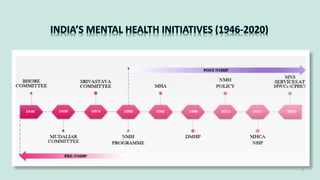
INDIA’S MENTAL HEALTH INITIATIVES (1946-2020)
5
The NMHP was launched with the stated objectives-
•To ensure the availability and accessibility of mental health care for
all in the foreseeable future, particularly to the most vulnerable
and underprivileged sections of the population.
•Encourage the application of mental health knowledge in general
health care and social development.
•Promote community participation in mental health services
development and stimulate efforts towards self-help in community.
Objectives of NMHP:
N E X T
6
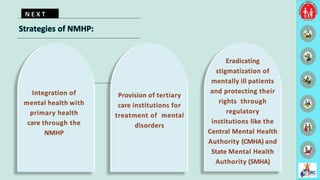
Strategies of NMHP:
Integration of
mental health with
primary health
care through the
NMHP
Provision of tertiary
care institutions for
treatment of mental
disorders
Eradicating
stigmatization of
mentally ill patients
and protecting their
rights through
regulatory
institutions like the
Central Mental Health
Authority (CMHA) and
State Mental Health
Authority (SMHA)
N E X T
7
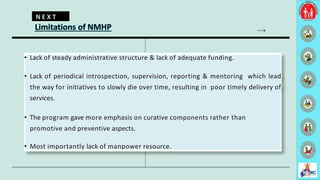
Limitations of NMHP
• Lack of steady administrative structure & lack of adequate funding.
• Lack of periodical introspection, supervision, reporting & mentoring which lead
the way for initiatives to slowly die over time, resulting in poor timely delivery of
services.
• The program gave more emphasis on curative components rather than
promotive and preventive aspects.
• Most importantly lack of manpower resource.
N E X T
8
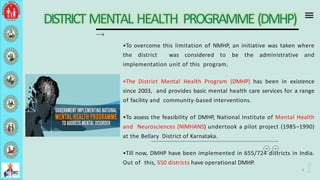
DISTRICT MENTAL HEALTH PROGRAMME (DMHP)
•To overcome this limitation of NMHP, an initiative was taken where
the district was considered to be the administrative and
implementation unit of this program.
•The District Mental Health Program (DMHP) has been in existence
since 2003, and provides basic mental health care services for a range
of facility and community-based interventions.
•To assess the feasibility of DMHP, National Institute of Mental Health
and Neurosciences (NIMHANS) undertook a pilot project (1985–1990)
at the Bellary District of Karnataka.
•Till now, DMHP have been implemented in 655/724 districts in India.
Out of this, 550 districts have operational DMHP.
9
N E X T
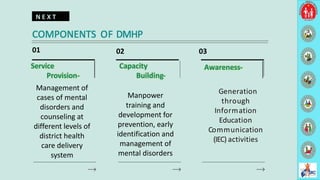
Manpower
training and
development for
prevention, early
identification and
management of
mental disorders
Generation
through
Information
Education
Communication
(IEC) activities
Service
Provision-
Capacity
Building-
Awareness-
01 02 03
COMPONENTS OF DMHP
Management of
cases of mental
disorders and
counseling at
different levels of
district health
care delivery
system
10
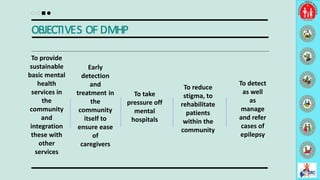
OBJECTIVES OF DMHP
To provide
sustainable
basic mental
health
services in
the
community
and
integration
these with
other
services
Early
detection
and
treatment in
the
community
itself to
ensure ease
of
caregivers
To take
pressure off
mental
hospitals
To reduce
stigma, to
rehabilitate
patients
within the
community
To detect
as well
as
manage
and refer
cases of
epilepsy
11
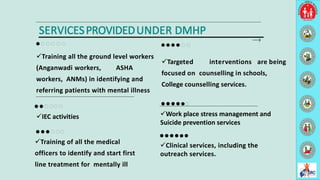
Targeted interventions are being
focused on counselling in schools,
College counselling services.
Training all the ground level workers
(Anganwadi workers, ASHA
workers, ANMs) in identifying and
referring patients with mental illness
Clinical services, including the
outreach services.
Training of all the medical
officers to identify and start first
line treatment for mentally ill
SERVICESPROVIDEDUNDER DMHP
IEC activities Work place stress management and
Suicide prevention services
12
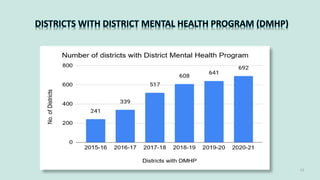
DISTRICTS WITH DISTRICT MENTAL HEALTH PROGRAM (DMHP)
13
THANK YOU !!!!!!
14

National mental health program.pptx

  • 1.
    Presented by P rof. Sneha B. Gaurkar DRGIOP, Amravati NATIONAL MENTAL HEALTH PROGRAMME 1
  • 2.
     Introduction  Strategies Limitations  Distric mental health program(DMHP)  Components of DMHP  Objectives of DMHP  Services provided under DMHP  Objectives Contents: Presentation Outline 2
  • 3.
    N E XT National Mental Health Programme National Health Programs are one of the prominent measures taken by the nation primarily for the control of both communicable and Non-Communicable diseases. MNSUDs (Mental, Neurological & Substance Use Disorders) are a broad domain included under the NCDs. These are the disorders which currently addressed least in terms of community attention, identification & treatment which proportionally reflects as large mental health gap (mhGap). India is one of the major countries to adopt a national program for mental health at the national level after the meeting of WHO mental health advisory group. The National Mental Health Programme (NMHP) was implemented all over the country in a phased manner. 3
  • 4.
    Words to LiveBy -- THOMAS JEFFERSON. 4
  • 5.
    INDIA’S MENTAL HEALTHINITIATIVES (1946-2020) 5
  • 6.
    The NMHP waslaunched with the stated objectives- •To ensure the availability and accessibility of mental health care for all in the foreseeable future, particularly to the most vulnerable and underprivileged sections of the population. •Encourage the application of mental health knowledge in general health care and social development. •Promote community participation in mental health services development and stimulate efforts towards self-help in community. Objectives of NMHP: N E X T 6
  • 7.
    Strategies of NMHP: Integrationof mental health with primary health care through the NMHP Provision of tertiary care institutions for treatment of mental disorders Eradicating stigmatization of mentally ill patients and protecting their rights through regulatory institutions like the Central Mental Health Authority (CMHA) and State Mental Health Authority (SMHA) N E X T 7
  • 8.
    Limitations of NMHP •Lack of steady administrative structure & lack of adequate funding. • Lack of periodical introspection, supervision, reporting & mentoring which lead the way for initiatives to slowly die over time, resulting in poor timely delivery of services. • The program gave more emphasis on curative components rather than promotive and preventive aspects. • Most importantly lack of manpower resource. N E X T 8
  • 9.
    DISTRICT MENTAL HEALTHPROGRAMME (DMHP) •To overcome this limitation of NMHP, an initiative was taken where the district was considered to be the administrative and implementation unit of this program. •The District Mental Health Program (DMHP) has been in existence since 2003, and provides basic mental health care services for a range of facility and community-based interventions. •To assess the feasibility of DMHP, National Institute of Mental Health and Neurosciences (NIMHANS) undertook a pilot project (1985–1990) at the Bellary District of Karnataka. •Till now, DMHP have been implemented in 655/724 districts in India. Out of this, 550 districts have operational DMHP. 9
  • 10.
    N E XT Manpower training and development for prevention, early identification and management of mental disorders Generation through Information Education Communication (IEC) activities Service Provision- Capacity Building- Awareness- 01 02 03 COMPONENTS OF DMHP Management of cases of mental disorders and counseling at different levels of district health care delivery system 10
  • 11.
    OBJECTIVES OF DMHP Toprovide sustainable basic mental health services in the community and integration these with other services Early detection and treatment in the community itself to ensure ease of caregivers To take pressure off mental hospitals To reduce stigma, to rehabilitate patients within the community To detect as well as manage and refer cases of epilepsy 11
  • 12.
    Targeted interventions arebeing focused on counselling in schools, College counselling services. Training all the ground level workers (Anganwadi workers, ASHA workers, ANMs) in identifying and referring patients with mental illness Clinical services, including the outreach services. Training of all the medical officers to identify and start first line treatment for mentally ill SERVICESPROVIDEDUNDER DMHP IEC activities Work place stress management and Suicide prevention services 12
  • 13.
    DISTRICTS WITH DISTRICTMENTAL HEALTH PROGRAM (DMHP) 13
  • 14.