Submitted to : Dr. kassem Ahmad
Submitted by: Sara Shall
*
*
*What is IoT?
*Components of IoT
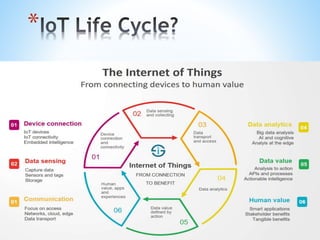
*IoT life cycle
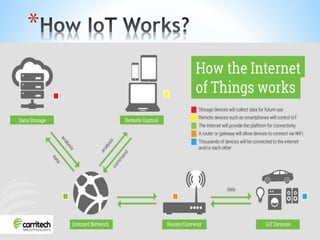
*How IoT Works?
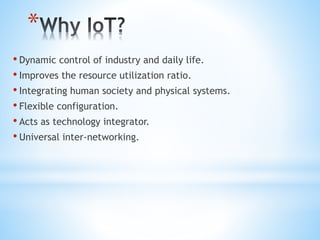
*Why IoT?
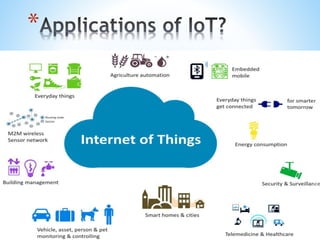
*Applications of IoT?
*Disadvantages of IoT
*Summury
*
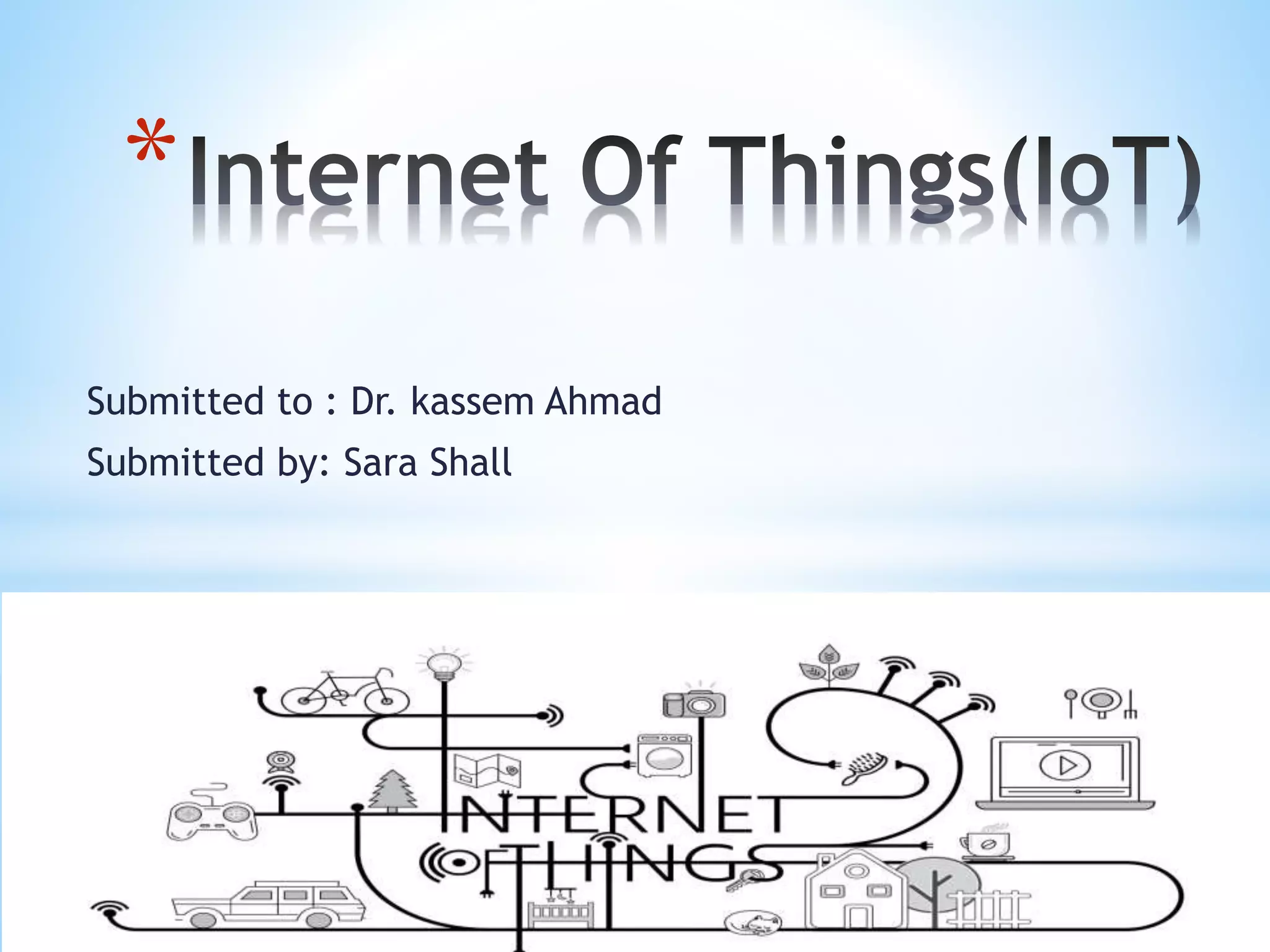
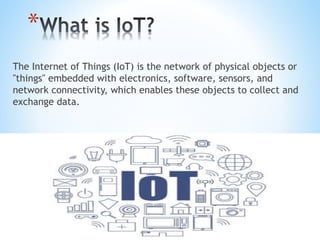
The Internet of Things (IoT) is the network of physical objects or
"things" embedded with electronics, software, sensors, and
network connectivity, which enables these objects to collect and
exchange data.
*
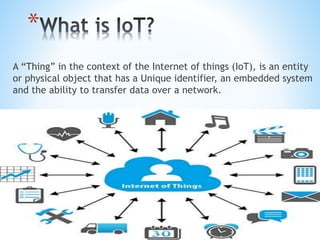
A “Thing” in the context of the Internet of things (IoT), is an entity
or physical object that has a Unique identifier, an embedded system
and the ability to transfer data over a network.
*
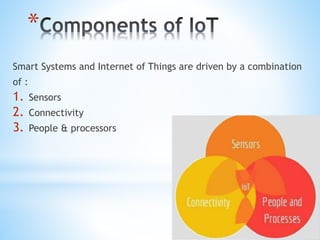
Smart Systems and Internet of Things are driven by a combination
of :
1. Sensors
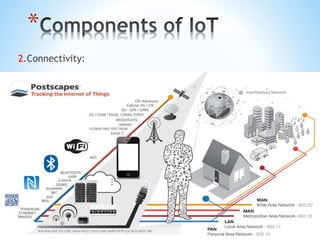
2. Connectivity
3. People & processors
*
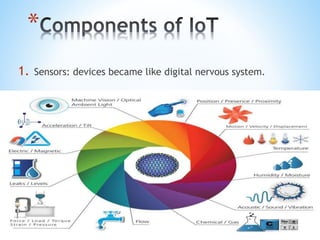
1. Sensors: devices became like digital nervous system.
2.Connectivity:
*
*
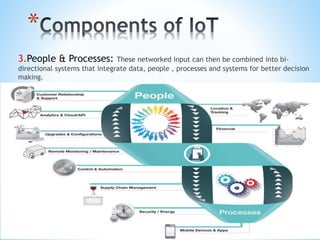
3.People & Processes: These networked input can then be combined into bi-
directional systems that integrate data, people , processes and systems for better decision
making.
*
*
• It consists of all the web-enabled devices that collect, send and
act on data they acquire from their surrounding environments using
embedded sensors, processors and communication hardware.
• These smart devices can sometimes talk to other related devices, a
process called machine-to-machine (M2M) communication.
• They act on the information they get from one another.
• Humans can interact with the gadgets to set them up, give them
instructions or access the data, but the devices do most of the
work on their own without human intervention.
*
*
• Dynamic control of industry and daily life.
• Improves the resource utilization ratio.
• Integrating human society and physical systems.
• Flexible configuration.
• Acts as technology integrator.
• Universal inter-networking.
*
*
breach of privacy,
• there is always the possibility of hackers breaking into the system
and stealing the data.
 over-reliance on technology
• No system is robust and fault-free.
the loss of jobs.
• will have a devastating impact on the employment prospects of
less-educated
*
The scope of IoT is to connect all small devices or “things” to
internet in order to collect and exchange data..
Small devices contains sensors that transport data through
network to analyze it then pass results to remote devices that
show results or to make an action
Organizations productivity increased using big data resulted from
IoT
IoT is being used in everyday things and many other domains.
Although IoT has many benefits but it also contains errors,
breaches privacy, and leads to unemployment.
*Thank you..

what is Internet of things(iot) & how does it work

  • 1.
    Submitted to :Dr. kassem Ahmad Submitted by: Sara Shall *
  • 2.
    * *What is IoT? *Componentsof IoT *IoT life cycle *How IoT Works? *Why IoT? *Applications of IoT? *Disadvantages of IoT *Summury
  • 4.
    * The Internet ofThings (IoT) is the network of physical objects or "things" embedded with electronics, software, sensors, and network connectivity, which enables these objects to collect and exchange data.
  • 5.
    * A “Thing” inthe context of the Internet of things (IoT), is an entity or physical object that has a Unique identifier, an embedded system and the ability to transfer data over a network.
  • 6.
    * Smart Systems andInternet of Things are driven by a combination of : 1. Sensors 2. Connectivity 3. People & processors
  • 7.
    * 1. Sensors: devicesbecame like digital nervous system.
  • 8.
  • 9.
    * 3.People & Processes:These networked input can then be combined into bi- directional systems that integrate data, people , processes and systems for better decision making.
  • 10.
  • 11.
    * • It consistsof all the web-enabled devices that collect, send and act on data they acquire from their surrounding environments using embedded sensors, processors and communication hardware. • These smart devices can sometimes talk to other related devices, a process called machine-to-machine (M2M) communication. • They act on the information they get from one another. • Humans can interact with the gadgets to set them up, give them instructions or access the data, but the devices do most of the work on their own without human intervention.
  • 12.
  • 13.
    * • Dynamic controlof industry and daily life. • Improves the resource utilization ratio. • Integrating human society and physical systems. • Flexible configuration. • Acts as technology integrator. • Universal inter-networking.
  • 14.
  • 15.
    * breach of privacy, •there is always the possibility of hackers breaking into the system and stealing the data.  over-reliance on technology • No system is robust and fault-free. the loss of jobs. • will have a devastating impact on the employment prospects of less-educated
  • 16.
    * The scope ofIoT is to connect all small devices or “things” to internet in order to collect and exchange data.. Small devices contains sensors that transport data through network to analyze it then pass results to remote devices that show results or to make an action Organizations productivity increased using big data resulted from IoT IoT is being used in everyday things and many other domains. Although IoT has many benefits but it also contains errors, breaches privacy, and leads to unemployment.
  • 17.

Editor's Notes

  • #6 These devices collect useful data with the help of various existing technologies and then autonomously flow thedata between otherdevices
  • #8 Location data using GPS sensors. Eyes and ears using cameras and microphones . Along with sensory organs that can measure everything from the temperature to prussere changes
  • #10 These networked input can then be combined into bi-directional systems that integrate data, people , processes and systems for better decision making
  • #11 2- devices and sensors are collecting data every where. 3-communication sending data and events through networks to some destination 4-Analysis is to create info. From data. 5-taking action based on the information and data