Scope of e-commerce
Learning objectives 
• What is e-commerce? 
• What are the e-challenges? 
• What are the strategies for e-commerce?
Learning objectives 
• What is e-commerce? 
• What are the e-challenges? 
• What are the strategies for e-commerce?
E-commerce definition 
Technology-enabled transactions and technology-mediated 
exchanges of digitized information 
between parties (individuals or organizations) as 
well as the electronically based intra-organizational 
or inter-organizational activities that facilitate such 
exchanges
E-commerce definition 
Scope of e-commerce: 
1. Exchange of digitized information 
2. Technology-enabled transactions 
3. Technology-mediated relationships 
4. Intra- & inter-organizational activities
E-commerce definition 
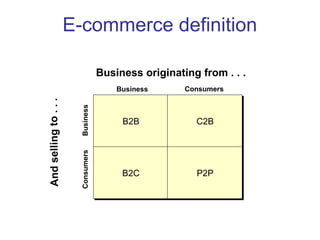
Business originating from . . . 
Business Consumers 
B2B C2B 
B2C P2P 
Consumers Business 
And selling to . . .
E-commerce categories 
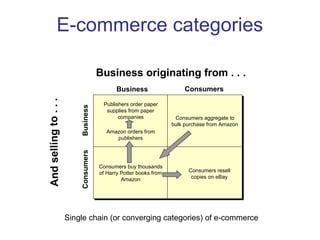
Business originating from . . . 
Business Consumers 
Publishers order paper 
supplies from paper 
Publishers order paper 
supplies from paper 
companies 
companies 
Amazon orders from 
Amazon orders from 
publishers 
publishers 
Consumers aggregate to 
bulk purchase from Amazon 
Consumers aggregate to 
bulk purchase from Amazon 
Consumers buy thousands 
of Harry Potter books from 
Consumers buy thousands 
of Harry Potter books from 
Amazon 
Amazon 
Consumers Business 
And selling to . . . 
Consumers resell 
copies on eBay 
Single chain (or converging categories) of e-commerce
E-commerce definition 
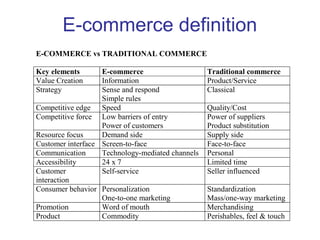
E-COMMERCE vs TRADITIONAL COMMERCE 
Key elements E-commerce Traditional commerce 
Value Creation Information Product/Service 
Strategy Sense and respond 
Simple rules 
Classical 
Competitive edge Speed Quality/Cost 
Competitive force Low barriers of entry 
Power of customers 
Power of suppliers 
Product substitution 
Resource focus Demand side Supply side 
Customer interface Screen-to-face Face-to-face 
Communication Technology-mediated channels Personal 
Accessibility 24 x 7 Limited time 
Customer 
interaction 
Self-service Seller influenced 
Consumer behavior Personalization 
One-to-one marketing 
Standardization 
Mass/one-way marketing 
Promotion Word of mouth Merchandising 
Product Commodity Perishables, feel & touch
E-commerce definition 
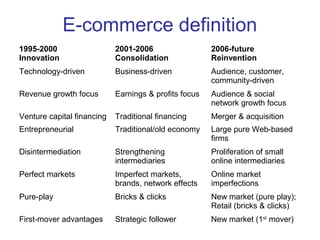
1995-2000 
Innovation 
2001-2006 
Consolidation 
2006-future 
Reinvention 
Technology-driven Business-driven Audience, customer, 
community-driven 
Revenue growth focus Earnings & profits focus Audience & social 
network growth focus 
Venture capital financing Traditional financing Merger & acquisition 
Entrepreneurial Traditional/old economy Large pure Web-based 
firms 
Disintermediation Strengthening 
intermediaries 
Proliferation of small 
online intermediaries 
Perfect markets Imperfect markets, 
brands, network effects 
Online market 
imperfections 
Pure-play Bricks & clicks New market (pure play); 
Retail (bricks & clicks) 
First-mover advantages Strategic follower New market (1st mover)
Learning objectives 
• What is e-commerce? 
• What are the e-challenges? 
• What are the strategies for e-commerce?
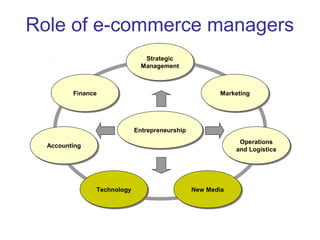
Role of e-commerce managers 
Strategic 
Management 
Strategic 
Management 
FFiinnaannccee MMaarrkkeettiinngg 
EEnnttrreepprreenneeuurrsshhiipp 
Operations 
and Logistics 
AAccccoouunnttiinngg Operations 
TTeecchhnnoollooggyy NNeeww MMeeddiiaa 
and Logistics
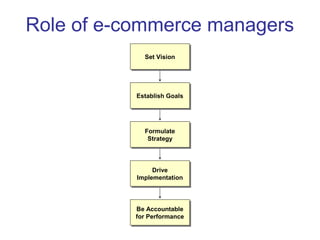
Role of e-commerce managers 
SSeett VViissiioonn 
EEssttaabblliisshh GGooaallss 
Formulate 
Strategy 
Formulate 
Strategy 
Drive 
Drive 
Implementation 
Implementation 
Be Accountable 
for Performance 
Be Accountable 
for Performance
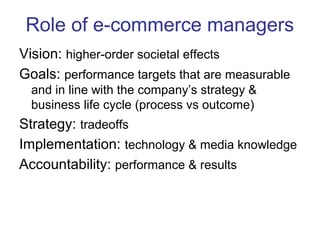
Role of e-commerce managers 
Vision: higher-order societal effects 
Goals: performance targets that are measurable 
and in line with the company’s strategy & 
business life cycle (process vs outcome) 
Strategy: tradeoffs 
Implementation: technology & media knowledge 
Accountability: performance & results
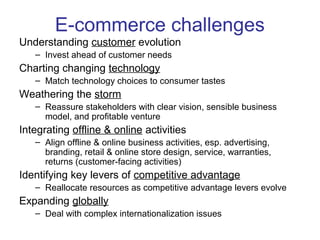
E-commerce challenges 
Understanding customer evolution 
– Invest ahead of customer needs 
Charting changing technology 
– Match technology choices to consumer tastes 
Weathering the storm 
– Reassure stakeholders with clear vision, sensible business 
model, and profitable venture 
Integrating offline & online activities 
– Align offline & online business activities, esp. advertising, 
branding, retail & online store design, service, warranties, 
returns (customer-facing activities) 
Identifying key levers of competitive advantage 
– Reallocate resources as competitive advantage levers evolve 
Expanding globally 
– Deal with complex internationalization issues
Learning objectives 
• What is e-commerce? 
• What are the e-challenges? 
• What are the strategies for e-commerce?
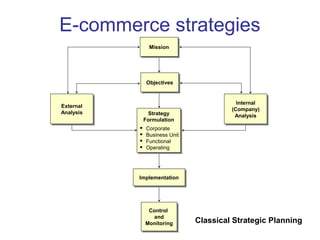
E-commerce strategies 
MMiissssiioonn 
OObbjjeeccttiivveess 
Strategy 
Strategy 
Formulation 
Formulation 
 Corporate 
 Business Unit 
 Functional 
 Operating 
IImmpplleemmeennttaattiioonn 
Internal 
(Company) 
Analysis 
Internal 
(Company) 
Analysis 
External 
Analysis 
External 
Analysis 
Control 
and 
Monitoring 
Control 
and 
Monitoring 
Classical Strategic Planning
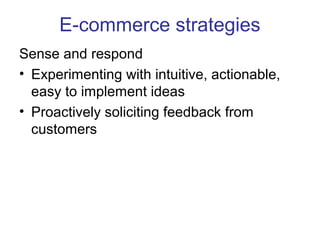
E-commerce strategies 
Sense and respond 
• Experimenting with intuitive, actionable, 
easy to implement ideas 
• Proactively soliciting feedback from 
customers
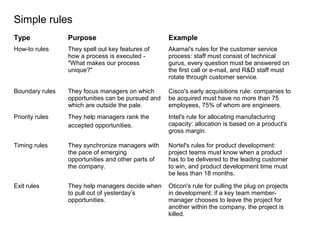
Type Purpose Example 
How-to rules They spell out key features of 
how a process is executed - 
"What makes our process 
unique?" 
Akamai's rules for the customer service 
process: staff must consist of technical 
gurus, every question must be answered on 
the first call or e-mail, and R&D staff must 
rotate through customer service. 
Boundary rules They focus managers on which 
opportunities can be pursued and 
which are outside the pale. 
Cisco's early acquisitions rule: companies to 
be acquired must have no more than 75 
employees, 75% of whom are engineers. 
Priority rules They help managers rank the 
accepted opportunities. 
Intel's rule for allocating manufacturing 
capacity: allocation is based on a product's 
gross margin. 
Timing rules They synchronize managers with 
the pace of emerging 
opportunities and other parts of 
the company. 
Nortel's rules for product development: 
project teams must know when a product 
has to be delivered to the leading customer 
to win, and product development time must 
be less than 18 months. 
Exit rules They help managers decide when 
to pull out of yesterday’s 
opportunities. 
Oticon's rule for pulling the plug on projects 
in development: if a key team member-manager 
chooses to leave the project for 
another within the company, the project is 
killed. 
Simple rules
E-commerce strategies 
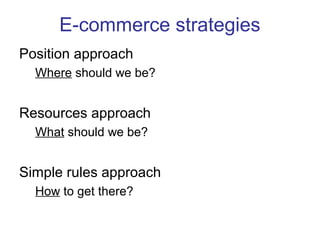
Position approach 
Where should we be? 
Resources approach 
What should we be? 
Simple rules approach 
How to get there?
E-commerce strategies 
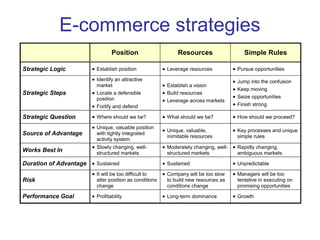
Position Resources Simple Rules 
Strategic Logic Establish position Leverage resources Pursue opportunities 
Strategic Steps 
Identify an attractive 
market 
Locate a defensible 
position 
Fortify and defend 
Establish a vision 
Build resources 
Leverage across markets 
Jump into the confusion 
Keep moving 
Seize opportunities 
Finish strong 
Strategic Question Where should we be? What should we be? How should we proceed? 
Source of Advantage 
Unique, valuable position 
with tightly integrated 
activity system 
Unique, valuable, 
inimitable resources 
Key processes and unique 
simple rules 
Works Best In Slowly changing, well-structured 
markets 
Moderately changing, well-structured 
markets 
Rapidly changing, 
ambiguous markets 
Duration of Advantage Sustained Sustained Unpredictable 
Risk 
It will be too difficult to 
alter position as conditions 
change 
Company will be too slow 
to build new resources as 
conditions change 
Managers will be too 
tentative in executing on 
promising opportunities 
Performance Goal Profitability Long-term dominance Growth
E-commerce strategies 
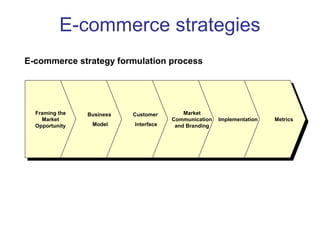
Framing the 
Market 
Opportunity 
Framing the 
Market 
Opportunity 
Business 
Model 
Business 
Model 
Customer 
Interface 
Customer 
Interface 
Market 
Market 
Communication 
and Branding 
Communication 
and Branding 
Implementation Implementation Metrics Metrics 
E-commerce strategy formulation process

Introduction

  • 1.
  • 2.
    Learning objectives •What is e-commerce? • What are the e-challenges? • What are the strategies for e-commerce?
  • 3.
    Learning objectives •What is e-commerce? • What are the e-challenges? • What are the strategies for e-commerce?
  • 4.
    E-commerce definition Technology-enabledtransactions and technology-mediated exchanges of digitized information between parties (individuals or organizations) as well as the electronically based intra-organizational or inter-organizational activities that facilitate such exchanges
  • 5.
    E-commerce definition Scopeof e-commerce: 1. Exchange of digitized information 2. Technology-enabled transactions 3. Technology-mediated relationships 4. Intra- & inter-organizational activities
  • 6.
    E-commerce definition Businessoriginating from . . . Business Consumers B2B C2B B2C P2P Consumers Business And selling to . . .
  • 7.
    E-commerce categories Businessoriginating from . . . Business Consumers Publishers order paper supplies from paper Publishers order paper supplies from paper companies companies Amazon orders from Amazon orders from publishers publishers Consumers aggregate to bulk purchase from Amazon Consumers aggregate to bulk purchase from Amazon Consumers buy thousands of Harry Potter books from Consumers buy thousands of Harry Potter books from Amazon Amazon Consumers Business And selling to . . . Consumers resell copies on eBay Single chain (or converging categories) of e-commerce
  • 9.
    E-commerce definition E-COMMERCEvs TRADITIONAL COMMERCE Key elements E-commerce Traditional commerce Value Creation Information Product/Service Strategy Sense and respond Simple rules Classical Competitive edge Speed Quality/Cost Competitive force Low barriers of entry Power of customers Power of suppliers Product substitution Resource focus Demand side Supply side Customer interface Screen-to-face Face-to-face Communication Technology-mediated channels Personal Accessibility 24 x 7 Limited time Customer interaction Self-service Seller influenced Consumer behavior Personalization One-to-one marketing Standardization Mass/one-way marketing Promotion Word of mouth Merchandising Product Commodity Perishables, feel & touch
  • 10.
    E-commerce definition 1995-2000 Innovation 2001-2006 Consolidation 2006-future Reinvention Technology-driven Business-driven Audience, customer, community-driven Revenue growth focus Earnings & profits focus Audience & social network growth focus Venture capital financing Traditional financing Merger & acquisition Entrepreneurial Traditional/old economy Large pure Web-based firms Disintermediation Strengthening intermediaries Proliferation of small online intermediaries Perfect markets Imperfect markets, brands, network effects Online market imperfections Pure-play Bricks & clicks New market (pure play); Retail (bricks & clicks) First-mover advantages Strategic follower New market (1st mover)
  • 11.
    Learning objectives •What is e-commerce? • What are the e-challenges? • What are the strategies for e-commerce?
  • 12.
    Role of e-commercemanagers Strategic Management Strategic Management FFiinnaannccee MMaarrkkeettiinngg EEnnttrreepprreenneeuurrsshhiipp Operations and Logistics AAccccoouunnttiinngg Operations TTeecchhnnoollooggyy NNeeww MMeeddiiaa and Logistics
  • 13.
    Role of e-commercemanagers SSeett VViissiioonn EEssttaabblliisshh GGooaallss Formulate Strategy Formulate Strategy Drive Drive Implementation Implementation Be Accountable for Performance Be Accountable for Performance
  • 14.
    Role of e-commercemanagers Vision: higher-order societal effects Goals: performance targets that are measurable and in line with the company’s strategy & business life cycle (process vs outcome) Strategy: tradeoffs Implementation: technology & media knowledge Accountability: performance & results
  • 15.
    E-commerce challenges Understandingcustomer evolution – Invest ahead of customer needs Charting changing technology – Match technology choices to consumer tastes Weathering the storm – Reassure stakeholders with clear vision, sensible business model, and profitable venture Integrating offline & online activities – Align offline & online business activities, esp. advertising, branding, retail & online store design, service, warranties, returns (customer-facing activities) Identifying key levers of competitive advantage – Reallocate resources as competitive advantage levers evolve Expanding globally – Deal with complex internationalization issues
  • 17.
    Learning objectives •What is e-commerce? • What are the e-challenges? • What are the strategies for e-commerce?
  • 18.
    E-commerce strategies MMiissssiioonn OObbjjeeccttiivveess Strategy Strategy Formulation Formulation  Corporate  Business Unit  Functional  Operating IImmpplleemmeennttaattiioonn Internal (Company) Analysis Internal (Company) Analysis External Analysis External Analysis Control and Monitoring Control and Monitoring Classical Strategic Planning
  • 19.
    E-commerce strategies Senseand respond • Experimenting with intuitive, actionable, easy to implement ideas • Proactively soliciting feedback from customers
  • 20.
    Type Purpose Example How-to rules They spell out key features of how a process is executed - "What makes our process unique?" Akamai's rules for the customer service process: staff must consist of technical gurus, every question must be answered on the first call or e-mail, and R&D staff must rotate through customer service. Boundary rules They focus managers on which opportunities can be pursued and which are outside the pale. Cisco's early acquisitions rule: companies to be acquired must have no more than 75 employees, 75% of whom are engineers. Priority rules They help managers rank the accepted opportunities. Intel's rule for allocating manufacturing capacity: allocation is based on a product's gross margin. Timing rules They synchronize managers with the pace of emerging opportunities and other parts of the company. Nortel's rules for product development: project teams must know when a product has to be delivered to the leading customer to win, and product development time must be less than 18 months. Exit rules They help managers decide when to pull out of yesterday’s opportunities. Oticon's rule for pulling the plug on projects in development: if a key team member-manager chooses to leave the project for another within the company, the project is killed. Simple rules
  • 21.
    E-commerce strategies Positionapproach Where should we be? Resources approach What should we be? Simple rules approach How to get there?
  • 22.
    E-commerce strategies PositionResources Simple Rules Strategic Logic Establish position Leverage resources Pursue opportunities Strategic Steps Identify an attractive market Locate a defensible position Fortify and defend Establish a vision Build resources Leverage across markets Jump into the confusion Keep moving Seize opportunities Finish strong Strategic Question Where should we be? What should we be? How should we proceed? Source of Advantage Unique, valuable position with tightly integrated activity system Unique, valuable, inimitable resources Key processes and unique simple rules Works Best In Slowly changing, well-structured markets Moderately changing, well-structured markets Rapidly changing, ambiguous markets Duration of Advantage Sustained Sustained Unpredictable Risk It will be too difficult to alter position as conditions change Company will be too slow to build new resources as conditions change Managers will be too tentative in executing on promising opportunities Performance Goal Profitability Long-term dominance Growth
  • 23.
    E-commerce strategies Framingthe Market Opportunity Framing the Market Opportunity Business Model Business Model Customer Interface Customer Interface Market Market Communication and Branding Communication and Branding Implementation Implementation Metrics Metrics E-commerce strategy formulation process