Objectives
 In this chapter, you will learn about:
 What electronic commerce is and how it is evolved
into a second wave of growth and profitability
 Why business models have given way to revenue
models and the analysis of business processes as
key elements of electronic commerce initiatives
2
Objectives
 How economic forces have created a business
environment that is fostering a rebirth of electronic
commerce How businesses use value chains to
identify electronic commerce opportunities
 How businesses use SWOT analysis to analyze and
evaluate business opportunities
3
Objectives
 Why electronic commerce is international by its
very nature and what challenges arise in doing
global electronic commerce
4
Electronic Commerce: The Second Wave
 Electronic commerce (e-commerce)
 Businesses trading with other businesses and
internal processes
 Electronic business (e-business)
 Term used interchangeably with e-commerce
 The transformation of key business processes
through the use of Internet technologies
5
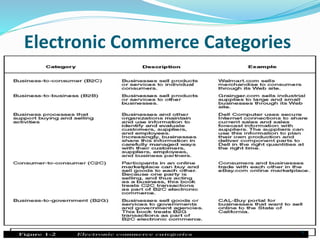
Categories of Electronic Commerce
 Five general e-commerce categories
 Business-to-consumer
 Business-to-business
 Business processes
 Consumer-to-consumer
 Business-to-government
 Supply management or procurement
 Departments devoted to negotiating purchase
transactions with suppliers
6
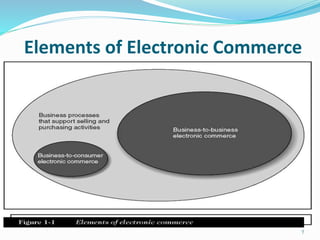
Elements of Electronic Commerce
7
Categories of Electronic Commerce (Conti..)
 Transaction
 An exchange of value
 Business processes
 The group of logical, related, and sequential
activities and transactions in which businesses
engage
 Telecommuting or Telework
 Employee logs in to company computer through
Internet instead of traveling to office
8
Electronic Commerce Categories
9
The Development and Growth of
Electronic Commerce
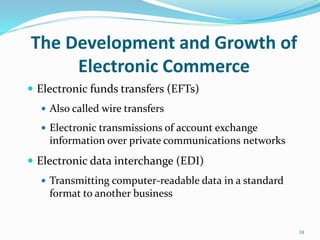
 Electronic funds transfers (EFTs)
 Also called wire transfers
 Electronic transmissions of account exchange
information over private communications networks
 Electronic data interchange (EDI)
 Transmitting computer-readable data in a standard
format to another business
10
The Development and Growth of
Electronic Commerce (Continued)
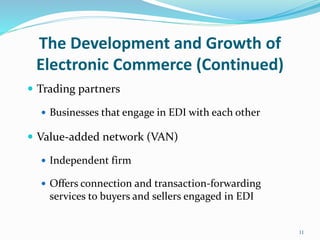
 Trading partners
 Businesses that engage in EDI with each other
 Value-added network (VAN)
 Independent firm
 Offers connection and transaction-forwarding
services to buyers and sellers engaged in EDI
11
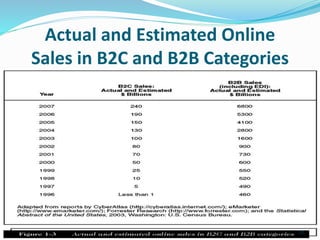
Actual and Estimated Online
Sales in B2C and B2B Categories
12
The Second Wave of Electronic
Commerce
 Defining characteristics of first wave
 Dominant influence of U.S. businesses
 Extensive use of the English language
 Low bandwidth data transmission technologies
 Unstructured use of e-mail
 Overreliance on advertising as a revenue source
13
The Second Wave of Electronic
Commerce (Continued)
 As second wave begins
 Future of electronic commerce will be international
in scope
 Language translation and handling currency
conversion problem will need to be solved
 E-mail will be used as an integral part of marketing
and customer contact strategies
14
Business Models, Revenue
Models, and Business Processes
 Business model
 A set of processes that combine to yield a profit
 Revenue model
 Used to
 Identify customers
 Market to those customers
 Generate sales to those customers
15
Focus on Specific Business
Processes
 Merchandising
 Combination of store design, layout, and product
display knowledge
 Commodity item
 Hard to distinguish from the same products or
services provided by other sellers
 Features have become standardized and well known
16
Focus on Specific Business
Processes (Continued)
 Shipping profile
 Collection of attributes that affect how easily a
product can be packaged and delivered
 High value-to-weight ratio
 Can make overall shipping cost a small fraction of
the selling price
17
Advantages of Electronic
Commerce
 Can increase sales and decrease costs
 If advertising done well on the Web
 Can get a firm’s promotional message out to potential
customers in every country
 Using e-commerce sales support and order-taking
processes, a business can
 Reduce costs of handling sales inquiries
 Provide price quotes
18
Advantages of Electronic
Commerce (Continued)
 Increases purchasing opportunities for buyer
 Negotiating price and delivery terms is easier
 The following cost less to issue and arrive securely
and quickly
 Electronic payments of tax refunds
 Public retirement
 Welfare support
19
Disadvantages of Electronic
Commerce
 Perishable grocery products are much harder to sell
online
 Difficult to
 Calculate return-on-investment
 Integrate existing databases and transaction-
processing software into software that enables e-
commerce
 Cultural and legal obstacles also exist
20
Economic Forces and Electronic
Commerce
 Economics
 Study of how people allocate scarce resources
 Two conditions of a market
 Potential sellers of a good come into contact with
potential buyers
 A medium of exchange is available
21
Transaction Costs
 Total costs that a buyer and seller incur
 Significant components of transaction costs
 Cost of information search and acquisition
 Investment of seller in equipment or in the hiring of
skilled employees to supply product or service to
buyer
22
The Role of Electronic Commerce
 Businesses and individuals
 Can use electronic commerce to reduce transaction
costs by
 Improving flow of information
 Increasing coordination of actions
23
Network Economic Structures
 Network economic structure
 Companies coordinate their strategies, resources,
and skill sets
 Strategic alliances (strategic partnerships)
 Relationships created within the network economic
structure
24
Network Economic Structures
(Continued)
 Virtual companies
 Strategic alliances that occur between or among
companies operating on the Internet
 Strategic partners
 Come together as a team for a specific project or
activity
25
Network Effects
 Law of diminishing returns
 Most activities yield less value as the amount of
consumption increases
 Network effect
 As more people or organizations participate in a
network
 Value of network to each participant increases
26
Value Chains in Electronic
Commerce
 Strategic business unit
 One particular combination of product, distribution
channel, and customer type
 Firm
 Multiple business units owned by a common set of
shareholders
 Industry
 Multiple firms that sell similar products to similar
customers
27
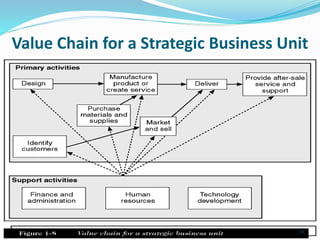
Strategic Business Unit Value
Chains
 Value chain
 A way of organizing the activities that each strategic
business unit undertakes
 Primary activities
 Design, produce, promote, market, deliver, and support
the products or services it sells
 Supporting activities
 Human resource management and purchasing
28
Value Chain for a Strategic Business Unit
29
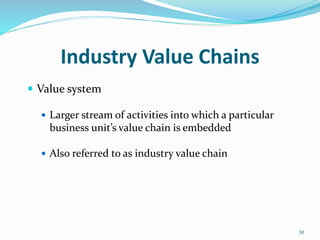
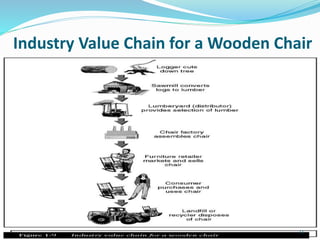
Industry Value Chains
 Value system
 Larger stream of activities into which a particular
business unit’s value chain is embedded
 Also referred to as industry value chain
30
Industry Value Chain for a Wooden Chair
31
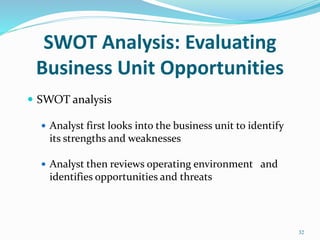
SWOT Analysis: Evaluating
Business Unit Opportunities
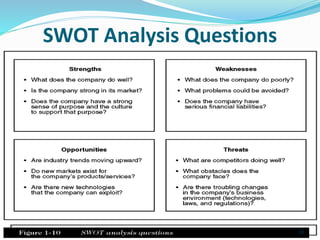
 SWOT analysis
 Analyst first looks into the business unit to identify
its strengths and weaknesses
 Analyst then reviews operating environment and
identifies opportunities and threats
32
SWOT Analysis Questions
33
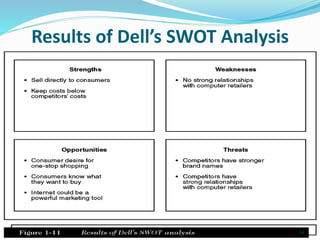
Results of Dell’s SWOT Analysis
34
International Nature of Electronic
Commerce
 Companies with established reputations
 Often create trust by ensuring that customers know
who they are
 Can rely on their established brand names to create
trust on the Web
 Customers’ inherent lack of trust in “strangers” on
the Web
 Logical and to be expected
35
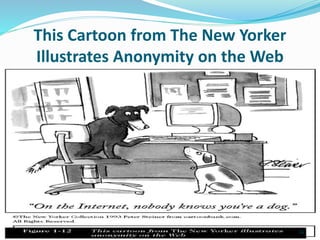
This Cartoon from The New Yorker
Illustrates Anonymity on the Web
36
Language Issues
 To do business effectively in other cultures
 Must adapt to culture
 Researchers have found that
 Customers are more likely to buy products and services
from Web sites in their own language
 Localization
 Translation that considers multiple elements of local
environment
37
Culture Issues
 Important element of business trust
 Anticipate how the other party to a transaction will act
in specific circumstances
 Culture
 Combination of language and customs
 Varies across national boundaries
 Varies across regions within nations
38
Infrastructure Issues
 Internet infrastructure includes
 Computers and software connected to Internet
 Communications networks over which message
packets travel
 Organization for Economic Cooperation and
Development’s (OECD)
 Statements on Information and Communications
Policy
 Deal with telecommunications infrastructure
development issues
39
Infrastructure Issues (Continued)
 Flat-rate access system
 Consumer or business pays one monthly fee for
unlimited telephone line usage
 Contributed to rapid rise of U.S. electronic commerce
 Targets for technological solutions
 Paperwork and processes that accompany international
transactions
40
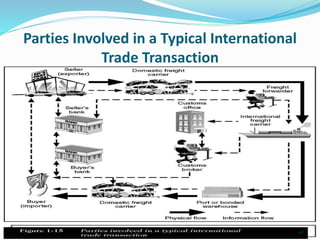
Parties Involved in a Typical International
Trade Transaction
41
Summary
 Commerce
 Negotiated exchange of goods or services
 Electronic commerce
 Application of new technologies to conduct business
more effectively
 First wave of electronic commerce
 Ended in 2000
 Second wave of electronic commerce
 New approaches to integrating Internet technologies
into business processes
42
Summary
 Using electronic commerce, businesses have
 Created new products and services
 Improved promotion, marketing, and delivery of
existing offerings
 Global nature of electronic commerce
 Leads to many opportunities and few challenges
 To conduct electronic commerce across
international borders
 You must understand the trust, cultural, and
language legal issues
43

Adp e commerce

  • 2.
    Objectives  In thischapter, you will learn about:  What electronic commerce is and how it is evolved into a second wave of growth and profitability  Why business models have given way to revenue models and the analysis of business processes as key elements of electronic commerce initiatives 2
  • 3.
    Objectives  How economicforces have created a business environment that is fostering a rebirth of electronic commerce How businesses use value chains to identify electronic commerce opportunities  How businesses use SWOT analysis to analyze and evaluate business opportunities 3
  • 4.
    Objectives  Why electroniccommerce is international by its very nature and what challenges arise in doing global electronic commerce 4
  • 5.
    Electronic Commerce: TheSecond Wave  Electronic commerce (e-commerce)  Businesses trading with other businesses and internal processes  Electronic business (e-business)  Term used interchangeably with e-commerce  The transformation of key business processes through the use of Internet technologies 5
  • 6.
    Categories of ElectronicCommerce  Five general e-commerce categories  Business-to-consumer  Business-to-business  Business processes  Consumer-to-consumer  Business-to-government  Supply management or procurement  Departments devoted to negotiating purchase transactions with suppliers 6
  • 7.
  • 8.
    Categories of ElectronicCommerce (Conti..)  Transaction  An exchange of value  Business processes  The group of logical, related, and sequential activities and transactions in which businesses engage  Telecommuting or Telework  Employee logs in to company computer through Internet instead of traveling to office 8
  • 9.
  • 10.
    The Development andGrowth of Electronic Commerce  Electronic funds transfers (EFTs)  Also called wire transfers  Electronic transmissions of account exchange information over private communications networks  Electronic data interchange (EDI)  Transmitting computer-readable data in a standard format to another business 10
  • 11.
    The Development andGrowth of Electronic Commerce (Continued)  Trading partners  Businesses that engage in EDI with each other  Value-added network (VAN)  Independent firm  Offers connection and transaction-forwarding services to buyers and sellers engaged in EDI 11
  • 12.
    Actual and EstimatedOnline Sales in B2C and B2B Categories 12
  • 13.
    The Second Waveof Electronic Commerce  Defining characteristics of first wave  Dominant influence of U.S. businesses  Extensive use of the English language  Low bandwidth data transmission technologies  Unstructured use of e-mail  Overreliance on advertising as a revenue source 13
  • 14.
    The Second Waveof Electronic Commerce (Continued)  As second wave begins  Future of electronic commerce will be international in scope  Language translation and handling currency conversion problem will need to be solved  E-mail will be used as an integral part of marketing and customer contact strategies 14
  • 15.
    Business Models, Revenue Models,and Business Processes  Business model  A set of processes that combine to yield a profit  Revenue model  Used to  Identify customers  Market to those customers  Generate sales to those customers 15
  • 16.
    Focus on SpecificBusiness Processes  Merchandising  Combination of store design, layout, and product display knowledge  Commodity item  Hard to distinguish from the same products or services provided by other sellers  Features have become standardized and well known 16
  • 17.
    Focus on SpecificBusiness Processes (Continued)  Shipping profile  Collection of attributes that affect how easily a product can be packaged and delivered  High value-to-weight ratio  Can make overall shipping cost a small fraction of the selling price 17
  • 18.
    Advantages of Electronic Commerce Can increase sales and decrease costs  If advertising done well on the Web  Can get a firm’s promotional message out to potential customers in every country  Using e-commerce sales support and order-taking processes, a business can  Reduce costs of handling sales inquiries  Provide price quotes 18
  • 19.
    Advantages of Electronic Commerce(Continued)  Increases purchasing opportunities for buyer  Negotiating price and delivery terms is easier  The following cost less to issue and arrive securely and quickly  Electronic payments of tax refunds  Public retirement  Welfare support 19
  • 20.
    Disadvantages of Electronic Commerce Perishable grocery products are much harder to sell online  Difficult to  Calculate return-on-investment  Integrate existing databases and transaction- processing software into software that enables e- commerce  Cultural and legal obstacles also exist 20
  • 21.
    Economic Forces andElectronic Commerce  Economics  Study of how people allocate scarce resources  Two conditions of a market  Potential sellers of a good come into contact with potential buyers  A medium of exchange is available 21
  • 22.
    Transaction Costs  Totalcosts that a buyer and seller incur  Significant components of transaction costs  Cost of information search and acquisition  Investment of seller in equipment or in the hiring of skilled employees to supply product or service to buyer 22
  • 23.
    The Role ofElectronic Commerce  Businesses and individuals  Can use electronic commerce to reduce transaction costs by  Improving flow of information  Increasing coordination of actions 23
  • 24.
    Network Economic Structures Network economic structure  Companies coordinate their strategies, resources, and skill sets  Strategic alliances (strategic partnerships)  Relationships created within the network economic structure 24
  • 25.
    Network Economic Structures (Continued) Virtual companies  Strategic alliances that occur between or among companies operating on the Internet  Strategic partners  Come together as a team for a specific project or activity 25
  • 26.
    Network Effects  Lawof diminishing returns  Most activities yield less value as the amount of consumption increases  Network effect  As more people or organizations participate in a network  Value of network to each participant increases 26
  • 27.
    Value Chains inElectronic Commerce  Strategic business unit  One particular combination of product, distribution channel, and customer type  Firm  Multiple business units owned by a common set of shareholders  Industry  Multiple firms that sell similar products to similar customers 27
  • 28.
    Strategic Business UnitValue Chains  Value chain  A way of organizing the activities that each strategic business unit undertakes  Primary activities  Design, produce, promote, market, deliver, and support the products or services it sells  Supporting activities  Human resource management and purchasing 28
  • 29.
    Value Chain fora Strategic Business Unit 29
  • 30.
    Industry Value Chains Value system  Larger stream of activities into which a particular business unit’s value chain is embedded  Also referred to as industry value chain 30
  • 31.
    Industry Value Chainfor a Wooden Chair 31
  • 32.
    SWOT Analysis: Evaluating BusinessUnit Opportunities  SWOT analysis  Analyst first looks into the business unit to identify its strengths and weaknesses  Analyst then reviews operating environment and identifies opportunities and threats 32
  • 33.
  • 34.
    Results of Dell’sSWOT Analysis 34
  • 35.
    International Nature ofElectronic Commerce  Companies with established reputations  Often create trust by ensuring that customers know who they are  Can rely on their established brand names to create trust on the Web  Customers’ inherent lack of trust in “strangers” on the Web  Logical and to be expected 35
  • 36.
    This Cartoon fromThe New Yorker Illustrates Anonymity on the Web 36
  • 37.
    Language Issues  Todo business effectively in other cultures  Must adapt to culture  Researchers have found that  Customers are more likely to buy products and services from Web sites in their own language  Localization  Translation that considers multiple elements of local environment 37
  • 38.
    Culture Issues  Importantelement of business trust  Anticipate how the other party to a transaction will act in specific circumstances  Culture  Combination of language and customs  Varies across national boundaries  Varies across regions within nations 38
  • 39.
    Infrastructure Issues  Internetinfrastructure includes  Computers and software connected to Internet  Communications networks over which message packets travel  Organization for Economic Cooperation and Development’s (OECD)  Statements on Information and Communications Policy  Deal with telecommunications infrastructure development issues 39
  • 40.
    Infrastructure Issues (Continued) Flat-rate access system  Consumer or business pays one monthly fee for unlimited telephone line usage  Contributed to rapid rise of U.S. electronic commerce  Targets for technological solutions  Paperwork and processes that accompany international transactions 40
  • 41.
    Parties Involved ina Typical International Trade Transaction 41
  • 42.
    Summary  Commerce  Negotiatedexchange of goods or services  Electronic commerce  Application of new technologies to conduct business more effectively  First wave of electronic commerce  Ended in 2000  Second wave of electronic commerce  New approaches to integrating Internet technologies into business processes 42
  • 43.
    Summary  Using electroniccommerce, businesses have  Created new products and services  Improved promotion, marketing, and delivery of existing offerings  Global nature of electronic commerce  Leads to many opportunities and few challenges  To conduct electronic commerce across international borders  You must understand the trust, cultural, and language legal issues 43