#CILIPConf17
Sponsored by Media partners Organised by
Literacy and Learning
Seminar
#CILIPConf17
Sponsored by Media partners Organised by
Poverty, place and low
literacy
Jason Vit, Literacy Hubs Manager,
National Literacy Trust
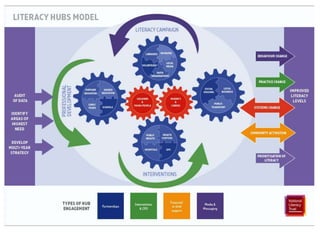
National Literacy Trust Hubs
Jason Vit - Literacy Hubs Manager
@literacy_trust
National Literacy Trust
www.literacytrust.org.uk
contact @literacytrust.org.uk
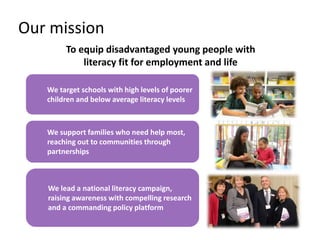
Our mission
To equip disadvantaged young people with
literacy fit for employment and life
We target schools with high levels of poorer
children and below average literacy levels
We support families who need help most,
reaching out to communities through
partnerships
We lead a national literacy campaign,
raising awareness with compelling research
and a commanding policy platform
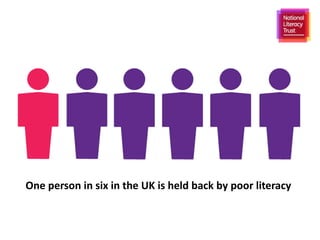
One person in six in the UK is held back by poor literacy
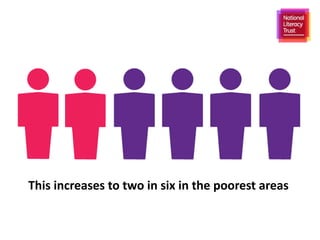
This increases to two in six in the poorest areas
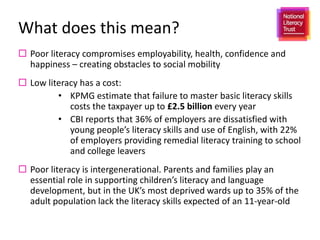
What does this mean?
 Poor literacy compromises employability, health, confidence and
happiness – creating obstacles to social mobility
 Low literacy has a cost:
• KPMG estimate that failure to master basic literacy skills
costs the taxpayer up to £2.5 billion every year
• CBI reports that 36% of employers are dissatisfied with
young people’s literacy skills and use of English, with 22%
of employers providing remedial literacy training to school
and college leavers
 Poor literacy is intergenerational. Parents and families play an
essential role in supporting children’s literacy and language
development, but in the UK’s most deprived wards up to 35% of the
adult population lack the literacy skills expected of an 11-year-old
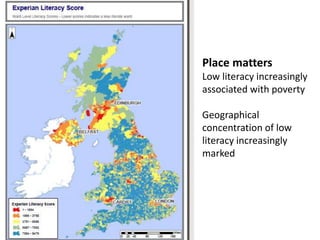
Place matters
Low literacy increasingly
associated with poverty
Geographical
concentration of low
literacy increasingly
marked
National Literacy Trust Hubs
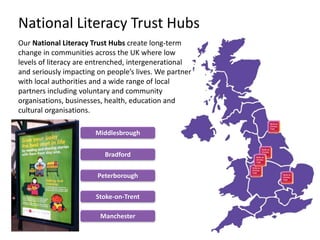
Our National Literacy Trust Hubs create long-term
change in communities across the UK where low
levels of literacy are entrenched, intergenerational
and seriously impacting on people’s lives. We partner
with local authorities and a wide range of local
partners including voluntary and community
organisations, businesses, health, education and
cultural organisations.
Middlesbrough
Peterborough
Bradford
Stoke-on-Trent
Manchester
A place-based solution to intergenerational low literacy which:
• Harnesses community assets to address poverty and joblessness through
campaigning, influencing and supporting literacy attitudes and behaviours.
• Targets wards, groups and communities most at risk of low literacy with evidence-
based interventions.
• Recognises that the child is a product of the community not just the educational
establishments.
• Builds partnerships with between local authorities, libraries, sporting and cultural
organisations, faith and voluntary community groups, as well as businesses, health
and education organisations.
• Aims to create long-term sustainability via community activation and system
change.
National Literacy Trust Hubs
A three-year independent evaluation of the Hubs has demonstrated that they have
significant impact on local literacy and social mobility priorities.
• School readiness: more children in Middlesbrough are achieving a Good Level of
Development at the end of the EYFS, closing the gap with the national average from
22.6 percentage points in 2013 to 6.27 percentage points in 2015.
• Writing: in 2015 more of Bradford’s children and young people aged 11-14 write
every day or a few times a week outside of school (52.6%), compared to their peers
regionally (39.7%) and nationally (44.1%).
• Reading: the number of KS2 pupils who enjoy reading in Peterborough has
increased by 23.4% between 2014 and 2015, rising from 59.8% in 2014 to 73.8% in
2015.
Impact
Identifying Hub areas
Defined geographic areas where there are at least three
wards with high:
Deprivation
• UK wards within most deprived 30%
Intergenerational low literacy
• Based on adult skills and early years data
Schools struggling to break the cycle
• Low attainment at school
An engaged local partner
Scope for local / regional sustainability
Examples from the Hubs
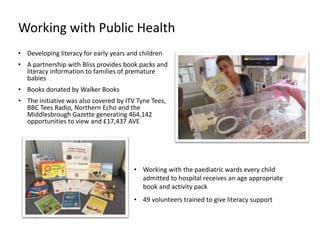
• Developing literacy for early years and children
• A partnership with Bliss provides book packs and
literacy information to families of premature
babies
• Books donated by Walker Books
• The initiative was also covered by ITV Tyne Tees,
BBC Tees Radio, Northern Echo and the
Middlesbrough Gazette generating 464,142
opportunities to view and £17,437 AVE
• Working with the paediatric wards every child
admitted to hospital receives an age appropriate
book and activity pack
• 49 volunteers trained to give literacy support
Working with Public Health
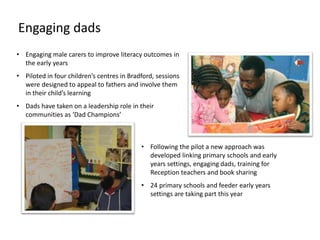
• Engaging male carers to improve literacy outcomes in
the early years
• Piloted in four children’s centres in Bradford, sessions
were designed to appeal to fathers and involve them
in their child’s learning
• Dads have taken on a leadership role in their
communities as ‘Dad Champions’
• Following the pilot a new approach was
developed linking primary schools and early
years settings, engaging dads, training for
Reception teachers and book sharing
• 24 primary schools and feeder early years
settings are taking part this year
Engaging dads
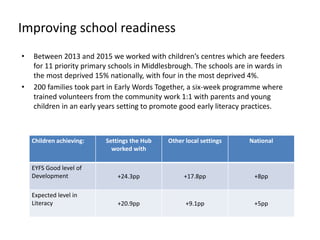
• Between 2013 and 2015 we worked with children’s centres which are feeders
for 11 priority primary schools in Middlesbrough. The schools are in wards in
the most deprived 15% nationally, with four in the most deprived 4%.
• 200 families took part in Early Words Together, a six-week programme where
trained volunteers from the community work 1:1 with parents and young
children in an early years setting to promote good early literacy practices.
Children achieving: Settings the Hub
worked with
Other local settings National
EYFS Good level of
Development +24.3pp +17.8pp +8pp
Expected level in
Literacy +20.9pp +9.1pp +5pp
Improving school readiness
• A programme with cultural and creative partners involving local performance
poets
• A full programme of lesson plan support for teachers was available
• Four setting pilot working with primary and secondary schools
% of pupils at
expected level in
writing before
programme
% of pupils at
expected level in
writing after
programme
% of pupils exceeding
expected level in
writing after
programme
Year 6 pilot group 46% 92% 36%
Year 8 pilot group 17% 40% 14%
Key Stage 2 – 3 poetry transition
We gave away free children’s books to barbers
and hairdressers in Bradford to encourage
them to ask children to read to them as they
get their haircut.
The local paper, the Telegraph & Argus
championed the idea through it’s print
newspaper and Facebook page. Asian Echo and
Bradford Council also shared the story. The
story received 500+ likes and 250+ shares on
Facebook.
Books in barbers
• We teamed up with the Telegraph
and Argus in Bradford, local
children’s centres and local role
model, the CEO of Bradford Bulls,
Robbie Hunter-Paul, to launch a
Father’s Day ‘family reading selfie’
calling out to Dads to send in a
photo of them reading to their
children.
• A selection of photos were
published on the Telegraph and
Argus’s website alongside
information on the Hub’s work
with Dads.
Father’s Day reading selfie
• Ran for four days in Peterborough
• More than 1,200 books given away
• 836,224 OTV coverage through print, online and
broadcast media and over 250,000 OTV through
social media
• This approach is now being used in four
community settings in the form of ‘Meet and Eat’
sessions
Pop up literacy shop
Bradford
Distributed across 50
early years settings and
libraries across district
including 100 First buses
and the Big Screen in
City Park.
Peterborough
Distributed across
60 early years
settings and
libraries across
district including
20 Stagecoach
buses
Middlesbrough
Distributed across all
early years settings and
primary schools. Also
displayed on bus stops,
city centre Big Screen.
And included in baby
record book for all new-
borns.
Poster campaign
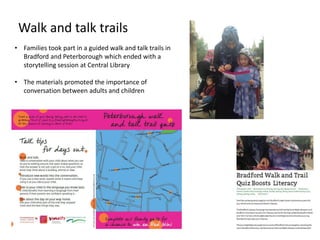
• Families took part in a guided walk and talk trails in
Bradford and Peterborough which ended with a
storytelling session at Central Library
• The materials promoted the importance of
conversation between adults and children
Walk and talk trails
National Literacy Trust Hub - impact
• Over 7 million opportunities to view key messages
• Working with more than 300 schools in Hub areas
• Achieved statistically significant increases in literacy
levels through pilot programmes, particularly early
years language development and KS2 writing
• £500,000+ of books given away for free
• More than £500,000 of literacy programmes brought
to the hub areas
contact @literacytrust.org.uk
Thank you
Jason Vit
Poverty, place and low literacy

Poverty, place and low literacy

  • 1.
    #CILIPConf17 Sponsored by Mediapartners Organised by Literacy and Learning Seminar
  • 2.
    #CILIPConf17 Sponsored by Mediapartners Organised by Poverty, place and low literacy Jason Vit, Literacy Hubs Manager, National Literacy Trust
  • 3.
    National Literacy TrustHubs Jason Vit - Literacy Hubs Manager @literacy_trust National Literacy Trust www.literacytrust.org.uk contact @literacytrust.org.uk
  • 4.
    Our mission To equipdisadvantaged young people with literacy fit for employment and life We target schools with high levels of poorer children and below average literacy levels We support families who need help most, reaching out to communities through partnerships We lead a national literacy campaign, raising awareness with compelling research and a commanding policy platform
  • 5.
    One person insix in the UK is held back by poor literacy
  • 6.
    This increases totwo in six in the poorest areas
  • 7.
    What does thismean?  Poor literacy compromises employability, health, confidence and happiness – creating obstacles to social mobility  Low literacy has a cost: • KPMG estimate that failure to master basic literacy skills costs the taxpayer up to £2.5 billion every year • CBI reports that 36% of employers are dissatisfied with young people’s literacy skills and use of English, with 22% of employers providing remedial literacy training to school and college leavers  Poor literacy is intergenerational. Parents and families play an essential role in supporting children’s literacy and language development, but in the UK’s most deprived wards up to 35% of the adult population lack the literacy skills expected of an 11-year-old
  • 8.
    Place matters Low literacyincreasingly associated with poverty Geographical concentration of low literacy increasingly marked
  • 9.
    National Literacy TrustHubs Our National Literacy Trust Hubs create long-term change in communities across the UK where low levels of literacy are entrenched, intergenerational and seriously impacting on people’s lives. We partner with local authorities and a wide range of local partners including voluntary and community organisations, businesses, health, education and cultural organisations. Middlesbrough Peterborough Bradford Stoke-on-Trent Manchester
  • 10.
    A place-based solutionto intergenerational low literacy which: • Harnesses community assets to address poverty and joblessness through campaigning, influencing and supporting literacy attitudes and behaviours. • Targets wards, groups and communities most at risk of low literacy with evidence- based interventions. • Recognises that the child is a product of the community not just the educational establishments. • Builds partnerships with between local authorities, libraries, sporting and cultural organisations, faith and voluntary community groups, as well as businesses, health and education organisations. • Aims to create long-term sustainability via community activation and system change. National Literacy Trust Hubs
  • 11.
    A three-year independentevaluation of the Hubs has demonstrated that they have significant impact on local literacy and social mobility priorities. • School readiness: more children in Middlesbrough are achieving a Good Level of Development at the end of the EYFS, closing the gap with the national average from 22.6 percentage points in 2013 to 6.27 percentage points in 2015. • Writing: in 2015 more of Bradford’s children and young people aged 11-14 write every day or a few times a week outside of school (52.6%), compared to their peers regionally (39.7%) and nationally (44.1%). • Reading: the number of KS2 pupils who enjoy reading in Peterborough has increased by 23.4% between 2014 and 2015, rising from 59.8% in 2014 to 73.8% in 2015. Impact
  • 12.
    Identifying Hub areas Definedgeographic areas where there are at least three wards with high: Deprivation • UK wards within most deprived 30% Intergenerational low literacy • Based on adult skills and early years data Schools struggling to break the cycle • Low attainment at school An engaged local partner Scope for local / regional sustainability
  • 14.
  • 15.
    • Developing literacyfor early years and children • A partnership with Bliss provides book packs and literacy information to families of premature babies • Books donated by Walker Books • The initiative was also covered by ITV Tyne Tees, BBC Tees Radio, Northern Echo and the Middlesbrough Gazette generating 464,142 opportunities to view and £17,437 AVE • Working with the paediatric wards every child admitted to hospital receives an age appropriate book and activity pack • 49 volunteers trained to give literacy support Working with Public Health
  • 16.
    • Engaging malecarers to improve literacy outcomes in the early years • Piloted in four children’s centres in Bradford, sessions were designed to appeal to fathers and involve them in their child’s learning • Dads have taken on a leadership role in their communities as ‘Dad Champions’ • Following the pilot a new approach was developed linking primary schools and early years settings, engaging dads, training for Reception teachers and book sharing • 24 primary schools and feeder early years settings are taking part this year Engaging dads
  • 17.
    • Between 2013and 2015 we worked with children’s centres which are feeders for 11 priority primary schools in Middlesbrough. The schools are in wards in the most deprived 15% nationally, with four in the most deprived 4%. • 200 families took part in Early Words Together, a six-week programme where trained volunteers from the community work 1:1 with parents and young children in an early years setting to promote good early literacy practices. Children achieving: Settings the Hub worked with Other local settings National EYFS Good level of Development +24.3pp +17.8pp +8pp Expected level in Literacy +20.9pp +9.1pp +5pp Improving school readiness
  • 18.
    • A programmewith cultural and creative partners involving local performance poets • A full programme of lesson plan support for teachers was available • Four setting pilot working with primary and secondary schools % of pupils at expected level in writing before programme % of pupils at expected level in writing after programme % of pupils exceeding expected level in writing after programme Year 6 pilot group 46% 92% 36% Year 8 pilot group 17% 40% 14% Key Stage 2 – 3 poetry transition
  • 19.
    We gave awayfree children’s books to barbers and hairdressers in Bradford to encourage them to ask children to read to them as they get their haircut. The local paper, the Telegraph & Argus championed the idea through it’s print newspaper and Facebook page. Asian Echo and Bradford Council also shared the story. The story received 500+ likes and 250+ shares on Facebook. Books in barbers
  • 20.
    • We teamedup with the Telegraph and Argus in Bradford, local children’s centres and local role model, the CEO of Bradford Bulls, Robbie Hunter-Paul, to launch a Father’s Day ‘family reading selfie’ calling out to Dads to send in a photo of them reading to their children. • A selection of photos were published on the Telegraph and Argus’s website alongside information on the Hub’s work with Dads. Father’s Day reading selfie
  • 21.
    • Ran forfour days in Peterborough • More than 1,200 books given away • 836,224 OTV coverage through print, online and broadcast media and over 250,000 OTV through social media • This approach is now being used in four community settings in the form of ‘Meet and Eat’ sessions Pop up literacy shop
  • 22.
    Bradford Distributed across 50 earlyyears settings and libraries across district including 100 First buses and the Big Screen in City Park. Peterborough Distributed across 60 early years settings and libraries across district including 20 Stagecoach buses Middlesbrough Distributed across all early years settings and primary schools. Also displayed on bus stops, city centre Big Screen. And included in baby record book for all new- borns. Poster campaign
  • 23.
    • Families tookpart in a guided walk and talk trails in Bradford and Peterborough which ended with a storytelling session at Central Library • The materials promoted the importance of conversation between adults and children Walk and talk trails
  • 24.
    National Literacy TrustHub - impact • Over 7 million opportunities to view key messages • Working with more than 300 schools in Hub areas • Achieved statistically significant increases in literacy levels through pilot programmes, particularly early years language development and KS2 writing • £500,000+ of books given away for free • More than £500,000 of literacy programmes brought to the hub areas
  • 25.

Editor's Notes

  • #4 When using this template remember to Save As . . . a new file.
  • #5 Partnership working – ROGO, BBC and others
  • #8 (less than 75% achieving Level 4b + less than 60% achieving 5 GCSE A* - C) Give examples of areas where this would apply
  • #9 This map was created for us by Experian. They
  • #10 M’Bro - e.g. Working with health services to disseminate messaging around early language and communication development.
  • #11 More on 2nd bullet point: Schools and settings are central but the Hubs assert the crucial role that the community, home and family learning environment play in a child’s development.
  • #13 (less than 75% achieving Level 4b + less than 60% achieving 5 GCSE A* - C) Give examples of areas where this would apply
  • #14 More on 2nd bullet point: Schools and settings are central but the Hubs assert the crucial role that the community, home and family learning environment play in a child’s development.
  • #16 James Cook University Hospital - Our added value – volunteers were hospital volunteers – we gave training and resources to enhance their work Extended to work with GPs and public health teams and led to reading poster campaign, led by public health in town centre
  • #17 Barbers, campaigning, reading selfies; football teams
  • #18 In Middlesbrough – 50% of the people live in wards in the bottom 20% of deprivation nationally! The number of children reaching the expected level in Communication and Language increased by 20.1 percentage points (pp) vs. an increase of 12.4pp for children in settings that did not receive Early Words Together and a national average increase of 5pp. • The increase in children reaching the expected levels in literacy was even greater, with a 20.9pp increase vs. a 9.1pp increase for children in settings that did not receive Early Words Together and a national average increase of 5pp. • The percentage of children achieving an overall Good Level of Development increased by 24.3pp vs. a 17.8pp increase for children in settings that did not receive Early Words Together and national average increase of 8pp.
  • #19 In Bradford – poetry has been the route to working with boys – especially from the South East Asian community Stage one: We took advantage of the Salik-Ul-Malook festival (an international celebration of a famous piece of Punjabi performance poetry) and linked local schools and madrasses. People from the community worked with pupils to prepare them and some had a chance to perform in front of some of the worlds most renowned performers. Stage two: Local performance poets are going into schools to work with children (impact above) and encourage poetry and performance. Including the production of a resource
  • #25 Children attending Hemlington Children’s Centre have historically been significantly below national expectations, only able to make two word utterances, immature speech, e.g. ‘me do it’, lack of understanding of book behaviours, and poor concentration and attention. The majority of children in the target EWT group were a band below expectations, functioning within 16 to 24 months when they attended the Children’s Centre. Reviewing the assessment data of these children on entry to nursery and at the end of the summer term against a control group, it is evident that the EWTchildren have made accelerated progress and from a lower starting base are now on track with expectations secure at 30-50 months. Parental engagement is 100% - attendance at phonics sessions, parent workshops Activity days Parents are confident to talk through issues with teachers Attendance for EWT children is very high Parental engagement in heading children read and recording comments is good Evidence of Dads engaging with school stronger than the control group