Introducing theLinked Data Research CentreDr. Michael Hausenblashttp://linkeddata.deri.ie
What is it about?a new cluster?a new project?a new stream?a new unit?
What is it about?No
What is it about?actually, it is about …
What is it about?YOU!
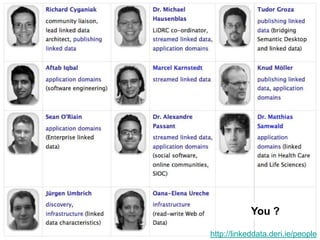
What is it about?You ?http://linkeddata.deri.ie/people
Facts & FiguresThe Linked Data Research Centre (LiDRC) is an effort to bundle activities around linked dataOperating horizontal to units, appointed to drive and lead the linked data research and developmentLaunched in June 2009Currently we are11 DERI researcher, and work together with 9 international peers
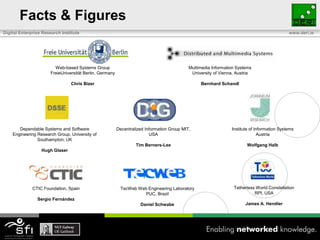
Facts & FiguresMultimedia Information SystemsUniversity of Vienna, AustriaBernhard SchandlWeb-based Systems GroupFreieUniversität Berlin, GermanyChris BizerDependable Systems and Software Engineering Research Group, University of Southampton, UKHugh GlaserDecentralized Information Group MIT, USATim Berners-LeeInstitute of Information SystemsAustriaWolfgang HalbTetherless World ConstellationRPI, USAJames A. HendlerCTIC Foundation, SpainSergio FernándezTecWeb Web Engineering LaboratoryPUC, BrazilDaniel Schwabe
Linked Data Principles* Use URIs to name things; not only documents, but also people, locations, concepts, etc. To enable agents (human users and machine agents alike) to look up those names, use HTTP URIs When someone looks up a URI we provide useful information; with 'useful' in the strict sense we usually mean structured data in RDF. Include links to other URIs allowing agents (machines and humans) to discover more things(*) http://www.w3.org/DesignIssues/LinkedData.html
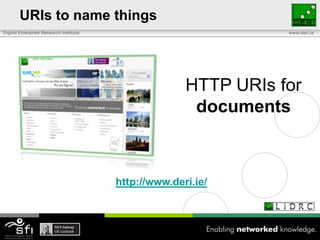
URIs to name thingsHTTP URIs fordocumentshttp://www.deri.ie/
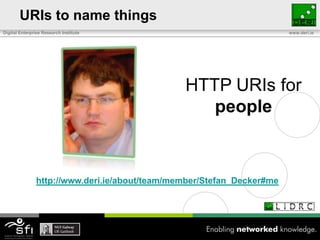
URIs to name thingsHTTP URIs forpeoplehttp://www.deri.ie/about/team/member/Stefan_Decker#me
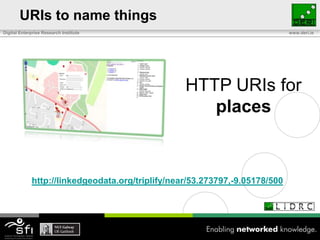
URIs to name thingsHTTP URIs forplaceshttp://linkedgeodata.org/triplify/near/53.273797,-9.05178/500
URIs to name thingsHTTP URIs forsoftwarehttp://ld2sd.deri.org/pushback/doap#pushback
URIs to name thingsHTTP URIs forabstract conceptssuch asemotionshttp://en.wikipedia.org/wiki/File:Smiley.svghttp://dbpedia.org/resource/Happiness
URIs to name things… or not so abstract …
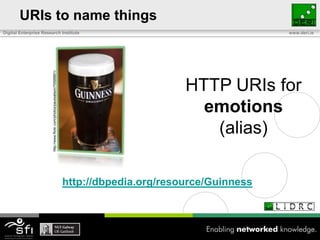
URIs to name thingsHTTP URIs foremotions(alias)http://www.flickr.com/photos/paulwatson/70589901/http://dbpedia.org/resource/Guinness
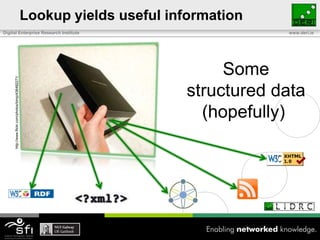
Lookup yields useful information Some structured data(hopefully)http://www.flickr.com/photos/bimp/436482271/
Link to other entities typed links==relations between entitiesand there are many relations one can think of …
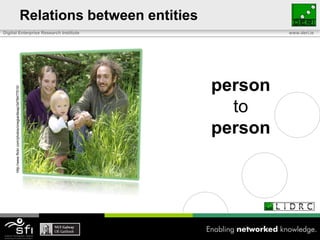
Relations between entitiespersontopersonhttp://www.flickr.com/photos/onegiantleap/3478477510/
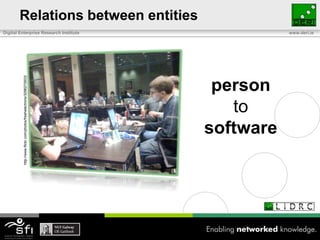
Relations between entitiespersontosoftwarehttp://www.flickr.com/photos/freshelectrons/3296272933/
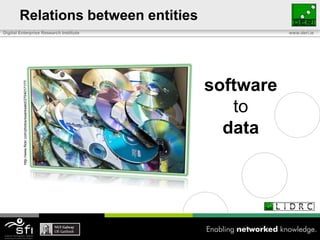
Relations between entitiessoftwaretodatahttp://www.flickr.com/photos/swanksalot/2704017177/
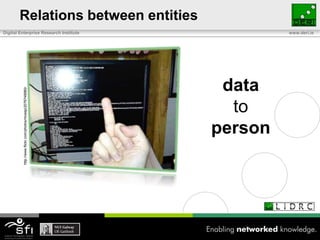
Relations between entitiesdatatopersonhttp://www.flickr.com/photos/mceep/2076748980/
Principles applied …Linked data principles, aka ‘RDF over HTTP’ are good, but they need to be appliedLinked data principles applied to… open, freely available datasets (in various source formats such as CSV, XML, etc.), such as WikipediaLinking Open Data (LOD)… enterprise data (CRM, XBRL, etc.)Enterprise linked data (eLD)… (news) feeds, sensors, etc.Streamed linked data… and what is about your domain?
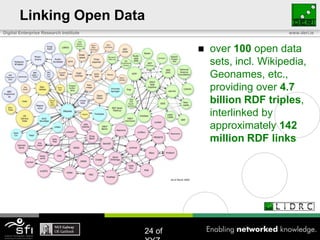
Linking Open Dataover 100 open data sets, incl. Wikipedia, Geonames, etc., providing over 4.7 billion RDF triples, interlinked by approximately 142 million RDF links24 of XYZ
So, how does it work?The LiDRC operates within so calledResearch Themes
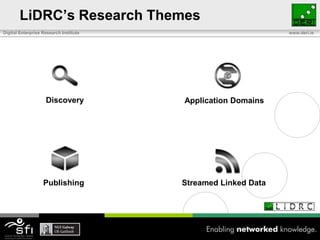
LiDRC’s Research ThemesDiscoveryApplication Domains Publishing Streamed Linked Data
LiDRC’s Research ThemesPublishing – creation, interlinking and deployment of linked dataDiscovery – finding and using linked dataApplication Domains – from specific content domains (software engineering, multimedia, etc.) to linked data driven applications)Streamed Linked Data – researches data stream such as news feeds, microblogging, RFID/sensor data, etc.
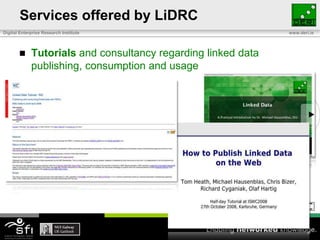
Services offered by LiDRCTutorials and consultancy regarding linked data publishing, consumption and usage
 Architecture of the World Wide Semantic Web Task Force
 Media Fragments Working Group
RDFaTask Force
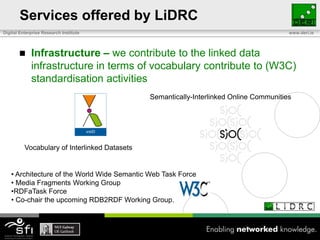
 Co-chair the upcoming RDB2RDF Working Group.Services offered by LiDRCInfrastructure – we contribute to the linked data infrastructure in terms of vocabulary contribute to (W3C) standardisation activitiesSemantically-Interlinked Online CommunitiesVocabulary of Interlinked Datasets
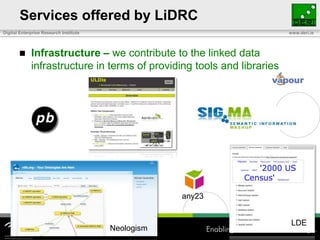
Services offered by LiDRCInfrastructure – we contribute to the linked data infrastructure in terms of providing tools and librariesany23LDENeologism

Introducing the Linked Data Research Centre

  • 1.
    Introducing theLinked DataResearch CentreDr. Michael Hausenblashttp://linkeddata.deri.ie
  • 2.
    What is itabout?a new cluster?a new project?a new stream?a new unit?
  • 3.
    What is itabout?No
  • 4.
    What is itabout?actually, it is about …
  • 5.
    What is itabout?YOU!
  • 6.
    What is itabout?You ?http://linkeddata.deri.ie/people
  • 7.
    Facts & FiguresTheLinked Data Research Centre (LiDRC) is an effort to bundle activities around linked dataOperating horizontal to units, appointed to drive and lead the linked data research and developmentLaunched in June 2009Currently we are11 DERI researcher, and work together with 9 international peers
  • 8.
    Facts & FiguresMultimediaInformation SystemsUniversity of Vienna, AustriaBernhard SchandlWeb-based Systems GroupFreieUniversität Berlin, GermanyChris BizerDependable Systems and Software Engineering Research Group, University of Southampton, UKHugh GlaserDecentralized Information Group MIT, USATim Berners-LeeInstitute of Information SystemsAustriaWolfgang HalbTetherless World ConstellationRPI, USAJames A. HendlerCTIC Foundation, SpainSergio FernándezTecWeb Web Engineering LaboratoryPUC, BrazilDaniel Schwabe
  • 9.
    Linked Data Principles*Use URIs to name things; not only documents, but also people, locations, concepts, etc. To enable agents (human users and machine agents alike) to look up those names, use HTTP URIs When someone looks up a URI we provide useful information; with 'useful' in the strict sense we usually mean structured data in RDF. Include links to other URIs allowing agents (machines and humans) to discover more things(*) http://www.w3.org/DesignIssues/LinkedData.html
  • 10.
    URIs to namethingsHTTP URIs fordocumentshttp://www.deri.ie/
  • 11.
    URIs to namethingsHTTP URIs forpeoplehttp://www.deri.ie/about/team/member/Stefan_Decker#me
  • 12.
    URIs to namethingsHTTP URIs forplaceshttp://linkedgeodata.org/triplify/near/53.273797,-9.05178/500
  • 13.
    URIs to namethingsHTTP URIs forsoftwarehttp://ld2sd.deri.org/pushback/doap#pushback
  • 14.
    URIs to namethingsHTTP URIs forabstract conceptssuch asemotionshttp://en.wikipedia.org/wiki/File:Smiley.svghttp://dbpedia.org/resource/Happiness
  • 15.
    URIs to namethings… or not so abstract …
  • 16.
    URIs to namethingsHTTP URIs foremotions(alias)http://www.flickr.com/photos/paulwatson/70589901/http://dbpedia.org/resource/Guinness
  • 17.
    Lookup yields usefulinformation Some structured data(hopefully)http://www.flickr.com/photos/bimp/436482271/
  • 18.
    Link to otherentities typed links==relations between entitiesand there are many relations one can think of …
  • 19.
  • 20.
  • 21.
  • 22.
  • 23.
    Principles applied …Linkeddata principles, aka ‘RDF over HTTP’ are good, but they need to be appliedLinked data principles applied to… open, freely available datasets (in various source formats such as CSV, XML, etc.), such as WikipediaLinking Open Data (LOD)… enterprise data (CRM, XBRL, etc.)Enterprise linked data (eLD)… (news) feeds, sensors, etc.Streamed linked data… and what is about your domain?
  • 24.
    Linking Open Dataover100 open data sets, incl. Wikipedia, Geonames, etc., providing over 4.7 billion RDF triples, interlinked by approximately 142 million RDF links24 of XYZ
  • 25.
    So, how doesit work?The LiDRC operates within so calledResearch Themes
  • 26.
    LiDRC’s Research ThemesDiscoveryApplicationDomains Publishing Streamed Linked Data
  • 27.
    LiDRC’s Research ThemesPublishing– creation, interlinking and deployment of linked dataDiscovery – finding and using linked dataApplication Domains – from specific content domains (software engineering, multimedia, etc.) to linked data driven applications)Streamed Linked Data – researches data stream such as news feeds, microblogging, RFID/sensor data, etc.
  • 28.
    Services offered byLiDRCTutorials and consultancy regarding linked data publishing, consumption and usage
  • 29.
    Architecture ofthe World Wide Semantic Web Task Force
  • 30.
    Media FragmentsWorking Group
  • 31.
  • 32.
    Co-chair theupcoming RDB2RDF Working Group.Services offered by LiDRCInfrastructure – we contribute to the linked data infrastructure in terms of vocabulary contribute to (W3C) standardisation activitiesSemantically-Interlinked Online CommunitiesVocabulary of Interlinked Datasets
  • 33.
    Services offered byLiDRCInfrastructure – we contribute to the linked data infrastructure in terms of providing tools and librariesany23LDENeologism