Open Data IrelandFrom Research to PracticeMichael Hausenblas, DERI, NUI GalwayIreland’s First Open Data 18-hr ChallengeDublin, July 2011
?
awareness
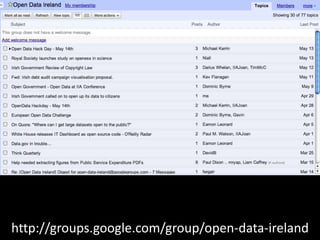
http://groups.google.com/group/open-data-ireland
data sources
publish
CSV
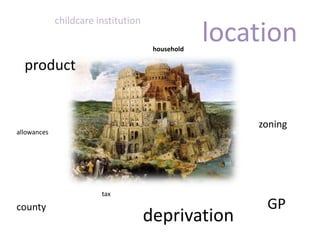
locationchildcare institutionhouseholdproductzoningallowancestaxGPcountydeprivation
apps
Open Data Ireland - from research to practice

Open Data Ireland - from research to practice

Editor's Notes

  • #2 michael.hausenblas@deri.org | @mhausenblason Twitter | http://profiles.google.com/Michael.Hausenblas on Google+
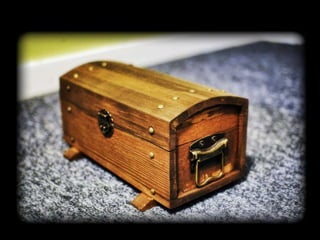
  • #3 You’re likely sitting on a treasure chest …
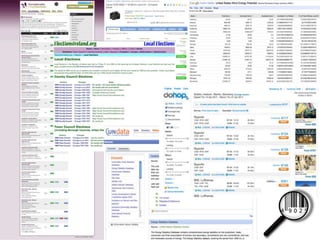
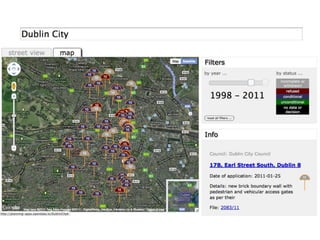
  • #4 … and the treasure is the data: - about energy usage, election data, products, geographical data, flights, development data, emissions, water quality, waste management, planning applications, education, etc.
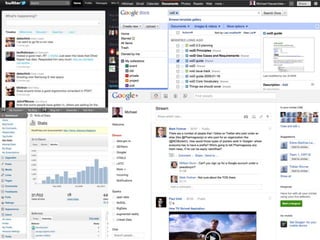
  • #5 But people don’t like data, what people like and use are applications. Applications produce, consume, manipulate, distribute, store, search, access … and sometimes destroy data.
  • #6 But how do we get applications out of the data, and, for starters … how do we get the data?
  • #7 Who of you knows this fellow here? I’d like to think of him as a data superstar. His name is Hans Rosling and he is a Swedish guy who deals mainly with statistical data.He coined a term for this problem: the so called database hugging disorder.Meaning: people and institutions, even if they are aware of their data, tend to not share it or hide it in applications.
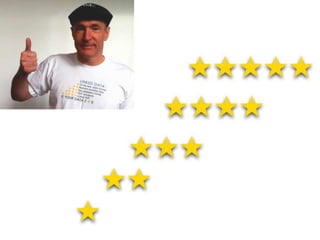
  • #8 Tim Berner’s Lee 5-star plan …★ Make your data available on the Web under an open license★★ Make it available as structured data(Excel sheet instead of image scan of a table) ★★★ Use a non-proprietary format (CSV file instead of an Excel sheet) ★★★★ Use Linked Data format (URIs to identify things, structured data such as in microdata, Atom/OData, RDF to represent data)★★★★★ Link your data to otherpeople’s data to provide context
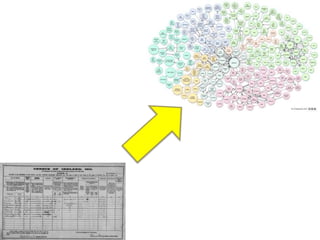
  • #9 Stepwise migration from inaccessible, locked-down data sources to open, publicly available, structured and ‘pre-integrated’ data sources.
  • #10 So, how do we really get there? How do we get the data out of the wallet gardens?
  • #11 People need to be able to come together (also virtually) and exchange thoughts, ideas, etc.
  • #12 … they need to see what others do about it.
  • #13 Where do we get the data from?
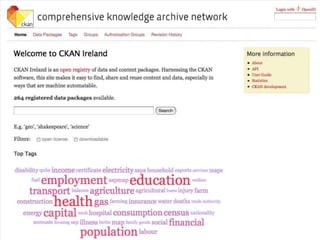
  • #14 You might be lucky and find already some data,for example, via http://ie.ckan.net/
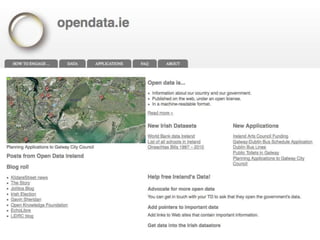
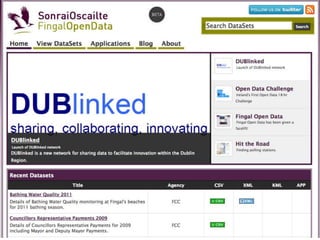
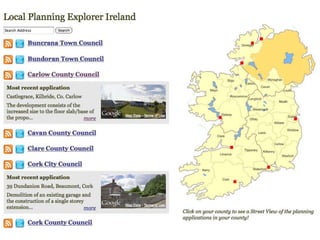
  • #15 … or local data catalogs …
  • #16 … but typically you need to invest a bit into freeing the data ;)
  • #17 And how do we make the data available?
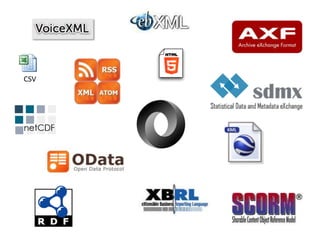
  • #18 You might need to think about in which format you make your data available … there are quite some to choose from.
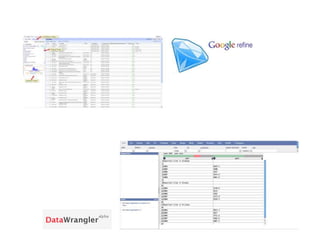
  • #19 And of course you’ll need some tools for cleaning and publishing the data …
  • #20 But there is another problem we’re facing … how to represent and exchange the terms we’re talking about …
  • #21 No matter if we’re looking at the public sector or in the industry … we need to express the terms and the relationships between the terms
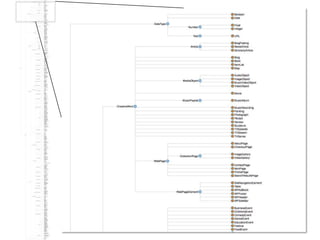
  • #22 Schema.org, introduced in June 2011 by the ‘big three’, mainly for SEO …
  • #23 A collection of terms (some 300 concepts and 200 properties or relations between the concepts)
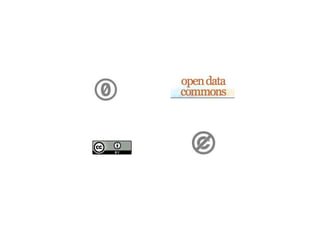
  • #24 Ah, and don’t forget … we’re talking about OPEN data, so a clear license does matter.
  • #25 What’s next? Build applications!