Introducing Agile to the
             Enterprise
 Getting your company to give up the Gantt
chart and learn to love software development
Who Am I?
• Kendall Miller
• One of the Founders of Gibraltar Software
   – Small Independent Software Vendor Founded in 2008
   – Developers of VistaDB and Gibraltar
   – Engineers, not Sales People
• Enterprise Systems Architect & Developer since 1995
• BSE in Computer Engineering, University of Illinois
  Urbana-Champaign (UIUC)
• Twitter: @KendallMiller
What Do We Do?

The easy-to-deploy, SQL Server-
compatible, pure .NET embedded database.


Advanced logging and analysis of
errors, performance, and usage patterns for
.NET web apps, desktop apps and services
Fair Warning
Development
   Team
Development
   Team
Why Agile?
Why Agile?
•   No idea or control over cost or schedule
•   Constant rework and re-testing
•   Ongoing distractions
•   Contention between business units
Agile Manifesto


Individuals and Interactions
    Processes and Tools
Agile Manifesto


Working Software
 Comprehensive
 Documentation
Agile Manifesto


Customer Collaboration
 Contract Negotiation
Agile Manifesto


Responding to Change
  Following a Plan
Hard Stop


Agile Isn’t Coding Without
 a Plan or Requirements
“I love that you were able to demo
functionality so early on and make the
  changes we wanted. Now you just
    need to tell us exactly when the
     remaining functionality will be
               completed”
               - A Senior Program Manager
“You built exactly what we asked
 for, but now that we see it, it’s all
wrong. Can you do redo it in the next
            two weeks?..

.. Why can’t you say when everything
         else will get done?”
            - A Senior Customer Stakeholder
Business Goals
•   Create and Follow a Plan
•   Predictable Cost and Schedule
•   Clear agreements between parties
•   Clear accountability
•   Easy status reporting and monitoring
How’d We Get Here?
How’d we get here?

     Control Cost through
      Eliminating Waste
• Code once
• Test once
• Don’t code unnecessary stuff
How’d we get here?

  Processes Embody a
Method to Achieve A Goal
Follow the process and you can’t help but
            achieve the goal
How’d we get here?

  Processes are a Surrogate
        for the Goal
• Hard to argue against doing things
• No one is really sure what would happen
  if they were changed or removed
How’d we get here?


Processes Stand In for Trust
• I can trust the Process not the People
• We can Blame the Process
• Easier than doing the hard work of
  Managing your People
Hard Stop


Political Problems Can’t be
Solved with your Software
  Development Process
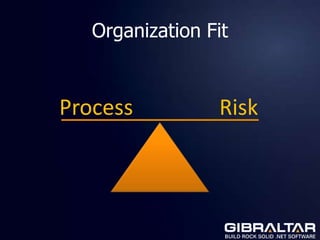
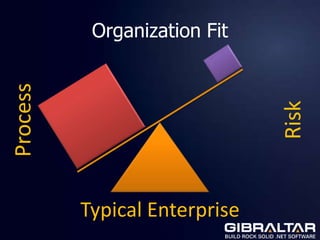
Organization Fit


Process          Risk
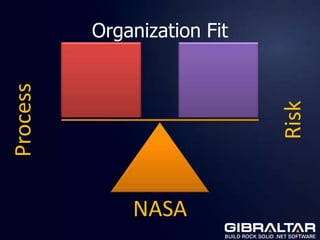
Process   Organization Fit


                             Risk
              NASA
Process    Organization Fit


                               Risk
          Typical Enterprise
Hard Stop


  The higher the P/R
   ratio, the more
management Buy-in you
      must have
Is Agile a Fit for my Shop?
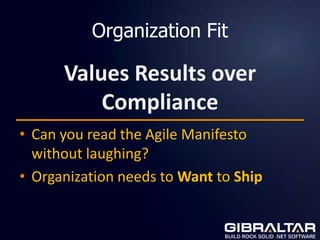
Organization Fit

      Values Results over
          Compliance
• Can you read the Agile Manifesto
  without laughing?
• Organization needs to Want to Ship
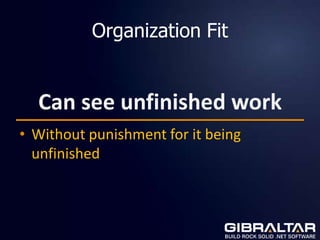
Organization Fit


  Can see unfinished work
• Without punishment for it being
  unfinished
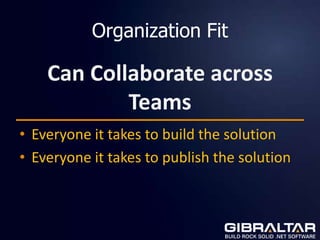
Organization Fit

    Can Collaborate across
            Teams
• Everyone it takes to build the solution
• Everyone it takes to publish the solution
Organization Fit


        How Much Trust?
• Find a project team that has the trust of
  the business and go with them first.
• Less trust requires more formal
  agreements (until Agile is impossible)
Hard Stop


If you can’t find the Team
  and the Project, it’s the
       wrong Time.
Selling Agile to the Business
Agile Selling Points

You Will get Everything you
           Need
• We’re working on your most important
  items (says you) each sprint
Agile Selling Points

  You have a Buying Choice
        every Sprint
• If it’s good enough, we can stop
• If it’s no longer a good investment, we
  can stop
Agile Selling Points


  We can change on a dime
• How often does your business climate
  change?
• How transformative is the project?
Agile Selling Points

   No surprises on what it
            does
• No disappointment it isn’t all you hoped
  for
Agile Selling Points

    Build confidence in the
Solution instead of the Process
• No disappointment it isn’t all you hoped
  for
• Nothing beats real users with real data
  on real servers
Things that Don’t Sell
Agile Selling Points that Fail


            Lower Cost
• Visible rework and chaos
Agile Selling Points that Fail


           Done Sooner
• You can’t give them date certainty
• Iterations instead of measure twice cut
  once
Agile Selling Points that Fail


   Higher Quality Solution
• Quality is subjective
• Businesses rarely prioritize User
  Experience over Cost & Schedule
Ways Teams Sabotage Agile
Agile Anti-Patterns for Devs


Not providing a Project Plan
• Track interactions between development
  and external dependencies
• Team, not individual assignments
• Externally observable results
Agile Anti-Patterns for Devs


 Making Waterfall Promises
• Work out rolling UAT options
• Buffer external dependencies
• Evangelize advantages of rapid iterations
Agile Anti-Patterns for Devs

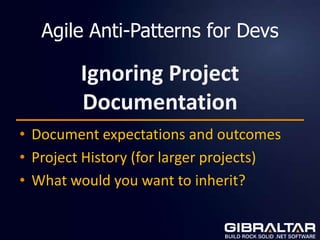
         Ignoring Project
         Documentation
• Document expectations and outcomes
• Project History (for larger projects)
• What would you want to inherit?
Agile Anti-Patterns for Devs

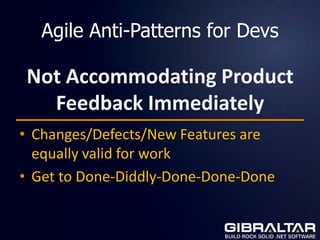
Not Accommodating Product
  Feedback Immediately
• Changes/Defects/New Features are
  equally valid for work
• Get to Done-Diddly-Done-Done-Done
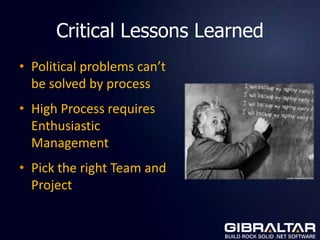
Critical Lessons Learned
• Political problems can’t
  be solved by process
• High Process requires
  Enthusiastic
  Management
• Pick the right Team and
  Project
Additional Information:
   Websites
      – www.GibraltarSoftware.com
      – www.eSymmetrix.com

   Follow Up
      – Kendall.Miller@eSymmetrix.com
      – Twitter: kendallmiller

Introducing Agile to the Enterprise

  • 1.
    Introducing Agile tothe Enterprise Getting your company to give up the Gantt chart and learn to love software development
  • 2.
    Who Am I? •Kendall Miller • One of the Founders of Gibraltar Software – Small Independent Software Vendor Founded in 2008 – Developers of VistaDB and Gibraltar – Engineers, not Sales People • Enterprise Systems Architect & Developer since 1995 • BSE in Computer Engineering, University of Illinois Urbana-Champaign (UIUC) • Twitter: @KendallMiller
  • 3.
    What Do WeDo? The easy-to-deploy, SQL Server- compatible, pure .NET embedded database. Advanced logging and analysis of errors, performance, and usage patterns for .NET web apps, desktop apps and services
  • 4.
  • 5.
  • 6.
  • 7.
  • 8.
    Why Agile? • No idea or control over cost or schedule • Constant rework and re-testing • Ongoing distractions • Contention between business units
  • 9.
    Agile Manifesto Individuals andInteractions Processes and Tools
  • 10.
    Agile Manifesto Working Software Comprehensive Documentation
  • 11.
  • 12.
    Agile Manifesto Responding toChange Following a Plan
  • 13.
    Hard Stop Agile Isn’tCoding Without a Plan or Requirements
  • 14.
    “I love thatyou were able to demo functionality so early on and make the changes we wanted. Now you just need to tell us exactly when the remaining functionality will be completed” - A Senior Program Manager
  • 15.
    “You built exactlywhat we asked for, but now that we see it, it’s all wrong. Can you do redo it in the next two weeks?.. .. Why can’t you say when everything else will get done?” - A Senior Customer Stakeholder
  • 16.
    Business Goals • Create and Follow a Plan • Predictable Cost and Schedule • Clear agreements between parties • Clear accountability • Easy status reporting and monitoring
  • 17.
  • 18.
    How’d we gethere? Control Cost through Eliminating Waste • Code once • Test once • Don’t code unnecessary stuff
  • 19.
    How’d we gethere? Processes Embody a Method to Achieve A Goal Follow the process and you can’t help but achieve the goal
  • 20.
    How’d we gethere? Processes are a Surrogate for the Goal • Hard to argue against doing things • No one is really sure what would happen if they were changed or removed
  • 21.
    How’d we gethere? Processes Stand In for Trust • I can trust the Process not the People • We can Blame the Process • Easier than doing the hard work of Managing your People
  • 22.
    Hard Stop Political ProblemsCan’t be Solved with your Software Development Process
  • 23.
  • 24.
    Process Organization Fit Risk NASA
  • 25.
    Process Organization Fit Risk Typical Enterprise
  • 26.
    Hard Stop The higher the P/R ratio, the more management Buy-in you must have
  • 27.
    Is Agile aFit for my Shop?
  • 28.
    Organization Fit Values Results over Compliance • Can you read the Agile Manifesto without laughing? • Organization needs to Want to Ship
  • 29.
    Organization Fit Can see unfinished work • Without punishment for it being unfinished
  • 30.
    Organization Fit Can Collaborate across Teams • Everyone it takes to build the solution • Everyone it takes to publish the solution
  • 31.
    Organization Fit How Much Trust? • Find a project team that has the trust of the business and go with them first. • Less trust requires more formal agreements (until Agile is impossible)
  • 32.
    Hard Stop If youcan’t find the Team and the Project, it’s the wrong Time.
  • 33.
    Selling Agile tothe Business
  • 34.
    Agile Selling Points YouWill get Everything you Need • We’re working on your most important items (says you) each sprint
  • 35.
    Agile Selling Points You have a Buying Choice every Sprint • If it’s good enough, we can stop • If it’s no longer a good investment, we can stop
  • 36.
    Agile Selling Points We can change on a dime • How often does your business climate change? • How transformative is the project?
  • 37.
    Agile Selling Points No surprises on what it does • No disappointment it isn’t all you hoped for
  • 38.
    Agile Selling Points Build confidence in the Solution instead of the Process • No disappointment it isn’t all you hoped for • Nothing beats real users with real data on real servers
  • 39.
  • 40.
    Agile Selling Pointsthat Fail Lower Cost • Visible rework and chaos
  • 41.
    Agile Selling Pointsthat Fail Done Sooner • You can’t give them date certainty • Iterations instead of measure twice cut once
  • 42.
    Agile Selling Pointsthat Fail Higher Quality Solution • Quality is subjective • Businesses rarely prioritize User Experience over Cost & Schedule
  • 43.
  • 44.
    Agile Anti-Patterns forDevs Not providing a Project Plan • Track interactions between development and external dependencies • Team, not individual assignments • Externally observable results
  • 45.
    Agile Anti-Patterns forDevs Making Waterfall Promises • Work out rolling UAT options • Buffer external dependencies • Evangelize advantages of rapid iterations
  • 46.
    Agile Anti-Patterns forDevs Ignoring Project Documentation • Document expectations and outcomes • Project History (for larger projects) • What would you want to inherit?
  • 47.
    Agile Anti-Patterns forDevs Not Accommodating Product Feedback Immediately • Changes/Defects/New Features are equally valid for work • Get to Done-Diddly-Done-Done-Done
  • 48.
    Critical Lessons Learned •Political problems can’t be solved by process • High Process requires Enthusiastic Management • Pick the right Team and Project
  • 49.
    Additional Information: Websites – www.GibraltarSoftware.com – www.eSymmetrix.com Follow Up – Kendall.Miller@eSymmetrix.com – Twitter: kendallmiller

Editor's Notes

  • #5 We are not going to talk about various Agile processes or their detailed implementationThe focus is on what it takes to get your organization to give you the right shot to put Agile into practice
  • #6 We often think about why the development team wants Agile and what it does for the organizationFrom OUR perspective
  • #7 But what really matters is how it looks from the company’s perspective
  • #8 As a development team we like agile because it:Creates a process built around uncertaintyEnsure what gets built matters
  • #13 Don’t Forget: it’s not that we don’t value the things on the bottom, it’s that we value the things on the top MORE
  • #17 When you survey businesses about what they want from projects (software or otherwise), here’s what they respond.
  • #19 They think they get all of this from Waterfall.
  • #21 It was all reasonable as it wentWhy can’t you know how long to do x? Everyone else can say..In the inches it’s hard to argue against each item, have you ever answered “What are we going to do to make sure this never happens again?”No one is sure what happens if processes are changed:The implications are lost as the process is codifiedProcesses have side effects these become an “unknown unknown” risk
  • #29 Any part of the organization that is not incentivized to ship will have no reason to take on the risk of change
  • #30 Any part of the organization that is not incentivized to ship will have no reason to take on the risk of change
  • #45 They still are the benchmark for tracking external dependencies and interacting with parties that are not operating in an Agile mode.
  • #46 “Sure, we can accommodate that feedback and not change the schedule”Treating sprints as fixed scope & scheduleLeaving UAT to the End
  • #48 False Progress“Revision Sprints” or other BSEach Story should be D5 to move on.