Puppet for
    Dummies
    ZendCon - October 2011
    Santa Clara - United States


http://joind.in/3781
Who am I?


   Joshua Thijssen
   Senior Software Engineer @ Enrise (Netherlands)

   Development in PHP, Python, Perl, C, Java,
   and System & DB admin.


   Blog:    http://adayinthelifeof.nl
   Email:   joshua@enrise.com
   Twitter: @jaytaph


http://www.flickr.com/photos/akrabat/5422369749/in/photostream/
Joind.in


‣ http://joind.in/3781
The question of the day


  What is puppet and why should I care?
Why should I care?


 “People are finally figuring out puppet
 and how it gets you to the pub by 4pm.

 Note that I’ve been at this pub since
 2pm.”
                                 - Jorge Castro
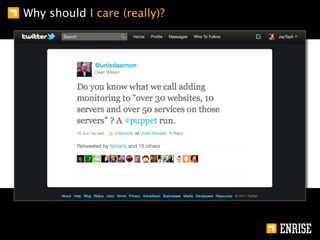
Why should I care (really)?
What is puppet?


     Puppet is a (not necessarily the)
    solution for the following problem:

 How do we setup, manage, synchronize,
  and upgrade our internal and external
            infrastructure?
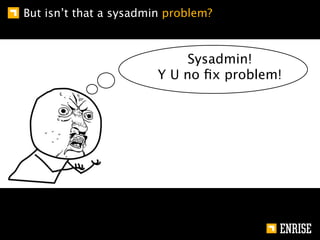
But isn’t that a sysadmin problem?


                             Sysadmin!
                        Y U no fix problem!
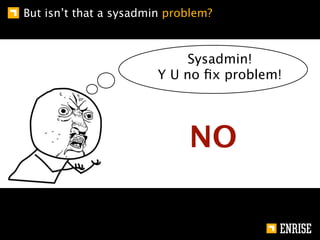
But isn’t that a sysadmin problem?


                             Sysadmin!
                        Y U no fix problem!


                             NO
What is puppet?


                  LAMP-stack
What is puppet?


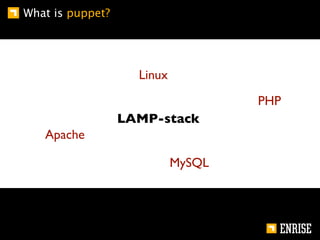
                    Linux
                                    PHP
                  LAMP-stack
   Apache

                            MySQL
What is puppet?


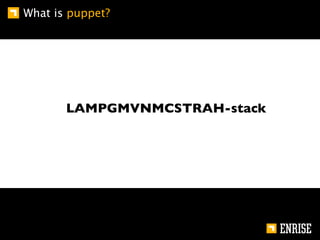
       LAMPGMVNMCSTRAH-stack
What is puppet?


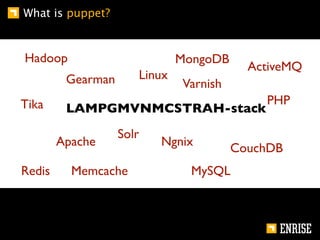
Hadoop                        MongoDB
                                          ActiveMQ
         Gearman      Linux
                              Varnish
Tika                                        PHP
         LAMPGMVNMCSTRAH-stack
                   Solr
        Apache            Ngnix         CouchDB
Redis     Memcache              MySQL
How do we manage our infrastructure?


 ‣ Solution 1: We don’t,
How do we manage our infrastructure?


 ‣ Solution 1: We don’t,
 ‣ Solution 2: We outsource,
How do we manage our infrastructure?


 ‣ Solution 1: We don’t,
 ‣ Solution 2: We outsource,
 ‣ Solution 3: We automate the process.
How do we manage our infrastructure? (1)


‣ Solution 1: we don’t
How do we manage our infrastructure? (1)


   ‣ It’s not funny: you find it more often
     than not. Especially inside small
     development companies.


‣ Solution 1: we don’t
How do we manage our infrastructure? (1)


   ‣ It’s not funny: you find it more often
     than not. Especially inside small
     development companies.
   ‣ Internal sysadmin, but he’s too busy
     with development to do sysadmin.


‣ Solution 1: we don’t
How do we manage our infrastructure? (1)


   ‣ It’s not funny: you find it more often
     than not. Especially inside small
     development companies.
   ‣ Internal sysadmin, but he’s too busy
     with development to do sysadmin.
   ‣ We only act on escalation


‣ Solution 1: we don’t
How do we manage our infrastructure? (1)


   ‣ It’s not funny: you find it more often
     than not. Especially inside small
     development companies.
   ‣ Internal sysadmin, but he’s too busy
     with development to do sysadmin.
   ‣ We only act on escalation
   ‣ reactive, not proactive

‣ Solution 1: we don’t
How do we manage our infrastructure? (2)


‣ Solution 2: we outsource
How do we manage our infrastructure? (2)


   ‣ Expensive $LA’s.


‣ Solution 2: we outsource
How do we manage our infrastructure? (2)


   ‣ Expensive $LA’s.
   ‣ What about INTERNAL servers like
     your development systems and
     infrastructure?


‣ Solution 2: we outsource
How do we manage our infrastructure? (2)


   ‣ Expensive $LA’s.
   ‣ What about INTERNAL servers like
     your development systems and
     infrastructure?
   ‣ Fight between stability and agility.


‣ Solution 2: we outsource
How do we manage our infrastructure? (2)


   ‣ Expensive $LA’s.
   ‣ What about INTERNAL servers like
     your development systems and
     infrastructure?
   ‣ Fight between stability and agility.
   ‣ Does your hosting company decide
     on whether you can use PHP5.3???

‣ Solution 2: we outsource
How do we manage our infrastructure? (3)


‣ Solution 3: we do it ourselves and automate
How do we manage our infrastructure? (3)


   ‣ We are in charge.


‣ Solution 3: we do it ourselves and automate
How do we manage our infrastructure? (3)


   ‣ We are in charge.
   ‣ You can do what you like


‣ Solution 3: we do it ourselves and automate
How do we manage our infrastructure? (3)


   ‣ We are in charge.
   ‣ You can do what you like
   ‣ Use: cfEngine, chef, puppet.


‣ Solution 3: we do it ourselves and automate
How do we manage our infrastructure? (3)


   ‣ We are in charge.
   ‣ You can do what you like
   ‣ Use: cfEngine, chef, puppet.
   ‣ When done right, maintenance
     should not be difficult.


‣ Solution 3: we do it ourselves and automate
What is puppet?


‣ PUPPET TO THE RESCUE
What is puppet?


 ‣ Open source configuration
   management tool.
 ‣ Written in Ruby
 ‣ Open source:
   https://github.com/puppetlabs
 ‣ Commercial version available
   (puppet enterprise)
What is puppet?


                                                       ¹
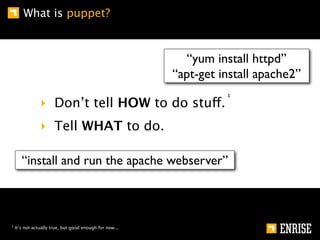
             ‣ Don’t tell HOW to do stuff.
             ‣ Tell WHAT to do.


¹ It’s not actually true, but good enough for now...
What is puppet?


                                                         “yum install httpd”
                                                       “apt-get install apache2”
                                                                 ¹
             ‣ Don’t tell HOW to do stuff.
             ‣ Tell WHAT to do.

    “install and run the apache webserver”


¹ It’s not actually true, but good enough for now...
Architectural overview


                     Puppet
Architectural overview


                              Puppet
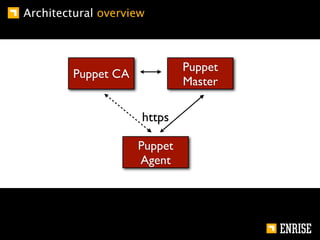
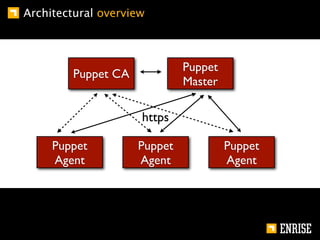
         Puppet CA
                              Master

                     https

                     Puppet
                     Agent
Architectural overview


                              Puppet
         Puppet CA
                              Master

                     https

     Puppet          Puppet            Puppet
     Agent           Agent             Agent
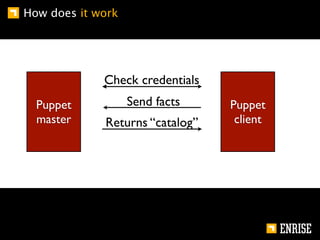
How does it work


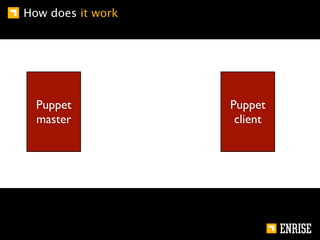
  Puppet           Puppet
  master            client
How does it work


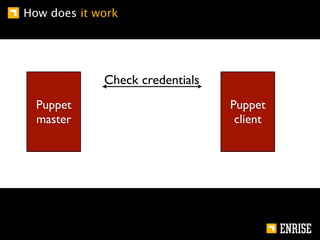
             Check credentials
  Puppet                         Puppet
  master                          client
How does it work


             Check credentials
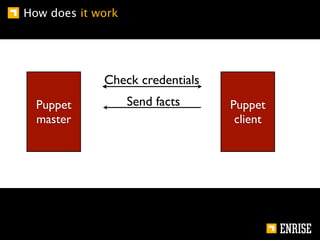
  Puppet           Send facts    Puppet
  master                          client
How does it work


             Check credentials
  Puppet           Send facts    Puppet
  master     Returns “catalog”    client
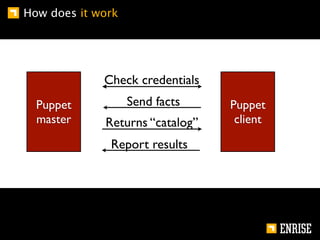
How does it work


             Check credentials
  Puppet           Send facts    Puppet
  master     Returns “catalog”    client

              Report results
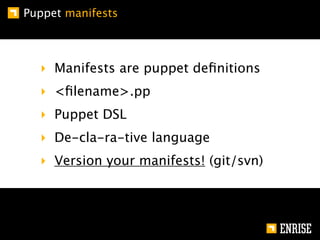
Puppet manifests


  ‣ Manifests are puppet definitions
  ‣ <filename>.pp
  ‣ Puppet DSL
  ‣ De-cla-ra-tive language
  ‣ Version your manifests! (git/svn)
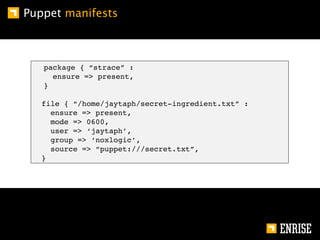
Puppet manifests


   package { “strace” :
     ensure => present,
   }

   file { “/home/jaytaph/secret-ingredient.txt” :
     ensure => present,
     mode => 0600,
     user => ‘jaytaph’,
     group => ‘noxlogic’,
     source => “puppet:///secret.txt”,
   }
Puppet manifests


      package { “httpd” :
        ensure => present,
      }

      service { “httpd”:
        running => true,
        enable => true,
        require => Package[“httpd”],
      }


‣ Spot the problem....
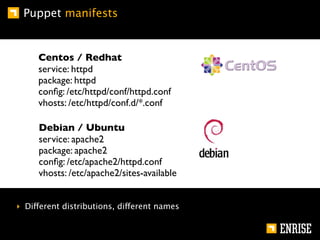
Puppet manifests


     Centos / Redhat
     service: httpd
     package: httpd
     config: /etc/httpd/conf/httpd.conf
     vhosts: /etc/httpd/conf.d/*.conf

     Debian / Ubuntu
     service: apache2
     package: apache2
     config: /etc/apache2/httpd.conf
     vhosts: /etc/apache2/sites-available


‣ Different distributions, different names
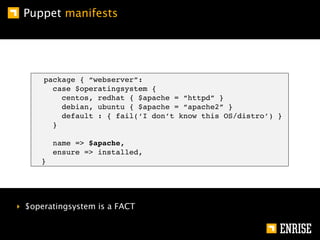
Puppet manifests


      package { “webserver”:
        case $operatingsystem {
          centos, redhat { $apache = “httpd” }
          debian, ubuntu { $apache = “apache2” }
          default : { fail(‘I don’t know this OS/distro’) }
        }

         name => $apache,
         ensure => installed,
     }


‣ $operatingsystem is a FACT
Facter


[root@puppetnode1 ~]# facter --puppet
architecture => x86_64
fqdn => puppetnode1.noxlogic.local
interfaces => eth1,eth2,lo
ipaddress_eth1 => 192.168.1.114
ipaddress_eth2 => 192.168.56.200
kernel => Linux
kernelmajversion => 2.6
operatingsystem => CentOS
operatingsystemrelease => 6.0
processor0 => Intel(R) Core(TM)2 Duo CPU             T7500   @ 2.20GHz
puppetversion => 2.6.9


‣ A simple list with info (also useable in your own tools)
Puppet manifests


  /etc/puppet/manifests/site.pp:
  node default {
    $def_packages = [ “mc”, “strace”, “sysstat” ]
    package { $def_packages :
      ensure => latest,
    }
  }


‣ “Main” manifest
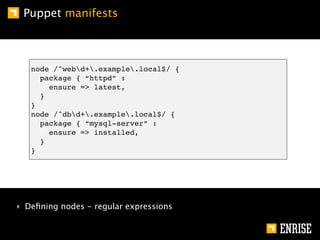
Puppet manifests


   node /^webd+.example.local$/ {
     package { “httpd” :
       ensure => latest,
     }
   }
   node /^dbd+.example.local$/ {
     package { “mysql-server” :
       ensure => installed,
     }
   }


‣ Defining nodes - regular expressions
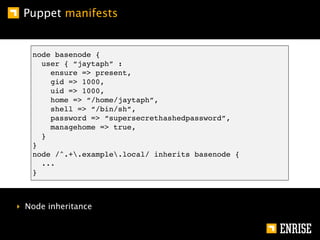
Puppet manifests


   node basenode {
     user { “jaytaph” :
       ensure => present,
       gid => 1000,
       uid => 1000,
       home => “/home/jaytaph”,
       shell => “/bin/sh”,
       password => “supersecrethashedpassword”,
       managehome => true,
     }
   }
   node /^.+.example.local/ inherits basenode {
     ...
   }


‣ Node inheritance
Puppet manifests


‣ Group together into a class
Puppet manifests


      class webserver {
        service { “apache”:
          ensure => running,
          require => Package[“apache”],
       }
       package { “apache” :
          ensure => installed,
       }


      }


‣ Group together into a class
Puppet manifests


      class webserver {
        service { “apache”:
          ensure => running,
          require => Package[“apache”],
       }
       package { “apache” :
          ensure => installed,
       }
          file { “vhost_${webserver_name}” :
            path => “/etc/httpd/conf/10-vhost.conf”,
            content => template(“vhost.template.erb”),
            notify => Service[“httpd”],
          }
      }


‣ Group together into a class
Puppet manifests


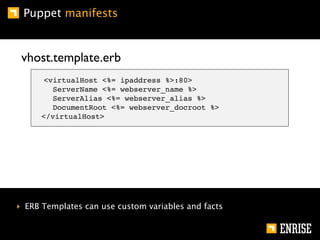
 vhost.template.erb
       <virtualHost <%= ipaddress %>:80>
         ServerName <%= webserver_name %>
         ServerAlias <%= webserver_alias %>
         DocumentRoot <%= webserver_docroot %>
      </virtualHost>


‣ ERB Templates can use custom variables and facts
Puppet manifests


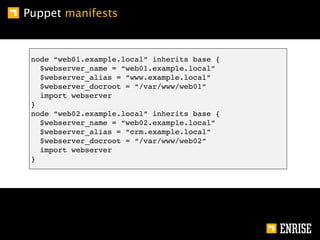
 node “web01.example.local” inherits base {
   $webserver_name = “web01.example.local”
   $webserver_alias = “www.example.local”
   $webserver_docroot = “/var/www/web01”
   import webserver
 }
 node “web02.example.local” inherits base {
   $webserver_name = “web02.example.local”
   $webserver_alias = “crm.example.local”
   $webserver_docroot = “/var/www/web02”
   import webserver
 }
Puppet modules


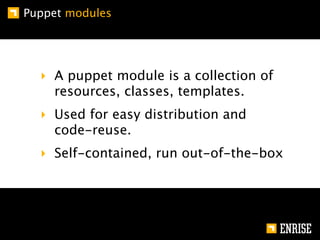
  ‣ A puppet module is a collection of
    resources, classes, templates.
  ‣ Used for easy distribution and
    code-reuse.
  ‣ Self-contained, run out-of-the-box
Puppet modules


  ‣ puppetforge / github
  ‣ Create your own (and share!).
  ‣ Use the ones from puppet
    enterprise edition.
  ‣ Use the standard layout / best
    practices
Puppet modules
 class ntp::install {
     package{"ntpd":
         ensure => latest
     }
 }
 class ntp::config {
     File{
         require => Class["ntp::install"],
         notify => Class["ntp::service"],
         owner    => "root",
         group    => "root",
         mode     => 644
     }
     file{"/etc/ntp.conf":
              source => "puppet:///ntp/ntp.conf";
           "/etc/ntp/step-tickers":
              source => "puppet:///ntp/step-tickers";
     }
 }
 class ntp::service {
     service{"ntp":
         ensure => running,
         enable => true,
         require => Class["ntp::config"],
     }
 }
 class ntp {
     include ntp::install, ntp::config, ntp::service
 }
Test your modules


  ‣ (Unit)test your modules
  ‣ Test them with:
    puppet apply --noop
  ‣ More advanced testing: cucumber /
    cucumber-puppet (BDD)
What can puppet manage


     ‣ Almost everything.
     ‣ standard 48 different resource types
     ‣ Ranging from “file” to “cron” to
       “ssh_key” to “user” to “selinux”.
     ‣ Can control your Cisco routers and
       windows machines too (sortakinda)


‣ http://docs.puppetlabs.com/references/stable/type.html
Confusing puppet things


 ‣ Puppet went from v0.25 to v2.6.
 ‣ REST interface since 2.6. XMLRPC
   before that.
 ‣ One binary to rule them all (puppet).
 ‣ Puppet v2.7 switched from GPLv2 to
   apache2.0 license.
Confusing puppet things


 ‣ --test does not mean dry-run!
   (--noop does).
 ‣ It’s not object oriented. (puppet
   class != php class)
 ‣ It’s a declarative language.
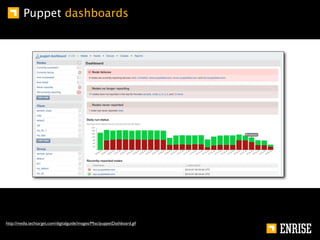
Puppet dashboards


http://media.techtarget.com/digitalguide/images/Misc/puppetDashboard.gif
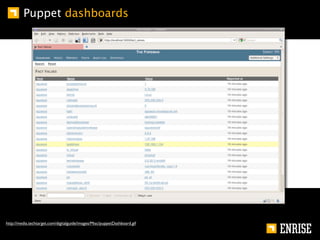
Puppet dashboards


http://media.techtarget.com/digitalguide/images/Misc/puppetDashboard.gif
Live demo | MCollective?
MCollective


‣ Puppet agent “calls” the master every 30
  minutes.
‣ But what about realtime command & control?
‣ “Puppet kick”... (meh)
‣ MCollective (Marionette Collective)
MCollective


     ‣ Which systems running a database
       and have 16GB or less?
     ‣ Which systems are using <50% of
       available memory?
     ‣ Restart all apache services in
       timezone GMT+5.


‣ How do we handle large number of nodes?
MCollective


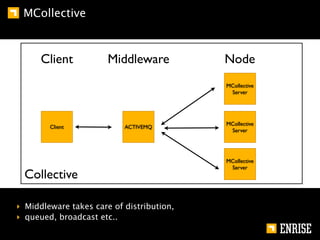
      Client           Middleware          Node
                                           MCollective
                                            Server


                                           MCollective
        Client             ACTIVEMQ
                                            Server


                                           MCollective
                                            Server
  Collective

‣ Middleware takes care of distribution,
‣ queued, broadcast etc..
MCollective


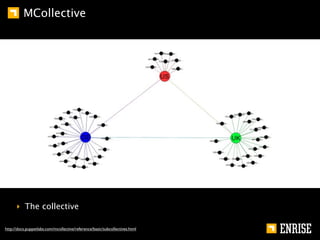
      ‣ The collective

http://docs.puppetlabs.com/mcollective/reference/basic/subcollectives.html
MCollective


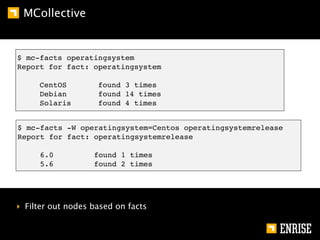
$ mc-facts operatingsystem
Report for fact: operatingsystem

     CentOS         found 3 times
     Debian         found 14 times
     Solaris        found 4 times


$ mc-facts -W operatingsystem=Centos operatingsystemrelease
Report for fact: operatingsystemrelease

     6.0           found 1 times
     5.6           found 2 times


‣ Filter out nodes based on facts
MCollective - cool stuff


   ‣ Display all running processes
   ‣ Run or deploy software
   ‣ Restart services
   ‣ Start puppet agent
   ‣ Upgrade your systems
Recap


        -ETOOMUCHINFO

           Let’s recap
Recap (1)


 ‣ Configuration management tool.
 ‣ Focusses on “what” instead of “how”.
 ‣ Scales from 1 to 100K+ systems.
 ‣ Uses descriptive manifests.
Recap (2)


 ‣ Useful for sysadmins and developers.
 ‣ Keeps your infrastructure in sync.
 ‣ Keeps your infrastructure versioned.
 ‣ MCollective controls your hosts
   based on facts, not names.
Any questions?


http://farm1.static.flickr.com/73/163450213_18478d3aa6_d.jpg
to remove this comic sans font, please rate my talk on:
                http://joind.in/3781

Puppet for dummies - ZendCon 2011 Edition

  • 1.
    Puppet for Dummies ZendCon - October 2011 Santa Clara - United States http://joind.in/3781
  • 2.
    Who am I? Joshua Thijssen Senior Software Engineer @ Enrise (Netherlands) Development in PHP, Python, Perl, C, Java, and System & DB admin. Blog: http://adayinthelifeof.nl Email: joshua@enrise.com Twitter: @jaytaph http://www.flickr.com/photos/akrabat/5422369749/in/photostream/
  • 3.
  • 4.
  • 5.
    The question ofthe day What is puppet and why should I care?
  • 6.
    Why should Icare? “People are finally figuring out puppet and how it gets you to the pub by 4pm. Note that I’ve been at this pub since 2pm.” - Jorge Castro
  • 7.
    Why should Icare (really)?
  • 8.
    What is puppet? Puppet is a (not necessarily the) solution for the following problem: How do we setup, manage, synchronize, and upgrade our internal and external infrastructure?
  • 9.
    But isn’t thata sysadmin problem? Sysadmin! Y U no fix problem!
  • 10.
    But isn’t thata sysadmin problem? Sysadmin! Y U no fix problem! NO
  • 11.
    What is puppet? LAMP-stack
  • 12.
    What is puppet? Linux PHP LAMP-stack Apache MySQL
  • 13.
    What is puppet? LAMPGMVNMCSTRAH-stack
  • 14.
    What is puppet? Hadoop MongoDB ActiveMQ Gearman Linux Varnish Tika PHP LAMPGMVNMCSTRAH-stack Solr Apache Ngnix CouchDB Redis Memcache MySQL
  • 15.
    How do wemanage our infrastructure?
  • 16.
    How do wemanage our infrastructure? ‣ Solution 1: We don’t,
  • 17.
    How do wemanage our infrastructure? ‣ Solution 1: We don’t, ‣ Solution 2: We outsource,
  • 18.
    How do wemanage our infrastructure? ‣ Solution 1: We don’t, ‣ Solution 2: We outsource, ‣ Solution 3: We automate the process.
  • 19.
    How do wemanage our infrastructure? (1) ‣ Solution 1: we don’t
  • 20.
    How do wemanage our infrastructure? (1) ‣ It’s not funny: you find it more often than not. Especially inside small development companies. ‣ Solution 1: we don’t
  • 21.
    How do wemanage our infrastructure? (1) ‣ It’s not funny: you find it more often than not. Especially inside small development companies. ‣ Internal sysadmin, but he’s too busy with development to do sysadmin. ‣ Solution 1: we don’t
  • 22.
    How do wemanage our infrastructure? (1) ‣ It’s not funny: you find it more often than not. Especially inside small development companies. ‣ Internal sysadmin, but he’s too busy with development to do sysadmin. ‣ We only act on escalation ‣ Solution 1: we don’t
  • 23.
    How do wemanage our infrastructure? (1) ‣ It’s not funny: you find it more often than not. Especially inside small development companies. ‣ Internal sysadmin, but he’s too busy with development to do sysadmin. ‣ We only act on escalation ‣ reactive, not proactive ‣ Solution 1: we don’t
  • 24.
    How do wemanage our infrastructure? (2) ‣ Solution 2: we outsource
  • 25.
    How do wemanage our infrastructure? (2) ‣ Expensive $LA’s. ‣ Solution 2: we outsource
  • 26.
    How do wemanage our infrastructure? (2) ‣ Expensive $LA’s. ‣ What about INTERNAL servers like your development systems and infrastructure? ‣ Solution 2: we outsource
  • 27.
    How do wemanage our infrastructure? (2) ‣ Expensive $LA’s. ‣ What about INTERNAL servers like your development systems and infrastructure? ‣ Fight between stability and agility. ‣ Solution 2: we outsource
  • 28.
    How do wemanage our infrastructure? (2) ‣ Expensive $LA’s. ‣ What about INTERNAL servers like your development systems and infrastructure? ‣ Fight between stability and agility. ‣ Does your hosting company decide on whether you can use PHP5.3??? ‣ Solution 2: we outsource
  • 29.
    How do wemanage our infrastructure? (3) ‣ Solution 3: we do it ourselves and automate
  • 30.
    How do wemanage our infrastructure? (3) ‣ We are in charge. ‣ Solution 3: we do it ourselves and automate
  • 31.
    How do wemanage our infrastructure? (3) ‣ We are in charge. ‣ You can do what you like ‣ Solution 3: we do it ourselves and automate
  • 32.
    How do wemanage our infrastructure? (3) ‣ We are in charge. ‣ You can do what you like ‣ Use: cfEngine, chef, puppet. ‣ Solution 3: we do it ourselves and automate
  • 33.
    How do wemanage our infrastructure? (3) ‣ We are in charge. ‣ You can do what you like ‣ Use: cfEngine, chef, puppet. ‣ When done right, maintenance should not be difficult. ‣ Solution 3: we do it ourselves and automate
  • 34.
    What is puppet? ‣PUPPET TO THE RESCUE
  • 35.
    What is puppet? ‣ Open source configuration management tool. ‣ Written in Ruby ‣ Open source: https://github.com/puppetlabs ‣ Commercial version available (puppet enterprise)
  • 36.
    What is puppet? ¹ ‣ Don’t tell HOW to do stuff. ‣ Tell WHAT to do. ¹ It’s not actually true, but good enough for now...
  • 37.
    What is puppet? “yum install httpd” “apt-get install apache2” ¹ ‣ Don’t tell HOW to do stuff. ‣ Tell WHAT to do. “install and run the apache webserver” ¹ It’s not actually true, but good enough for now...
  • 38.
  • 39.
  • 40.
    Architectural overview Puppet Puppet CA Master https Puppet Agent
  • 41.
    Architectural overview Puppet Puppet CA Master https Puppet Puppet Puppet Agent Agent Agent
  • 42.
    How does itwork Puppet Puppet master client
  • 43.
    How does itwork Check credentials Puppet Puppet master client
  • 44.
    How does itwork Check credentials Puppet Send facts Puppet master client
  • 45.
    How does itwork Check credentials Puppet Send facts Puppet master Returns “catalog” client
  • 46.
    How does itwork Check credentials Puppet Send facts Puppet master Returns “catalog” client Report results
  • 47.
    Puppet manifests ‣ Manifests are puppet definitions ‣ <filename>.pp ‣ Puppet DSL ‣ De-cla-ra-tive language ‣ Version your manifests! (git/svn)
  • 48.
    Puppet manifests package { “strace” : ensure => present, } file { “/home/jaytaph/secret-ingredient.txt” : ensure => present, mode => 0600, user => ‘jaytaph’, group => ‘noxlogic’, source => “puppet:///secret.txt”, }
  • 49.
    Puppet manifests package { “httpd” : ensure => present, } service { “httpd”: running => true, enable => true, require => Package[“httpd”], } ‣ Spot the problem....
  • 50.
    Puppet manifests Centos / Redhat service: httpd package: httpd config: /etc/httpd/conf/httpd.conf vhosts: /etc/httpd/conf.d/*.conf Debian / Ubuntu service: apache2 package: apache2 config: /etc/apache2/httpd.conf vhosts: /etc/apache2/sites-available ‣ Different distributions, different names
  • 51.
    Puppet manifests package { “webserver”: case $operatingsystem { centos, redhat { $apache = “httpd” } debian, ubuntu { $apache = “apache2” } default : { fail(‘I don’t know this OS/distro’) } } name => $apache, ensure => installed, } ‣ $operatingsystem is a FACT
  • 52.
    Facter [root@puppetnode1 ~]# facter--puppet architecture => x86_64 fqdn => puppetnode1.noxlogic.local interfaces => eth1,eth2,lo ipaddress_eth1 => 192.168.1.114 ipaddress_eth2 => 192.168.56.200 kernel => Linux kernelmajversion => 2.6 operatingsystem => CentOS operatingsystemrelease => 6.0 processor0 => Intel(R) Core(TM)2 Duo CPU T7500 @ 2.20GHz puppetversion => 2.6.9 ‣ A simple list with info (also useable in your own tools)
  • 53.
    Puppet manifests /etc/puppet/manifests/site.pp: node default { $def_packages = [ “mc”, “strace”, “sysstat” ] package { $def_packages : ensure => latest, } } ‣ “Main” manifest
  • 54.
    Puppet manifests node /^webd+.example.local$/ { package { “httpd” : ensure => latest, } } node /^dbd+.example.local$/ { package { “mysql-server” : ensure => installed, } } ‣ Defining nodes - regular expressions
  • 55.
    Puppet manifests node basenode { user { “jaytaph” : ensure => present, gid => 1000, uid => 1000, home => “/home/jaytaph”, shell => “/bin/sh”, password => “supersecrethashedpassword”, managehome => true, } } node /^.+.example.local/ inherits basenode { ... } ‣ Node inheritance
  • 56.
    Puppet manifests ‣ Grouptogether into a class
  • 57.
    Puppet manifests class webserver { service { “apache”: ensure => running, require => Package[“apache”], } package { “apache” : ensure => installed, } } ‣ Group together into a class
  • 58.
    Puppet manifests class webserver { service { “apache”: ensure => running, require => Package[“apache”], } package { “apache” : ensure => installed, } file { “vhost_${webserver_name}” : path => “/etc/httpd/conf/10-vhost.conf”, content => template(“vhost.template.erb”), notify => Service[“httpd”], } } ‣ Group together into a class
  • 59.
    Puppet manifests vhost.template.erb <virtualHost <%= ipaddress %>:80> ServerName <%= webserver_name %> ServerAlias <%= webserver_alias %> DocumentRoot <%= webserver_docroot %> </virtualHost> ‣ ERB Templates can use custom variables and facts
  • 60.
    Puppet manifests node“web01.example.local” inherits base { $webserver_name = “web01.example.local” $webserver_alias = “www.example.local” $webserver_docroot = “/var/www/web01” import webserver } node “web02.example.local” inherits base { $webserver_name = “web02.example.local” $webserver_alias = “crm.example.local” $webserver_docroot = “/var/www/web02” import webserver }
  • 61.
    Puppet modules ‣ A puppet module is a collection of resources, classes, templates. ‣ Used for easy distribution and code-reuse. ‣ Self-contained, run out-of-the-box
  • 62.
    Puppet modules ‣ puppetforge / github ‣ Create your own (and share!). ‣ Use the ones from puppet enterprise edition. ‣ Use the standard layout / best practices
  • 63.
    Puppet modules classntp::install { package{"ntpd": ensure => latest } } class ntp::config { File{ require => Class["ntp::install"], notify => Class["ntp::service"], owner => "root", group => "root", mode => 644 } file{"/etc/ntp.conf": source => "puppet:///ntp/ntp.conf"; "/etc/ntp/step-tickers": source => "puppet:///ntp/step-tickers"; } } class ntp::service { service{"ntp": ensure => running, enable => true, require => Class["ntp::config"], } } class ntp { include ntp::install, ntp::config, ntp::service }
  • 64.
    Test your modules ‣ (Unit)test your modules ‣ Test them with: puppet apply --noop ‣ More advanced testing: cucumber / cucumber-puppet (BDD)
  • 65.
    What can puppetmanage ‣ Almost everything. ‣ standard 48 different resource types ‣ Ranging from “file” to “cron” to “ssh_key” to “user” to “selinux”. ‣ Can control your Cisco routers and windows machines too (sortakinda) ‣ http://docs.puppetlabs.com/references/stable/type.html
  • 66.
  • 67.
    Confusing puppet things ‣ Puppet went from v0.25 to v2.6. ‣ REST interface since 2.6. XMLRPC before that. ‣ One binary to rule them all (puppet). ‣ Puppet v2.7 switched from GPLv2 to apache2.0 license.
  • 68.
    Confusing puppet things ‣ --test does not mean dry-run! (--noop does). ‣ It’s not object oriented. (puppet class != php class) ‣ It’s a declarative language.
  • 69.
  • 70.
  • 71.
    Live demo |MCollective?
  • 72.
    MCollective ‣ Puppet agent“calls” the master every 30 minutes. ‣ But what about realtime command & control? ‣ “Puppet kick”... (meh) ‣ MCollective (Marionette Collective)
  • 73.
    MCollective ‣ Which systems running a database and have 16GB or less? ‣ Which systems are using <50% of available memory? ‣ Restart all apache services in timezone GMT+5. ‣ How do we handle large number of nodes?
  • 74.
    MCollective Client Middleware Node MCollective Server MCollective Client ACTIVEMQ Server MCollective Server Collective ‣ Middleware takes care of distribution, ‣ queued, broadcast etc..
  • 75.
    MCollective ‣ The collective http://docs.puppetlabs.com/mcollective/reference/basic/subcollectives.html
  • 76.
    MCollective $ mc-facts operatingsystem Reportfor fact: operatingsystem CentOS found 3 times Debian found 14 times Solaris found 4 times $ mc-facts -W operatingsystem=Centos operatingsystemrelease Report for fact: operatingsystemrelease 6.0 found 1 times 5.6 found 2 times ‣ Filter out nodes based on facts
  • 77.
    MCollective - coolstuff ‣ Display all running processes ‣ Run or deploy software ‣ Restart services ‣ Start puppet agent ‣ Upgrade your systems
  • 78.
    Recap -ETOOMUCHINFO Let’s recap
  • 79.
    Recap (1) ‣Configuration management tool. ‣ Focusses on “what” instead of “how”. ‣ Scales from 1 to 100K+ systems. ‣ Uses descriptive manifests.
  • 80.
    Recap (2) ‣Useful for sysadmins and developers. ‣ Keeps your infrastructure in sync. ‣ Keeps your infrastructure versioned. ‣ MCollective controls your hosts based on facts, not names.
  • 81.
  • 82.
    to remove thiscomic sans font, please rate my talk on: http://joind.in/3781