The International Baccalaureate Organization At a Glance
Induction Programme for 2010 Welcome and Introductions General Overview of the International Baccalaureate Organisation PYP Programme: Mission Statement Learner Profile PYP Model/Essential Elements Bubble Planner Inquiry at T.N.I.S Programme of Inquiry at T.N.I.S Online Curriculum Centre and KNet Pages
Organization:  Who governs and manages the IBO? An elected council govern the IBO and the director general along with more than 300 staff are located in 11 offices for a balance of global coverage and administrative efficiency/focus. New York, United States Regional office for North America and the Caribbean  Cardiff, United Kingdom Academic, assessment, HR & building services, finance and publications, ICT,  strategic planning and communications  Buenos Aires, Argentina  Regional office for Latin America Geneva, Switzerland Headquarters Regional office for Africa, Europe and the Middle East  Singapore Regional office for Asia Pacific  Sydney, Australia Regional representative for Australasia Yokohama, Japan Regional representative for Japan  Beijing, China Regional representative for Mongolia and China Mumbai, India Regional representative for South Asia Bath, United Kingdom Research  Vancouver Regional office for North  America and the Caribbean
Our three programmes span the years of kindergarten to pre-university. The programmes can be offered individually or as a continuum. The Primary Years Programme  (PYP) for students aged 3 to 12. The Middle Years Programme  (MYP) for students aged 11 to 16.  The Diploma Programme  for students aged 16 to 19.  Organization: What does the IBO offer? The IBO develops three programmes of international education for students aged 3 to 19, working in cooperation with IB World Schools.
Schools:  How has the IBO grown? The IBO has experienced rapid and consistent growth over the past 15 years. Programme   Apr 2005   Apr 2006   Apr 2008   PYP  208  259  490  MYP  443  491  676 DIPLOMA  1,253  1,373  1857  Totals   1,904  2,123  3,023  Annual growth rates for the three programmes demonstrate strong year-on-year growth. The IB is currently estimated to reach over 200,000 students
Organization: What makes the IBO unique?  The IBO offers a continuum of high-quality education that encourages international-mindedness and a positive attitude to learning.   The IBO is proud of its high quality education  sustained for over 35 years. The Diploma Programme assessment process is recognized by the world’s leading universities. The IBO actively trains and supports teachers to maintain its high standards. The IBO encourages international-mindedness in IB students who must firstly develop an understanding of their own cultural and national identity. The IBO encourages a positive attitude to learning. The IBO ensures that its programmes are accessible to students in a wide variety of schools.
Programmes:  What makes the PYP special? An opportunity for learners to construct meaning. Designed to foster the development of the whole child. Organized around six transdisciplinary themes of global significance intended to help children engage with their world and the world around them. Students will inquire, make connections, develop conceptual understanding, think critically, work collaboratively, consider multiple perspectives, construct meaning, reflect, take action.  Supported in English, French and Spanish but can be taught in other languages.
Services: How is a school authorized?  Any school wishing to offer an IB programme must be authorized by the IBO. Schools must go through an intensive authorization process that lasts  at least  two years covering a number of key stages. First key stage includes: Feasibility study and identification of resources Obtaining appropriate publications Examining the programme’s philosophy and curriculum Conduct a feasibility study on possible outcomes Arrange for staff to undertake IBO-approved training. Second key stage (for MYP and PYP candidate schools only) includes: A trial implementation stage as a candidate school   Third key stage is a visit from an IBO team to: Consult those involved in implementation Evaluate the school’s readiness to implement the programme Complete a report on the school’s commitment and ability to deliver the programme.
Services: How does the IBO provide professional development for teachers? The IBO supports teachers through both face-to-face workshops and online. The  Online Curriculum Centre (OCC)  is an international community of practice for 44,465 registered IB teachers at  http: //occ . ibo .org . Face-to-face workshops   Organized by each IB region for all programmes and all levels. Nearly 30,000 teachers were trained in 2005 . Teacher support materials  Online courses Teacher qualifications in development.
Organization: What is the IBO mission? We are motivated by a mission to create a better world through education. Mission The International Baccalaureate Organization aims to develop inquiring, knowledgeable and caring young people who help to create a better and more peaceful world through intercultural understanding and respect. To this end, the IBO works with schools, governments and international organizations to develop challenging programmes of international education and rigorous assessment. These programmes encourage students across the world to become active, compassionate and lifelong learners who understand that other people, with their differences, can also be right.
Organization: What is the learner profile? It’s the IBO mission statement translated into a set of learning outcomes for the 21st century. IB learners strive to be: Inquirers Knowledgeable Thinkers Communicators Principled Open-minded Caring Risk-takers Balanced Reflective The attributes of the learner profile express the values inherent to the IB continuum of international education.  IB programmes promote the education of the whole person, emphasizing intellectual, personal, emotional and social growth through all domains of knowledge.
Learners Constructing Meaning Written curriculum Taught curriculum Assessed curriculum Components of the curriculum
Scope and sequence documents Sample assessments Sample activities Sample questions Specific expectations How will we know what students have learned? How best will students learn? What do we want students to learn? Written curriculum Taught curriculum Learned curriculum
Overview of the programme Skills Attitudes Action Knowledge Six subject domains Who we are Where we are in place and time How we express ourselves How the world works Sharing the planet How we  organize ourselves Concepts
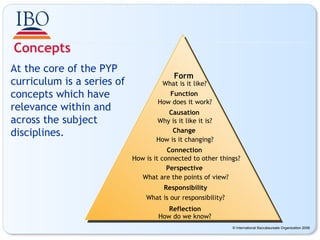
At the core of the PYP curriculum is a series of concepts which have relevance within and across the subject disciplines. Concepts Form  What is it like?   Function  How does it work?   Causation  Why is it like it is?   Change  How is it changing?   Connection  How is it connected to other things?   Perspective  What are the points of view?   Responsibility What is our responsibility?   Reflection  How do we know?
Attitudes, transdisciplinary skills and action appreciation commitment confidence cooperation creativity curiosity empathy enthusiasm independence integrity respect tolerance social research communication thinking self-management Reflect   Choose    Act ACTION ATTITUDES SKILLS to enhance learning to provide service
Organization of the planner Title:   Subject focus: Stage 1: What is our purpose? Central idea An inquiry into . . . Stage 2: What resources will we use? Stage 3: What do we want to learn? Key questions (concepts) that drive the inquiry Teacher questions Student questions Stage 4: How best will we learn? Stage 5: How will we know what we have learned? Assessment strategies including self-assessment Stage 6: To what extent did we achieve our purpose? Stage 7: How will we take action?
Programmes: How are the students assessed? IB assessment is rigorous, criterion-referenced, consistent and differentiating of student ability. PYP : teachers select methods of assessment appropriate to the learning outcomes they wish to capture. Students receive feedback to encourage the start of lifelong learning.
Using Information in Stages DECIDING on information needs FINDING and selecting the resources USING - working directly with the resources to answer the questions RECORDING and organising the information PRESENTING and communicating the knowledge EVALUATING the process and the content (Gawith, 1987)

Induction2010

  • 1.
    The International BaccalaureateOrganization At a Glance
  • 2.
    Induction Programme for2010 Welcome and Introductions General Overview of the International Baccalaureate Organisation PYP Programme: Mission Statement Learner Profile PYP Model/Essential Elements Bubble Planner Inquiry at T.N.I.S Programme of Inquiry at T.N.I.S Online Curriculum Centre and KNet Pages
  • 3.
    Organization: Whogoverns and manages the IBO? An elected council govern the IBO and the director general along with more than 300 staff are located in 11 offices for a balance of global coverage and administrative efficiency/focus. New York, United States Regional office for North America and the Caribbean Cardiff, United Kingdom Academic, assessment, HR & building services, finance and publications, ICT, strategic planning and communications Buenos Aires, Argentina Regional office for Latin America Geneva, Switzerland Headquarters Regional office for Africa, Europe and the Middle East Singapore Regional office for Asia Pacific Sydney, Australia Regional representative for Australasia Yokohama, Japan Regional representative for Japan Beijing, China Regional representative for Mongolia and China Mumbai, India Regional representative for South Asia Bath, United Kingdom Research Vancouver Regional office for North America and the Caribbean
  • 4.
    Our three programmesspan the years of kindergarten to pre-university. The programmes can be offered individually or as a continuum. The Primary Years Programme (PYP) for students aged 3 to 12. The Middle Years Programme (MYP) for students aged 11 to 16. The Diploma Programme for students aged 16 to 19. Organization: What does the IBO offer? The IBO develops three programmes of international education for students aged 3 to 19, working in cooperation with IB World Schools.
  • 5.
    Schools: Howhas the IBO grown? The IBO has experienced rapid and consistent growth over the past 15 years. Programme Apr 2005 Apr 2006 Apr 2008 PYP 208 259 490 MYP 443 491 676 DIPLOMA 1,253 1,373 1857  Totals 1,904 2,123 3,023 Annual growth rates for the three programmes demonstrate strong year-on-year growth. The IB is currently estimated to reach over 200,000 students
  • 6.
    Organization: What makesthe IBO unique? The IBO offers a continuum of high-quality education that encourages international-mindedness and a positive attitude to learning. The IBO is proud of its high quality education sustained for over 35 years. The Diploma Programme assessment process is recognized by the world’s leading universities. The IBO actively trains and supports teachers to maintain its high standards. The IBO encourages international-mindedness in IB students who must firstly develop an understanding of their own cultural and national identity. The IBO encourages a positive attitude to learning. The IBO ensures that its programmes are accessible to students in a wide variety of schools.
  • 7.
    Programmes: Whatmakes the PYP special? An opportunity for learners to construct meaning. Designed to foster the development of the whole child. Organized around six transdisciplinary themes of global significance intended to help children engage with their world and the world around them. Students will inquire, make connections, develop conceptual understanding, think critically, work collaboratively, consider multiple perspectives, construct meaning, reflect, take action. Supported in English, French and Spanish but can be taught in other languages.
  • 8.
    Services: How isa school authorized? Any school wishing to offer an IB programme must be authorized by the IBO. Schools must go through an intensive authorization process that lasts at least two years covering a number of key stages. First key stage includes: Feasibility study and identification of resources Obtaining appropriate publications Examining the programme’s philosophy and curriculum Conduct a feasibility study on possible outcomes Arrange for staff to undertake IBO-approved training. Second key stage (for MYP and PYP candidate schools only) includes: A trial implementation stage as a candidate school Third key stage is a visit from an IBO team to: Consult those involved in implementation Evaluate the school’s readiness to implement the programme Complete a report on the school’s commitment and ability to deliver the programme.
  • 9.
    Services: How doesthe IBO provide professional development for teachers? The IBO supports teachers through both face-to-face workshops and online. The Online Curriculum Centre (OCC) is an international community of practice for 44,465 registered IB teachers at http: //occ . ibo .org . Face-to-face workshops Organized by each IB region for all programmes and all levels. Nearly 30,000 teachers were trained in 2005 . Teacher support materials Online courses Teacher qualifications in development.
  • 10.
    Organization: What isthe IBO mission? We are motivated by a mission to create a better world through education. Mission The International Baccalaureate Organization aims to develop inquiring, knowledgeable and caring young people who help to create a better and more peaceful world through intercultural understanding and respect. To this end, the IBO works with schools, governments and international organizations to develop challenging programmes of international education and rigorous assessment. These programmes encourage students across the world to become active, compassionate and lifelong learners who understand that other people, with their differences, can also be right.
  • 11.
    Organization: What isthe learner profile? It’s the IBO mission statement translated into a set of learning outcomes for the 21st century. IB learners strive to be: Inquirers Knowledgeable Thinkers Communicators Principled Open-minded Caring Risk-takers Balanced Reflective The attributes of the learner profile express the values inherent to the IB continuum of international education. IB programmes promote the education of the whole person, emphasizing intellectual, personal, emotional and social growth through all domains of knowledge.
  • 12.
    Learners Constructing MeaningWritten curriculum Taught curriculum Assessed curriculum Components of the curriculum
  • 13.
    Scope and sequencedocuments Sample assessments Sample activities Sample questions Specific expectations How will we know what students have learned? How best will students learn? What do we want students to learn? Written curriculum Taught curriculum Learned curriculum
  • 14.
    Overview of theprogramme Skills Attitudes Action Knowledge Six subject domains Who we are Where we are in place and time How we express ourselves How the world works Sharing the planet How we organize ourselves Concepts
  • 15.
    At the coreof the PYP curriculum is a series of concepts which have relevance within and across the subject disciplines. Concepts Form What is it like? Function How does it work? Causation Why is it like it is? Change How is it changing? Connection How is it connected to other things? Perspective What are the points of view? Responsibility What is our responsibility? Reflection How do we know?
  • 16.
    Attitudes, transdisciplinary skillsand action appreciation commitment confidence cooperation creativity curiosity empathy enthusiasm independence integrity respect tolerance social research communication thinking self-management Reflect  Choose  Act ACTION ATTITUDES SKILLS to enhance learning to provide service
  • 17.
    Organization of theplanner Title: Subject focus: Stage 1: What is our purpose? Central idea An inquiry into . . . Stage 2: What resources will we use? Stage 3: What do we want to learn? Key questions (concepts) that drive the inquiry Teacher questions Student questions Stage 4: How best will we learn? Stage 5: How will we know what we have learned? Assessment strategies including self-assessment Stage 6: To what extent did we achieve our purpose? Stage 7: How will we take action?
  • 18.
    Programmes: How arethe students assessed? IB assessment is rigorous, criterion-referenced, consistent and differentiating of student ability. PYP : teachers select methods of assessment appropriate to the learning outcomes they wish to capture. Students receive feedback to encourage the start of lifelong learning.
  • 19.
    Using Information inStages DECIDING on information needs FINDING and selecting the resources USING - working directly with the resources to answer the questions RECORDING and organising the information PRESENTING and communicating the knowledge EVALUATING the process and the content (Gawith, 1987)