intro to
planning
A crash course in common terms and
concepts used in the planning process.
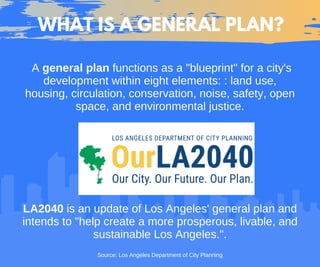
WHAT IS A GENERAL PLAN?
A general plan functions as a "blueprint" for a city's
development within eight elements: : land use,
housing, circulation, conservation, noise, safety, open
space, and environmental justice.
LA2040 is an update of Los Angeles' general plan and
intends to "help create a more prosperous, livable, and
sustainable Los Angeles.".
Source: Los Angeles Department of City Planning
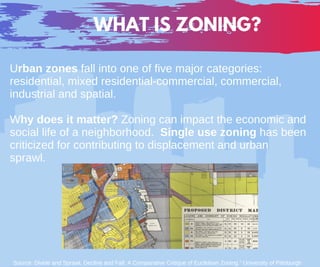
WHAT IS ZONING?
Urban zones fall into one of five major categories:
residential, mixed residential-commercial, commercial,
industrial and spatial.
Why does it matter? Zoning can impact the economic and
social life of a neighborhood. Single use zoning has been
criticized for contributing to displacement and urban
sprawl.
Source: Divide and Sprawl, Decline and Fall: A Comparative Critique of Euclidean Zoning.” University of Pittsburgh
OVERLAYS & SPECIFIC PLANS
Community Plans provide an opportunity for area-specific
policy that ranges from affordable housing regulations to
protections for historical buildings.
A Historic Preservation Overlay Zone can help prevent
historic buildings from demolition or significant alterations.
Cities like Boston and Portland have adopted conservation
districts that help communities who do not qualify for historic
status provide guidelines for new development to match with
the neighborhood.
Source: Los Angeles Conservancy
PUBLIC PARTICPATION
How does the community plau role to play in the
planning process? Here are a few examples.
A public community workshop is an
opportunity for a neighborhood to learn more
about a plan through a presentation by planners,
exhibits and maps.
Neighborhood Councils can help facilitate
opportunities for the community to learn more.
An Open House presents and distribute the
Preliminary Plan to the public with presentations
from planners and/or council liaisons.
A public hearing allows community members to
provide formal testimony regarding a preliminary
plan, a proposed development project, and more.
These are usually held during work hours.
Source: Los Angeles Department of City Planning

Intro to Planning

  • 1.
    intro to planning A crashcourse in common terms and concepts used in the planning process.
  • 2.
    WHAT IS AGENERAL PLAN? A general plan functions as a "blueprint" for a city's development within eight elements: : land use, housing, circulation, conservation, noise, safety, open space, and environmental justice. LA2040 is an update of Los Angeles' general plan and intends to "help create a more prosperous, livable, and sustainable Los Angeles.". Source: Los Angeles Department of City Planning
  • 3.
    WHAT IS ZONING? Urbanzones fall into one of five major categories: residential, mixed residential-commercial, commercial, industrial and spatial. Why does it matter? Zoning can impact the economic and social life of a neighborhood. Single use zoning has been criticized for contributing to displacement and urban sprawl. Source: Divide and Sprawl, Decline and Fall: A Comparative Critique of Euclidean Zoning.” University of Pittsburgh
  • 4.
    OVERLAYS & SPECIFICPLANS Community Plans provide an opportunity for area-specific policy that ranges from affordable housing regulations to protections for historical buildings. A Historic Preservation Overlay Zone can help prevent historic buildings from demolition or significant alterations. Cities like Boston and Portland have adopted conservation districts that help communities who do not qualify for historic status provide guidelines for new development to match with the neighborhood. Source: Los Angeles Conservancy
  • 5.
    PUBLIC PARTICPATION How doesthe community plau role to play in the planning process? Here are a few examples. A public community workshop is an opportunity for a neighborhood to learn more about a plan through a presentation by planners, exhibits and maps. Neighborhood Councils can help facilitate opportunities for the community to learn more. An Open House presents and distribute the Preliminary Plan to the public with presentations from planners and/or council liaisons. A public hearing allows community members to provide formal testimony regarding a preliminary plan, a proposed development project, and more. These are usually held during work hours. Source: Los Angeles Department of City Planning