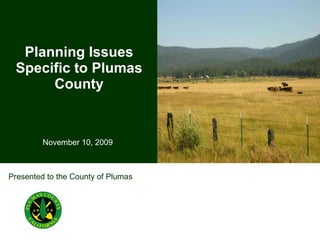
Planning Issues Specific to Plumas County November 10, 2009 Presented to the County of Plumas
Purpose of Workshop  Topics to be Addressed  Introduction to California General Plans (10:00 to 11:30).  Lunch Break (11:30 to 12:00). Panel Discussion – Best Planning Practices (12:00 to 1:30). Working Group Session – Planning Opportunities for Plumas County (1:30 to 3:30). Role of Participants  “ Where do we want to be in 20 years…” Introduction and Overview  Introduction
Introduction to California General Plans
As part of this presentation we will:  Discuss what a General Plan is (and is not) intended to provide.  Discuss how a General Plan is typically used. Describe a typical General Plan Update process. Introduction to General Plans
What is a General Plan?  A General Plan focuses on shaping the physical form of a community over a 20 to 25 year period. It is an expression of community goals and priorities;  It is a decision-making guide; and  It fulfills legal requirements created by state law. Introduction to General Plans
How is the General Plan Used?  A General Plan has specific uses for individual community members: Board of Supervisor/Planning Commission members  – use plan to evaluate policy changes and make funding/budget decisions.  County staff  – use plan to evaluate building/development and make recommendations on projects.  Citizens  – use plan to understand a community’s long range vision and proposals for different geographic areas.  Introduction to General Plans
What the General Plan is Not  A General Plan does not typically provide site-level details. A General Plan is not an operational plan. A General Plan is most effective when it is dealing with the physical environment. Introduction to General Plans
The General Plan Update Process  The basic requirements for a General Plan:  Each county and city must adopt a comprehensive, long-term general plan for the physical development of the county or city, and of any land outside its boundaries which in the planning agency’s judgement bears relation to its planning.  (§65300) The general plan acts as “constitution for future development.” Lesher Communications v. City of Walnut Creek Introduction to General Plans
Basic Requirements (cont.) Comprehensive Planning  Geographic. Issues.  Long Term (typically 15 to 20 years) Consistency  Equal status among elements. Between elements. Within elements.  City of Lincoln’s updated General Plan has a 50 year planning horizon. Introduction to General Plans
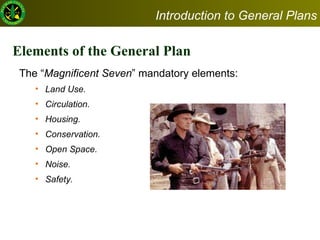
Elements of the General Plan The “ Magnificent Seven ” mandatory elements:  Land Use.  Circulation.  Housing.  Conservation. Open Space. Noise.  Safety. Introduction to General Plans
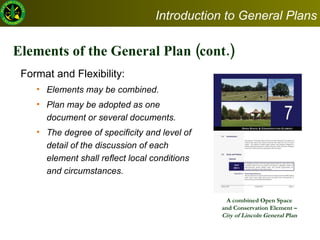
Elements of the General Plan (cont.) Format and Flexibility:   Elements may be combined.  Plan may be adopted as one document or several documents.  The degree of specificity and level of detail of the discussion of each element shall reflect local conditions and circumstances.  A combined Open Space and Conservation Element –  City of Lincoln General Plan  Introduction to General Plans
Elements of the General Plan (cont.) Popular optional elements:   Air Quality ( required in the Central Valley ). Design. Economic Development. Growth Management. Historic Preservation. Parks and Recreation. Public Facilities. Scenic Highways. Seismic. Introduction to General Plans Emerging trends elements:   Agriculture.  Water Resources. Sustainability.
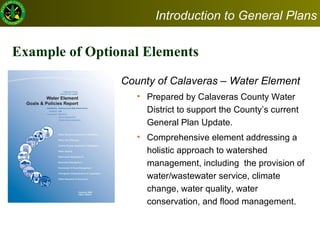
Example of Optional Elements County of Calaveras – Water Element  Prepared by Calaveras County Water District to support the County’s current General Plan Update.  Comprehensive element addressing a holistic approach to watershed management, including  the provision of water/wastewater service, climate change, water quality, water conservation, and flood management.  Introduction to General Plans
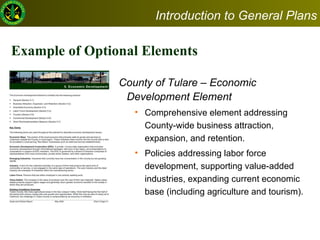
Example of Optional Elements  County of Tulare – Economic Development Element  Comprehensive element addressing County-wide business attraction, expansion, and retention. Policies addressing labor force development, supporting value-added industries, expanding current economic base (including agriculture and tourism).  Introduction to General Plans
Example of Optional Elements City of Oxnard – Sustainability Element  Designed to address recent State legislation including AB32 and SB375. Policies addressing global warming, climate change, sea level rise, energy conservation, and long-term water supply. Introduction to General Plans
Preparing a General Plan Adoption deadlines:  30 months after incorporation. Housing Element revised every 5 years. Update recommendations.  General Plan Guidelines (Office of Planning & Research)   Last revised 2003.  Introduction to General Plans
Preparing a General Plan (cont.) Public Participation (§65351) Goals:  Inform the public.  Obtain input regarding major issues and objectives. Participate in alternative selection. Inform decision makers of public opinion. Work towards community consensus. Introduction to General Plans
Preparing a General Plan (cont.) Public Participation Tools  Townhall meetings. Workshops. Publications & Surveys. Website and Interactive Technology.  Committees  Steering.  Advisory. Introduction to General Plans
Preparing a General Plan (cont.) Introduction to General Plans The Draft General Plan  Goals & objectives, policies, implementation measures. Background data in appendices or separate document.
Preparing a General Plan (cont.) Adoption:  Legislative act (§65301.5) Inter-governmental Coordination (§65352) Cities, counties, special districts.  School districts.  LAFCO Regional planning agencies (Plumas County Transportation Commission).  Federal agencies (which may be affected). Water and utility providers. Affected Native American Groups.  Introduction to General Plans
Preparing a General Plan (cont.) Adoption:  Submittal to state agencies: HCD: Housing Element.  Division of Mines & Geology; OES: Safety Element.  Resources Agency: Open Space Element.  Special Situations: Board of Forestry: Fire Protection.  Mining & Geology Board: SMARA.  Coastal Commission: Local Coastal Plan. Introduction to General Plans
Preparing a General Plan (cont.) Adoption:  Recommendation made by planning commission (§65354) Adoption made by legislative body. Notice and hearing (§65353 and 65355) Introduction to General Plans
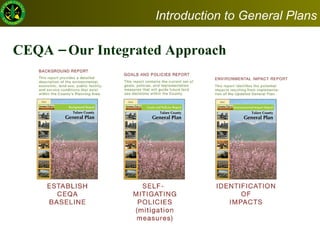
CEQA Compliance  Adoption or amending a General Plan is an action subject to the California Environmental Quality Act (CEQA). Ideally, the CEQA process should parallel the general planning process.  Objectives.  Data Collection. Alternatives. Introduction to General Plans
CEQA – Our Integrated Approach Introduction to General Plans
CEQA Compliance (cont.)  Key Aspects:  Environmental Impact Report (EIR). Describe significant environmental effects, including cumulative and growth-inducing effects. Mitigation Measures incorporated into General Plan. Tiering. Master and Program EIR’s Introduction to General Plans
CEQA Compliance (cont.) Advantages of Tiering:  Streamlines environmental review by focusing future documents on project-specific effects. Deals with secondary, cumulative and growth-inducing impacts on a broad level.  Analysis and mitigation can be incorporated into second tier documents.  May cover future general plan implementation actions (e.g., master plans, CIP, rezoning). EIR required for certain exemptions (SB 1925).  Introduction to General Plans
Implementation  Implementation Measures Annual Reporting:  Legislative Body (by October 1). OPR. HCD (Housing Element). Introduction to General Plans
Implementation (cont.)  Implementation Tools:   Zoning.  Specific Plans. Subdivision Regulations. Capitol Facilities. Redevelopment. Acquisition. Introduction to General Plans
Implementation (cont.)  Consistency with the General Plan:   Zoning.  Subdivisions. Specific Plans. Public Works Projects (§65401). Acquisition/Disposition of Property (§65402). Optional Capitol Improvement Plans (§65403). Introduction to General Plans
Implementation (cont.)  Basis for exactions:   Adequate General Plan can provide the basis for exactions (“nexus”).  Soderling v. City of Santa Monica Basis for thresholds of significance:   Objectives and policies may provide basis for determining significant impacts. e.g. Levels of Service, Noise Contours, Aesthetics.  Introduction to General Plans
Implementation (cont.)  Amendments (§65358): No mandatory element shall be amended more than four times during any calendar year.  Exceptions:  Low-moderate income housing projects. Consistency with Airport Land Use Plans. Development of Local Coastal Program.  Compliance with court decisions. Affected specific plans must be reviewed and amended as required for consistency.  Introduction to General Plans
Implementation (cont.) Amendments: Suggested Criteria:  Is the amendment in the public interest? Is the amendment consistent with all other parts of the General Plan? If other changes will be required, are they being considered at the same time (“ripple effect”). Will the amendment necessitate changes in zoning or other implementing ordinances? Introduction to General Plans
General Plan Update Costs  Introduction to General Plans
General Plan Guidelines  Published by OPR as required by state planning law (§ 65040.2): Guidelines are advisory only. Guidelines include discussion of general plan process, format, statutory requirements, and other laws and issues which can influence the general plan. Introduction to General Plans
General Plan Guidelines (cont.)  For each mandatory element, the OPR guidelines provide:   Background;  Court cases and Attorney General’s Opinions;  Relevant issues; Ideas for data and analysis; and  Ideas for policy development. Introduction to General Plans
Example: OPR Guidelines  Issue: Parks and Recreation (Land Use): Ideas for Data and Analysis  Assess demand for parks and recreation facilities (often expressed as acres/1000 residents).  Identify future park and recreation sites. Policy Suggestion Address location, acquisition, and development of public park and recreation facilities.  Introduction to General Plans
Example: Local General Plan  Goal:  Distribute parks, open spaces and recreation programs and facilities throughout the City.  Policy:  Construct new parks and recreation facilities. Action:  Acquire and develop parks to meet the distance from dwelling standard (3/8 mile to neighborhood park).  Introduction to General Plans
2002 OPR Update  Environmental Justice (AB 1553) Community Participation Sustainable Development Format and Element Consolidation Optional Elements: Water.  Energy. Introduction to General Plans
Panel Discussion - Best Planning Practices
Planning Opportunities for Plumas County

Planning Issues Specific To Plumas County

  • 1.
    Planning Issues Specificto Plumas County November 10, 2009 Presented to the County of Plumas
  • 2.
    Purpose of Workshop Topics to be Addressed Introduction to California General Plans (10:00 to 11:30). Lunch Break (11:30 to 12:00). Panel Discussion – Best Planning Practices (12:00 to 1:30). Working Group Session – Planning Opportunities for Plumas County (1:30 to 3:30). Role of Participants “ Where do we want to be in 20 years…” Introduction and Overview Introduction
  • 3.
  • 4.
    As part ofthis presentation we will: Discuss what a General Plan is (and is not) intended to provide. Discuss how a General Plan is typically used. Describe a typical General Plan Update process. Introduction to General Plans
  • 5.
    What is aGeneral Plan? A General Plan focuses on shaping the physical form of a community over a 20 to 25 year period. It is an expression of community goals and priorities; It is a decision-making guide; and It fulfills legal requirements created by state law. Introduction to General Plans
  • 6.
    How is theGeneral Plan Used? A General Plan has specific uses for individual community members: Board of Supervisor/Planning Commission members – use plan to evaluate policy changes and make funding/budget decisions. County staff – use plan to evaluate building/development and make recommendations on projects. Citizens – use plan to understand a community’s long range vision and proposals for different geographic areas. Introduction to General Plans
  • 7.
    What the GeneralPlan is Not A General Plan does not typically provide site-level details. A General Plan is not an operational plan. A General Plan is most effective when it is dealing with the physical environment. Introduction to General Plans
  • 8.
    The General PlanUpdate Process The basic requirements for a General Plan: Each county and city must adopt a comprehensive, long-term general plan for the physical development of the county or city, and of any land outside its boundaries which in the planning agency’s judgement bears relation to its planning. (§65300) The general plan acts as “constitution for future development.” Lesher Communications v. City of Walnut Creek Introduction to General Plans
  • 9.
    Basic Requirements (cont.)Comprehensive Planning Geographic. Issues. Long Term (typically 15 to 20 years) Consistency Equal status among elements. Between elements. Within elements. City of Lincoln’s updated General Plan has a 50 year planning horizon. Introduction to General Plans
  • 10.
    Elements of theGeneral Plan The “ Magnificent Seven ” mandatory elements: Land Use. Circulation. Housing. Conservation. Open Space. Noise. Safety. Introduction to General Plans
  • 11.
    Elements of theGeneral Plan (cont.) Format and Flexibility: Elements may be combined. Plan may be adopted as one document or several documents. The degree of specificity and level of detail of the discussion of each element shall reflect local conditions and circumstances. A combined Open Space and Conservation Element – City of Lincoln General Plan Introduction to General Plans
  • 12.
    Elements of theGeneral Plan (cont.) Popular optional elements: Air Quality ( required in the Central Valley ). Design. Economic Development. Growth Management. Historic Preservation. Parks and Recreation. Public Facilities. Scenic Highways. Seismic. Introduction to General Plans Emerging trends elements: Agriculture. Water Resources. Sustainability.
  • 13.
    Example of OptionalElements County of Calaveras – Water Element Prepared by Calaveras County Water District to support the County’s current General Plan Update. Comprehensive element addressing a holistic approach to watershed management, including the provision of water/wastewater service, climate change, water quality, water conservation, and flood management. Introduction to General Plans
  • 14.
    Example of OptionalElements County of Tulare – Economic Development Element Comprehensive element addressing County-wide business attraction, expansion, and retention. Policies addressing labor force development, supporting value-added industries, expanding current economic base (including agriculture and tourism). Introduction to General Plans
  • 15.
    Example of OptionalElements City of Oxnard – Sustainability Element Designed to address recent State legislation including AB32 and SB375. Policies addressing global warming, climate change, sea level rise, energy conservation, and long-term water supply. Introduction to General Plans
  • 16.
    Preparing a GeneralPlan Adoption deadlines: 30 months after incorporation. Housing Element revised every 5 years. Update recommendations. General Plan Guidelines (Office of Planning & Research) Last revised 2003. Introduction to General Plans
  • 17.
    Preparing a GeneralPlan (cont.) Public Participation (§65351) Goals: Inform the public. Obtain input regarding major issues and objectives. Participate in alternative selection. Inform decision makers of public opinion. Work towards community consensus. Introduction to General Plans
  • 18.
    Preparing a GeneralPlan (cont.) Public Participation Tools Townhall meetings. Workshops. Publications & Surveys. Website and Interactive Technology. Committees Steering. Advisory. Introduction to General Plans
  • 19.
    Preparing a GeneralPlan (cont.) Introduction to General Plans The Draft General Plan Goals & objectives, policies, implementation measures. Background data in appendices or separate document.
  • 20.
    Preparing a GeneralPlan (cont.) Adoption: Legislative act (§65301.5) Inter-governmental Coordination (§65352) Cities, counties, special districts. School districts. LAFCO Regional planning agencies (Plumas County Transportation Commission). Federal agencies (which may be affected). Water and utility providers. Affected Native American Groups. Introduction to General Plans
  • 21.
    Preparing a GeneralPlan (cont.) Adoption: Submittal to state agencies: HCD: Housing Element. Division of Mines & Geology; OES: Safety Element. Resources Agency: Open Space Element. Special Situations: Board of Forestry: Fire Protection. Mining & Geology Board: SMARA. Coastal Commission: Local Coastal Plan. Introduction to General Plans
  • 22.
    Preparing a GeneralPlan (cont.) Adoption: Recommendation made by planning commission (§65354) Adoption made by legislative body. Notice and hearing (§65353 and 65355) Introduction to General Plans
  • 23.
    CEQA Compliance Adoption or amending a General Plan is an action subject to the California Environmental Quality Act (CEQA). Ideally, the CEQA process should parallel the general planning process. Objectives. Data Collection. Alternatives. Introduction to General Plans
  • 24.
    CEQA – OurIntegrated Approach Introduction to General Plans
  • 25.
    CEQA Compliance (cont.) Key Aspects: Environmental Impact Report (EIR). Describe significant environmental effects, including cumulative and growth-inducing effects. Mitigation Measures incorporated into General Plan. Tiering. Master and Program EIR’s Introduction to General Plans
  • 26.
    CEQA Compliance (cont.)Advantages of Tiering: Streamlines environmental review by focusing future documents on project-specific effects. Deals with secondary, cumulative and growth-inducing impacts on a broad level. Analysis and mitigation can be incorporated into second tier documents. May cover future general plan implementation actions (e.g., master plans, CIP, rezoning). EIR required for certain exemptions (SB 1925). Introduction to General Plans
  • 27.
    Implementation ImplementationMeasures Annual Reporting: Legislative Body (by October 1). OPR. HCD (Housing Element). Introduction to General Plans
  • 28.
    Implementation (cont.) Implementation Tools: Zoning. Specific Plans. Subdivision Regulations. Capitol Facilities. Redevelopment. Acquisition. Introduction to General Plans
  • 29.
    Implementation (cont.) Consistency with the General Plan: Zoning. Subdivisions. Specific Plans. Public Works Projects (§65401). Acquisition/Disposition of Property (§65402). Optional Capitol Improvement Plans (§65403). Introduction to General Plans
  • 30.
    Implementation (cont.) Basis for exactions: Adequate General Plan can provide the basis for exactions (“nexus”). Soderling v. City of Santa Monica Basis for thresholds of significance: Objectives and policies may provide basis for determining significant impacts. e.g. Levels of Service, Noise Contours, Aesthetics. Introduction to General Plans
  • 31.
    Implementation (cont.) Amendments (§65358): No mandatory element shall be amended more than four times during any calendar year. Exceptions: Low-moderate income housing projects. Consistency with Airport Land Use Plans. Development of Local Coastal Program. Compliance with court decisions. Affected specific plans must be reviewed and amended as required for consistency. Introduction to General Plans
  • 32.
    Implementation (cont.) Amendments:Suggested Criteria: Is the amendment in the public interest? Is the amendment consistent with all other parts of the General Plan? If other changes will be required, are they being considered at the same time (“ripple effect”). Will the amendment necessitate changes in zoning or other implementing ordinances? Introduction to General Plans
  • 33.
    General Plan UpdateCosts Introduction to General Plans
  • 34.
    General Plan Guidelines Published by OPR as required by state planning law (§ 65040.2): Guidelines are advisory only. Guidelines include discussion of general plan process, format, statutory requirements, and other laws and issues which can influence the general plan. Introduction to General Plans
  • 35.
    General Plan Guidelines(cont.) For each mandatory element, the OPR guidelines provide: Background; Court cases and Attorney General’s Opinions; Relevant issues; Ideas for data and analysis; and Ideas for policy development. Introduction to General Plans
  • 36.
    Example: OPR Guidelines Issue: Parks and Recreation (Land Use): Ideas for Data and Analysis Assess demand for parks and recreation facilities (often expressed as acres/1000 residents). Identify future park and recreation sites. Policy Suggestion Address location, acquisition, and development of public park and recreation facilities. Introduction to General Plans
  • 37.
    Example: Local GeneralPlan Goal: Distribute parks, open spaces and recreation programs and facilities throughout the City. Policy: Construct new parks and recreation facilities. Action: Acquire and develop parks to meet the distance from dwelling standard (3/8 mile to neighborhood park). Introduction to General Plans
  • 38.
    2002 OPR Update Environmental Justice (AB 1553) Community Participation Sustainable Development Format and Element Consolidation Optional Elements: Water. Energy. Introduction to General Plans
  • 39.
    Panel Discussion -Best Planning Practices
  • 40.

Editor's Notes