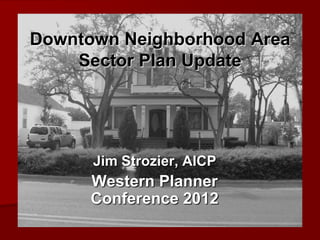
Downtown Neighborhood Area
    Sector Plan Update


      Jim Strozier, AICP
      Western Planner
      Conference 2012
Presentation Outline/Approach
 A case study
 Context/Problem Definition
 Process
 Outcomes/Solutions
 Lessons Learned
 Discussion Points Built In – Participate!
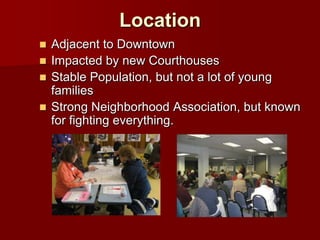
Location
 Adjacent to Downtown
 Impacted by new Courthouses
 Stable Population, but not a lot of young
  families
 Strong Neighborhood Association, but known
  for fighting everything.
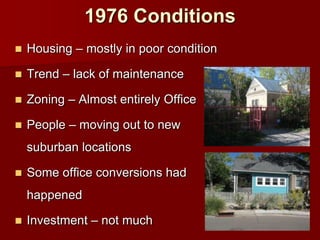
1976 Conditions
   Housing – mostly in poor condition

   Trend – lack of maintenance

   Zoning – Almost entirely Office

   People – moving out to new
    suburban locations

   Some office conversions had
    happened

   Investment – not much
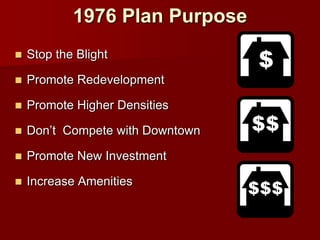
1976 Plan Purpose
   Stop the Blight

   Promote Redevelopment

   Promote Higher Densities

   Don’t Compete with Downtown

   Promote New Investment

   Increase Amenities
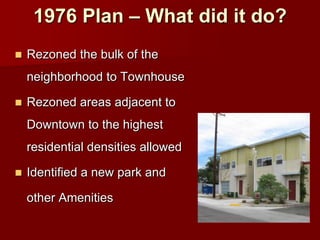
1976 Plan – What did it do?
   Rezoned the bulk of the
    neighborhood to Townhouse

   Rezoned areas adjacent to
    Downtown to the highest
    residential densities allowed

   Identified a new park and

    other Amenities
What Happened?
   Nothing Planned!
    – No redevelopment, or very little
    – Reinvestment in existing houses
    – Office continued to creep
      into the neighborhood
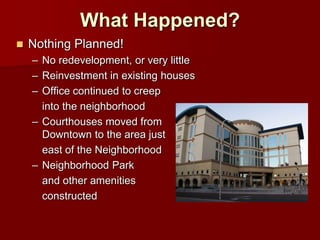
    – Courthouses moved from
      Downtown to the area just
      east of the Neighborhood
    – Neighborhood Park
      and other amenities
      constructed
What Happened? (cont.)
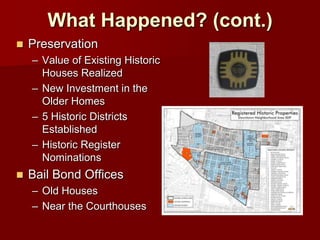
   Preservation
    – Value of Existing Historic
      Houses Realized
    – New Investment in the
      Older Homes
    – 5 Historic Districts
      Established
    – Historic Register
      Nominations
   Bail Bond Offices
    – Old Houses
    – Near the Courthouses
Questions/Discussion
Process
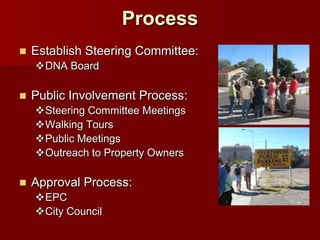
   Establish Steering Committee:
    DNA Board

   Public Involvement Process:
    Steering Committee Meetings
    Walking Tours
    Public Meetings
    Outreach to Property Owners

   Approval Process:
    EPC
    City Council
Walking Tours

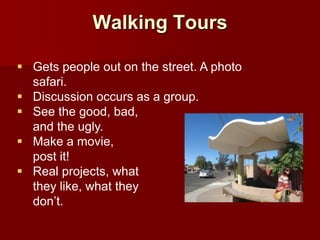
 Gets people out on the street. A photo
  safari.
 Discussion occurs as a group.
 See the good, bad,
  and the ugly.
 Make a movie,
  post it!
 Real projects, what
  they like, what they
  don’t.
Purpose
   To update the original Plan (1976)

   Sector Plan Seeks To:
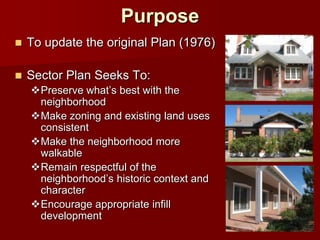
    Preserve what’s best with the
     neighborhood
    Make zoning and existing land uses
     consistent
    Make the neighborhood more
     walkable
    Remain respectful of the
     neighborhood’s historic context and
     character
    Encourage appropriate infill
     development
Planning Themes
 Matching the zoning with the existing land use
  for properties within the DNA.

 Preserving and celebrating the historic
  buildings and character of the DNA.

 Reinforcing the DNA as primarily
  residential, with mixed-use
  corridors.

 Creating a walkable, bike-friendly
  community that connects the DNA
  with Old Town and Downtown.
Planning Themes
 Allowing for appropriately-designed and scaled
  infill development, while respecting the historic
  character of the DNA.

 Creating tree-lined streetscapes throughout the
  DNA.

 Calming traffic speeds and reducing cut-through
  traffic on local streets through the DNA.
Goals and Objectives
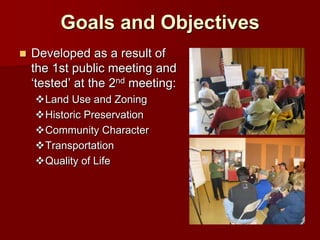
   Developed as a result of
    the 1st public meeting and
    ‘tested’ at the 2nd meeting:
    Land Use and Zoning
    Historic Preservation
    Community Character
    Transportation
    Quality of Life
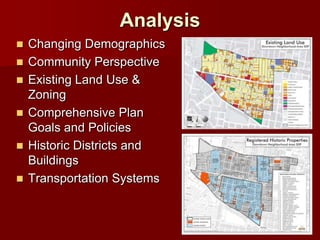
Analysis
   Changing Demographics
   Community Perspective
   Existing Land Use &
    Zoning
   Comprehensive Plan
    Goals and Policies
   Historic Districts and
    Buildings
   Transportation Systems
Questions/Discussion
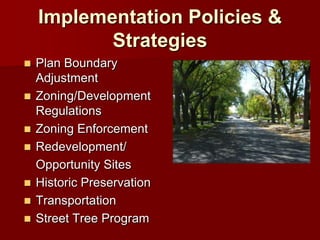
Implementation Policies &
           Strategies
   Plan Boundary
    Adjustment
   Zoning/Development
    Regulations
   Zoning Enforcement
   Redevelopment/
    Opportunity Sites
   Historic Preservation
   Transportation
   Street Tree Program
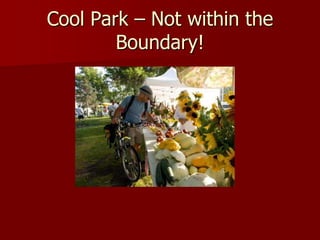
Cool Park – Not within the
        Boundary!
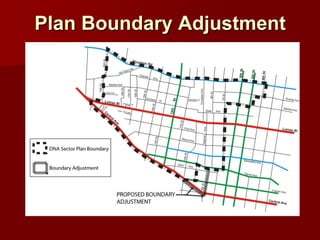
Plan Boundary Adjustment
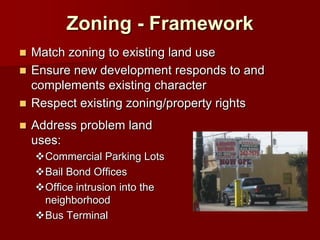
Zoning - Framework
 Match zoning to existing land use
 Ensure new development responds to and
  complements existing character
 Respect existing zoning/property rights

   Address problem land
    uses:
    Commercial Parking Lots
    Bail Bond Offices
    Office intrusion into the
     neighborhood
    Bus Terminal
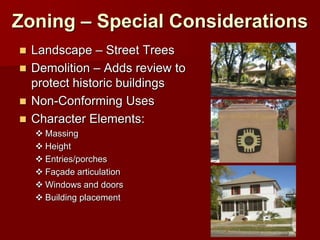
Zoning – Special Considerations
 Landscape – Street Trees
 Demolition – Adds review to
  protect historic buildings
 Non-Conforming Uses
 Character Elements:
     Massing
     Height
     Entries/porches
     Façade articulation
     Windows and doors
     Building placement
Zoning - Categories
   SF – Single Family
     Based on the R-1 zone
     Exceptions – setbacks, garages, façade articulation, secondary
      dwelling units are permissive
     Add Secondary Dwelling Allowed

   TH – Townhouse
     Minimized, purpose is limited in the updated plan
     Exceptions - setbacks, garage placement, curb cuts,
      secondary dwelling units, etc.
     Minimum lot size has stayed the same as the current Sector
      Plan

   MR – Mixed Residential
     Replaces the existing HDA and MDA zones
     Based on the R-2 zone
     Exceptions - building height, parking, no maximum floor area
      ratio, and allows senior housing as a conditional use
Zoning - Categories
   OR – Office/Residential
     Transition zone between the commercial zone along Central Ave.
      and the single family core of the neighborhood
     No commercial uses are allowed
     Strict criteria for new office development

   MUM – Mixed Use Medium
     Replaces the existing RC zone
     Allows mixed use with no min. or max. requirements for residential
     Permissive uses include R-G zone, institutions, professional
      office, limited retail and services uses
     Building heights can go above 26 feet if certain conditions are met

   MUL – Mixed Use Light
     Replaces the existing MRO zone
     Allows mixed use with no min. or max. requirements for residential
     Strict criteria for new non-residential development
Zoning - Categories
   CC – Central Corridor
     Based on the C-2 zone
     Exceptions related to land use, building heights,
      setbacks, parking, façade articulation, etc.
     Residential use based on R-3 zone, but with no
      maximum floor area ratio


   NC – Neighborhood Commercial
     Based on the C-1 zone
     Exceptions related to land use, building articulation,
      entries, lighting, etc.
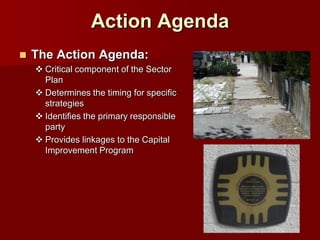
Action Agenda
   The Action Agenda:
     Critical component of the Sector
      Plan
     Determines the timing for specific
      strategies
     Identifies the primary responsible
      party
     Provides linkages to the Capital
      Improvement Program
Questions/Discussion
Albuquerque Oddities
 Zoning Changes and Plans done
  simultaneously
 Quasi-Judicial Process – Councilor Can’t
  Participate
 City Council has their own planners
 Neighborhood Association Led – Need to
  fight to have property owners and
  businesses included
Lessons Learned
 Trust the process (grocery store upgrade
  – citizen led initiative)
 Make sure that all are given the
  opportunity to participate
 Analysis is hard, but needs to be done – in
  older neighborhoods it can be a real
  challenge
Lessons Learned (cont.)
 Property rights are important – figure out
  a way to make it a win-win
 Be creative, think of new ways to
  accomplish the same goal (demolition
  ordinance)
 Make sure the process is transparent
Questions/Discussion


      Thank you!

Western Planner 2012

  • 1.
    Downtown Neighborhood Area Sector Plan Update Jim Strozier, AICP Western Planner Conference 2012
  • 2.
    Presentation Outline/Approach  Acase study  Context/Problem Definition  Process  Outcomes/Solutions  Lessons Learned  Discussion Points Built In – Participate!
  • 3.
    Location  Adjacent toDowntown  Impacted by new Courthouses  Stable Population, but not a lot of young families  Strong Neighborhood Association, but known for fighting everything.
  • 4.
    1976 Conditions  Housing – mostly in poor condition  Trend – lack of maintenance  Zoning – Almost entirely Office  People – moving out to new suburban locations  Some office conversions had happened  Investment – not much
  • 5.
    1976 Plan Purpose  Stop the Blight  Promote Redevelopment  Promote Higher Densities  Don’t Compete with Downtown  Promote New Investment  Increase Amenities
  • 6.
    1976 Plan –What did it do?  Rezoned the bulk of the neighborhood to Townhouse  Rezoned areas adjacent to Downtown to the highest residential densities allowed  Identified a new park and other Amenities
  • 7.
    What Happened?  Nothing Planned! – No redevelopment, or very little – Reinvestment in existing houses – Office continued to creep into the neighborhood – Courthouses moved from Downtown to the area just east of the Neighborhood – Neighborhood Park and other amenities constructed
  • 8.
    What Happened? (cont.)  Preservation – Value of Existing Historic Houses Realized – New Investment in the Older Homes – 5 Historic Districts Established – Historic Register Nominations  Bail Bond Offices – Old Houses – Near the Courthouses
  • 9.
  • 10.
    Process  Establish Steering Committee: DNA Board  Public Involvement Process: Steering Committee Meetings Walking Tours Public Meetings Outreach to Property Owners  Approval Process: EPC City Council
  • 11.
    Walking Tours  Getspeople out on the street. A photo safari.  Discussion occurs as a group.  See the good, bad, and the ugly.  Make a movie, post it!  Real projects, what they like, what they don’t.
  • 12.
    Purpose  To update the original Plan (1976)  Sector Plan Seeks To: Preserve what’s best with the neighborhood Make zoning and existing land uses consistent Make the neighborhood more walkable Remain respectful of the neighborhood’s historic context and character Encourage appropriate infill development
  • 13.
    Planning Themes  Matchingthe zoning with the existing land use for properties within the DNA.  Preserving and celebrating the historic buildings and character of the DNA.  Reinforcing the DNA as primarily residential, with mixed-use corridors.  Creating a walkable, bike-friendly community that connects the DNA with Old Town and Downtown.
  • 14.
    Planning Themes  Allowingfor appropriately-designed and scaled infill development, while respecting the historic character of the DNA.  Creating tree-lined streetscapes throughout the DNA.  Calming traffic speeds and reducing cut-through traffic on local streets through the DNA.
  • 15.
    Goals and Objectives  Developed as a result of the 1st public meeting and ‘tested’ at the 2nd meeting: Land Use and Zoning Historic Preservation Community Character Transportation Quality of Life
  • 16.
    Analysis  Changing Demographics  Community Perspective  Existing Land Use & Zoning  Comprehensive Plan Goals and Policies  Historic Districts and Buildings  Transportation Systems
  • 17.
  • 18.
    Implementation Policies & Strategies  Plan Boundary Adjustment  Zoning/Development Regulations  Zoning Enforcement  Redevelopment/ Opportunity Sites  Historic Preservation  Transportation  Street Tree Program
  • 19.
    Cool Park –Not within the Boundary!
  • 20.
  • 21.
    Zoning - Framework Match zoning to existing land use  Ensure new development responds to and complements existing character  Respect existing zoning/property rights  Address problem land uses: Commercial Parking Lots Bail Bond Offices Office intrusion into the neighborhood Bus Terminal
  • 22.
    Zoning – SpecialConsiderations  Landscape – Street Trees  Demolition – Adds review to protect historic buildings  Non-Conforming Uses  Character Elements:  Massing  Height  Entries/porches  Façade articulation  Windows and doors  Building placement
  • 23.
    Zoning - Categories  SF – Single Family  Based on the R-1 zone  Exceptions – setbacks, garages, façade articulation, secondary dwelling units are permissive  Add Secondary Dwelling Allowed  TH – Townhouse  Minimized, purpose is limited in the updated plan  Exceptions - setbacks, garage placement, curb cuts, secondary dwelling units, etc.  Minimum lot size has stayed the same as the current Sector Plan  MR – Mixed Residential  Replaces the existing HDA and MDA zones  Based on the R-2 zone  Exceptions - building height, parking, no maximum floor area ratio, and allows senior housing as a conditional use
  • 24.
    Zoning - Categories  OR – Office/Residential  Transition zone between the commercial zone along Central Ave. and the single family core of the neighborhood  No commercial uses are allowed  Strict criteria for new office development  MUM – Mixed Use Medium  Replaces the existing RC zone  Allows mixed use with no min. or max. requirements for residential  Permissive uses include R-G zone, institutions, professional office, limited retail and services uses  Building heights can go above 26 feet if certain conditions are met  MUL – Mixed Use Light  Replaces the existing MRO zone  Allows mixed use with no min. or max. requirements for residential  Strict criteria for new non-residential development
  • 25.
    Zoning - Categories  CC – Central Corridor  Based on the C-2 zone  Exceptions related to land use, building heights, setbacks, parking, façade articulation, etc.  Residential use based on R-3 zone, but with no maximum floor area ratio  NC – Neighborhood Commercial  Based on the C-1 zone  Exceptions related to land use, building articulation, entries, lighting, etc.
  • 26.
    Action Agenda  The Action Agenda:  Critical component of the Sector Plan  Determines the timing for specific strategies  Identifies the primary responsible party  Provides linkages to the Capital Improvement Program
  • 27.
  • 28.
    Albuquerque Oddities  ZoningChanges and Plans done simultaneously  Quasi-Judicial Process – Councilor Can’t Participate  City Council has their own planners  Neighborhood Association Led – Need to fight to have property owners and businesses included
  • 29.
    Lessons Learned  Trustthe process (grocery store upgrade – citizen led initiative)  Make sure that all are given the opportunity to participate  Analysis is hard, but needs to be done – in older neighborhoods it can be a real challenge
  • 30.
    Lessons Learned (cont.) Property rights are important – figure out a way to make it a win-win  Be creative, think of new ways to accomplish the same goal (demolition ordinance)  Make sure the process is transparent
  • 31.