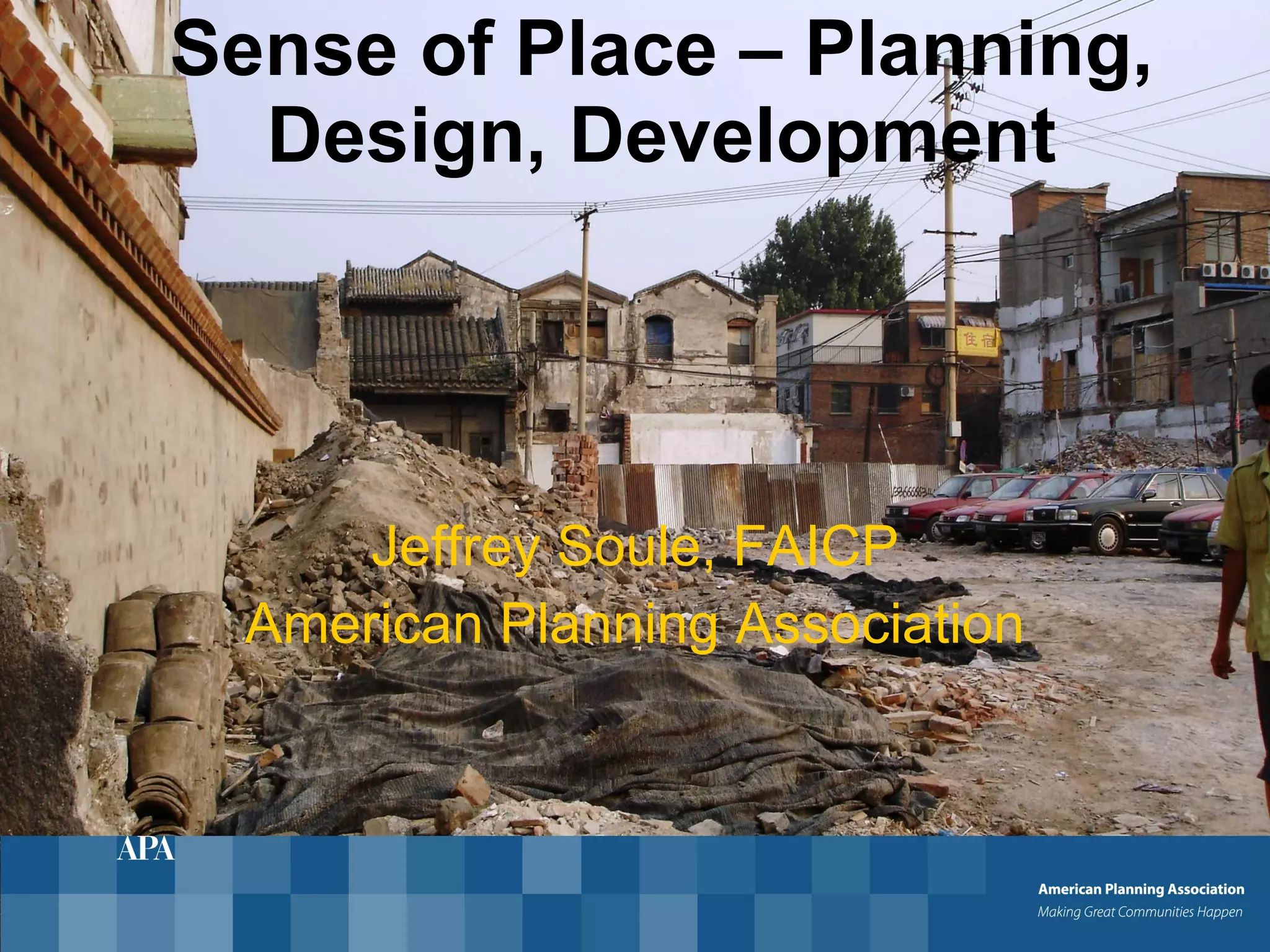
Sense of Place – Planning, Design, Development Jeffrey Soule, FAICP American Planning Association
Outline International Cultural Engagement What is the sense of place? Understanding the role of design Examples Observations
Challenges of Urbanization (190,000) Cultural Identity vs. globalization Scarce resources Impact on quality of life Civic view vs. Ego A philosophy as much as technique What is sense of place and why do we care?
 
 
Ideological Battle Many architects promote a “no context” design philosophy Koolhaas “Tabla Rasa” Much of the world views architecture and engineering as planning Planning takes a humanistic approach
Ring Road System Copied from Moscow
Goals for Urban Planning: improve quality of life for the most people.  Fairly distribute positive and negative aspects of development.   Cultural and historic preservation  Provide a predictable process for decision making informed by community goals.  Environmental conservation Involve a variety of people
Human Impacts of Development Destruction of traditional settlements Opportunity costs: Beijing example CCTV building= $800,000,000 Opera House= $300,000,000 Misunderstanding modernity  
Planning in America Comprehensive  Citizen participation  Many approaches   Long term perspective  Enforcement of Plans  Bottom up process Planners represent public
Zoning: Legal Authority and Background 1920s The Standard State Zoning Enabling Act  The Standard City Planning Enabling Act  State enabling legislation  Prevent law suits due to urbanization Planning act an afterthought
Sense of place at the regional scale Planning Principles Global challenge: Going beyond objects to places Benefits of this approach US Heritage Area Efforts
Heritage area concept Natural, historic, and cultural resources  Managed as an whole Reflects an entire narrative Provide opportunities to conserve natural, cultural, historic, and scenic features;  Provide recreational, economic and educational opportunities.
Elements and application Corridors, features that span a region Containing a variety of resources, tangible, intangible, natural and cultural Appalachian trail example
Strategic Economic value of planning and design Analysis and positioning Celebrate cultural character Engage institutions and individual Develop a strategy
Interpretation engages people Develop a narrative Highlight the linkages Scenic Cultural Historic Natural Oral and musical Arts
Short Term Planning Fads 规划短视的表现 Bad ideas from elsewhere are not good ideas in China 中国不要走其它国家城市规划失误弯路 CBD, Wide Streets, Skyscrapers, Plazas 概念误区: CBD ,大街道,摩天大厦,大广场 Architecture alone does not make a city 建筑本身不能形成城市 Design competitions are not good for planning 设计竞标无助优质规划
Purpose of regulations Provide a process to manage growth  Predictability over time  Fairness  Carry out the vision and general plan  Provide for appeals  Shared power  Encourage continuity
Zoning is only a piece of the process Incentives like finance  Advice, education and discussion  Subdivision  Design Guidelines  Historic Preservation Districts/Overlays Environmental standards Energy standards
City Design Process Reading the city Refle ct  cultur al layers Human perspective Citizen participation  Urban design is between  city plan and architecture Manage at different levels
Elements of Reading Places Customs History Climate Visual elements Scale Architecture Landscape
 
Linking design with management Establish the infrastructure to direct development Create neighborhoods with distinct character Establish Design guidelines based on district characteristics
Design Guidelines Strengthen the city’s character Helps implement the civic vision and plan Encourage new development that adds value to the city Establishes a process and criteria for review Essential for success
Annapolis Design Guidelines preserve the city fabric
Washington DC
 
Design Guidelines Elements for Success   Clarity of purpose Legal integrity Link to City Plan  Third-party review Weather criticism from architects Celebrate results with the public Specific design elements well defined Mandeville Louisiana case study
Case Examples
Nanjing Men Xi  Combining preservation with development
Inventory Establish form characteristics Locate Key new development in cleared industrial area Tie into overall tourism strategy Pilot efforts in engagement
Zhenjiang  New Town Design Based on historic urban landscape Incorporates modern design within a local framework Responds to both human and environmental needs
 
Beijing Qianmen  Historic preservation, tourism and redevelopment High visibility Ethical conflict
Heritage Area and scenic corridor ChangXing Example
 
节点 3
Shanghai Xu Hui Response to mega design Urban redevelopment from human perspective Transportation underlies urban form Scale, pedestrian orientation Individual buildings subordinate to pattern
Other tools Historic Preservation Tax Credits National Register of Historic Places Historic Overlay districts
20% rehabilitation tax credit The building must be used in a trade or business or held for the production of income.  The rehabilitation must be  substantial .  The property must be placed in service  The building must be a  certified historic structure  when placed in service Qualified rehabilitation expenditures include costs of the work on the historic building, as well as architectural and engineering fees, site survey fees, legal expenses, development fees, and other construction-related costs http://www.nps.gov/history/hps/tps/tax/index.htm
Criteria for “Adverse Impact” Under the National Register Physical destruction, damage  Alteration not consistent with the Secretary’s guidelines; Removal of the property from its historic location; Change of the character of the property’s use or of physical features within the property's setting that contribute to its historic significance; Introduction of visual, atmospheric or audible elements that diminish the integrity of the property's historic features; Neglect of a property which causes its deterioration.
Observations Essentially missing from global debates Link cultural heritage conversations to issues of sustainability Establish a community-based planning process Base dialogues on defining local cultural values Link to community  development Quality of life is the entry point Planning and design is about good governance and tools for managing change Provide incentives for residents and businesses Examine the lessons from heritage areas Engage political leaders more effectively

World Heritage Presentation

  • 1.
    Sense of Place– Planning, Design, Development Jeffrey Soule, FAICP American Planning Association
  • 2.
    Outline International CulturalEngagement What is the sense of place? Understanding the role of design Examples Observations
  • 3.
    Challenges of Urbanization(190,000) Cultural Identity vs. globalization Scarce resources Impact on quality of life Civic view vs. Ego A philosophy as much as technique What is sense of place and why do we care?
  • 4.
  • 5.
  • 6.
    Ideological Battle Manyarchitects promote a “no context” design philosophy Koolhaas “Tabla Rasa” Much of the world views architecture and engineering as planning Planning takes a humanistic approach
  • 7.
    Ring Road SystemCopied from Moscow
  • 8.
    Goals for UrbanPlanning: improve quality of life for the most people. Fairly distribute positive and negative aspects of development. Cultural and historic preservation Provide a predictable process for decision making informed by community goals.  Environmental conservation Involve a variety of people
  • 9.
    Human Impacts ofDevelopment Destruction of traditional settlements Opportunity costs: Beijing example CCTV building= $800,000,000 Opera House= $300,000,000 Misunderstanding modernity  
  • 10.
    Planning in AmericaComprehensive Citizen participation Many approaches Long term perspective Enforcement of Plans Bottom up process Planners represent public
  • 11.
    Zoning: Legal Authorityand Background 1920s The Standard State Zoning Enabling Act The Standard City Planning Enabling Act State enabling legislation Prevent law suits due to urbanization Planning act an afterthought
  • 12.
    Sense of placeat the regional scale Planning Principles Global challenge: Going beyond objects to places Benefits of this approach US Heritage Area Efforts
  • 13.
    Heritage area conceptNatural, historic, and cultural resources Managed as an whole Reflects an entire narrative Provide opportunities to conserve natural, cultural, historic, and scenic features; Provide recreational, economic and educational opportunities.
  • 14.
    Elements and applicationCorridors, features that span a region Containing a variety of resources, tangible, intangible, natural and cultural Appalachian trail example
  • 15.
    Strategic Economic valueof planning and design Analysis and positioning Celebrate cultural character Engage institutions and individual Develop a strategy
  • 16.
    Interpretation engages peopleDevelop a narrative Highlight the linkages Scenic Cultural Historic Natural Oral and musical Arts
  • 17.
    Short Term PlanningFads 规划短视的表现 Bad ideas from elsewhere are not good ideas in China 中国不要走其它国家城市规划失误弯路 CBD, Wide Streets, Skyscrapers, Plazas 概念误区: CBD ,大街道,摩天大厦,大广场 Architecture alone does not make a city 建筑本身不能形成城市 Design competitions are not good for planning 设计竞标无助优质规划
  • 18.
    Purpose of regulationsProvide a process to manage growth Predictability over time Fairness Carry out the vision and general plan Provide for appeals Shared power Encourage continuity
  • 19.
    Zoning is onlya piece of the process Incentives like finance Advice, education and discussion Subdivision Design Guidelines Historic Preservation Districts/Overlays Environmental standards Energy standards
  • 20.
    City Design ProcessReading the city Refle ct cultur al layers Human perspective Citizen participation Urban design is between city plan and architecture Manage at different levels
  • 21.
    Elements of ReadingPlaces Customs History Climate Visual elements Scale Architecture Landscape
  • 22.
  • 23.
    Linking design withmanagement Establish the infrastructure to direct development Create neighborhoods with distinct character Establish Design guidelines based on district characteristics
  • 24.
    Design Guidelines Strengthenthe city’s character Helps implement the civic vision and plan Encourage new development that adds value to the city Establishes a process and criteria for review Essential for success
  • 25.
    Annapolis Design Guidelinespreserve the city fabric
  • 26.
  • 27.
  • 28.
    Design Guidelines Elementsfor Success Clarity of purpose Legal integrity Link to City Plan Third-party review Weather criticism from architects Celebrate results with the public Specific design elements well defined Mandeville Louisiana case study
  • 29.
  • 30.
    Nanjing Men Xi Combining preservation with development
  • 31.
    Inventory Establish formcharacteristics Locate Key new development in cleared industrial area Tie into overall tourism strategy Pilot efforts in engagement
  • 32.
    Zhenjiang NewTown Design Based on historic urban landscape Incorporates modern design within a local framework Responds to both human and environmental needs
  • 33.
  • 34.
    Beijing Qianmen Historic preservation, tourism and redevelopment High visibility Ethical conflict
  • 35.
    Heritage Area andscenic corridor ChangXing Example
  • 36.
  • 37.
  • 38.
    Shanghai Xu HuiResponse to mega design Urban redevelopment from human perspective Transportation underlies urban form Scale, pedestrian orientation Individual buildings subordinate to pattern
  • 39.
    Other tools HistoricPreservation Tax Credits National Register of Historic Places Historic Overlay districts
  • 40.
    20% rehabilitation taxcredit The building must be used in a trade or business or held for the production of income. The rehabilitation must be substantial . The property must be placed in service The building must be a certified historic structure when placed in service Qualified rehabilitation expenditures include costs of the work on the historic building, as well as architectural and engineering fees, site survey fees, legal expenses, development fees, and other construction-related costs http://www.nps.gov/history/hps/tps/tax/index.htm
  • 41.
    Criteria for “AdverseImpact” Under the National Register Physical destruction, damage Alteration not consistent with the Secretary’s guidelines; Removal of the property from its historic location; Change of the character of the property’s use or of physical features within the property's setting that contribute to its historic significance; Introduction of visual, atmospheric or audible elements that diminish the integrity of the property's historic features; Neglect of a property which causes its deterioration.
  • 42.
    Observations Essentially missingfrom global debates Link cultural heritage conversations to issues of sustainability Establish a community-based planning process Base dialogues on defining local cultural values Link to community development Quality of life is the entry point Planning and design is about good governance and tools for managing change Provide incentives for residents and businesses Examine the lessons from heritage areas Engage political leaders more effectively