Introduction to Machine learning
By: Behnam Farsi
M.A.Sc ,CIISE Department
May, 2020
Contents
2
1. Introduction
2. Python
3. Machine Learning and Different Methods
4. Deep Learning
Introduction
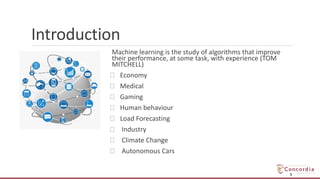
Machine learning is the study of algorithms that improve
their performance, at some task, with experience (TOM
MITCHELL)
� Economy
� Medical
� Gaming
� Human behaviour
� Load Forecasting
� Industry
� Climate Change
� Autonomous Cars
3
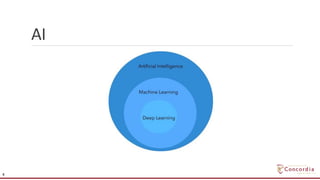
AI
4
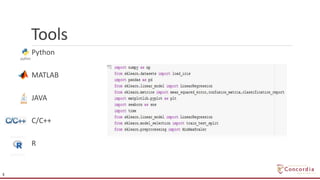
Tools
•Python
•MATLAB
•JAVA
•C/C++
•R
5
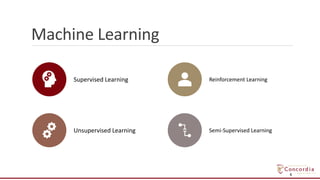
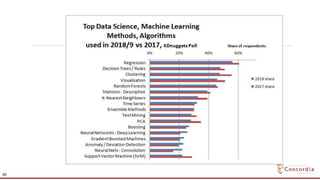
Machine Learning
6
Supervised Learning Reinforcement Learning
Unsupervised Learning Semi-Supervised Learning
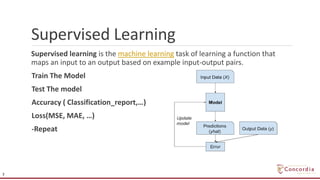
Supervised Learning
Supervised learning is the machine learning task of learning a function that
maps an input to an output based on example input-output pairs.
•Train The Model
•Test The model
•Accuracy ( Classification_report,…)
•Loss(MSE, MAE, …)
•-Repeat
7
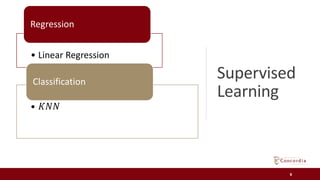
Supervised
Learning
8
• Linear Regression
Regression
• 𝐾𝑁𝑁
Classification
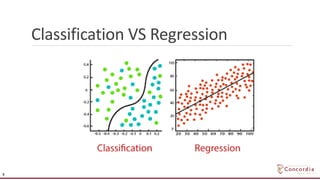
Classification VS Regression
9
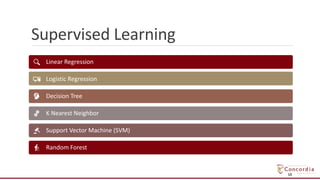
Supervised Learning
10
Linear Regression
Logistic Regression
Decision Tree
K Nearest Neighbor
Support Vector Machine (SVM)
Random Forest
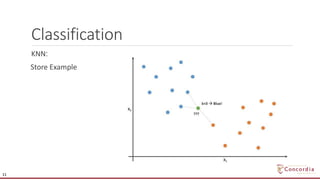
Classification
KNN:
Store Example
11
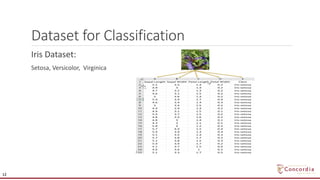
Dataset for Classification
Iris Dataset:
Setosa, Versicolor, Virginica
12
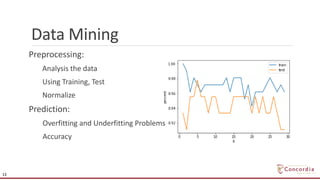
Data Mining
Preprocessing:
1. Analysis the data
2. Using Training, Test
3. Normalize
Prediction:
1. Overfitting and Underfitting Problems
2. Accuracy
13
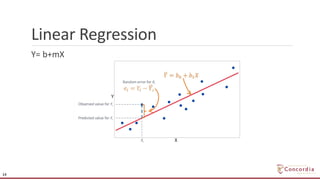
Linear Regression
Y= b+mX
14
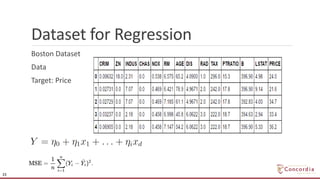
Dataset for Regression
Boston Dataset
Data
Target: Price
15
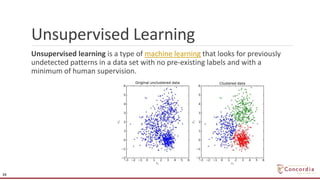
Unsupervised Learning
Unsupervised learning is a type of machine learning that looks for previously
undetected patterns in a data set with no pre-existing labels and with a
minimum of human supervision.
16
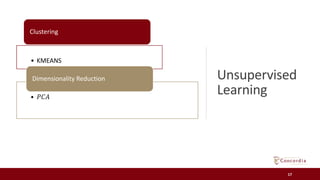
Unsupervised
Learning
17
• KMEANS
Clustering
• 𝑃𝐶𝐴
Dimensionality Reduction
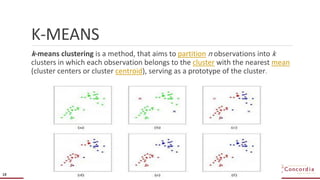
K-MEANS
k-means clustering is a method, that aims to partition n observations into k
clusters in which each observation belongs to the cluster with the nearest mean
(cluster centers or cluster centroid), serving as a prototype of the cluster.
18
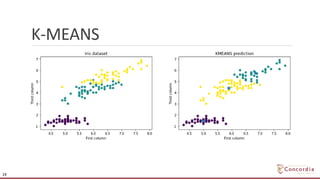
K-MEANS
19
20
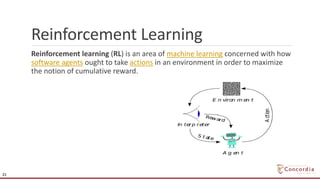
Reinforcement Learning
Reinforcement learning (RL) is an area of machine learning concerned with how
software agents ought to take actions in an environment in order to maximize
the notion of cumulative reward.
21
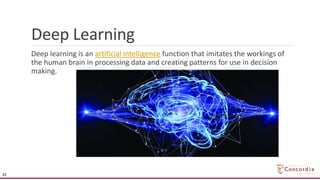
Deep Learning
Deep learning is an artificial intelligence function that imitates the workings of
the human brain in processing data and creating patterns for use in decision
making.
22
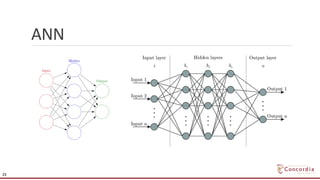
ANN
23
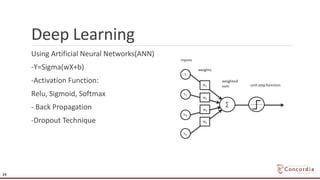
Deep Learning
Using Artificial Neural Networks(ANN)
-Y=Sigma(wX+b)
-Activation Function:
Relu, Sigmoid, Softmax
- Back Propagation
-Dropout Technique
24
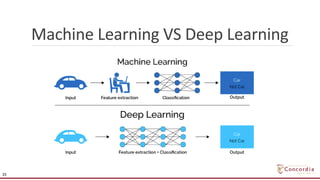
Machine Learning VS Deep Learning
25
3

Intro to machine learning