






An Introduction to Hyper-Local Media:Emerging Thoughts & EvidenceDamian Radcliffe November 2010
Running OrderWhy this matters to Ofcom- purposes and duties	 	- evidenceDefinitions and Characteristics The UK picture:TVRadioPrintWeb (with an emphasis on the web)Top Ten trendsIssues/BarriersWhat might happen next? Q&A
Why does this matter to us?
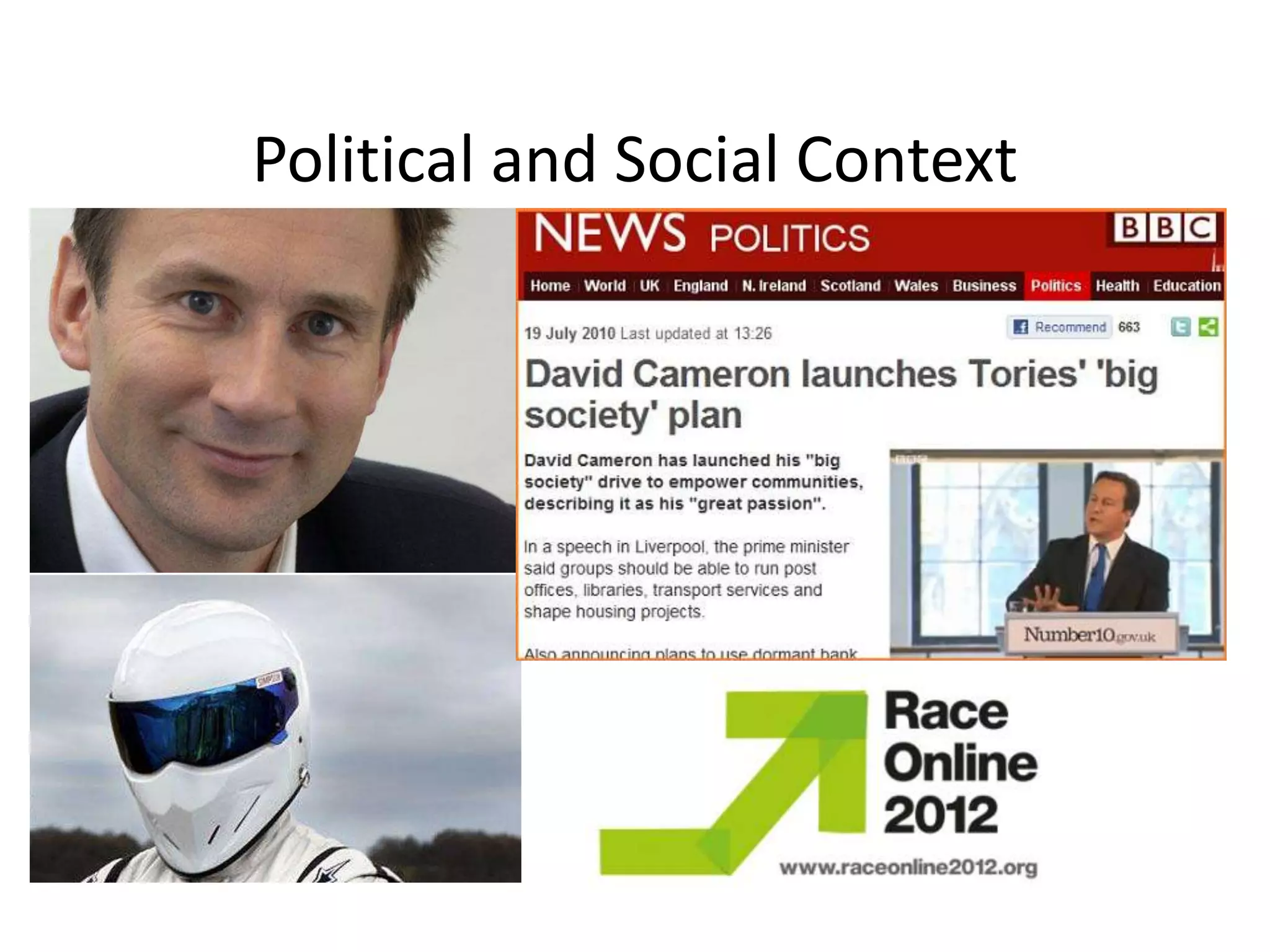
Political and Social ContextLocal TV
Regulatory Context: PurposesThe Communications Act requires us to “further the interests of citizens and consumers”Strategic purposes: To promote effective and sustainable competition, Promote efficient use of public assets, Help markets work for consumers, Provide appropriate assurance to audiences, and To implement specific public policies defined by Parliament
Regulatory Context: Statutory DutiesSecure wide range of TV and radio services of high quality and wide appeal
Maintain sufficient plurality of providers
Licence national and local analogue and community radio stations
Ensure optimal use of the radio spectrum – including for Local TV Other reasons why this mattersOn-going mission to:Understand how local media is changing and evolving.Understand how citizens and consumers use – and value - local media.Understand new business models.Understand how hyper-local can underpin local democracy in the UK.Role of hyper-local in supporting PSB ecology.Promote Media Literacy (use, understand, create).
Reasons why this matters. Part Two.  The evidence base.
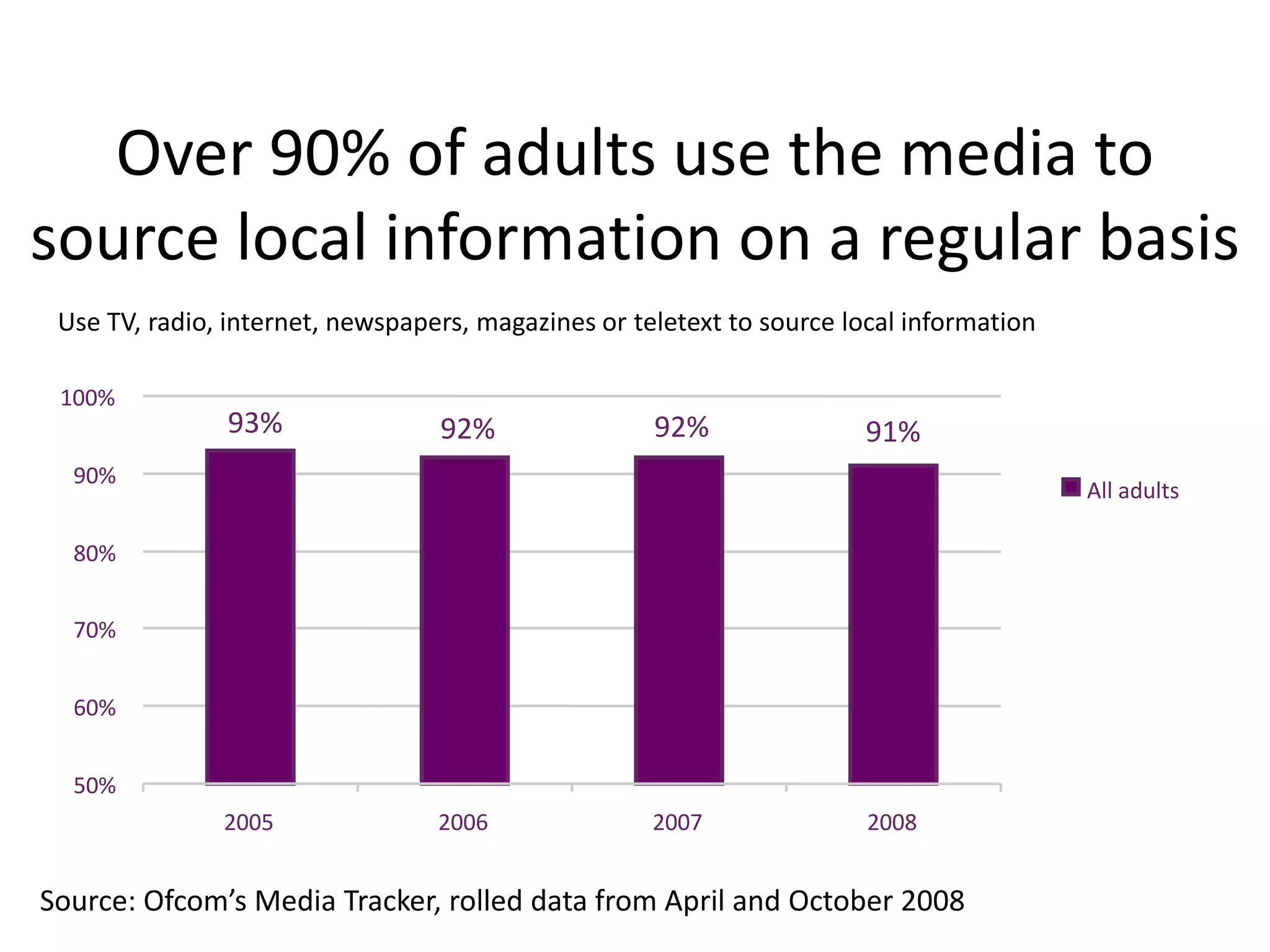
Over 90% of adults use the media to source local information on a regular basisUse TV, radio, internet, newspapers, magazines or teletext to source local information100%93%92%92%91%90%All adults80%70%60%50%2005200620072008Source: Ofcom’s Media Tracker, rolled data from April and October 2008
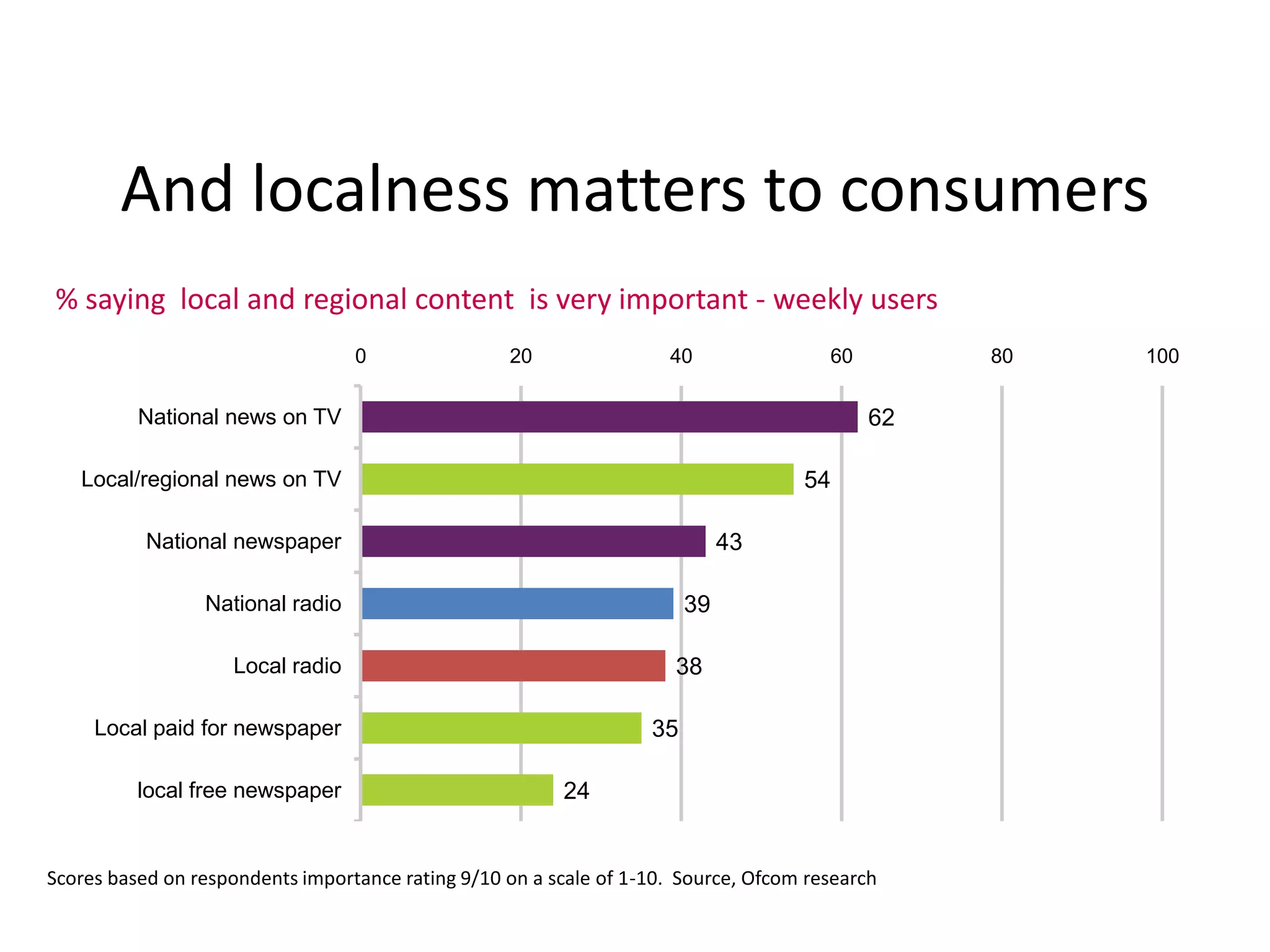
And localness matters to consumers% saying  local and regional content  is very important - weekly usersScores based on respondents importance rating 9/10 on a scale of 1-10.  Source, Ofcom research
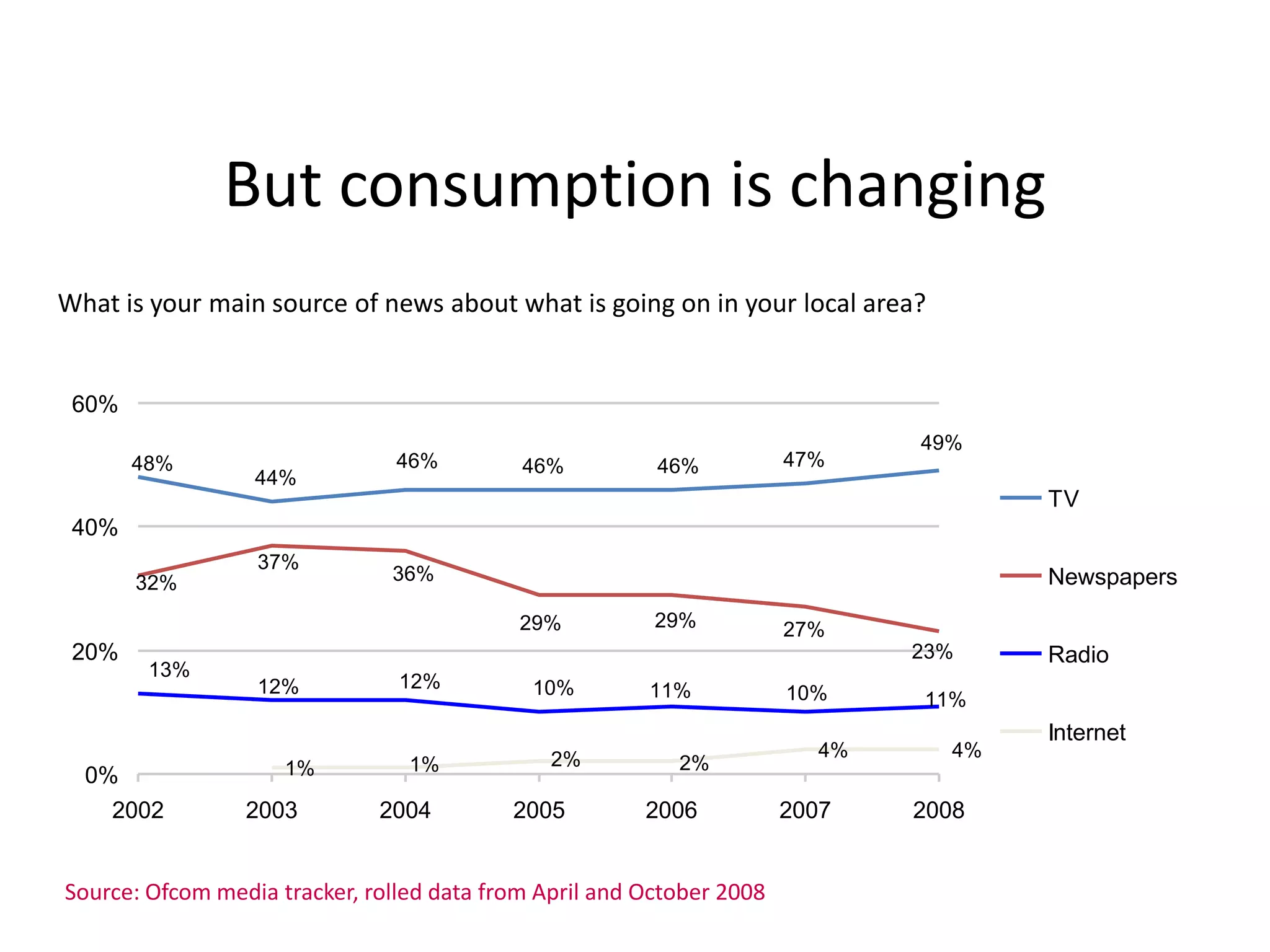
But consumption is changingWhat is your main source of news about what is going on in your local area?Source: Ofcom media tracker, rolled data from April and October 2008
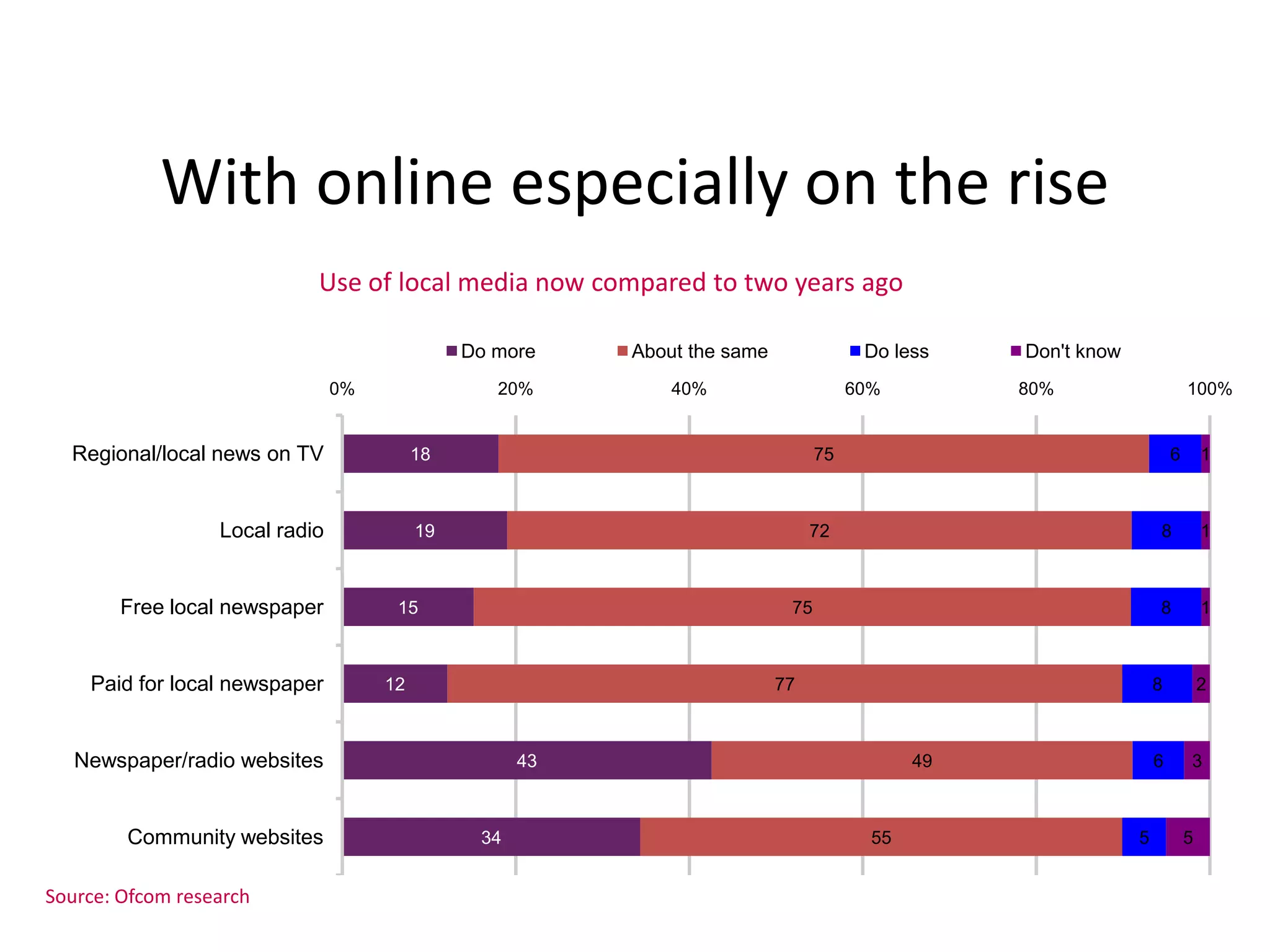
With online especially on the riseUse of local media now compared to two years agoSource: Ofcom research 12
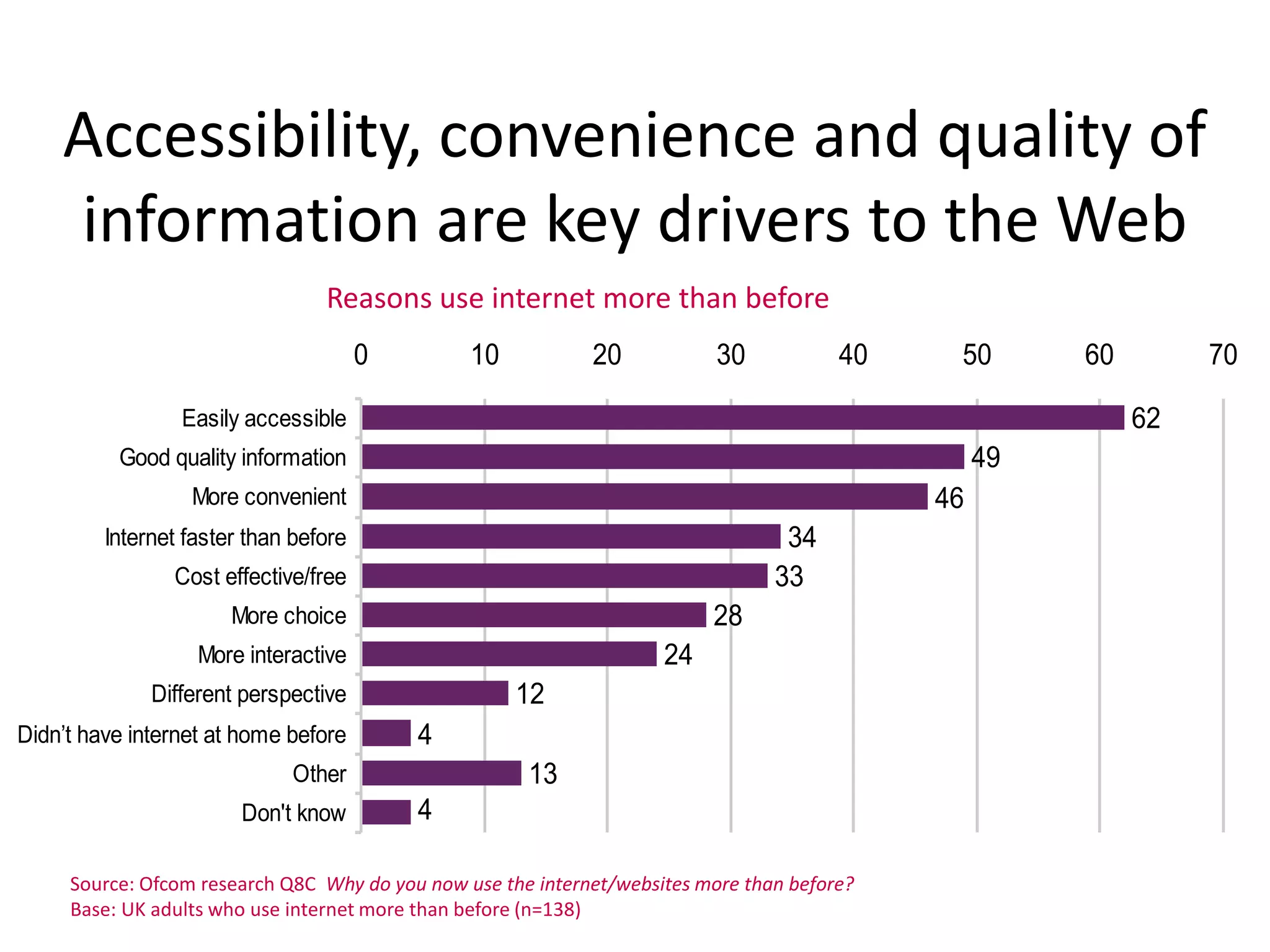
Accessibility, convenience and quality of information are key drivers to the WebReasons use internet more than beforeSource: Ofcom research Q8C  Why do you now use the internet/websites more than before?Base: UK adults who use internet more than before (n=138)13
Trend quite likely to continue
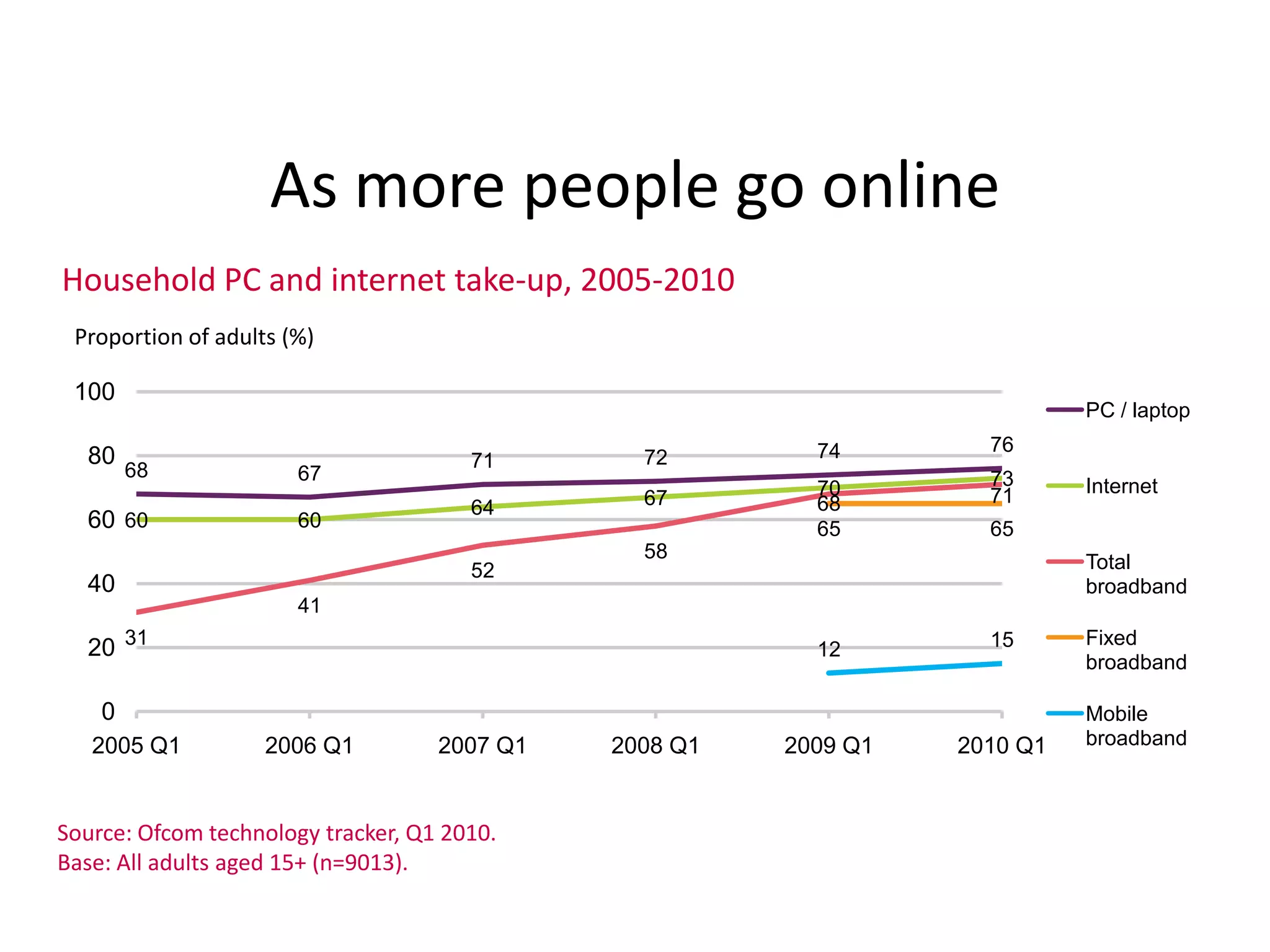
As more people go onlineHousehold PC and internet take-up, 2005-2010Proportion of adults (%)Source: Ofcom technology tracker, Q1 2010.Base: All adults aged 15+ (n=9013).
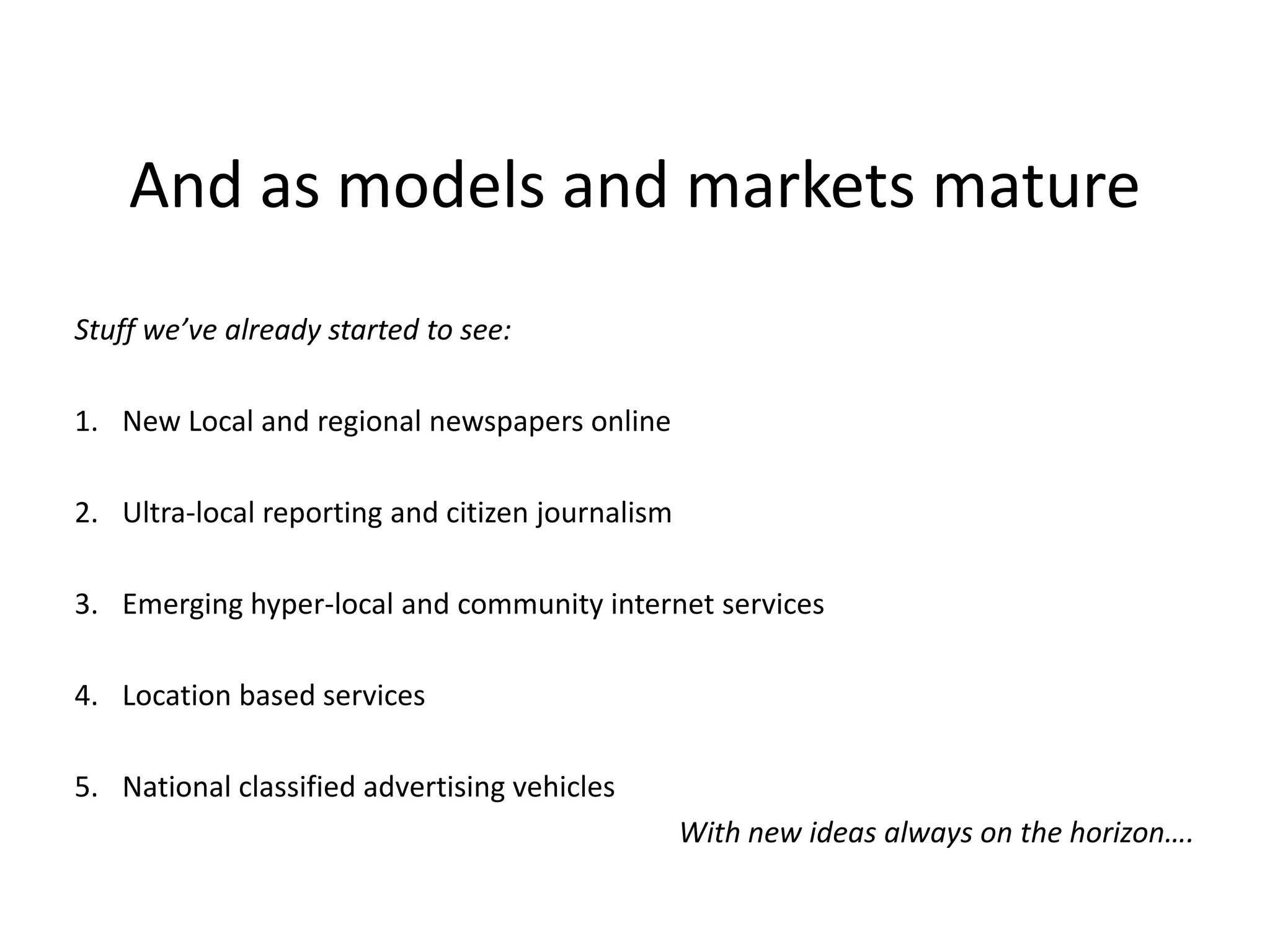
And as models and markets matureStuff we’ve already started to see:New Local and regional newspapers onlineUltra-local reporting and citizen journalismEmerging hyper-local and community internet servicesLocation based servicesNational classified advertising vehiclesWith new ideas always on the horizon….
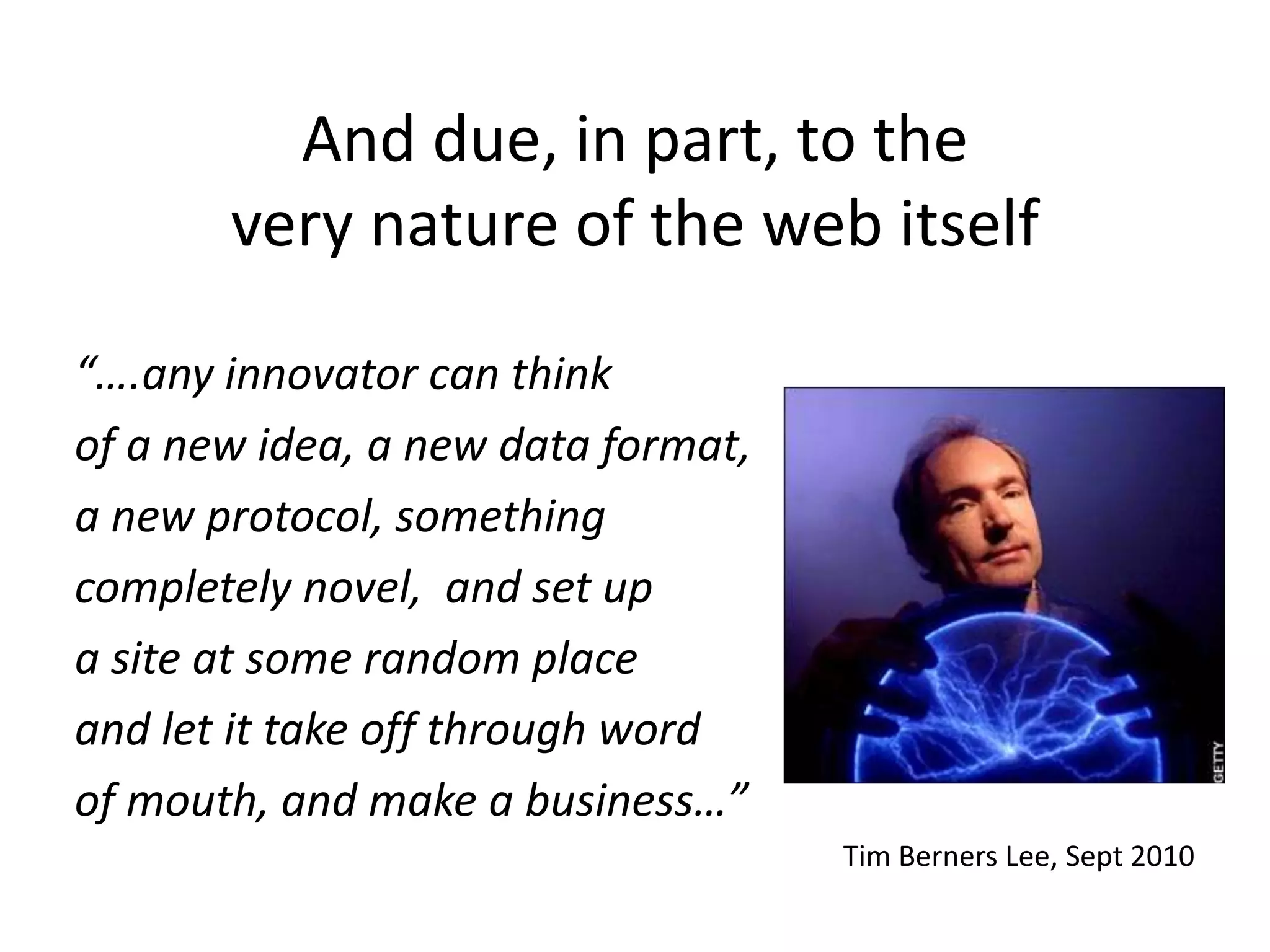
And due, in part, to the very nature of the web itself“….any innovator can thinkof a new idea, a new data format, a new protocol, something completely novel,  and set up a site at some random place and let it take off through word of mouth, and make a business…”Tim Berners Lee, Sept 2010
So, that’s the background.Now let’s talk hyper-local.
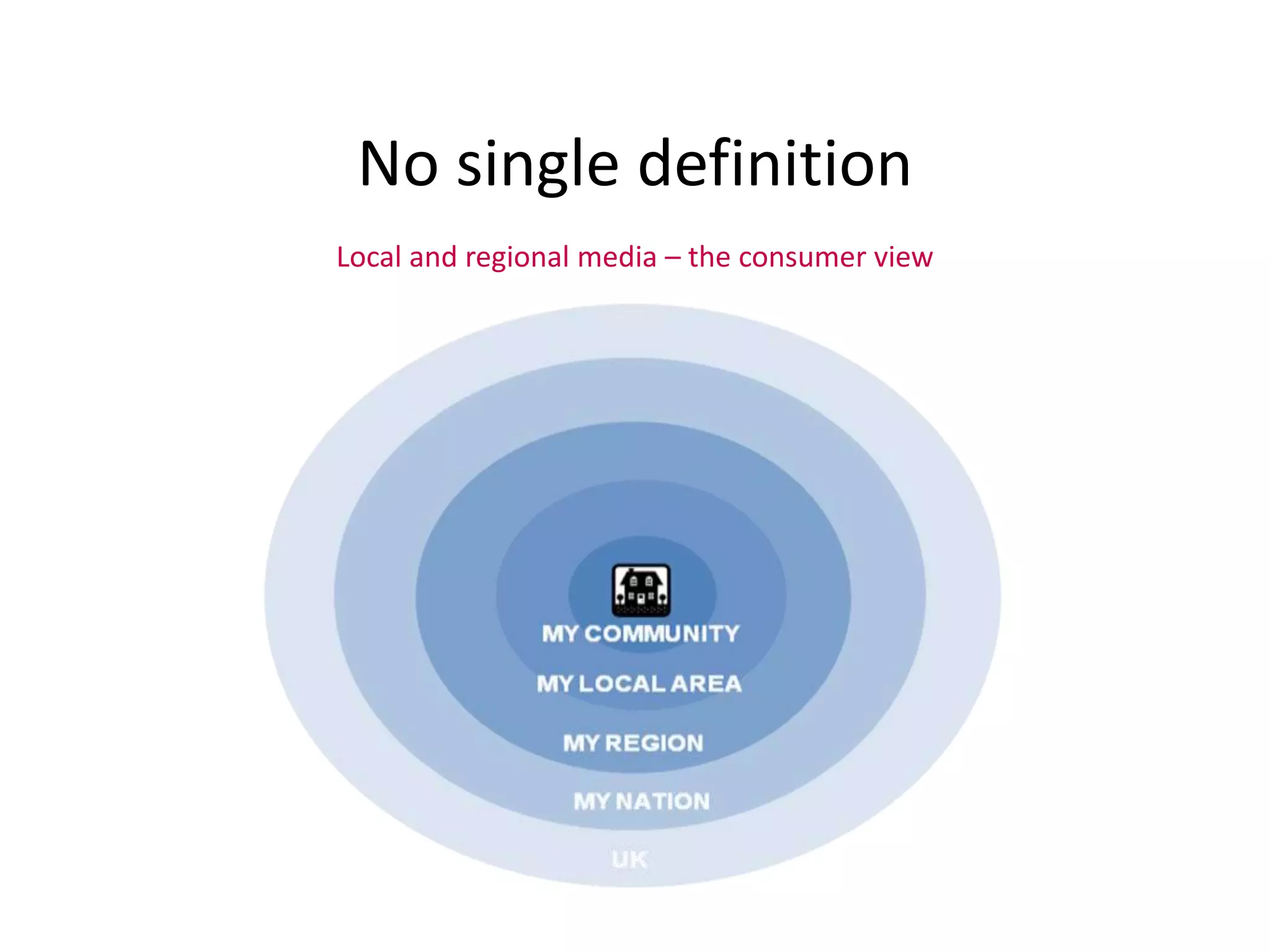
No single definitionLocal and regional media – the consumer view
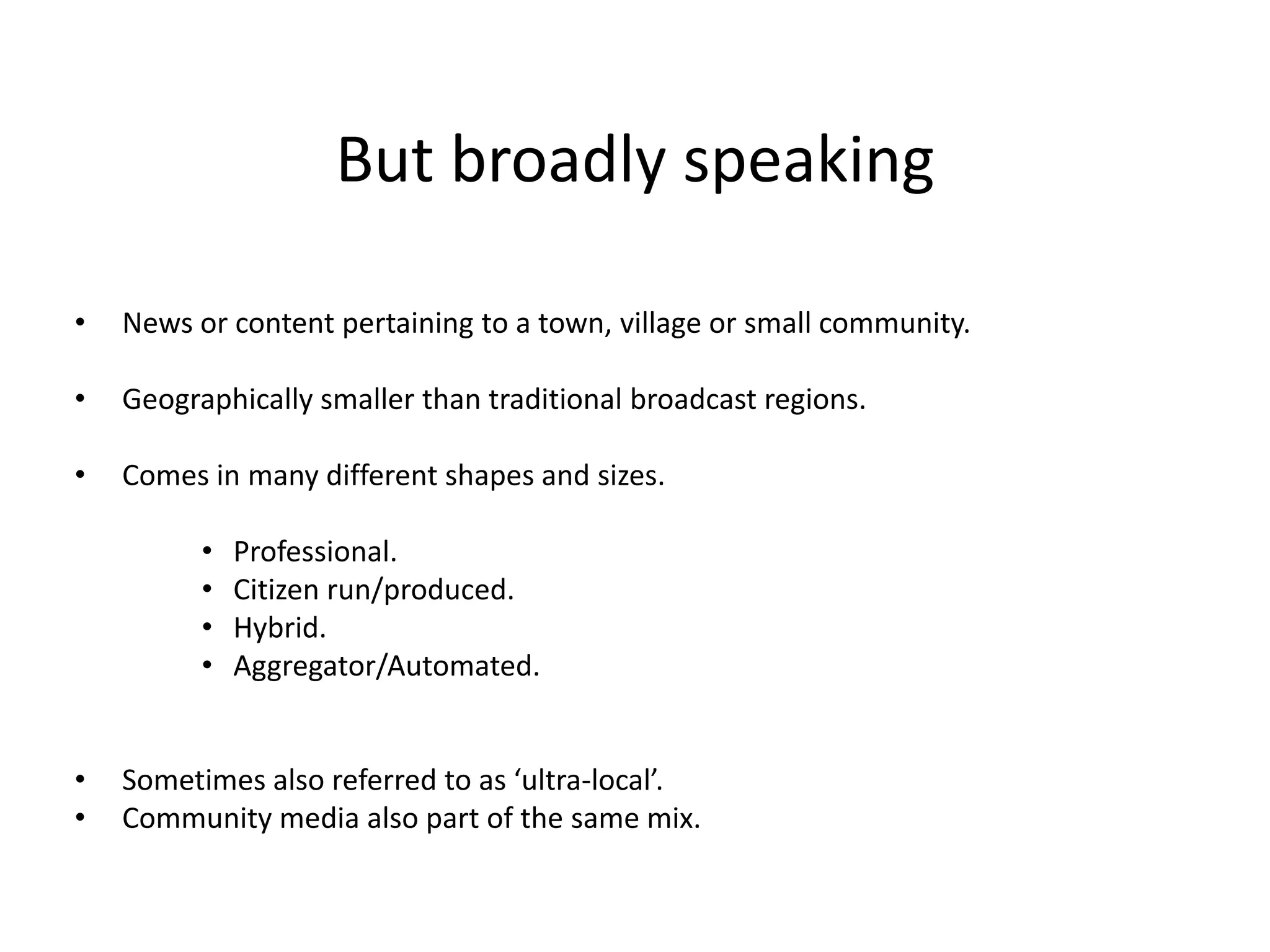
But broadly speakingNews or content pertaining to a town, village or small community.Geographically smaller than traditional broadcast regions.Comes in many different shapes and sizes.Professional.Citizen run/produced.Hybrid.Aggregator/Automated.Sometimes also referred to as ‘ultra-local’.Community media also part of the same mix.
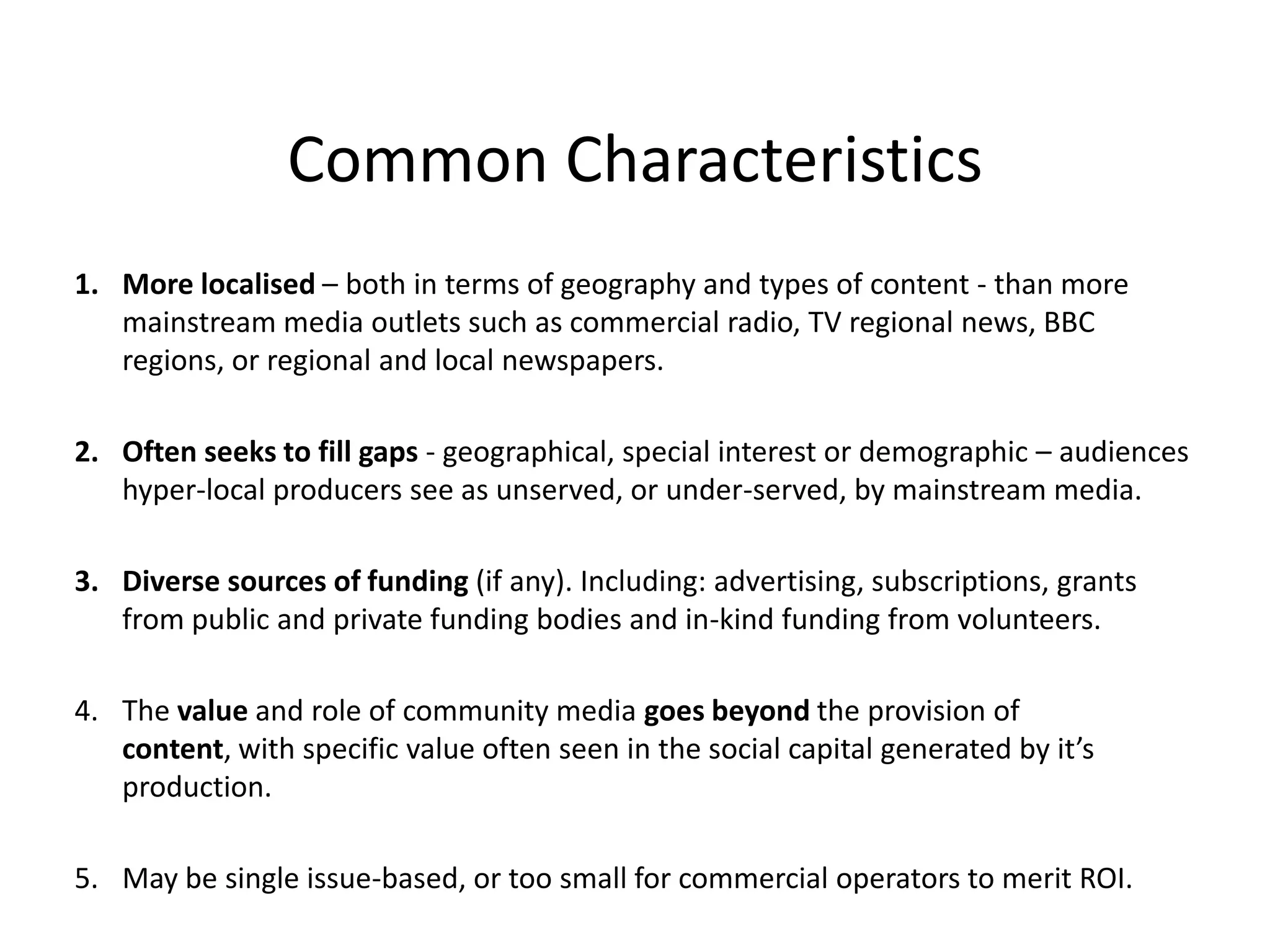
Common CharacteristicsMore localised – both in terms of geography and types of content - than more mainstream media outlets such as commercial radio, TV regional news, BBC regions, or regional and local newspapers. Often seeks to fill gaps - geographical, special interest or demographic – audiences hyper-local producers see as unserved, or under-served, by mainstream media.Diverse sources of funding (if any). Including: advertising, subscriptions, grants from public and private funding bodies and in-kind funding from volunteers.The value and role of community media goes beyond the provision of content, with specific value often seen in the social capital generated by it’s production. May be single issue-based, or too small for commercial operators to merit ROI.
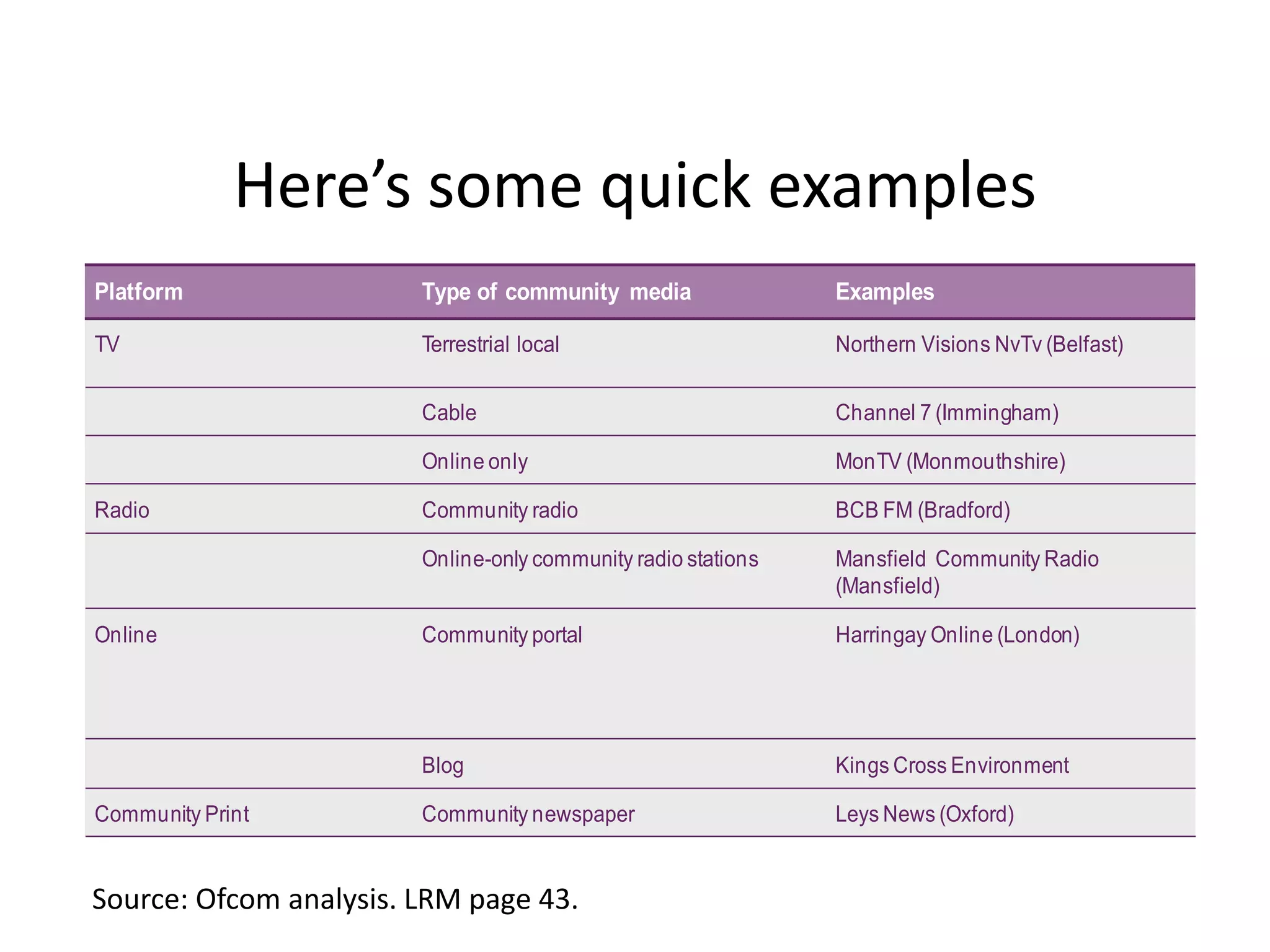
Here’s some quick examplesSource: Ofcom analysis. LRM page 43.
… And here’s some in more detail
Local TV in the UK
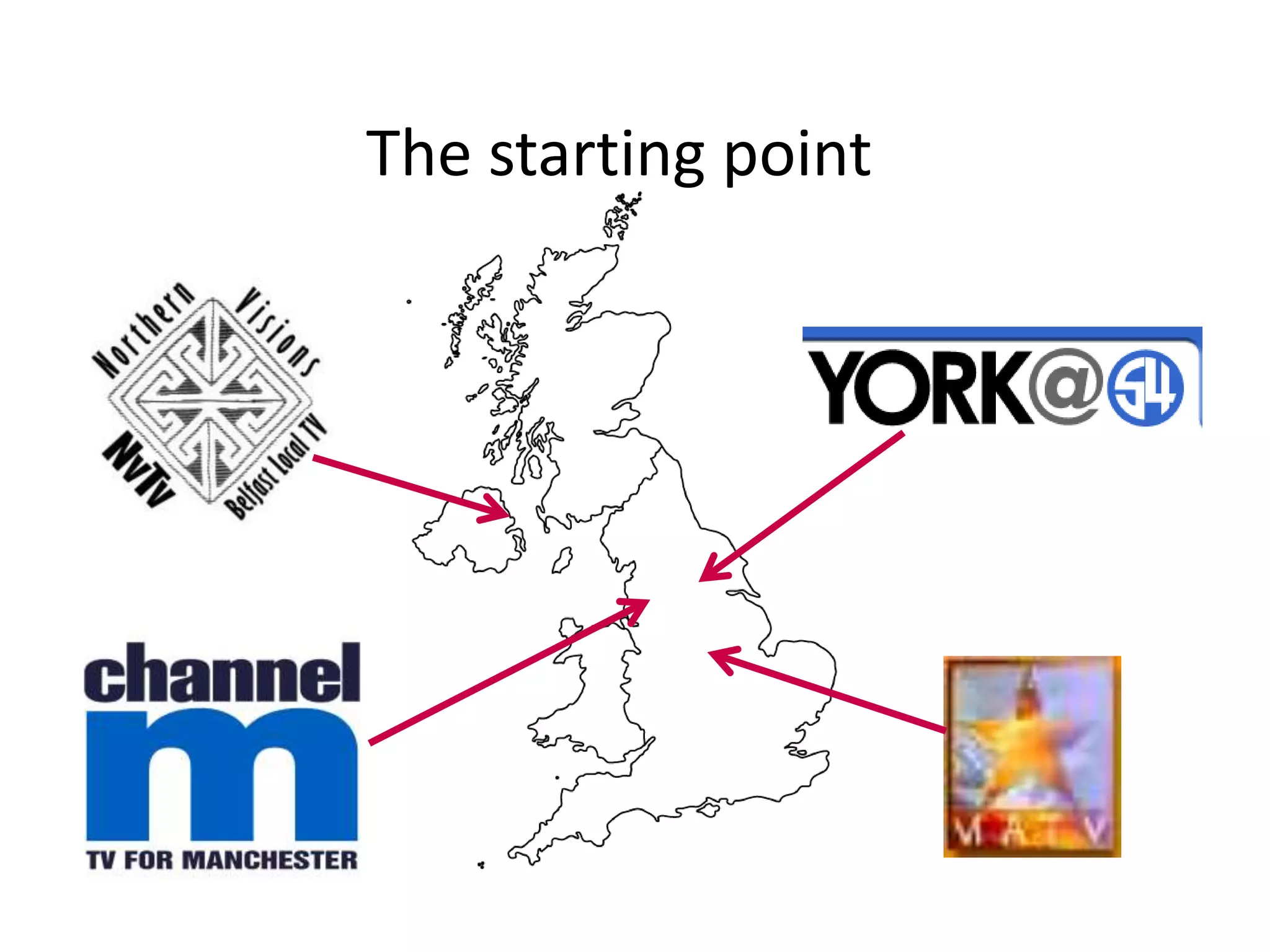
The starting point
The existing channelsWholly commercial channel owned by Guardian Media Group. Now on digital, cable and satellite. But programme plans significantly scaled back in 2010Community model supported by grants from regional and educational bodies. Mix of professional (mainly freelance) labour and volunteers. Emphasis on training Privately owned channel aimed mainly at ethnic Asian community in Leicester. Strong links with broadcasters in India to source contentSmall scale service run on semi-amateur basis. Contains local news and sport.
Channel 7, ImminghamLongest-running local TV channel in the UK. Launched in January 1998.140,000 homes can access on TV, via Virgin. (Channel 879). Some content online. The station is a community interest company (a not-for-profit social enterprise).Own production centre and studios. Broadcasts 9am to 7pm, seven days a week.What's On, Events and other local info broadcast in graphic form overnight.Recently won an O2 Think Big Award for its work with young people.Recent PartnershipsWorked with the owners of the Grimsby Telegraph, on election coverage, including videos for the paper's website and broadcast on Seven as a longer programme. Community magazine publisher CPO Media to deliver a series of Media Mash Up! Workshops, training local students to create their own websites, magazines and TV. In partnership with the BBC, it recorded the BBC General Election programme at Immage Studios. The programme was re-broadcast under licence on Seven Local TV, which is believed to be a first for local TV in the UK.
Local Video Online
Local Video Online - backgroundSmaller number of sites than text based services. Often less well known. Many models.Some large operations, reasonably well resourced:Kent TV high profile, pilot closed on 31st March 2010. (Ten Alps, 500k).Lakes TV on digital platforms, covers the Lakes, Barrow and Penrith.myCornwall.tv – funders include The Eden Project,  Fifteen  Restaurant, SW Tourism.Smaller operations  include:Kings Cross TV  - mixes  original content with video material pulled in from across the web, but freely available on sites like YouTube and blip.tv. Camden.tv encourages community to submit films about their area, and acting as a	curator for content across a broad range of themes including history, music and politics.Hertsweb.tv. – run by Craig McKenzie, in his spare time.  Craig works full-time for the NHS, has 2 kids and runs 2 hyper-local sites  - Discover Hertford and Ware Online.
Mon-TVLaunched in 2008  offering “Local Television for Monmouthshire”, Features a weekly 15 minute news bulletin as well as a range of other content such as local Sport, Music, Festivals and human interest stories. Typically gets 1,000 users a day, increasing by 300% at busy times e.g. Festivals. Last December it recorded its millionth visitor.Run (voluntarily) by two professional filmmakers, and volunteers - some doing 15 hours p/w to help with filming, editing and scheduling. A lot of the content is generated by students doing a City & Guilds Level 3 Diploma at the station; with coursework being showcased in the “Mon TV Academy” . Many graduates stay on as volunteers after graduating.
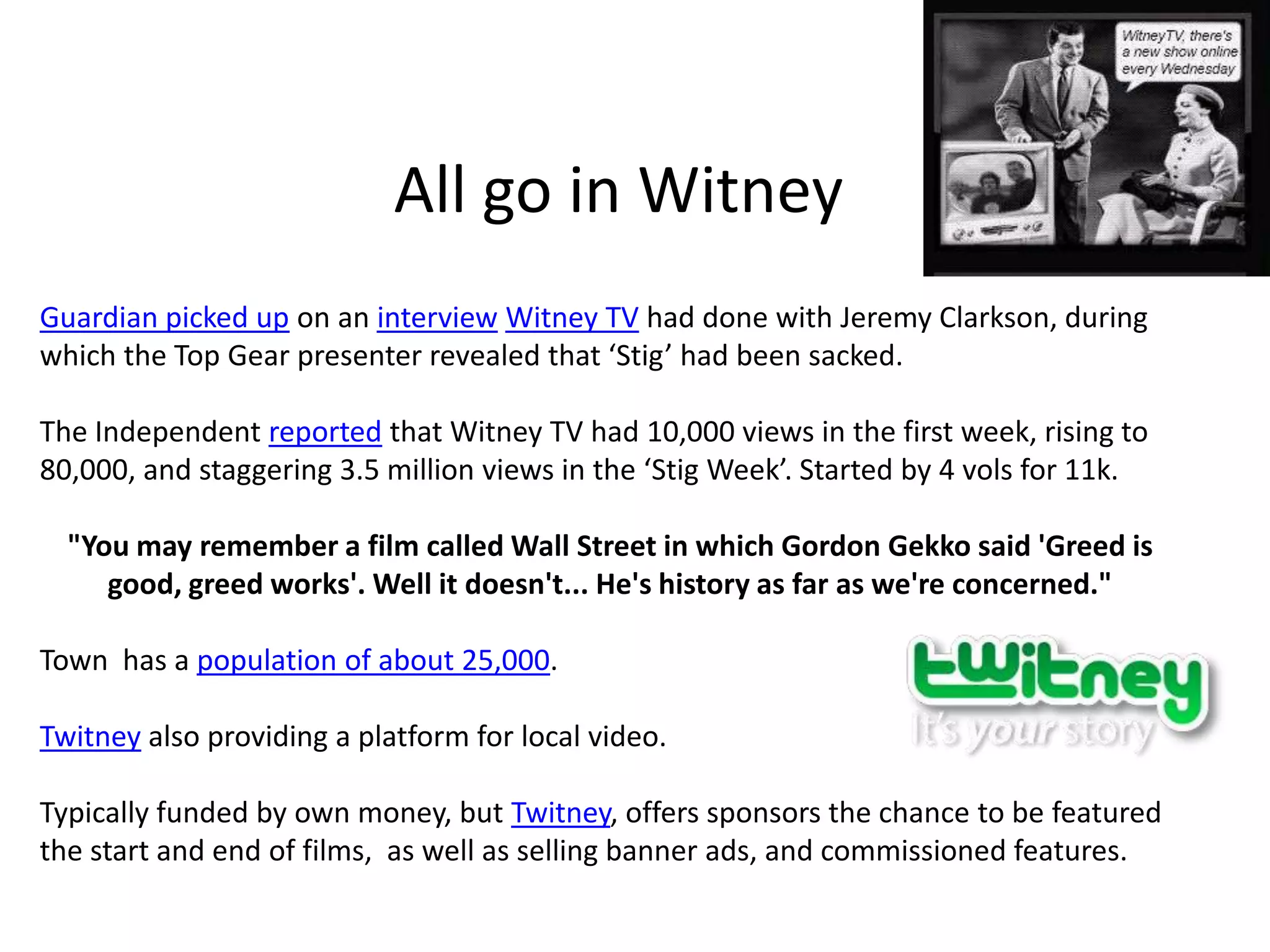
			All go in WitneyGuardian picked up on an interviewWitney TV had done with Jeremy Clarkson, during which the Top Gear presenter revealed that ‘Stig’ had been sacked. The Independent reported that Witney TV had 10,000 views in the first week, rising to 80,000, and staggering 3.5 million views in the ‘Stig Week’. Started by 4 vols for 11k."You may remember a film called Wall Street in which Gordon Gekko said 'Greed is good, greed works'. Well it doesn't... He's history as far as we're concerned." Town  has a population of about 25,000. Twitney also providing a platform for local video. Typically funded by own money, but Twitney, offers sponsors the chance to be featured the start and end of films,  as well as selling banner ads, and commissioned features.
Community Radio
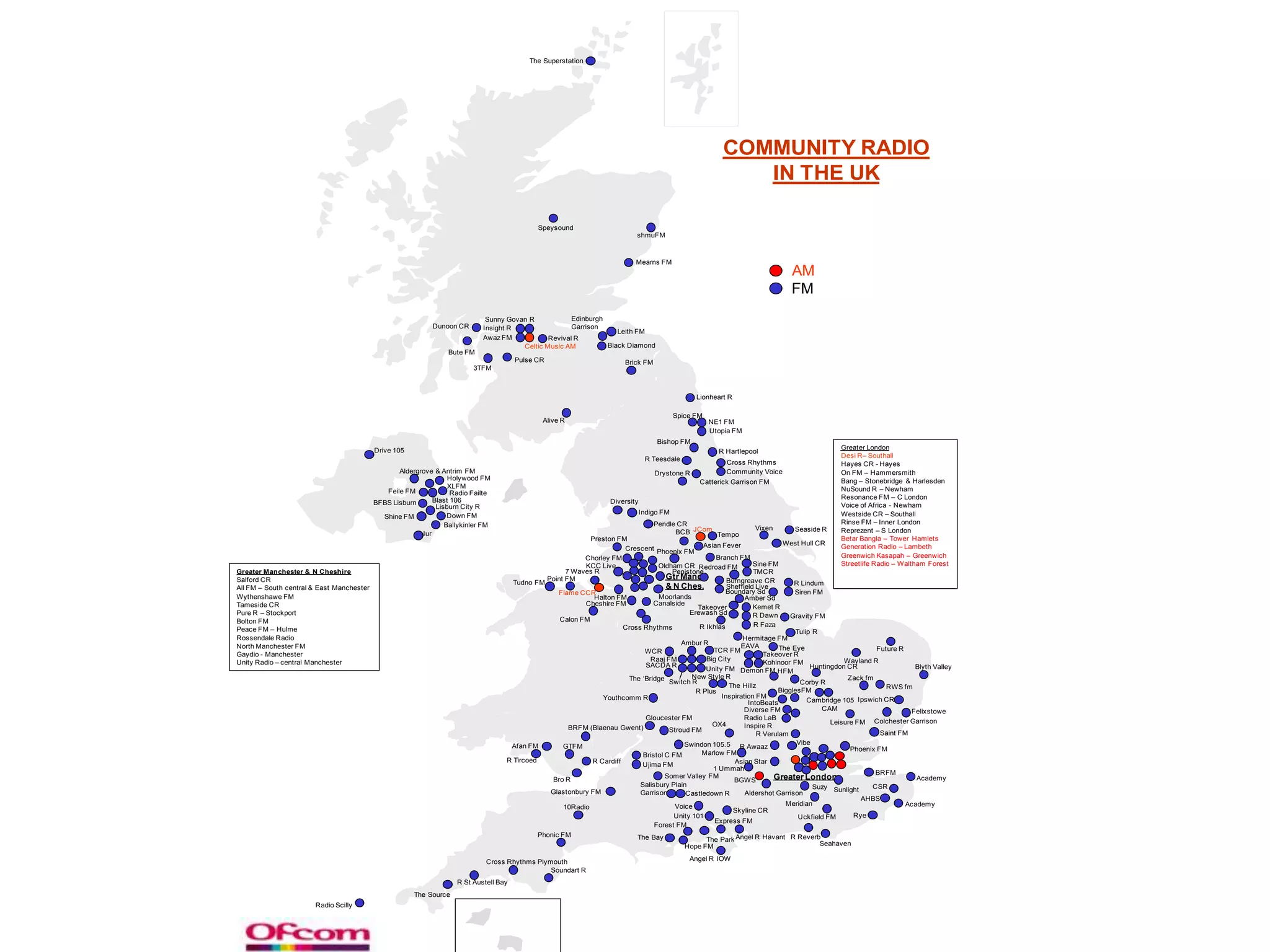
Licenced Community RadioCommunity radio stations are not-for-profit radio services designed to operate on a small scale and to deliver community benefits aka ‘social gain’, to one or more communities.Initial legislation introduced in 2004. First station launched November 2005.   Ofcom has to date licensed 228 stations over two rounds of licensing.
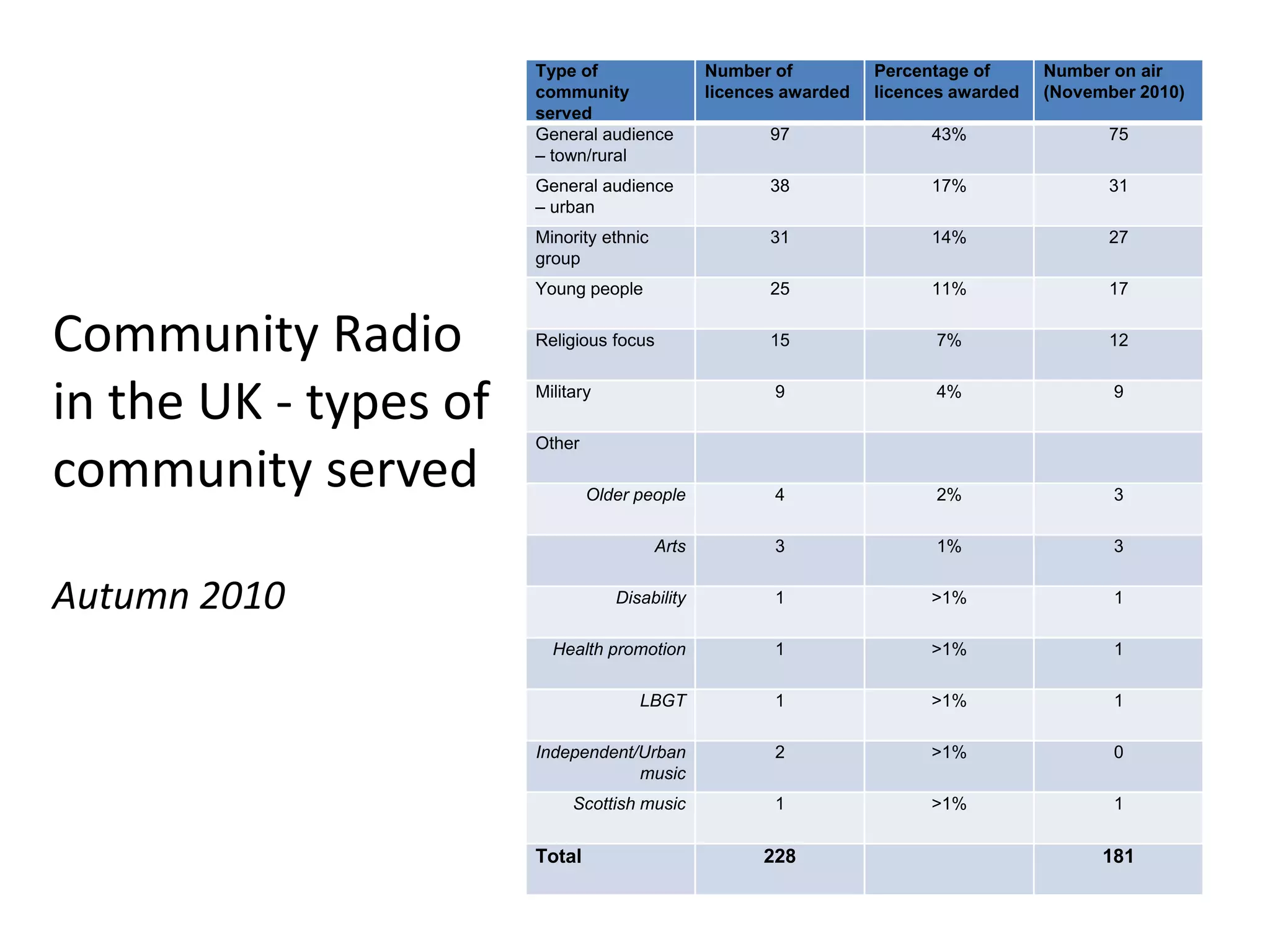
  181 are broadcasting, 17 have either not launch or handed their licence back.
  Remainder preparing to start broadcasting. 9.2 million adults (just over 11 million people) are able to receive a community radio station broadly aimed at them. C.15% of the total UK population may be able to receive a community radio service aimed at them on FM or AM.
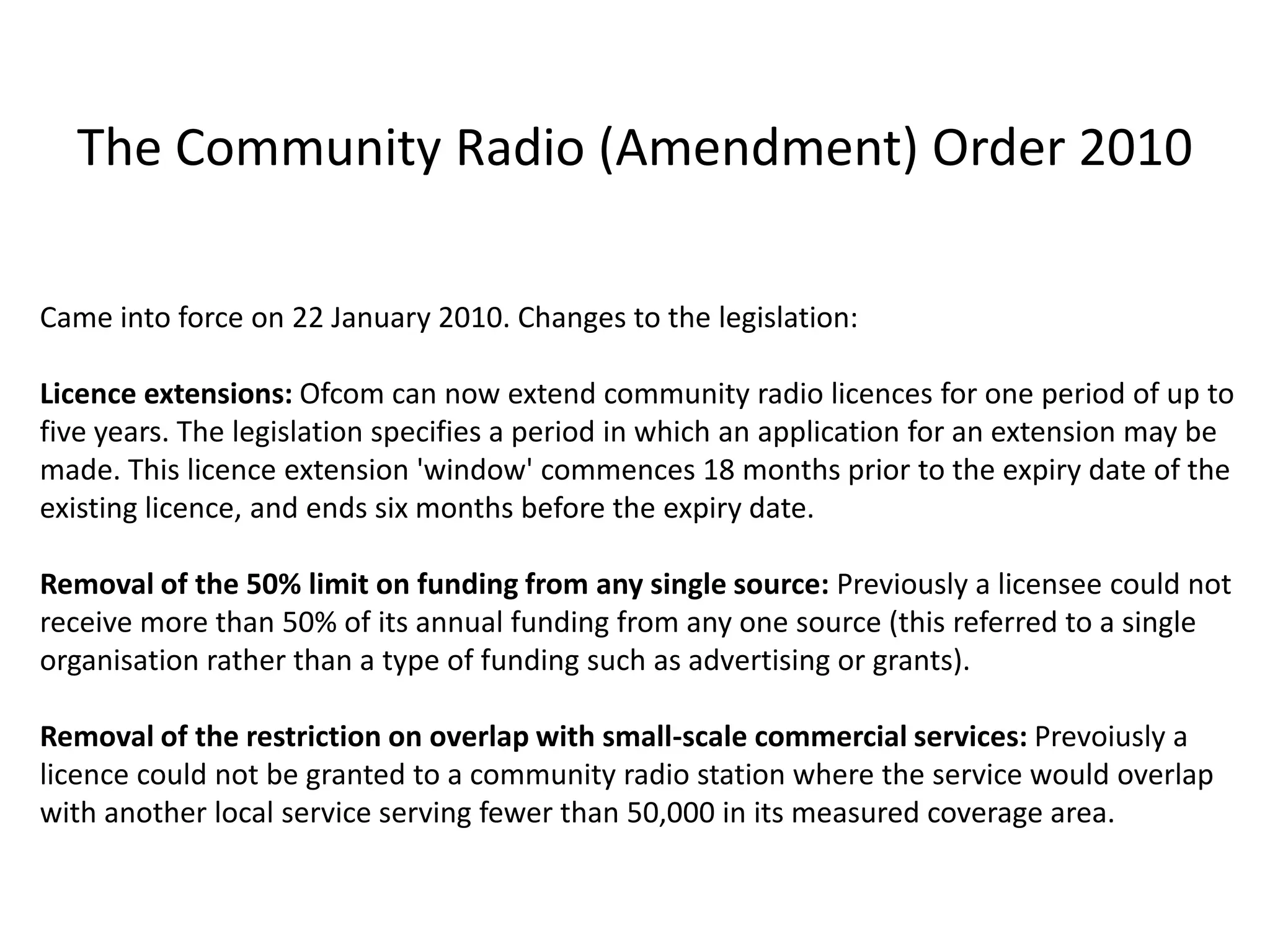
The Community Radio (Amendment) Order 2010Came into force on 22 January 2010. Changes to the legislation:Licence extensions: Ofcom can now extend community radio licences for one period of up to five years. The legislation specifies a period in which an application for an extension may be made. This licence extension 'window' commences 18 months prior to the expiry date of the existing licence, and ends six months before the expiry date.Removal of the 50% limit on funding from any single source: Previously a licensee could not receive more than 50% of its annual funding from any one source (this referred to a single organisation rather than a type of funding such as advertising or grants). Removal of the restriction on overlap with small-scale commercial services:Prevoiusly a licence could not be granted to a community radio station where the service would overlap with another local service serving fewer than 50,000 in its measured coverage area.
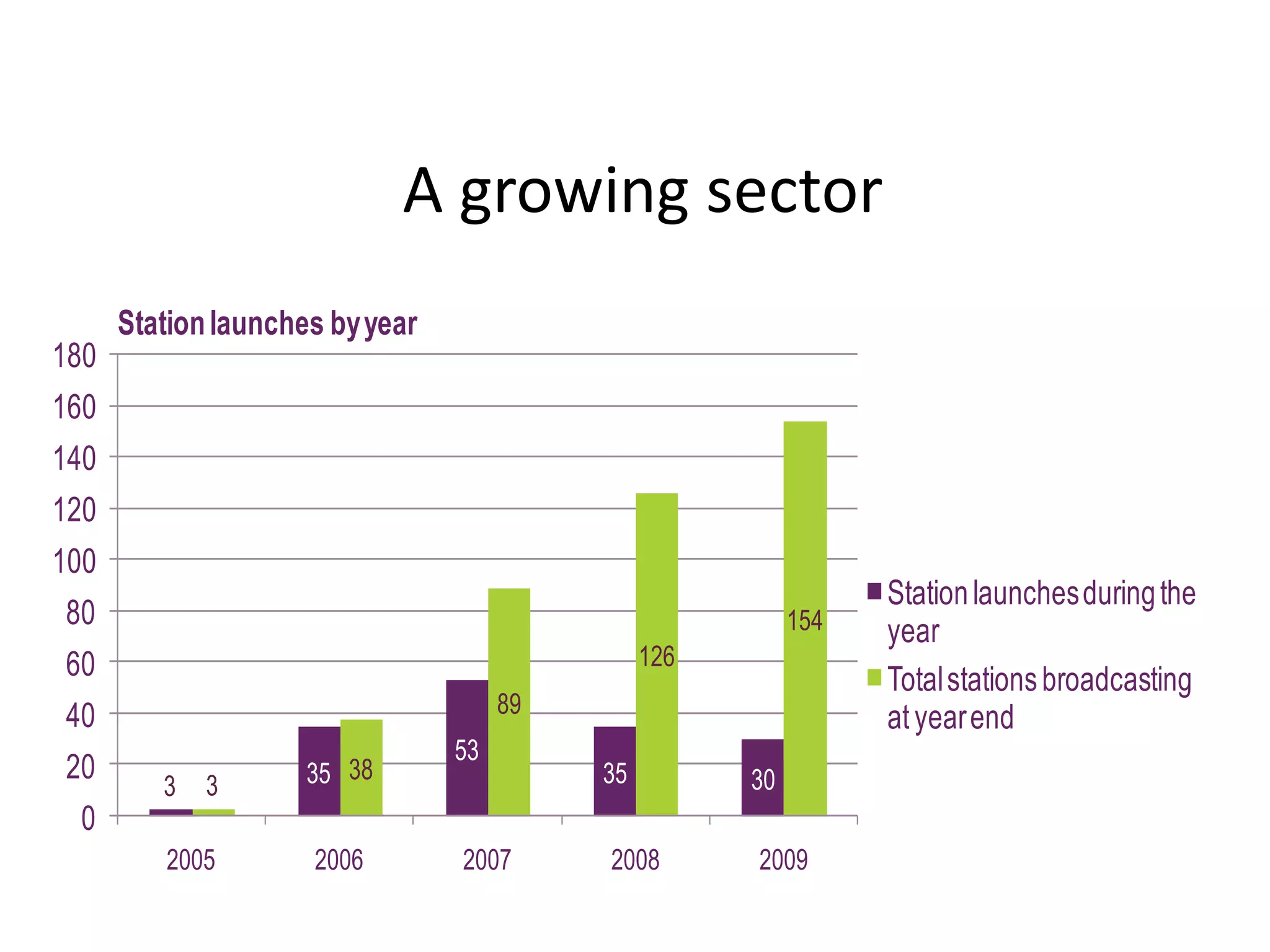
A growing sector
Community Radioin the UK - types of community servedAutumn 2010
Other Community Radio & Audio
Hackney Podcast  The Hackney Podcast won Sony Radio Gold 2010 for the best internet radio programme.
  Recently won the Gold award for General programming in the New York Festivals     International Radio Awards.Launched 2008;  available to download for free each month from their website. The winning podcast looked at water and how it fits into the lives of people in Hackney.  Featured author and psycho-geographer Iain Sinclair and architectural historian Simon Inglis, and music from electro-acoustic composers incl. Francisco Lopez and Stefano Tedesco.  “The Hackney Podcast is just the type of targeted and locally orientated content that sets podcasting apart from conventional radio broadcasting. Using first rate contributors the podcast examined how water fits into the lives of people in Hackney. The production quality is outstanding giving the whole listen a water like lyricism that carries the listen through to it's conclusion.”Sony Radio Judges, 2010
Prison Radio AssociationBased in HMP Brixton, Electric Radio Brixton supports rehabilitation by engaging prisoners in programming that addresses a range of issues related to offending behaviour. Broadcasts cover issues like education, employment and finance; mental and physical health; drug misuse; maintaining family relationships – all factors key to reducing re-offending. Majority of content is inspired, developed and produced, under guidance, by prisoners and broadcast across the jail to prisoners in their cells. Advertises educational opportunities and key messages on behalf of the prison or agencies e.g. Samaritans and Alcoholics Anonymous. Prisoners completing radio training courses gain recognised qualifications and develop a range of skills, including measurable improvements in literacy, numeracy and ICT. They also develop transferable life skills, essential to successful reintegration into mainstream society. “This no holds barred approach captures the harsh realities of life inside.  The story delivered impact through impressive production techniques and credible story telling.”Sony Radio Judges
Print
“When your small daughter wins a prize at school, she is in the local paper with all the status in the community that holds. Will the internet replace the local weekly paper? No - the two will live side by side.”Sir Ray Tindle, quoted in theIndependent on Sunday31st October 2010
Local & Regional Press  Death of the local presses not quite happened just yet.
  Still a big industry  as seen by  the number of titles, 1995 – 2009
  And the number of publishers: - the Newspaper Society identified 87 local / regional press publishers in early 2009. Source: Newspaper Society / Oliver & Ohlbaum analysis
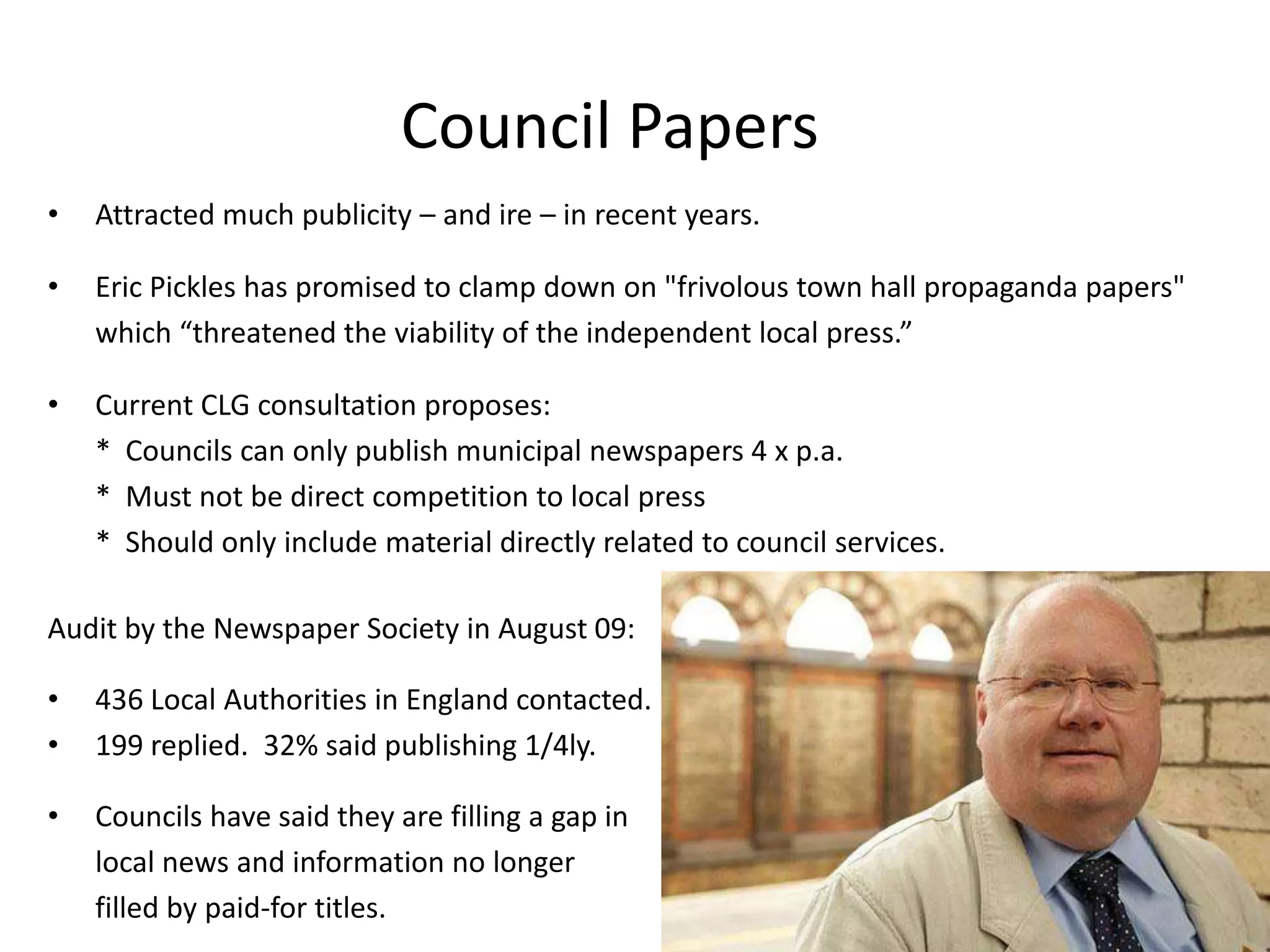
Council PapersAttracted much publicity – and ire – in recent years. Eric Pickles has promised to clamp down on "frivolous town hall propaganda papers" 	which “threatened the viability of the independent local press.”Current CLG consultation proposes: 	*  Councils can only publish municipal newspapers 4 x p.a.  	*  Must not be direct competition to local press	*  Should only include material directly related to council services. Audit by the Newspaper Society in August 09:436 Local Authorities in England contacted.199 replied.  32% said publishing 1/4ly.Councils have said they are filling a gap in 	local news and information no longer 	filled by paid-for titles.
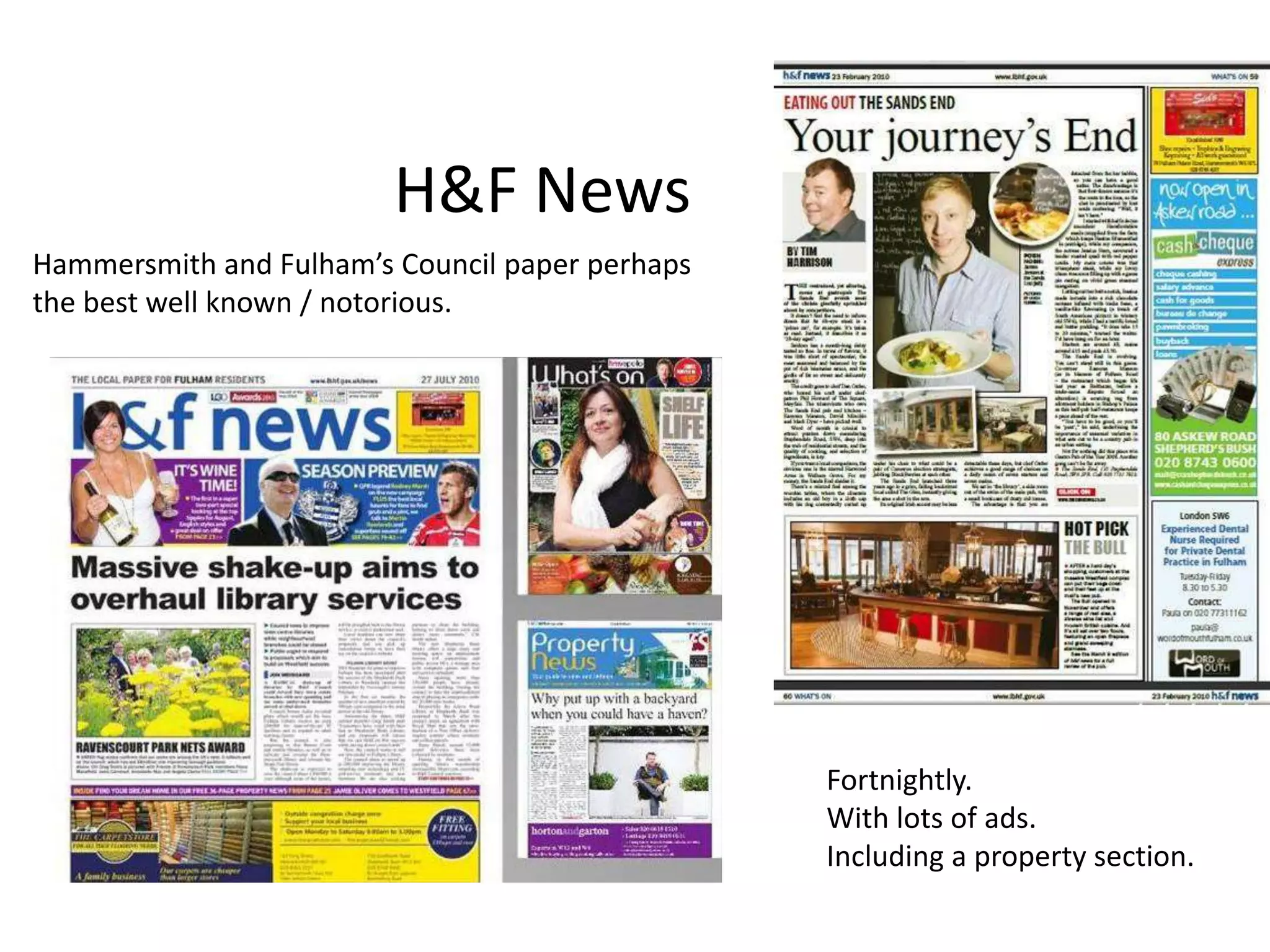
			H&F NewsHammersmith and Fulham’s Council paper perhaps the best well known / notorious.Fortnightly.With lots of ads.Including a property section.
My focus though is community printOften  best known type of community and hyper-local media:	e.g. newsletters for residents associations or parish councils,Targeted at a small number of people within a small geographic locale. Often highly visible, frequently  delivered directly to you, or displayed   prominently in key locations such as Parish Noticeboards or libraries. No technology is required to access it. Long history and tradition e.g. local pamphleteers
Community Print - definitionIn this instance, I am not:Including publications billed as community newspapers such as: The quarterly Fife Life which is distributed free to 170,000 homes across Fife.
  Or Park Life, a “free community newspaper designed exclusively for the residents of     Leigh Park” in Hampshire These publications are produced by professional bodies on behalf of Councils and other Public Bodies e.g. Fife Life =  NHS Fife and Fife Council. Whilst these are aimed at a specific community, they are not produced  by the community for the community.
“A community newspaper is…”…usually run on a shoestring with a small number of paid staff (Leys News has three part-time paid staff at the moment, but it's more common in my experience for a community paper to have just one or two paid part-timers.)usually owes a lot to the work of volunteers, most of whom live locallynumbers its readers in hundreds or thousands usually comes out bi-monthly or quarterlyactively encourages residents to get involved with the paperis usually offered free at the point of useoften operates in an area which is defined by Government statistics as deprived often does things which go beyond a newspaper's core activities: running training courses, organising community fun days, holding drop-in sessionsis often dependent on grant funding to stay afloat financially.”Kate Griffin, http://www.kategriffin.info/post/how_spot_a_community_newspaper_wild
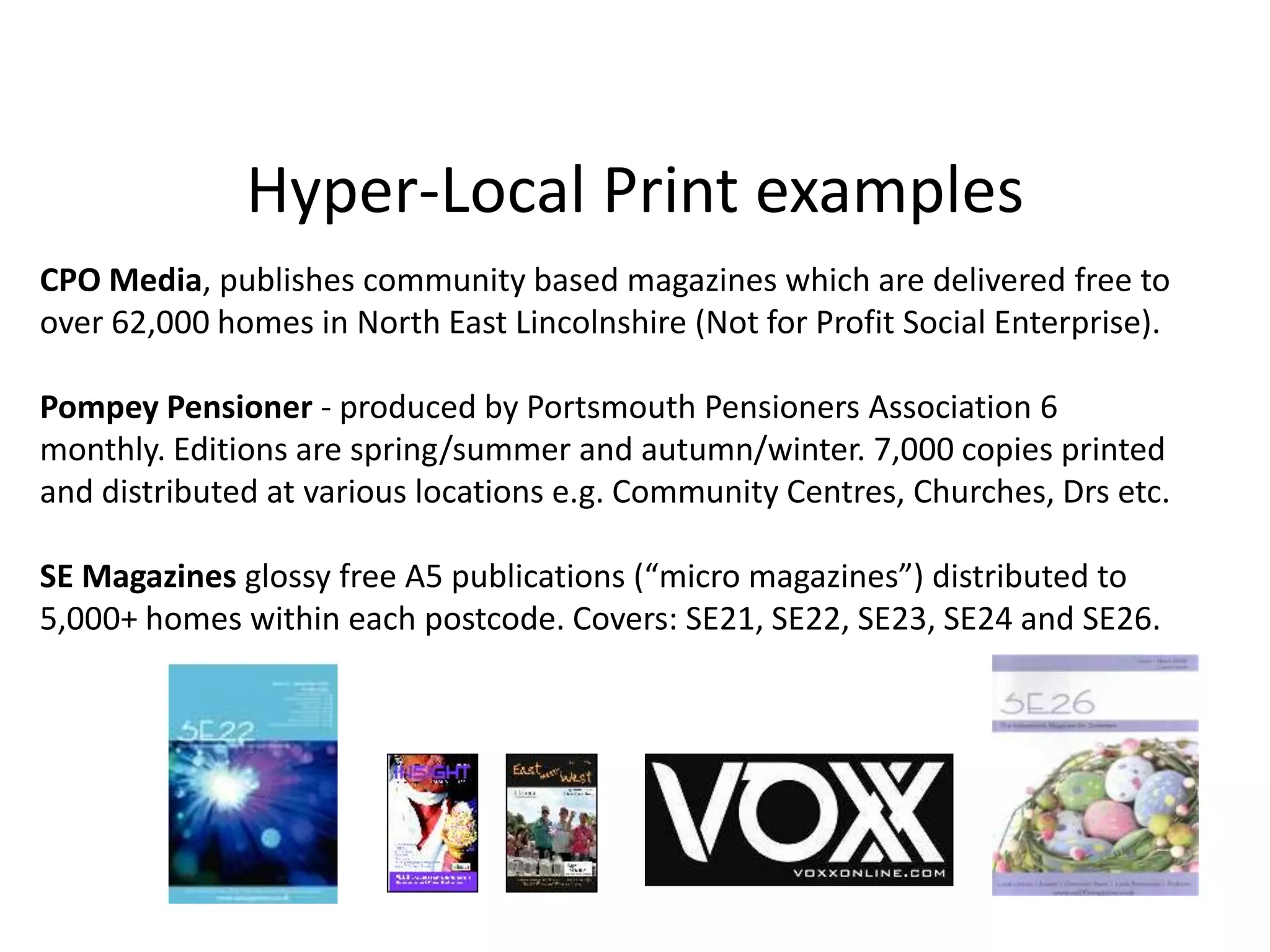
Hyper-Local Print examplesCPO Media, publishes community based magazines which are delivered free to over 62,000 homes in North East Lincolnshire (Not for Profit Social Enterprise). Pompey Pensioner - produced by Portsmouth Pensioners Association 6 monthly. Editions are spring/summer and autumn/winter. 7,000 copies printed and distributed at various locations e.g. Community Centres, Churches, Drs etc. SE Magazines glossy free A5 publications (“micro magazines”) distributed to 5,000+ homes within each postcode. Covers: SE21, SE22, SE23, SE24 and SE26.
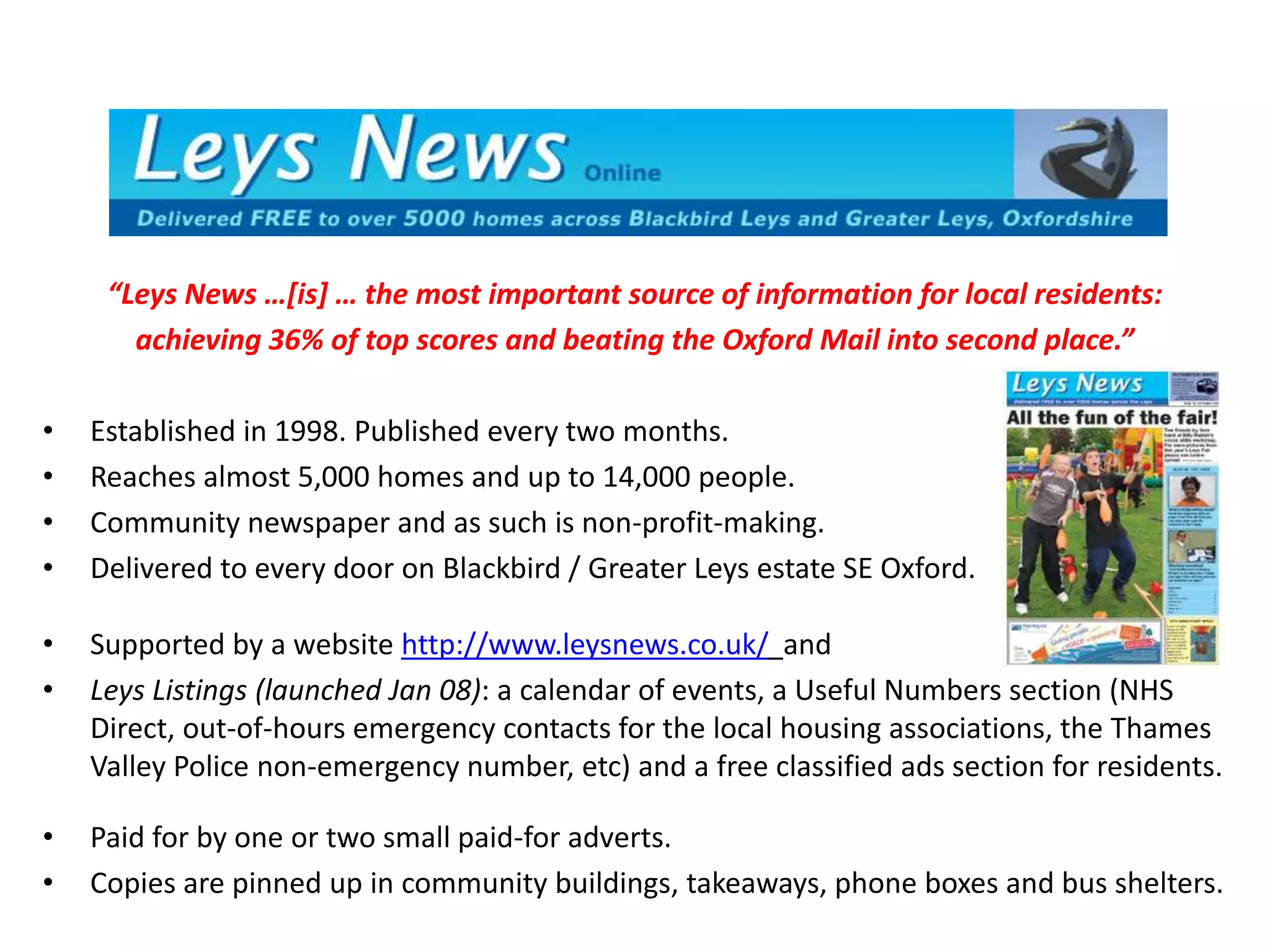
Leys News“Leys News …[is] … the most important source of information for local residents: achieving 36% of top scores and beating the Oxford Mail into second place.”Established in 1998. Published every two months. Reaches almost 5,000 homes and up to 14,000 people.Community newspaper and as such is non-profit-making. Delivered to every door on Blackbird / Greater Leys estate SE Oxford.  Supported by a website http://www.leysnews.co.uk/andLeys Listings (launched Jan 08): a calendar of events, a Useful Numbers section (NHS Direct, out-of-hours emergency contacts for the local housing associations, the Thames Valley Police non-emergency number, etc) and a free classified ads section for residents. Paid for by one or two small paid-for adverts. Copies are pinned up in community buildings, takeaways, phone boxes and bus shelters.
Paid for publication (eleven times a year). Established in 1979.Covers the Earlsdon, Chapelfields, Hearsall and Spon End districts of Coventry.Provides information, comment and entertainment for residents of these areas. Produced entirely by a core team of 10-12 volunteers.But anyone is welcome to contribute. It is independently financed by sales and advertising Not affiliated to  political, religious or commercial  orgs.Sold through local outlets e.g. newsagents, churches, 	pubs and local shops. Sell without taking a commission.Website has extensive links for local businesses and a 	detailed diary of activities organised by local groups. http://www.echonews.org.uk/
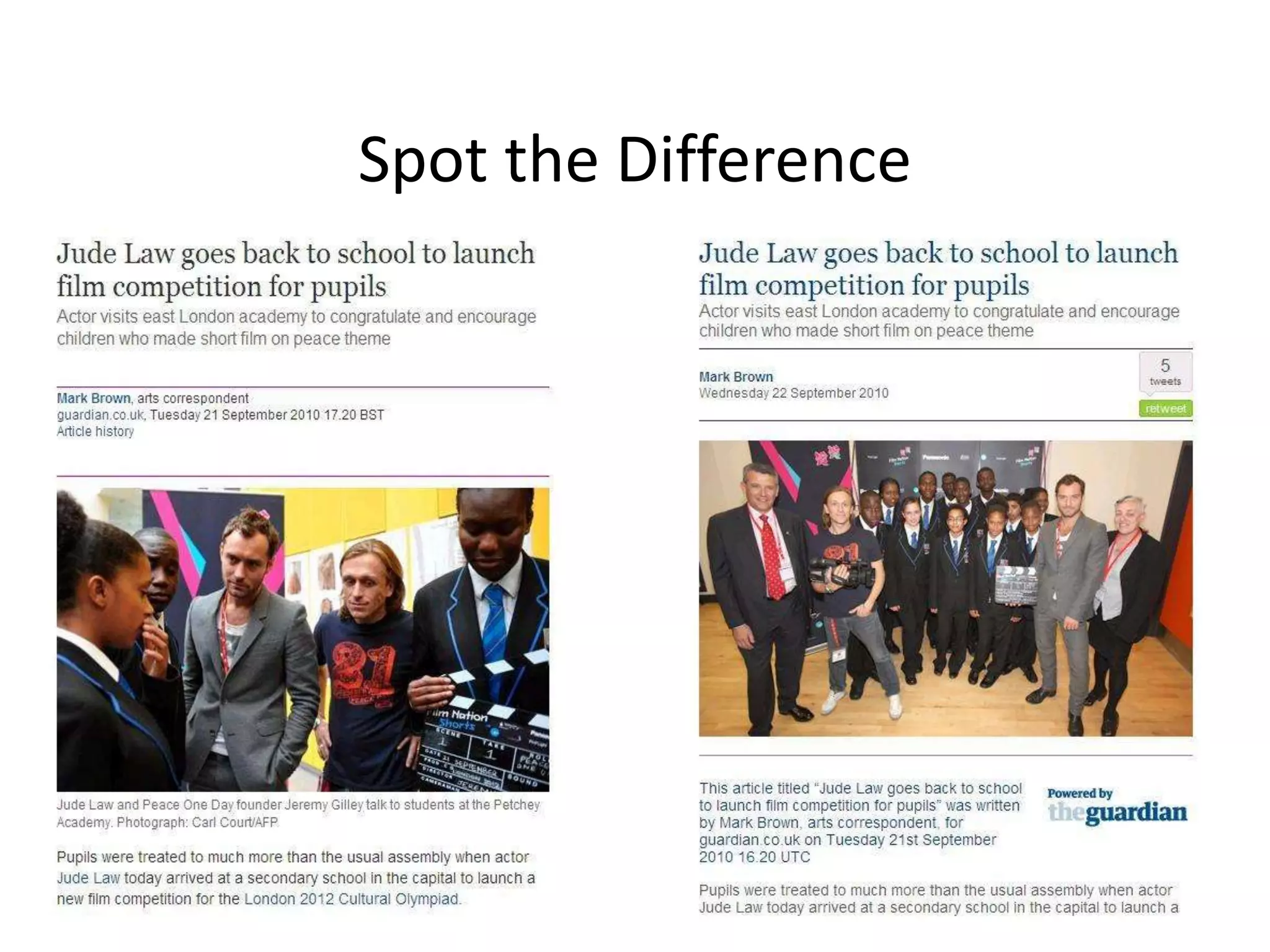
Hackney Citizen10,000 copies distributed face-to-face in the first week of every month at markets, train stations, and events and also in cafes, shop, businesses and libraries. Estimated readership: 30,000.   Plus online audience: http://www.hackneycitizen.co.uk/Written by the community incl. freelancers from NCTJ, Telegraph and  the Guardian.No office, no staff, no overheads.  No previous experience. (Keith Magnum who runs it used to work for the Green Party.)Sell ads, ABC1 skew. Won’t take ads from chains competing with local business e.g. Morrisons.Uses free Guardian API to pull in relevant content produced elsewhere e.g. a visit from  Jude Law to the Petchey Academy in Dalston.
Spot the Difference
Hyper-local online
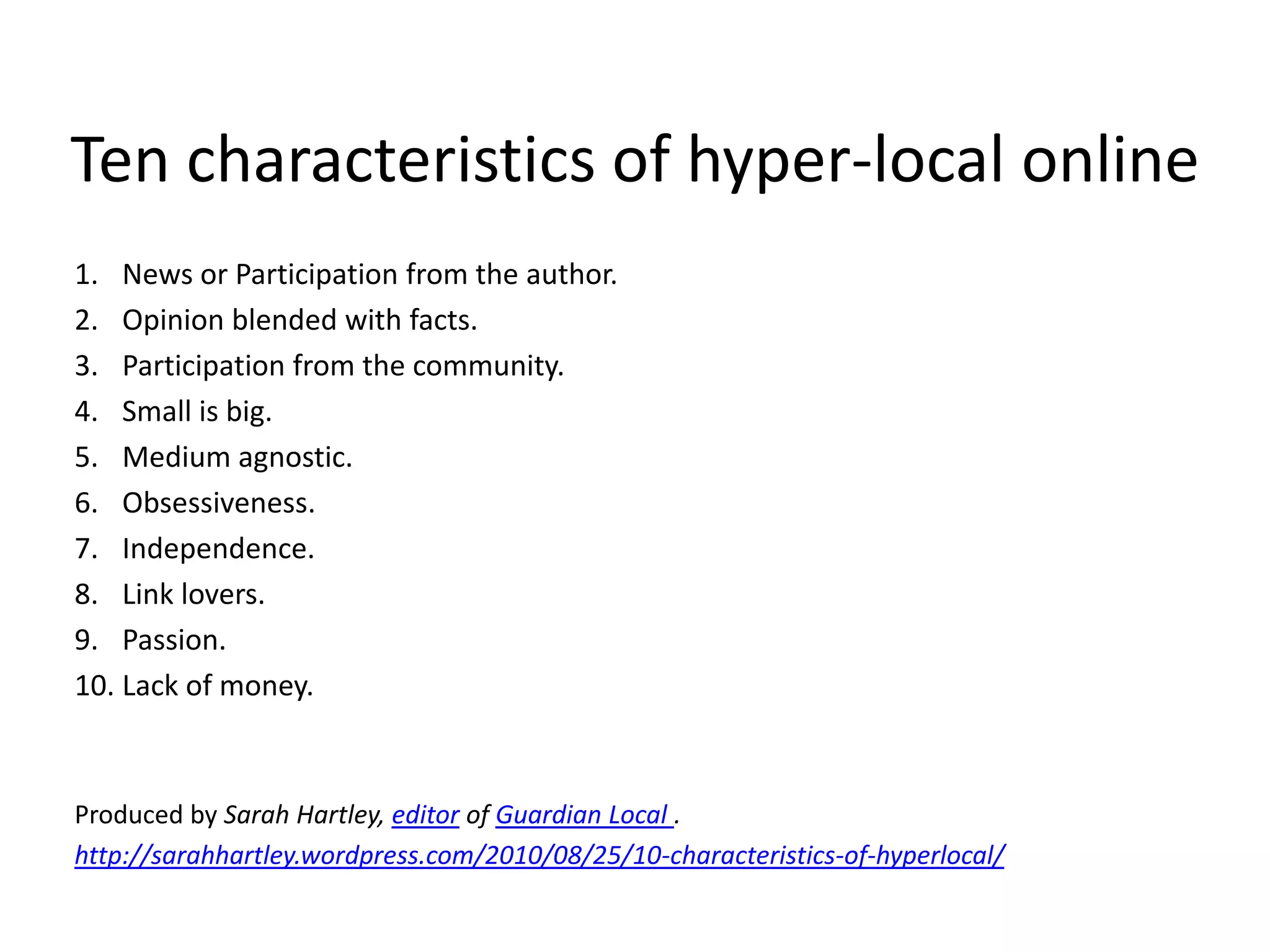
Ten characteristics of hyper-local onlineNews or Participation from the author. Opinion blended with facts. Participation from the community.Small is big.Medium agnostic.Obsessiveness. Independence. Link lovers. Passion.Lack of money.Produced by Sarah Hartley, editor of Guardian Local .http://sarahhartley.wordpress.com/2010/08/25/10-characteristics-of-hyperlocal/
Diverse ecosystemHugh Flouch and Kevin Harris recently identified eight types of site in London. “Six of those can be described as citizen-led sites, typically set up with a civil purpose.The remaining two types are run on a commercial basis.”Civil Social Networks. Local Discussion Sites. Placeblogs.Local Blogazines.Public Social Spaces.Local Action Groups Online. Local Digital News (Commercial). Multiples & Listings (Commercial). See: London’s Digital Neighbourhoods Study for more information.
Here’s some examples of different hyper-local activity.Using my own definitions of types.
Online, Commercial
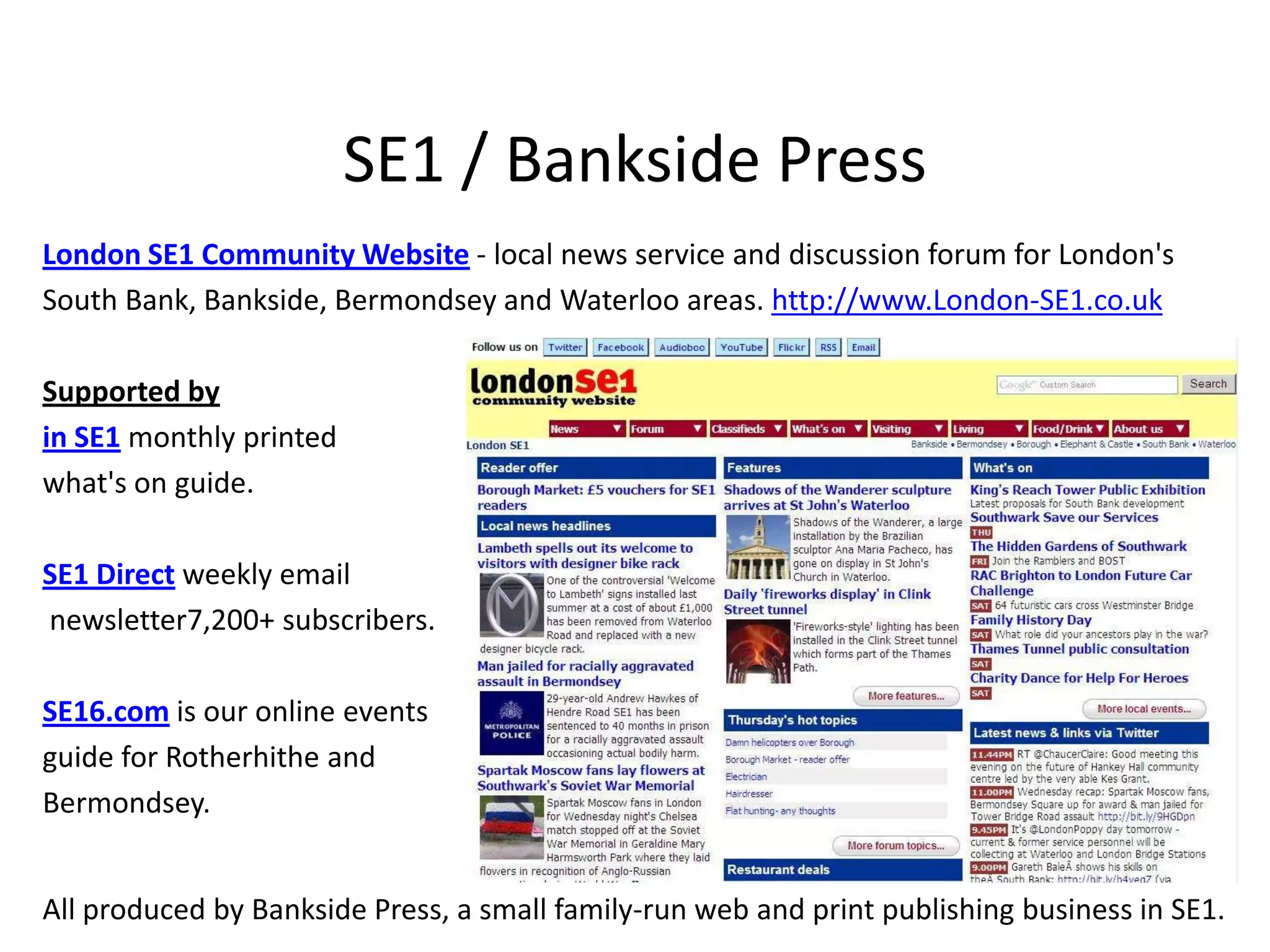
SE1 / Bankside PressLondon SE1 Community Website - local news service and discussion forum for London's South Bank, Bankside, Bermondsey and Waterloo areas. http://www.London-SE1.co.ukSupported byin SE1 monthly printed what's on guide.SE1 Direct weekly email newsletter7,200+ subscribers.SE16.com is our online events guide for Rotherhithe and Bermondsey.All produced by Bankside Press, a small family-run web and print publishing business in SE1.
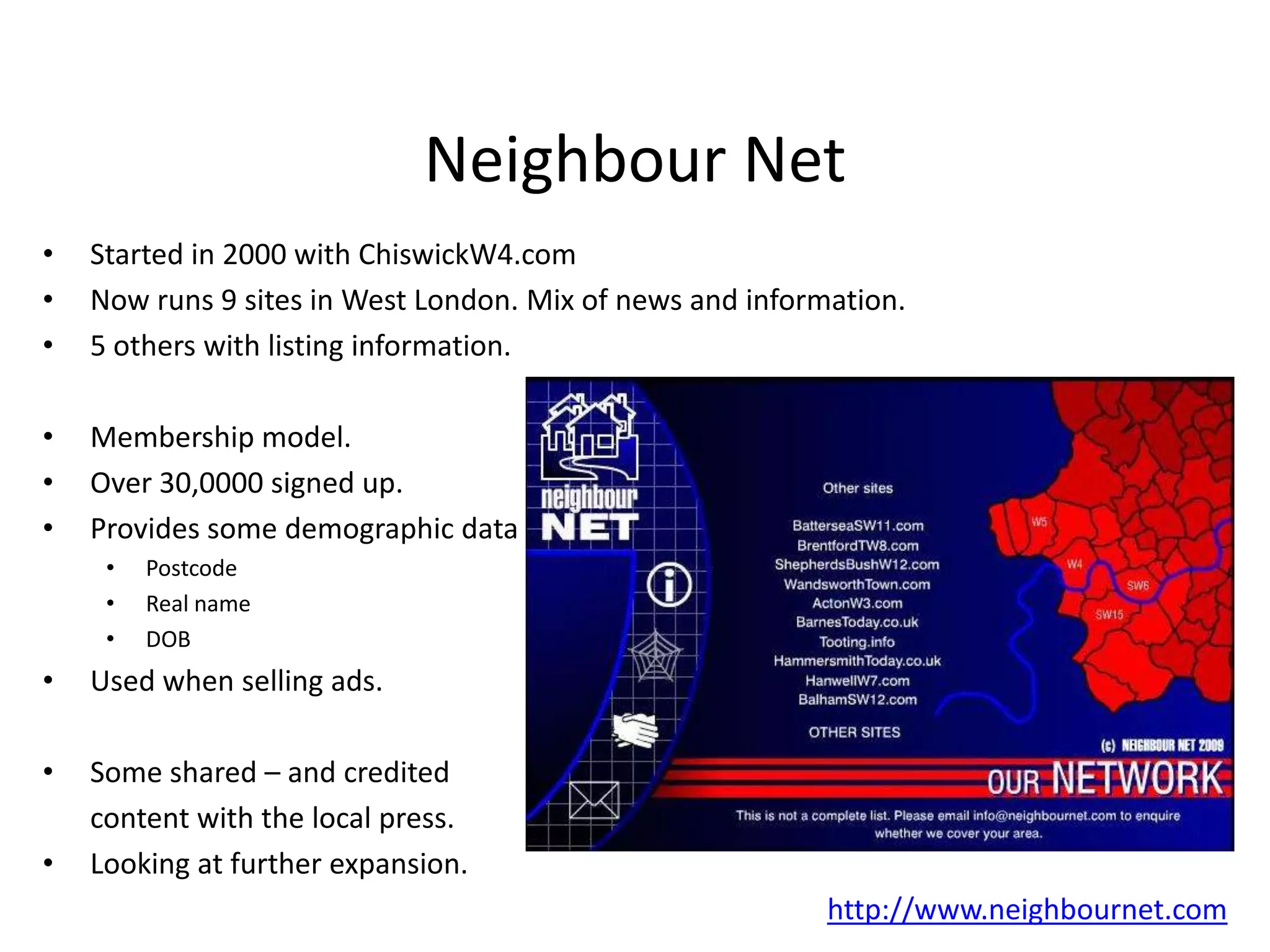
Neighbour NetStarted in 2000 with ChiswickW4.comNow runs 9 sites in West London. Mix of news and information.5 others with listing information.Membership model.Over 30,0000 signed up.Provides some demographic dataPostcode
Real name
DOBUsed when selling ads.Some shared – and credited 	content with the local press.Looking at further expansion.http://www.neighbournet.com
Online, Forums
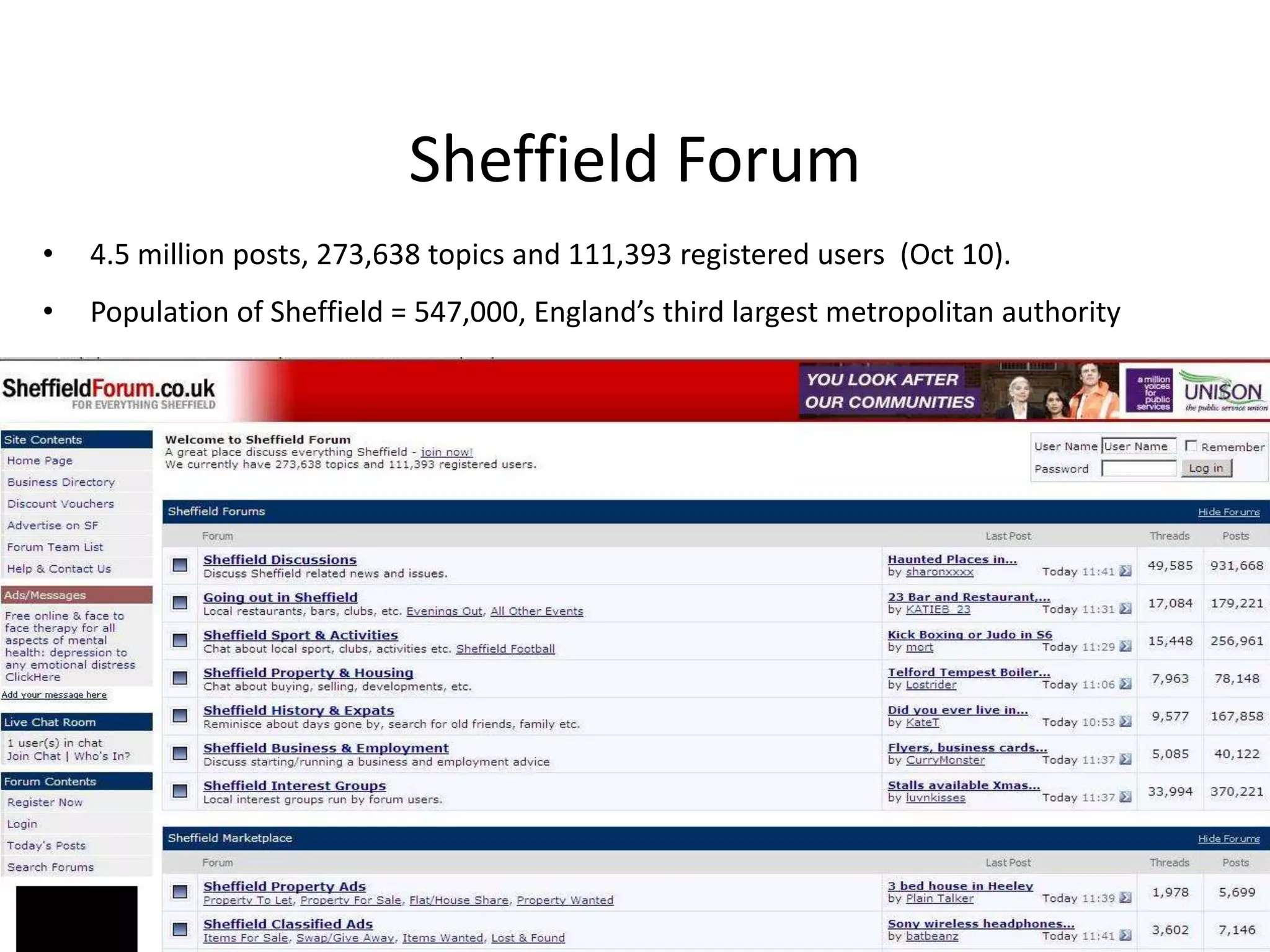
Sheffield Forum4.5 million posts, 273,638 topics and 111,393 registered users  (Oct 10).Population of Sheffield = 547,000, England’s third largest metropolitan authority
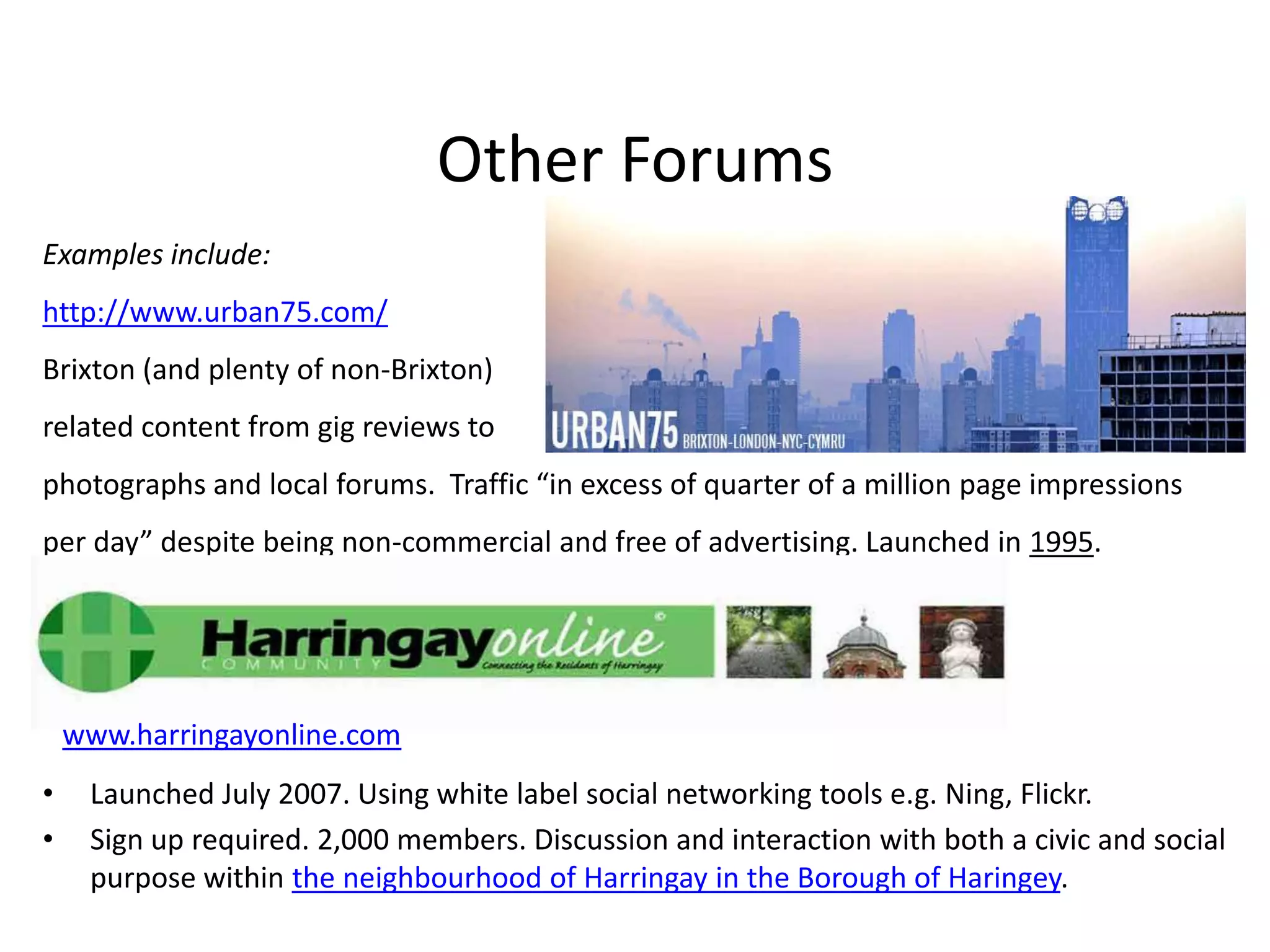
Other ForumsExamples include:http://www.urban75.com/Brixton (and plenty of non-Brixton) related content from gig reviews to photographs and local forums.  Traffic “in excess of quarter of a million page impressionsper day” despite being non-commercial and free of advertising. Launched in 1995.Launched July 2007. Using white label social networking tools e.g. Ning, Flickr. Sign up required. 2,000 members. Discussion and interaction with both a civic and social purpose within the neighbourhood of Harringay in the Borough of Haringey. www.harringayonline.com
Online, Campaigning

Introduction to hyper local media, part one: audience data, definitions and UK overview

  • 1.
    An Introduction toHyper-Local Media:Emerging Thoughts & EvidenceDamian Radcliffe November 2010
  • 2.
    Running OrderWhy thismatters to Ofcom- purposes and duties - evidenceDefinitions and Characteristics The UK picture:TVRadioPrintWeb (with an emphasis on the web)Top Ten trendsIssues/BarriersWhat might happen next? Q&A
  • 3.
    Why does thismatter to us?
  • 4.
    Political and SocialContextLocal TV
  • 5.
    Regulatory Context: PurposesTheCommunications Act requires us to “further the interests of citizens and consumers”Strategic purposes: To promote effective and sustainable competition, Promote efficient use of public assets, Help markets work for consumers, Provide appropriate assurance to audiences, and To implement specific public policies defined by Parliament
  • 6.
    Regulatory Context: StatutoryDutiesSecure wide range of TV and radio services of high quality and wide appeal
  • 7.
  • 8.
    Licence national andlocal analogue and community radio stations
  • 9.
    Ensure optimal useof the radio spectrum – including for Local TV Other reasons why this mattersOn-going mission to:Understand how local media is changing and evolving.Understand how citizens and consumers use – and value - local media.Understand new business models.Understand how hyper-local can underpin local democracy in the UK.Role of hyper-local in supporting PSB ecology.Promote Media Literacy (use, understand, create).
  • 10.
    Reasons why thismatters. Part Two. The evidence base.
  • 11.
    Over 90% ofadults use the media to source local information on a regular basisUse TV, radio, internet, newspapers, magazines or teletext to source local information100%93%92%92%91%90%All adults80%70%60%50%2005200620072008Source: Ofcom’s Media Tracker, rolled data from April and October 2008
  • 12.
    And localness mattersto consumers% saying local and regional content is very important - weekly usersScores based on respondents importance rating 9/10 on a scale of 1-10. Source, Ofcom research
  • 13.
    But consumption ischangingWhat is your main source of news about what is going on in your local area?Source: Ofcom media tracker, rolled data from April and October 2008
  • 14.
    With online especiallyon the riseUse of local media now compared to two years agoSource: Ofcom research 12
  • 15.
    Accessibility, convenience andquality of information are key drivers to the WebReasons use internet more than beforeSource: Ofcom research Q8C Why do you now use the internet/websites more than before?Base: UK adults who use internet more than before (n=138)13
  • 16.
  • 17.
    As more peoplego onlineHousehold PC and internet take-up, 2005-2010Proportion of adults (%)Source: Ofcom technology tracker, Q1 2010.Base: All adults aged 15+ (n=9013).
  • 18.
    And as modelsand markets matureStuff we’ve already started to see:New Local and regional newspapers onlineUltra-local reporting and citizen journalismEmerging hyper-local and community internet servicesLocation based servicesNational classified advertising vehiclesWith new ideas always on the horizon….
  • 19.
    And due, inpart, to the very nature of the web itself“….any innovator can thinkof a new idea, a new data format, a new protocol, something completely novel, and set up a site at some random place and let it take off through word of mouth, and make a business…”Tim Berners Lee, Sept 2010
  • 20.
    So, that’s thebackground.Now let’s talk hyper-local.
  • 21.
    No single definitionLocaland regional media – the consumer view
  • 22.
    But broadly speakingNewsor content pertaining to a town, village or small community.Geographically smaller than traditional broadcast regions.Comes in many different shapes and sizes.Professional.Citizen run/produced.Hybrid.Aggregator/Automated.Sometimes also referred to as ‘ultra-local’.Community media also part of the same mix.
  • 23.
    Common CharacteristicsMore localised– both in terms of geography and types of content - than more mainstream media outlets such as commercial radio, TV regional news, BBC regions, or regional and local newspapers. Often seeks to fill gaps - geographical, special interest or demographic – audiences hyper-local producers see as unserved, or under-served, by mainstream media.Diverse sources of funding (if any). Including: advertising, subscriptions, grants from public and private funding bodies and in-kind funding from volunteers.The value and role of community media goes beyond the provision of content, with specific value often seen in the social capital generated by it’s production. May be single issue-based, or too small for commercial operators to merit ROI.
  • 24.
    Here’s some quickexamplesSource: Ofcom analysis. LRM page 43.
  • 25.
    … And here’ssome in more detail
  • 26.
  • 27.
  • 28.
    The existing channelsWhollycommercial channel owned by Guardian Media Group. Now on digital, cable and satellite. But programme plans significantly scaled back in 2010Community model supported by grants from regional and educational bodies. Mix of professional (mainly freelance) labour and volunteers. Emphasis on training Privately owned channel aimed mainly at ethnic Asian community in Leicester. Strong links with broadcasters in India to source contentSmall scale service run on semi-amateur basis. Contains local news and sport.
  • 29.
    Channel 7, ImminghamLongest-runninglocal TV channel in the UK. Launched in January 1998.140,000 homes can access on TV, via Virgin. (Channel 879). Some content online. The station is a community interest company (a not-for-profit social enterprise).Own production centre and studios. Broadcasts 9am to 7pm, seven days a week.What's On, Events and other local info broadcast in graphic form overnight.Recently won an O2 Think Big Award for its work with young people.Recent PartnershipsWorked with the owners of the Grimsby Telegraph, on election coverage, including videos for the paper's website and broadcast on Seven as a longer programme. Community magazine publisher CPO Media to deliver a series of Media Mash Up! Workshops, training local students to create their own websites, magazines and TV. In partnership with the BBC, it recorded the BBC General Election programme at Immage Studios. The programme was re-broadcast under licence on Seven Local TV, which is believed to be a first for local TV in the UK.
  • 30.
  • 31.
    Local Video Online- backgroundSmaller number of sites than text based services. Often less well known. Many models.Some large operations, reasonably well resourced:Kent TV high profile, pilot closed on 31st March 2010. (Ten Alps, 500k).Lakes TV on digital platforms, covers the Lakes, Barrow and Penrith.myCornwall.tv – funders include The Eden Project, Fifteen Restaurant, SW Tourism.Smaller operations include:Kings Cross TV - mixes original content with video material pulled in from across the web, but freely available on sites like YouTube and blip.tv. Camden.tv encourages community to submit films about their area, and acting as a curator for content across a broad range of themes including history, music and politics.Hertsweb.tv. – run by Craig McKenzie, in his spare time. Craig works full-time for the NHS, has 2 kids and runs 2 hyper-local sites - Discover Hertford and Ware Online.
  • 32.
    Mon-TVLaunched in 2008 offering “Local Television for Monmouthshire”, Features a weekly 15 minute news bulletin as well as a range of other content such as local Sport, Music, Festivals and human interest stories. Typically gets 1,000 users a day, increasing by 300% at busy times e.g. Festivals. Last December it recorded its millionth visitor.Run (voluntarily) by two professional filmmakers, and volunteers - some doing 15 hours p/w to help with filming, editing and scheduling. A lot of the content is generated by students doing a City & Guilds Level 3 Diploma at the station; with coursework being showcased in the “Mon TV Academy” . Many graduates stay on as volunteers after graduating.
  • 33.
    All go inWitneyGuardian picked up on an interviewWitney TV had done with Jeremy Clarkson, during which the Top Gear presenter revealed that ‘Stig’ had been sacked. The Independent reported that Witney TV had 10,000 views in the first week, rising to 80,000, and staggering 3.5 million views in the ‘Stig Week’. Started by 4 vols for 11k."You may remember a film called Wall Street in which Gordon Gekko said 'Greed is good, greed works'. Well it doesn't... He's history as far as we're concerned." Town has a population of about 25,000. Twitney also providing a platform for local video. Typically funded by own money, but Twitney, offers sponsors the chance to be featured the start and end of films, as well as selling banner ads, and commissioned features.
  • 34.
  • 35.
    Licenced Community RadioCommunityradio stations are not-for-profit radio services designed to operate on a small scale and to deliver community benefits aka ‘social gain’, to one or more communities.Initial legislation introduced in 2004. First station launched November 2005. Ofcom has to date licensed 228 stations over two rounds of licensing.
  • 36.
    181are broadcasting, 17 have either not launch or handed their licence back.
  • 37.
    Remainderpreparing to start broadcasting. 9.2 million adults (just over 11 million people) are able to receive a community radio station broadly aimed at them. C.15% of the total UK population may be able to receive a community radio service aimed at them on FM or AM.
  • 38.
    The Community Radio(Amendment) Order 2010Came into force on 22 January 2010. Changes to the legislation:Licence extensions: Ofcom can now extend community radio licences for one period of up to five years. The legislation specifies a period in which an application for an extension may be made. This licence extension 'window' commences 18 months prior to the expiry date of the existing licence, and ends six months before the expiry date.Removal of the 50% limit on funding from any single source: Previously a licensee could not receive more than 50% of its annual funding from any one source (this referred to a single organisation rather than a type of funding such as advertising or grants). Removal of the restriction on overlap with small-scale commercial services:Prevoiusly a licence could not be granted to a community radio station where the service would overlap with another local service serving fewer than 50,000 in its measured coverage area.
  • 39.
  • 41.
    Community Radioin theUK - types of community servedAutumn 2010
  • 42.
  • 43.
    Hackney Podcast The Hackney Podcast won Sony Radio Gold 2010 for the best internet radio programme.
  • 44.
    Recentlywon the Gold award for General programming in the New York Festivals International Radio Awards.Launched 2008; available to download for free each month from their website. The winning podcast looked at water and how it fits into the lives of people in Hackney.  Featured author and psycho-geographer Iain Sinclair and architectural historian Simon Inglis, and music from electro-acoustic composers incl. Francisco Lopez and Stefano Tedesco.  “The Hackney Podcast is just the type of targeted and locally orientated content that sets podcasting apart from conventional radio broadcasting. Using first rate contributors the podcast examined how water fits into the lives of people in Hackney. The production quality is outstanding giving the whole listen a water like lyricism that carries the listen through to it's conclusion.”Sony Radio Judges, 2010
  • 45.
    Prison Radio AssociationBasedin HMP Brixton, Electric Radio Brixton supports rehabilitation by engaging prisoners in programming that addresses a range of issues related to offending behaviour. Broadcasts cover issues like education, employment and finance; mental and physical health; drug misuse; maintaining family relationships – all factors key to reducing re-offending. Majority of content is inspired, developed and produced, under guidance, by prisoners and broadcast across the jail to prisoners in their cells. Advertises educational opportunities and key messages on behalf of the prison or agencies e.g. Samaritans and Alcoholics Anonymous. Prisoners completing radio training courses gain recognised qualifications and develop a range of skills, including measurable improvements in literacy, numeracy and ICT. They also develop transferable life skills, essential to successful reintegration into mainstream society. “This no holds barred approach captures the harsh realities of life inside. The story delivered impact through impressive production techniques and credible story telling.”Sony Radio Judges
  • 46.
  • 47.
    “When your smalldaughter wins a prize at school, she is in the local paper with all the status in the community that holds. Will the internet replace the local weekly paper? No - the two will live side by side.”Sir Ray Tindle, quoted in theIndependent on Sunday31st October 2010
  • 48.
    Local & RegionalPress Death of the local presses not quite happened just yet.
  • 49.
    Stilla big industry as seen by the number of titles, 1995 – 2009
  • 50.
    Andthe number of publishers: - the Newspaper Society identified 87 local / regional press publishers in early 2009. Source: Newspaper Society / Oliver & Ohlbaum analysis
  • 51.
    Council PapersAttracted muchpublicity – and ire – in recent years. Eric Pickles has promised to clamp down on "frivolous town hall propaganda papers" which “threatened the viability of the independent local press.”Current CLG consultation proposes: * Councils can only publish municipal newspapers 4 x p.a. * Must not be direct competition to local press * Should only include material directly related to council services. Audit by the Newspaper Society in August 09:436 Local Authorities in England contacted.199 replied. 32% said publishing 1/4ly.Councils have said they are filling a gap in local news and information no longer filled by paid-for titles.
  • 52.
    H&F NewsHammersmith andFulham’s Council paper perhaps the best well known / notorious.Fortnightly.With lots of ads.Including a property section.
  • 53.
    My focus thoughis community printOften best known type of community and hyper-local media: e.g. newsletters for residents associations or parish councils,Targeted at a small number of people within a small geographic locale. Often highly visible, frequently delivered directly to you, or displayed prominently in key locations such as Parish Noticeboards or libraries. No technology is required to access it. Long history and tradition e.g. local pamphleteers
  • 54.
    Community Print -definitionIn this instance, I am not:Including publications billed as community newspapers such as: The quarterly Fife Life which is distributed free to 170,000 homes across Fife.
  • 55.
    OrPark Life, a “free community newspaper designed exclusively for the residents of Leigh Park” in Hampshire These publications are produced by professional bodies on behalf of Councils and other Public Bodies e.g. Fife Life = NHS Fife and Fife Council. Whilst these are aimed at a specific community, they are not produced by the community for the community.
  • 56.
    “A community newspaperis…”…usually run on a shoestring with a small number of paid staff (Leys News has three part-time paid staff at the moment, but it's more common in my experience for a community paper to have just one or two paid part-timers.)usually owes a lot to the work of volunteers, most of whom live locallynumbers its readers in hundreds or thousands usually comes out bi-monthly or quarterlyactively encourages residents to get involved with the paperis usually offered free at the point of useoften operates in an area which is defined by Government statistics as deprived often does things which go beyond a newspaper's core activities: running training courses, organising community fun days, holding drop-in sessionsis often dependent on grant funding to stay afloat financially.”Kate Griffin, http://www.kategriffin.info/post/how_spot_a_community_newspaper_wild
  • 57.
    Hyper-Local Print examplesCPOMedia, publishes community based magazines which are delivered free to over 62,000 homes in North East Lincolnshire (Not for Profit Social Enterprise). Pompey Pensioner - produced by Portsmouth Pensioners Association 6 monthly. Editions are spring/summer and autumn/winter. 7,000 copies printed and distributed at various locations e.g. Community Centres, Churches, Drs etc. SE Magazines glossy free A5 publications (“micro magazines”) distributed to 5,000+ homes within each postcode. Covers: SE21, SE22, SE23, SE24 and SE26.
  • 58.
    Leys News“Leys News…[is] … the most important source of information for local residents: achieving 36% of top scores and beating the Oxford Mail into second place.”Established in 1998. Published every two months. Reaches almost 5,000 homes and up to 14,000 people.Community newspaper and as such is non-profit-making. Delivered to every door on Blackbird / Greater Leys estate SE Oxford. Supported by a website http://www.leysnews.co.uk/andLeys Listings (launched Jan 08): a calendar of events, a Useful Numbers section (NHS Direct, out-of-hours emergency contacts for the local housing associations, the Thames Valley Police non-emergency number, etc) and a free classified ads section for residents. Paid for by one or two small paid-for adverts. Copies are pinned up in community buildings, takeaways, phone boxes and bus shelters.
  • 59.
    Paid for publication(eleven times a year). Established in 1979.Covers the Earlsdon, Chapelfields, Hearsall and Spon End districts of Coventry.Provides information, comment and entertainment for residents of these areas. Produced entirely by a core team of 10-12 volunteers.But anyone is welcome to contribute. It is independently financed by sales and advertising Not affiliated to political, religious or commercial orgs.Sold through local outlets e.g. newsagents, churches, pubs and local shops. Sell without taking a commission.Website has extensive links for local businesses and a detailed diary of activities organised by local groups. http://www.echonews.org.uk/
  • 60.
    Hackney Citizen10,000 copiesdistributed face-to-face in the first week of every month at markets, train stations, and events and also in cafes, shop, businesses and libraries. Estimated readership: 30,000. Plus online audience: http://www.hackneycitizen.co.uk/Written by the community incl. freelancers from NCTJ, Telegraph and the Guardian.No office, no staff, no overheads. No previous experience. (Keith Magnum who runs it used to work for the Green Party.)Sell ads, ABC1 skew. Won’t take ads from chains competing with local business e.g. Morrisons.Uses free Guardian API to pull in relevant content produced elsewhere e.g. a visit from Jude Law to the Petchey Academy in Dalston.
  • 61.
  • 62.
  • 63.
    Ten characteristics ofhyper-local onlineNews or Participation from the author. Opinion blended with facts. Participation from the community.Small is big.Medium agnostic.Obsessiveness. Independence. Link lovers. Passion.Lack of money.Produced by Sarah Hartley, editor of Guardian Local .http://sarahhartley.wordpress.com/2010/08/25/10-characteristics-of-hyperlocal/
  • 64.
    Diverse ecosystemHugh Flouchand Kevin Harris recently identified eight types of site in London. “Six of those can be described as citizen-led sites, typically set up with a civil purpose.The remaining two types are run on a commercial basis.”Civil Social Networks. Local Discussion Sites. Placeblogs.Local Blogazines.Public Social Spaces.Local Action Groups Online. Local Digital News (Commercial). Multiples & Listings (Commercial). See: London’s Digital Neighbourhoods Study for more information.
  • 65.
    Here’s some examplesof different hyper-local activity.Using my own definitions of types.
  • 66.
  • 67.
    SE1 / BanksidePressLondon SE1 Community Website - local news service and discussion forum for London's South Bank, Bankside, Bermondsey and Waterloo areas. http://www.London-SE1.co.ukSupported byin SE1 monthly printed what's on guide.SE1 Direct weekly email newsletter7,200+ subscribers.SE16.com is our online events guide for Rotherhithe and Bermondsey.All produced by Bankside Press, a small family-run web and print publishing business in SE1.
  • 68.
    Neighbour NetStarted in2000 with ChiswickW4.comNow runs 9 sites in West London. Mix of news and information.5 others with listing information.Membership model.Over 30,0000 signed up.Provides some demographic dataPostcode
  • 69.
  • 70.
    DOBUsed when sellingads.Some shared – and credited content with the local press.Looking at further expansion.http://www.neighbournet.com
  • 71.
  • 72.
    Sheffield Forum4.5 millionposts, 273,638 topics and 111,393 registered users (Oct 10).Population of Sheffield = 547,000, England’s third largest metropolitan authority
  • 73.
    Other ForumsExamples include:http://www.urban75.com/Brixton(and plenty of non-Brixton) related content from gig reviews to photographs and local forums. Traffic “in excess of quarter of a million page impressionsper day” despite being non-commercial and free of advertising. Launched in 1995.Launched July 2007. Using white label social networking tools e.g. Ning, Flickr. Sign up required. 2,000 members. Discussion and interaction with both a civic and social purpose within the neighbourhood of Harringay in the Borough of Haringey. www.harringayonline.com
  • 74.
  • 75.
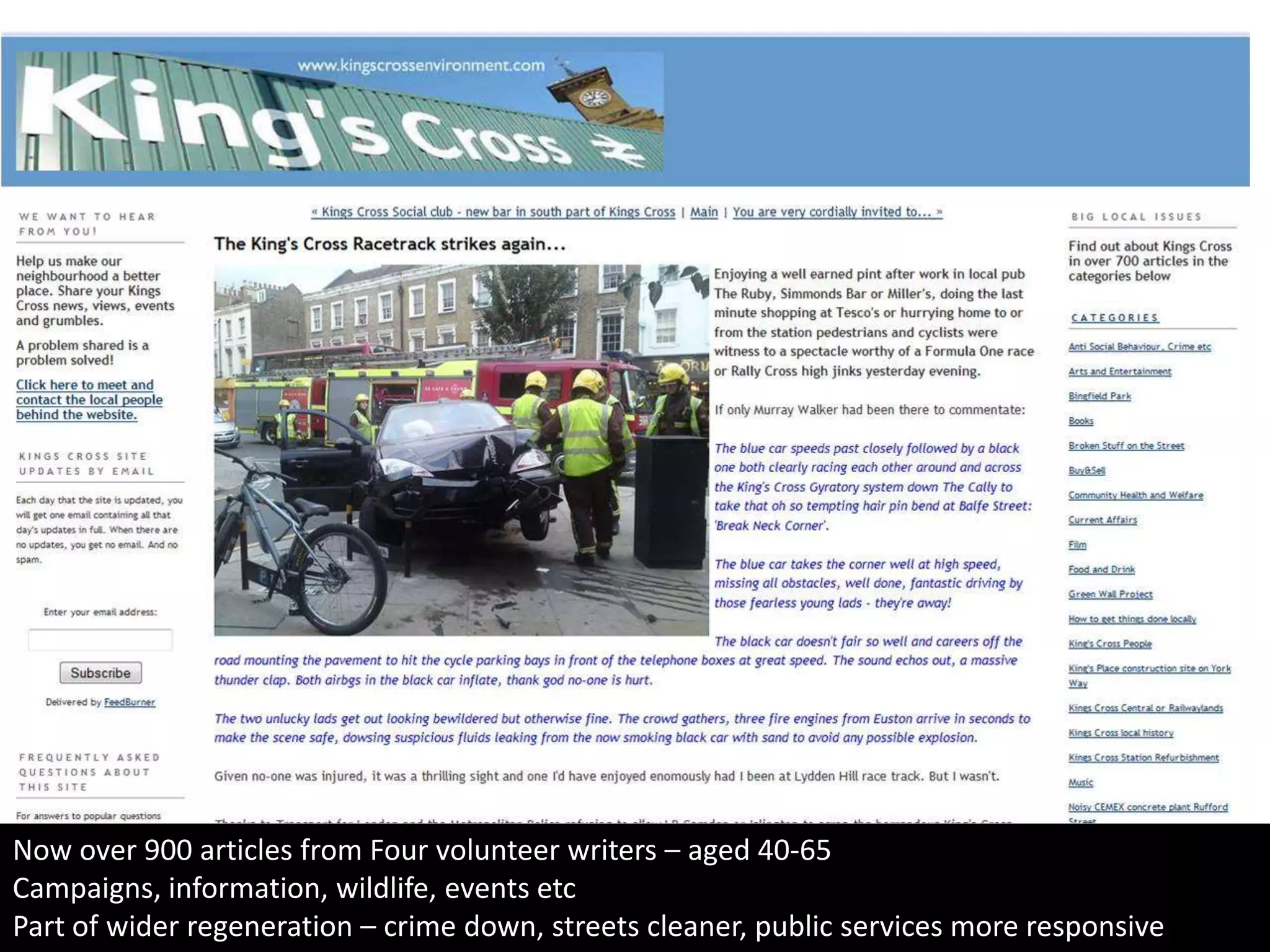
    Now over 900articles from Four volunteer writers – aged 40-65Campaigns, information, wildlife, events etcPart of wider regeneration – crime down, streets cleaner, public services more responsive
  • 76.
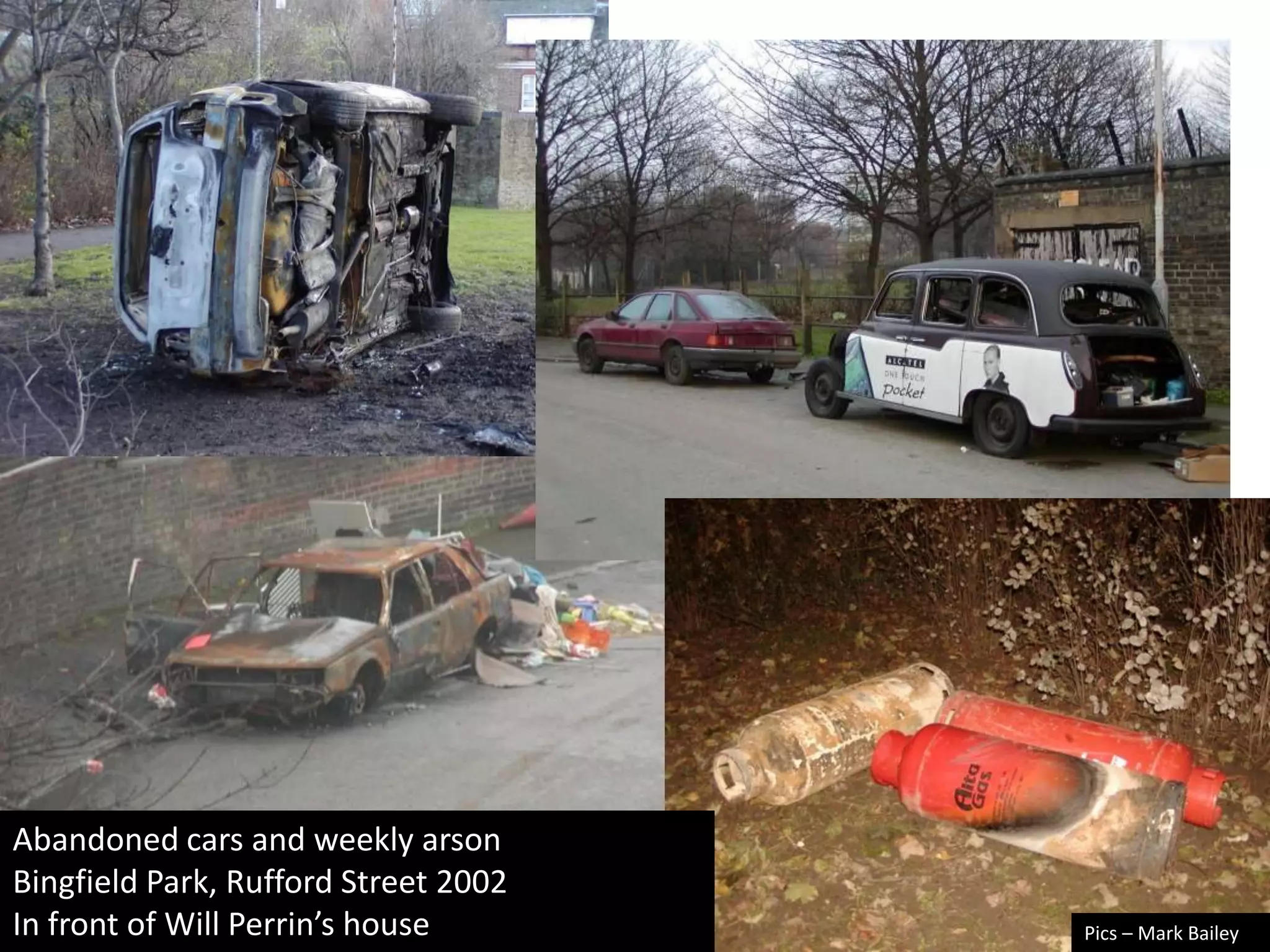
    Abandoned cars andweekly arsonBingfield Park, Rufford Street 2002In front of Will Perrin’s housePics – Mark Bailey
  • 77.
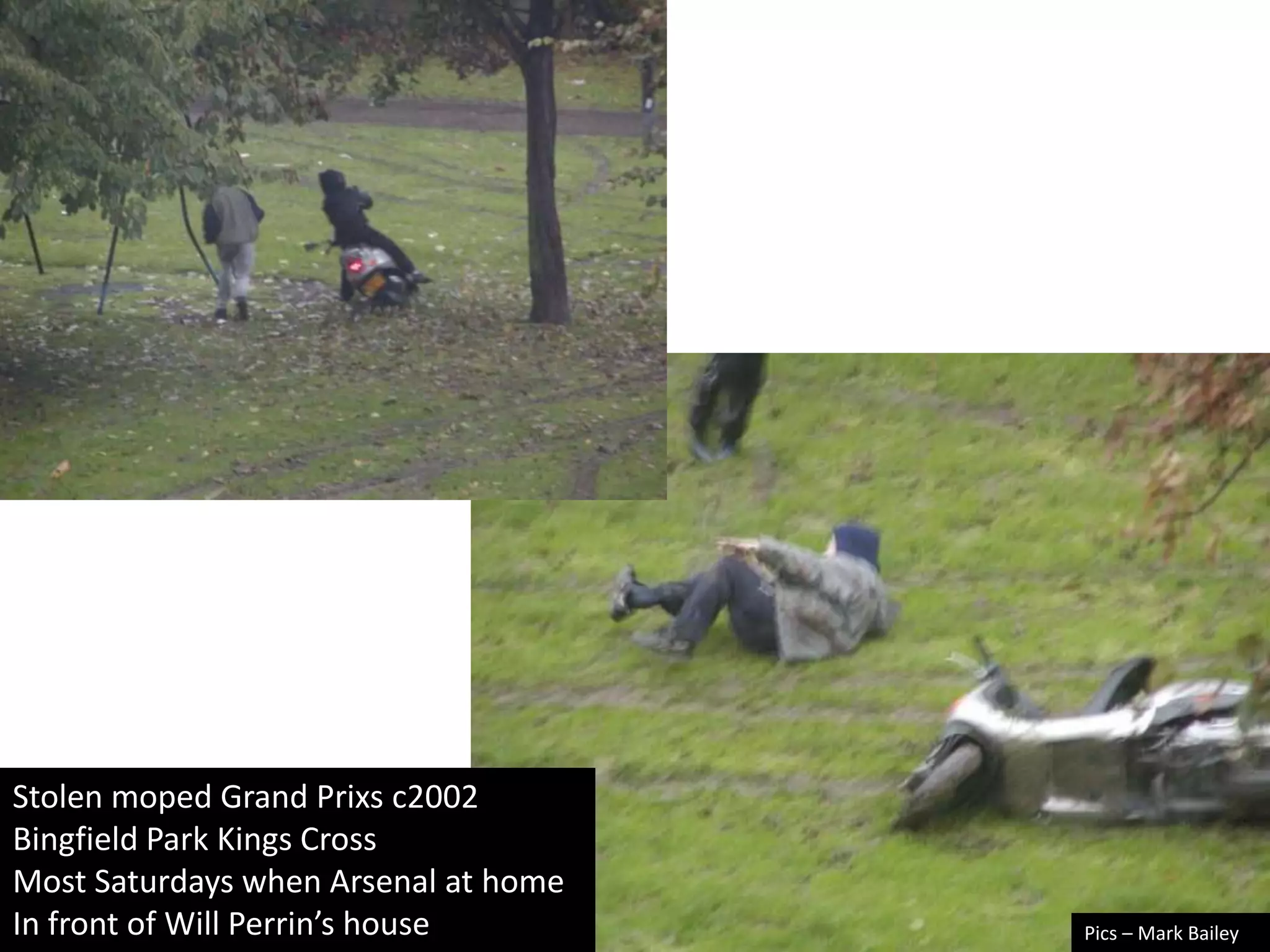
    Stolen moped GrandPrixs c2002Bingfield Park Kings CrossMost Saturdays when Arsenal at homeIn front of Will Perrin’s housePics – Mark Bailey
  • 78.
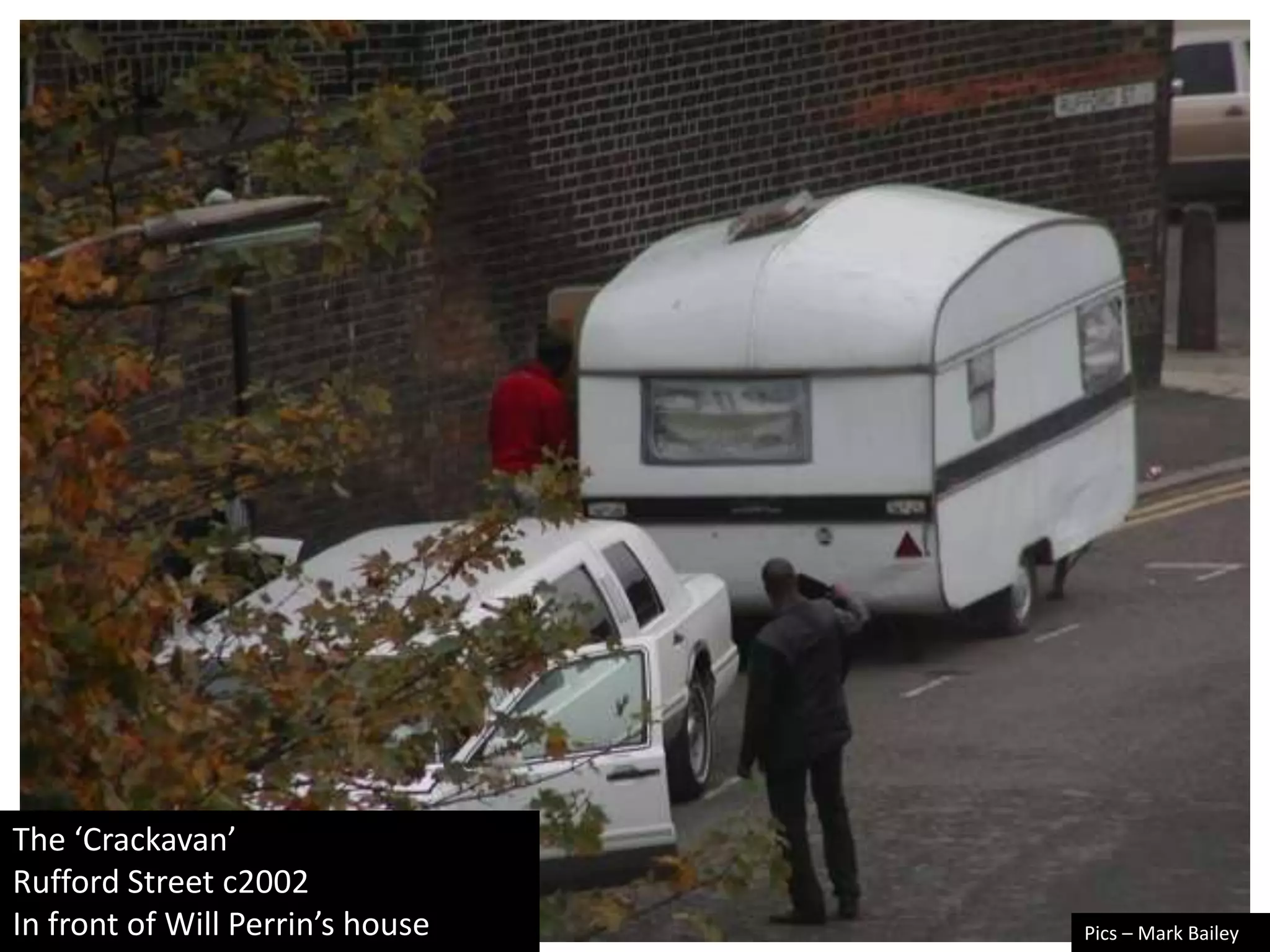
    The ‘Crackavan’Rufford Streetc2002In front of Will Perrin’s housePics – Mark Bailey
  • 79.
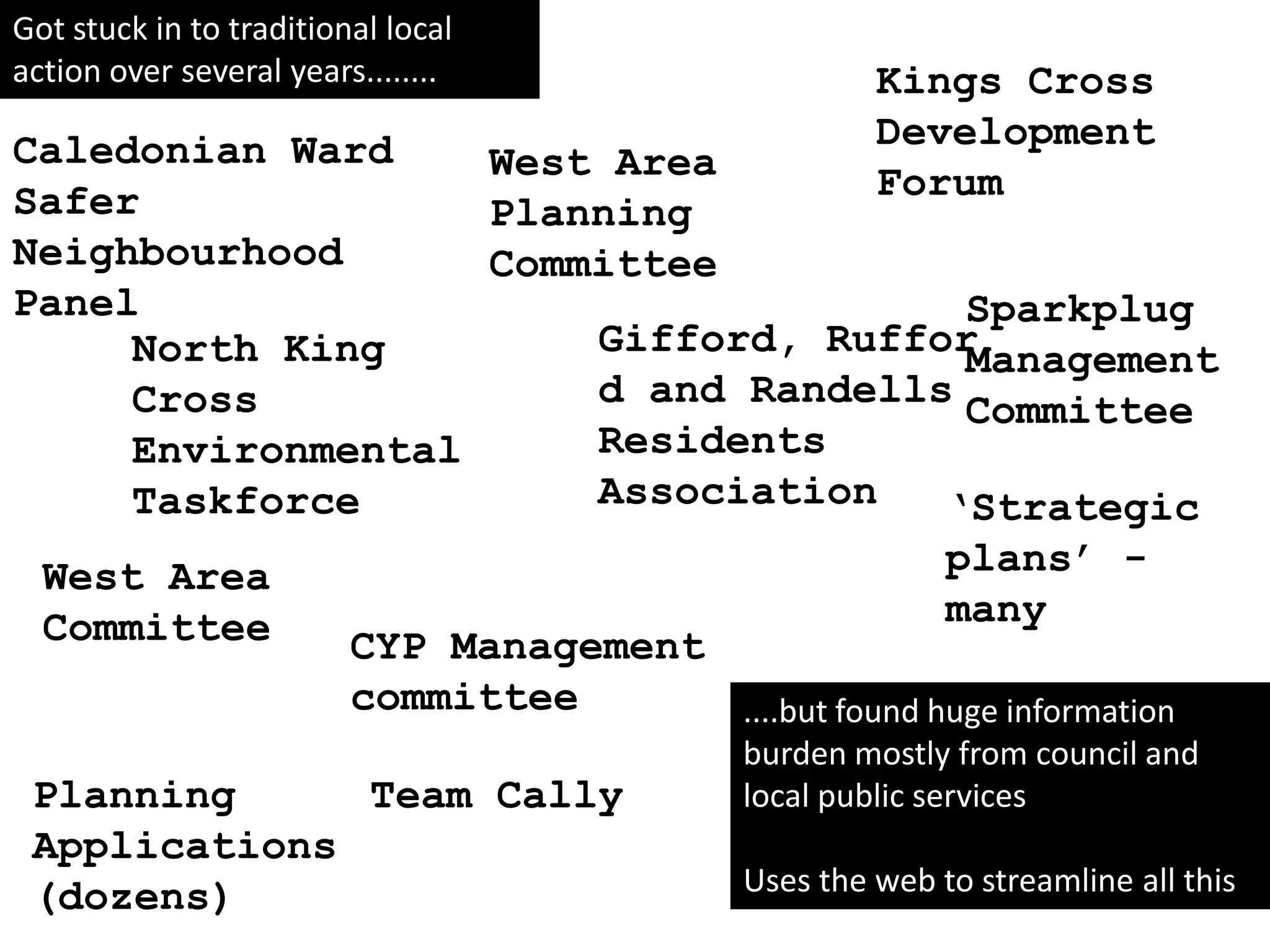
    Got stuck into traditional local action over several years........Kings Cross Development ForumCaledonian Ward Safer Neighbourhood PanelWest Area Planning CommitteeSparkplug Management CommitteeGifford, Rufford and Randells Residents AssociationNorth King Cross Environmental Taskforce‘Strategic plans’ - manyWest Area CommitteeCYP Management committee....but found huge information burden mostly from council and local public servicesUses the web to streamline all thisTeam CallyPlanning Applications (dozens)
  • 80.
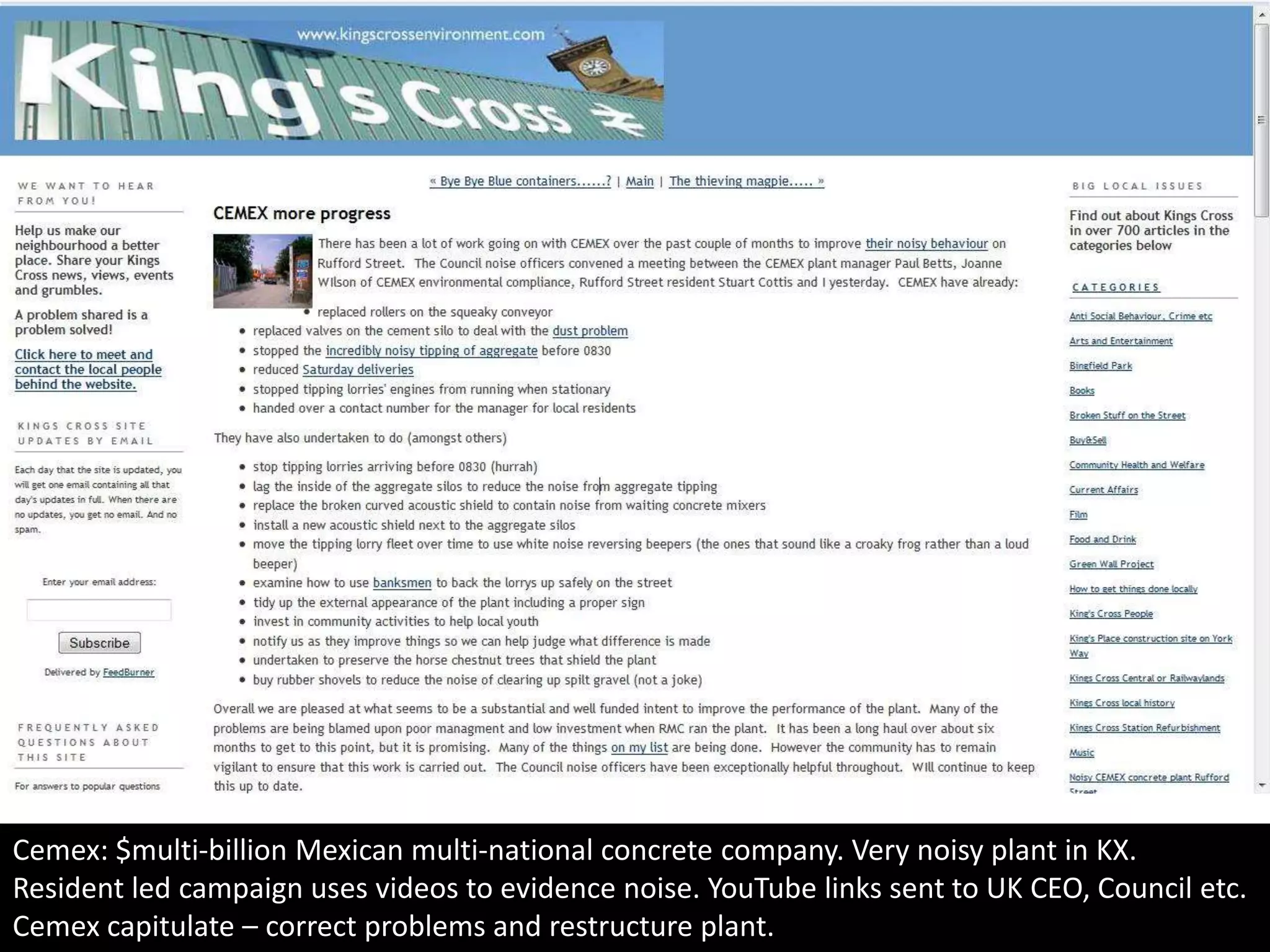
    Cemex: $multi-billion Mexicanmulti-national concrete company. Very noisy plant in KX. Resident led campaign uses videos to evidence noise. YouTube links sent to UK CEO, Council etc. Cemex capitulate – correct problems and restructure plant.
  • 81.
  • 82.
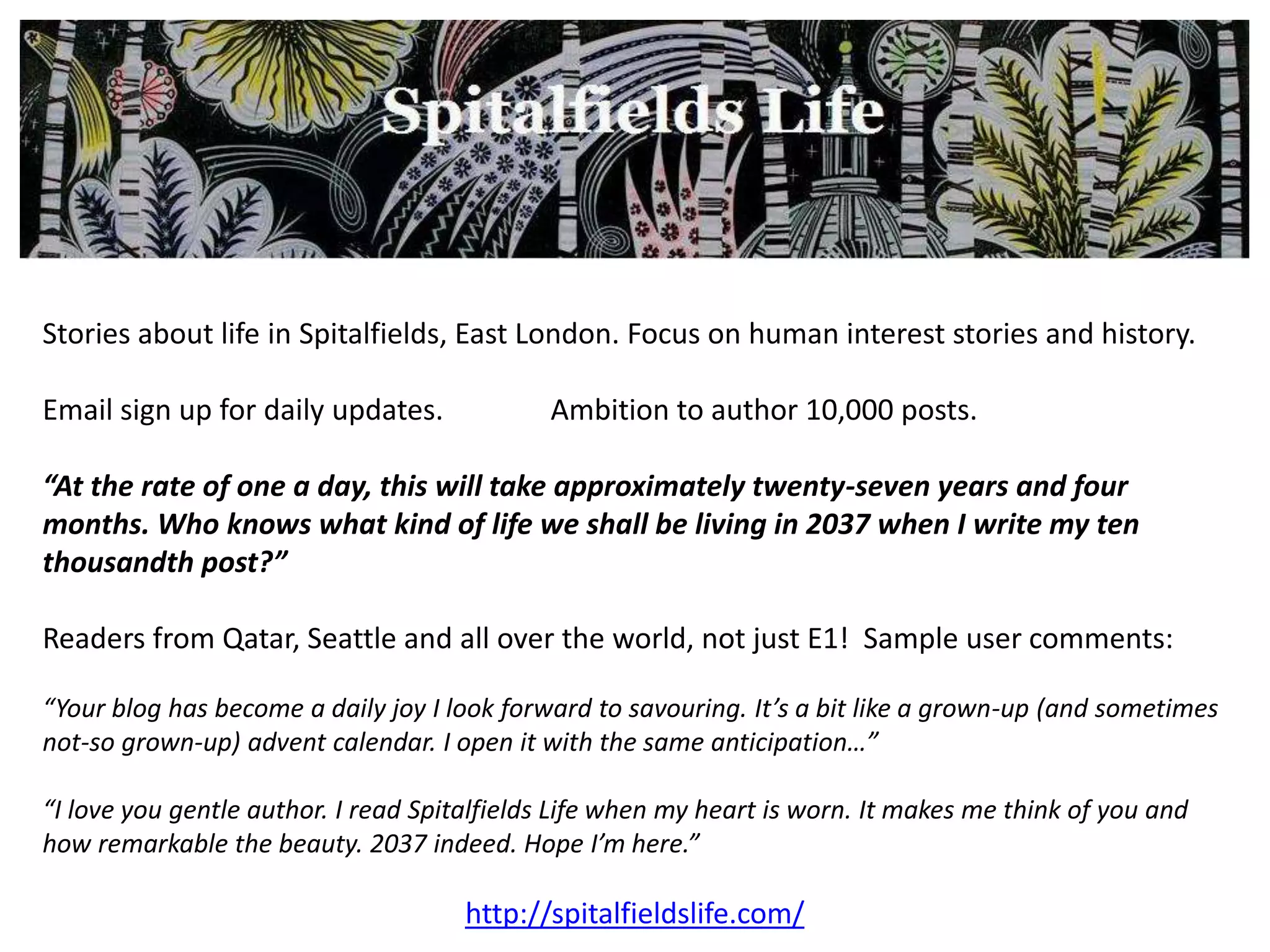
    Other ForumsStories aboutlife in Spitalfields, East London. Focus on human interest stories and history.Email sign up for daily updates. Ambition to author 10,000 posts. “At the rate of one a day, this will take approximately twenty-seven years and four months. Who knows what kind of life we shall be living in 2037 when I write my ten thousandth post?”Readers from Qatar, Seattle and all over the world, not just E1! Sample user comments:“Your blog has become a daily joy I look forward to savouring. It’s a bit like a grown-up (and sometimes not-so grown-up) advent calendar. I open it with the same anticipation…”“I love you gentle author. I read Spitalfields Life when my heart is worn. It makes me think of you and how remarkable the beauty. 2037 indeed. Hope I’m here.”http://spitalfieldslife.com/
  • 83.
    And some otherswell worth a look…
  • 84.
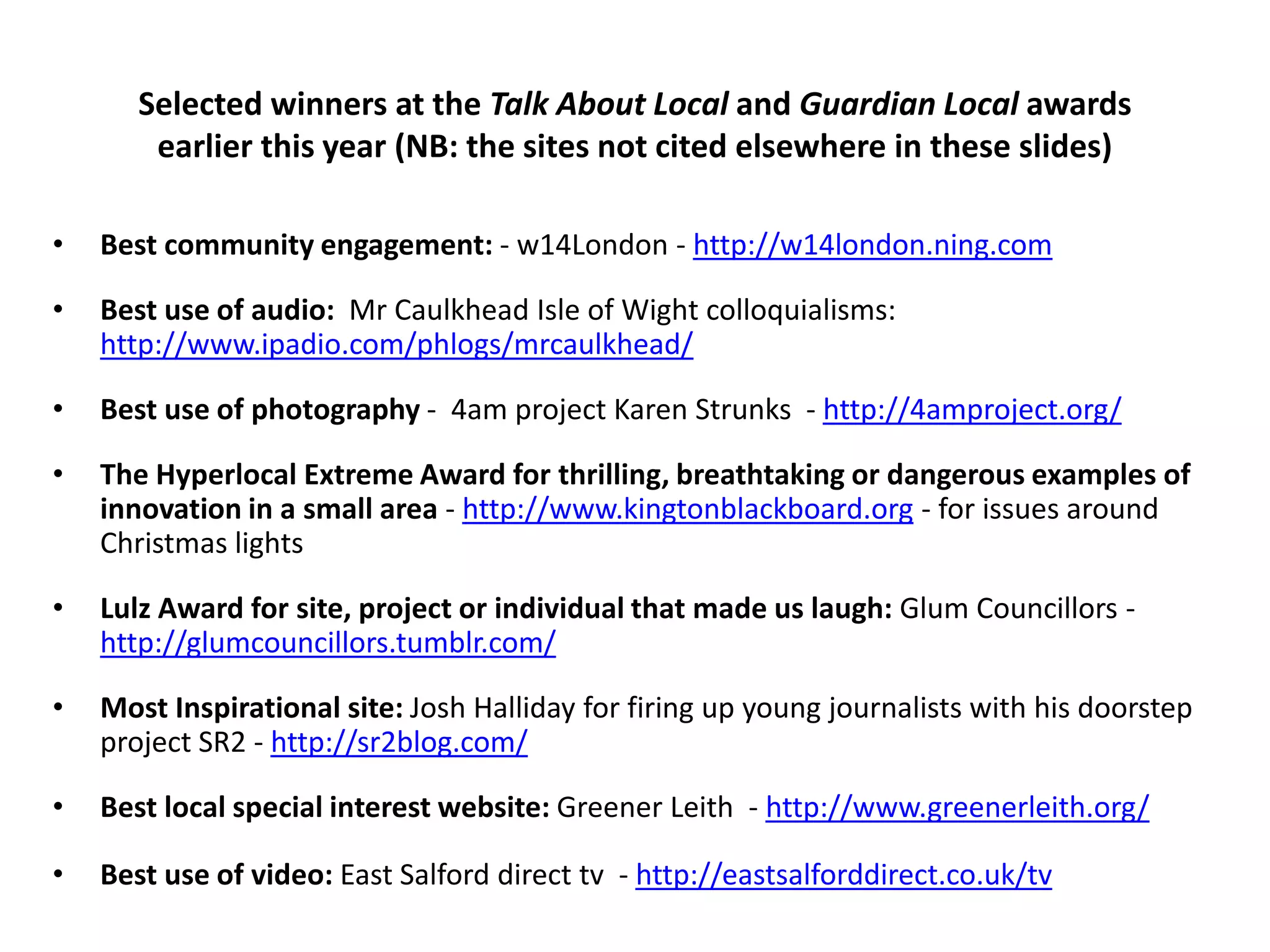
    Selected winners atthe Talk About Local and Guardian Local awards earlier this year (NB: the sites not cited elsewhere in these slides)Best community engagement: - w14London - http://w14london.ning.comBest use of audio: Mr Caulkhead Isle of Wight colloquialisms: http://www.ipadio.com/phlogs/mrcaulkhead/Best use of photography - 4am project Karen Strunks - http://4amproject.org/The Hyperlocal Extreme Award for thrilling, breathtaking or dangerous examples of innovation in a small area - http://www.kingtonblackboard.org - for issues around Christmas lightsLulz Award for site, project or individual that made us laugh: Glum Councillors - http://glumcouncillors.tumblr.com/Most Inspirational site: Josh Halliday for firing up young journalists with his doorstep project SR2 - http://sr2blog.com/Best local special interest website: Greener Leith - http://www.greenerleith.org/Best use of video: East Salford direct tv - http://eastsalforddirect.co.uk/tv