Presentation Birmingham City University Damian Radcliffe26th November 2009
1AgendaAbout OfcomCommunications Market in the UK todayHot topic (1) – Public Service BroadcastingHot topic (2) –  Delivering news, media and information at a local level	BreakHot topic (3) – the Digital Economy Bill6.	Broadcasting Code
21:	About Ofcom
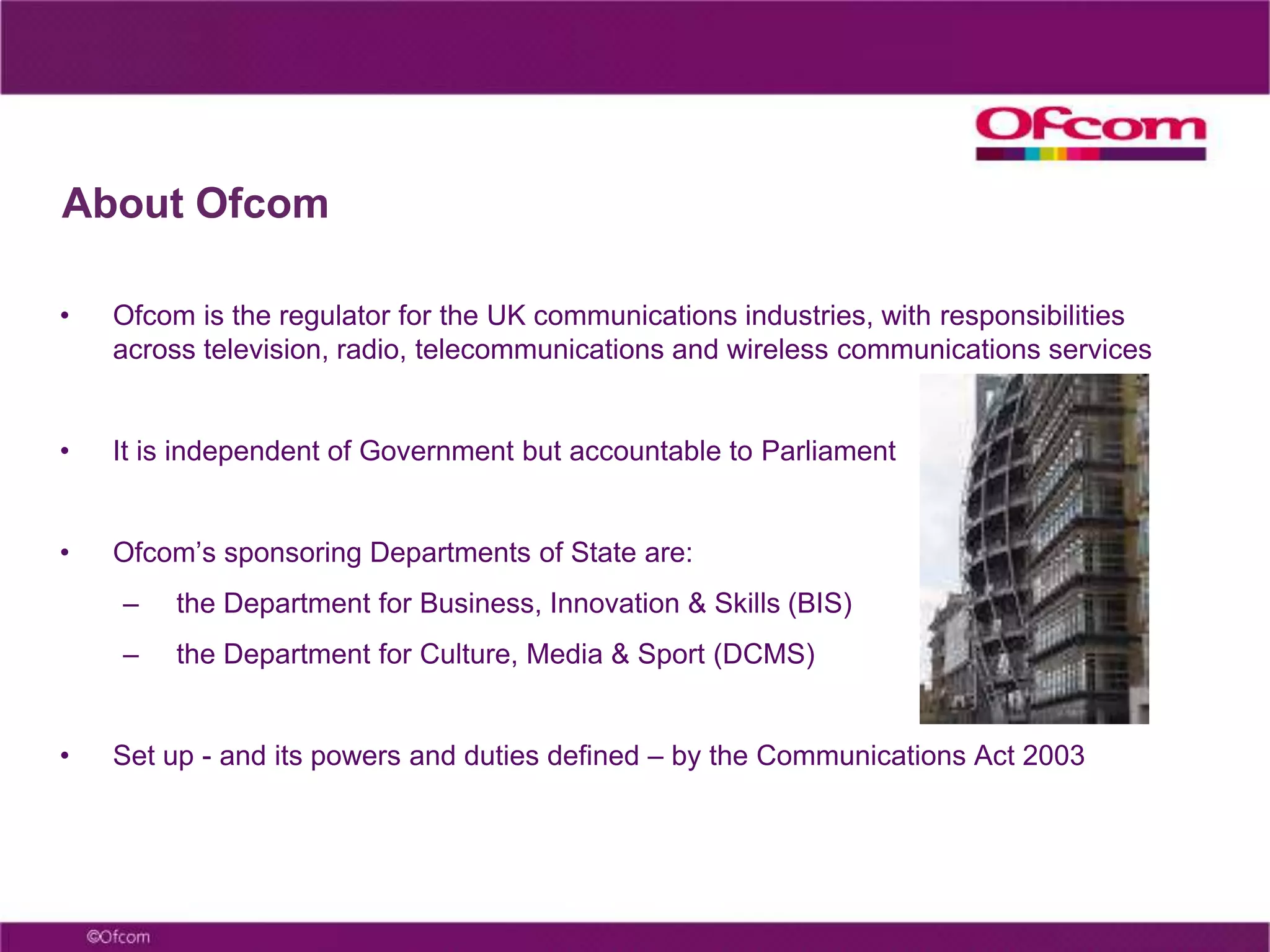
About OfcomOfcom is the regulator for the UK communications industries, with responsibilities across television, radio, telecommunications and wireless communications servicesIt is independent of Government but accountable to ParliamentOfcom’s sponsoring Departments of State are:the Department for Business, Innovation & Skills (BIS)the Department for Culture, Media & Sport (DCMS)Set up - and its powers and duties defined – by the Communications Act 2003
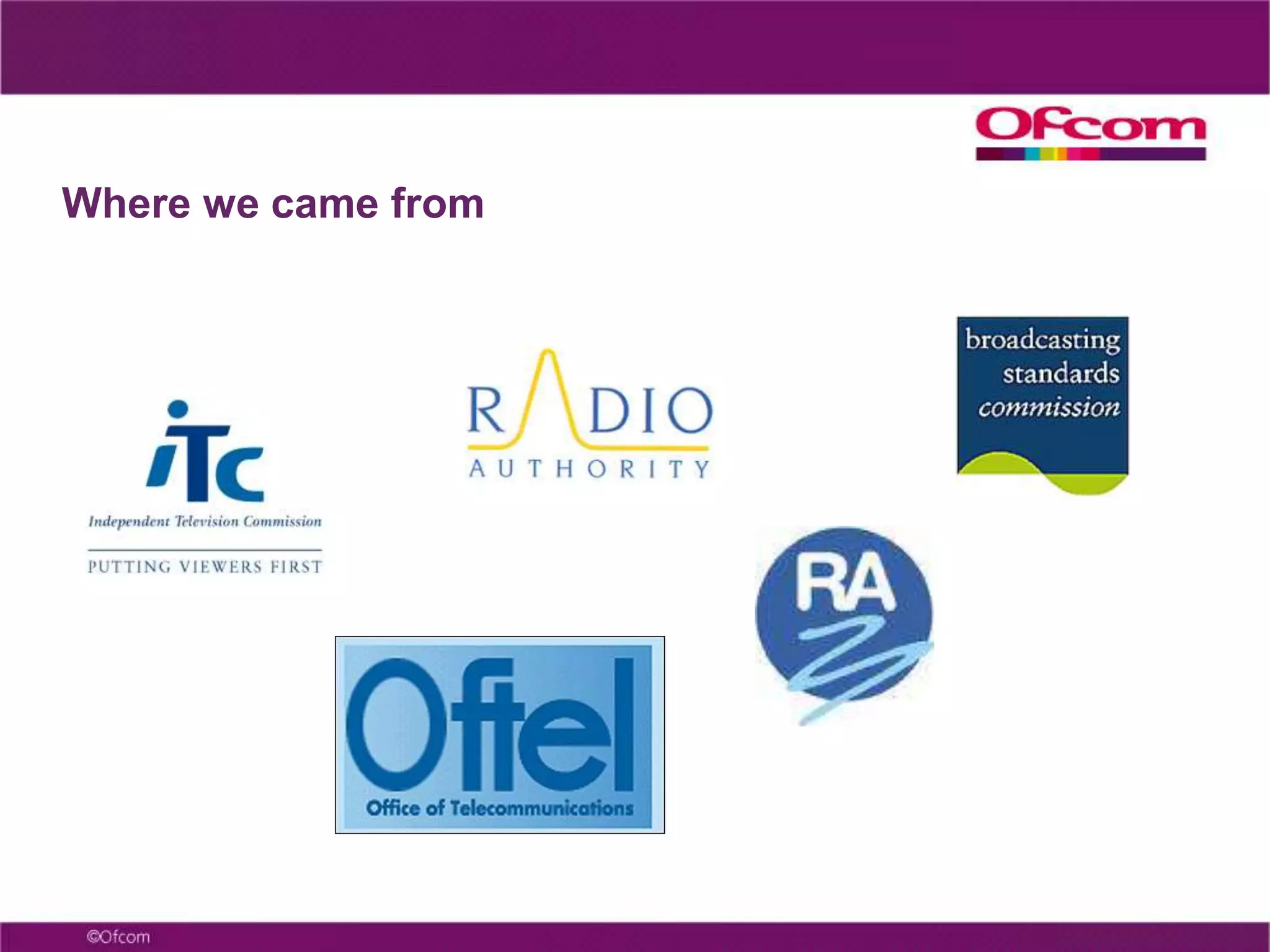
Where we came from
5Ofcom’s statutory dutiesUnder the Communications Act 2003 “It shall be the principal duty of Ofcom, in carrying out their functions;(a) to further the interests of citizens in relation to communications matters; and(b) to further the interests of consumers in relevant markets, where appropriate by promoting competition" Ofcom’s specific duties fall into six areas:
Ensuring the optimal use of the electro-magnetic spectrum
Ensuring that a wide range of electronic communications services - including high speed data services - is available throughout the UK
Ensuring a wide range of TV and radio services of high quality and wide appeal
Maintaining plurality in the provision of broadcasting
Applying adequate protection for audiences against offensive or harmful material
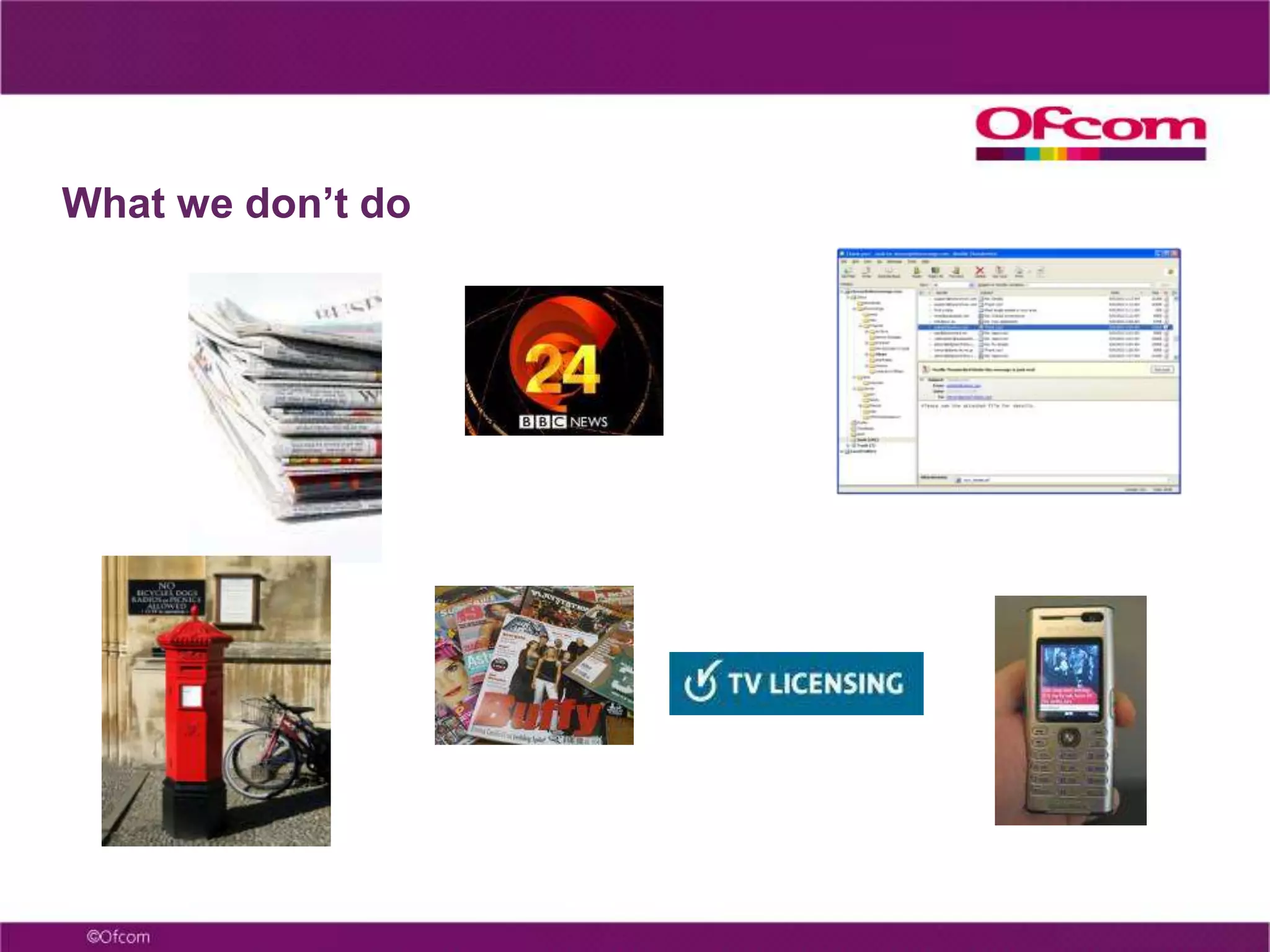
Applying adequate protection for audiences against unfairness or the infringement of privacy What we don’t do
72:	Communications Market in the UK today
8The communications market in 2008 – key storiesTrends
 Communications markets and the recession
 Consumers take control of their viewing
 Broadband sees double-digit growth in 2008
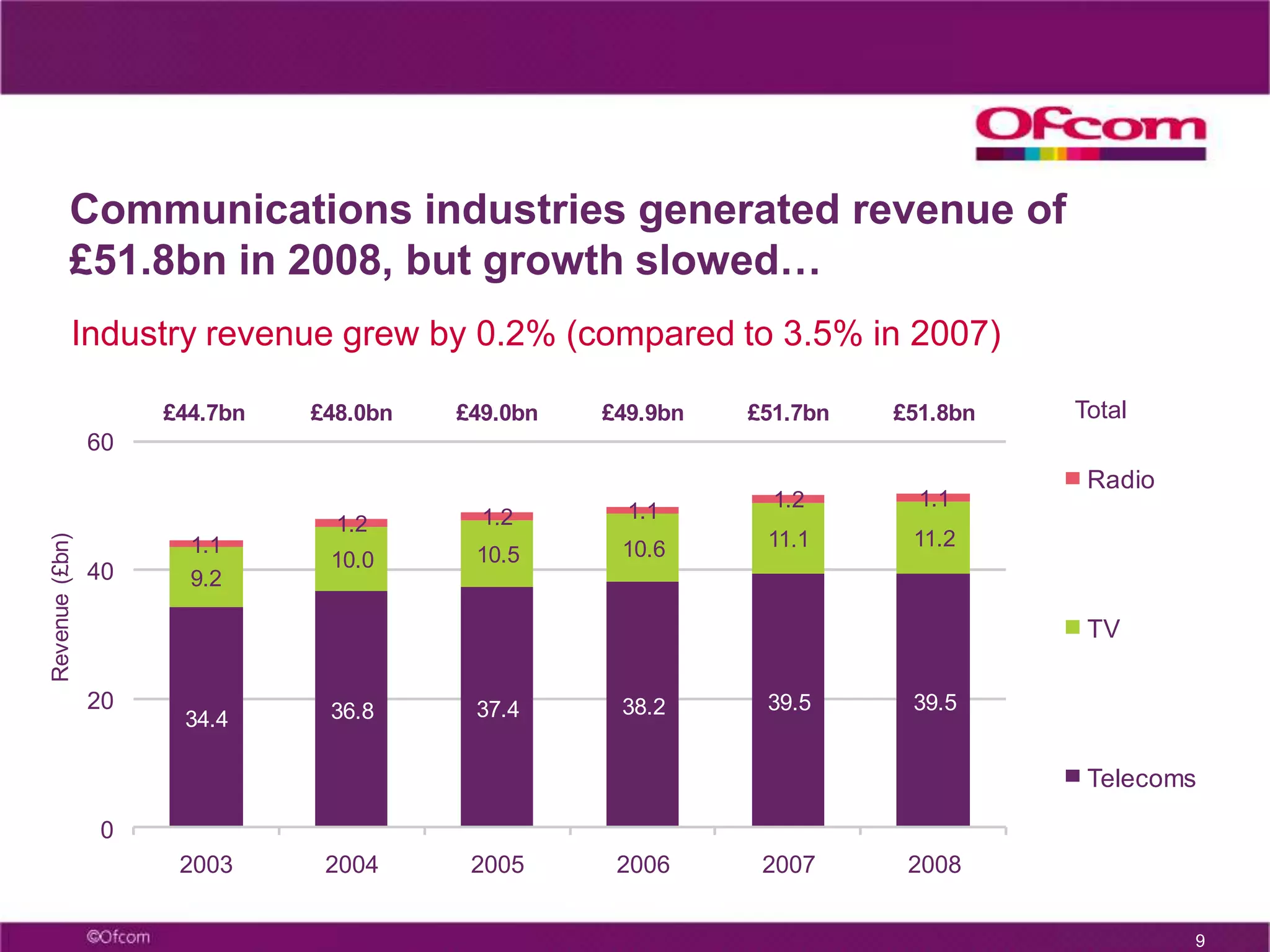
 Communications in the Nations and Regions9Communications industries generated revenue of £51.8bn in 2008, but growth slowed…Industry revenue grew by 0.2% (compared to 3.5% in 2007)Total
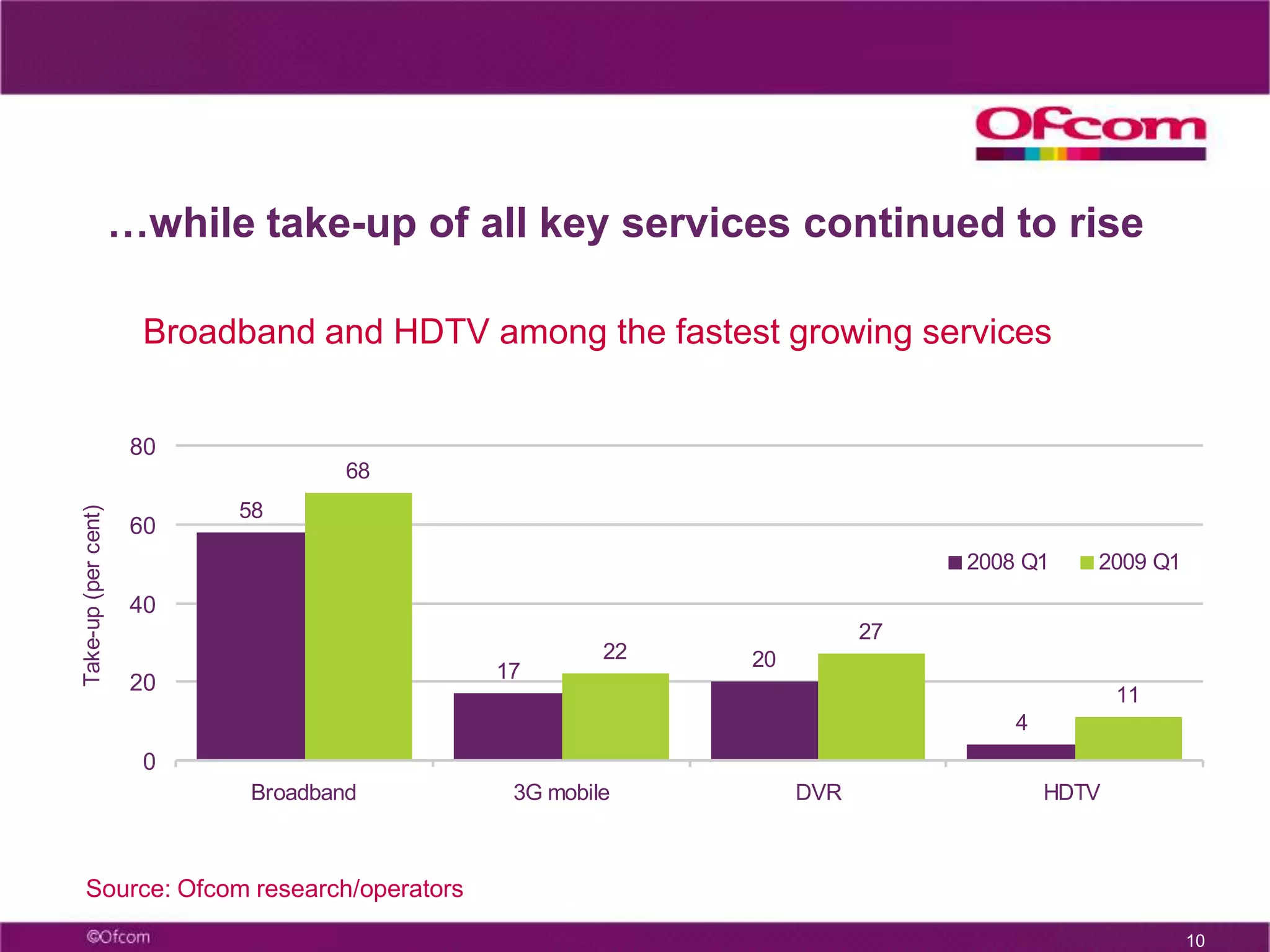
10…while take-up of all key services continued to riseBroadband and HDTV among the fastest growing servicesSource: Ofcom research/operators
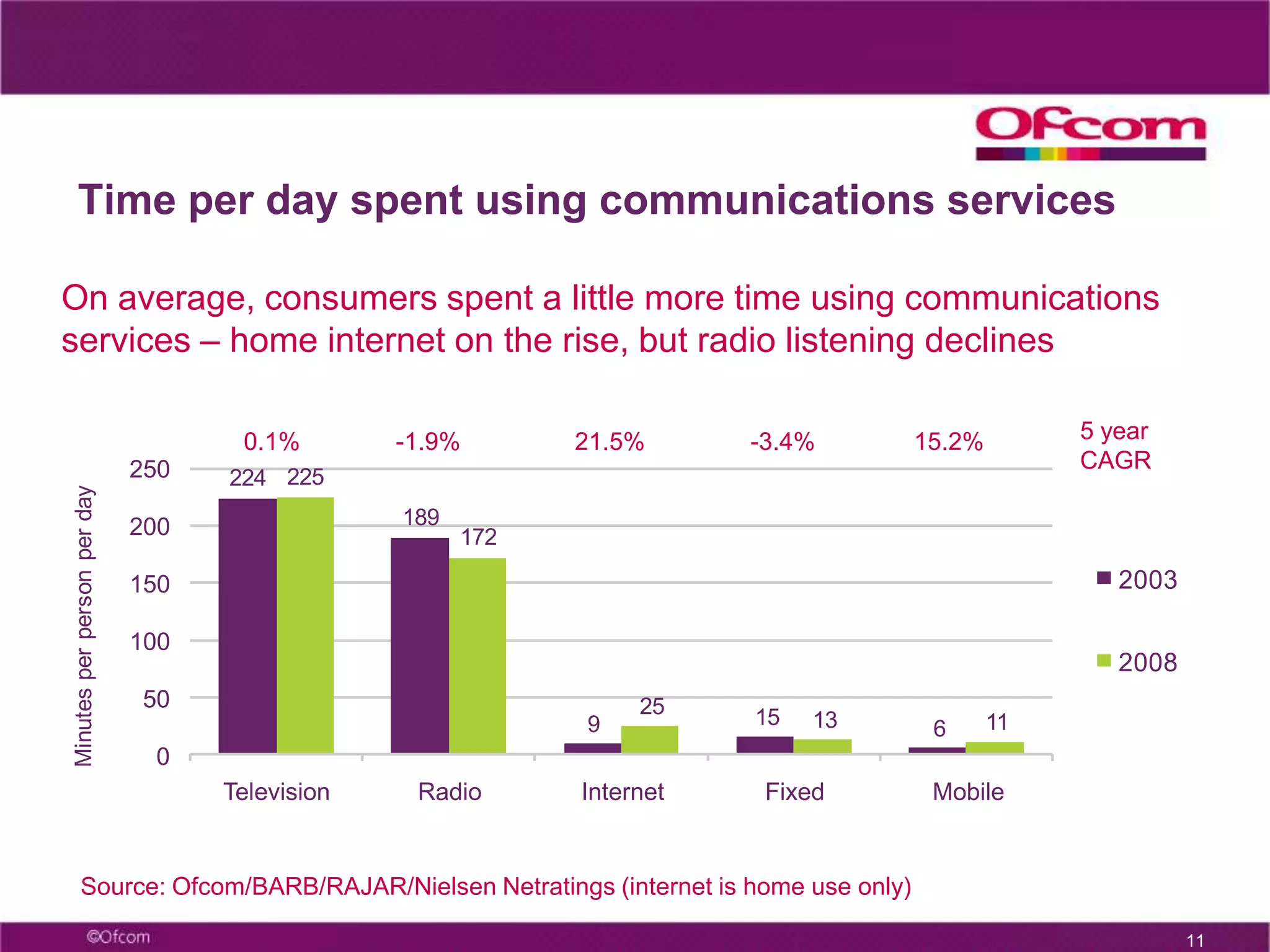
11Time per day spent using communications services On average, consumers spent a little more time using communications services – home internet on the rise, but radio listening declines5 year CAGR0.1%-1.9%21.5%-3.4%15.2%Source: Ofcom/BARB/RAJAR/Nielsen Netratings (internet is home use only)
12The communications market in 2008 – key stories Trends
 Communications markets and the recession
 Consumers take control of their viewing
 Broadband sees double-digit growth in 2008
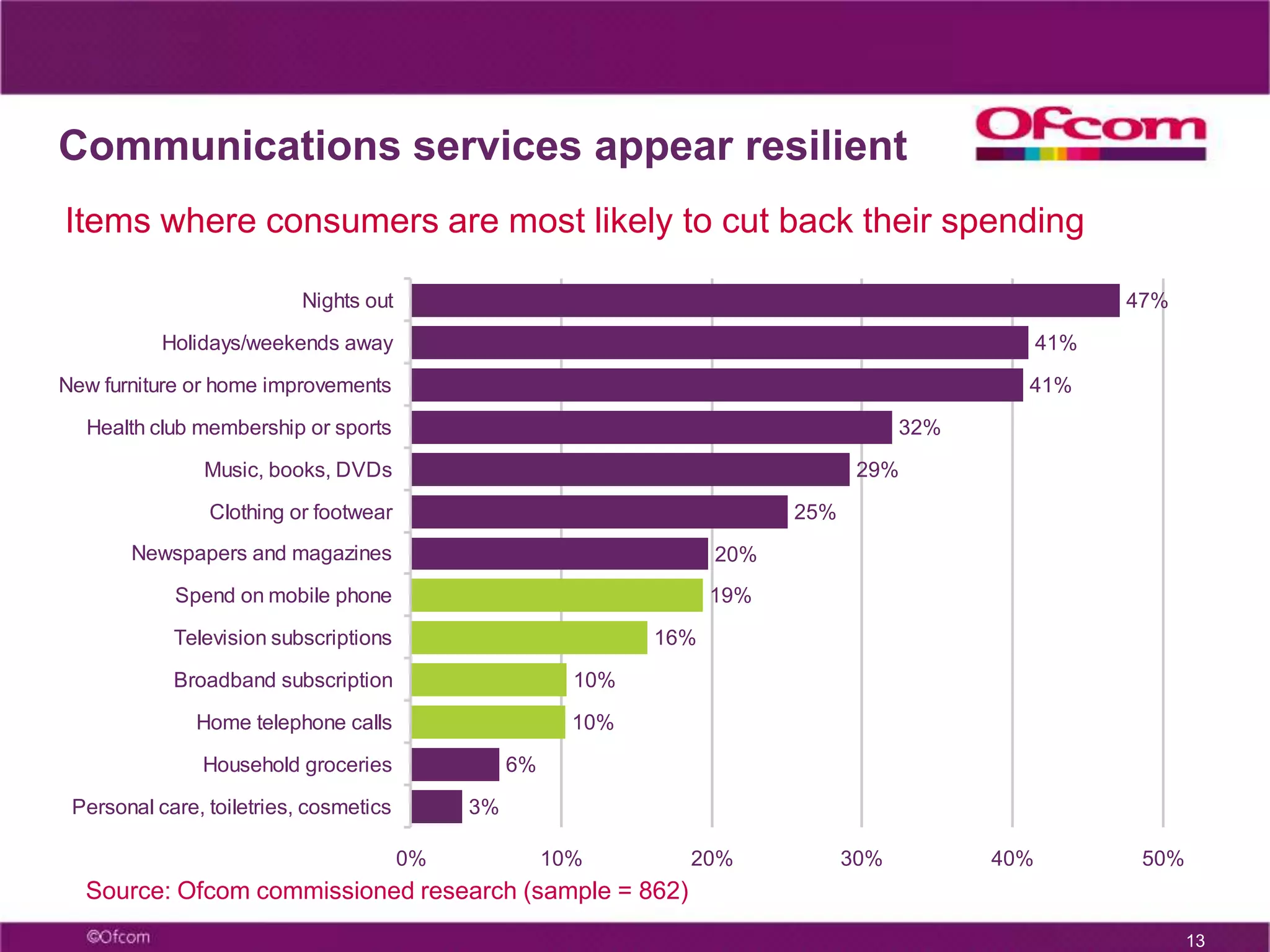
 Communications in the Nations and Regions13Communications services appear resilient Items where consumers are most likely to cut back their spendingSource: Ofcom commissioned research (sample = 862)
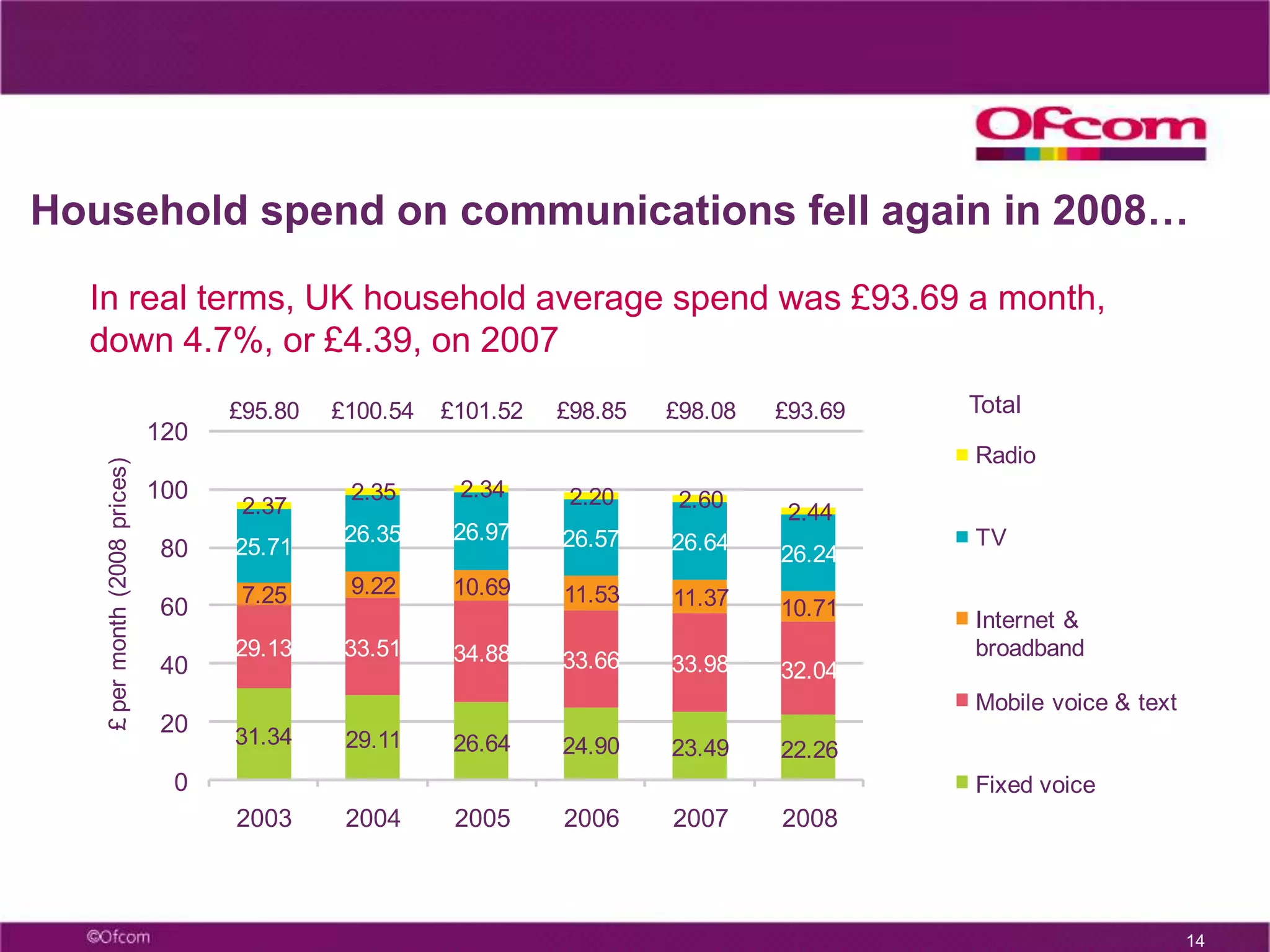
14Household spend on communications fell again in 2008…In real terms, UK household average spend was £93.69 a month, down 4.7%, or £4.39, on 2007Total
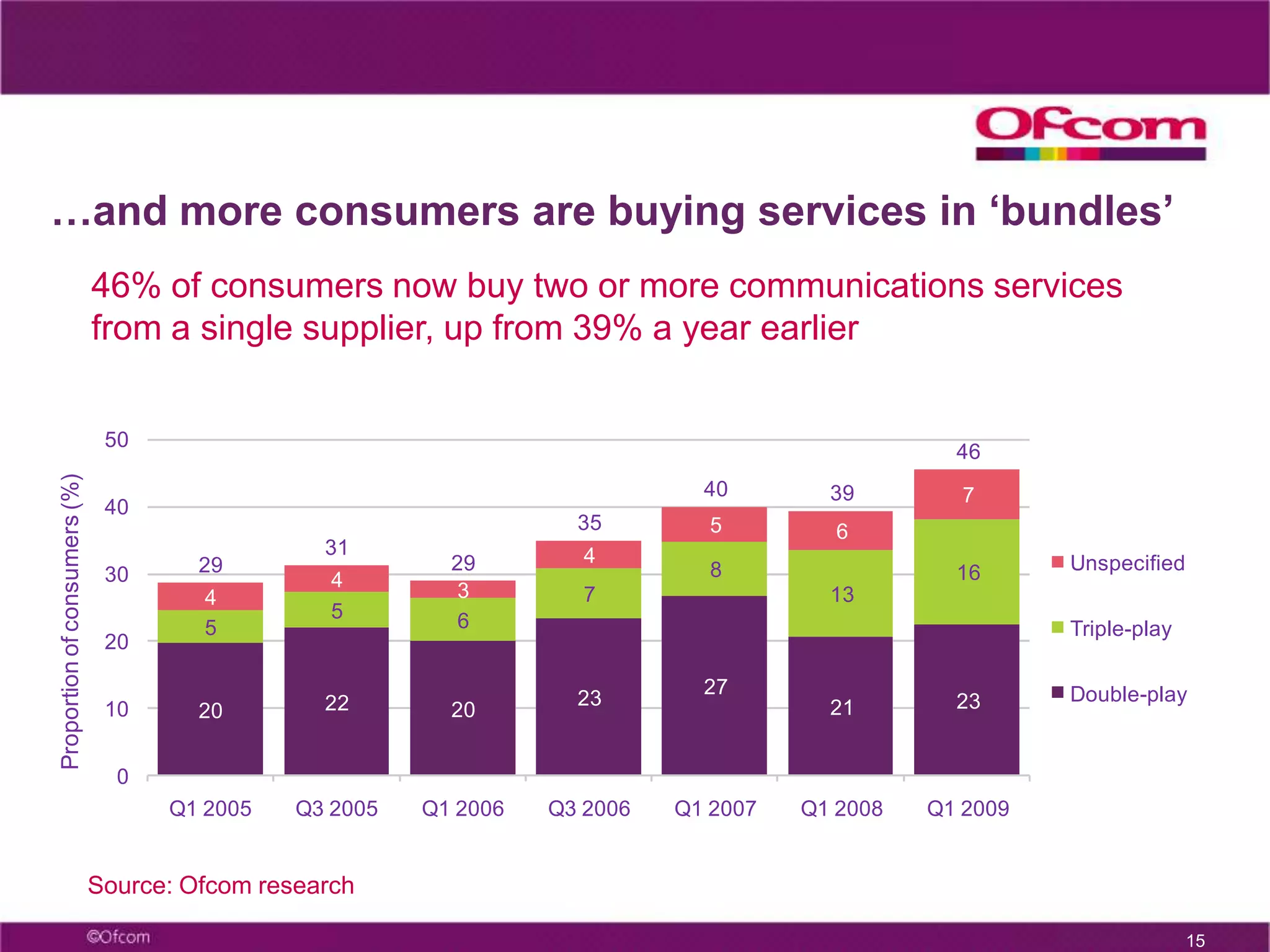
15…and more consumers are buying services in ‘bundles’ 46% of consumers now buy two or more communications services from a single supplier, up from 39% a year earlierSource: Ofcom research
16Communications Market 2008 - key stories Trends
 Communications markets and the recession
 Consumers take control of their viewing
 Broadband sees double-digit growth in 2008
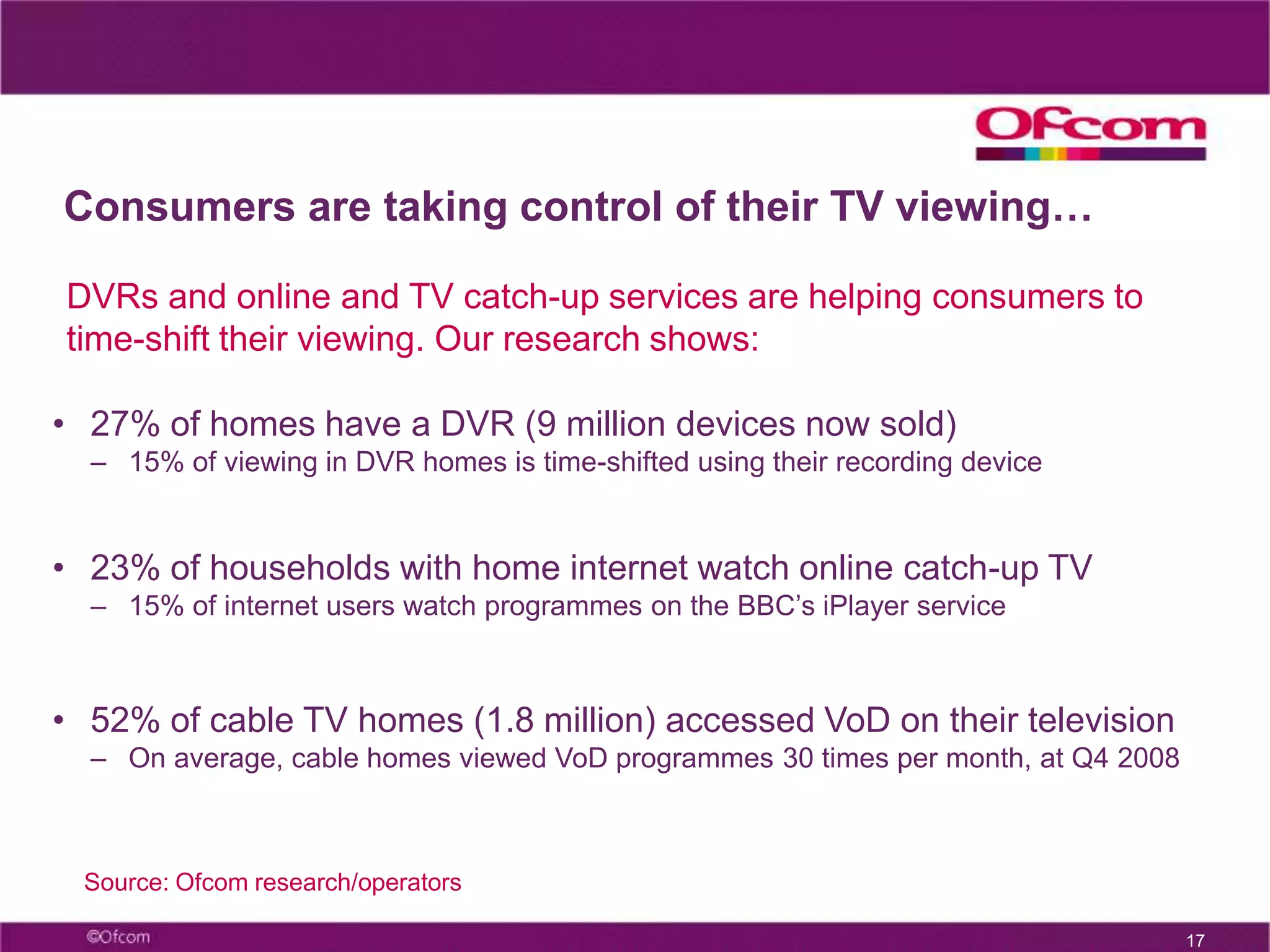
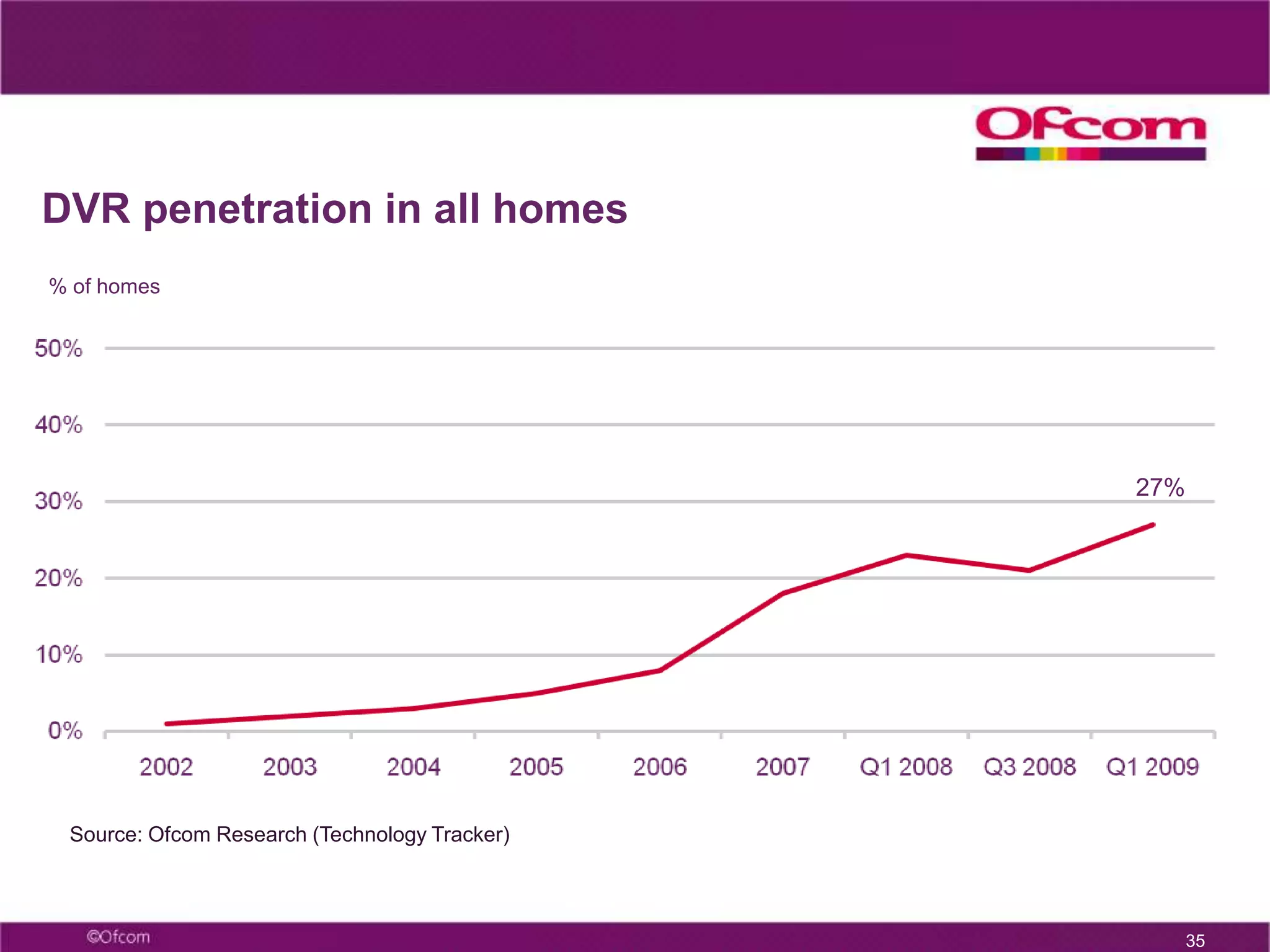
 Communications in the Nations and Regions17Consumers are taking control of their TV viewing…DVRs and online and TV catch-up services are helping consumers to time-shift their viewing. Our research shows:27% of homes have a DVR (9 million devices now sold)
15% of viewing in DVR homes is time-shifted using their recording device
23% of households with home internet watch online catch-up TV
15% of internet users watch programmes on the BBC’s iPlayer service
52% of cable TV homes (1.8 million) accessed VoD on their television
On average, cable homes viewed VoD programmes 30 times per month, at Q4 2008Source: Ofcom research/operators
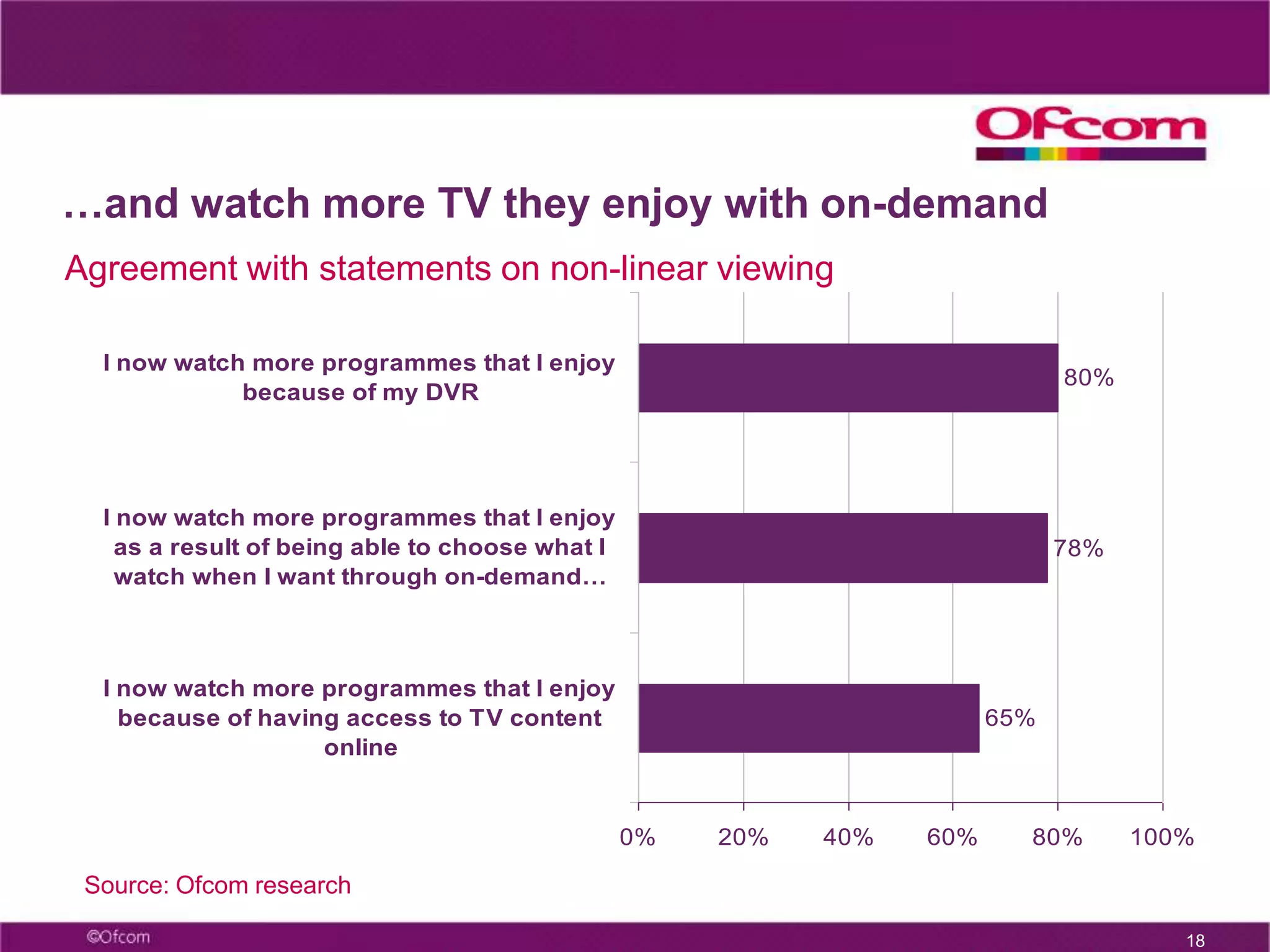
…and watch more TV they enjoy with on-demand18Agreement with statements on non-linear viewingSource: Ofcom research
19Communications Market 2008 - key stories Trends
 Communications markets and the recession
 Consumers take control of their viewing
 Broadband sees double-digit growth in 2008
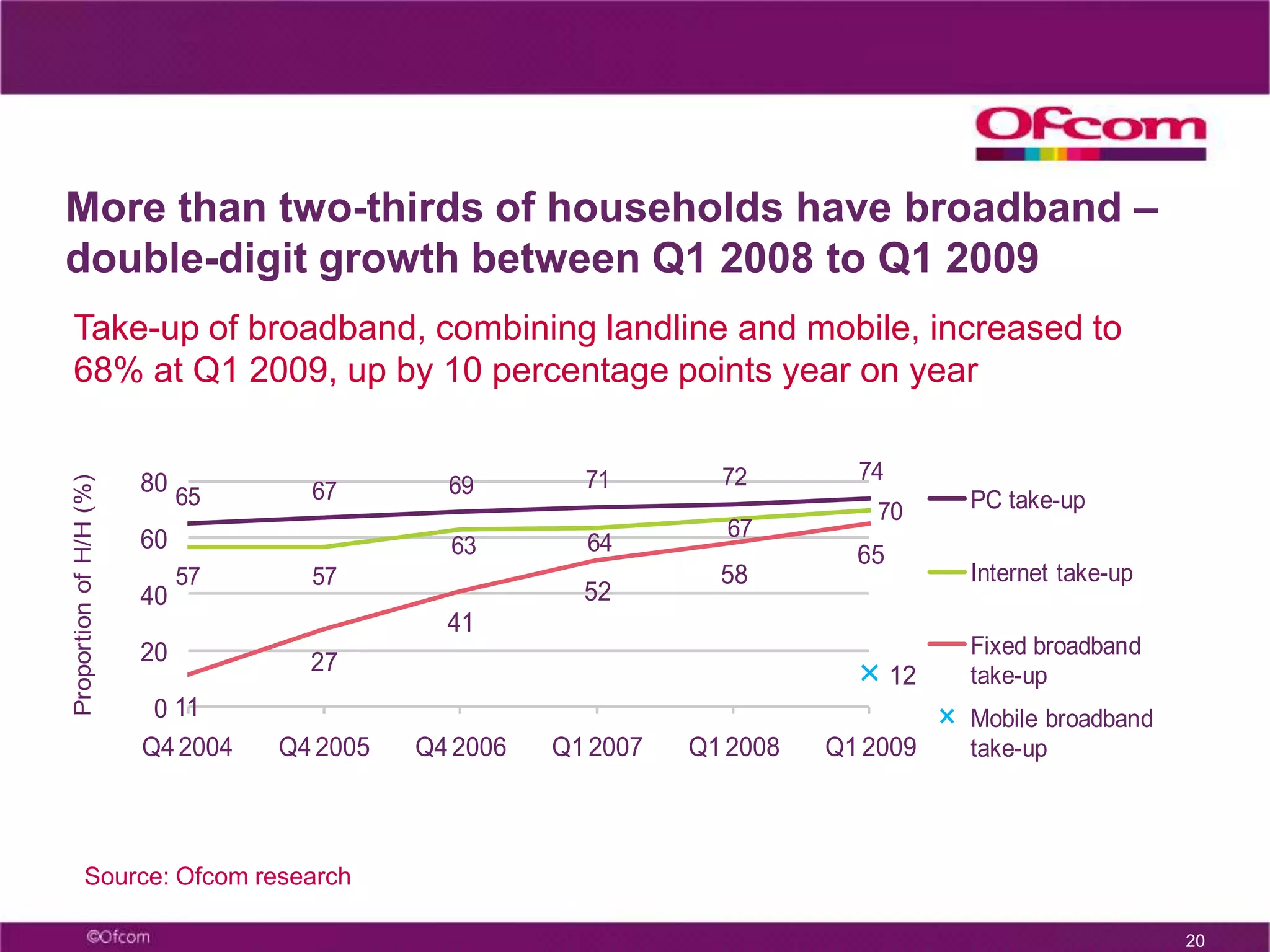
 Communications in the Nations and Regions20More than two-thirds of households have broadband – double-digit growth between Q1 2008 to Q1 2009 Take-up of broadband, combining landline and mobile, increased to 68% at Q1 2009, up by 10 percentage points year on yearSource: Ofcom research
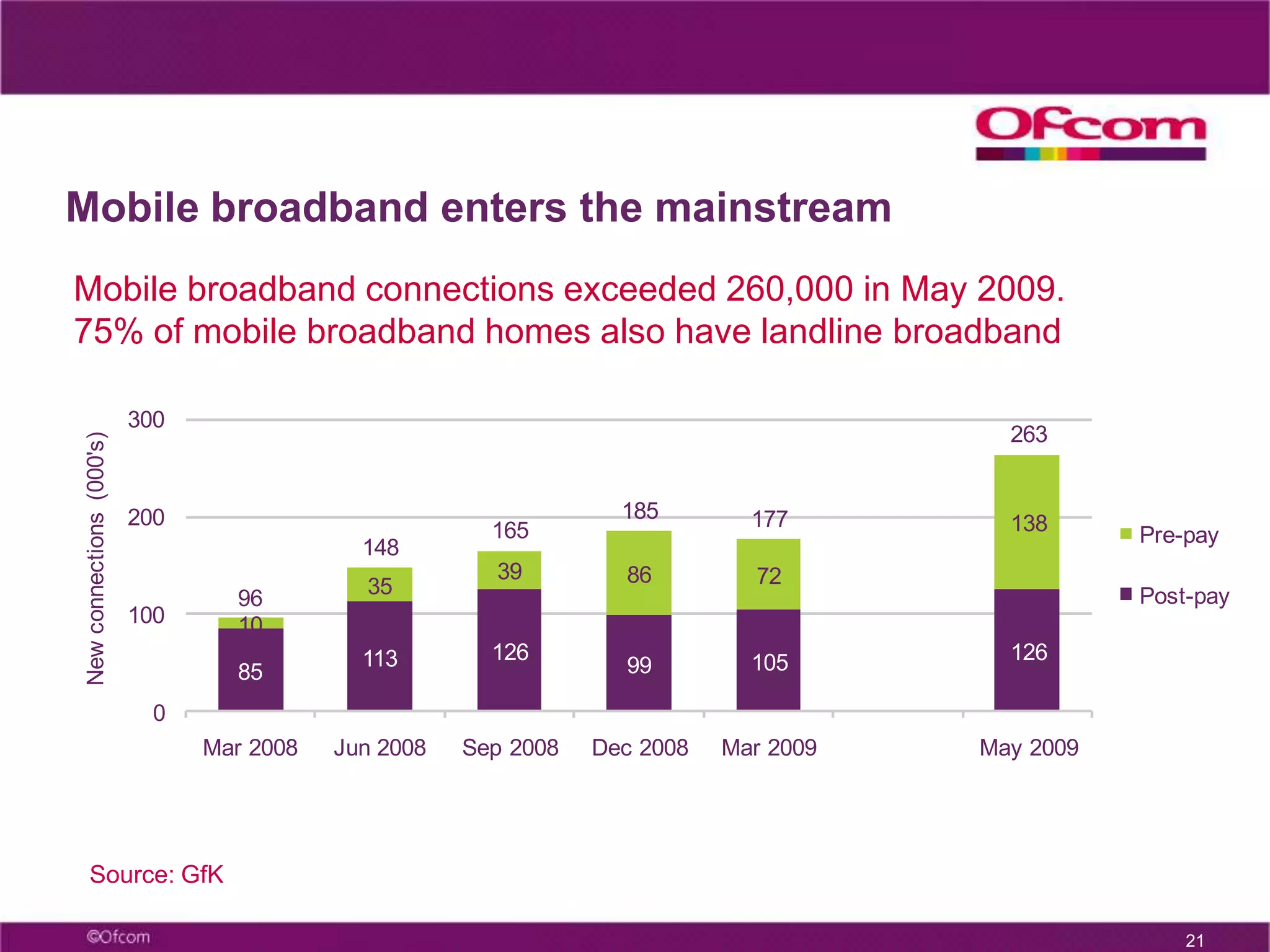
21Mobile broadband enters the mainstreamMobile broadband connections exceeded 260,000 in May 2009. 75% of mobile broadband homes also have landline broadbandSource: GfK
22Communications Market 2008 - key stories Trends
 Communications markets and the recession
 Consumers take control of their viewing
 Broadband sees double-digit growth
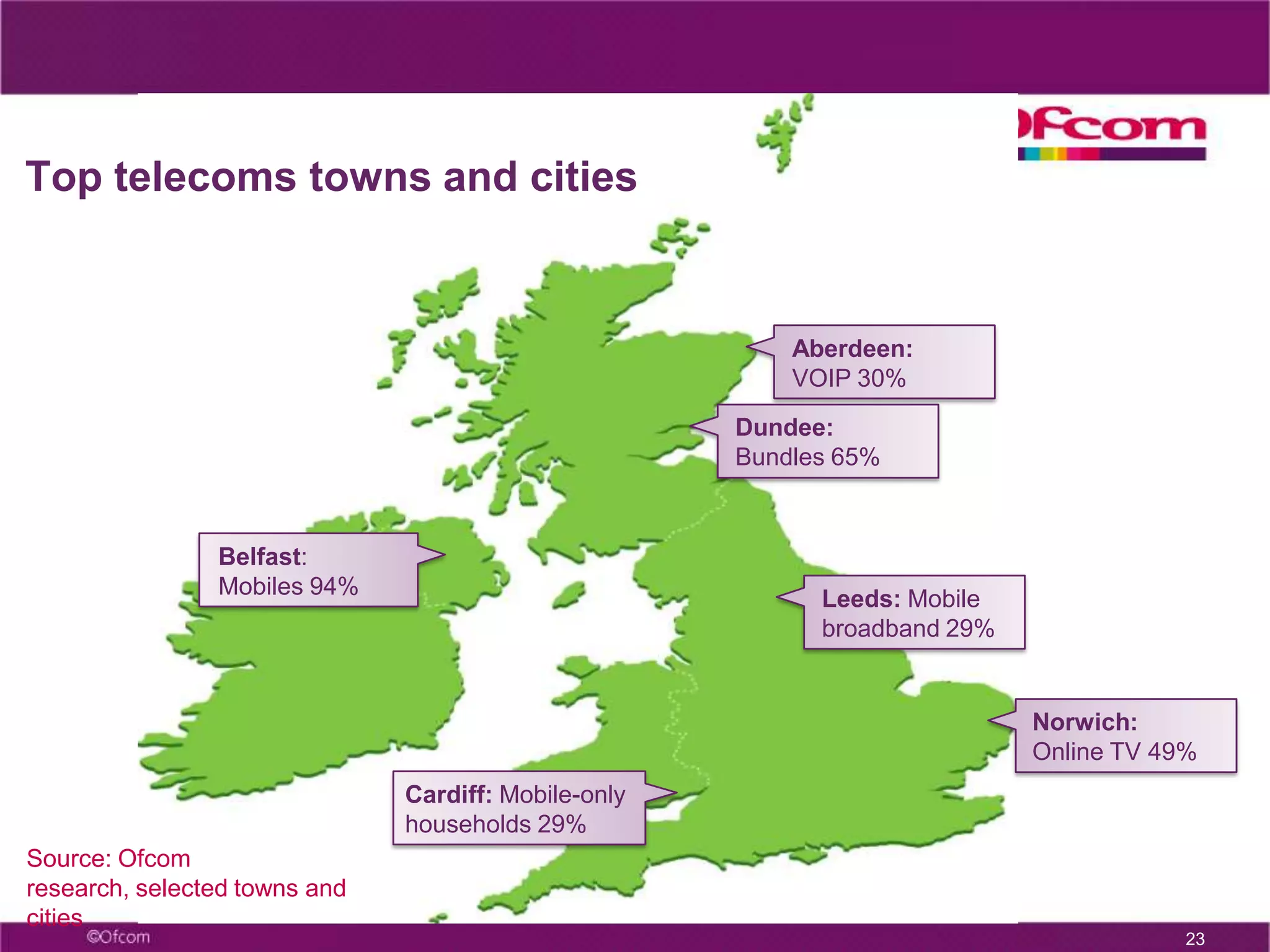
 Communications in the Nations and RegionsTop telecoms towns and citiesAberdeen: VOIP 30%Dundee: Bundles 65%Belfast: Mobiles 94%Leeds: Mobile broadband 29%Norwich: Online TV 49%Cardiff: Mobile-only households 29%Source: Ofcom research, selected towns and cities23
243:Hot Topic (2): PSB “under pressure”
PSB purposes 25Informing our understanding of the world - To inform ourselves and others and to increase our understanding of the world through news, information and analysis of current events and ideas 2.  Stimulating knowledge and learning -To stimulate our interest in and  knowledge of arts, science, history and other topics through content that is accessible and can encourage informal learning 3. Reflecting UK cultural identity - To reflect and strengthen our cultural identity through original programming at UK, national and regional level, on occasion bringing audiences together for shared experiences 4. Representing diversity and alternative viewpoints - To make us aware of different cultures and alternative viewpoints, through programmes that reflect the lives of other people and other communities, both within the UK and elsewhere
PSB characteristics 26High quality - well-funded and well-produced Original - new UK content rather than repeats or acquisitions Innovative - breaking new ideas or re-inventing exciting approaches, rather than copying old ones Challenging - making viewers think Engaging - remaining accessible and attractive to viewers Widely available - if content is publicly funded, a large majority of citizens need to be given the chance to watch it
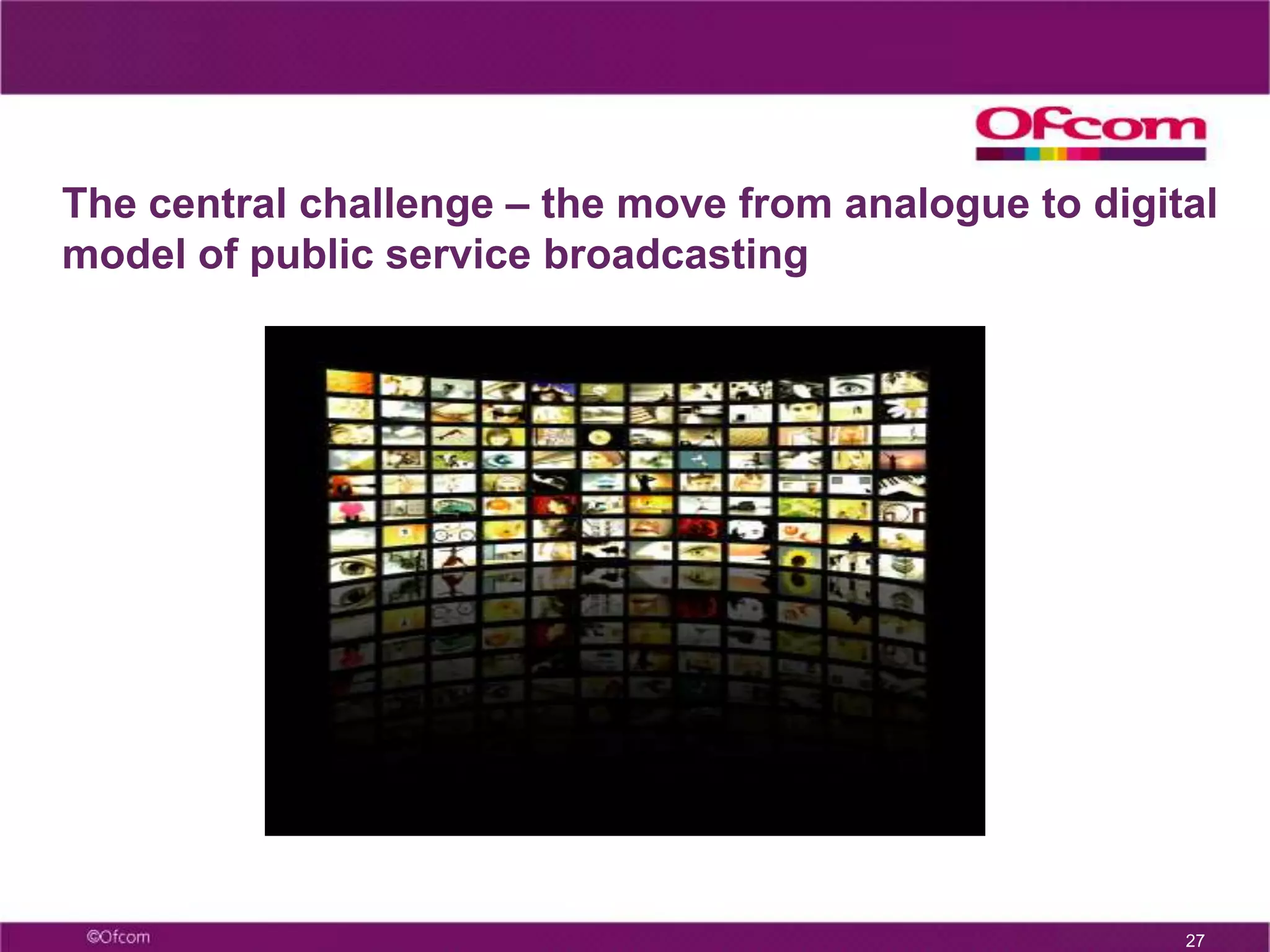
27The central challenge – the move from analogue to digital model of public service broadcasting
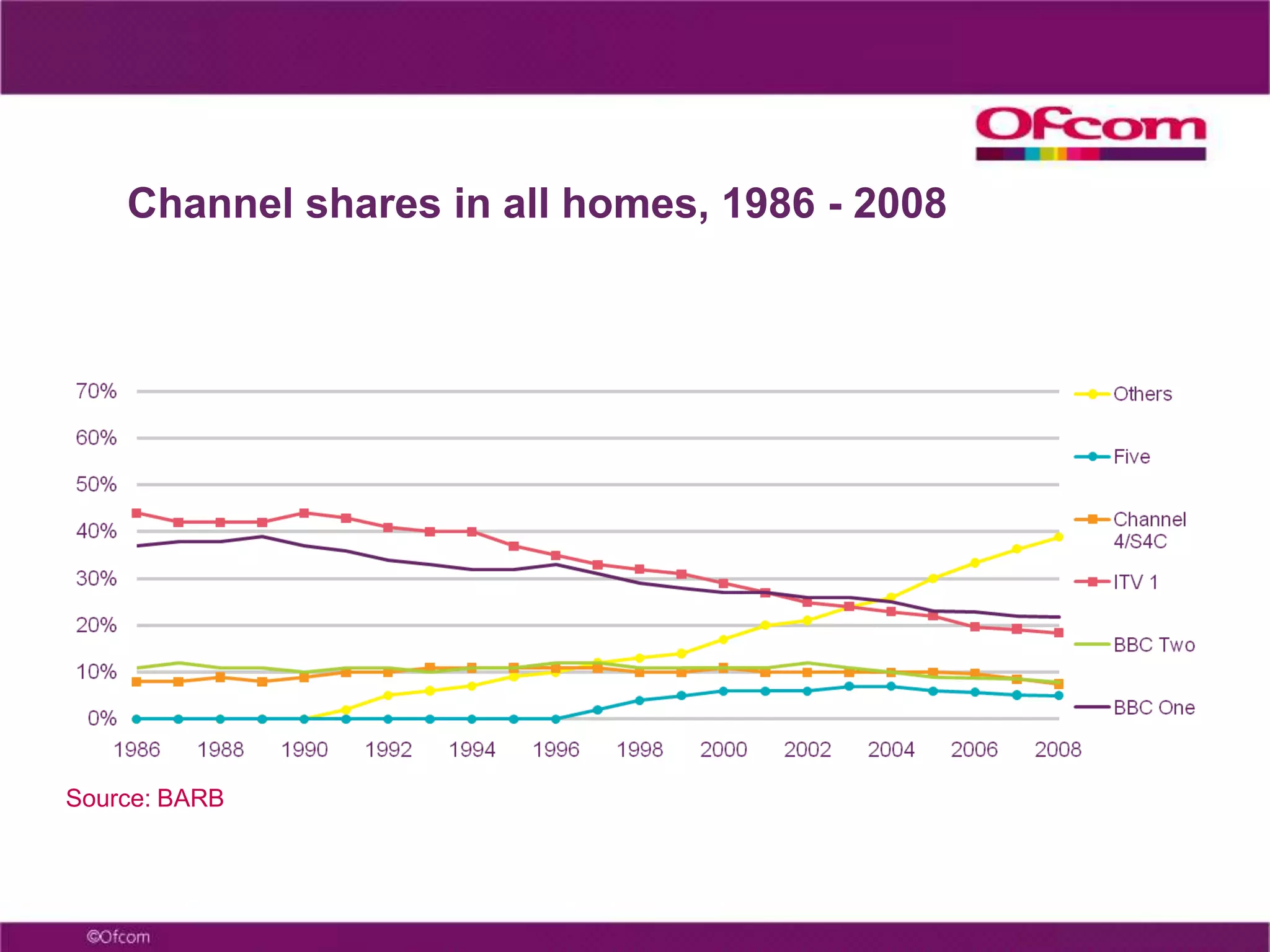
	Channel shares in all homes, 1986 - 2008Source: BARB
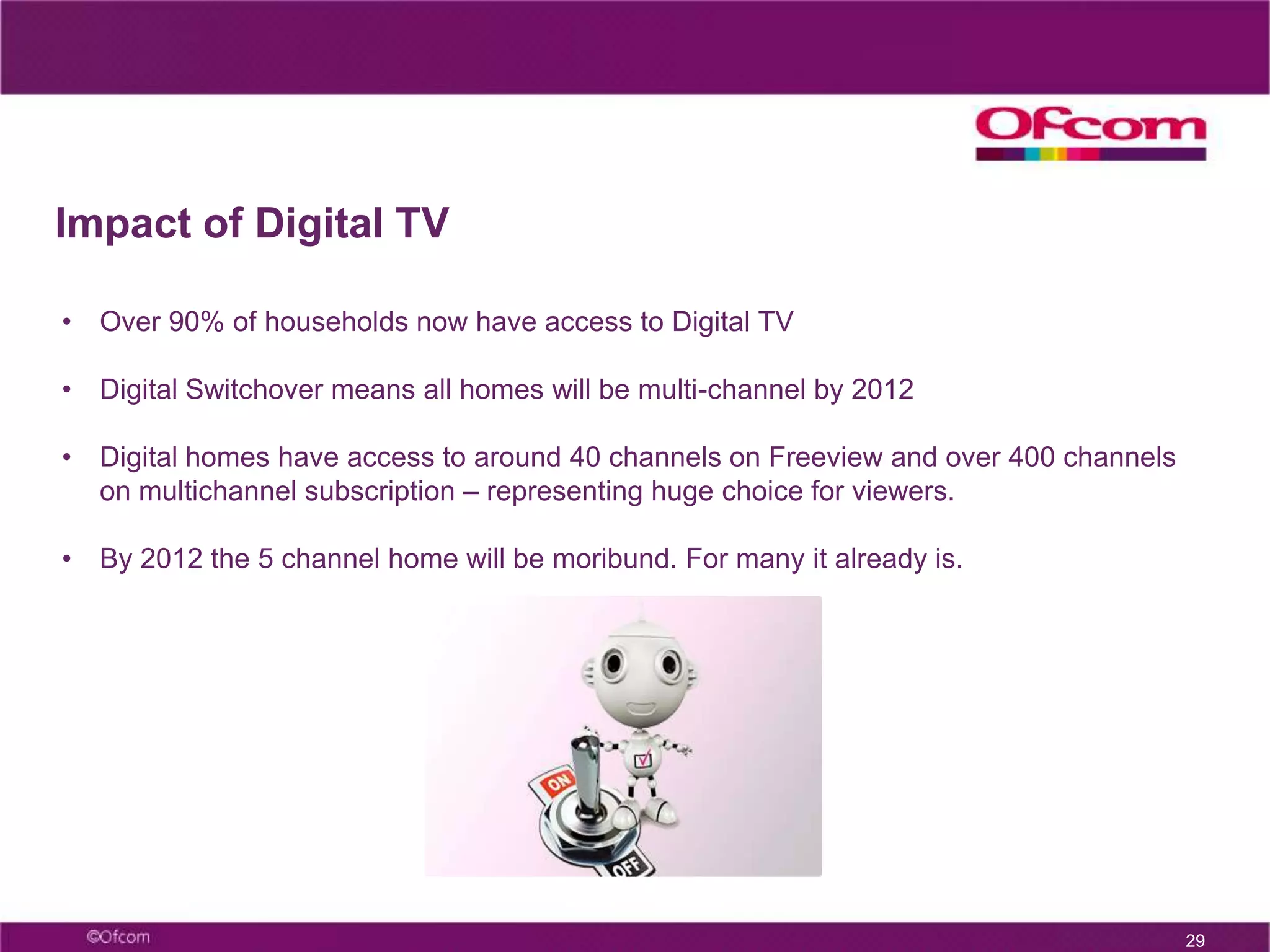
29Impact of Digital TVOver 90% of households now have access to Digital TVDigital Switchover means all homes will be multi-channel by 2012Digital homes have access to around 40 channels on Freeview and over 400 channels on multichannel subscription – representing huge choice for viewers.By 2012 the 5 channel home will be moribund. For many it already is.
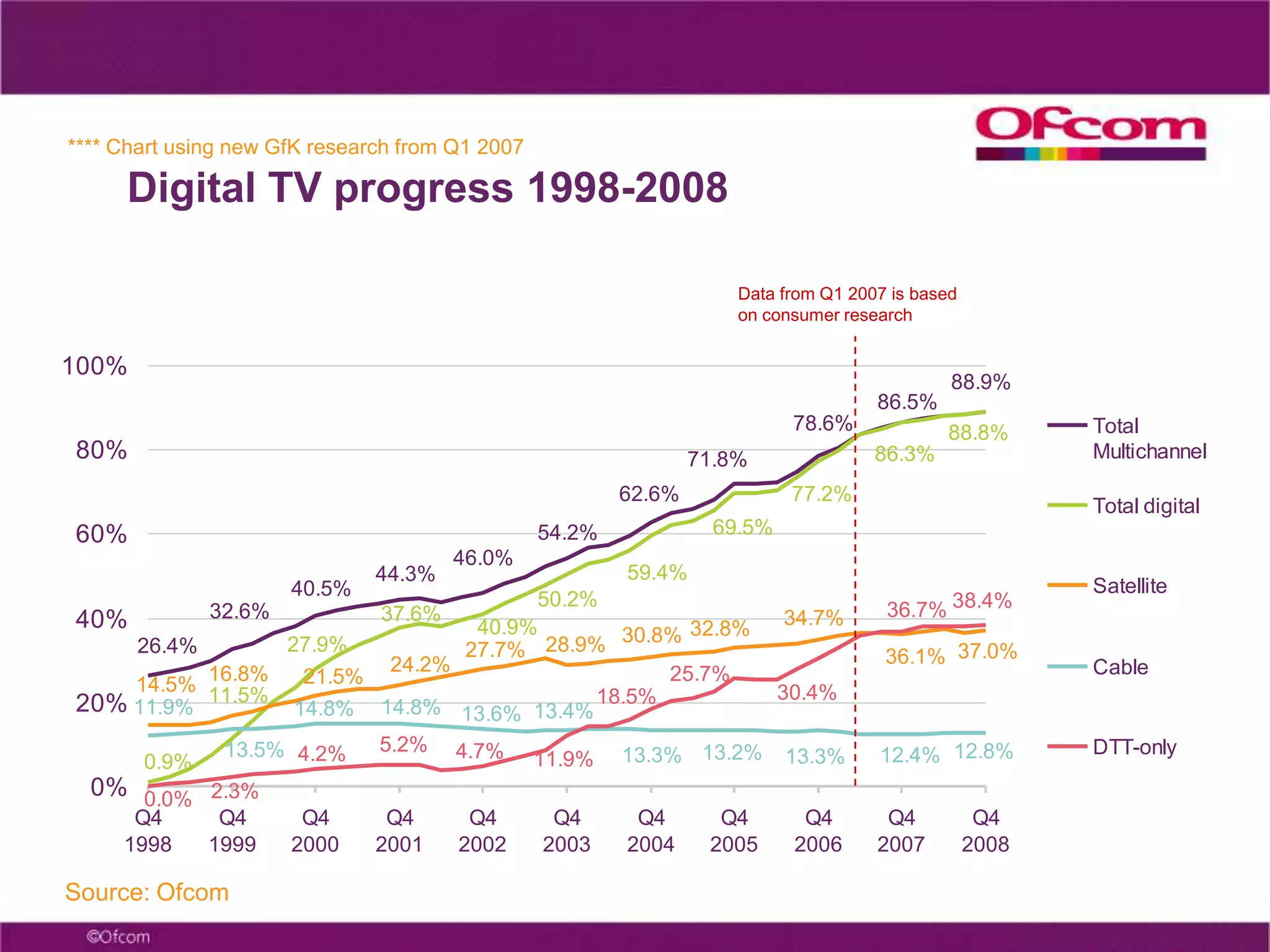
Data from Q1 2007 is basedon consumer research**** Chart using new GfK research from Q1 2007	Digital TV progress 1998-2008Source: Ofcom
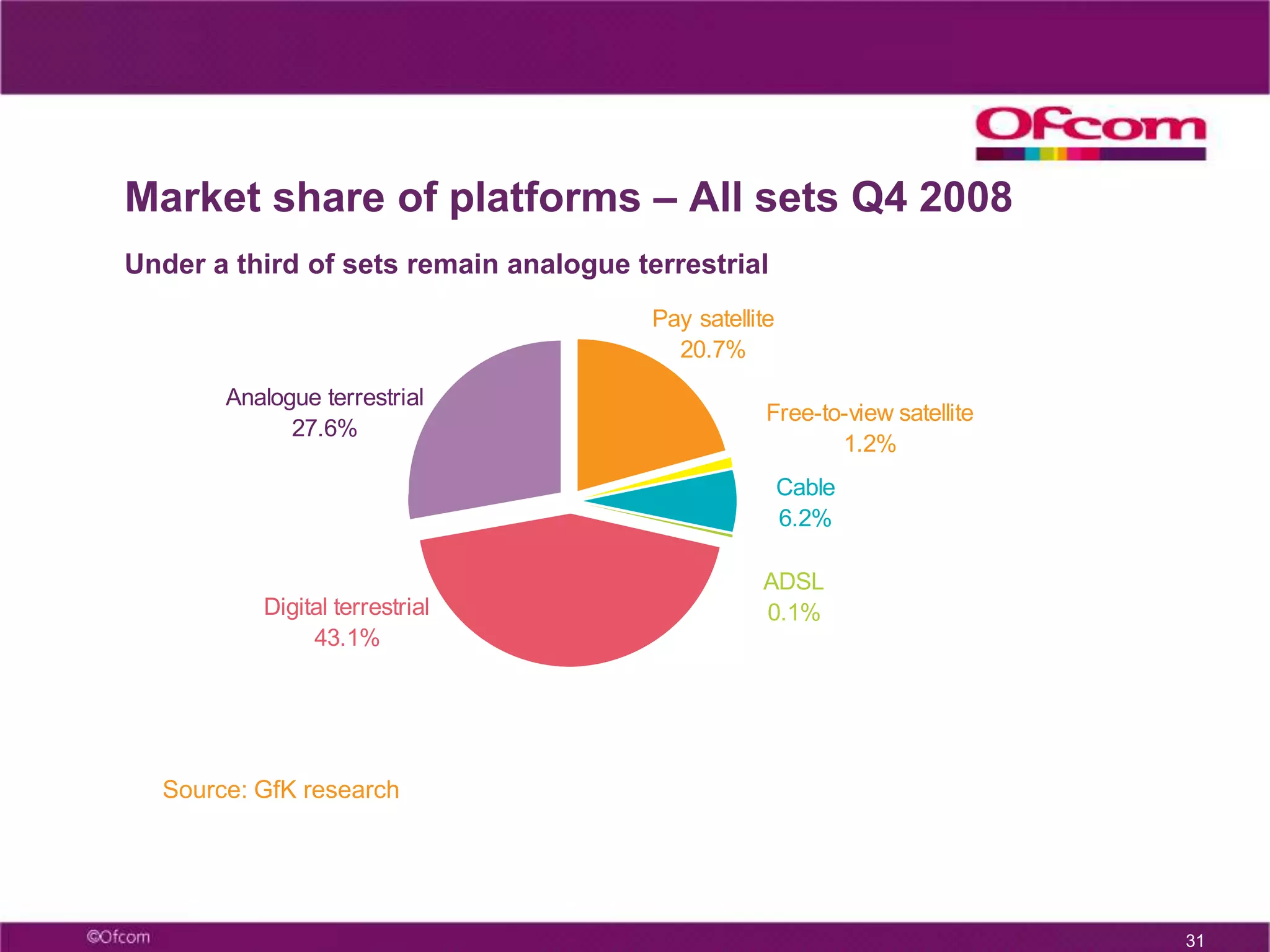
Market share of platforms – All sets Q4 2008Under a third of sets remain analogue terrestrialSource: GfK research31
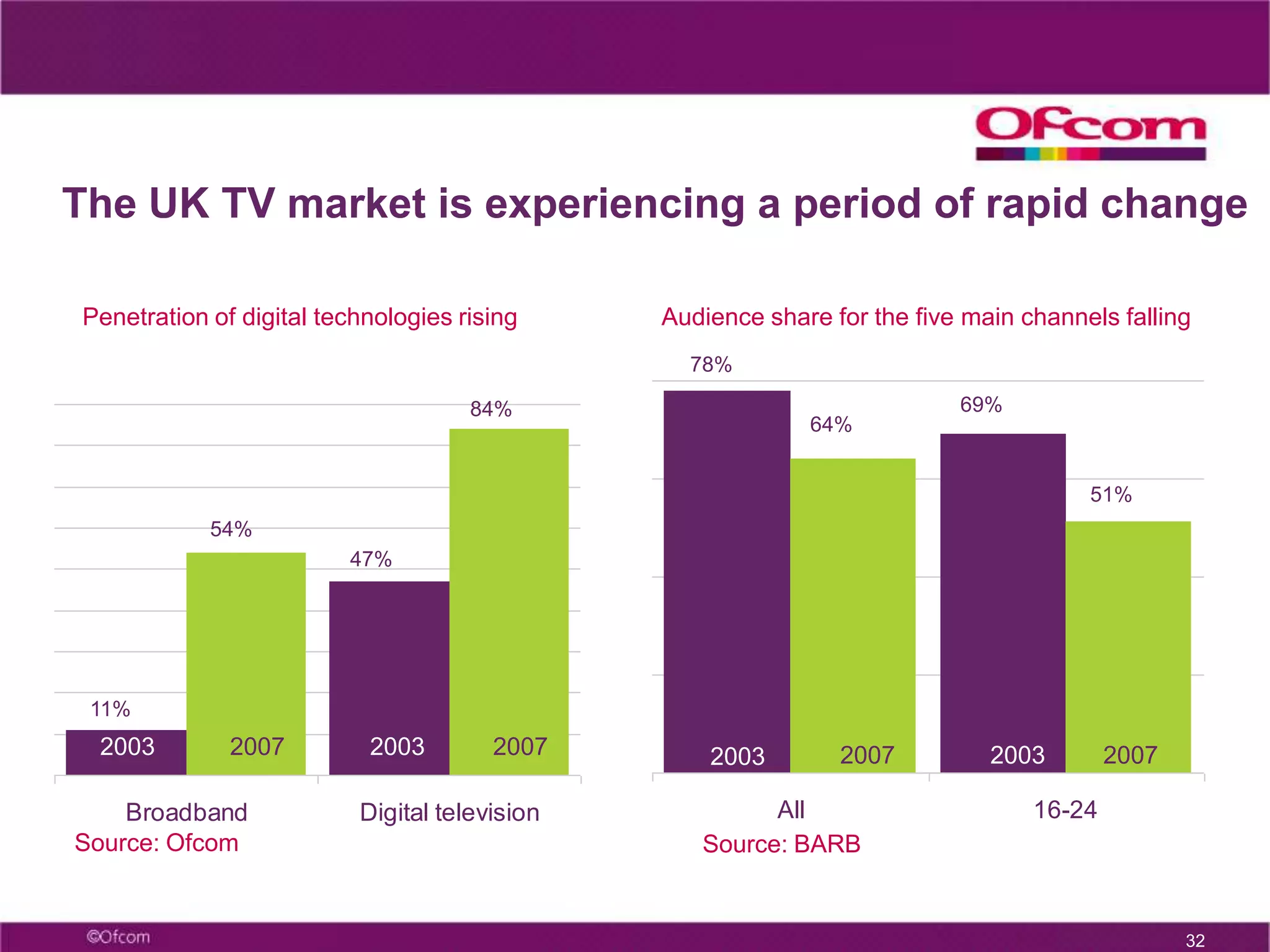
32The UK TV market is experiencing a period of rapid changePenetration of digital technologies risingAudience share for the five main channels falling78%69%84%64%51%54%47%11%20032007200320072003200720072003Source: Ofcom Source: BARB
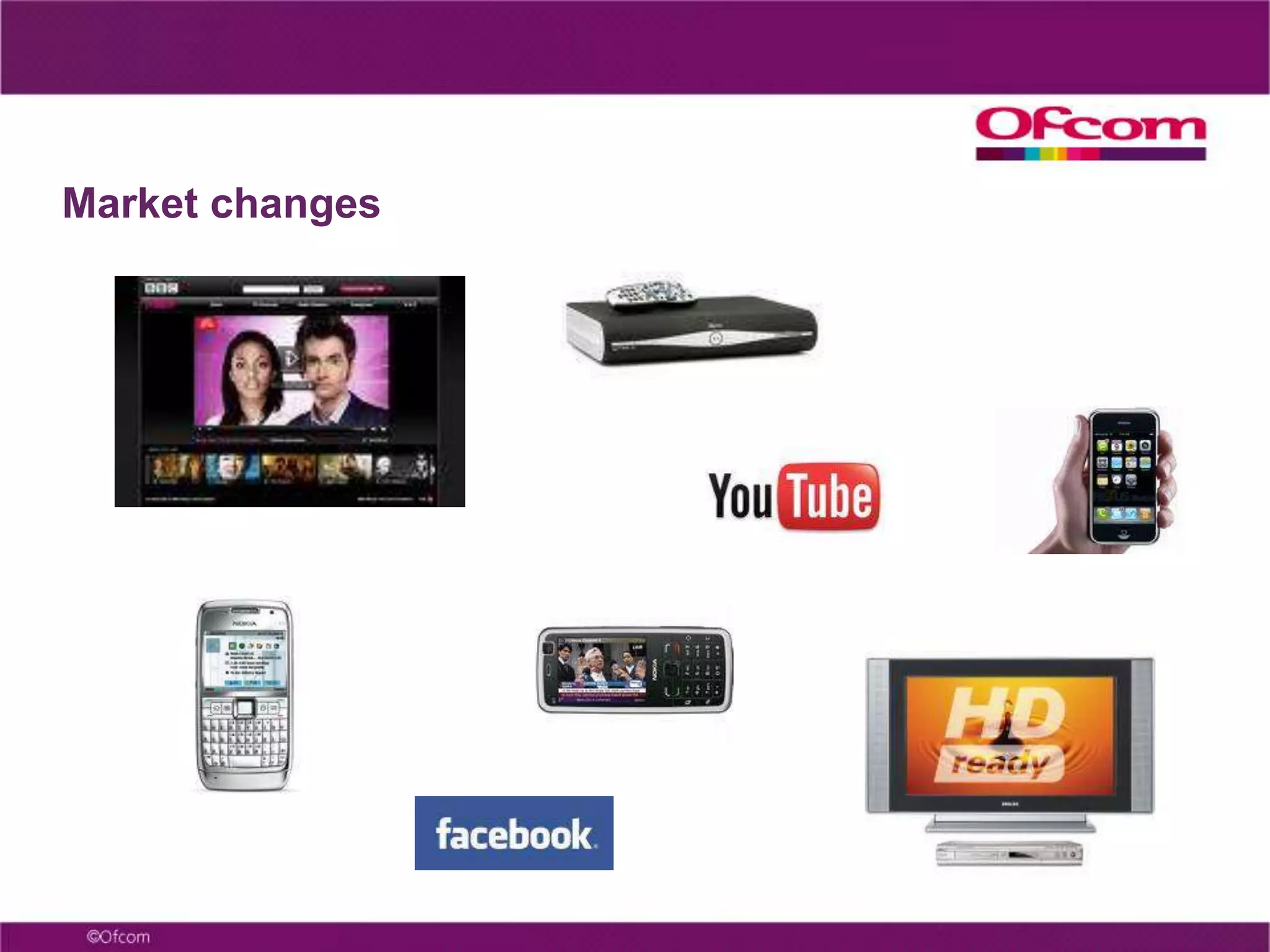
Market changes
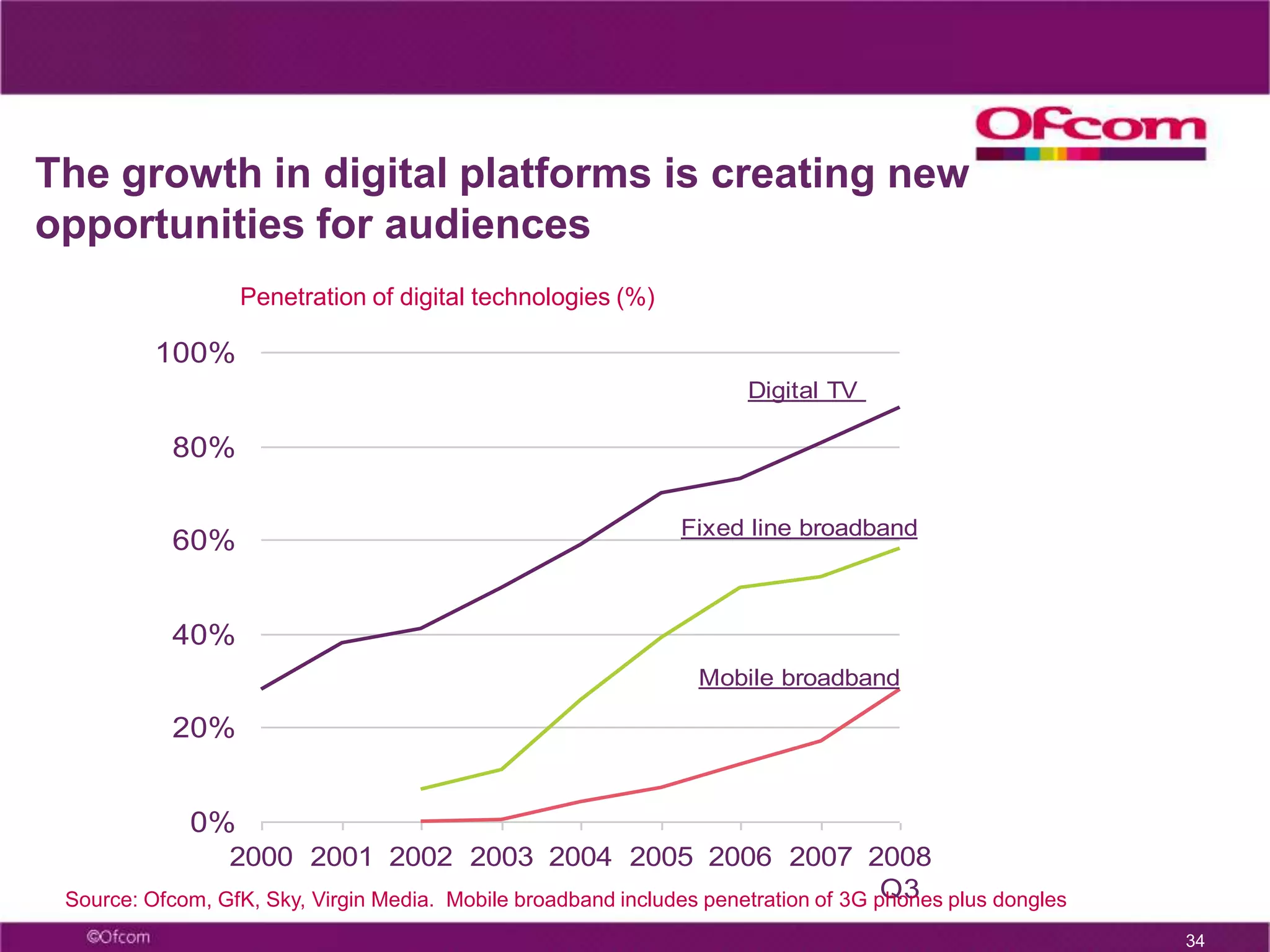
34The growth in digital platforms is creating new opportunities for audiencesPenetration of digital technologies (%)Source: Ofcom, GfK, Sky, Virgin Media.  Mobile broadband includes penetration of 3G phones plus dongles
DVR penetration in all homes% of homes27%Source: Ofcom Research (Technology Tracker)35
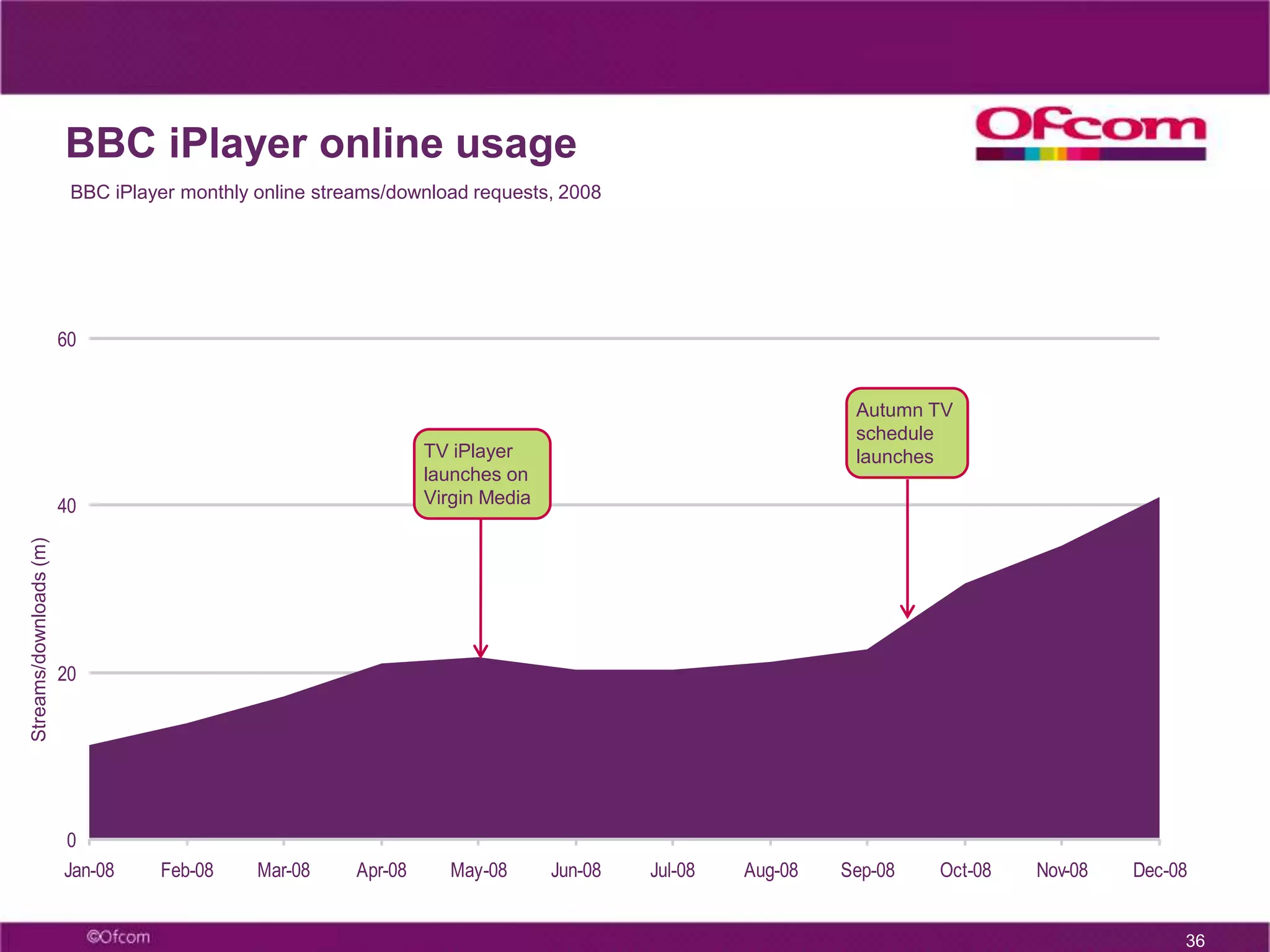
BBC iPlayer online usageBBC iPlayer monthly online streams/download requests, 2008 Autumn TV schedule launchesTV iPlayer launches on Virgin Media Streams/downloads (m)36
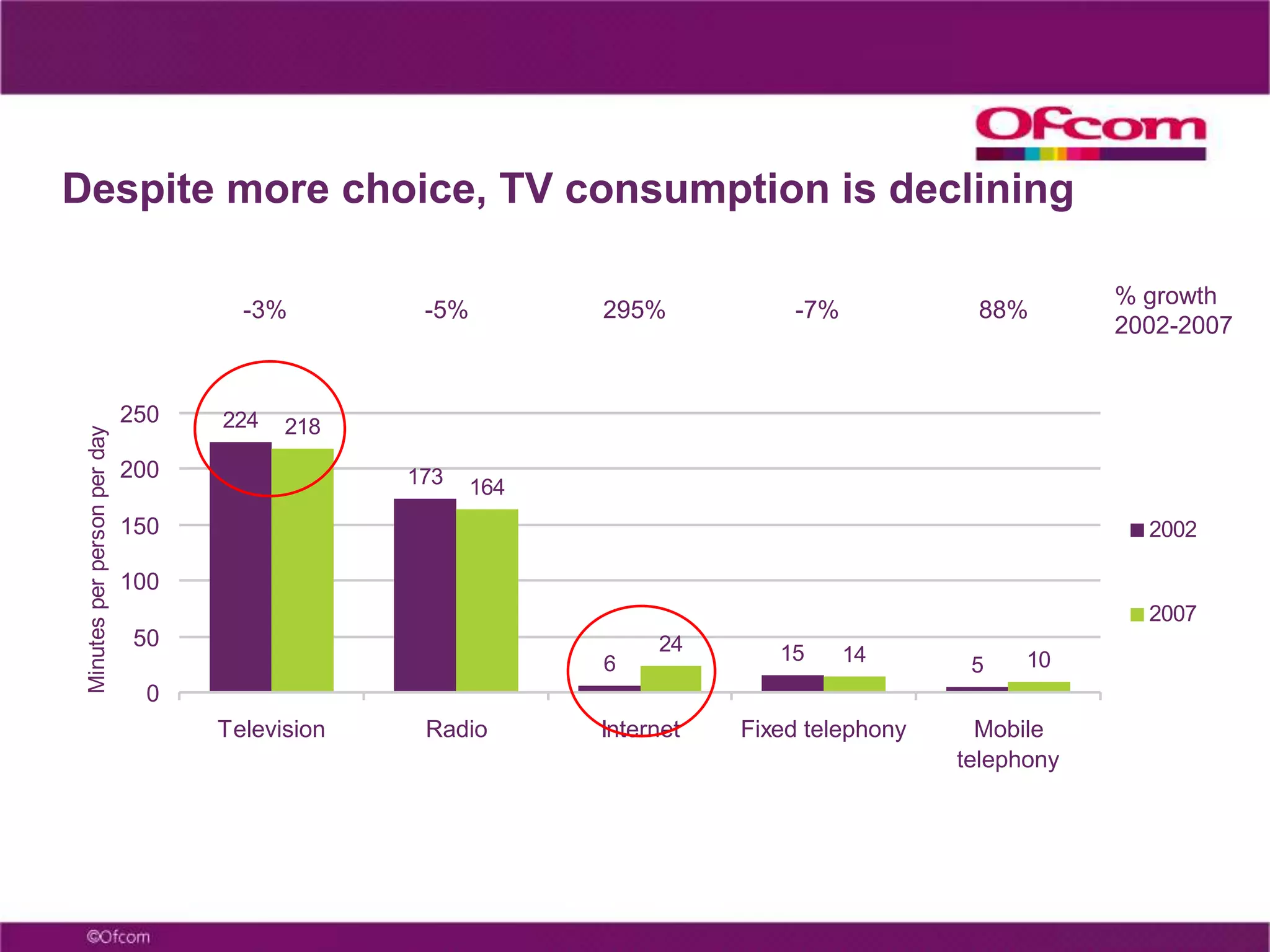
Despite more choice, TV consumption is declining% growth 2002-2007-3%-5%295%-7%88%
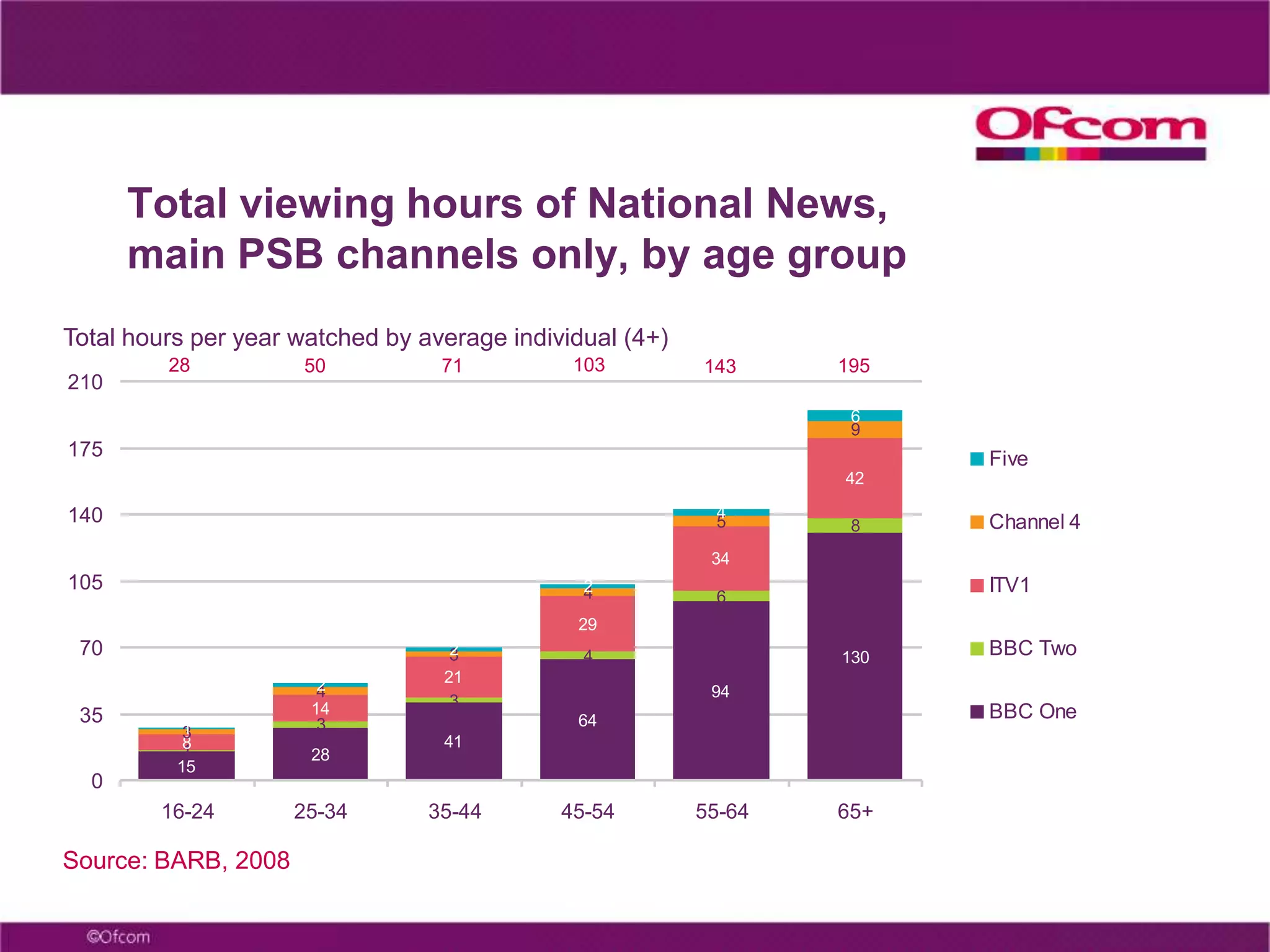
	Total viewing hours of National News, main PSB channels only, by age group Total hours per year watched by average individual (4+)103285019571143Source: BARB, 2008
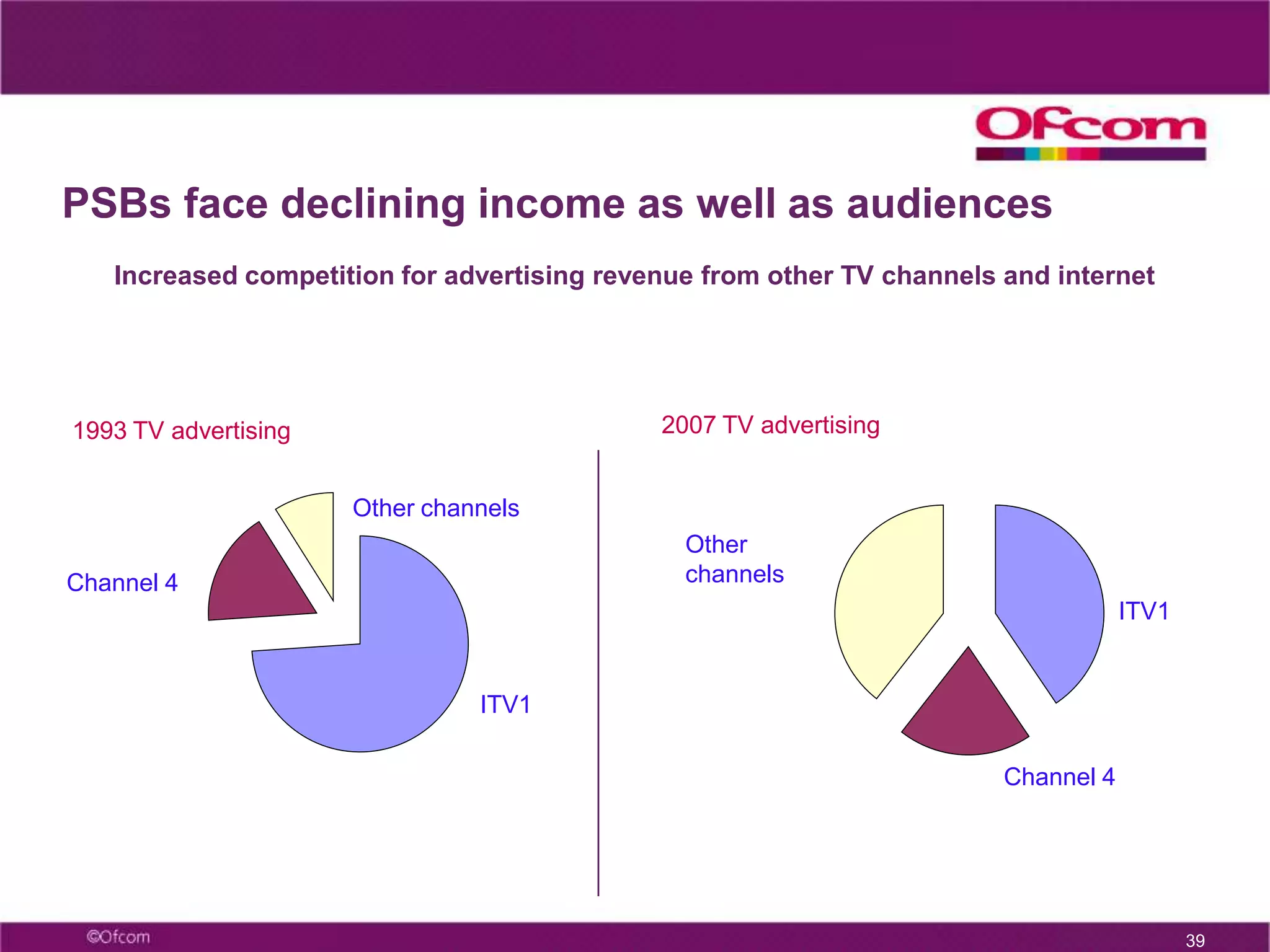
39PSBs face declining income as well as audiencesIncreased competition for advertising revenue from other TV channels and internet2007 TV advertising1993 TV advertisingOther channelsOtherchannelsChannel 4ITV1ITV1Channel 4
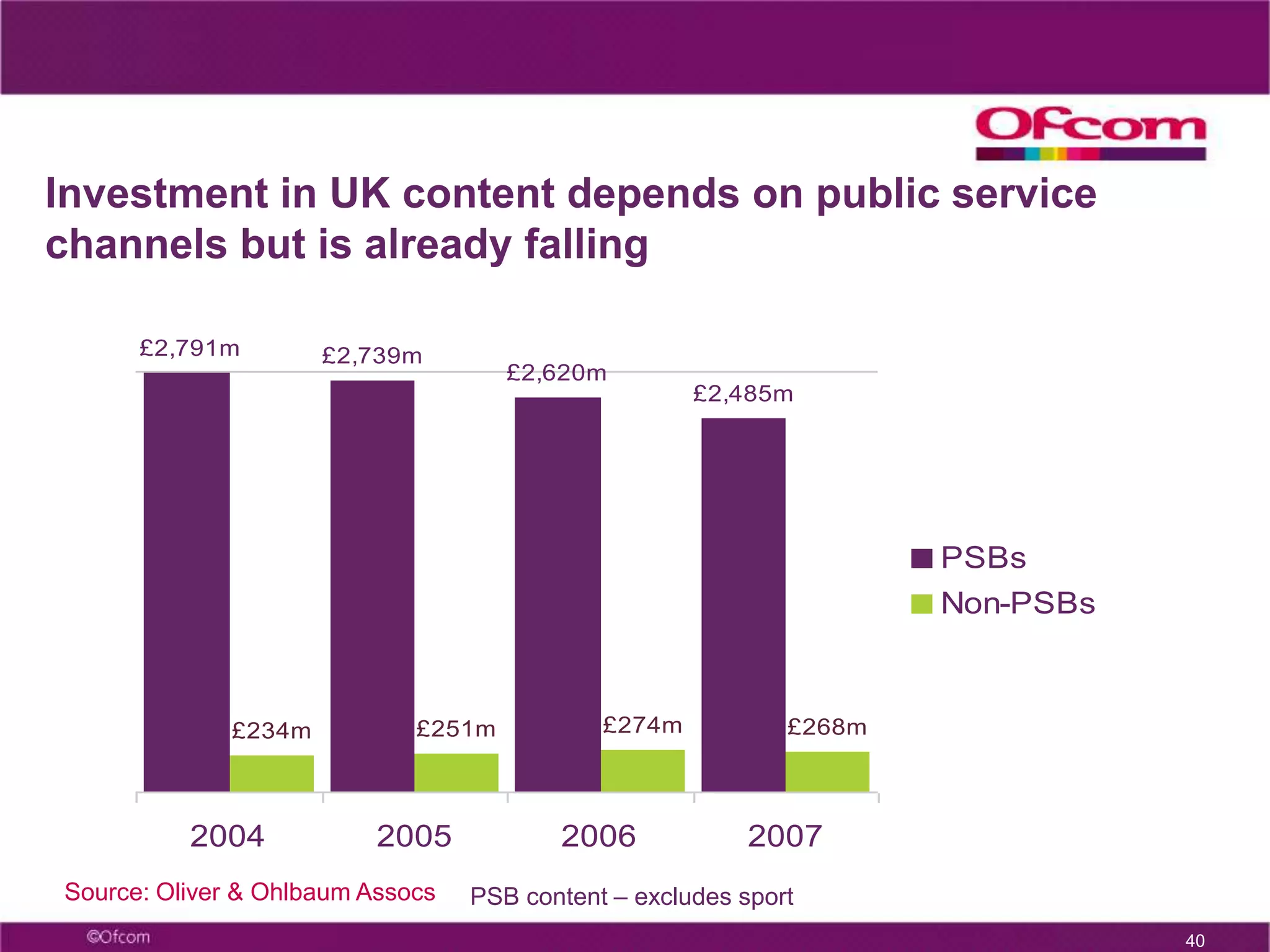
40Investment in UK content depends on public service channels but is already fallingPSB content – excludes sportSource: Oliver & Ohlbaum Assocs
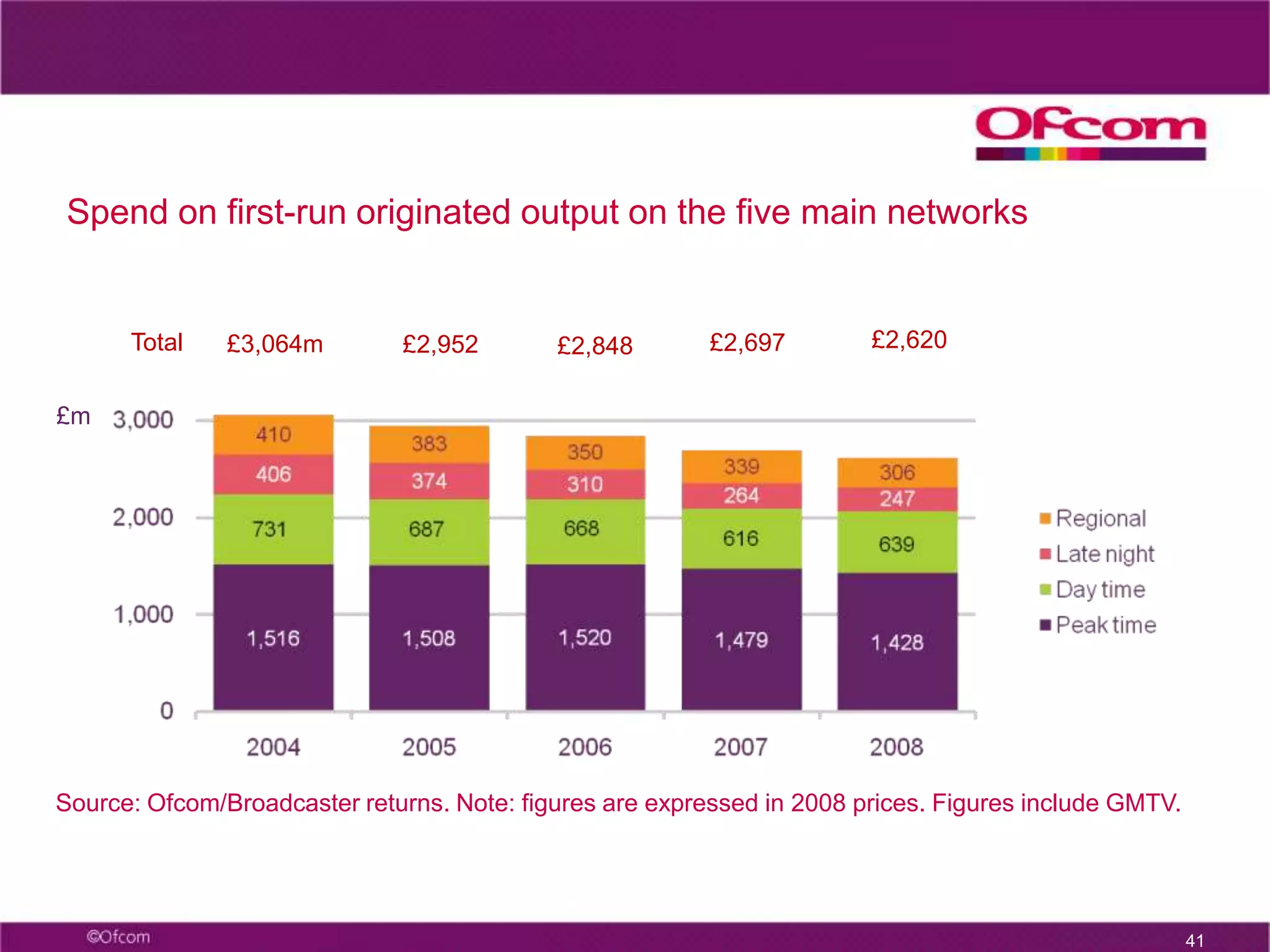
Spend on first-run originated output on the five main networks£2,620Total£2,697£3,064m£2,952£2,848£mSource: Ofcom/Broadcaster returns. Note: figures are expressed in 2008 prices. Figures include GMTV. 41
424:	Delivering news, media and information 	at a local level
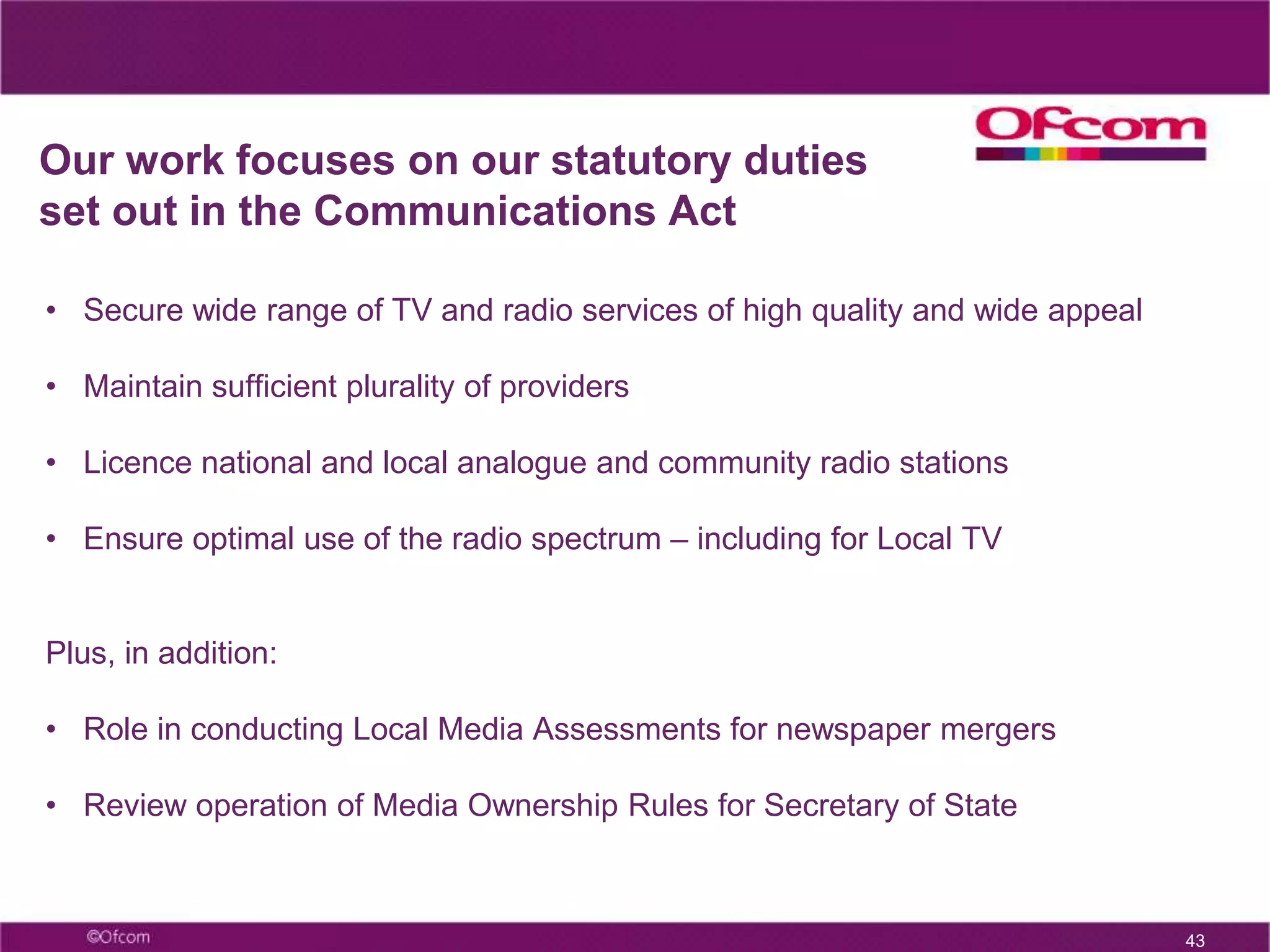
Our work focuses on our statutory duties set out in the Communications Act43Secure wide range of TV and radio services of high quality and wide appeal
Maintain sufficient plurality of providers
Licence national and local analogue and community radio stations

Slides for BCU Presentation, Nov 2009.

  • 1.
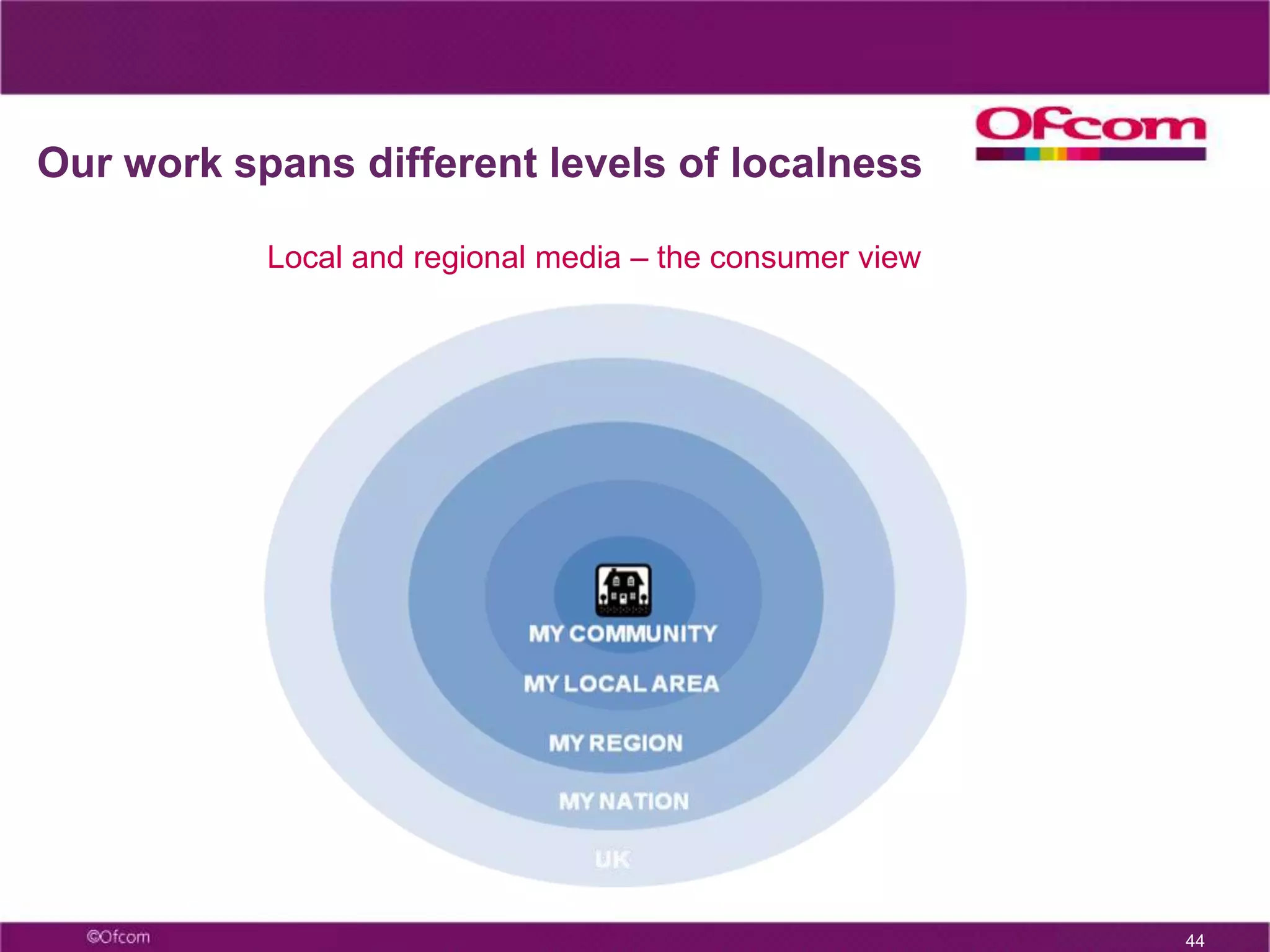
    Presentation Birmingham CityUniversity Damian Radcliffe26th November 2009
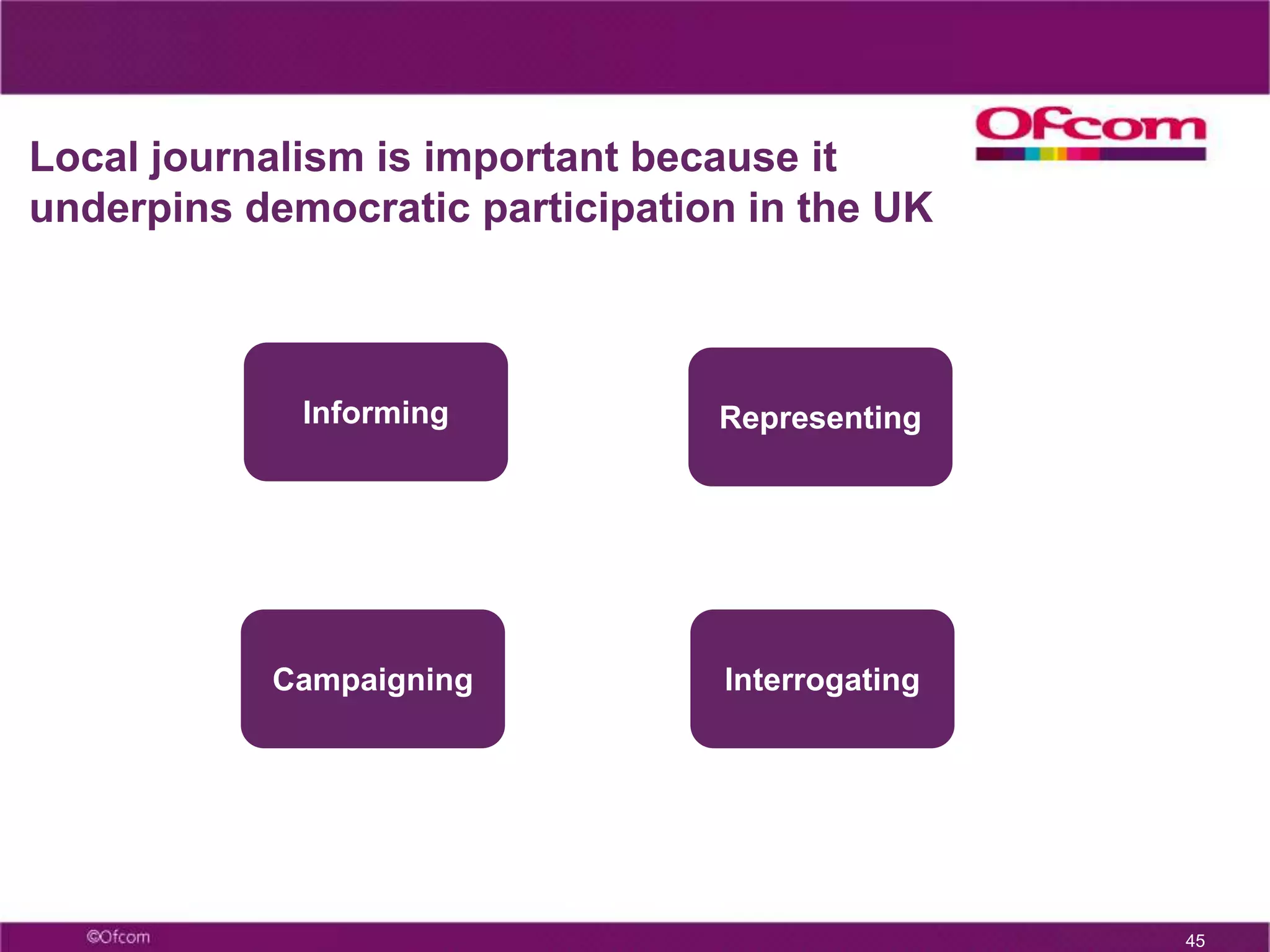
  • 2.
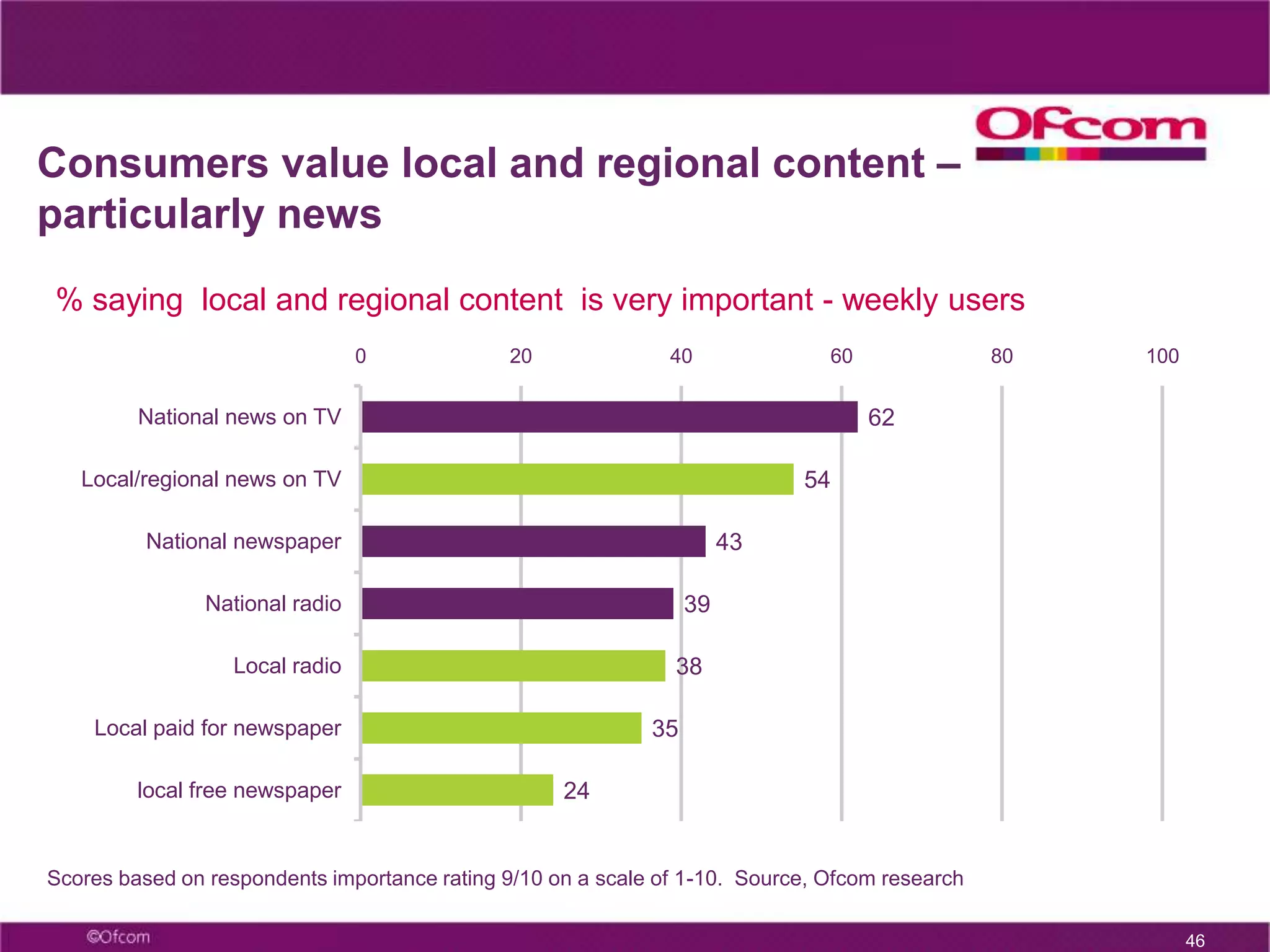
    1AgendaAbout OfcomCommunications Marketin the UK todayHot topic (1) – Public Service BroadcastingHot topic (2) – Delivering news, media and information at a local level BreakHot topic (3) – the Digital Economy Bill6. Broadcasting Code
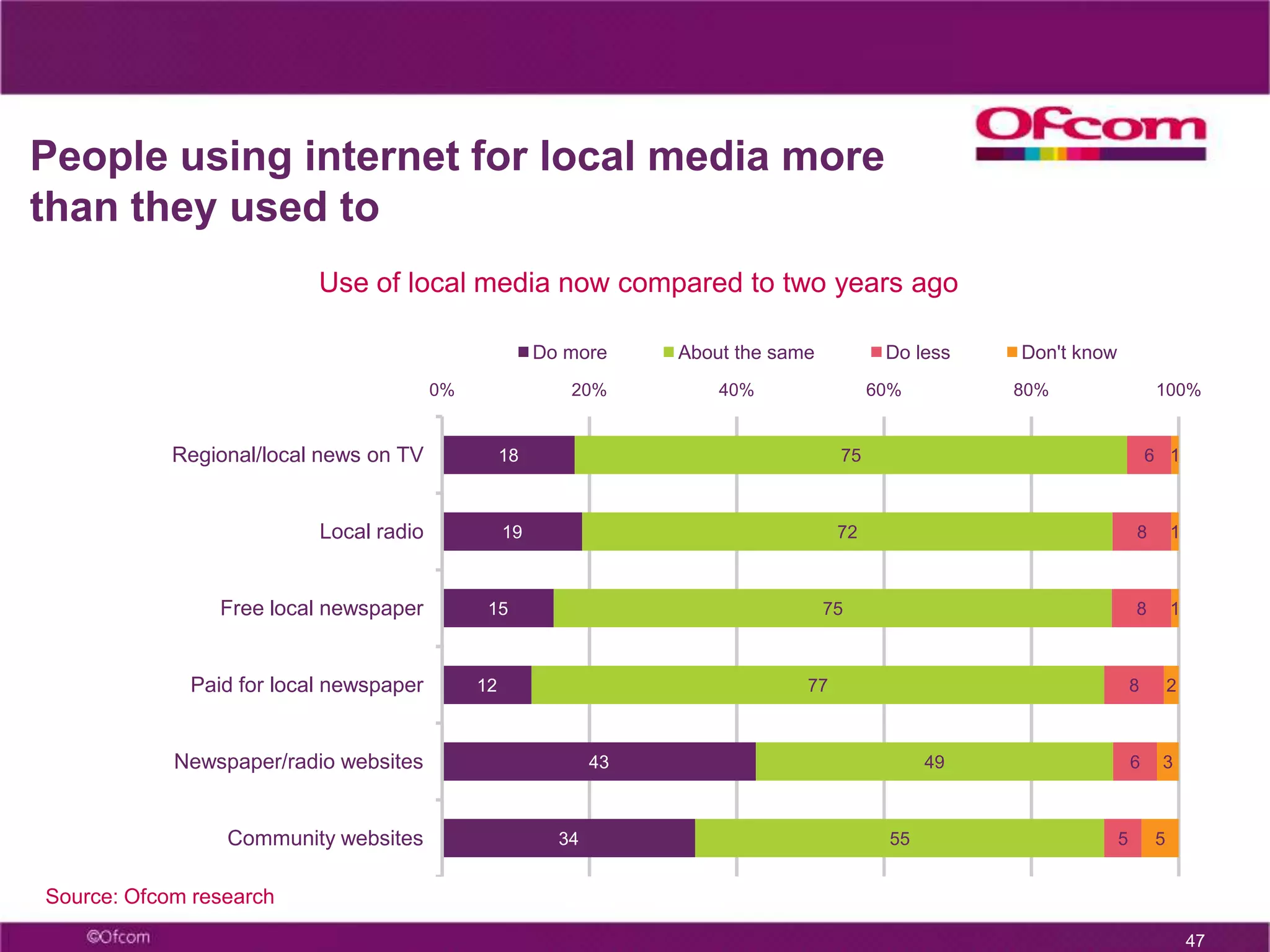
  • 3.
  • 4.
    About OfcomOfcom isthe regulator for the UK communications industries, with responsibilities across television, radio, telecommunications and wireless communications servicesIt is independent of Government but accountable to ParliamentOfcom’s sponsoring Departments of State are:the Department for Business, Innovation & Skills (BIS)the Department for Culture, Media & Sport (DCMS)Set up - and its powers and duties defined – by the Communications Act 2003
  • 5.
  • 6.
    5Ofcom’s statutory dutiesUnderthe Communications Act 2003 “It shall be the principal duty of Ofcom, in carrying out their functions;(a) to further the interests of citizens in relation to communications matters; and(b) to further the interests of consumers in relevant markets, where appropriate by promoting competition" Ofcom’s specific duties fall into six areas:
  • 7.
    Ensuring the optimaluse of the electro-magnetic spectrum
  • 8.
    Ensuring that awide range of electronic communications services - including high speed data services - is available throughout the UK
  • 9.
    Ensuring a widerange of TV and radio services of high quality and wide appeal
  • 10.
    Maintaining plurality inthe provision of broadcasting
  • 11.
    Applying adequate protectionfor audiences against offensive or harmful material
  • 12.
    Applying adequate protectionfor audiences against unfairness or the infringement of privacy What we don’t do
  • 13.
  • 14.
    8The communications marketin 2008 – key storiesTrends
  • 15.
    Communications marketsand the recession
  • 16.
    Consumers takecontrol of their viewing
  • 17.
    Broadband seesdouble-digit growth in 2008
  • 18.
    Communications inthe Nations and Regions9Communications industries generated revenue of £51.8bn in 2008, but growth slowed…Industry revenue grew by 0.2% (compared to 3.5% in 2007)Total
  • 19.
    10…while take-up ofall key services continued to riseBroadband and HDTV among the fastest growing servicesSource: Ofcom research/operators
  • 20.
    11Time per dayspent using communications services On average, consumers spent a little more time using communications services – home internet on the rise, but radio listening declines5 year CAGR0.1%-1.9%21.5%-3.4%15.2%Source: Ofcom/BARB/RAJAR/Nielsen Netratings (internet is home use only)
  • 21.
    12The communications marketin 2008 – key stories Trends
  • 22.
    Communications marketsand the recession
  • 23.
    Consumers takecontrol of their viewing
  • 24.
    Broadband seesdouble-digit growth in 2008
  • 25.
    Communications inthe Nations and Regions13Communications services appear resilient Items where consumers are most likely to cut back their spendingSource: Ofcom commissioned research (sample = 862)
  • 26.
    14Household spend oncommunications fell again in 2008…In real terms, UK household average spend was £93.69 a month, down 4.7%, or £4.39, on 2007Total
  • 27.
    15…and more consumersare buying services in ‘bundles’ 46% of consumers now buy two or more communications services from a single supplier, up from 39% a year earlierSource: Ofcom research
  • 28.
    16Communications Market 2008- key stories Trends
  • 29.
    Communications marketsand the recession
  • 30.
    Consumers takecontrol of their viewing
  • 31.
    Broadband seesdouble-digit growth in 2008
  • 32.
    Communications inthe Nations and Regions17Consumers are taking control of their TV viewing…DVRs and online and TV catch-up services are helping consumers to time-shift their viewing. Our research shows:27% of homes have a DVR (9 million devices now sold)
  • 33.
    15% of viewingin DVR homes is time-shifted using their recording device
  • 34.
    23% of householdswith home internet watch online catch-up TV
  • 35.
    15% of internetusers watch programmes on the BBC’s iPlayer service
  • 36.
    52% of cableTV homes (1.8 million) accessed VoD on their television
  • 37.
    On average, cablehomes viewed VoD programmes 30 times per month, at Q4 2008Source: Ofcom research/operators
  • 38.
    …and watch moreTV they enjoy with on-demand18Agreement with statements on non-linear viewingSource: Ofcom research
  • 39.
    19Communications Market 2008- key stories Trends
  • 40.
    Communications marketsand the recession
  • 41.
    Consumers takecontrol of their viewing
  • 42.
    Broadband seesdouble-digit growth in 2008
  • 43.
    Communications inthe Nations and Regions20More than two-thirds of households have broadband – double-digit growth between Q1 2008 to Q1 2009 Take-up of broadband, combining landline and mobile, increased to 68% at Q1 2009, up by 10 percentage points year on yearSource: Ofcom research
  • 44.
    21Mobile broadband entersthe mainstreamMobile broadband connections exceeded 260,000 in May 2009. 75% of mobile broadband homes also have landline broadbandSource: GfK
  • 45.
    22Communications Market 2008- key stories Trends
  • 46.
    Communications marketsand the recession
  • 47.
    Consumers takecontrol of their viewing
  • 48.
    Broadband seesdouble-digit growth
  • 49.
    Communications inthe Nations and RegionsTop telecoms towns and citiesAberdeen: VOIP 30%Dundee: Bundles 65%Belfast: Mobiles 94%Leeds: Mobile broadband 29%Norwich: Online TV 49%Cardiff: Mobile-only households 29%Source: Ofcom research, selected towns and cities23
  • 50.
    243:Hot Topic (2):PSB “under pressure”
  • 51.
    PSB purposes 25Informingour understanding of the world - To inform ourselves and others and to increase our understanding of the world through news, information and analysis of current events and ideas 2. Stimulating knowledge and learning -To stimulate our interest in and knowledge of arts, science, history and other topics through content that is accessible and can encourage informal learning 3. Reflecting UK cultural identity - To reflect and strengthen our cultural identity through original programming at UK, national and regional level, on occasion bringing audiences together for shared experiences 4. Representing diversity and alternative viewpoints - To make us aware of different cultures and alternative viewpoints, through programmes that reflect the lives of other people and other communities, both within the UK and elsewhere
  • 52.
    PSB characteristics 26Highquality - well-funded and well-produced Original - new UK content rather than repeats or acquisitions Innovative - breaking new ideas or re-inventing exciting approaches, rather than copying old ones Challenging - making viewers think Engaging - remaining accessible and attractive to viewers Widely available - if content is publicly funded, a large majority of citizens need to be given the chance to watch it
  • 53.
    27The central challenge– the move from analogue to digital model of public service broadcasting
  • 54.
    Channel shares inall homes, 1986 - 2008Source: BARB
  • 55.
    29Impact of DigitalTVOver 90% of households now have access to Digital TVDigital Switchover means all homes will be multi-channel by 2012Digital homes have access to around 40 channels on Freeview and over 400 channels on multichannel subscription – representing huge choice for viewers.By 2012 the 5 channel home will be moribund. For many it already is.
  • 56.
    Data from Q12007 is basedon consumer research**** Chart using new GfK research from Q1 2007 Digital TV progress 1998-2008Source: Ofcom
  • 57.
    Market share ofplatforms – All sets Q4 2008Under a third of sets remain analogue terrestrialSource: GfK research31
  • 58.
    32The UK TVmarket is experiencing a period of rapid changePenetration of digital technologies risingAudience share for the five main channels falling78%69%84%64%51%54%47%11%20032007200320072003200720072003Source: Ofcom Source: BARB
  • 59.
  • 60.
    34The growth indigital platforms is creating new opportunities for audiencesPenetration of digital technologies (%)Source: Ofcom, GfK, Sky, Virgin Media. Mobile broadband includes penetration of 3G phones plus dongles
  • 61.
    DVR penetration inall homes% of homes27%Source: Ofcom Research (Technology Tracker)35
  • 62.
    BBC iPlayer onlineusageBBC iPlayer monthly online streams/download requests, 2008 Autumn TV schedule launchesTV iPlayer launches on Virgin Media Streams/downloads (m)36
  • 63.
    Despite more choice,TV consumption is declining% growth 2002-2007-3%-5%295%-7%88%
  • 64.
    Total viewing hoursof National News, main PSB channels only, by age group Total hours per year watched by average individual (4+)103285019571143Source: BARB, 2008
  • 65.
    39PSBs face decliningincome as well as audiencesIncreased competition for advertising revenue from other TV channels and internet2007 TV advertising1993 TV advertisingOther channelsOtherchannelsChannel 4ITV1ITV1Channel 4
  • 66.
    40Investment in UKcontent depends on public service channels but is already fallingPSB content – excludes sportSource: Oliver & Ohlbaum Assocs
  • 67.
    Spend on first-runoriginated output on the five main networks£2,620Total£2,697£3,064m£2,952£2,848£mSource: Ofcom/Broadcaster returns. Note: figures are expressed in 2008 prices. Figures include GMTV. 41
  • 68.
    424: Delivering news, mediaand information at a local level
  • 69.
    Our work focuseson our statutory duties set out in the Communications Act43Secure wide range of TV and radio services of high quality and wide appeal
  • 70.
  • 71.
    Licence national andlocal analogue and community radio stations
  • 72.
    Ensure optimal useof the radio spectrum – including for Local TV Plus, in addition:Role in conducting Local Media Assessments for newspaper mergers
  • 73.
    Review operation ofMedia Ownership Rules for Secretary of StateOur work spans different levels of localness44Local and regional media – the consumer view
  • 74.
    Local journalism isimportant because it underpins democratic participation in the UK45InformingRepresentingInterrogatingCampaigning
  • 75.
    Consumers value localand regional content – particularly news46% saying local and regional content is very important - weekly usersScores based on respondents importance rating 9/10 on a scale of 1-10. Source, Ofcom research
  • 76.
    People using internetfor local media more than they used toUse of local media now compared to two years agoSource: Ofcom research 47
  • 77.
    The internet hasalso created new opportunities and business modelsLocal and regional newspapers onlineUltra-local reporting and citizen journalismEmerging hyper-local and community internet servicesLocation based servicesNational classified advertising vehicles48
  • 78.
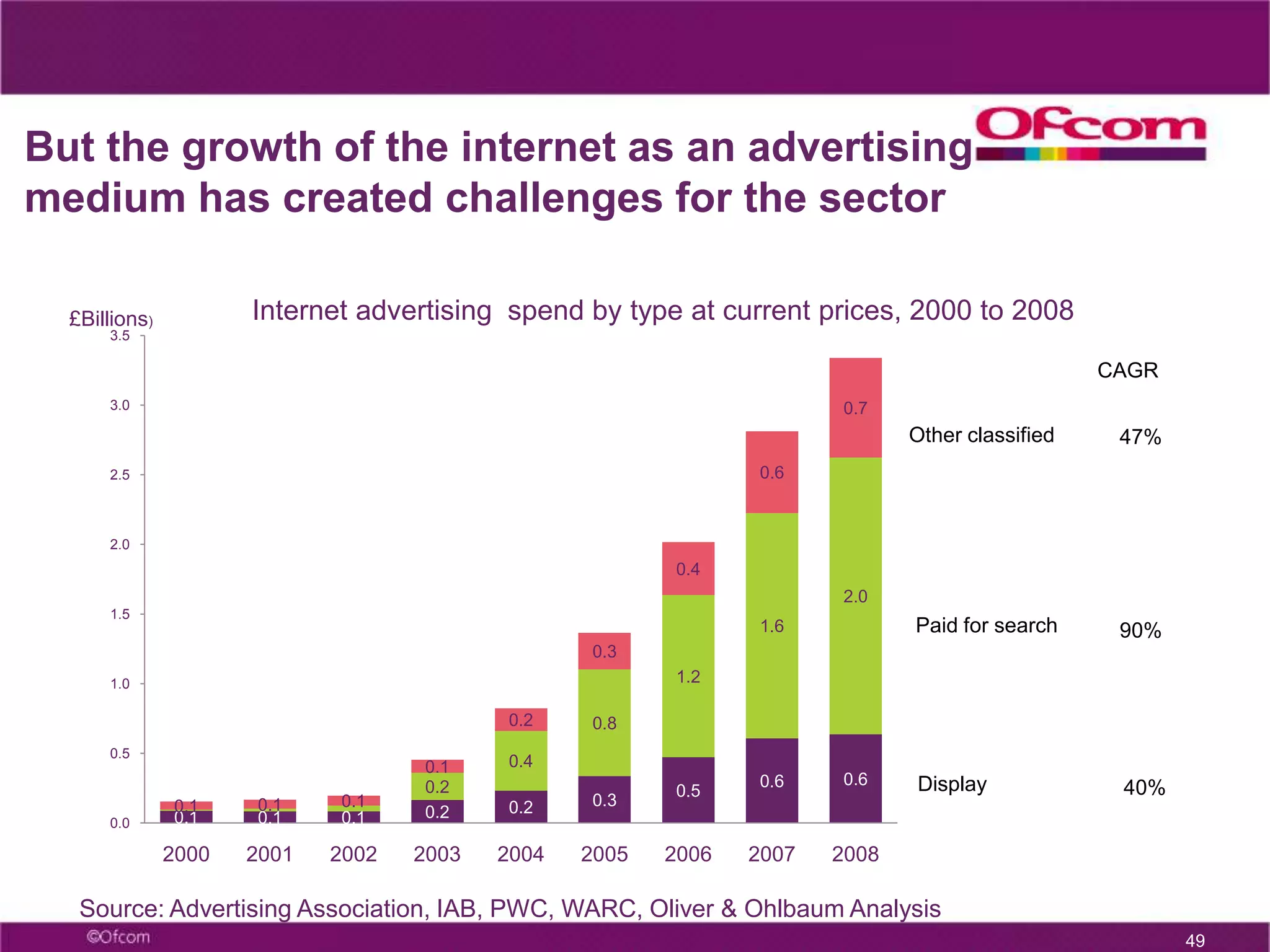
    But the growthof the internet as an advertising medium has created challenges for the sector49Source: Advertising Association, IAB, PWC, WARC, Oliver & Ohlbaum Analysis
  • 79.
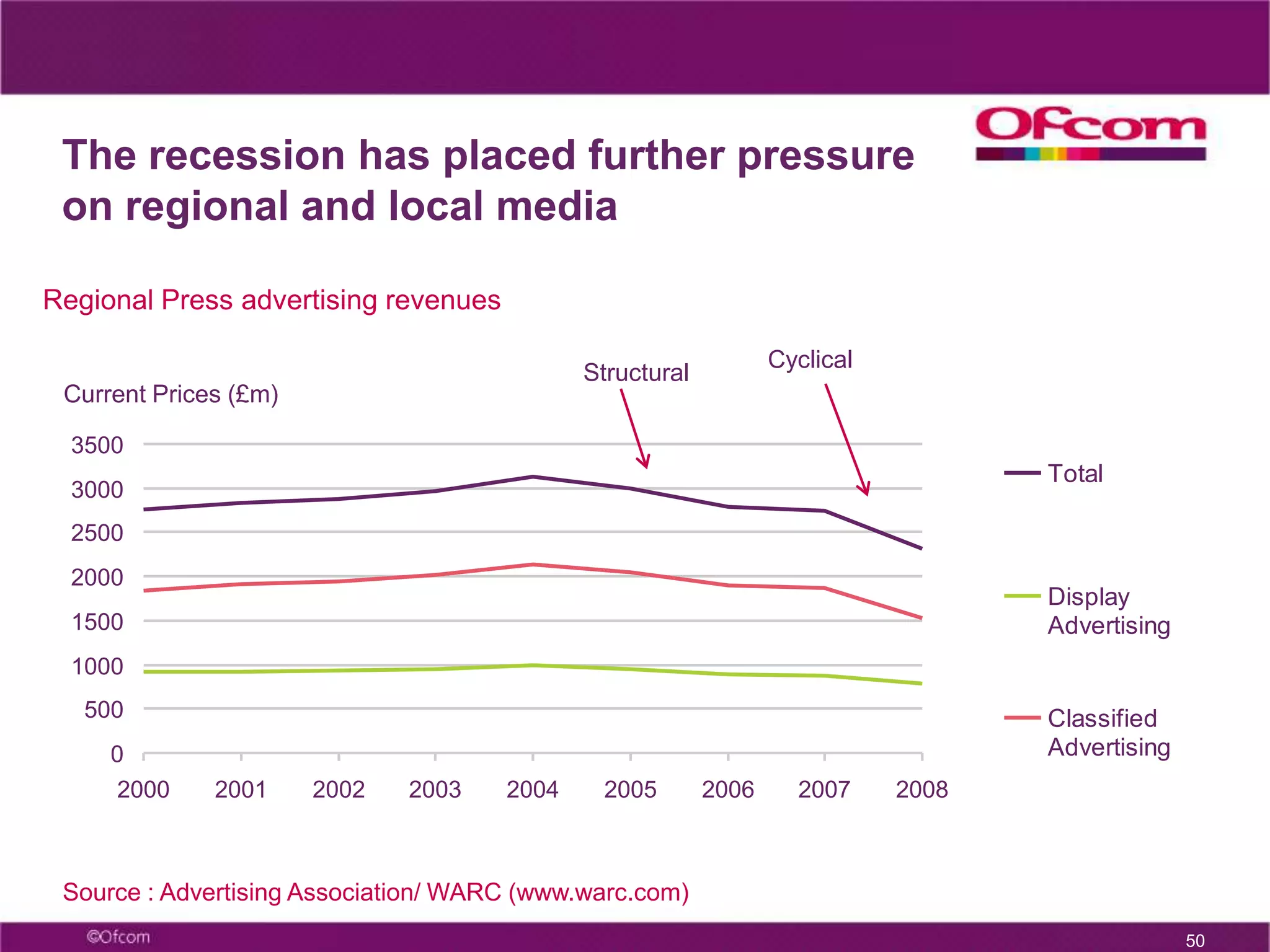
    50The recession hasplaced further pressure on regional and local mediaRegional Press advertising revenuesCyclicalStructuralCurrent Prices (£m)Source : Advertising Association/ WARC (www.warc.com)
  • 80.
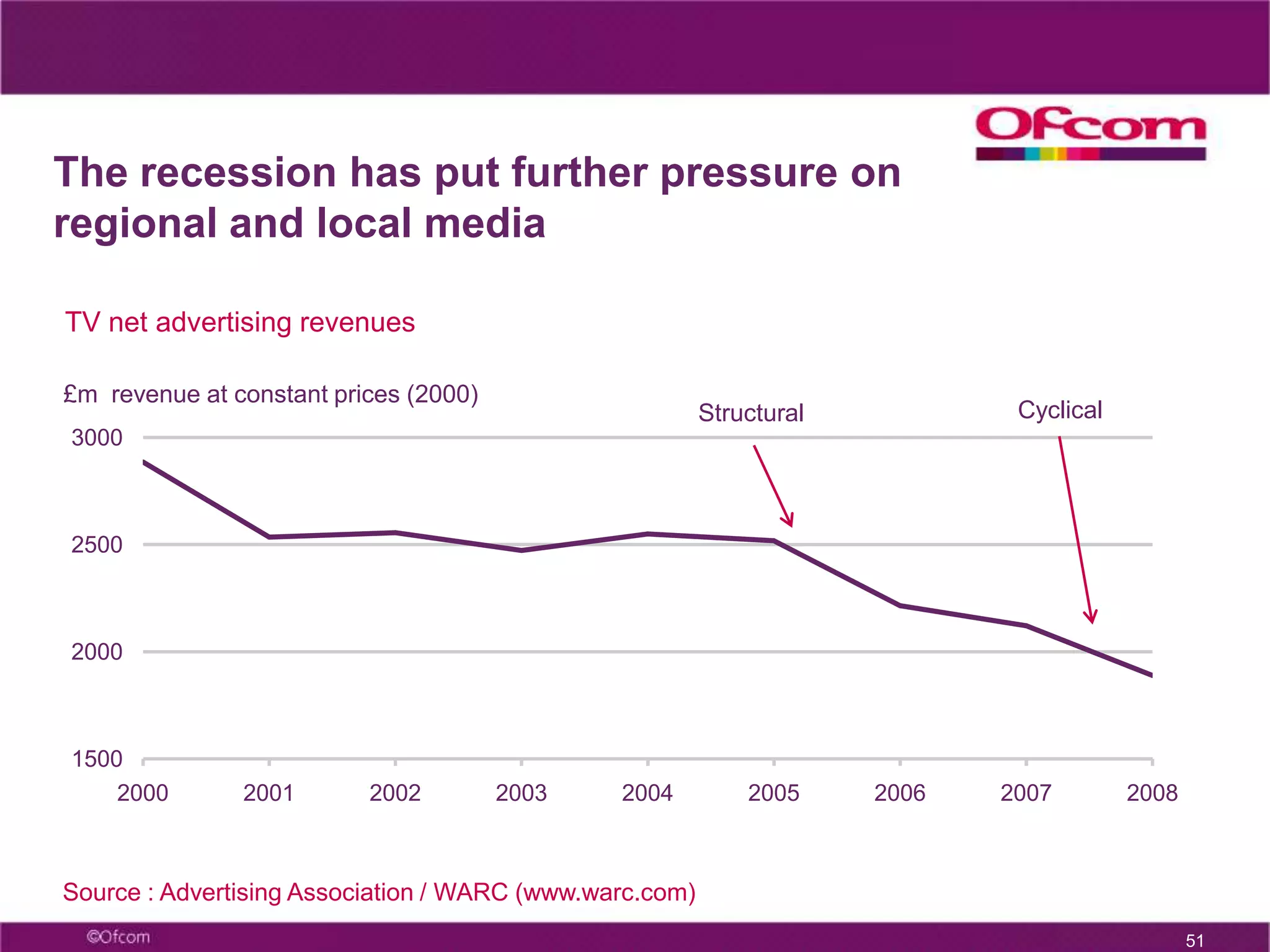
    51The recession hasput further pressure on regional and local media TV net advertising revenues£m revenue at constant prices (2000)CyclicalStructuralSource : Advertising Association / WARC (www.warc.com)
  • 81.
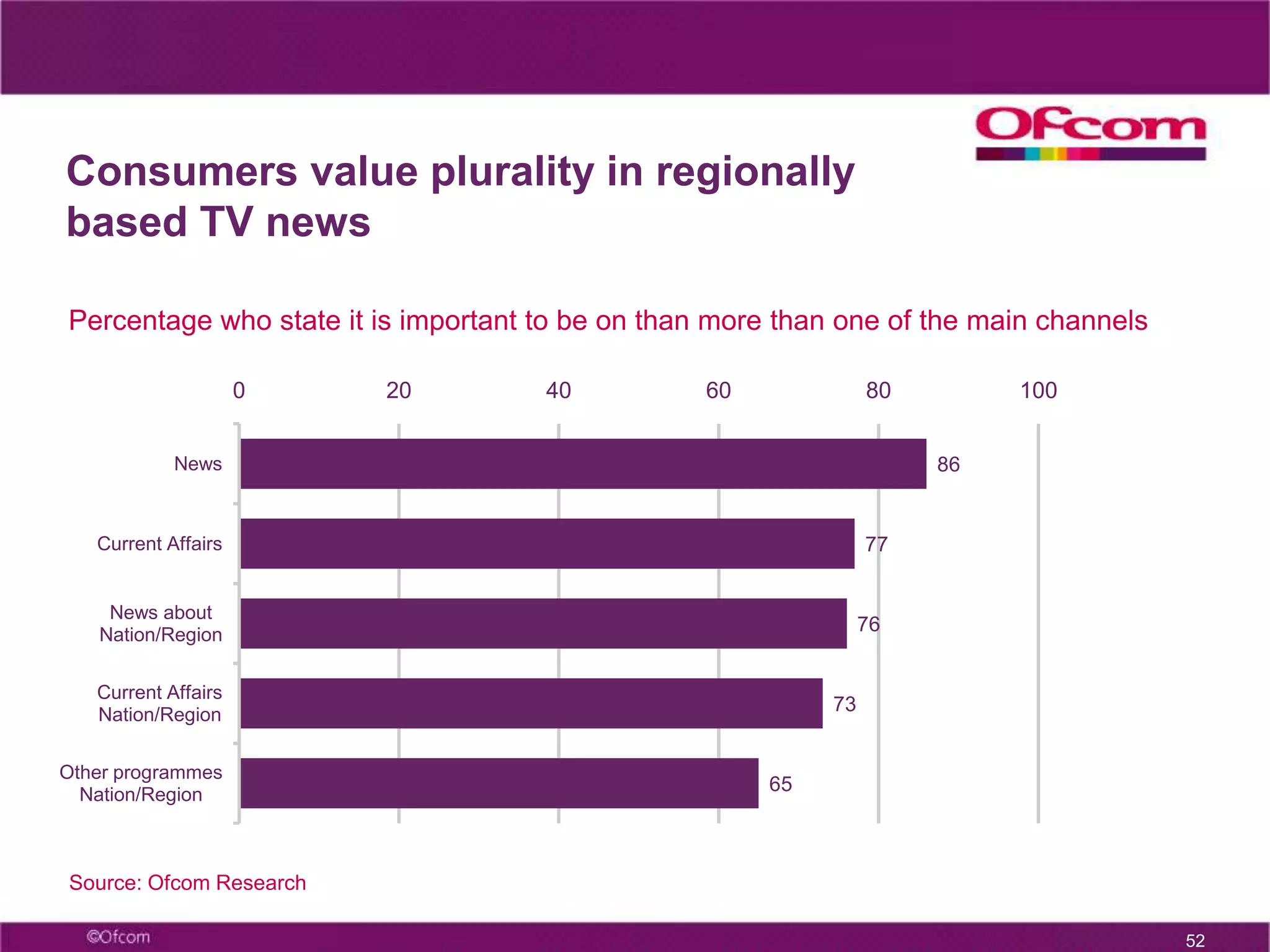
    Consumers value pluralityin regionally based TV newsPercentage who state it is important to be on than more than one of the main channelsSource: Ofcom Research 52
  • 82.
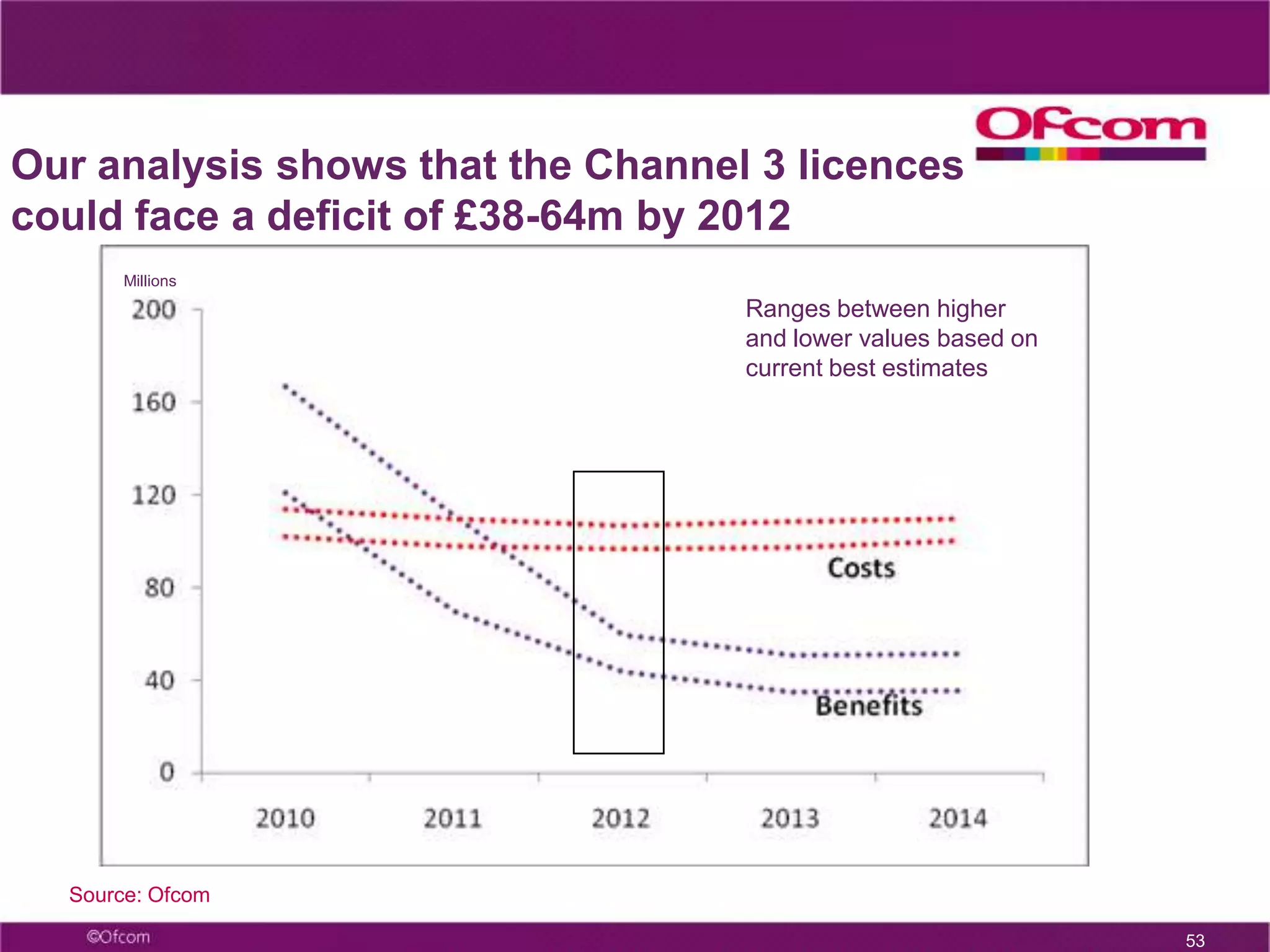
    Our analysis showsthat the Channel 3 licences could face a deficit of £38-64m by 201253MillionsRanges between higher and lower values based on current best estimatesCost Benefit of PSB status for the Channel 3 networkSource: Ofcom
  • 83.
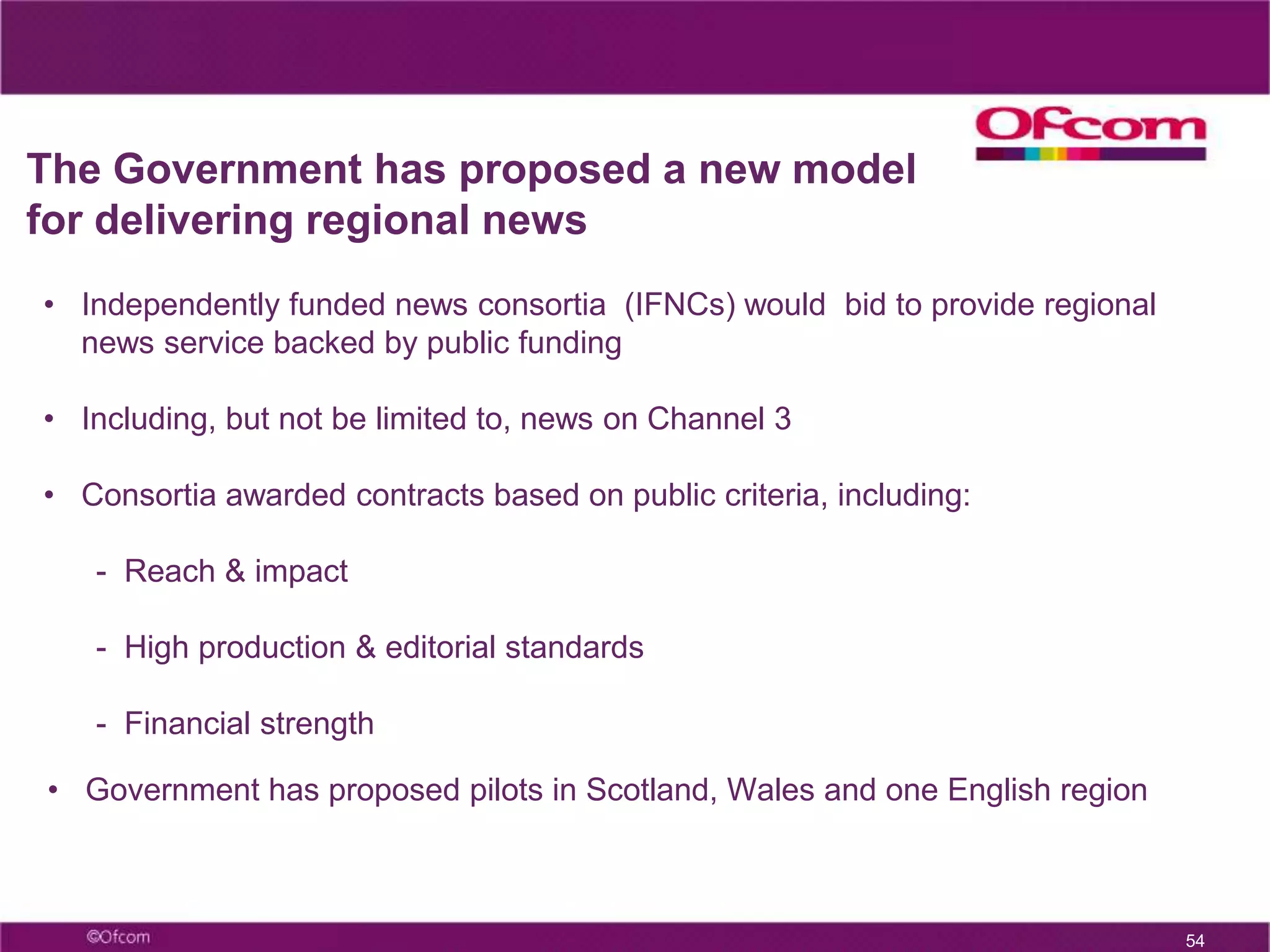
    The Government hasproposed a new model for delivering regional news54Independently funded news consortia (IFNCs) would bid to provide regional news service backed by public funding
  • 84.
    Including, but notbe limited to, news on Channel 3
  • 85.
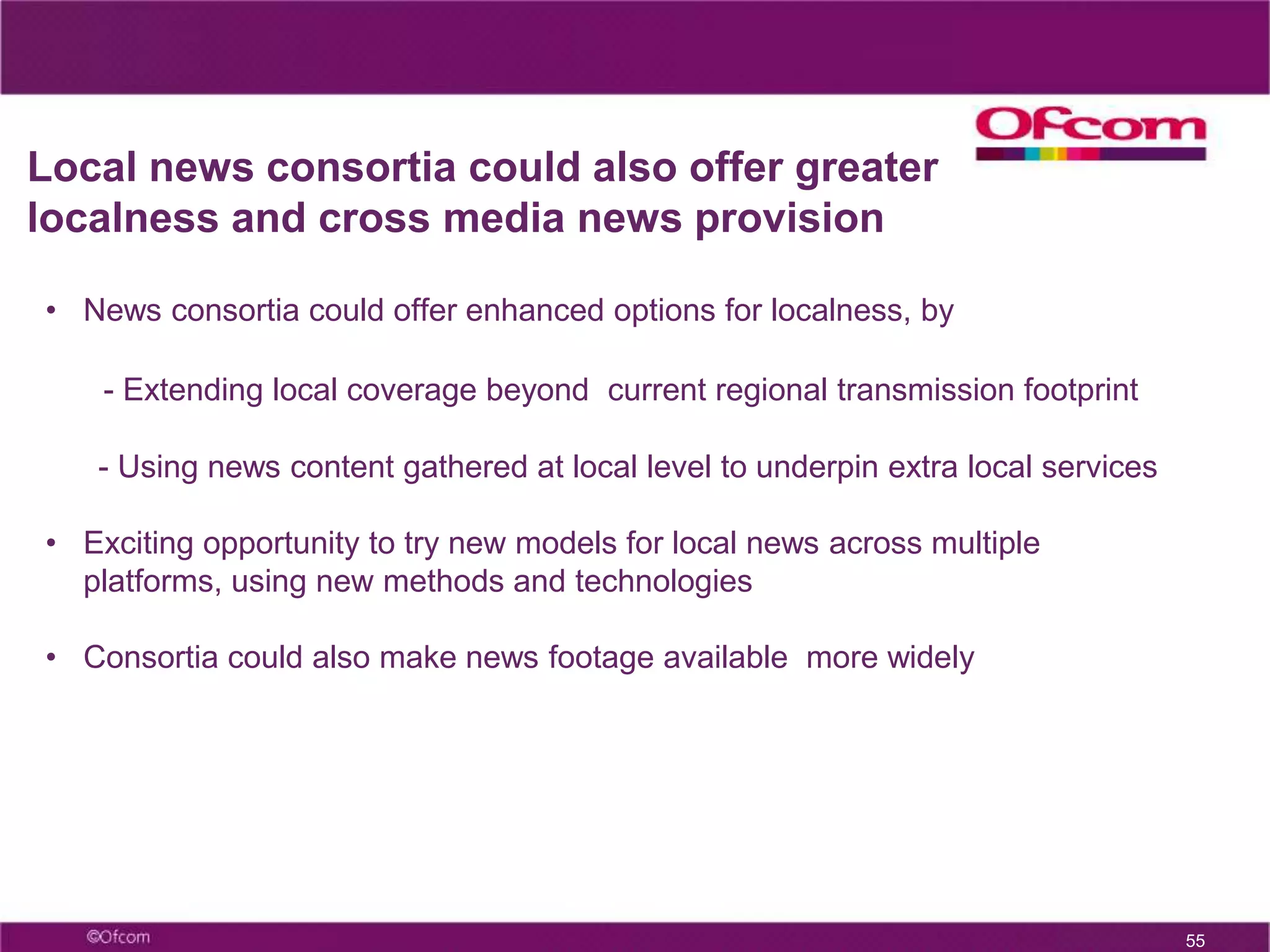
    Consortia awarded contractsbased on public criteria, including: - Reach & impact - High production & editorial standards - Financial strengthGovernment has proposed pilots in Scotland, Wales and one English regionLocal news consortia could also offer greater localness and cross media news provision55News consortia could offer enhanced options for localness, by- Extending local coverage beyond current regional transmission footprint - Using news content gathered at local level to underpin extra local servicesExciting opportunity to try new models for local news across multiple platforms, using new methods and technologies
  • 86.
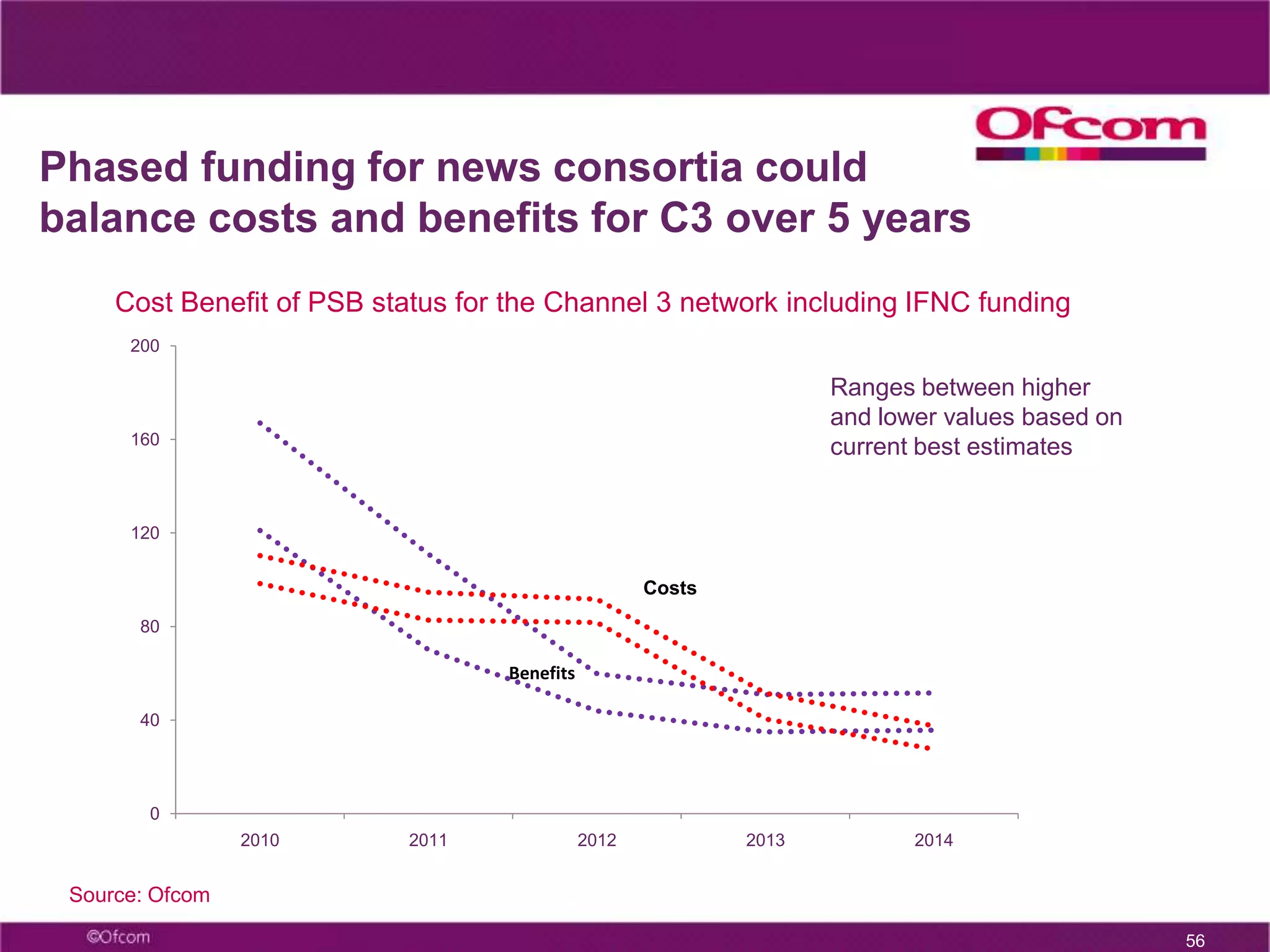
    Consortia could alsomake news footage available more widelyPhased funding for news consortia could balance costs and benefits for C3 over 5 years56Cost Benefit of PSB status for the Channel 3 network including IFNC fundingRanges between higher and lower values based on current best estimatesSource: Ofcom
  • 87.
    57A number ofpotential bidders have already emerged
  • 88.
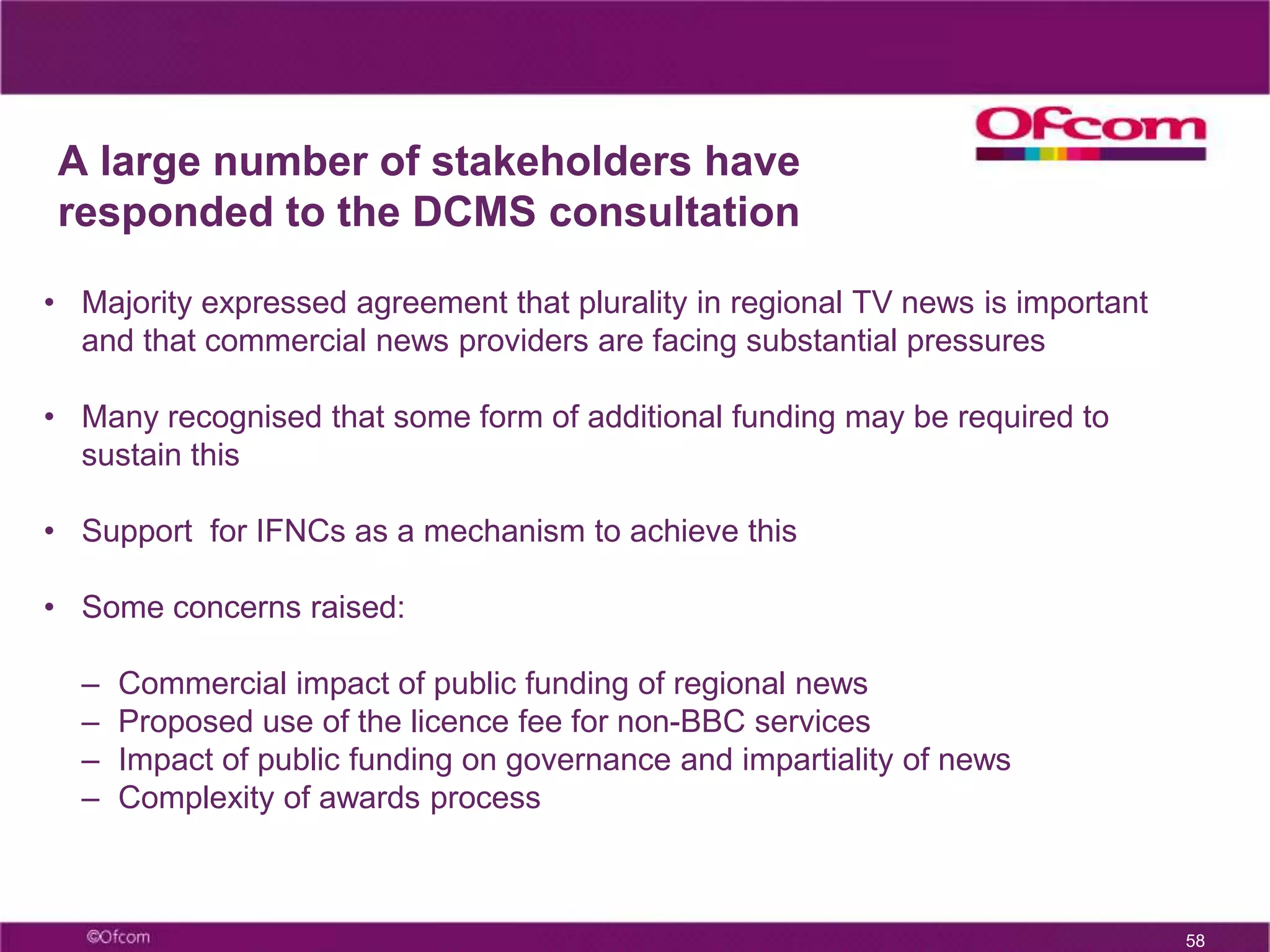
    A large numberof stakeholders have responded to the DCMS consultation Majority expressed agreement that plurality in regional TV news is important and that commercial news providers are facing substantial pressures Many recognised that some form of additional funding may be required to sustain this Support for IFNCs as a mechanism to achieve thisSome concerns raised:Commercial impact of public funding of regional newsProposed use of the licence fee for non-BBC services Impact of public funding on governance and impartiality of newsComplexity of awards process58
  • 89.
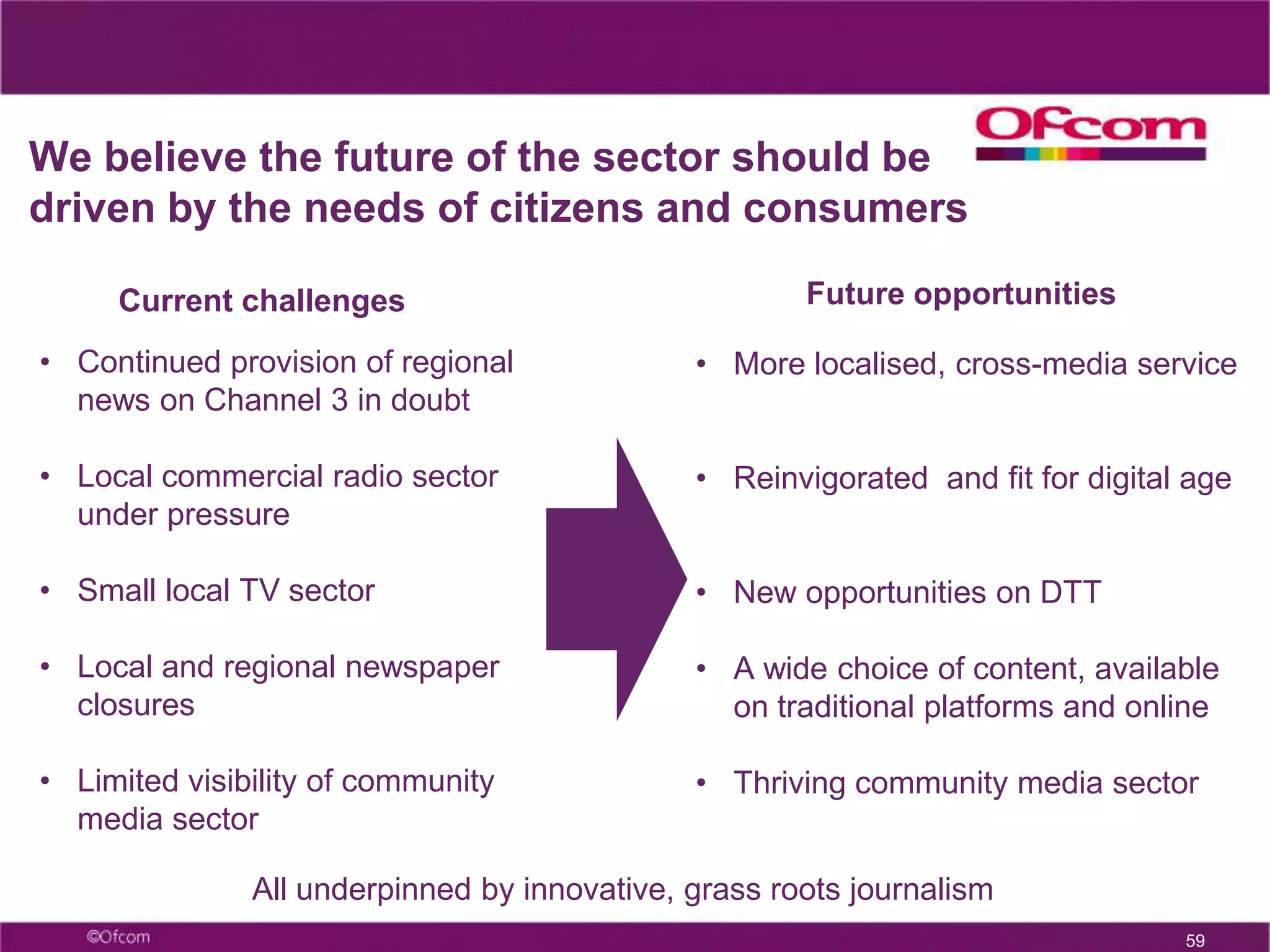
    We believe thefuture of the sector should be driven by the needs of citizens and consumers59Future opportunities Current challenges Continued provision of regional news on Channel 3 in doubt
  • 90.
    Local commercial radiosector under pressure
  • 91.
  • 92.
    Local and regionalnewspaper closures
  • 93.
    Limited visibility ofcommunity media sector
  • 94.
  • 95.
    Reinvigorated andfit for digital age
  • 96.
  • 97.
    A wide choiceof content, available on traditional platforms and online
  • 98.
    Thriving community mediasectorAll underpinned by innovative, grass roots journalism
  • 99.
  • 100.
    Government leading on-going work on IFNC pilots
  • 101.
    Ofcom’s Statement withrecommendations on Media Ownership Rules – to Secretary of State has been published
  • 102.
    Ofcom Consultation onDDR in due course615:Hot Topic (3): The Digital Economy Bill
  • 103.
    Digital Economy Bill62“Thecommunications sector underpins everything Britain does as an economy and society. The rapid drive to digital technology is transforming how both businesses and people operate. And this digital revolution offers great opportunities.Not only does the digital economy contribute around eight per cent of our GDP, it is vital for the success of every other area of productivity. It is growing in significance as we plan for recovery from the economic downturn. The Government is committed to securing the UK’s position as one of the world’s leading digital knowledge economies.This Bill would put in place the necessary legislative measures to deliver the strategic vision set out in the Digital Britain White Paper.”http://www.commonsleader.gov.uk/output/page2920.asp
  • 104.
    Digital Economy Bill(2)63“The purpose of the Bill is to: Strengthen the nation’s communications infrastructures, equipping the UK to compete and lead in the global digital economy.The main benefits of the Bill would be:Promoting a competitive digital communications infrastructure, through proposals on radio licensing, changes to Ofcom’s duties and spectrum modernisation. Providing essential support for creative industries in a digital world, through proposals on online copyright infringement and changes to copyright licensing. Improving digital security and safety, by putting in place a classification system for boxed video games that meets the needs of parents and children. Securing public service content in a rapidly changing broadcasting landscape, through action on the provision of news in the nations, regionally and locally, updating Channel 4 Corporation’s functions and future-proofing the Channel 3 and 5 licences.”
  • 105.
    Digital Economy Bill(3) - main elements64“Online infringement of copyright – tackling widespread copyright infringement via a two-stage process. First by making legal action more effective and educating consumers about copyright on-line. Second through reserve powers, if needed, to introduce technical measures, such as disconnection.
  • 106.
    Support the pluralityof independent and high quality news in the Nations, locally and in the regions – giving Ofcom powers to appoint and fund Independently Funded News Consortia.
  • 107.
    Digital infrastructure andcontent – giving Ofcom new duties to promote investment in infrastructure and public service media content, and to carry out an assessment of the UK’s communications infrastructure every two years.”Digital Economy Bill (4) - main elements (2)65“Mobile and wireless broadband – enabling investment in next generation technologies through spectrum modernisation.
  • 108.
    Digital radio - updating the regulatory framework to make moves to digital switchover for radio possible by 2015.
  • 109.
    Channel 4 Corporation– updating its functions to encompass public service content on all media platforms - online as well as television.
  • 110.
    Video games –protecting children by making age ratings compulsory for all boxed games designed for those aged 12 or above.”66Questions & Break
  • 111.
  • 112.
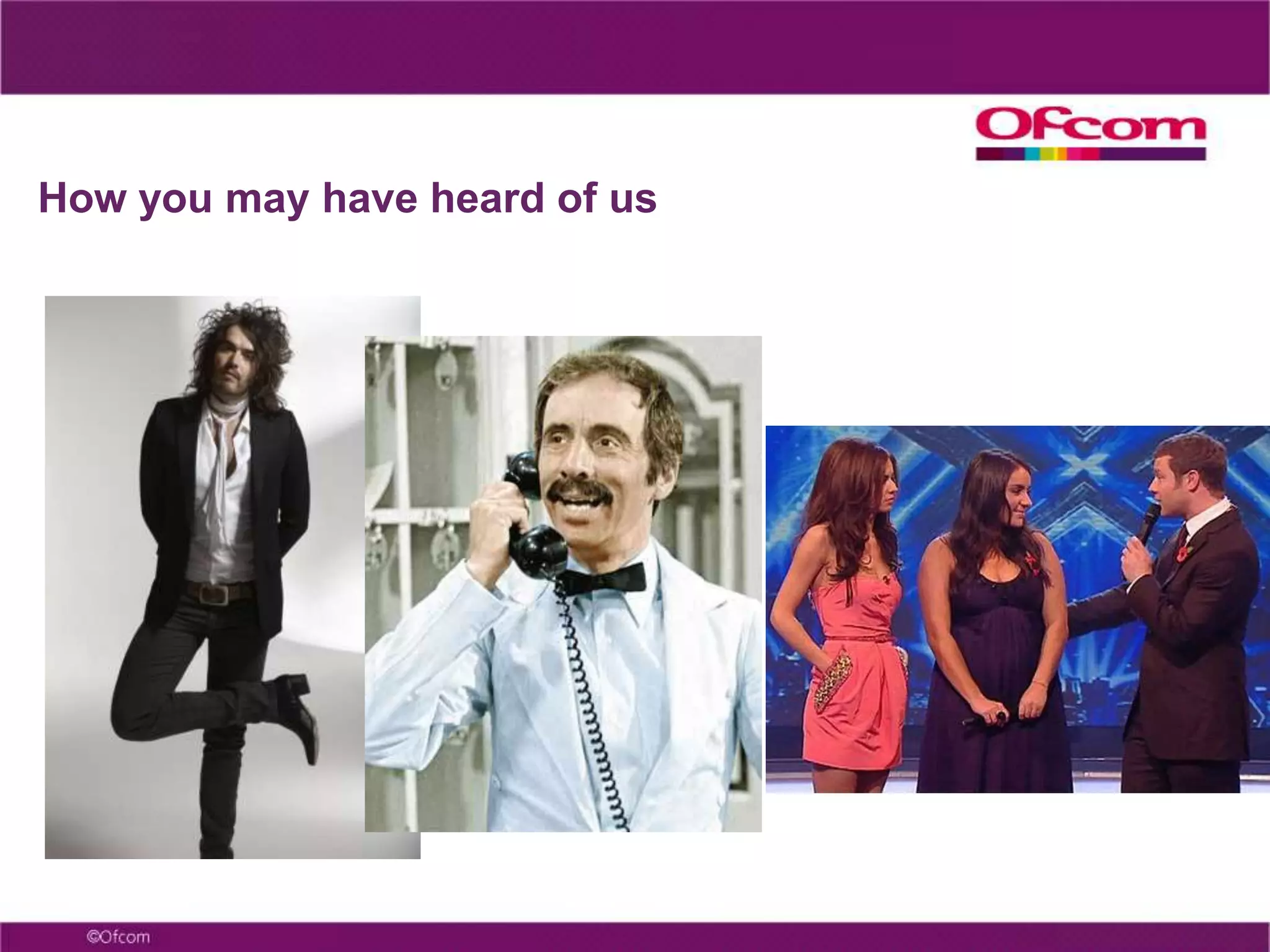
    How you mayhave heard of us
  • 113.
    69Case StudiesGordon Ramsay'sGreat British Nightmare, Channel 4 Casualty, BBC1 Breakfast Show, Kiss FM Katie and Peter, ITV2 Sumo TV
  • 114.
    Thank you forlisteningdamian.radcliffe@ofcom.org.uk70

Editor's Notes

  • #24 Further highlights in Nations and Regions Reports and also in the UK report.
  • #26 Government is playing the leading role – owning policy in this area HMG taking leading role in relation to: Digital Economy Bill On going work on IFNC pilotsThe Queen’s speech scheduled for 18 NovemberFurther Ofcom activity in this area Ofcom Statement on Media Ownership Rules – due to Secretary of State by 13 NovemberOfcom Consultation on DDR in due course - will include discussion of spectrum suitable for local TV
  • #27 Government is playing the leading role – owning policy in this area HMG taking leading role in relation to: Digital Economy Bill On going work on IFNC pilotsThe Queen’s speech scheduled for 18 NovemberFurther Ofcom activity in this area Ofcom Statement on Media Ownership Rules – due to Secretary of State by 13 NovemberOfcom Consultation on DDR in due course - will include discussion of spectrum suitable for local TV
  • #44 Overall duties are to further interests of citizens and consumers in relation to communications matters, where appropriate by promoting competitionSecure availability of wide range of TV and radio services of high quality and wide appealMaintain sufficient plurality of providersLicence national and local analogue and community radio stationsEnsure optimal use of the radio spectrum – including for Local TV Plus, in addition:Role in conducting Local Media Assessments for newspaper mergers where there may be competition concerns
  • #45 Consumers identify with the area they live in as a form of concentric circles with community at the centre, and the UK as a whole on the outside. Our work looks at all elements of this below the UK as a whole.
  • #46 Informing: To participate in their local communities, citizens need to be informed about important local issues such as major planning applications, new transport initiatives or proposals to close a hospital wing. People want to be informed – succinctly, accurately and accessibly – about significant events of relevance to them: from court reports, decisions of council committees and key local appointments, to achievements by local people on the national or international stage, progress of local sports teams, or the activities of local amenity groups. Representing: Local media can also act as tribunes of the people, facilitating the expression of popular opinion (through letters pages, blogs or discussion programmes) and ensuring that the collective view is passed on to key decision makers. Local newspapers or radio stations have historically been important vehicles for large-scale expressions of dissatisfaction over, for example, a major stadium building project or the inadequacy of local hospitals. And local media can be champions of their own localities, drawing attention to particular achievements or inadequate central government investment. Campaigning: Newspapers in particular have a long tradition of identifying issues directly relevant to their readers, and demanding appropriate action from relevant authorities. At the local level, such campaigns will be attuned to the specific needs of local communities, such as charity appeals, campaigns for action on unsafe roads, or protests against the proposed closure of a local amenity. All local media have traditionally regarded such campaigns as an integral element of their rootedness in the local community. Interrogating: An integral part of the media’s contribution is its watchdog role, holding public authorities and private corporations to account - from elected council officials, school governors, chief constables and county court judges to major employers and retail stores. Effective scrutiny depends on institutional support and adequate resources: as these become more depleted, local institutions become less accountable and arguably less responsive to the needs of the local community.Journalism, Democracy and the Public Interest: rethinking media pluralism for the Digital Age (Barnett 2009)
  • #47 Consumers value local and regional content92% consume some form of local media at least weeklyOver half say local/regional news on TV is very important while over a third say the same for paid for local newspapers and local radioIts also worth saying that more people view early evening regional news programming on the BBC and ITV than watch the combined UK-wide network news programmes around the same time (8.7m vs 8.2m) – 10% higher
  • #50 The% of advertising on internet has grown from 3% in 2003 to 20% in 2008While search has been driver of this growth, classified and display have seen significant increases too.
  • #54 Red lines are our best estimate of costsBlue lines are our best estimate of benefitsThe gap between cost and benefits is between £38m-64m in 2012The single biggest PSB cost attributable to the Channel 3 network is the production cost of regional news which is estimated at £68 million in 2010, and projected to be £72 million in 2012, based on current production costs. These costs are after the regulatory changes made in the PSB Review.It is notable that the production cost of regional news is very similar to the scale of the opportunity cost deficit across the Channel 3 network.This data is based on the figures supplied by the ITV regional broadcasters. As we outline in our LRM report, we have also commissioned an independent assessment of production costs which has produced a similar set of figures.
  • #55 Independently funded news consortia (IFNCs) would bid to provide regional news service on Channel 3 backed by public fundingConsortia could include incumbent TV news providers, newspaper groups, TV production companies and newsgathering agenciesConsortia awarded contracts based on public criteria, including: - reach & impact - high production & editorial standards - financial stamina
  • #56 News consortia could offer enhanced options for localness, by- extending local coverage beyond current regional transmission footprint - using news content gathered at local level to underpin extra local servicesEnhanced news services could be offered across media platformsConsortia could also make news footage available more widely
  • #57 The hypothetical scenario modelled above assumes public funding for news consortia in one English region and two nations commencing late 2010, and full funding commencing in early 2013, as suggested by the timeline in DCMS consultation. There are likely to be transitional financial issues for the Channel 3 licensees until the funding for a full roll out of news consortia is secured. As such, the surplus that we see in the Channel 3 licences today, and again potentially once full funding is provided, may be needed to offset the deficits in the transitional years when funding is only provided for the pilots.Beginning a full roll out of news consortia in early 2013 may leave the winning bidders an insufficient contractual length to allow amortisation of start up and capital costs, and a suitable return on their investment before the Channel 3 licences expire at the end of 2014. In this case, the terms of the contract may need to extend into the new licensing period. Ranges between higher and lower values based on current best estimates
  • #59 Majority expressed agreement that plurality in regional TV news is importantMany recognised that some form of additional funding may be required to sustain this Support for IFNCs as a mechanism to achieve this – but was not universal Some concerns and opposition expressed in relation to:Commercial impact of public funding of regional newsProposed use of the licence fee for non-BBC services Impact of public funding on governance and impartiality of newsComplexity of awards process
  • #60 The local and regional media sector is currently facing a range of challenges:Continued provision of regional news on Channel 3 in doubtLocal commercial radio sector under pressureSmall local TV sectorLocal and regional newspaper closures Limited visibility of community media sector ... But also a range of opportunities More localised, cross-media serviceReinvigorated and fit for digital ageNew opportunities on DTTA wide choice of content, available on traditional platforms and onlineThriving community media sectorUnderpinned by innovative, grass roots journalism – supporting the 4 aims
  • #61 Government is playing the leading role – owning policy in this area HMG taking leading role in relation to: Digital Economy Bill On going work on IFNC pilotsThe Queen’s speech scheduled for 18 NovemberFurther Ofcom activity in this area Ofcom Statement on Media Ownership Rules – due to Secretary of State by 13 NovemberOfcom Consultation on DDR in due course - will include discussion of spectrum suitable for local TV
  • #63 Government is playing the leading role – owning policy in this area HMG taking leading role in relation to: Digital Economy Bill On going work on IFNC pilotsThe Queen’s speech scheduled for 18 NovemberFurther Ofcom activity in this area Ofcom Statement on Media Ownership Rules – due to Secretary of State by 13 NovemberOfcom Consultation on DDR in due course - will include discussion of spectrum suitable for local TV
  • #64 Government is playing the leading role – owning policy in this area HMG taking leading role in relation to: Digital Economy Bill On going work on IFNC pilotsThe Queen’s speech scheduled for 18 NovemberFurther Ofcom activity in this area Ofcom Statement on Media Ownership Rules – due to Secretary of State by 13 NovemberOfcom Consultation on DDR in due course - will include discussion of spectrum suitable for local TV
  • #65 Government is playing the leading role – owning policy in this area HMG taking leading role in relation to: Digital Economy Bill On going work on IFNC pilotsThe Queen’s speech scheduled for 18 NovemberFurther Ofcom activity in this area Ofcom Statement on Media Ownership Rules – due to Secretary of State by 13 NovemberOfcom Consultation on DDR in due course - will include discussion of spectrum suitable for local TV
  • #66 Government is playing the leading role – owning policy in this area HMG taking leading role in relation to: Digital Economy Bill On going work on IFNC pilotsThe Queen’s speech scheduled for 18 NovemberFurther Ofcom activity in this area Ofcom Statement on Media Ownership Rules – due to Secretary of State by 13 NovemberOfcom Consultation on DDR in due course - will include discussion of spectrum suitable for local TV