?            ?


                ?            ?
  Supertanker in the Ocean
    p
              Ellen Chaffee, Ph.D.


    No land in sight; Very slow to turn
                  Therefore…
       Every li l movement matters!
       E     little
Need a simple, sophisticated guidance system
Topics Today
•   What is a Balanced Scorecard?
•   Why do organizations use it?
•   What i h
    Wh might ___’s S
                   ’ Scorecard l k lik ?
                              d look like?
•   How-to and practical tips
•   Learning more
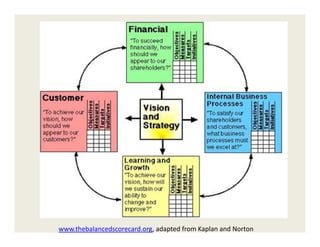
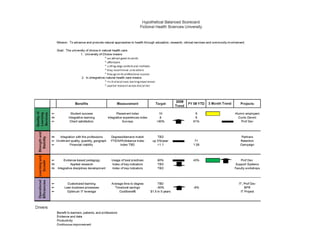
What is a scorecard?
•A simple yet (properly used) sophisticated guidance system,
or living report card for the organization

•That covers the four essential areas of organizational health
   • FiFinancial
              i l
   • Learning and growth
   • Customers
   • Business processes

•Integral to the strategic plan. Cascades directly into
 Integral                  plan
resource allocation at all levels of the organization

•Focuses on trend lines, with reference to goals/benchmarks
 Foc ses    t end lines ith efe ence goals/benchma ks
from best practice
www.thebalancedscorecard.org, adapted from Kaplan and Norton
Reasons for creating scorecards
•   Aligns efforts across units AND through time, even with turnover
•   Creates a target so all the organizational arrows can line up
•   Brings priorities sharply into focus
•   Provides a foundation for unit and individual goals/performance
•   Provides a framework for budgeting
•   Develops a sense of momentum, focus, accomplishment
•   Translates the vision i
         l      h i i into a “l
                             “language” all can use strategically
                                      ” ll                 i ll
•   Translates the goals into researchable problems we can study/solve
•   Defines the desired “effects”
                         effects
•         What are the essential “causes?” – action plans
•   Creates a foundation for organizational learning and experimentation
•   Facilitates accountability
Primary Implementation Success Factors
Obtaining executive sponsorship and commitment

Involving a broad base of leaders, managers and employees in scorecard development

Agreeing on terminology

Choosing the right BSC Program Champion

Beginning interactive (two-way) communication first

Working through mission, vision, strategic results, and strategy mapping first to avoid
rushing to judgment on measures or software
      g j g

Viewing the scorecard as a long-term journey rather than a short-term project

Planning for and managing change

Applying a disciplined implementation framework

Getting outside help if needed
                                                 From www balancedscorecard org
                                                      www.balancedscorecard.org
Sample Implementation Steps
Readiness: mission, vision, strategic plan
Map strategies onto outcomes
Set objectives
Match with projects/initiatives
Define measures and targets
Re-examine, reduce, refine, build scorecard
Plan formative and summative reporting
processes, individual/unit accountabilities for
p j
projects/initiatives …
As a practical matter
•   If meaningful, use metrics you already collect for other purposes.

•   Use leading metrics, too – not just lagging.

•   Develop a systematic way of collecting and reporting the data.

•   Lock in routine times to review, learn from, and act on the report.

•   Analyze the causes of change in metrics (e.g., flowchart) –
    environmental, organizational, unit, individual? Levers for change?

•   The only right way is the way that works for the individual
    organization. Generic or borrowed scorecards are useless.

•   Thoughtful revisions are good, especially for learning from
    experiments and for clarity, simplicity, and focus
Learning More:
 Balanced Scorecards, Change Management, Strategic Planning, Quality
          Scorecards         Management            Planning
Management, Lean, Continuous Improvement, Accountability, Alignment

• Read – from reference list provided, search on Amazon, Google,
  etc.
• Professional groups, conferences,
  workshops such as AIR (Association for Institutional
      k h
  Research), SCUP (Society for College and University Planning),
  Palladium Group, balanced scorecard.org
• Build a peer network of institutions or individuals
• Bring in workshops such as from groups above or AGB
      g            p               g p

• Work with consultant(s) such as from groups above or
  AGB
Questions?
• How does this fit into our strategic plan, NCA
                                   g p ,
  self-study, and long range goal of becoming
  the best that we can be?
• How does this help us to best use our limited
  resources to our advantage?
• What kind of training does our staff and
  administration need to support such an
  initiative?
• H
  How can we establish meaningful
                  t bli h      i f l
  performance measures aligned with strategic
  g
  goals?

Intro To Balanced Scorecard

  • 1.
    ? ? ? ? Supertanker in the Ocean p Ellen Chaffee, Ph.D. No land in sight; Very slow to turn Therefore… Every li l movement matters! E little Need a simple, sophisticated guidance system
  • 2.
    Topics Today • What is a Balanced Scorecard? • Why do organizations use it? • What i h Wh might ___’s S ’ Scorecard l k lik ? d look like? • How-to and practical tips • Learning more
  • 3.
    What is ascorecard? •A simple yet (properly used) sophisticated guidance system, or living report card for the organization •That covers the four essential areas of organizational health • FiFinancial i l • Learning and growth • Customers • Business processes •Integral to the strategic plan. Cascades directly into Integral plan resource allocation at all levels of the organization •Focuses on trend lines, with reference to goals/benchmarks Foc ses t end lines ith efe ence goals/benchma ks from best practice
  • 4.
  • 5.
    Reasons for creatingscorecards • Aligns efforts across units AND through time, even with turnover • Creates a target so all the organizational arrows can line up • Brings priorities sharply into focus • Provides a foundation for unit and individual goals/performance • Provides a framework for budgeting • Develops a sense of momentum, focus, accomplishment • Translates the vision i l h i i into a “l “language” all can use strategically ” ll i ll • Translates the goals into researchable problems we can study/solve • Defines the desired “effects” effects • What are the essential “causes?” – action plans • Creates a foundation for organizational learning and experimentation • Facilitates accountability
  • 7.
    Primary Implementation SuccessFactors Obtaining executive sponsorship and commitment Involving a broad base of leaders, managers and employees in scorecard development Agreeing on terminology Choosing the right BSC Program Champion Beginning interactive (two-way) communication first Working through mission, vision, strategic results, and strategy mapping first to avoid rushing to judgment on measures or software g j g Viewing the scorecard as a long-term journey rather than a short-term project Planning for and managing change Applying a disciplined implementation framework Getting outside help if needed From www balancedscorecard org www.balancedscorecard.org
  • 8.
    Sample Implementation Steps Readiness:mission, vision, strategic plan Map strategies onto outcomes Set objectives Match with projects/initiatives Define measures and targets Re-examine, reduce, refine, build scorecard Plan formative and summative reporting processes, individual/unit accountabilities for p j projects/initiatives …
  • 9.
    As a practicalmatter • If meaningful, use metrics you already collect for other purposes. • Use leading metrics, too – not just lagging. • Develop a systematic way of collecting and reporting the data. • Lock in routine times to review, learn from, and act on the report. • Analyze the causes of change in metrics (e.g., flowchart) – environmental, organizational, unit, individual? Levers for change? • The only right way is the way that works for the individual organization. Generic or borrowed scorecards are useless. • Thoughtful revisions are good, especially for learning from experiments and for clarity, simplicity, and focus
  • 10.
    Learning More: BalancedScorecards, Change Management, Strategic Planning, Quality Scorecards Management Planning Management, Lean, Continuous Improvement, Accountability, Alignment • Read – from reference list provided, search on Amazon, Google, etc. • Professional groups, conferences, workshops such as AIR (Association for Institutional k h Research), SCUP (Society for College and University Planning), Palladium Group, balanced scorecard.org • Build a peer network of institutions or individuals • Bring in workshops such as from groups above or AGB g p g p • Work with consultant(s) such as from groups above or AGB
  • 11.
    Questions? • How doesthis fit into our strategic plan, NCA g p , self-study, and long range goal of becoming the best that we can be? • How does this help us to best use our limited resources to our advantage? • What kind of training does our staff and administration need to support such an initiative? • H How can we establish meaningful t bli h i f l performance measures aligned with strategic g goals?