Adaptive Leadership:
People, Process and Pipeline
February 12, 2015
1
People, Process and Pipeline
• Adaptive vs. Technical Review
• People: The who
• Process: The how
• Pipeline: Looking forward
• Self Assessment
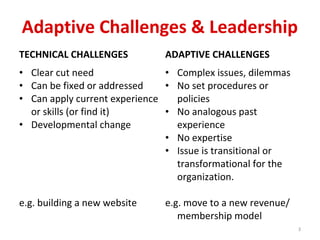
Adaptive Challenges & Leadership
3
TECHNICAL CHALLENGES ADAPTIVE CHALLENGES
• Clear cut need
• Can be fixed or addressed
• Can apply current experience
or skills (or find it)
• Developmental change
e.g. building a new website
• Complex issues, dilemmas
• No set procedures or
policies
• No analogous past
experience
• No expertise
• Issue is transitional or
transformational for the
organization.
e.g. move to a new revenue/
membership model
Adaptive Challenges & Leadership
4
What’s a recent example of an adaptive
challenge in your congregation?
What made it adaptive? How did you navigate it?
Maybe it fell into one of these three domains:
– Finance
– Religious Practice
– Education
People: The Who
What people, skills and talents are needed?
People: The Who
What people, skills and talents are needed?
6
Community Builder. Builds
consensus and mobilizes around
common causes.
Risk Evaluator. Objectively assesses
costs and benefits (re: financial,
human and social capital)
Connector. Influential “social node”
with relationships with various
subgroups and individuals.
Entrepreneur. Agile, startup
generator
Visionary Leader. Big picture thinker
who can envision possibilities.
Implementer. “Do-er” who can move
from concept to implementation.
Facilitator. Meeting or process
facilitator. Designs and/or leads/guides.
Communicator. Skilled at tailoring the
message and using various channels to
get it out, as well as listening inward.
Mediator. Intercessor who can bring
about consensus and/or mobilize
forward motion.
Synthesizer. Analyst who can
consolidate views (“This is what I heard
and…”)
People: The Who
Examples from your work? Which do you need?
7
Community Builder. Builds
consensus and mobilizes around
common causes.
Risk Evaluator. Objectively assesses
costs and benefits (re: financial,
human and social capital)
Connector. Influential “social node”
with relationships with various
subgroups and individuals.
Entrepreneur. Agile, startup
generator
Visionary Leader. Big picture thinker
who can envision possibilities.
Implementer. “Do-er” who can move
from concept to implementation.
Facilitator. Meeting or process
facilitator. Designs and/or leads/guides.
Communicator. Skilled at tailoring the
message and using various channels to
get it out, as well as listening inward.
Mediator. Intercessor who can bring
about consensus and/or mobilize
forward motion.
Synthesizer. Analyst who can
consolidate views (“This is what I heard
and…”)
Process: The How
To what extent does your leadership team apply
adaptive and collaborative leadership practices
(processes and culture) in your decision making
and implementation?
What practices and cultural adjustments are
needed to help you work as an adaptive team?
8
Process: The How
What adaptive and collaborative leadership
practices and cultural element do you need?
9
Open. Permeable boundaries to the
leadership team.
Action Oriented. Seizing the moment;
prioritizing “doing”.
Iterative. Willing to revisit and adapt
previous decisions on the basis of data
and experience.
Agile. Being nimble in order to take
advantage of emergent opportunities.
Momentum Seeking. Not stuck in status
quo; constantly on a growth trajectory.
Transparent. Culture of sharing
information.
Positivist. Culture of abundance (rather
than scarcity); reframe challenges as
opportunities.
Trusting & Mutually Respectful. Stance of
openness and listening to the perspectives
of others.
Authentic Modeling of Relationship
Building. Know one another;
personal connections.
Process: The How
10
Open. Permeable boundaries to the
leadership team.
Action Oriented. Seizing the moment;
prioritizing “doing”.
Iterative. Willing to revisit and adapt
previous decisions on the basis of data
and experience.
Agile. Being nimble in order to take
advantage of emergent opportunities.
Momentum Seeking. Not stuck in status
quo; constantly on a growth trajectory.
Transparent. Culture of sharing
information.
Positivist. Culture of abundance (rather
than scarcity); reframe challenges as
opportunities.
Trusting & Mutually Respectful. Stance of
openness and listening to the perspectives
of others.
Authentic Modeling of Relationship
Building. Know one another;
personal connections.
Examples from your work?
Which attributes do you need to work on?
The Pipeline: Looking Forward
To what extent does your leadership team have
ways to continually identify, cultivate, on-board,
develop and nurture leaders? What does this
mean for your next nomination process?
11
The Pipeline: Looking Forward
How do you identify, cultivate, on-board, develop &
nurture leaders to complete the picture?
12
Leadership identification mechanism.
How to identify attributes you need, and who can bring those attributes.
Leadership cultivation practices.
Gradual integration into leadership.
Leadership on-boarding processes.
Orientation, culture setting and mentoring.
Leadership development activities.
Ongoing board development.
Leadership nurturing.
Recognition, support, reflection, celebration.
The Pipeline: Looking Forward
13
Leadership identification mechanism.
How to identify attributes you need, and who can bring those attributes.
Leadership cultivation practices.
Gradual integration into leadership.
Leadership on-boarding processes.
Orientation, culture setting and mentoring.
Leadership development activities.
Ongoing board development.
Leadership nurturing.
Recognition, support, reflection, celebration.
Examples from your work?
Which do you need to work on?
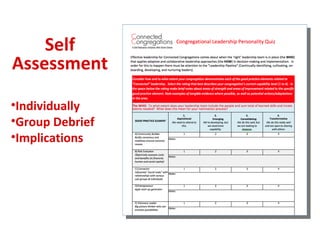
Self
Assessment
•Individually
•Group Debrief
•Implications
Upcoming Events
• Cohort Workshop: March 24th
• Cohort webinar: May 13, 2015 1 PM – 2 PM
Learning from Our Data
• Final Cohort Workshop: June 16th
Connected Congregations: Moving Toward
Lateral Leadership (webinar open to all)
Tuesday, March 3, 2015, 1:00 – 2:00 p.m.

Connected Congregations: Adaptive Leadership Webinar

  • 1.
    Adaptive Leadership: People, Processand Pipeline February 12, 2015 1
  • 2.
    People, Process andPipeline • Adaptive vs. Technical Review • People: The who • Process: The how • Pipeline: Looking forward • Self Assessment
  • 3.
    Adaptive Challenges &Leadership 3 TECHNICAL CHALLENGES ADAPTIVE CHALLENGES • Clear cut need • Can be fixed or addressed • Can apply current experience or skills (or find it) • Developmental change e.g. building a new website • Complex issues, dilemmas • No set procedures or policies • No analogous past experience • No expertise • Issue is transitional or transformational for the organization. e.g. move to a new revenue/ membership model
  • 4.
    Adaptive Challenges &Leadership 4 What’s a recent example of an adaptive challenge in your congregation? What made it adaptive? How did you navigate it? Maybe it fell into one of these three domains: – Finance – Religious Practice – Education
  • 5.
    People: The Who Whatpeople, skills and talents are needed?
  • 6.
    People: The Who Whatpeople, skills and talents are needed? 6 Community Builder. Builds consensus and mobilizes around common causes. Risk Evaluator. Objectively assesses costs and benefits (re: financial, human and social capital) Connector. Influential “social node” with relationships with various subgroups and individuals. Entrepreneur. Agile, startup generator Visionary Leader. Big picture thinker who can envision possibilities. Implementer. “Do-er” who can move from concept to implementation. Facilitator. Meeting or process facilitator. Designs and/or leads/guides. Communicator. Skilled at tailoring the message and using various channels to get it out, as well as listening inward. Mediator. Intercessor who can bring about consensus and/or mobilize forward motion. Synthesizer. Analyst who can consolidate views (“This is what I heard and…”)
  • 7.
    People: The Who Examplesfrom your work? Which do you need? 7 Community Builder. Builds consensus and mobilizes around common causes. Risk Evaluator. Objectively assesses costs and benefits (re: financial, human and social capital) Connector. Influential “social node” with relationships with various subgroups and individuals. Entrepreneur. Agile, startup generator Visionary Leader. Big picture thinker who can envision possibilities. Implementer. “Do-er” who can move from concept to implementation. Facilitator. Meeting or process facilitator. Designs and/or leads/guides. Communicator. Skilled at tailoring the message and using various channels to get it out, as well as listening inward. Mediator. Intercessor who can bring about consensus and/or mobilize forward motion. Synthesizer. Analyst who can consolidate views (“This is what I heard and…”)
  • 8.
    Process: The How Towhat extent does your leadership team apply adaptive and collaborative leadership practices (processes and culture) in your decision making and implementation? What practices and cultural adjustments are needed to help you work as an adaptive team? 8
  • 9.
    Process: The How Whatadaptive and collaborative leadership practices and cultural element do you need? 9 Open. Permeable boundaries to the leadership team. Action Oriented. Seizing the moment; prioritizing “doing”. Iterative. Willing to revisit and adapt previous decisions on the basis of data and experience. Agile. Being nimble in order to take advantage of emergent opportunities. Momentum Seeking. Not stuck in status quo; constantly on a growth trajectory. Transparent. Culture of sharing information. Positivist. Culture of abundance (rather than scarcity); reframe challenges as opportunities. Trusting & Mutually Respectful. Stance of openness and listening to the perspectives of others. Authentic Modeling of Relationship Building. Know one another; personal connections.
  • 10.
    Process: The How 10 Open.Permeable boundaries to the leadership team. Action Oriented. Seizing the moment; prioritizing “doing”. Iterative. Willing to revisit and adapt previous decisions on the basis of data and experience. Agile. Being nimble in order to take advantage of emergent opportunities. Momentum Seeking. Not stuck in status quo; constantly on a growth trajectory. Transparent. Culture of sharing information. Positivist. Culture of abundance (rather than scarcity); reframe challenges as opportunities. Trusting & Mutually Respectful. Stance of openness and listening to the perspectives of others. Authentic Modeling of Relationship Building. Know one another; personal connections. Examples from your work? Which attributes do you need to work on?
  • 11.
    The Pipeline: LookingForward To what extent does your leadership team have ways to continually identify, cultivate, on-board, develop and nurture leaders? What does this mean for your next nomination process? 11
  • 12.
    The Pipeline: LookingForward How do you identify, cultivate, on-board, develop & nurture leaders to complete the picture? 12 Leadership identification mechanism. How to identify attributes you need, and who can bring those attributes. Leadership cultivation practices. Gradual integration into leadership. Leadership on-boarding processes. Orientation, culture setting and mentoring. Leadership development activities. Ongoing board development. Leadership nurturing. Recognition, support, reflection, celebration.
  • 13.
    The Pipeline: LookingForward 13 Leadership identification mechanism. How to identify attributes you need, and who can bring those attributes. Leadership cultivation practices. Gradual integration into leadership. Leadership on-boarding processes. Orientation, culture setting and mentoring. Leadership development activities. Ongoing board development. Leadership nurturing. Recognition, support, reflection, celebration. Examples from your work? Which do you need to work on?
  • 14.
  • 15.
    Upcoming Events • CohortWorkshop: March 24th • Cohort webinar: May 13, 2015 1 PM – 2 PM Learning from Our Data • Final Cohort Workshop: June 16th Connected Congregations: Moving Toward Lateral Leadership (webinar open to all) Tuesday, March 3, 2015, 1:00 – 2:00 p.m.