
INTRODUCTION TO THE HOSPITALITY
INDUSTRY
LESSON 1
OBJECTIVES
After this lesson, you should be able to:
 Discuss the nature of the hospitality
industry;
 Name the characteristics of the hospitality
industry;
 Enumerate the scope of the hospitality
industry; and;
 Define the terms used in the industry.
In an increasingly competitive
employment arena, one must prepare for
and secure strong, definite jobs which lead
to long-term realistic career options and
opportunities.
One of the fastest growing sectors of
the economy of our time is the hospitality
industry. The hospitality industry alone is a
multi-billion dollar enterprise. It is exciting,
never boring and offers unlimited
opportunities.
THINK ABOUT THIS:
It makes sense to prepare for a job in
which you have numerous opportunities for
advancement, because it will be an
economic advantage for you in the long run.
CHARACTERISTICS OF THE
HOSPITALITY INDUSTRY:
 Hospitality businesses are open 365 days a
year and twenty-four hours a day.
 The hospitality industry depends heavily on
shift work (morning shift and afternoon
shift).
 There is a graveyard shift (which usually
starts from 10:00 P.M. and lasts until 6:00
A.M.
CHARACTERISTICS OF THE
HOSPITALITY INDUSTRY:
 The hospitality business produce guest
satisfaction which is different from other
business sectors.
 Products of the hospitality business are
intangible and perishable.
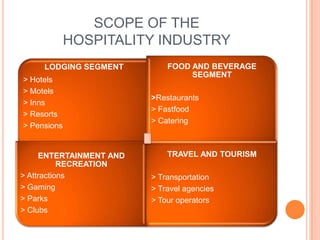
SCOPE OF THE
HOSPITALITY INDUSTRY
LODGING SEGMENT
> Hotels
> Motels
> Inns
> Resorts
> Pensions
FOOD AND BEVERAGE
SEGMENT
>Restaurants
> Fastfood
> Catering
ENTERTAINMENT AND
RECREATION
> Attractions
> Gaming
> Parks
> Clubs
TRAVEL AND TOURISM
> Transportation
> Travel agencies
> Tour operators
CAREER OPPORTUNITIES IN THE
HOSPITALITY INDUSTRY
Until the late 1950s, management
personnel in the hospitality industry were
not formally college educated.
Those interested in hospitality
management typically began their careers
by taking lower-level jobs to learn the
business and eventually worked their way
up through the organization.
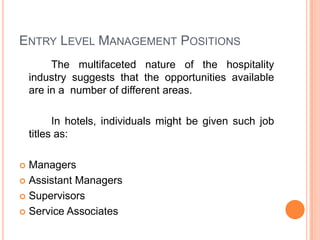
ENTRY LEVEL MANAGEMENT POSITIONS
The multifaceted nature of the hospitality
industry suggests that the opportunities available
are in a number of different areas.
In hotels, individuals might be given such job
titles as:
 Managers
 Assistant Managers
 Supervisors
 Service Associates
In restaurants and similar foodservice
operations, analogous positions might carry such
titles as:
 Managers
 Management Trainee
 Assistant Manager
 Dining Room Manager
 Steward
 Bar Manager
 Banquet Manager
 Service Staff
QUALIFICATIONS AND
EMPLOYER ASSESSMENT
 Attitude and Character
 Communication Skills
 Skills and Experiences

Intro hrm 111 a

  • 1.
    INTRODUCTION TO THEHOSPITALITY INDUSTRY LESSON 1
  • 2.
    OBJECTIVES After this lesson,you should be able to:  Discuss the nature of the hospitality industry;  Name the characteristics of the hospitality industry;  Enumerate the scope of the hospitality industry; and;  Define the terms used in the industry.
  • 3.
    In an increasinglycompetitive employment arena, one must prepare for and secure strong, definite jobs which lead to long-term realistic career options and opportunities.
  • 4.
    One of thefastest growing sectors of the economy of our time is the hospitality industry. The hospitality industry alone is a multi-billion dollar enterprise. It is exciting, never boring and offers unlimited opportunities.
  • 5.
    THINK ABOUT THIS: Itmakes sense to prepare for a job in which you have numerous opportunities for advancement, because it will be an economic advantage for you in the long run.
  • 6.
    CHARACTERISTICS OF THE HOSPITALITYINDUSTRY:  Hospitality businesses are open 365 days a year and twenty-four hours a day.  The hospitality industry depends heavily on shift work (morning shift and afternoon shift).  There is a graveyard shift (which usually starts from 10:00 P.M. and lasts until 6:00 A.M.
  • 7.
    CHARACTERISTICS OF THE HOSPITALITYINDUSTRY:  The hospitality business produce guest satisfaction which is different from other business sectors.  Products of the hospitality business are intangible and perishable.
  • 8.
    SCOPE OF THE HOSPITALITYINDUSTRY LODGING SEGMENT > Hotels > Motels > Inns > Resorts > Pensions FOOD AND BEVERAGE SEGMENT >Restaurants > Fastfood > Catering ENTERTAINMENT AND RECREATION > Attractions > Gaming > Parks > Clubs TRAVEL AND TOURISM > Transportation > Travel agencies > Tour operators
  • 9.
    CAREER OPPORTUNITIES INTHE HOSPITALITY INDUSTRY Until the late 1950s, management personnel in the hospitality industry were not formally college educated. Those interested in hospitality management typically began their careers by taking lower-level jobs to learn the business and eventually worked their way up through the organization.
  • 10.
    ENTRY LEVEL MANAGEMENTPOSITIONS The multifaceted nature of the hospitality industry suggests that the opportunities available are in a number of different areas. In hotels, individuals might be given such job titles as:  Managers  Assistant Managers  Supervisors  Service Associates
  • 11.
    In restaurants andsimilar foodservice operations, analogous positions might carry such titles as:  Managers  Management Trainee  Assistant Manager  Dining Room Manager  Steward  Bar Manager  Banquet Manager  Service Staff
  • 12.
    QUALIFICATIONS AND EMPLOYER ASSESSMENT Attitude and Character  Communication Skills  Skills and Experiences