Introduction to
Dentistry DA101
Lecture Five
Soft Deposits
Lecture Outlines
Terminology
Soft Deposits
1. Acquired Pellicle or Cuticle
2. Dental Biofilm
3. Materia Alba
4. Food Debris
SDashti 2017
2
Terminology
Terminology Meaning
Acellular Not containing a cell
Adsorption Action of a substance attracting and holding other materials
on its surface
Aerobe Microorganism that live and grow in the presence of O2
Anaerobe Microorganism that live sin almost complete absence of O2
Biofilm Matrix-enclosed bacterial populations adherent to each other
or to surfaces
Infection Invasion and multiplication of a microorganism in body
tissue
SDashti 2017
3
Terminology
Terminology Meaning
Calculogenesis Formation of calculus
Calculogenic Adjective applied to dental biofilm conductive to formation
of calculus
Cariogenesis Development of dental caries
Cariogenic Adjective to indicate a conduciveness to initiate dental
caries such as carogenic food or biofilm
Oral Flora Various bacteria and M.O. that inhabit oral cavity. The
mouth have indigenous flora (native to body).
Certain organisms specifically reside in certain part such
as tongue , mucosa, and gingival sulcus
SDashti 2017
4
Terminology
Terminology Meaning
Materia Alba White or cream – colored cheesy mass collects over
dental biofilm on unclean neglected teeth; it is
composed of food debris and bacteria
Leukocyte White blood cell (WBC); functions to protect body against
infection and disease
Microorganism Minute living microscopic organisms include bacteria,
fungi, viruses , protozoa and rickettsia
Maturation Stage or process of attaining maximal development,
become mature
Pathogen Disease –producing agent or microorganism ; adjective
pathogenic
SDashti 2017
5
Important Facts
 Dental caries and gingival and periodontal disease are all
caused by microorganisms in microbial or dental biofilms.
 Disease –producing M.O. attach to tooth surfaces and
colonize bring about:
 Carious lesions of enamel and root surface, in pits and
fissures, and on smooth surfaces
 Inflammatory changes in periodontium that lead to tissue
destructions and loss of attachment
SDashti 2017
6
Soft Deposits
1. Acquired Pellicle or Cuticle
2. Dental Biofilm
3. Materia Alba
4. Food Debris
 Each one has it is own entity and terms should not
be interchanged
SDashti 2017
7
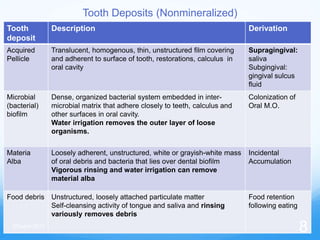
Tooth Deposits (Nonmineralized)
Tooth
deposit
Description Derivation
Acquired
Pellicle
Translucent, homogenous, thin, unstructured film covering
and adherent to surface of tooth, restorations, calculus in
oral cavity
Supragingival:
saliva
Subgingival:
gingival sulcus
fluid
Microbial
(bacterial)
biofilm
Dense, organized bacterial system embedded in inter-
microbial matrix that adhere closely to teeth, calculus and
other surfaces in oral cavity.
Water irrigation removes the outer layer of loose
organisms.
Colonization of
Oral M.O.
Materia
Alba
Loosely adherent, unstructured, white or grayish-white mass
of oral debris and bacteria that lies over dental biofilm
Vigorous rinsing and water irrigation can remove
material alba
Incidental
Accumulation
Food debris Unstructured, loosely attached particulate matter
Self-cleansing activity of tongue and saliva and rinsing
variously removes debris
Food retention
following eating
SDashti 2017
8
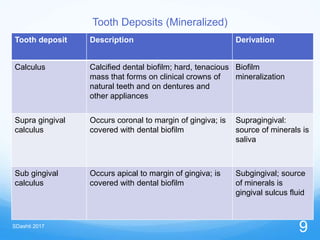
Tooth Deposits (Mineralized)
Tooth deposit Description Derivation
Calculus Calcified dental biofilm; hard, tenacious
mass that forms on clinical crowns of
natural teeth and on dentures and
other appliances
Biofilm
mineralization
Supra gingival
calculus
Occurs coronal to margin of gingiva; is
covered with dental biofilm
Supragingival:
source of minerals is
saliva
Sub gingival
calculus
Occurs apical to margin of gingiva; is
covered with dental biofilm
Subgingival; source
of minerals is
gingival sulcus fluid
SDashti 2017
9
1. Acquired Pellicle
 Acquired pellicle begins to form within minute after all
external material has been removed from tooth surfaces
with and abrasive; i.e. tooth brushing.
 It is composed of glycoproteins from saliva that selectivity
adsorbed by hydroxyapatite of tooth surface.
 The adsorbed material becomes a lightly insoluble
coating over teeth, calculus deposits, restorations, and
dentures.
SDashti 2017
10
Type of Pellicles
 Surface pellicle, Unstained:
Unstained pellicle is clear, translucent, insoluble and don’t
visible unless a disclosing agent is applied.
 Surface pellicle, Stained:
Unstained pellicle can take extrinsic stain and become brown,
grayish, or other colors
 Subsurface Pellicle:
Surface pellicle is continuous with subsurface pellicle that is
embedded in tooth structure in demineralized area in
particular.
SDashti 2017
11
Significance of Pellicle
 Protective:
Pellicle appears to provide a barrier against acids; thus reduce dental
caries attack
 Lubrication
Keeps surfaces moist , prevent drying
 Nidus for bacteria
Participates in biofilm formation by aiding adherence of M.O.
 Attachments of calculus
It is a mode of calculus attachment
SDashti 2017
12
2. Dental Biofilm
 It is a dense, non-mineralized, complex mass of clones
in a gel-like inter-microbial matrix adheres firmly to
acquired pellicle and hence the teeth, calculus ,
dentures, and restorations.
 It may contains M.O. other than bacteria like yeast,
protozoa, and viruses
SDashti 2017
13
Stages in Formation of Biofilm
1. Formation of a Pellicle
2. Bacterial attach to pellicle
3. Bacterial multiplication and colonization
4. Biofilm growth and maturation
5. Matrix formation
SDashti 2017
14
Gingivitis due to Biofilm
 Gingivitis develops within 2 to 3 weeks when biofilm is
left undisturbed on tooth surfaces
 Most gingivitis reversible and can be treated by biofilm
removal procedures and the gingiva can return to
health within few days
SDashti 2017
15
Clinical Aspects
 Distribution
A. Location
1. Supragingival Biofilm
Coronal to gingival margin
2. Gingival Biofilm
On external surfaces of attached gingiva
3. Subgingival biofilm
Located between periodontal attachment and gingival
margin within gingival sulcus or pocket
4. Fissure Biofilm
Develops in pits and fissures
SDashti 2017
16
B. By surface
1. During Formation: Supra gingival biofilm begins at gingival
margins; in interproximal surfaces in particular and increased
rapidly when left undisturbed. It spreads over gingival third and
on toward middle third of crown
1. Tooth Surfaces Involved:
 Biofilm occurs most frequently on proximal surfaces around the
gingival third
 The least amount occurs on palatal surface of maxillary teeth due to
tongue activity
SDashti 2017
17
Factors Influencing
Biofilm Accumulation
1. Crowded Teeth
2. Rough Surfaces
3. Difficult to clean
4. Out of Occlusion
5. Bacterial Multiplications
Acquired pellicle on
crowded mandibular
anterior after using
disclosing agent on facial
and lingual aspects
SDashti 2017
18
Significance of Dental Biofilm
 Biofilm plays a major role in initiation and progression of
dental caries and periodontal diseases
 Dental Caries and periodontal disease are infectious
diseases caused by pathogens M.O. found in bacterial
biofilms
 Biofilms is significant in formation of dental calculus which is
a mineralized dental biofilm
 General oral cleanliness depends of daily removal of dental
biofilm deposits
 Accumulations of dental biofilm on teeth and tongue
contributes to an unpleasant personal esthetic appearance
and Halitosis
SDashti 2017
19
3.Materia Alba
 Material Alba is loosely adherent mass of bacteria and
cellular debris that frequently occurs on top of dental
biofilm where biofilm removal is neglected.
 Materia Alba (white material) is clinically bulky , soft
deposit, and resemble cottage cheese.
 Forms over dental biofilm.
 Clearly visible without disclosing agent.
 It can be removed with water spry and oral irrigator
whereas biofilm CAN NOT.
SDashti 2017
20
4. Food Debris
 Loose food particles collect about cervical third and
proximal embrasures of teeth.
 Food may forced between teeth during mastication in
open contacts, irregularities of occlusion and tooth
mobility. Horizontal food impaction may occurs when
interdental papillae are reduced of missing
 Self-cleansing through action of tongue, lips, and saliva
may take place
 Full debris removal can be done by tooth brushing,
flossing and using other aids
SDashti 2017
21

Intro five soft deposits

  • 1.
  • 2.
    Lecture Outlines Terminology Soft Deposits 1.Acquired Pellicle or Cuticle 2. Dental Biofilm 3. Materia Alba 4. Food Debris SDashti 2017 2
  • 3.
    Terminology Terminology Meaning Acellular Notcontaining a cell Adsorption Action of a substance attracting and holding other materials on its surface Aerobe Microorganism that live and grow in the presence of O2 Anaerobe Microorganism that live sin almost complete absence of O2 Biofilm Matrix-enclosed bacterial populations adherent to each other or to surfaces Infection Invasion and multiplication of a microorganism in body tissue SDashti 2017 3
  • 4.
    Terminology Terminology Meaning Calculogenesis Formationof calculus Calculogenic Adjective applied to dental biofilm conductive to formation of calculus Cariogenesis Development of dental caries Cariogenic Adjective to indicate a conduciveness to initiate dental caries such as carogenic food or biofilm Oral Flora Various bacteria and M.O. that inhabit oral cavity. The mouth have indigenous flora (native to body). Certain organisms specifically reside in certain part such as tongue , mucosa, and gingival sulcus SDashti 2017 4
  • 5.
    Terminology Terminology Meaning Materia AlbaWhite or cream – colored cheesy mass collects over dental biofilm on unclean neglected teeth; it is composed of food debris and bacteria Leukocyte White blood cell (WBC); functions to protect body against infection and disease Microorganism Minute living microscopic organisms include bacteria, fungi, viruses , protozoa and rickettsia Maturation Stage or process of attaining maximal development, become mature Pathogen Disease –producing agent or microorganism ; adjective pathogenic SDashti 2017 5
  • 6.
    Important Facts  Dentalcaries and gingival and periodontal disease are all caused by microorganisms in microbial or dental biofilms.  Disease –producing M.O. attach to tooth surfaces and colonize bring about:  Carious lesions of enamel and root surface, in pits and fissures, and on smooth surfaces  Inflammatory changes in periodontium that lead to tissue destructions and loss of attachment SDashti 2017 6
  • 7.
    Soft Deposits 1. AcquiredPellicle or Cuticle 2. Dental Biofilm 3. Materia Alba 4. Food Debris  Each one has it is own entity and terms should not be interchanged SDashti 2017 7
  • 8.
    Tooth Deposits (Nonmineralized) Tooth deposit DescriptionDerivation Acquired Pellicle Translucent, homogenous, thin, unstructured film covering and adherent to surface of tooth, restorations, calculus in oral cavity Supragingival: saliva Subgingival: gingival sulcus fluid Microbial (bacterial) biofilm Dense, organized bacterial system embedded in inter- microbial matrix that adhere closely to teeth, calculus and other surfaces in oral cavity. Water irrigation removes the outer layer of loose organisms. Colonization of Oral M.O. Materia Alba Loosely adherent, unstructured, white or grayish-white mass of oral debris and bacteria that lies over dental biofilm Vigorous rinsing and water irrigation can remove material alba Incidental Accumulation Food debris Unstructured, loosely attached particulate matter Self-cleansing activity of tongue and saliva and rinsing variously removes debris Food retention following eating SDashti 2017 8
  • 9.
    Tooth Deposits (Mineralized) Toothdeposit Description Derivation Calculus Calcified dental biofilm; hard, tenacious mass that forms on clinical crowns of natural teeth and on dentures and other appliances Biofilm mineralization Supra gingival calculus Occurs coronal to margin of gingiva; is covered with dental biofilm Supragingival: source of minerals is saliva Sub gingival calculus Occurs apical to margin of gingiva; is covered with dental biofilm Subgingival; source of minerals is gingival sulcus fluid SDashti 2017 9
  • 10.
    1. Acquired Pellicle Acquired pellicle begins to form within minute after all external material has been removed from tooth surfaces with and abrasive; i.e. tooth brushing.  It is composed of glycoproteins from saliva that selectivity adsorbed by hydroxyapatite of tooth surface.  The adsorbed material becomes a lightly insoluble coating over teeth, calculus deposits, restorations, and dentures. SDashti 2017 10
  • 11.
    Type of Pellicles Surface pellicle, Unstained: Unstained pellicle is clear, translucent, insoluble and don’t visible unless a disclosing agent is applied.  Surface pellicle, Stained: Unstained pellicle can take extrinsic stain and become brown, grayish, or other colors  Subsurface Pellicle: Surface pellicle is continuous with subsurface pellicle that is embedded in tooth structure in demineralized area in particular. SDashti 2017 11
  • 12.
    Significance of Pellicle Protective: Pellicle appears to provide a barrier against acids; thus reduce dental caries attack  Lubrication Keeps surfaces moist , prevent drying  Nidus for bacteria Participates in biofilm formation by aiding adherence of M.O.  Attachments of calculus It is a mode of calculus attachment SDashti 2017 12
  • 13.
    2. Dental Biofilm It is a dense, non-mineralized, complex mass of clones in a gel-like inter-microbial matrix adheres firmly to acquired pellicle and hence the teeth, calculus , dentures, and restorations.  It may contains M.O. other than bacteria like yeast, protozoa, and viruses SDashti 2017 13
  • 14.
    Stages in Formationof Biofilm 1. Formation of a Pellicle 2. Bacterial attach to pellicle 3. Bacterial multiplication and colonization 4. Biofilm growth and maturation 5. Matrix formation SDashti 2017 14
  • 15.
    Gingivitis due toBiofilm  Gingivitis develops within 2 to 3 weeks when biofilm is left undisturbed on tooth surfaces  Most gingivitis reversible and can be treated by biofilm removal procedures and the gingiva can return to health within few days SDashti 2017 15
  • 16.
    Clinical Aspects  Distribution A.Location 1. Supragingival Biofilm Coronal to gingival margin 2. Gingival Biofilm On external surfaces of attached gingiva 3. Subgingival biofilm Located between periodontal attachment and gingival margin within gingival sulcus or pocket 4. Fissure Biofilm Develops in pits and fissures SDashti 2017 16
  • 17.
    B. By surface 1.During Formation: Supra gingival biofilm begins at gingival margins; in interproximal surfaces in particular and increased rapidly when left undisturbed. It spreads over gingival third and on toward middle third of crown 1. Tooth Surfaces Involved:  Biofilm occurs most frequently on proximal surfaces around the gingival third  The least amount occurs on palatal surface of maxillary teeth due to tongue activity SDashti 2017 17
  • 18.
    Factors Influencing Biofilm Accumulation 1.Crowded Teeth 2. Rough Surfaces 3. Difficult to clean 4. Out of Occlusion 5. Bacterial Multiplications Acquired pellicle on crowded mandibular anterior after using disclosing agent on facial and lingual aspects SDashti 2017 18
  • 19.
    Significance of DentalBiofilm  Biofilm plays a major role in initiation and progression of dental caries and periodontal diseases  Dental Caries and periodontal disease are infectious diseases caused by pathogens M.O. found in bacterial biofilms  Biofilms is significant in formation of dental calculus which is a mineralized dental biofilm  General oral cleanliness depends of daily removal of dental biofilm deposits  Accumulations of dental biofilm on teeth and tongue contributes to an unpleasant personal esthetic appearance and Halitosis SDashti 2017 19
  • 20.
    3.Materia Alba  MaterialAlba is loosely adherent mass of bacteria and cellular debris that frequently occurs on top of dental biofilm where biofilm removal is neglected.  Materia Alba (white material) is clinically bulky , soft deposit, and resemble cottage cheese.  Forms over dental biofilm.  Clearly visible without disclosing agent.  It can be removed with water spry and oral irrigator whereas biofilm CAN NOT. SDashti 2017 20
  • 21.
    4. Food Debris Loose food particles collect about cervical third and proximal embrasures of teeth.  Food may forced between teeth during mastication in open contacts, irregularities of occlusion and tooth mobility. Horizontal food impaction may occurs when interdental papillae are reduced of missing  Self-cleansing through action of tongue, lips, and saliva may take place  Full debris removal can be done by tooth brushing, flossing and using other aids SDashti 2017 21