1
The Intranet
2
What is Intranet?
Intranet is :
– A computer network that uses Internet standards
(HTML, HTTP & TCP/IP protocols) & software.
– Accessed only by authorized persons, especially
members or employees of the organization
The main purpose of an intranet is:
To share company information and computing resources
among employees.
Intranet
3
Usage of Intranet
Many companies use intranets for tasks as:
• Distributing a company newsletter
• Sharing information
• For facilitating the workgroups accordingly.
• Instant knowledge about important news and memos.
• Relationship building.
• Increasing productivity.
• Recommendations and suggestions.
• Project management.
4
5
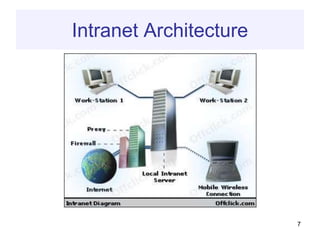
Intranet Characteristics
• In general it looks like a private version of the Internet
• Uses some (TCP/IP,HTTP) or all of the protocols of the
internet.
• Nodes interact in a client server relationship.
• Nodes are identified by using Internet Protocol (IP)
addresses
• Files are identified by universal resource locators
(URLs).
• The data being exchanged are typically formatted using
HTML and is controlled and displayed using a browser.
• It may consist of many interlinked local area networks.
6
Intranet Characteristics
• The users of intranet network may access the Internet
via proxy server and firewall server, or it may be totally
separate
• It includes connections through one or more gateway to
the outside Internet.
• With tunneling, companies can send private messages
through the public network, using encryption/decryption
and other security safeguards to connect one part of
their intranet to another.
• When part of an intranet is made accessible to
customers, partners, suppliers, or others outside the
company, that part becomes part of an extranet.
Intranet Architecture
7
8
Proxy Server
• Is a server that acts as an intermediary between a
workstation user and the Internet .
• A proxy server is associated with or part of a gateway
server that separates the enterprise network from the
outside network.
• The enterprise can ensure security, administrative
control, and caching service by using a proxy server.
Proxy Server- How it works
• A proxy server receives a request for an Internet service
(such as a Web page request) from a user.
• If it passes filtering requirements, the proxy server,
assuming it is also a cache server, looks in its local
cache of previously downloaded Web pages.
• If it finds the page, it returns it to the user without
needing to forward the request to the Internet.
9
Proxy Server- How it works
• If the page is not in the cache, the proxy server, acting
as a client on behalf of the user, uses one of its own IP
addresses to request the page from the server out on the
Internet.
• When the page is returned, the proxy server relates it to
the original request and forwards it on to the user.
10
11
Firewall
• Firewall : A firewall is a set of related programs, located
at a network gateway that protects the resources of a
private network from users from other networks.
• Firewall used in an intranet have the ability to screen
messages in both directions so that company security is
maintained.
• A firewall surrounding an intranet fends off unauthorized
access.
Proxy Server and Firewall
12
13
Gateway
• A gateway is a network point that acts as an entrance to
another network.
• On the Internet, a node can be either a gateway node or
a host (end-point) node.
• Both the computers of Internet users and the computers
that serve pages to users are host nodes.
• The computers that control traffic within your company's
network or at your local Internet service provider (ISP)
are gateway nodes.
Gateway
• In the network for an enterprise, a computer server
acting as a gateway node is often also acting as a proxy
server and a firewall server.
• A gateway is often associated with:
– a router, which knows where to direct a given packet
of data that arrives at the gateway,
– and a switch, which furnishes the actual path in and
out of the gateway for a given packet.
14
Gateway
15
Intranet as Business Tool
• Improves internal communication
A modern intranet is designed to promote collaboration throughout
your organization, so:
a) Teams can engage in open discussions.
b) Individuals can contribute their knowledge.
c) Leaders can stay in touch.
d) Departments can provide updates.
• Connects your company across time zones and places
An intranet is the central hub for organizations. It’s a place where
employees communicate, where company news is shared, and
where events are scheduled. With these features, an intranet may
bring together multi-location teams.
16
Intranet as Business Tool
• Helps in document sharing
The inability to access or share necessary files, policies,
presentations, etc., can be quickly resolved by implementing an
intranet solution. This system makes it easier to store the
information in a single space to which access can be provided
based on the roles and designations.
• Managing Projects
a) Providing a secure project workspace to focus and simplify team
communication and coordination
b) Accessing the latest version of project documents in a secure library
c) Tracking progress with a timeline of major milestones and associated
tasks
d) Build skilled project teams and allowing team members to share
ideas and insights
e) Helping team members engage and collaborate so they get to know
each other better, building stronger team dynamics 17
Intranet as Business Tool
• Facilitating Learning and Training
a) Integrating a Learning Management System (or providing built-in LMS
capabilities)
b) Allowing employees to browse courses and view learning paths
c) Accessing a variety of learning materials including video and interactive
quizzes
d) Organising training material into logical courses, modules and an entire
curriculum
e) Ensuring the completion of mandatory learning, for example compliance
training
f) Tracking learning progress for each individual, team managers and
training administrators
18
Intranet as Business Tool
• Simplifies employee onboarding
A good intranet makes onboarding easier than before. It gives new hires
easy-to-access documentation, up-to-date organizational charts, extensive
profiles of their colleagues, and a bustling news hub that provides
information and insights into the company’s culture.
• Reduces meetings and emails
An intranet platform certainly makes sense for you if your calendar and
inbox are overflowing with meetings and emails. 62% of emails that
employees receive are not important. Discussions are simple on intranets
with a solid, integrated instant chat capability. You can now stop using the
dreadful reply-all email feature and engage in valuable conversations away
from your cluttered inbox.
19
Intranet as Business Tool
• Improved internal communications
One of the greatest benefits of a next-gen intranet is its ability to completely
restructure the way your organization communicates with your employees.
Having a wealth of communication tools at their fingertips enables
employees to communicate how they want. Email, voice, video, instant
messaging and social means users can get the information they need from
colleagues faster than ever before.
• Seamless knowledge sharing &
collaboration
As a hub for all employee needs, a modern intranet doubles as a place
where your people can connect and collaborate with one another. Being
able to communicate effectively with co-workers improves collaboration, but
a quality intranet can take that further by enabling teams to work on the
same document simultaneously or see exactly who has previously made
what changes. 20
Intranet as Business Tool
• Fuel higher productivity
A quality intranet creates a more efficient business where workers are more
productive, loyal, collaborative and communicative, leading to greater
efficiencies and profits. Several Unily clients have seen dramatic
productivity gains since implementing their intranet platform.
• Improve employee loyalty and sense of
belonging
Employees that have a workspace specific to them, can communicate
effectively with colleagues, and feel they can input ideas and concerns to
management, are more likely to feel valued within an
organization. Providing employees with a personalized experience of your
company intranet, such as opening their home page with relevant news,
updates, apps and documents, while enabling them to generate their own
content, is a key driver of engagement.
21

intranet _

  • 1.
  • 2.
    2 What is Intranet? Intranetis : – A computer network that uses Internet standards (HTML, HTTP & TCP/IP protocols) & software. – Accessed only by authorized persons, especially members or employees of the organization The main purpose of an intranet is: To share company information and computing resources among employees.
  • 3.
  • 4.
    Usage of Intranet Manycompanies use intranets for tasks as: • Distributing a company newsletter • Sharing information • For facilitating the workgroups accordingly. • Instant knowledge about important news and memos. • Relationship building. • Increasing productivity. • Recommendations and suggestions. • Project management. 4
  • 5.
    5 Intranet Characteristics • Ingeneral it looks like a private version of the Internet • Uses some (TCP/IP,HTTP) or all of the protocols of the internet. • Nodes interact in a client server relationship. • Nodes are identified by using Internet Protocol (IP) addresses • Files are identified by universal resource locators (URLs). • The data being exchanged are typically formatted using HTML and is controlled and displayed using a browser. • It may consist of many interlinked local area networks.
  • 6.
    6 Intranet Characteristics • Theusers of intranet network may access the Internet via proxy server and firewall server, or it may be totally separate • It includes connections through one or more gateway to the outside Internet. • With tunneling, companies can send private messages through the public network, using encryption/decryption and other security safeguards to connect one part of their intranet to another. • When part of an intranet is made accessible to customers, partners, suppliers, or others outside the company, that part becomes part of an extranet.
  • 7.
  • 8.
    8 Proxy Server • Isa server that acts as an intermediary between a workstation user and the Internet . • A proxy server is associated with or part of a gateway server that separates the enterprise network from the outside network. • The enterprise can ensure security, administrative control, and caching service by using a proxy server.
  • 9.
    Proxy Server- Howit works • A proxy server receives a request for an Internet service (such as a Web page request) from a user. • If it passes filtering requirements, the proxy server, assuming it is also a cache server, looks in its local cache of previously downloaded Web pages. • If it finds the page, it returns it to the user without needing to forward the request to the Internet. 9
  • 10.
    Proxy Server- Howit works • If the page is not in the cache, the proxy server, acting as a client on behalf of the user, uses one of its own IP addresses to request the page from the server out on the Internet. • When the page is returned, the proxy server relates it to the original request and forwards it on to the user. 10
  • 11.
    11 Firewall • Firewall :A firewall is a set of related programs, located at a network gateway that protects the resources of a private network from users from other networks. • Firewall used in an intranet have the ability to screen messages in both directions so that company security is maintained. • A firewall surrounding an intranet fends off unauthorized access.
  • 12.
    Proxy Server andFirewall 12
  • 13.
    13 Gateway • A gatewayis a network point that acts as an entrance to another network. • On the Internet, a node can be either a gateway node or a host (end-point) node. • Both the computers of Internet users and the computers that serve pages to users are host nodes. • The computers that control traffic within your company's network or at your local Internet service provider (ISP) are gateway nodes.
  • 14.
    Gateway • In thenetwork for an enterprise, a computer server acting as a gateway node is often also acting as a proxy server and a firewall server. • A gateway is often associated with: – a router, which knows where to direct a given packet of data that arrives at the gateway, – and a switch, which furnishes the actual path in and out of the gateway for a given packet. 14
  • 15.
  • 16.
    Intranet as BusinessTool • Improves internal communication A modern intranet is designed to promote collaboration throughout your organization, so: a) Teams can engage in open discussions. b) Individuals can contribute their knowledge. c) Leaders can stay in touch. d) Departments can provide updates. • Connects your company across time zones and places An intranet is the central hub for organizations. It’s a place where employees communicate, where company news is shared, and where events are scheduled. With these features, an intranet may bring together multi-location teams. 16
  • 17.
    Intranet as BusinessTool • Helps in document sharing The inability to access or share necessary files, policies, presentations, etc., can be quickly resolved by implementing an intranet solution. This system makes it easier to store the information in a single space to which access can be provided based on the roles and designations. • Managing Projects a) Providing a secure project workspace to focus and simplify team communication and coordination b) Accessing the latest version of project documents in a secure library c) Tracking progress with a timeline of major milestones and associated tasks d) Build skilled project teams and allowing team members to share ideas and insights e) Helping team members engage and collaborate so they get to know each other better, building stronger team dynamics 17
  • 18.
    Intranet as BusinessTool • Facilitating Learning and Training a) Integrating a Learning Management System (or providing built-in LMS capabilities) b) Allowing employees to browse courses and view learning paths c) Accessing a variety of learning materials including video and interactive quizzes d) Organising training material into logical courses, modules and an entire curriculum e) Ensuring the completion of mandatory learning, for example compliance training f) Tracking learning progress for each individual, team managers and training administrators 18
  • 19.
    Intranet as BusinessTool • Simplifies employee onboarding A good intranet makes onboarding easier than before. It gives new hires easy-to-access documentation, up-to-date organizational charts, extensive profiles of their colleagues, and a bustling news hub that provides information and insights into the company’s culture. • Reduces meetings and emails An intranet platform certainly makes sense for you if your calendar and inbox are overflowing with meetings and emails. 62% of emails that employees receive are not important. Discussions are simple on intranets with a solid, integrated instant chat capability. You can now stop using the dreadful reply-all email feature and engage in valuable conversations away from your cluttered inbox. 19
  • 20.
    Intranet as BusinessTool • Improved internal communications One of the greatest benefits of a next-gen intranet is its ability to completely restructure the way your organization communicates with your employees. Having a wealth of communication tools at their fingertips enables employees to communicate how they want. Email, voice, video, instant messaging and social means users can get the information they need from colleagues faster than ever before. • Seamless knowledge sharing & collaboration As a hub for all employee needs, a modern intranet doubles as a place where your people can connect and collaborate with one another. Being able to communicate effectively with co-workers improves collaboration, but a quality intranet can take that further by enabling teams to work on the same document simultaneously or see exactly who has previously made what changes. 20
  • 21.
    Intranet as BusinessTool • Fuel higher productivity A quality intranet creates a more efficient business where workers are more productive, loyal, collaborative and communicative, leading to greater efficiencies and profits. Several Unily clients have seen dramatic productivity gains since implementing their intranet platform. • Improve employee loyalty and sense of belonging Employees that have a workspace specific to them, can communicate effectively with colleagues, and feel they can input ideas and concerns to management, are more likely to feel valued within an organization. Providing employees with a personalized experience of your company intranet, such as opening their home page with relevant news, updates, apps and documents, while enabling them to generate their own content, is a key driver of engagement. 21