Chapter 7
Intranet and Extranet

1
Intrabusiness E-Commerce
at Toshiba America
Problem
Intranet doubled as dealer extranet
300 dealers needed parts quickly
Orders placed by phone or fax by 2:00 in order
to have next-day delivery
Shipping fees expensive
Cumbersome order-entry system created in
1993 with no significant improvement

2
Intrabusiness E-Commerce
at Toshiba America
Solution

1997, Toshiba created a Web-based order-entry
system using extranet/intranet
Dealers lace orders for parts until 5:00 for nextday delivery—matter of hours to shipping
Physical warehouse in Memphis, TN near FedEx
headquarters ensures quick delivery
Dealers also:
Check accounts receivable balances
Pricing arrangements
Read service bulletins, etc.

3
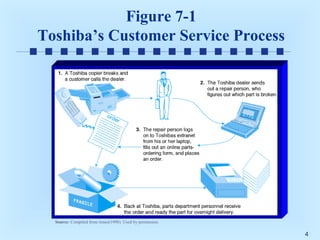
Figure 7-1
Toshiba’s Customer Service Process

Source: Compiled from Jones(1998). Used by permission.

4
Intrabusiness and
Business-to-Employee (B2E) E-commerce (cont.)
Between and among corporate employees
Large organizations have classified ads on the
intranet where employees can buy and sell
products and services from each other
Especially popular in universities
Interconnect their intranets to increase
exposure
Employees collaborate and communicate
using EC technologies
5
Architecture of the Internet, Intranet
and Extranet
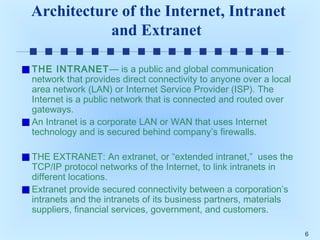
THE INTRANET— is a public and global communication
network that provides direct connectivity to anyone over a local
area network (LAN) or Internet Service Provider (ISP). The
Internet is a public network that is connected and routed over
gateways.
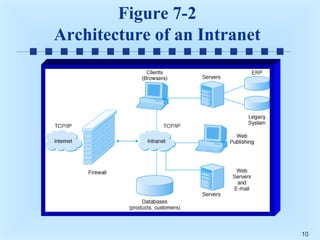
An Intranet is a corporate LAN or WAN that uses Internet
technology and is secured behind company’s firewalls.
THE EXTRANET: An extranet, or “extended intranet,” uses the
TCP/IP protocol networks of the Internet, to link intranets in
different locations.
Extranet provide secured connectivity between a corporation’s
intranets and the intranets of its business partners, materials
suppliers, financial services, government, and customers.
6
Characteristics of the INTERNET,
Intranet and Extranet
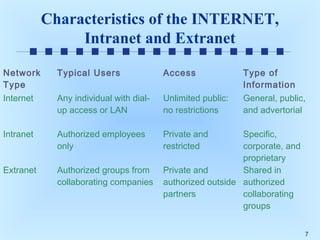
Network
Type

Typical Users

Access

Type of
Information

Internet

Any individual with dialup access or LAN

Unlimited public:
no restrictions

General, public,
and advertorial

Intranet

Authorized employees
only

Private and
restricted

Extranet

Authorized groups from
collaborating companies

Specific,
corporate, and
proprietary
Private and
Shared in
authorized outside authorized
partners
collaborating
groups
7
Intranets
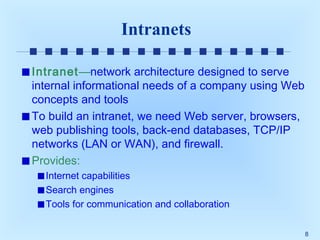
Intranet—network architecture designed to serve
internal informational needs of a company using Web
concepts and tools
To build an intranet, we need Web server, browsers,
web publishing tools, back-end databases, TCP/IP
networks (LAN or WAN), and firewall.
Provides:
Internet capabilities
Search engines
Tools for communication and collaboration
8
Intranets (cont.)
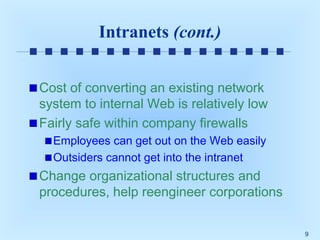
Cost of converting an existing network
system to internal Web is relatively low
Fairly safe within company firewalls
Employees can get out on the Web easily
Outsiders cannot get into the intranet

Change organizational structures and
procedures, help reengineer corporations
9
Figure 7-2
Architecture of an Intranet

10
Intranet Functionalities
Intranet functionalities
Corporate/department/individual Web pages
Web-based database access for ease of use
Search engines, indexing engines, directories
assisted by keyword search
Integration with EC: interface with Internet-based
electronic sales and purchasing
Interactive communication
Chatting
Audio support
Videoconferencing
11
Intranet Functionalities (cont.)
Document distribution and workflow
Web-based downloading
Routing of documents

Groupware including

Enhanced e-mail
Bulletin boards
Screen sharing
Other group support tools

Conduit for computer-based telephony system
Extranet: linking geographically dispersed branches,
customers, and suppliers to authorized sections of
intranets creates happier customers, more efficient
suppliers, and reduced staff costs.
12
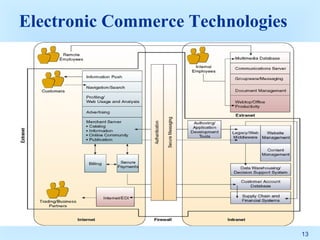
Electronic Commerce Technologies

13
Intranet Applications
Intranet application areas
Electronic commerce
Customer service
Search and access to documents
Personalized information
Enhanced knowledge sharing
Enhanced group decision and business
processes
14
Intranets Applications (cont.)
Intranet application areas (cont.)
Empowerment
Virtual organizations
Software distribution
Document management
Project management
Training
Enhanced transaction processing
Paperless information delivery
Improved administrative processes
15
Intranet Functionalities
Industry-specific intranet solutions

Classified by industry instead of technology
Development of business models is a critical
concern for managerial success of intranets
Top 100 intranet/extranet solutions classifications
Financial services
Information technology
Manufacturing
Retail
Services
16
Intranet Application (Case Studies)
Intranet case studies
Moen-connected ERP
Compaq Computer Corp.—investment assistant
Silicon Graphics, Inc.—share huge internal Web
sites
Coopers & Lybrand—share knowledge among
corporate employees

17
Extranets
Extranet combine the privacy and security
of intranets with the global reach of the
Internet, granting access to outside
business partners, suppliers, and
customers to a controlled portion of the
enterprise network.
Extranets are becoming the major
platforms for B2B EC replacing or
supplementing EDI.
18
The Structure of Extranets
ELEMENTS OF EXTRANET

Extranets are comprised of a wide variety of
components and participants, and there are several
possible configurations. These include intranet, Web
servers, Firewall, ISP’s tunneling technology, interface
software and business applications.
The tunneling means that data transmission across the
internet can be made secure by authenticating and
encrypting all IP packets.
Extranets are configured by two basic methods:
They can be implemented using a direct leased line
with full control over it, linking all intranets.
A secure link (tunnel) can be created across the
Internet, which can be used by the corporation as a
VPN, usually at a much lower cost.

19
Extranet Products and Services
Four Categories of extranet products and services.
1. Extranet development tools: to design extranet servers, a clientbase, security, EC applications, and electronic catalogs.
2. Extranet hosting and network connectivity: provide secure
ISP connections to Internet back bones and host extranet services for
corporations.
3. Extranet services provide extranet design expertise with
proprietary tools or turnkey services for building and operating
extranet-based services for corporate clients.
4. Virtual private networks: provide components specifically design
for connecting remote operators and creating IP WANs for
corporations
20
Extranet tools and Services Providers
1. Consultants
2. Developers
3. System integration
4. Internet service provider
21
Applications of Extranets
BENEFITS OF EXTRANETS
1. Enhanced communication
Improved internal communication
Improved business partnership channels
Effective marketing, sales and customer support
Collaborative activities support

1. Productivity enhancements
Just-in-time information delivery
Reduction of information overload
Productivity collaboration between work groups
Training on demand
22
Applications of Extranets
BENEFITS OF EXTRANETS (Cont.)
3. Business enhancements

Faster time to market
Simultaneous engineering potential
Lower design and production costs
Improved client relationships
New business opportunities

3. Cost reduction

Reduced error
Reduced travel and meeting
Improved comparison shopping
Reduced administrative and operational costs
23
Applications of Extranets
BENEFITS OF EXTRANETS (Cont.)
5. Information delivery

Low-cost publishing
Leveraging of legacy systems
Standard delivery systems
Ease of maintenance and implementation
Elimination of paper publishing and mailing costs.

INDUSTRY SPECIFIC EXTRANET SOLUTIONS
The application of extranets are classified by
industry. The popularly applied industries are
information services, computers, financial services,
travel, Industry/ manufacturing, business and
professional, real estate and customers.
24
Managerial Issues
Find business opportunities by utilizing the
intranet and extranet
Analyze whether the connectivity requirement
suits the intranet or extranet
Plan the most secure and economical choice
for implementation
Select the best outsourcers for implementation
Selling the intranet
Finding intranet applications
25

E-Commerce 07

  • 1.
  • 2.
    Intrabusiness E-Commerce at ToshibaAmerica Problem Intranet doubled as dealer extranet 300 dealers needed parts quickly Orders placed by phone or fax by 2:00 in order to have next-day delivery Shipping fees expensive Cumbersome order-entry system created in 1993 with no significant improvement 2
  • 3.
    Intrabusiness E-Commerce at ToshibaAmerica Solution 1997, Toshiba created a Web-based order-entry system using extranet/intranet Dealers lace orders for parts until 5:00 for nextday delivery—matter of hours to shipping Physical warehouse in Memphis, TN near FedEx headquarters ensures quick delivery Dealers also: Check accounts receivable balances Pricing arrangements Read service bulletins, etc. 3
  • 4.
    Figure 7-1 Toshiba’s CustomerService Process Source: Compiled from Jones(1998). Used by permission. 4
  • 5.
    Intrabusiness and Business-to-Employee (B2E)E-commerce (cont.) Between and among corporate employees Large organizations have classified ads on the intranet where employees can buy and sell products and services from each other Especially popular in universities Interconnect their intranets to increase exposure Employees collaborate and communicate using EC technologies 5
  • 6.
    Architecture of theInternet, Intranet and Extranet THE INTRANET— is a public and global communication network that provides direct connectivity to anyone over a local area network (LAN) or Internet Service Provider (ISP). The Internet is a public network that is connected and routed over gateways. An Intranet is a corporate LAN or WAN that uses Internet technology and is secured behind company’s firewalls. THE EXTRANET: An extranet, or “extended intranet,” uses the TCP/IP protocol networks of the Internet, to link intranets in different locations. Extranet provide secured connectivity between a corporation’s intranets and the intranets of its business partners, materials suppliers, financial services, government, and customers. 6
  • 7.
    Characteristics of theINTERNET, Intranet and Extranet Network Type Typical Users Access Type of Information Internet Any individual with dialup access or LAN Unlimited public: no restrictions General, public, and advertorial Intranet Authorized employees only Private and restricted Extranet Authorized groups from collaborating companies Specific, corporate, and proprietary Private and Shared in authorized outside authorized partners collaborating groups 7
  • 8.
    Intranets Intranet—network architecture designedto serve internal informational needs of a company using Web concepts and tools To build an intranet, we need Web server, browsers, web publishing tools, back-end databases, TCP/IP networks (LAN or WAN), and firewall. Provides: Internet capabilities Search engines Tools for communication and collaboration 8
  • 9.
    Intranets (cont.) Cost ofconverting an existing network system to internal Web is relatively low Fairly safe within company firewalls Employees can get out on the Web easily Outsiders cannot get into the intranet Change organizational structures and procedures, help reengineer corporations 9
  • 10.
  • 11.
    Intranet Functionalities Intranet functionalities Corporate/department/individualWeb pages Web-based database access for ease of use Search engines, indexing engines, directories assisted by keyword search Integration with EC: interface with Internet-based electronic sales and purchasing Interactive communication Chatting Audio support Videoconferencing 11
  • 12.
    Intranet Functionalities (cont.) Documentdistribution and workflow Web-based downloading Routing of documents Groupware including Enhanced e-mail Bulletin boards Screen sharing Other group support tools Conduit for computer-based telephony system Extranet: linking geographically dispersed branches, customers, and suppliers to authorized sections of intranets creates happier customers, more efficient suppliers, and reduced staff costs. 12
  • 13.
  • 14.
    Intranet Applications Intranet applicationareas Electronic commerce Customer service Search and access to documents Personalized information Enhanced knowledge sharing Enhanced group decision and business processes 14
  • 15.
    Intranets Applications (cont.) Intranetapplication areas (cont.) Empowerment Virtual organizations Software distribution Document management Project management Training Enhanced transaction processing Paperless information delivery Improved administrative processes 15
  • 16.
    Intranet Functionalities Industry-specific intranetsolutions Classified by industry instead of technology Development of business models is a critical concern for managerial success of intranets Top 100 intranet/extranet solutions classifications Financial services Information technology Manufacturing Retail Services 16
  • 17.
    Intranet Application (CaseStudies) Intranet case studies Moen-connected ERP Compaq Computer Corp.—investment assistant Silicon Graphics, Inc.—share huge internal Web sites Coopers & Lybrand—share knowledge among corporate employees 17
  • 18.
    Extranets Extranet combine theprivacy and security of intranets with the global reach of the Internet, granting access to outside business partners, suppliers, and customers to a controlled portion of the enterprise network. Extranets are becoming the major platforms for B2B EC replacing or supplementing EDI. 18
  • 19.
    The Structure ofExtranets ELEMENTS OF EXTRANET Extranets are comprised of a wide variety of components and participants, and there are several possible configurations. These include intranet, Web servers, Firewall, ISP’s tunneling technology, interface software and business applications. The tunneling means that data transmission across the internet can be made secure by authenticating and encrypting all IP packets. Extranets are configured by two basic methods: They can be implemented using a direct leased line with full control over it, linking all intranets. A secure link (tunnel) can be created across the Internet, which can be used by the corporation as a VPN, usually at a much lower cost. 19
  • 20.
    Extranet Products andServices Four Categories of extranet products and services. 1. Extranet development tools: to design extranet servers, a clientbase, security, EC applications, and electronic catalogs. 2. Extranet hosting and network connectivity: provide secure ISP connections to Internet back bones and host extranet services for corporations. 3. Extranet services provide extranet design expertise with proprietary tools or turnkey services for building and operating extranet-based services for corporate clients. 4. Virtual private networks: provide components specifically design for connecting remote operators and creating IP WANs for corporations 20
  • 21.
    Extranet tools andServices Providers 1. Consultants 2. Developers 3. System integration 4. Internet service provider 21
  • 22.
    Applications of Extranets BENEFITSOF EXTRANETS 1. Enhanced communication Improved internal communication Improved business partnership channels Effective marketing, sales and customer support Collaborative activities support 1. Productivity enhancements Just-in-time information delivery Reduction of information overload Productivity collaboration between work groups Training on demand 22
  • 23.
    Applications of Extranets BENEFITSOF EXTRANETS (Cont.) 3. Business enhancements Faster time to market Simultaneous engineering potential Lower design and production costs Improved client relationships New business opportunities 3. Cost reduction Reduced error Reduced travel and meeting Improved comparison shopping Reduced administrative and operational costs 23
  • 24.
    Applications of Extranets BENEFITSOF EXTRANETS (Cont.) 5. Information delivery Low-cost publishing Leveraging of legacy systems Standard delivery systems Ease of maintenance and implementation Elimination of paper publishing and mailing costs. INDUSTRY SPECIFIC EXTRANET SOLUTIONS The application of extranets are classified by industry. The popularly applied industries are information services, computers, financial services, travel, Industry/ manufacturing, business and professional, real estate and customers. 24
  • 25.
    Managerial Issues Find businessopportunities by utilizing the intranet and extranet Analyze whether the connectivity requirement suits the intranet or extranet Plan the most secure and economical choice for implementation Select the best outsourcers for implementation Selling the intranet Finding intranet applications 25