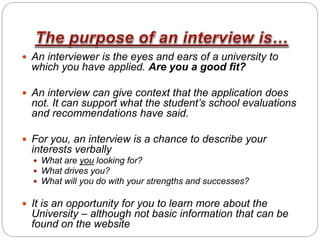
 An interviewer is the eyes and ears of a university to 
which you have applied. Are you a good fit? 
 An interview can give context that the application does 
not. It can support what the student’s school evaluations 
and recommendations have said. 
 For you, an interview is a chance to describe your 
interests verbally 
 What are you looking for? 
 What drives you? 
 What will you do with your strengths and successes? 
 It is an opportunity for you to learn more about the 
University – although not basic information that can be 
found on the website
 Do you allow me to get to know you in 30-45 minutes? 
 What are you like? 
 What do you like? 
 Will this student benefit from education at College X, and 
how will he or she contribute to the education of 
other students? 
 What can I communicate that may not be fully expressed 
in an application? This is your opportunity to bring 
dimension to listed activities.
 How you think: Conceptual, analytical, intuitive 
 A connection between your academic and personal 
interests 
 internal intellectual consistency 
 Insight into your motivations 
 A story: Perseverance, excellence, wrestling with the 
material
 Does the Interview “Count”? Help or Hurt? 
 Yes, and it is your opportunity to make it count 
 Remember that it is one piece of a holistic review 
 What is your objective in an interview? 
 To engage the interviewer, to “arm” him with material 
 To highlight messages not fully delivered in the 
application 
 Interviewers would love to write a great report: Help 
them! 
 What to wear? 
 Be prepared to explain “Why College X?” or why area of 
study? Explain in a way that strengthens your application. 
Learn about the University and your interest in the 
University, and its programs.
 Reflect! What are your strengths, interests – academic and 
non-academic? What are your goals and dreams? 
 Mark up your CV (resume) with highlights and reminders, and 
review before you go into the interview. Be prepared to be 
specific. Interviewers need to communicate through specifics. 
 Have questions ready – about the school, the process, 
whatever, but have questions! 
 Most importantly, be yourself! Don’t be who you think 
they want you to be. Be comfortable and relaxed; this is a 
conversation, not an exam. T 
 Talk about that which excites you – a passionate, eager, 
thoughtful applicant always comes across well! 
 If you get interviewer’s email, write a thank you note promptly
 …be late 
 …try to dominate the interview, keep it as a conversation 
 …game the interview 
 …leave your phone on or chew gum or anything 
inappropriate
What is your favorite class, subject? 
What are your interests outside of school? 
What do you read? 
Where have you held leadership positions? 
What does a particular leadership position or achievement mean to you? 
Why College X (and maybe why a particular program)? 
Tell me a little bit about yourself 
What do you most want out of your college education? 
Who has influenced you most in your life? 
Tell me about a mistake you have made? What did you learn from it? 
What do you aspire to? 
Unusual circumstances in background?
 e.g.What do you like to read? 
 Good: 
“Most remarkable to me in my conversation was his 
organized response to each question. He is clearly 
bright, and was well prepared for the interview with a 
range of answers to my questions. He remembered each 
question, answered them in order and did so thoroughly.” 
 Weak: 
“Outside of school she likes to read history and fiction, 
though she does not cite any specific examples.”
 Good: 
“I asked her to tell me about a time when she made a 
mistake, and what she learned from it. She considered 
the question, and instead said, “Let me talk about a time 
when I took a risk.” In doing so, she properly redirected 
the answer to my question. It was not a rehearsed 
answer.”
 Negative: 
“I could not engage him in deeper issues because I could 
not discover that about which he is passionate.” 
 Also negative: 
“He could not describe his motivation. He told me that he 
was applying to very good schools but he could not tell 
me why he chose those particular schools. I don’t know 
if it was a language issue, and he could not articulate the 
finer elements of emotion and judgment, or if he simply 
lacked insight into his own behavior. I explored for an 
overriding academic interest or curiosity, and could find 
none.”
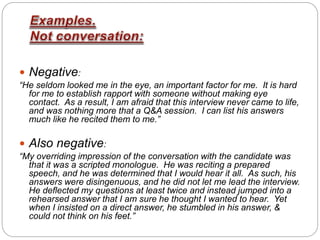
 Negative: 
“He seldom looked me in the eye, an important factor for me. It is hard 
for me to establish rapport with someone without making eye 
contact. As a result, I am afraid that this interview never came to life, 
and was nothing more that a Q&A session. I can list his answers 
much like he recited them to me.” 
 Also negative: 
“My overriding impression of the conversation with the candidate was 
that it was a scripted monologue. He was reciting a prepared 
speech, and he was determined that I would hear it all. As such, his 
answers were disingenuous, and he did not let me lead the interview. 
He deflected my questions at least twice and instead jumped into a 
rehearsed answer that I am sure he thought I wanted to hear. Yet 
when I insisted on a direct answer, he stumbled in his answer, & 
could not think on his feet.”

Interview Workshop

  • 2.
     An intervieweris the eyes and ears of a university to which you have applied. Are you a good fit?  An interview can give context that the application does not. It can support what the student’s school evaluations and recommendations have said.  For you, an interview is a chance to describe your interests verbally  What are you looking for?  What drives you?  What will you do with your strengths and successes?  It is an opportunity for you to learn more about the University – although not basic information that can be found on the website
  • 3.
     Do youallow me to get to know you in 30-45 minutes?  What are you like?  What do you like?  Will this student benefit from education at College X, and how will he or she contribute to the education of other students?  What can I communicate that may not be fully expressed in an application? This is your opportunity to bring dimension to listed activities.
  • 4.
     How youthink: Conceptual, analytical, intuitive  A connection between your academic and personal interests  internal intellectual consistency  Insight into your motivations  A story: Perseverance, excellence, wrestling with the material
  • 5.
     Does theInterview “Count”? Help or Hurt?  Yes, and it is your opportunity to make it count  Remember that it is one piece of a holistic review  What is your objective in an interview?  To engage the interviewer, to “arm” him with material  To highlight messages not fully delivered in the application  Interviewers would love to write a great report: Help them!  What to wear?  Be prepared to explain “Why College X?” or why area of study? Explain in a way that strengthens your application. Learn about the University and your interest in the University, and its programs.
  • 6.
     Reflect! Whatare your strengths, interests – academic and non-academic? What are your goals and dreams?  Mark up your CV (resume) with highlights and reminders, and review before you go into the interview. Be prepared to be specific. Interviewers need to communicate through specifics.  Have questions ready – about the school, the process, whatever, but have questions!  Most importantly, be yourself! Don’t be who you think they want you to be. Be comfortable and relaxed; this is a conversation, not an exam. T  Talk about that which excites you – a passionate, eager, thoughtful applicant always comes across well!  If you get interviewer’s email, write a thank you note promptly
  • 7.
     …be late  …try to dominate the interview, keep it as a conversation  …game the interview  …leave your phone on or chew gum or anything inappropriate
  • 8.
    What is yourfavorite class, subject? What are your interests outside of school? What do you read? Where have you held leadership positions? What does a particular leadership position or achievement mean to you? Why College X (and maybe why a particular program)? Tell me a little bit about yourself What do you most want out of your college education? Who has influenced you most in your life? Tell me about a mistake you have made? What did you learn from it? What do you aspire to? Unusual circumstances in background?
  • 9.
     e.g.What doyou like to read?  Good: “Most remarkable to me in my conversation was his organized response to each question. He is clearly bright, and was well prepared for the interview with a range of answers to my questions. He remembered each question, answered them in order and did so thoroughly.”  Weak: “Outside of school she likes to read history and fiction, though she does not cite any specific examples.”
  • 10.
     Good: “Iasked her to tell me about a time when she made a mistake, and what she learned from it. She considered the question, and instead said, “Let me talk about a time when I took a risk.” In doing so, she properly redirected the answer to my question. It was not a rehearsed answer.”
  • 11.
     Negative: “Icould not engage him in deeper issues because I could not discover that about which he is passionate.”  Also negative: “He could not describe his motivation. He told me that he was applying to very good schools but he could not tell me why he chose those particular schools. I don’t know if it was a language issue, and he could not articulate the finer elements of emotion and judgment, or if he simply lacked insight into his own behavior. I explored for an overriding academic interest or curiosity, and could find none.”
  • 12.
     Negative: “Heseldom looked me in the eye, an important factor for me. It is hard for me to establish rapport with someone without making eye contact. As a result, I am afraid that this interview never came to life, and was nothing more that a Q&A session. I can list his answers much like he recited them to me.”  Also negative: “My overriding impression of the conversation with the candidate was that it was a scripted monologue. He was reciting a prepared speech, and he was determined that I would hear it all. As such, his answers were disingenuous, and he did not let me lead the interview. He deflected my questions at least twice and instead jumped into a rehearsed answer that I am sure he thought I wanted to hear. Yet when I insisted on a direct answer, he stumbled in his answer, & could not think on his feet.”