Interview Skills
How to Improve your Performance During Interviews
How to Perform Well During an Interview
What’s an interview?
 A conversation between you and a prospective school or employer
 An opportunity for you to answer (and ask) questions
 An opportunity for you to evaluate a future school or job
What’s the purpose of the interview?
 Characteristics and qualities
 How you express yourself
 Your motivation, interests and enthusiasm
Interviews: The First Thing to Learn
There aren't any right or wrong answers to interview questions
The WAY you present yourself is AS IMPORTANT as what you say
Relax. Be yourself. Be as natural as possible.
Preparation is the First Step
Study and prepare
 You DO need to prepare for an interview if you want to perform well
 There is USUALLY a direct correlation between how well you perform and how
well you have prepared for the interview
Take the time to research
 The better you understand what you’re facing, the more effective you will be
in answering their questions
 The research process alone can often help you decide if there could be a good
match between your skills/characteristics and the program/job
What Information is Useful?
Internet research is very useful in gathering information about the
school, program, job position or company
 How large or small is the organization?
 How long has it been in business?
 What products/services/programs does it offer?
 What reputation does it have in the market?
 Has it been in the news in the recent past? Why?
 How does it present itself on its website?
 What are the values / what is the mission?
What Techniques are Useful?
First understand WHO you’ll be interviewing with…
then work on HOW you will approach interview
 Read the program description carefully
 Read your application form and personal statement carefully
 Try to ANTICIPATE which questions the interviewer may ask.
 Think about HOW you will answer difficult questions – from why you scored low on
an exam to your weaknesses (more on this later)
 Identify which parts of your character you want to emphasize
 Think about how you want the interviewer to describe you to his/her boss after the
interview
So What Kind of Questions WILL They Ask?
Standard interview questions
 Tell me about yourself
 How would your professors describe you
 What are your greatest strengths / What are your greatest weaknesses
 What do you know about our program/job
 How do you think you would fit in our organization
 Why do think you would succeed in our organization
So What Kind of Questions WILL They Ask?
Some of these questions can be difficult to answer
 Tell me about yourself
 Why should we let you into our program?
 How has your education prepared you for this program?
 Have you ever had a conflict with one of your professors? How was it resolved?
 What characteristics should a successful student have?
 How smart are you?
Interviews: The Second Thing to Learn
Remember that there aren't any right or wrong answers to interview
questions
The WAY you answer is AS IMPORTANT as what you say
If you can’t answer a question, you can always address the question
and try to move the interview to another question
 “I’m not sure how my professors would describe me, but I would hope that
they have seen my commitment to my studies and my interest in XYZ
How Do You Answer The Questions
Tell me about yourself?
 Describe your characteristics and interests
 Talk about your goals
 Don’t expand too much or talk too long
 What are your greatest weaknesses?
 “I’m perfect” is not the answer they’re looking for
 BEFORE the interview, identify parts of your character that could be
considered weaknesses AND identify how they can ALSO be strengths
Let’s Practice
Tell me about yourself?
 What are your greatest weaknesses?
Write 5 things for each question that can form your answer
From these 5 bullet points/things, create complete sentences as if
you were verbally answering the question
Pick one of the two questions
Take the sentences you wrote and put them together to create a
complete answer
Let’s Practice
Read your answer as if you were speaking it during an interview
 Does it convince you?
 Will it convince the interviewer?
 Does it convey everything you would want to say?
 Why or why not?
This is the SAME TECNIQUE that you should use for the questions you
feel are most likely going to be asked
Interview Skills
How Language and Presentation Play a Role in your Interview
Language is Important: Word Choice
Translating words from Italian to English does not always work
It is more important to translate CONCEPTS than the words
themselves
Volontà
 I was committed to a long term project
Realizzare
 I was able to successfully complete the project
Fattivo
 I contributed with a proactive approach to my studies
Language is Important: Choose the Right Words
Understand the context of the sentence
Identify translation options
Back-translate as needed
Eliminate impossibilities
Use thesaurus to explore the specific uses of the word
Try to detect emotional connotations
“Google” it
Language is Important: An Example
Underline
Sottolineare, evidenziare
Emphasize
Dare importanza
to ~ the importance of sth. sottolineare l’importanza di qcs.
(stress vocally) pronunciare con enfasi, enfatizzare
(highlight) mettere in evidenza [eyes etc.].
Language is Important: An Example
Underline
 Definition: emphasize; mark
 Synonyms: accentuate, bracket, call attention to, caption, check off, draw attention
to, feature, give emphasis, highlight, indicate, interlineate, italicize, play up, point to,
point up, rule, stress, underscore
 Emphasize
 Definition: stress, give priority to
 Synonyms: accent, accentuate, affirm, articulate, assert, headline, highlight, impress,
indicate, insist on, italicize, make a point, make clear, make emphatic, make much of,
mark, pinpoint, play up, point out, press, pronounce, punctuate, put accent on,
reiterate, repeat, rub in, spotlight, underline, underscore
Language is Important: An Example
How to choose the right word?
 Create your sentence using each of the two words
 Does one of the two sound better to you?
 Is one of the two more natural for you to say?
 Backtranslate your sentence to see if it still conveys your meaning
 Google the sentence to see how others have used it
 In the end, there may be very little difference between the words
Language is Important: Final Thoughts
What to focus on
 Mother Language flow /fluency
 Common sense
 Creativity
What to avoid
 Italian that is “Englishized”
 Highly informal language / slang
Interview Skills and Marketing
Yes, Marketing
 Simply put, an interview is a chance for us to MARKET ourselves
So what is Marketing?
 Strategy and actions intended to create an implied “need” for a product or
service
 The “insieme” of how you present yourself that is purposely planned to create
the best impression possible for your future school / employer
 How you dress, how you speak, how you move, how you react to questions –
all of this comes together as part of YOUR PERFORMANCE
Marketing: The Hierarchy-of-Effects Model
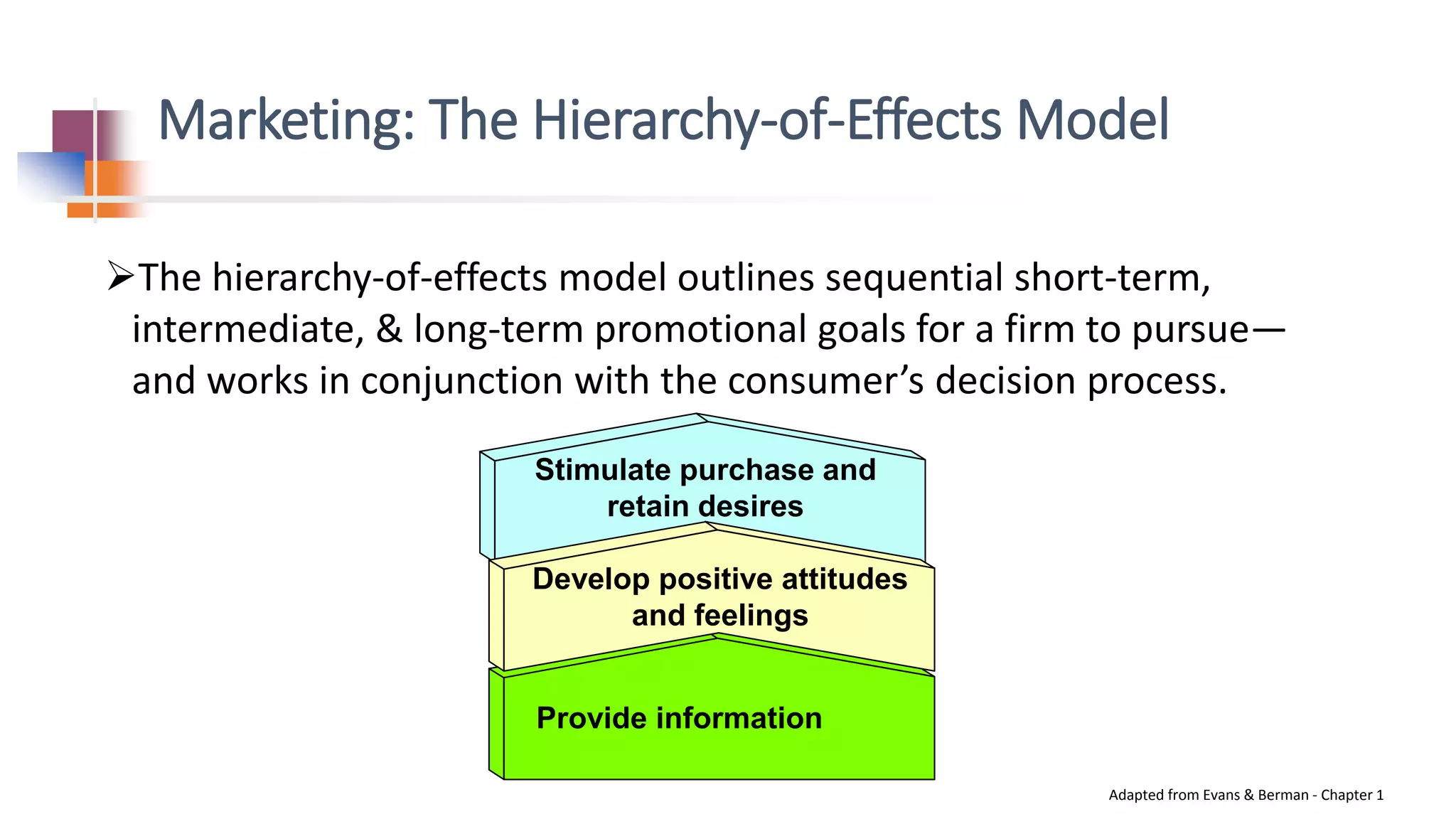
The hierarchy-of-effects model outlines sequential short-term,
intermediate, & long-term promotional goals for a firm to pursue—
and works in conjunction with the consumer’s decision process.
Adapted from Evans & Berman - Chapter 1
Provide information
Develop positive attitudes
and feelings
Stimulate purchase and
retain desires
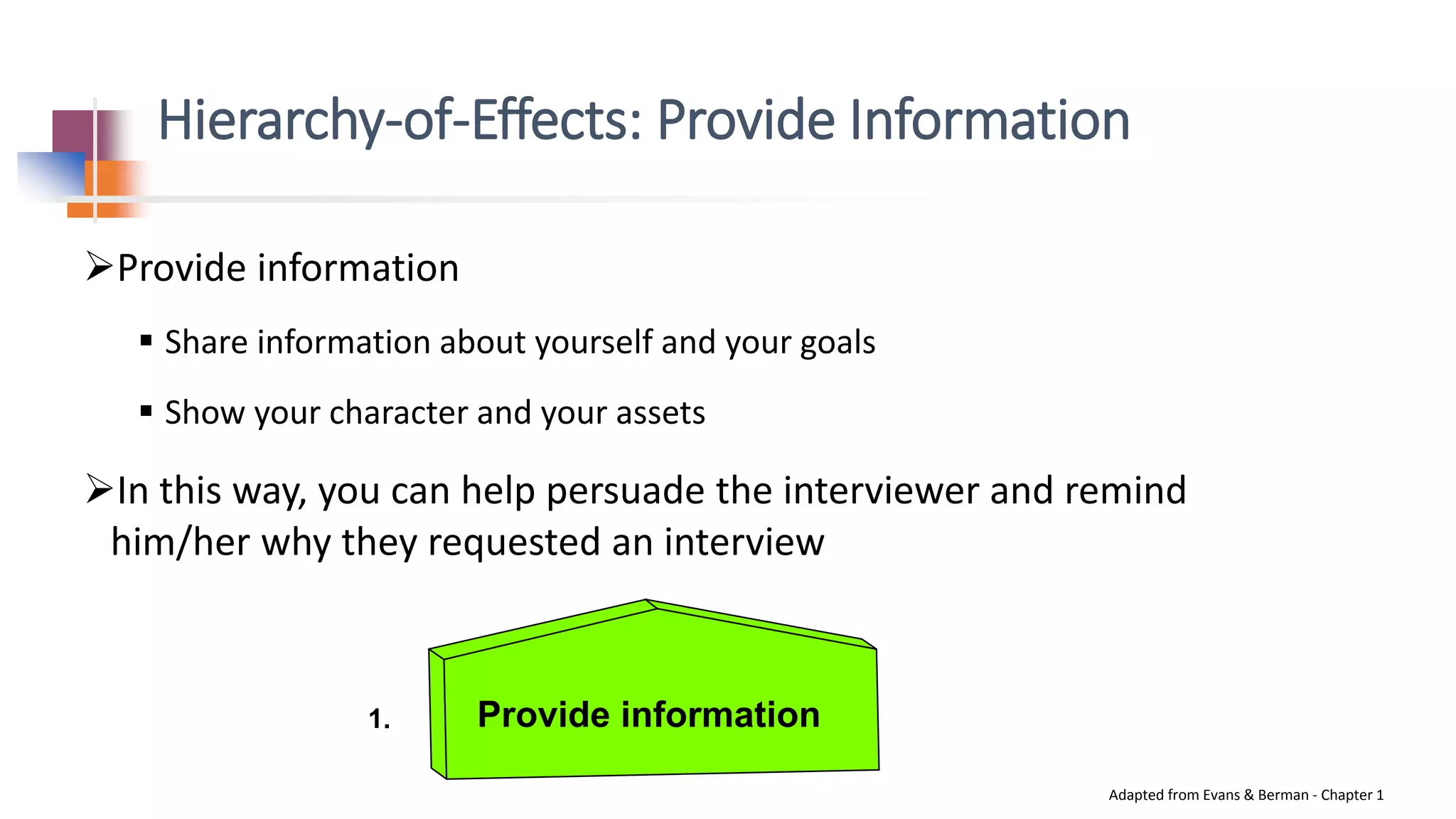
Hierarchy-of-Effects: Provide Information
Provide information
 Share information about yourself and your goals
 Show your character and your assets
In this way, you can help persuade the interviewer and remind
him/her why they requested an interview
Adapted from Evans & Berman - Chapter 1
Provide information1.
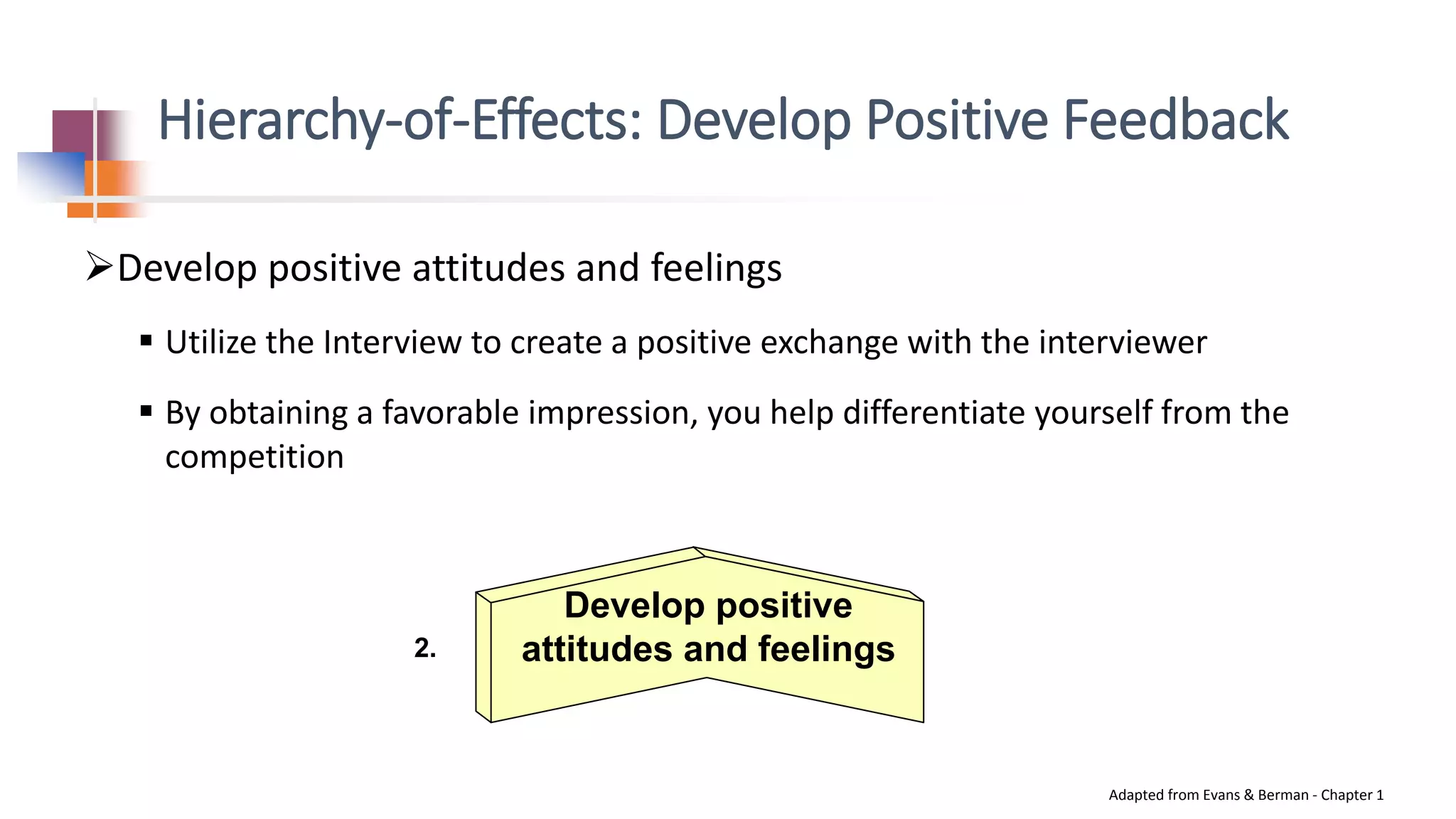
Hierarchy-of-Effects: Develop Positive Feedback
Develop positive attitudes and feelings
 Utilize the Interview to create a positive exchange with the interviewer
 By obtaining a favorable impression, you help differentiate yourself from the
competition
Adapted from Evans & Berman - Chapter 1
Develop positive
attitudes and feelings2.
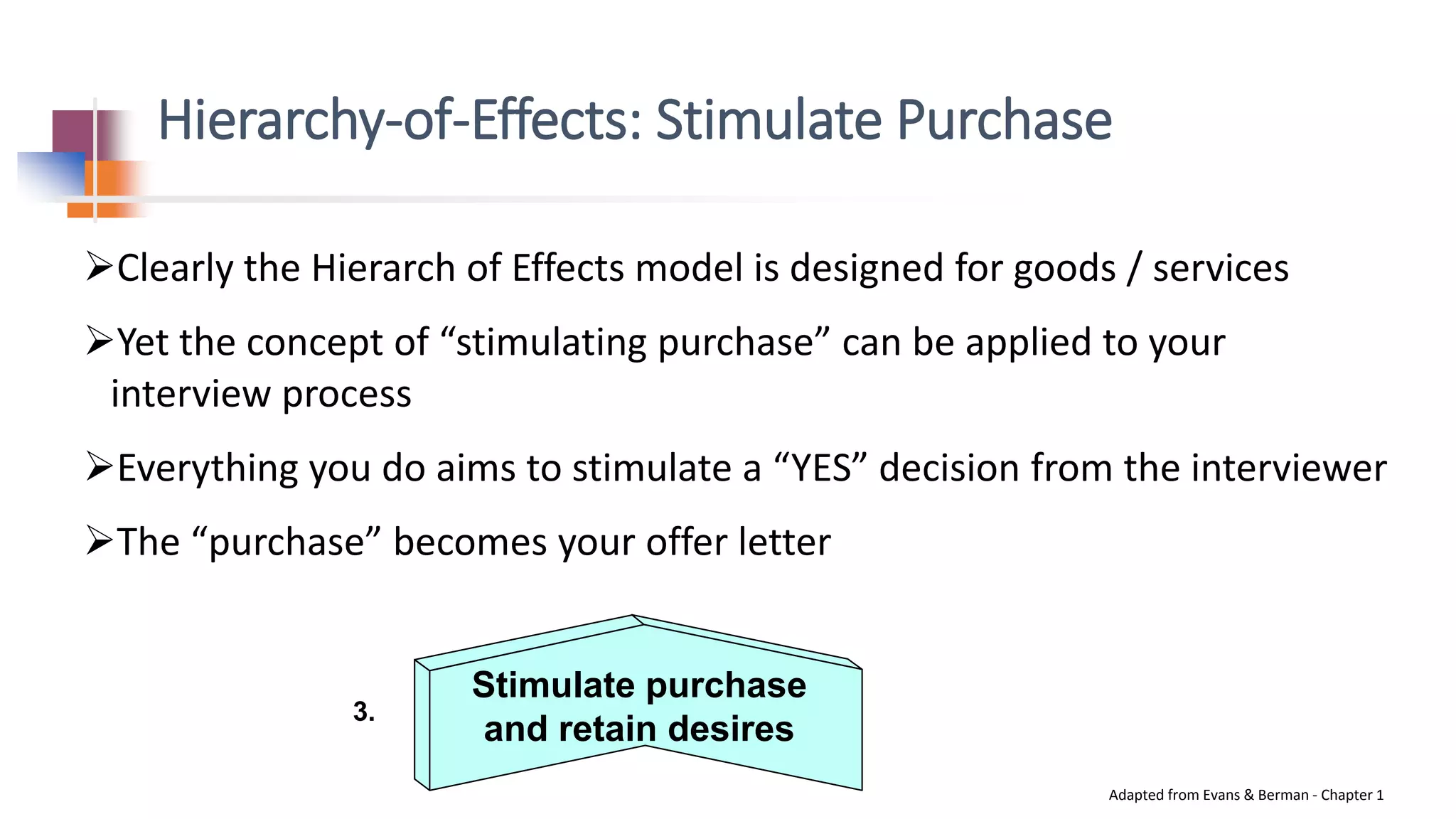
Hierarchy-of-Effects: Stimulate Purchase
Clearly the Hierarch of Effects model is designed for goods / services
Yet the concept of “stimulating purchase” can be applied to your
interview process
Everything you do aims to stimulate a “YES” decision from the interviewer
The “purchase” becomes your offer letter
Adapted from Evans & Berman - Chapter 1
Stimulate purchase
and retain desires
3.
Practice Makes Perfect
Practice - there is no other way to improve your interview skills
 Practice interviews can be done with friends, family or sometimes with the school
 They can be done alone using flash cards – especially if you record your answers
 Another way to practice is to apply to interview for a school/job that is not your top pick – it
becomes a no risk situation
Practice helps you prepare for the “REAL” interview
Practice can help you learn how to avoid getting nervous and making common mistakes
It can help you learn to create a good first impression
You can practice marketing yourself
You may be able to understand how your answers are perceived
You can learn what works and what doesn’t
Don’t Forget About Online Resources
https://bigfuture.collegeboard.org/get-in/interviews/college-interviews-practice-
questions-and-strategies
http://www.kent.ac.uk/careers/interviews/commonquestions.htm
http://cben.rice.edu/uploadedFiles/Education/Helpful%20Interview%20Tips.pdf
http://sharonsprings.org/wp-
content/uploads/2014/01/CollegeInterviewQuestions.pdf
Just to give you an idea…..
Putting Yourself to the Test
I want each of you to write down an interview question that you feel a
school may ask during an admissions interview
Then think about how you would answer the question and write it down
Write your question and your name on a piece of paper and pass it me
I will then randomly “interview” each of you
 The objective is to help you practice
 NOT to put you in difficulty

Interview skills

  • 1.
    Interview Skills How toImprove your Performance During Interviews
  • 2.
    How to PerformWell During an Interview What’s an interview?  A conversation between you and a prospective school or employer  An opportunity for you to answer (and ask) questions  An opportunity for you to evaluate a future school or job What’s the purpose of the interview?  Characteristics and qualities  How you express yourself  Your motivation, interests and enthusiasm
  • 3.
    Interviews: The FirstThing to Learn There aren't any right or wrong answers to interview questions The WAY you present yourself is AS IMPORTANT as what you say Relax. Be yourself. Be as natural as possible.
  • 4.
    Preparation is theFirst Step Study and prepare  You DO need to prepare for an interview if you want to perform well  There is USUALLY a direct correlation between how well you perform and how well you have prepared for the interview Take the time to research  The better you understand what you’re facing, the more effective you will be in answering their questions  The research process alone can often help you decide if there could be a good match between your skills/characteristics and the program/job
  • 5.
    What Information isUseful? Internet research is very useful in gathering information about the school, program, job position or company  How large or small is the organization?  How long has it been in business?  What products/services/programs does it offer?  What reputation does it have in the market?  Has it been in the news in the recent past? Why?  How does it present itself on its website?  What are the values / what is the mission?
  • 6.
    What Techniques areUseful? First understand WHO you’ll be interviewing with… then work on HOW you will approach interview  Read the program description carefully  Read your application form and personal statement carefully  Try to ANTICIPATE which questions the interviewer may ask.  Think about HOW you will answer difficult questions – from why you scored low on an exam to your weaknesses (more on this later)  Identify which parts of your character you want to emphasize  Think about how you want the interviewer to describe you to his/her boss after the interview
  • 7.
    So What Kindof Questions WILL They Ask? Standard interview questions  Tell me about yourself  How would your professors describe you  What are your greatest strengths / What are your greatest weaknesses  What do you know about our program/job  How do you think you would fit in our organization  Why do think you would succeed in our organization
  • 8.
    So What Kindof Questions WILL They Ask? Some of these questions can be difficult to answer  Tell me about yourself  Why should we let you into our program?  How has your education prepared you for this program?  Have you ever had a conflict with one of your professors? How was it resolved?  What characteristics should a successful student have?  How smart are you?
  • 9.
    Interviews: The SecondThing to Learn Remember that there aren't any right or wrong answers to interview questions The WAY you answer is AS IMPORTANT as what you say If you can’t answer a question, you can always address the question and try to move the interview to another question  “I’m not sure how my professors would describe me, but I would hope that they have seen my commitment to my studies and my interest in XYZ
  • 10.
    How Do YouAnswer The Questions Tell me about yourself?  Describe your characteristics and interests  Talk about your goals  Don’t expand too much or talk too long  What are your greatest weaknesses?  “I’m perfect” is not the answer they’re looking for  BEFORE the interview, identify parts of your character that could be considered weaknesses AND identify how they can ALSO be strengths
  • 11.
    Let’s Practice Tell meabout yourself?  What are your greatest weaknesses? Write 5 things for each question that can form your answer From these 5 bullet points/things, create complete sentences as if you were verbally answering the question Pick one of the two questions Take the sentences you wrote and put them together to create a complete answer
  • 12.
    Let’s Practice Read youranswer as if you were speaking it during an interview  Does it convince you?  Will it convince the interviewer?  Does it convey everything you would want to say?  Why or why not? This is the SAME TECNIQUE that you should use for the questions you feel are most likely going to be asked
  • 13.
    Interview Skills How Languageand Presentation Play a Role in your Interview
  • 14.
    Language is Important:Word Choice Translating words from Italian to English does not always work It is more important to translate CONCEPTS than the words themselves Volontà  I was committed to a long term project Realizzare  I was able to successfully complete the project Fattivo  I contributed with a proactive approach to my studies
  • 15.
    Language is Important:Choose the Right Words Understand the context of the sentence Identify translation options Back-translate as needed Eliminate impossibilities Use thesaurus to explore the specific uses of the word Try to detect emotional connotations “Google” it
  • 16.
    Language is Important:An Example Underline Sottolineare, evidenziare Emphasize Dare importanza to ~ the importance of sth. sottolineare l’importanza di qcs. (stress vocally) pronunciare con enfasi, enfatizzare (highlight) mettere in evidenza [eyes etc.].
  • 17.
    Language is Important:An Example Underline  Definition: emphasize; mark  Synonyms: accentuate, bracket, call attention to, caption, check off, draw attention to, feature, give emphasis, highlight, indicate, interlineate, italicize, play up, point to, point up, rule, stress, underscore  Emphasize  Definition: stress, give priority to  Synonyms: accent, accentuate, affirm, articulate, assert, headline, highlight, impress, indicate, insist on, italicize, make a point, make clear, make emphatic, make much of, mark, pinpoint, play up, point out, press, pronounce, punctuate, put accent on, reiterate, repeat, rub in, spotlight, underline, underscore
  • 18.
    Language is Important:An Example How to choose the right word?  Create your sentence using each of the two words  Does one of the two sound better to you?  Is one of the two more natural for you to say?  Backtranslate your sentence to see if it still conveys your meaning  Google the sentence to see how others have used it  In the end, there may be very little difference between the words
  • 19.
    Language is Important:Final Thoughts What to focus on  Mother Language flow /fluency  Common sense  Creativity What to avoid  Italian that is “Englishized”  Highly informal language / slang
  • 20.
    Interview Skills andMarketing Yes, Marketing  Simply put, an interview is a chance for us to MARKET ourselves So what is Marketing?  Strategy and actions intended to create an implied “need” for a product or service  The “insieme” of how you present yourself that is purposely planned to create the best impression possible for your future school / employer  How you dress, how you speak, how you move, how you react to questions – all of this comes together as part of YOUR PERFORMANCE
  • 21.
    Marketing: The Hierarchy-of-EffectsModel The hierarchy-of-effects model outlines sequential short-term, intermediate, & long-term promotional goals for a firm to pursue— and works in conjunction with the consumer’s decision process. Adapted from Evans & Berman - Chapter 1 Provide information Develop positive attitudes and feelings Stimulate purchase and retain desires
  • 22.
    Hierarchy-of-Effects: Provide Information Provideinformation  Share information about yourself and your goals  Show your character and your assets In this way, you can help persuade the interviewer and remind him/her why they requested an interview Adapted from Evans & Berman - Chapter 1 Provide information1.
  • 23.
    Hierarchy-of-Effects: Develop PositiveFeedback Develop positive attitudes and feelings  Utilize the Interview to create a positive exchange with the interviewer  By obtaining a favorable impression, you help differentiate yourself from the competition Adapted from Evans & Berman - Chapter 1 Develop positive attitudes and feelings2.
  • 24.
    Hierarchy-of-Effects: Stimulate Purchase Clearlythe Hierarch of Effects model is designed for goods / services Yet the concept of “stimulating purchase” can be applied to your interview process Everything you do aims to stimulate a “YES” decision from the interviewer The “purchase” becomes your offer letter Adapted from Evans & Berman - Chapter 1 Stimulate purchase and retain desires 3.
  • 25.
    Practice Makes Perfect Practice- there is no other way to improve your interview skills  Practice interviews can be done with friends, family or sometimes with the school  They can be done alone using flash cards – especially if you record your answers  Another way to practice is to apply to interview for a school/job that is not your top pick – it becomes a no risk situation Practice helps you prepare for the “REAL” interview Practice can help you learn how to avoid getting nervous and making common mistakes It can help you learn to create a good first impression You can practice marketing yourself You may be able to understand how your answers are perceived You can learn what works and what doesn’t
  • 26.
    Don’t Forget AboutOnline Resources https://bigfuture.collegeboard.org/get-in/interviews/college-interviews-practice- questions-and-strategies http://www.kent.ac.uk/careers/interviews/commonquestions.htm http://cben.rice.edu/uploadedFiles/Education/Helpful%20Interview%20Tips.pdf http://sharonsprings.org/wp- content/uploads/2014/01/CollegeInterviewQuestions.pdf Just to give you an idea…..
  • 27.
    Putting Yourself tothe Test I want each of you to write down an interview question that you feel a school may ask during an admissions interview Then think about how you would answer the question and write it down Write your question and your name on a piece of paper and pass it me I will then randomly “interview” each of you  The objective is to help you practice  NOT to put you in difficulty