Aim : Toorally test the extent of the candidates
knowledge and understanding of the world
around him and to assess the hidden qualities as
reflected by his general appearance, behavior and
speech mannerism.
Definition : An interview is a two party
conversation in which at least one party has a
specific serious purpose. The interviewer asks the
interviewee specific questions in order to assess
his suitability for recruitment, admission or
promotion, or for an opinion.
3.
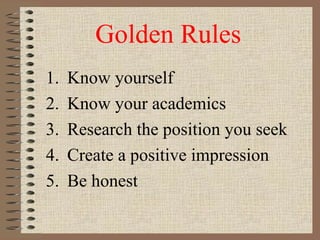
Golden Rules
1. Knowyourself
2. Know your academics
3. Research the position you seek
4. Create a positive impression
5. Be honest
4.
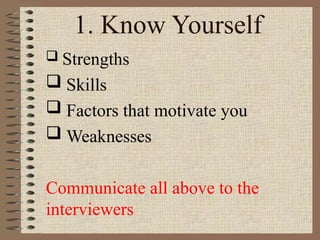
1. Know Yourself
Strengths
Skills
Factors that motivate you
Weaknesses
Communicate all above to the
interviewers
5.
2. Know YourAcademics
Brush up on technical knowledge
Know the titles and important details of
the subjects studied
[This speaks volumes about your ability to
gain and assimilate knowledge]
Current Affairs
(at least related to your specialized subject)
Be exact in stating percentages of marks
(as stated in your resume).
6.
3. Research theposition your seek
Details of the organization
Requirements of the particular position
Present projects handled by the company
Company’s status in the field
Important personalities of the company
7.
4. Create apositive impression
First five minutes conversation is the most crucial
Body language
Appearance
Attitude
Appear enthusiastic
Be transparent about your urge to join
8.
5. Be Honest
Do not lie to hide your inadequacies
Be natural
Be yourself
Focus on your strengths
Do not try to act smart
The way you tackle the problem is
important than the right answer.
9.
General Tips
Knowthe place and time of the interview in advance
confirm that you will be attending the interview
Keep all the records, documents and recommendations
neatly filed
Calm yourself, take a look at other participants and
deduce organizational culture
Be a good listener to the questions
Be polite and courteous
Do not interrupt
Do your homework, Be positive
Learn from your experiences
10.
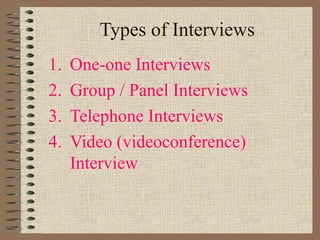
Types of Interviews
1.One-one Interviews
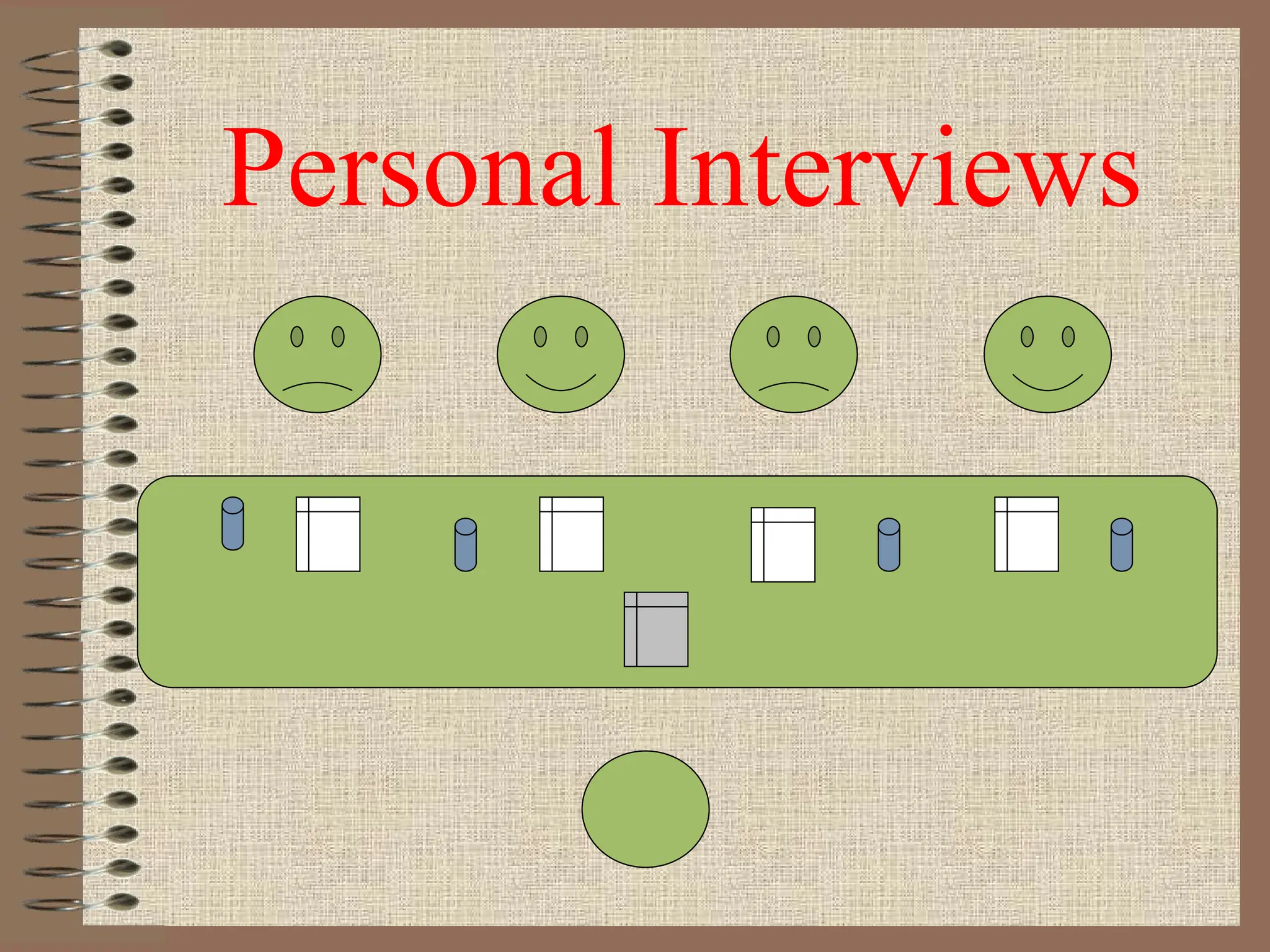
2. Group / Panel Interviews
3. Telephone Interviews
4. Video (videoconference)
Interview
11.
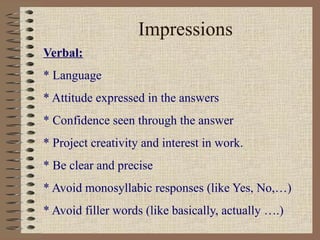
Impressions
Verbal:
* Language
* Attitudeexpressed in the answers
* Confidence seen through the answer
* Project creativity and interest in work.
* Be clear and precise
* Avoid monosyllabic responses (like Yes, No,…)
* Avoid filler words (like basically, actually ….)
12.
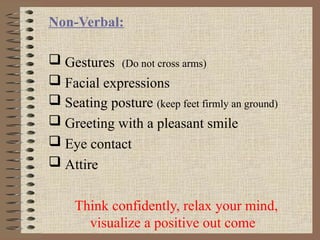
Non-Verbal:
Gestures (Donot cross arms)
Facial expressions
Seating posture (keep feet firmly an ground)
Greeting with a pleasant smile
Eye contact
Attire
Think confidently, relax your mind,
visualize a positive out come
13.
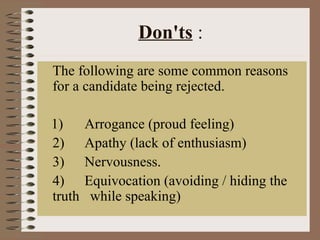
Don'ts :
The followingare some common reasons
for a candidate being rejected.
1) Arrogance (proud feeling)
2) Apathy (lack of enthusiasm)
3) Nervousness.
4) Equivocation (avoiding / hiding the
truth while speaking)
14.
5) Lack ofconcentration.
6) Lack of crispness (clarity and sharp
sense).
7) Lack of social skills.
8) Lack of firmness (confidence)
9) Inadequate skills.
10) Unsuitable personality.
15.
Interview Score Sheet
Nameof the candidate: A+ A B+ B C+ C
1.Appearance
2.Subject Knowledge
3.Conceptual Clarity
4.Logical Thinking
5.Attitude
6.Motivation
7.Communication Skills
8.Interpersonal Qualities
9.General Knowledge
10.Initiative

![2. Know Your Academics
Brush up on technical knowledge
Know the titles and important details of
the subjects studied
[This speaks volumes about your ability to
gain and assimilate knowledge]
Current Affairs
(at least related to your specialized subject)
Be exact in stating percentages of marks
(as stated in your resume).](https://image.slidesharecdn.com/personalinterviews-modified2-250327063530-e95bf0a2/85/Personal-Interviews-face-the-interviewer-with-confident-Modified-ppt-5-320.jpg)