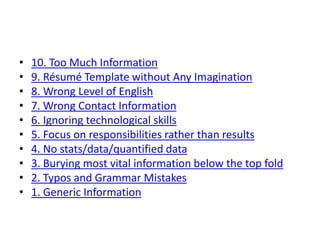
• 10. Too Much Information
• 9. Résumé Template without Any Imagination
• 8. Wrong Level of English
• 7. Wrong Contact Information
• 6. Ignoring technological skills
• 5. Focus on responsibilities rather than results
• 4. No stats/data/quantified data
• 3. Burying most vital information below the top fold
• 2. Typos and Grammar Mistakes
• 1. Generic Information
• Step One: Focus
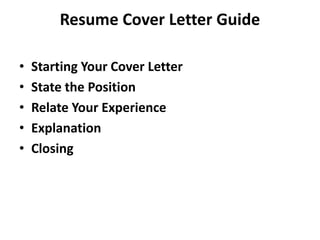
Resume Cover Letter Guide
• Starting Your Cover Letter
• State the Position
• Relate Your Experience
• Explanation
• Closing
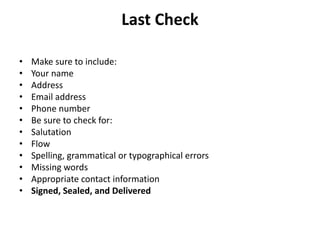
Last Check
• Make sure to include:
• Your name
• Address
• Email address
• Phone number
• Be sure to check for:
• Salutation
• Flow
• Spelling, grammatical or typographical errors
• Missing words
• Appropriate contact information
• Signed, Sealed, and Delivered
• Resume Followup Tips
• Thank you Notes
• Follow up Tips
• Remind the employer of your resume.
• Express your continued interest in the
position.
• Help you stand out from other applicants.
• Suggestion 1: Instead of telling the hiring
manager that you’re “passionate,” give them an
example of a project that you spearheaded to
increase company profits — that kind of
information relays your passion much more
clearly.
• Suggestion 2: Instead of telling the hiring
manager that you’re “driven,” give an example of
how you went above and beyond the call of duty
complete a project or support another
teammate.
• Suggestion 1: If you helped increase company
sales, write by how much.
• Suggestion 2: If you managed employees or
trained new employees, write down how many.
• Suggestion 3: If you saved the company money,
write down how you did it, and how much you
saved.
• Suggestion 4: Did you manage a budget? Write
down how big it was
• Suggestion 1: Find the hiring manager’s job
description, and sprinkle their keywords and
phrasing into your resume. NOTE: This does not
mean plagiarizing or copying what they’ve
written – simply strategically employing
important keywords to capture their attention.
• Suggestion 2: Draft your resume so that the skills
and abilities they are calling for are towards the
top of your resume, where they’ll instantly be
seen.
• Suggestion 1: If you’ve been out of work, use a
combination style resume to conceal your work
experience gaps while relaying your relevant
experience.
• Suggestion 2: Read the hiring manager’s job
description carefully, and consider whether you current
skill knowledge and skill set overlaps with their
requirements. Present the best spin possible on your
resume – even if you don’t have the skills yet, you may
be easily trainable because you have foundational skills
(such as software skills, customer service skills,
management skills, etc.)
• Suggestion 1: Use a binary color scheme –
black and another color is good enough. Use
the color on your headings and keep your
bullet points black.
• Suggestion 2: Keep it classy. Red, blue, and
orange with comic sans won’t get you a job,
unless you’re applying for a position at a
clown college
• Trend #1: Call-out boxes and breakaway text
• Trend #2: The value proposition
• The networking resume
• Inclusion of video
• Writing to the audience
• Visual engagement
• The formatting or template for your resume is pretty
standard -- Company name and location, your title and
dates of employment. (Not just years but months too.)
• See each job you worked at as a headline, and then fill in
the rest.
• Be spontaneous and don't judge what you're writing.
• The goal is to get it down on paper.
• List what you do, your accomplishments and abilities.
• Don't worry about the style. You'll send it to a resume
expert, who will make it look beautiful.
• One to two pages max. Simple. Clean lines. Easy to read
• . Take full advantage of it. Exploit the space.
• Entice people with your experience,
achievements and ambitions. Hook them
instantly.
• This is the place to be precise, creative and
clear about what you want.
• Express your career goals and aspirations
• Write out a 200 word summary.
• Then make it into a simple paragraph.
• Then 2 sentences.
• And finally, one word.
• These days about 90% of all applications are done on
line. What will you do with that statistic?
• Will it discourage or inspire you?
• How will you go beyond that process, get around it and
add to it?
• What are you willing to do to be noticed...and
remembered?
• What risks are you willing to take to have a company
discover you?
• Trust yourself. You have nothing to lose and all to gain
by trying new things
• Promote Yourself
interview tips for 2015

interview tips for 2015

  • 2.
    • 10. TooMuch Information • 9. Résumé Template without Any Imagination • 8. Wrong Level of English • 7. Wrong Contact Information • 6. Ignoring technological skills • 5. Focus on responsibilities rather than results • 4. No stats/data/quantified data • 3. Burying most vital information below the top fold • 2. Typos and Grammar Mistakes • 1. Generic Information
  • 4.
  • 5.
    Resume Cover LetterGuide • Starting Your Cover Letter • State the Position • Relate Your Experience • Explanation • Closing
  • 6.
    Last Check • Makesure to include: • Your name • Address • Email address • Phone number • Be sure to check for: • Salutation • Flow • Spelling, grammatical or typographical errors • Missing words • Appropriate contact information • Signed, Sealed, and Delivered
  • 7.
    • Resume FollowupTips • Thank you Notes • Follow up Tips • Remind the employer of your resume. • Express your continued interest in the position. • Help you stand out from other applicants.
  • 8.
    • Suggestion 1:Instead of telling the hiring manager that you’re “passionate,” give them an example of a project that you spearheaded to increase company profits — that kind of information relays your passion much more clearly. • Suggestion 2: Instead of telling the hiring manager that you’re “driven,” give an example of how you went above and beyond the call of duty complete a project or support another teammate.
  • 9.
    • Suggestion 1:If you helped increase company sales, write by how much. • Suggestion 2: If you managed employees or trained new employees, write down how many. • Suggestion 3: If you saved the company money, write down how you did it, and how much you saved. • Suggestion 4: Did you manage a budget? Write down how big it was
  • 10.
    • Suggestion 1:Find the hiring manager’s job description, and sprinkle their keywords and phrasing into your resume. NOTE: This does not mean plagiarizing or copying what they’ve written – simply strategically employing important keywords to capture their attention. • Suggestion 2: Draft your resume so that the skills and abilities they are calling for are towards the top of your resume, where they’ll instantly be seen.
  • 11.
    • Suggestion 1:If you’ve been out of work, use a combination style resume to conceal your work experience gaps while relaying your relevant experience. • Suggestion 2: Read the hiring manager’s job description carefully, and consider whether you current skill knowledge and skill set overlaps with their requirements. Present the best spin possible on your resume – even if you don’t have the skills yet, you may be easily trainable because you have foundational skills (such as software skills, customer service skills, management skills, etc.)
  • 13.
    • Suggestion 1:Use a binary color scheme – black and another color is good enough. Use the color on your headings and keep your bullet points black. • Suggestion 2: Keep it classy. Red, blue, and orange with comic sans won’t get you a job, unless you’re applying for a position at a clown college
  • 14.
    • Trend #1:Call-out boxes and breakaway text • Trend #2: The value proposition • The networking resume • Inclusion of video • Writing to the audience • Visual engagement
  • 15.
    • The formattingor template for your resume is pretty standard -- Company name and location, your title and dates of employment. (Not just years but months too.) • See each job you worked at as a headline, and then fill in the rest. • Be spontaneous and don't judge what you're writing. • The goal is to get it down on paper. • List what you do, your accomplishments and abilities. • Don't worry about the style. You'll send it to a resume expert, who will make it look beautiful. • One to two pages max. Simple. Clean lines. Easy to read
  • 16.
    • . Takefull advantage of it. Exploit the space. • Entice people with your experience, achievements and ambitions. Hook them instantly. • This is the place to be precise, creative and clear about what you want. • Express your career goals and aspirations
  • 17.
    • Write outa 200 word summary. • Then make it into a simple paragraph. • Then 2 sentences. • And finally, one word.
  • 18.
    • These daysabout 90% of all applications are done on line. What will you do with that statistic? • Will it discourage or inspire you? • How will you go beyond that process, get around it and add to it? • What are you willing to do to be noticed...and remembered? • What risks are you willing to take to have a company discover you? • Trust yourself. You have nothing to lose and all to gain by trying new things
  • 19.