
HOW TO
WRITE A RESUME
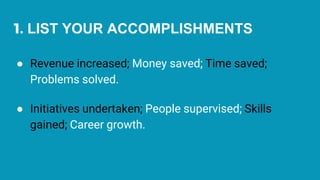
1. LIST YOUR ACCOMPLISHMENTS
● Revenue increased; Money saved; Time saved;
Problems solved.
● Initiatives undertaken; People supervised; Skills
gained; Career growth.
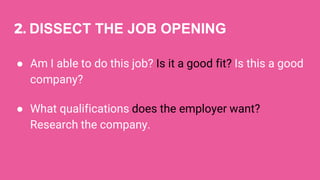
2. DISSECT THE JOB OPENING
● Am I able to do this job? Is it a good fit? Is this a good
company?
● What qualifications does the employer want?
Research the company.
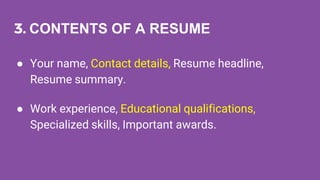
3. CONTENTS OF A RESUME
● Your name, Contact details, Resume headline,
Resume summary.
● Work experience, Educational qualifications,
Specialized skills, Important awards.
4. THE RESUME SUMMARY
● A snapshot paragraph of your resume, Show why you
are a rock star or a superstar.
● Showcase your awesomeness here, Customize for
the job that you are applying for.
5. IDENTIFY ACCOMPLISHMENTS
● Did you increase sales? How and by how much? Did
you improve processes? Which processes?
● Did you save the company money? How and how
much? Did you lead or manage projects? Which ones?
6. STORYTELLING IN A RESUME
● Add life to your resume with stories; Short, truthful
and punchy accomplishment stories.
● I did X and the result was Y; Make the claim and
provide the evidence/results.
7. POWER WORDS FOR RESUMES
● Solved; Managed; Developed; Presented; Completed;
Surpassed; Invented; Simplified; Initiated.
● Negotiated; Improved; Implemented; Overhauled;
Launched; Pioneered; Sold; Led; Generated.
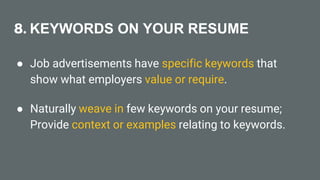
8. KEYWORDS ON YOUR RESUME
● Job advertisements have specific keywords that
show what employers value or require.
● Naturally weave in few keywords on your resume;
Provide context or examples relating to keywords.
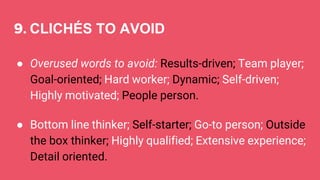
9. CLICHÉS TO AVOID
● Overused words to avoid: Results-driven; Team player;
Goal-oriented; Hard worker; Dynamic; Self-driven;
Highly motivated; People person.
● Bottom line thinker; Self-starter; Go-to person; Outside
the box thinker; Highly qualified; Extensive experience;
Detail oriented.
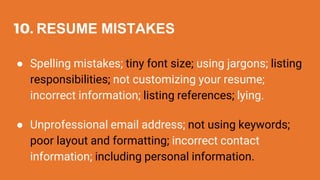
10. RESUME MISTAKES
● Spelling mistakes; tiny font size; using jargons; listing
responsibilities; not customizing your resume;
incorrect information; listing references; lying.
● Unprofessional email address; not using keywords;
poor layout and formatting; incorrect contact
information; including personal information.
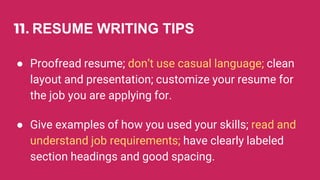
11. RESUME WRITING TIPS
● Proofread resume; don’t use casual language; clean
layout and presentation; customize your resume for
the job you are applying for.
● Give examples of how you used your skills; read and
understand job requirements; have clearly labeled
section headings and good spacing.
12. RESEARCHING A COMPANY
● Why Research? To better target your resume and
cover letter; To be as knowledgeable about the
company as possible.
● What to Read: The company’s website, social media
pages, annual reports, mission, values, news, online
reviews and about the industry.
13. COMPLYING WITH ATS
● Most resumes will be scanned by Applicant Tracking
Systems (ATS). ATS’s can quickly screen resumes
using keywords, skills, abilities and qualifications.
● Use standard section headings e.g. work experience;
avoid images & tables; include keywords; spell check
resume; spell out acronyms; no headers and footers.
14. TYPES OF RESUME FORMATS
● Reverse Chronological
● Functional/Skills-Based Resume
● Combination of Chronological & Functional
15. REVERSE CHRONOLOGICAL
● Most common resume format. Shows your career
path and growth/progression in an easy to follow
manner.
● Sequentially lists work experience and
accomplishments starting with recent experience and
proceeding backwards listing previous jobs.
16. FUNCTIONAL/SKILLS-BASED
● Prominently lists the key skills that you have. All your
work experience and accomplishments are
categorized under each respective skill.
● Used when you have gaps in employment, little work
experience, held a lot of unrelated jobs, trying to
change your career and showing transferable skills.
17. COMBINATION/HYBRID
● Combination of Chronological and Functional. Lists
job positions and segments each job based on key
skills e.g. analytical skills, decision making etc.
● Major accomplishments are listed under respective
skills. You then repeat the process for the other jobs
that you have held in the past.
18. RESUME LENGTH
● A resume can ideally be between 1 to 3 pages.
Depending on how much work experience you have
and key achievements to include.
● Nowadays, you can keep your resume brief and also
have a detailed online professional profile and include
the link to your profile on your resume.
19. RESUME CHECKLIST
● Is your name included? Are your current contact
details included? Is your resume customized for the
job? Is a summary included?
● Have you included accomplishments at each job?
Have you proofread your resume? Have you included
city and state for each job? Have you included skills?
20. RESUME REFERENCES
● Do not write your references on your resume, instead
write them on a separate document that has your
name and contact details at the top.
● Write the names, titles, and contact details of at least
three professional references. It is a good idea to give
your references an updated copy of your resume.
21. WRITING YOUR BIOGRAPHY
● Invest time to write your brief personal biography
after you have developed an up-to-date resume.
Remember to write your bio in the third person.
● A Bio explains who you are, what you have done, what
you want to do, credentials, experience, key skills,
something unique about you and contact details.
22. ROUTINE MAINTENANCE
● After you have written your resume and successfully
gotten a job, that should not be the end of it.
● A resume is a "living" document which you should
regularly review and update at least on a quarterly
basis by adding new accomplishments.
The Place for In-Depth Career Success Resources
Flourish | Prosper | Succeed

How To Write A Resume

  • 1.
  • 2.
    1. LIST YOURACCOMPLISHMENTS ● Revenue increased; Money saved; Time saved; Problems solved. ● Initiatives undertaken; People supervised; Skills gained; Career growth.
  • 3.
    2. DISSECT THEJOB OPENING ● Am I able to do this job? Is it a good fit? Is this a good company? ● What qualifications does the employer want? Research the company.
  • 4.
    3. CONTENTS OFA RESUME ● Your name, Contact details, Resume headline, Resume summary. ● Work experience, Educational qualifications, Specialized skills, Important awards.
  • 5.
    4. THE RESUMESUMMARY ● A snapshot paragraph of your resume, Show why you are a rock star or a superstar. ● Showcase your awesomeness here, Customize for the job that you are applying for.
  • 6.
    5. IDENTIFY ACCOMPLISHMENTS ●Did you increase sales? How and by how much? Did you improve processes? Which processes? ● Did you save the company money? How and how much? Did you lead or manage projects? Which ones?
  • 7.
    6. STORYTELLING INA RESUME ● Add life to your resume with stories; Short, truthful and punchy accomplishment stories. ● I did X and the result was Y; Make the claim and provide the evidence/results.
  • 8.
    7. POWER WORDSFOR RESUMES ● Solved; Managed; Developed; Presented; Completed; Surpassed; Invented; Simplified; Initiated. ● Negotiated; Improved; Implemented; Overhauled; Launched; Pioneered; Sold; Led; Generated.
  • 9.
    8. KEYWORDS ONYOUR RESUME ● Job advertisements have specific keywords that show what employers value or require. ● Naturally weave in few keywords on your resume; Provide context or examples relating to keywords.
  • 10.
    9. CLICHÉS TOAVOID ● Overused words to avoid: Results-driven; Team player; Goal-oriented; Hard worker; Dynamic; Self-driven; Highly motivated; People person. ● Bottom line thinker; Self-starter; Go-to person; Outside the box thinker; Highly qualified; Extensive experience; Detail oriented.
  • 11.
    10. RESUME MISTAKES ●Spelling mistakes; tiny font size; using jargons; listing responsibilities; not customizing your resume; incorrect information; listing references; lying. ● Unprofessional email address; not using keywords; poor layout and formatting; incorrect contact information; including personal information.
  • 12.
    11. RESUME WRITINGTIPS ● Proofread resume; don’t use casual language; clean layout and presentation; customize your resume for the job you are applying for. ● Give examples of how you used your skills; read and understand job requirements; have clearly labeled section headings and good spacing.
  • 13.
    12. RESEARCHING ACOMPANY ● Why Research? To better target your resume and cover letter; To be as knowledgeable about the company as possible. ● What to Read: The company’s website, social media pages, annual reports, mission, values, news, online reviews and about the industry.
  • 14.
    13. COMPLYING WITHATS ● Most resumes will be scanned by Applicant Tracking Systems (ATS). ATS’s can quickly screen resumes using keywords, skills, abilities and qualifications. ● Use standard section headings e.g. work experience; avoid images & tables; include keywords; spell check resume; spell out acronyms; no headers and footers.
  • 15.
    14. TYPES OFRESUME FORMATS ● Reverse Chronological ● Functional/Skills-Based Resume ● Combination of Chronological & Functional
  • 16.
    15. REVERSE CHRONOLOGICAL ●Most common resume format. Shows your career path and growth/progression in an easy to follow manner. ● Sequentially lists work experience and accomplishments starting with recent experience and proceeding backwards listing previous jobs.
  • 17.
    16. FUNCTIONAL/SKILLS-BASED ● Prominentlylists the key skills that you have. All your work experience and accomplishments are categorized under each respective skill. ● Used when you have gaps in employment, little work experience, held a lot of unrelated jobs, trying to change your career and showing transferable skills.
  • 18.
    17. COMBINATION/HYBRID ● Combinationof Chronological and Functional. Lists job positions and segments each job based on key skills e.g. analytical skills, decision making etc. ● Major accomplishments are listed under respective skills. You then repeat the process for the other jobs that you have held in the past.
  • 19.
    18. RESUME LENGTH ●A resume can ideally be between 1 to 3 pages. Depending on how much work experience you have and key achievements to include. ● Nowadays, you can keep your resume brief and also have a detailed online professional profile and include the link to your profile on your resume.
  • 20.
    19. RESUME CHECKLIST ●Is your name included? Are your current contact details included? Is your resume customized for the job? Is a summary included? ● Have you included accomplishments at each job? Have you proofread your resume? Have you included city and state for each job? Have you included skills?
  • 21.
    20. RESUME REFERENCES ●Do not write your references on your resume, instead write them on a separate document that has your name and contact details at the top. ● Write the names, titles, and contact details of at least three professional references. It is a good idea to give your references an updated copy of your resume.
  • 22.
    21. WRITING YOURBIOGRAPHY ● Invest time to write your brief personal biography after you have developed an up-to-date resume. Remember to write your bio in the third person. ● A Bio explains who you are, what you have done, what you want to do, credentials, experience, key skills, something unique about you and contact details.
  • 23.
    22. ROUTINE MAINTENANCE ●After you have written your resume and successfully gotten a job, that should not be the end of it. ● A resume is a "living" document which you should regularly review and update at least on a quarterly basis by adding new accomplishments.
  • 24.
    The Place forIn-Depth Career Success Resources Flourish | Prosper | Succeed