
The Art of Interviewing
The Art of Interviewing 
ď‚— Evaluate Yourself 
â—¦ Prepare today! 
ď‚— Types of Interview Questions & Dissecting 
Effective Responses 
â—¦ General 
â—¦ Behavioral 
â—¦ Case Study 
â—¦ Off-the-wall 
ď‚— Handling Unacceptable Questions
Prepare for the Interview 
ď‚— Know Yourself. 
Decision Making Worksheet 
ď‚— Know the position you are applying for 
– research the employer. 
ď‚— Know the company listing the position 
– prepare a list of questions. 
ď‚— Practice! Practice! Practice!
Evaluate Yourself 
ď‚— Non-Verbal Communication 
â—¦ Handshake, posture, eye contact, friendliness 
ď‚— Verbal Communication 
â—¦ Grammar, diction, limited use of non-words 
ď‚— Ability to Answer Questions 
â—¦ Preparedness, responsiveness, confidence 
ď‚— Provide Relevant Examples 
â—¦ Illustrate qualifications through relevant 
experiences
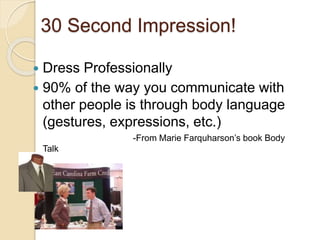
30 Second Impression! 
ď‚— Dress Professionally 
ď‚— 90% of the way you communicate with 
other people is through body language 
(gestures, expressions, etc.) 
-From Marie Farquharson’s book Body 
Talk
Preparing to answer 
interview Questions 
Know the . . . . 
ď‚— Company & Field 
ď‚— Job Description 
ď‚— Yourself (Skills, Values & Interests) 
ď‚— Resume (Experience) 
Make connections for the employer 
between what they are seeking and what 
you can provide. Scream, “I am the match 
you are looking for.”
TIPS for Answering!!! 
ď‚— Create a Strategy 
â—¦ Project your image/professional profile 
â—¦ Utilize your experiences, skills, interests and 
values as a backdrop to answer the question 
ď‚— Provide specific examples 
â—¦ STAR Acronym 
ď‚– Situation 
ď‚– Task 
ď‚– Action 
 Result (Don’t forget this one) 
ď‚— Convey your individuality and excitement!!
“Tell me about yourself.” 
Intro question that appears very broad. However, 
ď‚— Do not answer it in general terms (NO life story or 
irrelevant information). 
 Think of it as a 1 – 2 minute “commercial” of your 
personal highlights. 
ď‚— Focus on skills, accomplishments and relevant 
experiences. 
ď‚— IMPORTANT: Mention why are you interested in the 
position/ field.
Other General Questions 
ď‚— What makes you the ideal candidate for this job? 
ď‚— Why did you choose this major? 
ď‚— What do you know about our organization? 
ď‚— How do you plan to contribute to the success of 
our work place? 
ď‚— What do you value most? 
ď‚— How do you compensate for your lack of 
experience? 
ď‚— Is this really what you want to do?
A Sample – Dissected!!! 
Question: What makes you the ideal candidate for this 
position? 
MENTION YOUR STRONGEST QUALIFICATIONS (Draw 
connections to the position for the employer). 
“My international experience in addition to my position at 
the Technician as the Director of Advertising makes me an 
ideal candidate because I offer a global perspective as well 
a broad range of skills applicable to public relations. I am 
also very excited about the position and confident in my 
abilities to excel in it.”
Behavior Based Questions 
 Tell me about a time… 
 Describe for me a situation when… 
 Give an example of… 
Your Goal: To illustrate for the 
interviewer that you have applied 
relevant skills in real situations
Examples 
ď‚— Tell me about a time when you came up with a 
creative solution to a problem you were facing? 
ď‚— Describe a situation where you had to let down a 
customer in order to uphold company policy. 
ď‚— Have you experienced a failure when organizing a 
program, and how did you deal with it? 
ď‚— What is the hardest decision you have ever had to 
make?
Answering the Weakness ? 
ď‚— Make it skill based rather than behavior based. 
◦ I don’t feel my publishing skills are as strong as they could be. 
ď‚— Do not disguise a strength as a weakness. 
 Beware of “canned” responses. 
â—¦ I am a perfectionist. 
ď‚— Close by telling them how you plan to compensate. 
â—¦ Since that experience last semester, I have tried really hard to find a 
better balance between close attention to detail and keeping sight of 
the big picture.
A Sample – Dissected!!! 
Question: What are your weaknesses? 
SKILL BASED WEAKNESS 
“My technical skills are a weakness. I recognized it last 
year when I tried to put together a website for Alpha Zeta.” 
HOW YOU COMPENSATE 
“Since then, I have taken several of the free computer 
courses offered at my school and have increased my 
knowledge of programs like Dreamweaver, which I am 
excited about.”
Case Study Questions 
 Case study presents “what would you do 
if…” 
ď‚— How would you react in given scenario 
 No right or wrong answers – but, there are 
better and worse answers 
â—¦ Explain your thought process and support 
answers with examples when possible
Examples 
ď‚— How would you deal with an irate client? 
ď‚— Give an example of the best way to sell a purse 
to a man. 
ď‚— What would you do if one of the children you 
were watching threw a fit in the grocery store 
because they wanted some candy? 
ď‚— How would you confront a fellow employee who 
you knew was misusing company equipment for 
their own private use? 
ď‚— Sell me this calculator on my desk.
A Sample Dissected!! 
Question: How would you deal with an irate 
client? 
“First, I would try to calm the client down by 
assuring them that their needs are very important 
to the company. Then, I would listen to what their 
problem was and work with them to decide upon 
a mutually agreeable resolution. If the client 
continued to be upset and I knew that I would not 
be able to resolve the problem, I would have him 
talk to the manager.”
Off-the-wall Questions 
ď‚— Employers may ask to: 
â—¦ Measure creativity. 
â—¦ Watch for reactions. 
â—¦ Evaluate problem-solving and analytical skills. 
â—¦ Monitor ability to think quickly.
Examples 
ď‚— If you could be a cartoon character, who would 
you be and why? 
ď‚— Which fruit does your personality most resemble? 
ď‚— If you had to describe yourself as an animal, what 
animal would you be? 
ď‚— How many street signs are in a four block radius 
of the NU campus? 
ď‚— If you could be anyone from history, who would 
you be?
A Sample Dissected!! 
Question: If you were a cartoon 
character, who would you be and why? 
“Bugs Bunny- because he always likes a 
challenge, never loses his sense of humor 
and always ends up on his feet.”
Questions To Ask Employers 
Why Ask Questions??? 
ď‚— A lack of questions may be mistaken as a lack of interest. 
ď‚— To gain more information about the position/organization for 
yourself. Remember- it’s a mutual exchange of 
information. 
Questions to Ask!! 
ď‚— Ones that are not readily answered through company 
literature. 
ď‚— Questions based on your conversation. 
ď‚— Questions that demonstrate your knowledge of the company 
and field/industry.
Examples 
ď‚— Why do you like working for this organization? 
ď‚— Does your company value professional development 
among employees? 
 Would you describe a typical day’s activities? 
 What are your department’s major projects in the 
upcoming year? 
 I know that you’ve recently experienced a period of 
very rapid growth. How has that changed the ways 
you operate? 
ď‚— What is the next step in the search to fill this 
position?
After the Interview 
ď‚— Send personal thank you notes to all 
interviewers via mail. 
ď‚— Keep records in notebook. 
â—¦ Important dates, good or bad experience 
ď‚— Stay in pursuit. 
â—¦ Follow-up with a phone call to review 
status of employee selections
Unacceptable Questions 
ď‚— Birthplace, nationality, ancestry, or descent of 
applicant, applicant’s spouse, or parents 
â—¦ Your last name, Monet, is that French? 
 Applicant’s sex or marital status 
ď‚— Race or color 
ď‚— Religion or religious days observed 
ď‚— Physical disabilities or handicaps 
ď‚— Pregnancy, birth control, and child care 
ď‚— Number of dependents
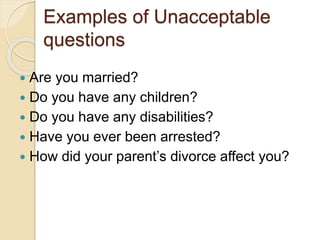
Examples of Unacceptable 
questions 
ď‚— Are you married? 
ď‚— Do you have any children? 
ď‚— Do you have any disabilities? 
ď‚— Have you ever been arrested? 
 How did your parent’s divorce affect you?
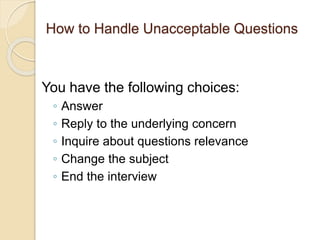
How to Handle Unacceptable Questions 
You have the following choices: 
â—¦ Answer 
â—¦ Reply to the underlying concern 
â—¦ Inquire about questions relevance 
â—¦ Change the subject 
â—¦ End the interview
Before everything else, “Getting Ready” is the 
secret of success. 
Henry Ford 
Thought for the Day

2. facing interview

  • 1.
    The Art ofInterviewing
  • 2.
    The Art ofInterviewing ď‚— Evaluate Yourself â—¦ Prepare today! ď‚— Types of Interview Questions & Dissecting Effective Responses â—¦ General â—¦ Behavioral â—¦ Case Study â—¦ Off-the-wall ď‚— Handling Unacceptable Questions
  • 3.
    Prepare for theInterview  Know Yourself. Decision Making Worksheet  Know the position you are applying for – research the employer.  Know the company listing the position – prepare a list of questions.  Practice! Practice! Practice!
  • 4.
    Evaluate Yourself ď‚—Non-Verbal Communication â—¦ Handshake, posture, eye contact, friendliness ď‚— Verbal Communication â—¦ Grammar, diction, limited use of non-words ď‚— Ability to Answer Questions â—¦ Preparedness, responsiveness, confidence ď‚— Provide Relevant Examples â—¦ Illustrate qualifications through relevant experiences
  • 5.
    30 Second Impression!  Dress Professionally  90% of the way you communicate with other people is through body language (gestures, expressions, etc.) -From Marie Farquharson’s book Body Talk
  • 6.
    Preparing to answer interview Questions Know the . . . .  Company & Field  Job Description  Yourself (Skills, Values & Interests)  Resume (Experience) Make connections for the employer between what they are seeking and what you can provide. Scream, “I am the match you are looking for.”
  • 7.
    TIPS for Answering!!!  Create a Strategy ◦ Project your image/professional profile ◦ Utilize your experiences, skills, interests and values as a backdrop to answer the question  Provide specific examples ◦ STAR Acronym  Situation  Task  Action  Result (Don’t forget this one)  Convey your individuality and excitement!!
  • 8.
    “Tell me aboutyourself.” Intro question that appears very broad. However,  Do not answer it in general terms (NO life story or irrelevant information).  Think of it as a 1 – 2 minute “commercial” of your personal highlights.  Focus on skills, accomplishments and relevant experiences.  IMPORTANT: Mention why are you interested in the position/ field.
  • 9.
    Other General Questions ď‚— What makes you the ideal candidate for this job? ď‚— Why did you choose this major? ď‚— What do you know about our organization? ď‚— How do you plan to contribute to the success of our work place? ď‚— What do you value most? ď‚— How do you compensate for your lack of experience? ď‚— Is this really what you want to do?
  • 10.
    A Sample –Dissected!!! Question: What makes you the ideal candidate for this position? MENTION YOUR STRONGEST QUALIFICATIONS (Draw connections to the position for the employer). “My international experience in addition to my position at the Technician as the Director of Advertising makes me an ideal candidate because I offer a global perspective as well a broad range of skills applicable to public relations. I am also very excited about the position and confident in my abilities to excel in it.”
  • 11.
    Behavior Based Questions  Tell me about a time…  Describe for me a situation when…  Give an example of… Your Goal: To illustrate for the interviewer that you have applied relevant skills in real situations
  • 12.
    Examples ď‚— Tellme about a time when you came up with a creative solution to a problem you were facing? ď‚— Describe a situation where you had to let down a customer in order to uphold company policy. ď‚— Have you experienced a failure when organizing a program, and how did you deal with it? ď‚— What is the hardest decision you have ever had to make?
  • 13.
    Answering the Weakness?  Make it skill based rather than behavior based. ◦ I don’t feel my publishing skills are as strong as they could be.  Do not disguise a strength as a weakness.  Beware of “canned” responses. ◦ I am a perfectionist.  Close by telling them how you plan to compensate. ◦ Since that experience last semester, I have tried really hard to find a better balance between close attention to detail and keeping sight of the big picture.
  • 14.
    A Sample –Dissected!!! Question: What are your weaknesses? SKILL BASED WEAKNESS “My technical skills are a weakness. I recognized it last year when I tried to put together a website for Alpha Zeta.” HOW YOU COMPENSATE “Since then, I have taken several of the free computer courses offered at my school and have increased my knowledge of programs like Dreamweaver, which I am excited about.”
  • 15.
    Case Study Questions  Case study presents “what would you do if…”  How would you react in given scenario  No right or wrong answers – but, there are better and worse answers ◦ Explain your thought process and support answers with examples when possible
  • 16.
    Examples ď‚— Howwould you deal with an irate client? ď‚— Give an example of the best way to sell a purse to a man. ď‚— What would you do if one of the children you were watching threw a fit in the grocery store because they wanted some candy? ď‚— How would you confront a fellow employee who you knew was misusing company equipment for their own private use? ď‚— Sell me this calculator on my desk.
  • 17.
    A Sample Dissected!! Question: How would you deal with an irate client? “First, I would try to calm the client down by assuring them that their needs are very important to the company. Then, I would listen to what their problem was and work with them to decide upon a mutually agreeable resolution. If the client continued to be upset and I knew that I would not be able to resolve the problem, I would have him talk to the manager.”
  • 18.
    Off-the-wall Questions ď‚—Employers may ask to: â—¦ Measure creativity. â—¦ Watch for reactions. â—¦ Evaluate problem-solving and analytical skills. â—¦ Monitor ability to think quickly.
  • 19.
    Examples ď‚— Ifyou could be a cartoon character, who would you be and why? ď‚— Which fruit does your personality most resemble? ď‚— If you had to describe yourself as an animal, what animal would you be? ď‚— How many street signs are in a four block radius of the NU campus? ď‚— If you could be anyone from history, who would you be?
  • 20.
    A Sample Dissected!! Question: If you were a cartoon character, who would you be and why? “Bugs Bunny- because he always likes a challenge, never loses his sense of humor and always ends up on his feet.”
  • 21.
    Questions To AskEmployers Why Ask Questions???  A lack of questions may be mistaken as a lack of interest.  To gain more information about the position/organization for yourself. Remember- it’s a mutual exchange of information. Questions to Ask!!  Ones that are not readily answered through company literature.  Questions based on your conversation.  Questions that demonstrate your knowledge of the company and field/industry.
  • 22.
    Examples  Whydo you like working for this organization?  Does your company value professional development among employees?  Would you describe a typical day’s activities?  What are your department’s major projects in the upcoming year?  I know that you’ve recently experienced a period of very rapid growth. How has that changed the ways you operate?  What is the next step in the search to fill this position?
  • 23.
    After the Interview ď‚— Send personal thank you notes to all interviewers via mail. ď‚— Keep records in notebook. â—¦ Important dates, good or bad experience ď‚— Stay in pursuit. â—¦ Follow-up with a phone call to review status of employee selections
  • 24.
    Unacceptable Questions Birthplace, nationality, ancestry, or descent of applicant, applicant’s spouse, or parents ◦ Your last name, Monet, is that French?  Applicant’s sex or marital status  Race or color  Religion or religious days observed  Physical disabilities or handicaps  Pregnancy, birth control, and child care  Number of dependents
  • 25.
    Examples of Unacceptable questions  Are you married?  Do you have any children?  Do you have any disabilities?  Have you ever been arrested?  How did your parent’s divorce affect you?
  • 26.
    How to HandleUnacceptable Questions You have the following choices: â—¦ Answer â—¦ Reply to the underlying concern â—¦ Inquire about questions relevance â—¦ Change the subject â—¦ End the interview
  • 27.
    Before everything else,“Getting Ready” is the secret of success. Henry Ford Thought for the Day