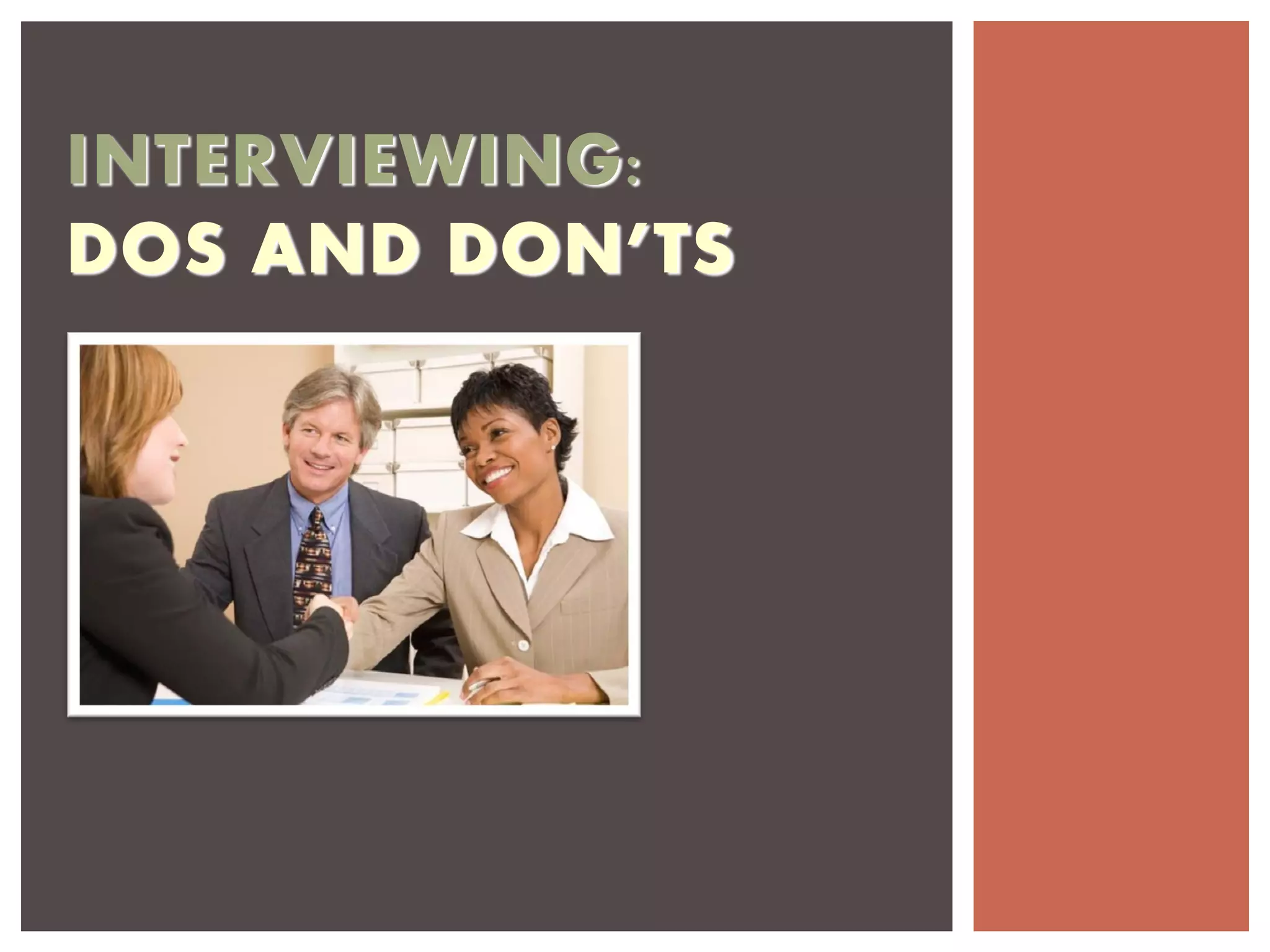
INTERVIEWING:
DOS AND DON’TS
 Fell asleep, woke up & apologized because he had been out all night.
 Showed up for the final interview on the wrong day – twice!
 Wore a baseball cap because he was having “a bad hair day.”
 Removed her shoes, pulled out debris, and handed it to the recruiter.
 Brought his mother to the interview.
 Used his tablet to check stocks and e-mail friends during the interview.
 Tried to bribe the recruiter with basketball tickets .
TALES FROM THE INTERVIEW ROOM
Common Types of Interviews:
 Preliminary or Screening Interview
 Follow Up Interview or Second/Third Interview
 Behavioral Interview
 Telephone Interview
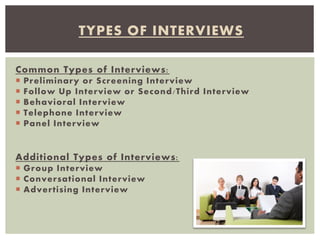
 Panel Interview
Additional Types of Interviews:
 Group Interview
 Conversational Interview
 Advertising Interview
TYPES OF INTERVIEWS
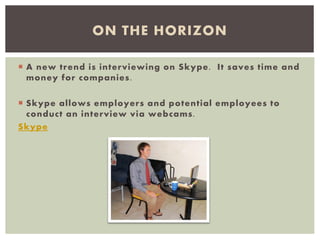
 A new trend is interviewing on Skype. It saves time and
money for companies.
 Skype allows employers and potential employees to
conduct an interview via webcams.
Skype
ON THE HORIZON
Be prepared!
 Know yourself.
 Know the employer/industry.
Before the interview:
 Confirm interview time, place & with whom (map route).
 Bring resume & other relevant materials.
 Be well groomed, dress neatly and appropriately.
 Arrive early.
GENERAL RULES FOR INTERVIEWING
During the Interview:
 Be confident and enthusiastic.
 Relax – an interview is a conversation.
 Listen – follow the lead of the interviewer.
 Ask intelligent questions.
 Clarify follow-up procedures.
After the Interview:
 Send a thank you letter (within 24 hours is best).
 Keep records.
GENERAL RULES FOR INTERVIEWING
 First Impressions
 Hiring managers typically make decision in 10 minutes of
the interview (even though avg. interview is 1 hour) -
Robert Half
 Career Planning Component
 Personal Qualifications and Background
 Organization and Position
 Candidate Questions
 Close/Follow-Up Questions
 Send Thank-you Letter
THE INTERVIEW PROCESS
Nonverbal cues are 50% of the interview:
 Non-verbal behavior observed by the employer often
reflects level of confidence, interest, and ability of the
person.
 Non-verbal behavior can be viewed as being both
positive and negative.
 Examples of positive non-verbal behavior include: Leaning
forward, sitting with hands, feet, and arms unfolded, smiling
appropriately, firm handshake, good eye contact.
 Examples of negative non-verbal behavior include:
Inappropriate facial expression or lack of expression, a weak
and ineffectual handshake, lack of eye contact, squirming in the
seat or sitting on the edge of the chair, frowning.
THE IMPORTANCE OF NON-
VERBAL BEHAVIOR
 Tell me about yourself.
 Reveals what is important to you and how you view yourself.
 Try to include qualifications for the position.
 Don’t ramble…know how to end your response (1-2 minutes).
 What is your weakness?
 Everybody has a weakness.
 Pick a weakness not directly related to any key responsibilities.
 Turn response into a positive…working to improve weakness.
 Answer is short and to the point.
A SAMPLING OF INTERVIEW QUESTIONS…
…AND HOW TO RESPOND
 What are your strengths?
 How do you work under pressure?
 What 2 or 3 things are most important to you in your job?
 Back up your responses with examples.
 Tailor your responses as much as possible to the position.
 Why should I hire you?
 Summarize response effectively…pull together major strengths –
SELL YOURSELF!
 Tailor response to position and company – why should this
particular company be interested in you?
 Know how to end response…don’t ramble.
A SAMPLING OF INTERVIEW QUESTIONS…
…AND HOW TO RESPOND
What is your favorite challenging question to ask
candidates?
 What is the toughest personal challenge you have had to
overcome?
 What makes you different from everybody else?
 What’s the most valuable lesson you’ve learned so far?
 What’s the biggest mistake you ever made and what did it
cost?
 Who is your personal hero?
 What else would you like for me to know about you?
KENT STATE UNIVERSITY CAREER SERVICES
CENTER
EMPLOYER SURVEY
“Tell me a situation when you had to…”
 Past behavior is the best predictor of future
behavior.
 Develop and rehearse your responses.
 “Tell a story” explaining the problem, your
approach and the results.
 Use the STAR approach: S: Situation, T: Task, A: Action, R: Result.
 Incorporate skills and personal attributes into responses.
BEHAVIOR BASED QUESTIONS
 “Give me an example of a time when you used good
judgment and logic in solving a problem.”
 “Tell me about a time when you failed and what
happened.”
 “By examples, convince me that you can adapt to a wide
variety of people, situations, and environments.”
 “Tell me about a time when you had to work with a client
that you didn’t like and what happened.”
 Be prepared for questions asking for more detail than you’ve
already given.
 Evaluate your background to identify your skills/experience
related to the job.
 Identify 3-5 top selling points – attributes that set you apart –
and be sure you point them out during the interview.
BEHAVIOR BASED QUESTIONS
EXAMPLES
 Age
 Arrest record (an arrest is not a conviction of guilt)
 Children/Pregnancy (or future child-bearing plans)
 Citizenship/Home Country
 Religion
 Medical history, illnesses, diseases, physical, mental impartment
-Americans with Disability Act
 Marital status and spouse’s job
 Race, Color, National Origin
ILLEGAL QUESTIONS
Pre-employment questions should focus on functions of
the position
Pre-employment inquiries about the following are generally not
acceptable:
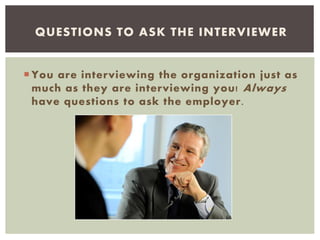
 You are interviewing the organization just as
much as they are interviewing you! Always
have questions to ask the employer.
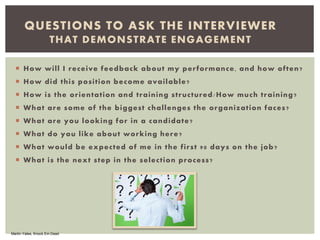
QUESTIONS TO ASK THE INTERVIEWER
 How will I receive feedback about my performance, and how often?
 How did this position become available?
 How is the orientation and training structured/How much training?
 What are some of the biggest challenges the organization faces?
 What are you looking for in a candidate?
 What do you like about working here?
 What would be expected of me in the first 90 days on the job?
 What is the next step in the selection process?
QUESTIONS TO ASK THE INTERVIEWER
THAT DEMONSTRATE ENGAGEMENT
Martin Yates, Knock Em Dead
 Need to catch your breathe or need a second to think? Before
you get flustered, ask a question that gives you some time to
explore your next answer.
 “To be sure that I understand you, would you mind telling me
more about that?” or “I want to make sure that we are on the
same page, could you elaborate further?”
QUESTIONS TO ASK THE INTERVIEWER
THAT BUY TIME
Martin Yates, Knock Em dead
 “Will there be follow-up interviews?” “I am very interested in
this position, can we schedule the next interview now?”
 Always express your interest and ask for the job!
 Your questions throughout the interview
should communicate competency,
commitment, and enthusiasm.
A good interview should feel like a
conversation between colleagues with similar
interests.
QUESTIONS TO ASK THE INTERVIEWER TO
DETERMINE NEXT STEP
Martin Yates, Knock Em Dead
 Poor appearance
 Poor voice, diction,
grammar
 Little enthusiasm,
passive, indifferent
 Evades, hedges
unfavorable factors
 Late for interview,
disrespectful
 Talks too much, rambles
 Unable to handle silence
 Negative attitude
 Lack of extracurricular
involvement
 Couldn’t sell him/herself
to the employer
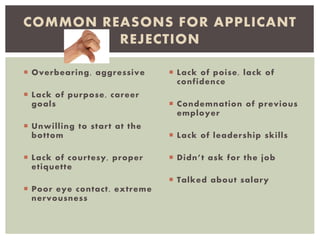
COMMON REASONS FOR APPLICANT
REJECTION
 Overbearing, aggressive
 Lack of purpose, career
goals
 Unwilling to start at the
bottom
 Lack of courtesy, proper
etiquette
 Poor eye contact, extreme
nervousness
 Lack of poise, lack of
confidence
 Condemnation of previous
employer
 Lack of leadership skills
 Didn’t ask for the job
 Talked about salary
COMMON REASONS FOR APPLICANT
REJECTION
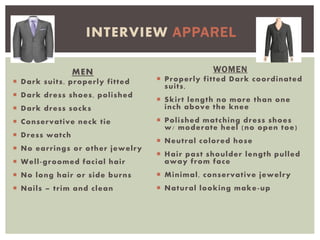
MEN
 Dark suits, properly fitted
 Dark dress shoes, polished
 Dark dress socks
 Conservative neck tie
 Dress watch
 No earrings or other jewelry
 Well-groomed facial hair
 No long hair or side burns
 Nails – trim and clean
WOMEN
 Properly fitted Dark coordinated
suits,
 Skirt length no more than one
inch above the knee
 Polished matching dress shoes
w/ moderate heel (no open toe)
 Neutral colored hose
 Hair past shoulder length pulled
away from face
 Minimal, conservative jewelry
 Natural looking make-up
INTERVIEW APPAREL
Both MEN and WOMEN
No visible tattoos
No heavy cologne/perfume
No visible body piercing
No purple, green, orange, etc. colored hair
Fresh breath
Freshly bathed/showered (use deodorant)
Freshly pressed clothing
INTERVIEW APPAREL
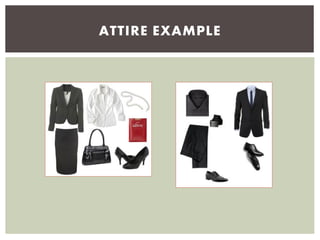
ATTIRE EXAMPLE
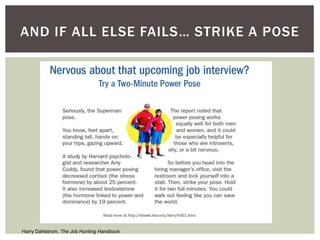
AND IF ALL ELSE FAILS… STRIKE A POSE
Harry Dahlstrom, The Job Hunting Handbook
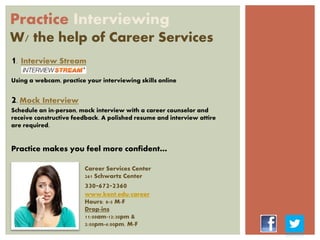
Practice Interviewing
W/ the help of Career Services
1. Interview Stream
Using a webcam, practice your interviewing skills online
2. Mock Interview
Schedule an in-person, mock interview with a career counselor and
receive constructive feedback. A polished resume and interview attire
are required.
Practice makes you feel more confident…
Career Services Center
261 Schwartz Center
330-672-2360
www.kent.edu/career
Hours: 8-5 M-F
Drop-ins
11:00am-12:30pm &
2:00pm-4:00pm. M-F
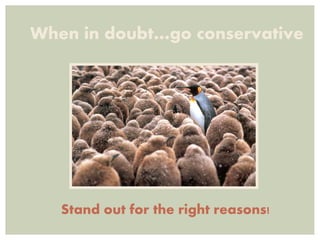
When in doubt…go conservative
Stand out for the right reasons!

Interview Do's and Don'ts.pdf

  • 1.
  • 2.
     Fell asleep,woke up & apologized because he had been out all night.  Showed up for the final interview on the wrong day – twice!  Wore a baseball cap because he was having “a bad hair day.”  Removed her shoes, pulled out debris, and handed it to the recruiter.  Brought his mother to the interview.  Used his tablet to check stocks and e-mail friends during the interview.  Tried to bribe the recruiter with basketball tickets . TALES FROM THE INTERVIEW ROOM
  • 3.
    Common Types ofInterviews:  Preliminary or Screening Interview  Follow Up Interview or Second/Third Interview  Behavioral Interview  Telephone Interview  Panel Interview Additional Types of Interviews:  Group Interview  Conversational Interview  Advertising Interview TYPES OF INTERVIEWS
  • 4.
     A newtrend is interviewing on Skype. It saves time and money for companies.  Skype allows employers and potential employees to conduct an interview via webcams. Skype ON THE HORIZON
  • 5.
    Be prepared!  Knowyourself.  Know the employer/industry. Before the interview:  Confirm interview time, place & with whom (map route).  Bring resume & other relevant materials.  Be well groomed, dress neatly and appropriately.  Arrive early. GENERAL RULES FOR INTERVIEWING
  • 6.
    During the Interview: Be confident and enthusiastic.  Relax – an interview is a conversation.  Listen – follow the lead of the interviewer.  Ask intelligent questions.  Clarify follow-up procedures. After the Interview:  Send a thank you letter (within 24 hours is best).  Keep records. GENERAL RULES FOR INTERVIEWING
  • 7.
     First Impressions Hiring managers typically make decision in 10 minutes of the interview (even though avg. interview is 1 hour) - Robert Half  Career Planning Component  Personal Qualifications and Background  Organization and Position  Candidate Questions  Close/Follow-Up Questions  Send Thank-you Letter THE INTERVIEW PROCESS
  • 8.
    Nonverbal cues are50% of the interview:  Non-verbal behavior observed by the employer often reflects level of confidence, interest, and ability of the person.  Non-verbal behavior can be viewed as being both positive and negative.  Examples of positive non-verbal behavior include: Leaning forward, sitting with hands, feet, and arms unfolded, smiling appropriately, firm handshake, good eye contact.  Examples of negative non-verbal behavior include: Inappropriate facial expression or lack of expression, a weak and ineffectual handshake, lack of eye contact, squirming in the seat or sitting on the edge of the chair, frowning. THE IMPORTANCE OF NON- VERBAL BEHAVIOR
  • 9.
     Tell meabout yourself.  Reveals what is important to you and how you view yourself.  Try to include qualifications for the position.  Don’t ramble…know how to end your response (1-2 minutes).  What is your weakness?  Everybody has a weakness.  Pick a weakness not directly related to any key responsibilities.  Turn response into a positive…working to improve weakness.  Answer is short and to the point. A SAMPLING OF INTERVIEW QUESTIONS… …AND HOW TO RESPOND
  • 10.
     What areyour strengths?  How do you work under pressure?  What 2 or 3 things are most important to you in your job?  Back up your responses with examples.  Tailor your responses as much as possible to the position.  Why should I hire you?  Summarize response effectively…pull together major strengths – SELL YOURSELF!  Tailor response to position and company – why should this particular company be interested in you?  Know how to end response…don’t ramble. A SAMPLING OF INTERVIEW QUESTIONS… …AND HOW TO RESPOND
  • 11.
    What is yourfavorite challenging question to ask candidates?  What is the toughest personal challenge you have had to overcome?  What makes you different from everybody else?  What’s the most valuable lesson you’ve learned so far?  What’s the biggest mistake you ever made and what did it cost?  Who is your personal hero?  What else would you like for me to know about you? KENT STATE UNIVERSITY CAREER SERVICES CENTER EMPLOYER SURVEY
  • 12.
    “Tell me asituation when you had to…”  Past behavior is the best predictor of future behavior.  Develop and rehearse your responses.  “Tell a story” explaining the problem, your approach and the results.  Use the STAR approach: S: Situation, T: Task, A: Action, R: Result.  Incorporate skills and personal attributes into responses. BEHAVIOR BASED QUESTIONS
  • 13.
     “Give mean example of a time when you used good judgment and logic in solving a problem.”  “Tell me about a time when you failed and what happened.”  “By examples, convince me that you can adapt to a wide variety of people, situations, and environments.”  “Tell me about a time when you had to work with a client that you didn’t like and what happened.”  Be prepared for questions asking for more detail than you’ve already given.  Evaluate your background to identify your skills/experience related to the job.  Identify 3-5 top selling points – attributes that set you apart – and be sure you point them out during the interview. BEHAVIOR BASED QUESTIONS EXAMPLES
  • 14.
     Age  Arrestrecord (an arrest is not a conviction of guilt)  Children/Pregnancy (or future child-bearing plans)  Citizenship/Home Country  Religion  Medical history, illnesses, diseases, physical, mental impartment -Americans with Disability Act  Marital status and spouse’s job  Race, Color, National Origin ILLEGAL QUESTIONS Pre-employment questions should focus on functions of the position Pre-employment inquiries about the following are generally not acceptable:
  • 15.
     You areinterviewing the organization just as much as they are interviewing you! Always have questions to ask the employer. QUESTIONS TO ASK THE INTERVIEWER
  • 16.
     How willI receive feedback about my performance, and how often?  How did this position become available?  How is the orientation and training structured/How much training?  What are some of the biggest challenges the organization faces?  What are you looking for in a candidate?  What do you like about working here?  What would be expected of me in the first 90 days on the job?  What is the next step in the selection process? QUESTIONS TO ASK THE INTERVIEWER THAT DEMONSTRATE ENGAGEMENT Martin Yates, Knock Em Dead
  • 17.
     Need tocatch your breathe or need a second to think? Before you get flustered, ask a question that gives you some time to explore your next answer.  “To be sure that I understand you, would you mind telling me more about that?” or “I want to make sure that we are on the same page, could you elaborate further?” QUESTIONS TO ASK THE INTERVIEWER THAT BUY TIME Martin Yates, Knock Em dead
  • 18.
     “Will therebe follow-up interviews?” “I am very interested in this position, can we schedule the next interview now?”  Always express your interest and ask for the job!  Your questions throughout the interview should communicate competency, commitment, and enthusiasm. A good interview should feel like a conversation between colleagues with similar interests. QUESTIONS TO ASK THE INTERVIEWER TO DETERMINE NEXT STEP Martin Yates, Knock Em Dead
  • 19.
     Poor appearance Poor voice, diction, grammar  Little enthusiasm, passive, indifferent  Evades, hedges unfavorable factors  Late for interview, disrespectful  Talks too much, rambles  Unable to handle silence  Negative attitude  Lack of extracurricular involvement  Couldn’t sell him/herself to the employer COMMON REASONS FOR APPLICANT REJECTION
  • 20.
     Overbearing, aggressive Lack of purpose, career goals  Unwilling to start at the bottom  Lack of courtesy, proper etiquette  Poor eye contact, extreme nervousness  Lack of poise, lack of confidence  Condemnation of previous employer  Lack of leadership skills  Didn’t ask for the job  Talked about salary COMMON REASONS FOR APPLICANT REJECTION
  • 21.
    MEN  Dark suits,properly fitted  Dark dress shoes, polished  Dark dress socks  Conservative neck tie  Dress watch  No earrings or other jewelry  Well-groomed facial hair  No long hair or side burns  Nails – trim and clean WOMEN  Properly fitted Dark coordinated suits,  Skirt length no more than one inch above the knee  Polished matching dress shoes w/ moderate heel (no open toe)  Neutral colored hose  Hair past shoulder length pulled away from face  Minimal, conservative jewelry  Natural looking make-up INTERVIEW APPAREL
  • 22.
    Both MEN andWOMEN No visible tattoos No heavy cologne/perfume No visible body piercing No purple, green, orange, etc. colored hair Fresh breath Freshly bathed/showered (use deodorant) Freshly pressed clothing INTERVIEW APPAREL
  • 23.
  • 24.
    AND IF ALLELSE FAILS… STRIKE A POSE Harry Dahlstrom, The Job Hunting Handbook
  • 25.
    Practice Interviewing W/ thehelp of Career Services 1. Interview Stream Using a webcam, practice your interviewing skills online 2. Mock Interview Schedule an in-person, mock interview with a career counselor and receive constructive feedback. A polished resume and interview attire are required. Practice makes you feel more confident… Career Services Center 261 Schwartz Center 330-672-2360 www.kent.edu/career Hours: 8-5 M-F Drop-ins 11:00am-12:30pm & 2:00pm-4:00pm. M-F
  • 26.
    When in doubt…goconservative Stand out for the right reasons!