Ângelo Batista
Joana Monteiro
Francisca Fonseca
HISTORY
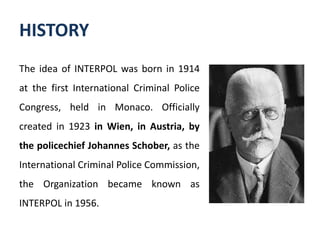
The idea of INTERPOL was born in 1914
at the first International Criminal Police
Congress, held in Monaco. Officially
created in 1923 in Wien, in Austria, by
the policechief Johannes Schober, as the
International Criminal Police Commission,
the Organization became known as
INTERPOL in 1956.
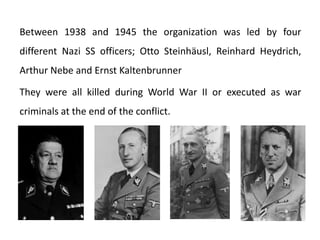
Between 1938 and 1945 the organization was led by four
different Nazi SS officers; Otto Steinhäusl, Reinhard Heydrich,
Arthur Nebe and Ernst Kaltenbrunner
They were all killed during World War II or executed as war
criminals at the end of the conflict.
INTERPOL
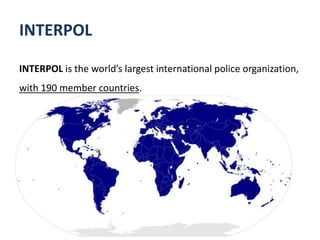
INTERPOL is the world’s largest international police organization,
with 190 member countries.
A GLOBAL PRESENCE
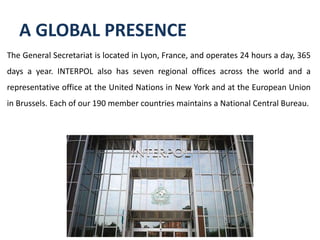
The General Secretariat is located in Lyon, France, and operates 24 hours a day, 365
days a year. INTERPOL also has seven regional offices across the world and a
representative office at the United Nations in New York and at the European Union
in Brussels. Each of our 190 member countries maintains a National Central Bureau.
NEUTRALITY
At INTERPOL, we aim to facilitate international police cooperation even where
diplomatic relations do not exist between particular countries. Action is taken
within the limits of existing laws in different countries and in the spirit of the
Universal Declaration of Human Rights. Our Constitution prohibits ‘any
intervention or activities of a political, military, religious or racial character'.
VISION AND MISSION
The vision:
"Connecting police for a safer world".
The mission:
"Preventing and fighting crime through enhanced cooperation and innovation
on police and security matters“.
PRIORITIES
INTERPOL’s Strategic Framework sets the Organization’s priorities and objectives for a
given period of time (three years).
The Framework contains four strategic priorities and two corporate priorities.
These priorities are in line with the Organization's vision and mission and reflect the
dynamic environment and challenges of international policing in the 21st century.
Strategic priorities
1. Secure global police information system
2. 24/7 support to policing and law enforcement
3. Innovation, capacity building and research
4. Assisting in the identification of crimes and criminals
Corporate priorities
1. Ensure organizational health and sustainability
2. Consolidate the institutional framework
OFFICIAL NAME AND ABBREVIATIONS
The Organization's official name is "ICPO–INTERPOL“ - 'International Criminal
Police Organization'. The word "INTERPOL" is a contraction of "international
police", and was chosen in 1946 as the telegraphic address.
THE EMBLEM
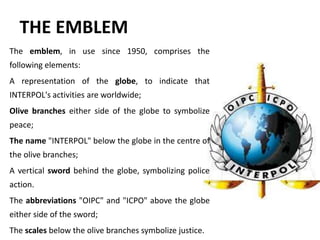
The emblem, in use since 1950, comprises the
following elements:
A representation of the globe, to indicate that
INTERPOL's activities are worldwide;
Olive branches either side of the globe to symbolize
peace;
The name "INTERPOL" below the globe in the centre of
the olive branches;
A vertical sword behind the globe, symbolizing police
action.
The abbreviations "OIPC" and "ICPO" above the globe
either side of the sword;
The scales below the olive branches symbolize justice.
THE FLAG
The flag has been in use since 1950.
It has a light-blue background;
The emblem is in the centre;
The four lightning flashes arranged symmetrically around the emblem
symbolize telecommunications and speed in police action.
WEBGRAFIA
• http://www.interpol.int/
• http://pt.wikipedia.org/wiki/Interpol
• http://super.abril.com.br/ciencia/interpol-443577.shtml

INTERPOL

  • 1.
  • 2.
    HISTORY The idea ofINTERPOL was born in 1914 at the first International Criminal Police Congress, held in Monaco. Officially created in 1923 in Wien, in Austria, by the policechief Johannes Schober, as the International Criminal Police Commission, the Organization became known as INTERPOL in 1956.
  • 3.
    Between 1938 and1945 the organization was led by four different Nazi SS officers; Otto Steinhäusl, Reinhard Heydrich, Arthur Nebe and Ernst Kaltenbrunner They were all killed during World War II or executed as war criminals at the end of the conflict.
  • 4.
    INTERPOL INTERPOL is theworld’s largest international police organization, with 190 member countries.
  • 5.
    A GLOBAL PRESENCE TheGeneral Secretariat is located in Lyon, France, and operates 24 hours a day, 365 days a year. INTERPOL also has seven regional offices across the world and a representative office at the United Nations in New York and at the European Union in Brussels. Each of our 190 member countries maintains a National Central Bureau.
  • 6.
    NEUTRALITY At INTERPOL, weaim to facilitate international police cooperation even where diplomatic relations do not exist between particular countries. Action is taken within the limits of existing laws in different countries and in the spirit of the Universal Declaration of Human Rights. Our Constitution prohibits ‘any intervention or activities of a political, military, religious or racial character'.
  • 7.
    VISION AND MISSION Thevision: "Connecting police for a safer world". The mission: "Preventing and fighting crime through enhanced cooperation and innovation on police and security matters“.
  • 8.
    PRIORITIES INTERPOL’s Strategic Frameworksets the Organization’s priorities and objectives for a given period of time (three years). The Framework contains four strategic priorities and two corporate priorities. These priorities are in line with the Organization's vision and mission and reflect the dynamic environment and challenges of international policing in the 21st century.
  • 9.
    Strategic priorities 1. Secureglobal police information system 2. 24/7 support to policing and law enforcement 3. Innovation, capacity building and research 4. Assisting in the identification of crimes and criminals Corporate priorities 1. Ensure organizational health and sustainability 2. Consolidate the institutional framework
  • 10.
    OFFICIAL NAME ANDABBREVIATIONS The Organization's official name is "ICPO–INTERPOL“ - 'International Criminal Police Organization'. The word "INTERPOL" is a contraction of "international police", and was chosen in 1946 as the telegraphic address.
  • 11.
    THE EMBLEM The emblem,in use since 1950, comprises the following elements: A representation of the globe, to indicate that INTERPOL's activities are worldwide; Olive branches either side of the globe to symbolize peace; The name "INTERPOL" below the globe in the centre of the olive branches; A vertical sword behind the globe, symbolizing police action. The abbreviations "OIPC" and "ICPO" above the globe either side of the sword; The scales below the olive branches symbolize justice.
  • 12.
    THE FLAG The flaghas been in use since 1950. It has a light-blue background; The emblem is in the centre; The four lightning flashes arranged symmetrically around the emblem symbolize telecommunications and speed in police action.
  • 13.
    WEBGRAFIA • http://www.interpol.int/ • http://pt.wikipedia.org/wiki/Interpol •http://super.abril.com.br/ciencia/interpol-443577.shtml