Confidential
Interpersonal Skills
Role plays
Confidential
text text text text text
Interpersonal
Skills
Importance &
Benefits
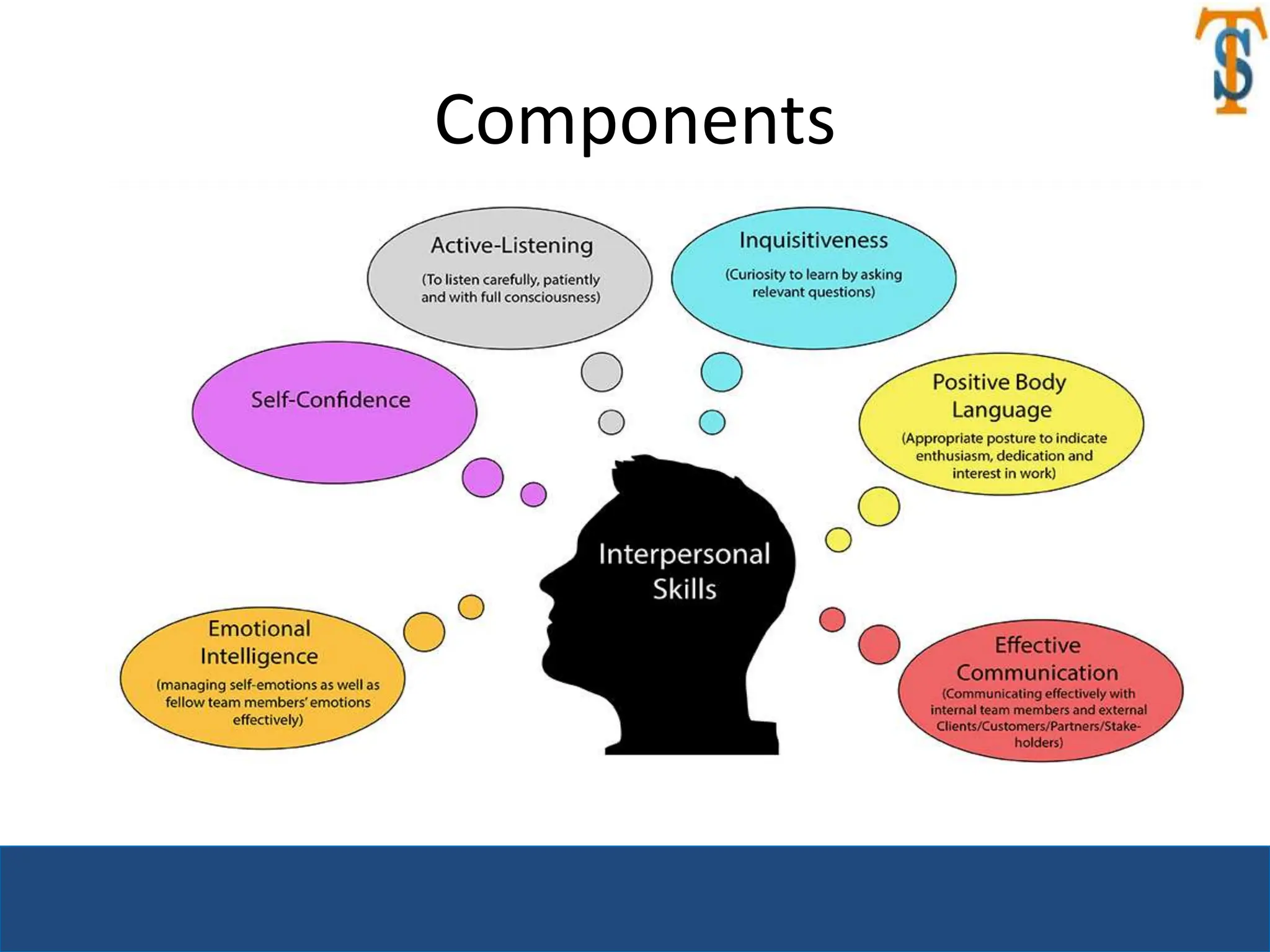
Components
Steps to
Interpersonal
Relationship
Emotional
Intelligence
Understanding
Self
Iceberg Model
Perceptions
Johari
Window
Understanding
Others
Empathy
Social Styles
Connecting
With Others
Rapport
Building
Building Trust
Assertiveness
Conflict
Management
LEARNING
OBJECTIVES
Expectations Mapping
Confidential
List the tasks
Confidential
ASK MODEL
Name ball grid
Confidential
Is My Role Dependent on Others?
Summarise challenges
Confidential
Human Bingo
Chart activity- how this info helps us
Confidential
Any One Word That Defines
Interpersonal Skills
Defining IP skill
Confidential
Components
Confidential
Steps
Chart activity
Confidential
Understanding Self
10
Confidential
What makes our Lenses
The Iceberg Model
Confidential
Perception
12
Adjective box
Confidential
Self- Assessment and Team Mates
Confidential
Fill in the Panes
Confidential
Understanding Others
SOCIAL AWARENESS
Activity: Orange- buyer & seller
Confidential
Confidential
The 5 levels of listening!
1
2
3
4
5
Clip- JKJ
Confidential
Four autobiographical
responses…
1. Evaluating : agreeing or disagreeing
2. Probing: from our frame of reference
3. Advising: based on our own experience
4. Interpreting: attributing motives based on our own motives
Activity: We have
not got enough
Confidential
Clip : Bugs race
Work inventory
Confidential
Communication Style Strengths
Analytical
Amiable Expressive
Driver
Controlled
Emotive
Tell
Ask
Objective
Precise
Thorough
Detailed
Rational
Controlled
Supportive
Empathic
Loyal
Group-Oriented
Team focus
Sharing
Decisive
Tough
Candid
Efficient
Results-Oriented
Controlled
Creative
Enthusiastic
Humorous
Energetic
Focus on Vision
Promoter
Confidential
Communication Style Gaps
Analytical
Amiable Expressive
Driver
Controlled
Emotive
Tell
Ask
Slow
Overcautious
Indecisive
Inflexible
Unfriendly
Nit-picky
Rigid
Complying
Pushover
Follower
Self-sacrificing
Passive
Hesitating
Autocratic
Overbearing
Insensitive
Impatient
Pressuring
Ruthless
Dominating
Excitable
High strung
Emotional
Loose cannon
Lacks detail
Over-committed
Not focused
Confidential
Improving Your Versatility
DECIDE
Be more flexible, more open-minded
Openly show more concern for other people
Be decisive with data
Listen for people’s feelings
DECLARE
Be less sensitive
Be more willing to take risks
Say “no” more often
Let people know what you think
RESTRAIN & CHECK
Talk less
Spend more time looking at facts
Control time and emotion
Think before you speak
LISTEN
Acknowledge different points of view
Show more patience
Tone down intensity
Pay attention to feelings
22
Confidential
Styles Under Stress
Driver
Commands / Takes Over
Analytical
Avoids / Withdraws
Amiable
Acquiesces / Goes Along
• Logically discuss the issue
• Acknowledge a need for time
• Set a deadline
• Restate their concerns
• Offer options for moving forward
• Recommit to results and time frame
Controlled
Emotive
Tell
Ask
• Ask open questions about concerns
• Allow them to express disagreement
• Acknowledge feelings and points
of view
• Separate emotions from facts
Expressive
Attacks / Confronts
23
Confidential
Connecting With Others
Role plays
Confidential
LEARNING COMPASS
Confidential
ACTION PLAN
Confidential
THANKYOU!

Interpersonal skills essential for effective leadership.ppt

Editor's Notes

  • #3 Identify the importance of effective communication at their workplace Identify Barriers to Communication. Understand the expectations and needs of their clients through effective communication Clearly communicate about goals, responsibility, performance, expectations and feedback to stakeholders Understand the key components of Impactful Communication Identify the benefits of Timely and Responsive Communication Understand the importance of Listening, Questioning, Paraphrasing & Probing Identify the components of Correct Grammar of English communication. Write clear concise messages using appropriate tone and formatting. Understand some common pitfalls in Email Writing Learn to incorporate effective techniques in their written communication Understand to apply effective Email Mechanics Learn and Apply Effective Email Writing Skills Develop a personal action plan for the purpose of implementing positive changes in the workplace.
  • #7 Debrief by asking for volunteers to share how they feel differently about the others in the group now that they know a few things about them. When we take the time to get to know each other, barriers dissolve, people open up, and learning can take place. When used with interprofessional teams, this has led to discussion related to team building, team relationships and respect. Often, team members display greater trust for each other, demonstrate improved communication, are more willing to approach each other and are much better at dealing with conflict once they think about colleagues as people rather than an unknown discipline. Why is connecting more important today than ever before? What are you missing by not connecting? Identify people you don’t connect effectively. They potentially add value or could make your job easier and you have something to offer them.
  • #8 Rearrange the words to make a statement /definition of IP Skills
  • #9 What did you exhibit to achieve your Task through IP Skills EI, Communication,
  • #10 Key Points Interpersonal skills are vital for forming and maintaining effective working relationships. They require a high degree of emotional intelligence, which enables you to understand how your thoughts and actions affect others in the workplace. You can develop your interpersonal skills in four key areas: Communication skills. Craft your message carefully, with your audience in mind, be aware of body language, and listen. Managing differences. Deal with difficult people assertively but with good grace, and learn to resolve conflict. Managing agreement. Establish trust and a supportive working environment. Accept the strengths and weaknesses in your team, and give effective feedback. Personal integrity. Recognize your core values, and act accordingly.
  • #12 Explain the Human Ice Berg Theory Research shows that the content of communication (words and data) represents only a small percentage of the meaning of communication (less than 10%). The vast majority of the perceived meaning of any experience is derived from what we can call context (the situation, the circumstances, timing, nonverbal cues, assumptions, and interpretations). Think of content as the small tip of an iceberg that is visible, while context is represented by the larger mass hidden beneath the surface. While people tend to be aware of the content of communication, most remain unaware of the context. They create meaning based on unconscious assumptions and interpretations about the context.  In fact, most people wouldn’t even know what to look for if they wanted to peer beneath the surface (the “text”) to understand the “subtext” that determines how communication is being interpreted (its meaning). Conscious communication is fundamentally about awareness, perspective, and choice. All effective interpersonal communication starts with awareness. What dimensions and dynamics (especially about the context/subtext) are you aware of?   Next, the person who is able to consider a topic from numerous diverse perspectives is able to construct a more accurate picture (and assessment) of the situation than the majority of people who are trapped in a singular vantage point. The English language is filled with words and phrases like viewpoint, outlook, angle, stance, “the way I see it,” and so on. All of these point to perspective as a key to understanding people and communicating with them effectively. Naturally, having a familiarity with the four fundamental worldviews (mindsets) helps us strengthen our perspective-taking ability and comfort with these wildly divergent viewpoints. Obviously, the more things you are aware of, and the more perspectives you can account for in a given situation, the more comprehensive and accurate your answers will be to the first and second set of integral leadership metaquestions: “What’s really happening here?” and “What’s important and what’s needed?” Conscious communication is also fundamentally about choice. Most people are unaware of the nuances of communication and tend to gravitate toward a singular communication style that reflects habitual and unconscious speaking and listening behaviors. By increasing their versatility with all the major modes modes of communication, integral leaders are far better equipped to consciously choose the most helpful way to respond to a given situation. This versatility is crucial when it comes to answering our third integral leadership metaquestion, “What’s the most helpful action I can take in this situation?” Our Actions/behaviours are driven by what lies beneath the surface. Our lenses are shaped by the collective of the material under the surface level. A discussion on how these are formed is interesting. How children in the same home turn out to be two different individuals.
  • #14 Self Assessment: Using the following list choose 5 adjectives that best describe yourself. Be objective and honest. 
  • #15 Fill In the Johari Window Panes Compare this list with the list the individual generated about themselves. Where an adjective appears on both lists, place it in the Arena Quadrant. If an adjective appears on the individual’s list, but not on the group’s, place it in the Mask Quadrant. When an adjective appears on the group’s list, but not on the individual’s, put it in the Blind Spots quadrant. Any adjective that appeared on neither list can go in the Unconscious Quadrant. Review & Analysis Once everyone has finished, allow each participant to review their Johari Window assessment. Encourage them to compare notes between self and team assessment.  Spend a few minutes discussing the adjectives that appear in the open quadrant. Ask an individual to disclose by talking about one of the adjectives they selected for themselves, but the group did not. Have the individual select one of the adjectives the group has identified, but the individual did not. The group now has the opportunity to give some feedback to the individual about this adjective.
  • #18 Note for the trainer: Say that, as part of formal education we get trained mostly on how to speak well and not so much on how to listen well. Thus we would be trying to understand over the next few slides as to what we need to do to achieve deeper listening. Take them through the contents of this slide
  • #19 Note for the Trainer: These are the obstacles which prevent us from achieving empathetic listening. Take the participants through the same.