BASIC SELLING SKILLS
PREPARED BY MOHAMMAD SALAH KHODAIRY
AIM OFTRAINING
• To create an outstanding success for our hospital.
• Understand in depth, the role of SalesTeam.
• Develop a Framework for an Effective Sales Approach.
SELLING & SALESPERSONS
• What selling is?
• What a salesperson does?
WHAT IS SELLING?
• To satisfy a Need /Want with your product / service for “Mutual Benefits”.
• To Identify / Generate / Influence a Need /Want.
SELLING IS
“The process of:
• Developing customer relationships,
• Discovering customer needs,
• Matching appropriate products with these needs,
• and communicating benefits.”
PHILOSOPHY OF SELLING
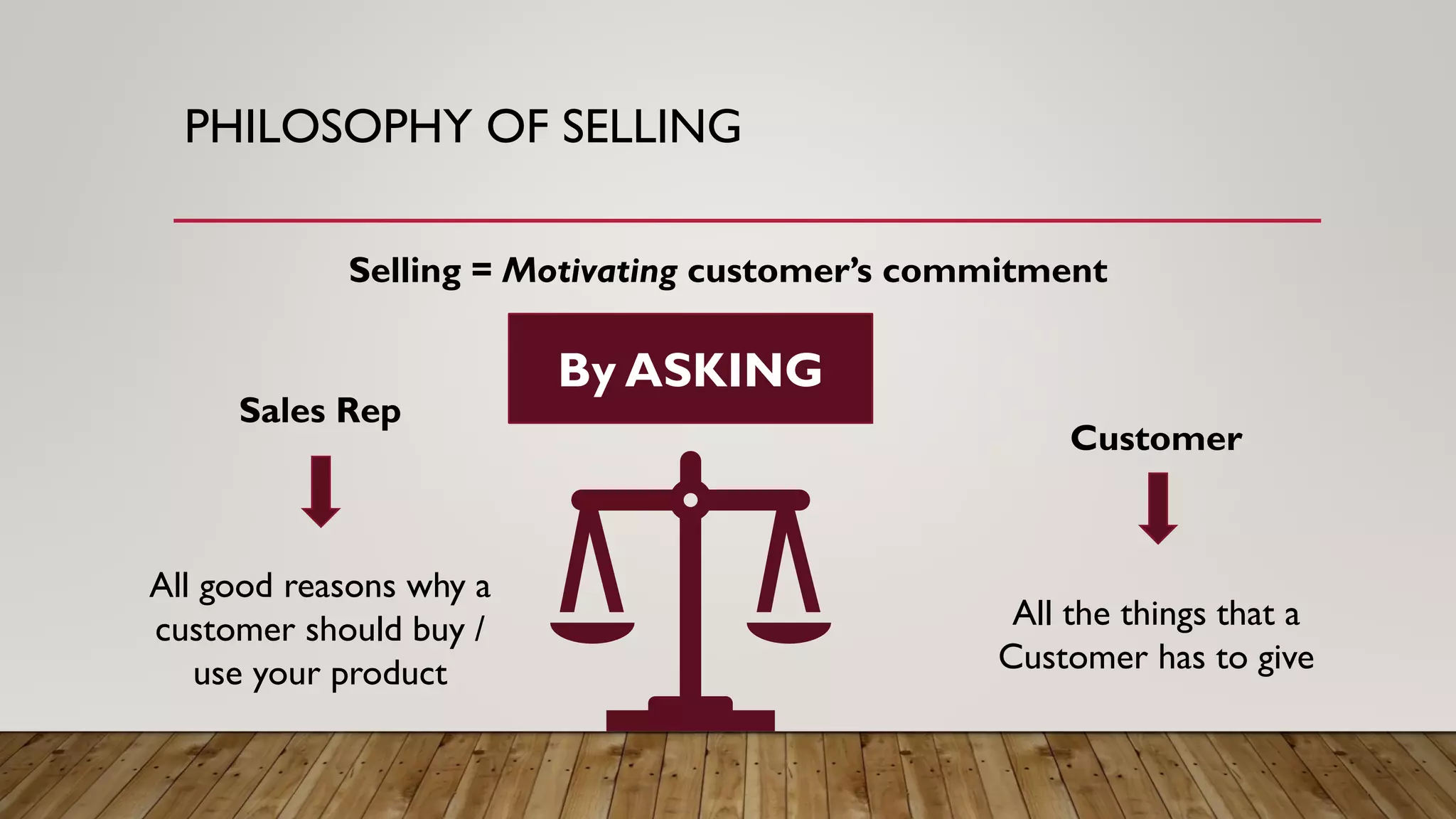
Selling = Motivating customer’s commitment
Sales Rep
All good reasons why a
customer should buy /
use your product
Customer
All the things that a
Customer has to give
By ASKING
SELLING IS ‘HELPING’ PEOPLE TO:
• Solve problems.
• Make more $.
• Buy.
• Meet their needs/goals.
SELLING PHILOSOPHY OF ‘GOOD’ SALESPEOPLE:
• Selling is problem solving.
• Selling is a helping, caring activity.
• A customer is a person to be served, not a prospect to be sold.
• Treat people as human beings, not $ signs.
• Unique products, relationships, cultures are important.
• Customer driven, not product driven.
SELLING PHILOSOPHY OF ‘GOOD’ SALESPEOPLE:
• Focus on customer needs.
• Long-term success depends on pleasing others.
• Selling is a ‘win-win’ activity.
• A commitment to self improvement and life-long learning essential for long-
term success.
• Adherence to a strict code of ethics emphasizing, among other things, mutual
trust, respect, and honesty is essential.
SELLING IS A ‘PROFESSION’ BASED ON:
• Scientific skills, even though it is not an ‘exact’ science.
• Knowledge about selling principles/theories & product.
• A code of ethics.
• Psychological & sociological aspects of human behavior (CONSUMER
BEHAVIOR).
WHAT DO SALESPEOPLE DO?
1)They Sell:
• Products/services
• Solutions
• Information
• Ideas
• Service
• Their company
• Themselves
WHAT DO SALESPEOPLE DO?
2)They work with people:
• Solve problems
• Represent the company
• Communicate (benefits?) with
customers
• Develop relationships, partnerships,
alliances
• Discover needs
• Gather information
• Educate customers
• Catalyze change
• Help people buy
• Serve customers
• Treat people with respect
WHAT DO SALESPEOPLE DO?
3)They Manage:
• Their time
• Their territory
• Their records
• Their stress
TYPES OF SELLING
• Indirect selling – any form of selling that does not involve a sales person.
(Ex: advertising, promotion, displays, signage)
• Direct Selling – when there is contact between a salesperson and the
customer.
ELEMENTS OF A
SALES CALL
1. Planning & setting pre-call objectives
2. Opening the detail
3. Probing
4. Presenting benefits
5. Handling feedback
6. Closing
7. Post call analysis
PLANNING & SETTING
PRE-CALL OBJECTIVES
IMPORTANCE OF
PLANNING
• To be professional
• To save time
• To be prepared
• To be persuasive
• To improve self-confidence
• To avoid embarrassment
• TO INCREASE SALES
YOU HAVETO KNOW:
Information about the Customers
• Time
• Routing
• Records & Reports
TYPES OF INFORMATION
STATIC
• Birth date
• Telephone & Mobile numbers,
• E-mail & address
• Potentiality & Attitude
• Best time of visit
• General need
DYNAMIC
• Our market share
• Competition relation
• Services delivered
• Family condition
• Contract situation
SOURCES OF INFORMATION
• Previous visit report.
• Colleagues.
• Competition.
• The customer.
• Assistant.
TIME MANAGEMENT
• 245 working day /year.
• 980 hour/year.
• Value of hour.
• Value of each visit.
• Cost of each hour.
• Cost of each visit.
• Actual selling time.
RECORDING & REPORTING
A short pencil is better than long
memory.
No job is done till the paper
work is finished.
WHAT ISTHE MEANING OF PRE-CALL OBJECTIVE?
What I want the doctor/customer to do as a result of my
visit.
PRE-CALL OBJECTIVES
• Need.
• Handling competition.
• Handling objection.
• Handling complaint.
S
M
A
R
T
• Specific.
• Measurable.
• Attainable.
• Realistic.
• Timed.
IMPORTANCE OF SETTING CALL OBJECTIVE
• Saves customer’sTime
(AndYour Time)
• Gives Him A Clear Idea Of WhatYou Say &WhatYouWant HimTo Do.
OPENING
WHAT IS OPENING
Opening is the skill of capturing the customer’s attention and
focusing
TOOLSTO ENHANCE ATTRACTION
• Smile
• Firm handshake
• Speak clearly
• Use the customer name
• Pronounce the name correctly
ATTRACTION METHODS
• Introductory
• Patient benefit
• Question
• Numerical
• Referral
• Flattery
THE ATTRACTION
THE RULE OF 12
• The first 12 steps
(First impression)
• The first 12 words
(First few seconds)
• The first 12 inches above shoulder
(Face to face)
PROBING
WHAT IS A PROBE?
• In Medical Sense:
= A slender, flexible instrument designed for introduction into a
wound, a cavity, or a sinus tract for the purpose of exploration.
MEDICAL DICTIONARY
WHAT IS A PROBE?
• In Communication Sense:
The conscious, directed use of specific types of structured
questions in order to achieve desired communication
objectives (Information).
TYPES OF QUESTIONS
• Open end questions:
No “yes or no” answer, no brief answer.
• Closed end questions:
Brief answer: yes, no, number, name, choice.
When designed & used to achieve communication objectives.
A question becomes a probe)
A GOOD QUESTION IS:
• Concise
• Easily Understood
• Relevant
TYPES OF PROBES
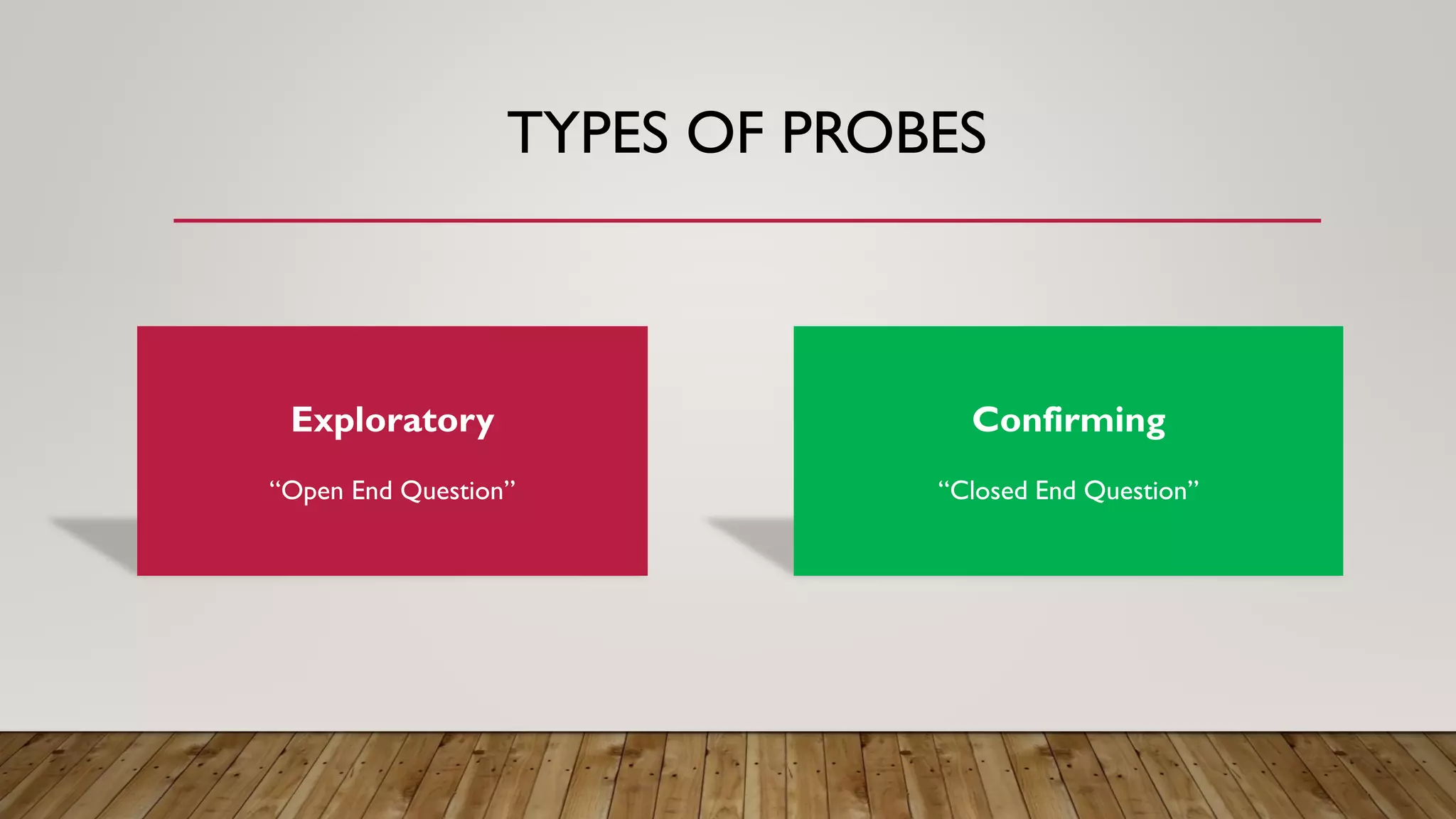
Exploratory
“Open End Question”
Confirming
“Closed End Question”
FUNCTIONS OF PROBING
EXPLORATORY PROBES
Used to:
I. Gain information:
• Needs, problems, attitudes, competition etc.
• Usually open end questions.
• How,What,Which,Why…
• Used any time: before opening, during detailing.
EXPLORATORY PROBES
Used to:
II. InvolveThe customer
• Establish a 2-way communication to show that you care.
• Used any time the customer has been silent too long.
CONFIRMING PROBES
• Always Closed End Questions
UsedTo:
I. Confirm
1. Interest :After opener ,discussion, hearing objections, need or problem
2. Understanding
3. Agreement: after discussion, handling objections, during the close.
CONFIRMING PROBES
II. Control the directions
1.Avoid off-the subject discussion.
2. Direct the customer’s attention.
Any time the customer gets off-the subject.
GOLDEN RULES FOR GOOD PROBING
• Appear relaxed.... BUT PROFESSIONAL.
• Wait for an answer before asking another question.
• Maintain eye contact.
PROPER EYE
CONTACT
Reflects Interest &
Confidence:
• InThe Product.
• InThe Question.
• InYourself.
LISTENING
COMMUNICATION CYCLE
CUSTOMER/DOCTOR SPEAKS IN ORDER TO:
Inform us of facts
or principles.
01
Persuade us to
believe in the
benefit of an
object , concept,
or value.
02
Entertain us in
order to relax the
atmosphere or
win our affection.
03
Motivate us to
feel or act as they
would like us to.
04
LISTENING
Types of listening:
• Passive (Hearing) Noise
• Active (Concentrate,
Understand & Remember)
• Responsive (Evaluate)
ACTIVE LISTENING
80-20 listening rule
Salespeople should listen
80% of the time and no more
than 20% of time
Speaking-Listening
Differential
People can speak ate a rate of
only 120-160 words per minute,
but they can listen to more than
800 words per minutes.
BARRIERS TO
GOOD
LISTENING
MindVs mouth
Lack of desire
Condemning the subject
Criticizing delivery
Selective listening.
Interruptions
Distractions (internal & external)
Day dreaming
Going to sleep
TOOLS TO ENHANCE ACTIVE LISTENING
Repeating
information
1
Clarifying
information
2
Restating
information
3
Summarizing
information
4
Tolerating
silence
5
WHAT MIGHT HAPPEN IF
THE CUSTOMER/DOCTOR
FEELSTHATYOU ARE NOT
LISTENINGTO HIM ?
WHAT MIGHT
HAPPEN IF THE
CUSTOMER/DOC
TOR FEELS THAT
YOU ARE NOT
LISTENING TO
HIM ?
The doctor will not answer
any other question you ask.
He will not give you complete
information.
He may not wish to see you
again !!!!
SO….YOU HAVE TO…
SO….YOU HAVE TO…
Listen.
Show that you are listening.
Do not pretend to listen!
FUNNELTECHNIQUE
A POWERFUL TOOL TO ENCOURAGETHE FLOW OF CONVERSATION
1) Motivate the customer
to talk. 2) Open with neutral
questions to get unbiased
information.
3) Ask lead questions to
explore more deeply.
4) Ask closed questions to
pinpoint precise requirement.
5) summarize to gain
customer’s acceptance of
requirements.
FEATURES & BENEFITS
SELECTING APPROPRIATE BENEFITS
• A FEATURE: WHAT THE PRODUCT “IS”
• A BENEFIT : WHAT THE PRODUCT “DOES”
PRODUCT BENEFITS
May provide:
1. A solution for a problem.
2. A satisfaction of a need.
3. An answer for a question.
WHAT ARE THE CUSTOMER/DOCTOR NEEDS?
QUALITY SERVICE PRICE OTHER
CONSIDERATIONS
ABILITYTO UNDERSTAND OTHERS
Body Language
55%
Tone of voice
38%
Words used
7%
Elements of personal communication
Body Language
Tone of voice
Words used
COMMUNICATING WITH WORDS
• Use concrete words & avoid abstract Words.
• Do not assume that everyone understands you.
• Do not assume that you understand everything.
• Use words familiar to the customer.
USE OF VOICE
• Power
• Pace
• Pause
• Pitch
NON-VERBAL COMMUMICATION
• Face.
• Eye contact.
• Posture & body movement.
• Hands.
• Legs.
LEARN
VS.
RETAIN
1 2 4
11
82
We Learn
Taste Touch Smell Hearing Sight
20%
50%
We Retain
Hear Hear & See
HANDLING FEEDBACK
TYPES OF FEEDBACK
• Positive
• Indifferent
• Negative
OBJECTIONS
An objection is never something
to be feared of.
A skillful salesman can easily
turn objection into an
opportunity to sell.
Objections should be
interpreted as request for
additional information.
WHY DOES A
CUSTOMER OBJECT?
• New ideas mean old ones are wrong.
• Fear of wrong decision.
• No enough information.
• No recognition of needs.
• Tactic to get a discount.
• Needs reassurance.
• A strategy to postpone decision making.
HOW TO MAKE USE OF POSITIVE FEEDBACK
• Agree.
• Paraphrase positive statement.
• State another related benefit.
INDIFFERENCE
This caused be:
• Presenting features rather than benefits.
• Presenting benefits that do not satisfy customer’s particular needs.
• Customer is satisfied with competitor’s product.
• Customer has never used that type of product.
HOW TO HANDLE INDIFFERENCE?
• Probe for needs.
• Identify a need that can not be satisfied by the customer’s preferred
product.
• Offer supporting benefits.
NEGATIVE FEEDBACK (OBJECTIONS)
• Doubt.
• Misunderstanding.
• Conflicting goals.
OVERCOMING OBJECTIONS ATTITUDE
• Pause & stay calm.
• You have to develop positive attitude.
• You must have empathy.
• Don’t (argue, get aggressive, get
defensive).
• Don't attack after overcoming objection.
• Do not disturb the customer.
• Let him/her speak first.
• Help them answer their objections.
DOUBT
• Customer Is NOT Convinced.
• He does not believe in something you have said.
• A customer’s doubt that your product can actually deliver the stated benefit.
OVERCOMING DOUBT
• Restate the benefit or feature in doubt.
• Cite & explain a proof source.
• Relate the proof back to the doubted benefit.
• Ask for the doctor's reaction to your proof.
MISUNDERSTANDING
The customer makes a statement that indicates that he misunderstood
something you have said.
HANDLING MISUNDERSTANDING
• Accept responsibility.
• Clarify.
• Relate the explanation to the benefit or feature that was misunderstood.
• Ask for a reaction for your clarification.
CONFLICTING GOALS
The customer wants Something your product just cannot provide.
RESPONDING TO CONFLICTING GOALS
• Acknowledge concern generally.
• Point out the importance of looking at the broad picture.
• Offer counterbalancing benefits.
• Ask for a reaction to what you have said.
HANDLING OBJECTIONS
• Verify by: PROBING
Ask a question that will encourage the customer to explain his objection
more fully.
So, you will be more able to specify your answer.
CLOSING THE CALL
CLOSING
• Always Be Closing (ABC) of the selling process.
• The logical conclusion to your conversation with the customer.
• A request for action which must be the action aimed for in your objective.
EFFECTIVE CLOSING
HOW? WHEN?
WHEN?
• The customer has understood your product completely
• The customer has developed trust in your company
• The customer has a desire for the benefits for his/her patients
BUYING SIGNALS (WHEN?)
• Customer makes a positive comment.
• Customer is satisfied with your answer to an objection.
• Customer asks for a subordinate buying decision.
• There is a pensive pause.
• Body language.
HOW TO CLOSE?
• Benefit Summary
-Brief
-Only the benefits you have agreed upon.
• Action Request (closed Q)
1- Direct:Will you….?
2- Indirect: Choice between alternatives OR An open ended Q (where,
when, what)
WHY A SALES REP MAY NOT CLOSEWELL?
• Wrong attitude.
• Poor presentation.
• Poor habits and skills.
• Poor objections handling.
• Too early.
• Too late.
WHY DO WE SOMETIMES
HESITATE TO ASK CLOSING
QUESTIONS?
WHY DO WE SOMETIMES HESITATETO ASK CLOSING
QUESTIONS?
• Fear of rejection.
• Fear of failure.
• Fear of appearing overly aggressive.
POST-CALL ANALYSIS
POST-CALL ANALYSIS
Post call analysis is the process of evaluating and recording the outcome of
the call, in order to plan for future calls.
• Evaluate the Call.
• Record Call Information.
• Set Objectives for the next visit.
POST-CALL ANALYSIS
• Did I Plan the sales call?
• Did I probe for the customer needs?
• Did I Listen to customer concerns?
• Did I Communicate F & B effectively?
• Did I Manage the feedback properly?
• Did I close the call efficiently & at the right time?
• What will be my next call objective?
THANKS
ROLE PLAY

Basic Selling skills - Mohammad S. Khodairy.pdf

  • 1.
    BASIC SELLING SKILLS PREPAREDBY MOHAMMAD SALAH KHODAIRY
  • 2.
    AIM OFTRAINING • Tocreate an outstanding success for our hospital. • Understand in depth, the role of SalesTeam. • Develop a Framework for an Effective Sales Approach.
  • 3.
    SELLING & SALESPERSONS •What selling is? • What a salesperson does?
  • 4.
    WHAT IS SELLING? •To satisfy a Need /Want with your product / service for “Mutual Benefits”. • To Identify / Generate / Influence a Need /Want.
  • 5.
    SELLING IS “The processof: • Developing customer relationships, • Discovering customer needs, • Matching appropriate products with these needs, • and communicating benefits.”
  • 6.
    PHILOSOPHY OF SELLING Selling= Motivating customer’s commitment Sales Rep All good reasons why a customer should buy / use your product Customer All the things that a Customer has to give By ASKING
  • 7.
    SELLING IS ‘HELPING’PEOPLE TO: • Solve problems. • Make more $. • Buy. • Meet their needs/goals.
  • 9.
    SELLING PHILOSOPHY OF‘GOOD’ SALESPEOPLE: • Selling is problem solving. • Selling is a helping, caring activity. • A customer is a person to be served, not a prospect to be sold. • Treat people as human beings, not $ signs. • Unique products, relationships, cultures are important. • Customer driven, not product driven.
  • 10.
    SELLING PHILOSOPHY OF‘GOOD’ SALESPEOPLE: • Focus on customer needs. • Long-term success depends on pleasing others. • Selling is a ‘win-win’ activity. • A commitment to self improvement and life-long learning essential for long- term success. • Adherence to a strict code of ethics emphasizing, among other things, mutual trust, respect, and honesty is essential.
  • 11.
    SELLING IS A‘PROFESSION’ BASED ON: • Scientific skills, even though it is not an ‘exact’ science. • Knowledge about selling principles/theories & product. • A code of ethics. • Psychological & sociological aspects of human behavior (CONSUMER BEHAVIOR).
  • 12.
    WHAT DO SALESPEOPLEDO? 1)They Sell: • Products/services • Solutions • Information • Ideas • Service • Their company • Themselves
  • 13.
    WHAT DO SALESPEOPLEDO? 2)They work with people: • Solve problems • Represent the company • Communicate (benefits?) with customers • Develop relationships, partnerships, alliances • Discover needs • Gather information • Educate customers • Catalyze change • Help people buy • Serve customers • Treat people with respect
  • 14.
    WHAT DO SALESPEOPLEDO? 3)They Manage: • Their time • Their territory • Their records • Their stress
  • 15.
    TYPES OF SELLING •Indirect selling – any form of selling that does not involve a sales person. (Ex: advertising, promotion, displays, signage) • Direct Selling – when there is contact between a salesperson and the customer.
  • 16.
    ELEMENTS OF A SALESCALL 1. Planning & setting pre-call objectives 2. Opening the detail 3. Probing 4. Presenting benefits 5. Handling feedback 6. Closing 7. Post call analysis
  • 17.
  • 19.
    IMPORTANCE OF PLANNING • Tobe professional • To save time • To be prepared • To be persuasive • To improve self-confidence • To avoid embarrassment • TO INCREASE SALES
  • 20.
    YOU HAVETO KNOW: Informationabout the Customers • Time • Routing • Records & Reports
  • 21.
    TYPES OF INFORMATION STATIC •Birth date • Telephone & Mobile numbers, • E-mail & address • Potentiality & Attitude • Best time of visit • General need DYNAMIC • Our market share • Competition relation • Services delivered • Family condition • Contract situation
  • 22.
    SOURCES OF INFORMATION •Previous visit report. • Colleagues. • Competition. • The customer. • Assistant.
  • 23.
    TIME MANAGEMENT • 245working day /year. • 980 hour/year. • Value of hour. • Value of each visit. • Cost of each hour. • Cost of each visit. • Actual selling time.
  • 24.
    RECORDING & REPORTING Ashort pencil is better than long memory. No job is done till the paper work is finished.
  • 25.
    WHAT ISTHE MEANINGOF PRE-CALL OBJECTIVE? What I want the doctor/customer to do as a result of my visit.
  • 26.
    PRE-CALL OBJECTIVES • Need. •Handling competition. • Handling objection. • Handling complaint.
  • 27.
    S M A R T • Specific. • Measurable. •Attainable. • Realistic. • Timed.
  • 28.
    IMPORTANCE OF SETTINGCALL OBJECTIVE • Saves customer’sTime (AndYour Time) • Gives Him A Clear Idea Of WhatYou Say &WhatYouWant HimTo Do.
  • 29.
  • 30.
    WHAT IS OPENING Openingis the skill of capturing the customer’s attention and focusing
  • 31.
    TOOLSTO ENHANCE ATTRACTION •Smile • Firm handshake • Speak clearly • Use the customer name • Pronounce the name correctly
  • 32.
    ATTRACTION METHODS • Introductory •Patient benefit • Question • Numerical • Referral • Flattery
  • 33.
    THE ATTRACTION THE RULEOF 12 • The first 12 steps (First impression) • The first 12 words (First few seconds) • The first 12 inches above shoulder (Face to face)
  • 34.
  • 35.
    WHAT IS APROBE? • In Medical Sense: = A slender, flexible instrument designed for introduction into a wound, a cavity, or a sinus tract for the purpose of exploration. MEDICAL DICTIONARY
  • 36.
    WHAT IS APROBE? • In Communication Sense: The conscious, directed use of specific types of structured questions in order to achieve desired communication objectives (Information).
  • 37.
    TYPES OF QUESTIONS •Open end questions: No “yes or no” answer, no brief answer. • Closed end questions: Brief answer: yes, no, number, name, choice. When designed & used to achieve communication objectives. A question becomes a probe)
  • 39.
    A GOOD QUESTIONIS: • Concise • Easily Understood • Relevant
  • 40.
    TYPES OF PROBES Exploratory “OpenEnd Question” Confirming “Closed End Question”
  • 41.
  • 42.
    EXPLORATORY PROBES Used to: I.Gain information: • Needs, problems, attitudes, competition etc. • Usually open end questions. • How,What,Which,Why… • Used any time: before opening, during detailing.
  • 43.
    EXPLORATORY PROBES Used to: II.InvolveThe customer • Establish a 2-way communication to show that you care. • Used any time the customer has been silent too long.
  • 44.
    CONFIRMING PROBES • AlwaysClosed End Questions UsedTo: I. Confirm 1. Interest :After opener ,discussion, hearing objections, need or problem 2. Understanding 3. Agreement: after discussion, handling objections, during the close.
  • 45.
    CONFIRMING PROBES II. Controlthe directions 1.Avoid off-the subject discussion. 2. Direct the customer’s attention. Any time the customer gets off-the subject.
  • 46.
    GOLDEN RULES FORGOOD PROBING • Appear relaxed.... BUT PROFESSIONAL. • Wait for an answer before asking another question. • Maintain eye contact.
  • 47.
    PROPER EYE CONTACT Reflects Interest& Confidence: • InThe Product. • InThe Question. • InYourself.
  • 48.
  • 49.
  • 50.
    CUSTOMER/DOCTOR SPEAKS INORDER TO: Inform us of facts or principles. 01 Persuade us to believe in the benefit of an object , concept, or value. 02 Entertain us in order to relax the atmosphere or win our affection. 03 Motivate us to feel or act as they would like us to. 04
  • 51.
    LISTENING Types of listening: •Passive (Hearing) Noise • Active (Concentrate, Understand & Remember) • Responsive (Evaluate)
  • 52.
    ACTIVE LISTENING 80-20 listeningrule Salespeople should listen 80% of the time and no more than 20% of time Speaking-Listening Differential People can speak ate a rate of only 120-160 words per minute, but they can listen to more than 800 words per minutes.
  • 54.
    BARRIERS TO GOOD LISTENING MindVs mouth Lackof desire Condemning the subject Criticizing delivery Selective listening. Interruptions Distractions (internal & external) Day dreaming Going to sleep
  • 55.
    TOOLS TO ENHANCEACTIVE LISTENING Repeating information 1 Clarifying information 2 Restating information 3 Summarizing information 4 Tolerating silence 5
  • 56.
    WHAT MIGHT HAPPENIF THE CUSTOMER/DOCTOR FEELSTHATYOU ARE NOT LISTENINGTO HIM ?
  • 57.
    WHAT MIGHT HAPPEN IFTHE CUSTOMER/DOC TOR FEELS THAT YOU ARE NOT LISTENING TO HIM ? The doctor will not answer any other question you ask. He will not give you complete information. He may not wish to see you again !!!!
  • 58.
  • 59.
    SO….YOU HAVE TO… Listen. Showthat you are listening. Do not pretend to listen!
  • 60.
    FUNNELTECHNIQUE A POWERFUL TOOLTO ENCOURAGETHE FLOW OF CONVERSATION 1) Motivate the customer to talk. 2) Open with neutral questions to get unbiased information. 3) Ask lead questions to explore more deeply. 4) Ask closed questions to pinpoint precise requirement. 5) summarize to gain customer’s acceptance of requirements.
  • 61.
  • 63.
    SELECTING APPROPRIATE BENEFITS •A FEATURE: WHAT THE PRODUCT “IS” • A BENEFIT : WHAT THE PRODUCT “DOES”
  • 64.
    PRODUCT BENEFITS May provide: 1.A solution for a problem. 2. A satisfaction of a need. 3. An answer for a question.
  • 65.
    WHAT ARE THECUSTOMER/DOCTOR NEEDS? QUALITY SERVICE PRICE OTHER CONSIDERATIONS
  • 66.
    ABILITYTO UNDERSTAND OTHERS BodyLanguage 55% Tone of voice 38% Words used 7% Elements of personal communication Body Language Tone of voice Words used
  • 67.
    COMMUNICATING WITH WORDS •Use concrete words & avoid abstract Words. • Do not assume that everyone understands you. • Do not assume that you understand everything. • Use words familiar to the customer.
  • 68.
    USE OF VOICE •Power • Pace • Pause • Pitch
  • 69.
    NON-VERBAL COMMUMICATION • Face. •Eye contact. • Posture & body movement. • Hands. • Legs.
  • 70.
    LEARN VS. RETAIN 1 2 4 11 82 WeLearn Taste Touch Smell Hearing Sight 20% 50% We Retain Hear Hear & See
  • 71.
  • 72.
    TYPES OF FEEDBACK •Positive • Indifferent • Negative
  • 73.
    OBJECTIONS An objection isnever something to be feared of. A skillful salesman can easily turn objection into an opportunity to sell. Objections should be interpreted as request for additional information.
  • 74.
    WHY DOES A CUSTOMEROBJECT? • New ideas mean old ones are wrong. • Fear of wrong decision. • No enough information. • No recognition of needs. • Tactic to get a discount. • Needs reassurance. • A strategy to postpone decision making.
  • 75.
    HOW TO MAKEUSE OF POSITIVE FEEDBACK • Agree. • Paraphrase positive statement. • State another related benefit.
  • 76.
    INDIFFERENCE This caused be: •Presenting features rather than benefits. • Presenting benefits that do not satisfy customer’s particular needs. • Customer is satisfied with competitor’s product. • Customer has never used that type of product.
  • 77.
    HOW TO HANDLEINDIFFERENCE? • Probe for needs. • Identify a need that can not be satisfied by the customer’s preferred product. • Offer supporting benefits.
  • 78.
    NEGATIVE FEEDBACK (OBJECTIONS) •Doubt. • Misunderstanding. • Conflicting goals.
  • 79.
    OVERCOMING OBJECTIONS ATTITUDE •Pause & stay calm. • You have to develop positive attitude. • You must have empathy. • Don’t (argue, get aggressive, get defensive). • Don't attack after overcoming objection. • Do not disturb the customer. • Let him/her speak first. • Help them answer their objections.
  • 80.
    DOUBT • Customer IsNOT Convinced. • He does not believe in something you have said. • A customer’s doubt that your product can actually deliver the stated benefit.
  • 81.
    OVERCOMING DOUBT • Restatethe benefit or feature in doubt. • Cite & explain a proof source. • Relate the proof back to the doubted benefit. • Ask for the doctor's reaction to your proof.
  • 82.
    MISUNDERSTANDING The customer makesa statement that indicates that he misunderstood something you have said.
  • 83.
    HANDLING MISUNDERSTANDING • Acceptresponsibility. • Clarify. • Relate the explanation to the benefit or feature that was misunderstood. • Ask for a reaction for your clarification.
  • 84.
    CONFLICTING GOALS The customerwants Something your product just cannot provide.
  • 85.
    RESPONDING TO CONFLICTINGGOALS • Acknowledge concern generally. • Point out the importance of looking at the broad picture. • Offer counterbalancing benefits. • Ask for a reaction to what you have said.
  • 86.
    HANDLING OBJECTIONS • Verifyby: PROBING Ask a question that will encourage the customer to explain his objection more fully. So, you will be more able to specify your answer.
  • 87.
  • 88.
    CLOSING • Always BeClosing (ABC) of the selling process. • The logical conclusion to your conversation with the customer. • A request for action which must be the action aimed for in your objective.
  • 89.
  • 90.
    WHEN? • The customerhas understood your product completely • The customer has developed trust in your company • The customer has a desire for the benefits for his/her patients
  • 91.
    BUYING SIGNALS (WHEN?) •Customer makes a positive comment. • Customer is satisfied with your answer to an objection. • Customer asks for a subordinate buying decision. • There is a pensive pause. • Body language.
  • 92.
    HOW TO CLOSE? •Benefit Summary -Brief -Only the benefits you have agreed upon. • Action Request (closed Q) 1- Direct:Will you….? 2- Indirect: Choice between alternatives OR An open ended Q (where, when, what)
  • 93.
    WHY A SALESREP MAY NOT CLOSEWELL? • Wrong attitude. • Poor presentation. • Poor habits and skills. • Poor objections handling. • Too early. • Too late.
  • 94.
    WHY DO WESOMETIMES HESITATE TO ASK CLOSING QUESTIONS?
  • 95.
    WHY DO WESOMETIMES HESITATETO ASK CLOSING QUESTIONS? • Fear of rejection. • Fear of failure. • Fear of appearing overly aggressive.
  • 96.
  • 97.
    POST-CALL ANALYSIS Post callanalysis is the process of evaluating and recording the outcome of the call, in order to plan for future calls. • Evaluate the Call. • Record Call Information. • Set Objectives for the next visit.
  • 98.
    POST-CALL ANALYSIS • DidI Plan the sales call? • Did I probe for the customer needs? • Did I Listen to customer concerns? • Did I Communicate F & B effectively? • Did I Manage the feedback properly? • Did I close the call efficiently & at the right time? • What will be my next call objective?
  • 99.
  • 100.