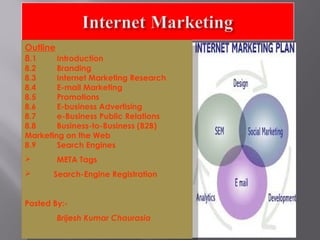
Outline
Outline
8.1
Introduction
8.1
Introduction
8.2
Branding

8.2
Branding
8.3
Internet Marketing Research
8.3
Internet Marketing Research
8.4
E-mail Marketing
8.4
E-mail Marketing
8.5
Promotions
8.5
Promotions
8.6
E-business Advertising
8.6
E-business Advertising
8.7
e-Business Public Relations
8.7
e-Business Public Relations
8.8
Business-to-Business (B2B)
8.8
MarketingBusiness-to-Business (B2B)
on the Web
Marketing on the Web
8.9
Search Engines
8.9
Search Engines

META Tags

META Tags

Search-Engine Registration

Search-Engine Registration
Posted By:Posted By:Brijesh Kumar Chaurasia
Brijesh Kumar Chaurasia


We explore Internet marketing campaign
components










Marketing research, advertising, promotions, public
relations, search-engine registration

Web-site traffic generation
Keeping user profiles
Recording visits
Analyzing promotional and advertising results
Target market is the group of people toward
whom it is most profitable to aim your marketing
Use Internet marketing with traditional marketing


Brand
Typically defined as a name, logo or symbol that helps
one identify a company’s products or services
 Customers’ experience can be considered part of its brand




Brand equity






Includes the value of tangible and intangible items, such
as a brand and its monetary value over time, customer
perceptions and customer loyalty to a company and its
products or services

Internet-only businesses must develop a brand that
customers trust and value
Brand uniformity will increase brand recognition


Marketing mix includes (4Ps):







Product or service details and development
Effective pricing
Promotion
Distribution

Traditional marketing research


Consists of focus groups, interviews, paper and telephone
surveys, questionnaires and secondary research
 Findings based on previously collected data



Online marketing research



Faster option for finding and analyzing industry, customer
and competitor information
Provides relaxed and anonymous setting to hold focus-group
discussions and distribute questionnaires


Demographics




Psychographics




Can include family lifestyle, cultural differences and
values 

Segmentation




Statistics on human population, including age, sex,
marital status and income

Can be based on age, income, gender, culture and
common needs and wants

Traditional focus groups can allow customers to
touch, smell and experience products or services


Online focus groups
Conducted to allow current or potential consumers to
present their opinions about products, services or ideas
 Comfortable setting for participants
 Leader of the focus group cannot interpret a participant’s
body language as a form of communication
 SurveySite




Online surveys
Conducted from Web site or through e-mail
 www.makesteps.com, Makesteps Technologies and
 Test your site and marketing campaign on a smaller scale
with focus groups and trials




Data collected from a company’s Web site



Evaluate campaign results
Measure costs and benefits of campaign
Helps with development of a budget for marketing
activities
 Identify growing and most profitable segments




Marketing-research firms




SEO, SMO, PPC Services, Content Writing Services and
Email Marketing Services

Freeware and shareware


Both are no cost software distribution; however,
shareware is distributed with the expectation of
donations in return


Pricing
Some products priced to reflect competition
 High pricing to influence perception of high-value
 Can use prices to position products and services on the
Internet


 Positioning includes affecting consumers’ overall views of a

company and its products and services as compared to the
way those customers view competitors’ products or services
 Positioning strategies can be based on price, quality, use and
competitors’ positions in the market



Distribution cost and time contributes to success or
failure
Fulfillment


Execute orders correctly and ship products promptly



Fast, cheap, far-reaching
Define the reach




Determine the level of personalization




The span of people you would like to target, including
geographic locations and demographic profiles
Personalized direct e-mail targets consumers with specific
information and offers by using customer names, offering
the right products at the right time and sending
promotions

Response rate


Shows campaign success or failure by measuring the
percentage of responses generated from the target market


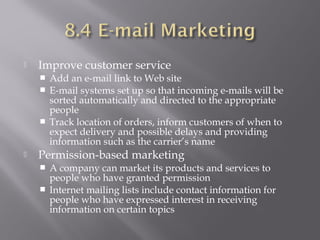
Improve customer service
Add an e-mail link to Web site
 E-mail systems set up so that incoming e-mails will be
sorted automatically and directed to the appropriate
people
 Track location of orders, inform customers of when to
expect delivery and possible delays and providing
information such as the carrier’s name




Permission-based marketing
A company can market its products and services to
people who have granted permission
 Internet mailing lists include contact information for
people who have expressed interest in receiving
information on certain topics



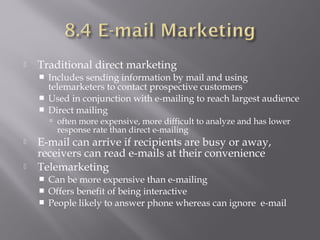
Traditional direct marketing




Includes sending information by mail and using
telemarketers to contact prospective customers
Used in conjunction with e-mailing to reach largest audience
Direct mailing
 often more expensive, more difficult to analyze and has lower

response rate than direct e-mailing




E-mail can arrive if recipients are busy or away,
receivers can read e-mails at their convenience
Telemarketing




Can be more expensive than e-mailing
Offers benefit of being interactive
People likely to answer phone whereas can ignore e-mail


Online and offline e-business promotions



Attract visitors to sites and may influence purchasing
Be sure customers are loyal to company, not reward
program
 Give away items that display company logo
 makesteps.com.


Frequent-flyer miles





Offered to consumers for making online purchases
Increase brand loyalty, offers a reason return visits

Points-based promotion


Customer performs a prespecified action and receives
points to be redeemed for products, services, rebates,
discounts, etc.


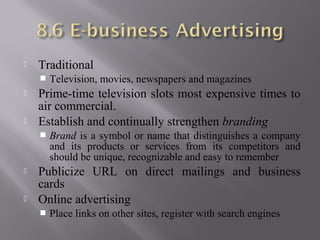
Traditional





Prime-time television slots most expensive times to
air commercial.
Establish and continually strengthen branding





Television, movies, newspapers and magazines

Brand is a symbol or name that distinguishes a company
and its products or services from its competitors and
should be unique, recognizable and easy to remember

Publicize URL on direct mailings and business
cards
Online advertising


Place links on other sites, register with search engines


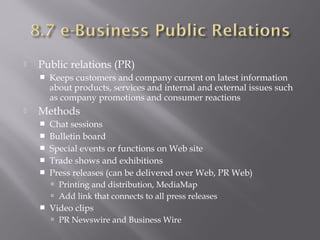
Public relations (PR)




Keeps customers and company current on latest information
about products, services and internal and external issues such
as company promotions and consumer reactions

Methods






Chat sessions
Bulletin board
Special events or functions on Web site
Trade shows and exhibitions
Press releases (can be delivered over Web, PR Web)
 Printing and distribution, MediaMap
 Add link that connects to all press releases



Video clips
 PR Newswire and Business Wire


Crisis management
Another responsibility of PR, is conducted in
response to problems the company is having
 Bridgestore/Firestone, Inc.




Outsourcing public relations


(B2B) marketing









Consider distributors, resellers, retailers and partners
Selling to someone who is not the direct user
Usually more than one person involved in purchasing
process
Businesses making large purchases depend on suppliers
and expect reliability and delivery of quality products
and services on time
Personalization

Intranets and extranets
Industry marketplaces.
Definition:B2C Commerce: Interactions relating to the purchase and
sale of goods and services between a business and
consumer—retail transactions.
“Novelty” is that retail transaction is done on the Internet,
rather than a “brick and mortar” store location.
Technical evolution of B2C from “brick and mortar”
model not new.
(B2C) Marketing
•Main Attraction: Lower Retail Prices
•“B2C Pure Plays” could eliminate intermediaries,
storefront costs, some distribution costs, etc.






B2C=Business-to-Consumer Market=
businesses sell products and services to
consumers for household or personal use
B2B=Business-to-Business Market= businesses
sell products and services to other businesses
for use in their daily operations or for making
other products and services
The B2B market is 5X as large as the B2C
market in the USA.


Search-engine ranking important to bring
consumers to a site






Method used by search engines to rank your Web
site will determine how "high" your site appears in
search results

Make sure all Web pages have been published
on the Web and linked correctly
By registering with search engines a company
will increase traffic to its site


META tag






Most search engines rank your site by sending out a
spider to inspect the site





An HTML tag that contains information about a Web page
Does not change how Web page is displayed
Can contain description of page, keywords and title of page

The spider reads the META tags, determines the relevance
of the Web page’s information and keywords and ranks the
site according to that visit’s findings

Examine competitors’ sites to see what META tags
they are using
Top ten results






Submit keywords and a description of business
Search engine will add information to its database
Registering will increase the possibility that a site
will make an appearance in search-engine results
Many search engines do not charge a fee for
registering


AltaVista, Yahoo!, Lycos, Excite, Google and Ask Jeeves
 Ask Jeeves uses natural-language technology that allows

people to enter their search subjects in the form of questions



Metasearch engines



Aggregate results from a variety of search engines
Metacrawler and FrameSearch.net
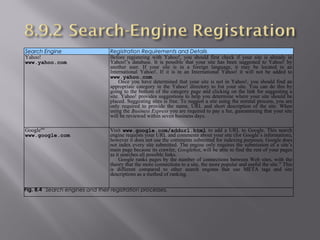
Search Engine
Yahoo!
www.yahoo.com

Registration Requirements and Details
Before registering with Yahoo!, you should first check if your site is already in
Yahoo!’s database. It is possible that your site has been suggested to Yahoo! by
another user. If your site is in a foreign language, it may be located in an
International Yahoo!. If it is in an International Yahoo! it will not be added to
www.yahoo.com.
Once you have determined that your site is not in Yahoo!, you should find an
appropriate category in the Yahoo! directory to list your site. You can do this by
going to the bottom of the category page and clicking on the link for suggesting a
site. Yahoo! provides suggestions to help you determine where your site should be
placed. Suggesting sites is free. To suggest a site using the normal process, you are
only required to provide the name, URL and short description of the site. When
using the Business Express you are required to pay a fee, guaranteeing that your site
will be reviewed within seven business days.

GoogleSM
www.google.com

Visit www.google.com/addurl.html to add a URL to Google. This search
engine requests your URL and comments about your site (for Google’s information),
however it does not use the comments submitted for indexing purposes. Google does
not index every site submitted. The engine only requires the submission of a site’s
main page because its crawler, Googlebot, will be able to find the rest of your pages
as it searches all possible links.
Google ranks pages by the number of connections between Web sites, with the
theory that the more connections to a site, the more popular and useful the site.28 This
is different compared to other search engines that use META tags and site
descriptions as a method of ranking.

Fig. 8.4 Search engines and their registration processes.

Internet marketing

  • 1.
    Outline Outline 8.1 Introduction 8.1 Introduction 8.2 Branding 8.2 Branding 8.3 Internet Marketing Research 8.3 InternetMarketing Research 8.4 E-mail Marketing 8.4 E-mail Marketing 8.5 Promotions 8.5 Promotions 8.6 E-business Advertising 8.6 E-business Advertising 8.7 e-Business Public Relations 8.7 e-Business Public Relations 8.8 Business-to-Business (B2B) 8.8 MarketingBusiness-to-Business (B2B) on the Web Marketing on the Web 8.9 Search Engines 8.9 Search Engines  META Tags  META Tags  Search-Engine Registration  Search-Engine Registration Posted By:Posted By:Brijesh Kumar Chaurasia Brijesh Kumar Chaurasia
  • 2.
     We explore Internetmarketing campaign components        Marketing research, advertising, promotions, public relations, search-engine registration Web-site traffic generation Keeping user profiles Recording visits Analyzing promotional and advertising results Target market is the group of people toward whom it is most profitable to aim your marketing Use Internet marketing with traditional marketing
  • 3.
     Brand Typically defined asa name, logo or symbol that helps one identify a company’s products or services  Customers’ experience can be considered part of its brand   Brand equity    Includes the value of tangible and intangible items, such as a brand and its monetary value over time, customer perceptions and customer loyalty to a company and its products or services Internet-only businesses must develop a brand that customers trust and value Brand uniformity will increase brand recognition
  • 4.
     Marketing mix includes(4Ps):      Product or service details and development Effective pricing Promotion Distribution Traditional marketing research  Consists of focus groups, interviews, paper and telephone surveys, questionnaires and secondary research  Findings based on previously collected data  Online marketing research   Faster option for finding and analyzing industry, customer and competitor information Provides relaxed and anonymous setting to hold focus-group discussions and distribute questionnaires
  • 5.
     Demographics   Psychographics   Can include familylifestyle, cultural differences and values  Segmentation   Statistics on human population, including age, sex, marital status and income Can be based on age, income, gender, culture and common needs and wants Traditional focus groups can allow customers to touch, smell and experience products or services
  • 6.
     Online focus groups Conductedto allow current or potential consumers to present their opinions about products, services or ideas  Comfortable setting for participants  Leader of the focus group cannot interpret a participant’s body language as a form of communication  SurveySite   Online surveys Conducted from Web site or through e-mail  www.makesteps.com, Makesteps Technologies and  Test your site and marketing campaign on a smaller scale with focus groups and trials   Data collected from a company’s Web site
  • 7.
      Evaluate campaign results Measurecosts and benefits of campaign Helps with development of a budget for marketing activities  Identify growing and most profitable segments   Marketing-research firms   SEO, SMO, PPC Services, Content Writing Services and Email Marketing Services Freeware and shareware  Both are no cost software distribution; however, shareware is distributed with the expectation of donations in return
  • 8.
     Pricing Some products pricedto reflect competition  High pricing to influence perception of high-value  Can use prices to position products and services on the Internet   Positioning includes affecting consumers’ overall views of a company and its products and services as compared to the way those customers view competitors’ products or services  Positioning strategies can be based on price, quality, use and competitors’ positions in the market   Distribution cost and time contributes to success or failure Fulfillment  Execute orders correctly and ship products promptly
  • 9.
      Fast, cheap, far-reaching Definethe reach   Determine the level of personalization   The span of people you would like to target, including geographic locations and demographic profiles Personalized direct e-mail targets consumers with specific information and offers by using customer names, offering the right products at the right time and sending promotions Response rate  Shows campaign success or failure by measuring the percentage of responses generated from the target market
  • 10.
     Improve customer service Addan e-mail link to Web site  E-mail systems set up so that incoming e-mails will be sorted automatically and directed to the appropriate people  Track location of orders, inform customers of when to expect delivery and possible delays and providing information such as the carrier’s name   Permission-based marketing A company can market its products and services to people who have granted permission  Internet mailing lists include contact information for people who have expressed interest in receiving information on certain topics 
  • 11.
     Traditional direct marketing    Includessending information by mail and using telemarketers to contact prospective customers Used in conjunction with e-mailing to reach largest audience Direct mailing  often more expensive, more difficult to analyze and has lower response rate than direct e-mailing   E-mail can arrive if recipients are busy or away, receivers can read e-mails at their convenience Telemarketing    Can be more expensive than e-mailing Offers benefit of being interactive People likely to answer phone whereas can ignore e-mail
  • 12.
     Online and offlinee-business promotions   Attract visitors to sites and may influence purchasing Be sure customers are loyal to company, not reward program  Give away items that display company logo  makesteps.com.  Frequent-flyer miles    Offered to consumers for making online purchases Increase brand loyalty, offers a reason return visits Points-based promotion  Customer performs a prespecified action and receives points to be redeemed for products, services, rebates, discounts, etc.
  • 13.
     Traditional    Prime-time television slotsmost expensive times to air commercial. Establish and continually strengthen branding    Television, movies, newspapers and magazines Brand is a symbol or name that distinguishes a company and its products or services from its competitors and should be unique, recognizable and easy to remember Publicize URL on direct mailings and business cards Online advertising  Place links on other sites, register with search engines
  • 14.
     Public relations (PR)   Keepscustomers and company current on latest information about products, services and internal and external issues such as company promotions and consumer reactions Methods      Chat sessions Bulletin board Special events or functions on Web site Trade shows and exhibitions Press releases (can be delivered over Web, PR Web)  Printing and distribution, MediaMap  Add link that connects to all press releases  Video clips  PR Newswire and Business Wire
  • 15.
     Crisis management Another responsibilityof PR, is conducted in response to problems the company is having  Bridgestore/Firestone, Inc.   Outsourcing public relations
  • 16.
     (B2B) marketing        Consider distributors,resellers, retailers and partners Selling to someone who is not the direct user Usually more than one person involved in purchasing process Businesses making large purchases depend on suppliers and expect reliability and delivery of quality products and services on time Personalization Intranets and extranets Industry marketplaces.
  • 17.
    Definition:B2C Commerce: Interactionsrelating to the purchase and sale of goods and services between a business and consumer—retail transactions. “Novelty” is that retail transaction is done on the Internet, rather than a “brick and mortar” store location. Technical evolution of B2C from “brick and mortar” model not new. (B2C) Marketing •Main Attraction: Lower Retail Prices •“B2C Pure Plays” could eliminate intermediaries, storefront costs, some distribution costs, etc.
  • 18.
       B2C=Business-to-Consumer Market= businesses sellproducts and services to consumers for household or personal use B2B=Business-to-Business Market= businesses sell products and services to other businesses for use in their daily operations or for making other products and services The B2B market is 5X as large as the B2C market in the USA.
  • 19.
     Search-engine ranking importantto bring consumers to a site    Method used by search engines to rank your Web site will determine how "high" your site appears in search results Make sure all Web pages have been published on the Web and linked correctly By registering with search engines a company will increase traffic to its site
  • 20.
     META tag     Most searchengines rank your site by sending out a spider to inspect the site    An HTML tag that contains information about a Web page Does not change how Web page is displayed Can contain description of page, keywords and title of page The spider reads the META tags, determines the relevance of the Web page’s information and keywords and ranks the site according to that visit’s findings Examine competitors’ sites to see what META tags they are using Top ten results
  • 21.
        Submit keywords anda description of business Search engine will add information to its database Registering will increase the possibility that a site will make an appearance in search-engine results Many search engines do not charge a fee for registering  AltaVista, Yahoo!, Lycos, Excite, Google and Ask Jeeves  Ask Jeeves uses natural-language technology that allows people to enter their search subjects in the form of questions  Metasearch engines   Aggregate results from a variety of search engines Metacrawler and FrameSearch.net
  • 22.
    Search Engine Yahoo! www.yahoo.com Registration Requirementsand Details Before registering with Yahoo!, you should first check if your site is already in Yahoo!’s database. It is possible that your site has been suggested to Yahoo! by another user. If your site is in a foreign language, it may be located in an International Yahoo!. If it is in an International Yahoo! it will not be added to www.yahoo.com. Once you have determined that your site is not in Yahoo!, you should find an appropriate category in the Yahoo! directory to list your site. You can do this by going to the bottom of the category page and clicking on the link for suggesting a site. Yahoo! provides suggestions to help you determine where your site should be placed. Suggesting sites is free. To suggest a site using the normal process, you are only required to provide the name, URL and short description of the site. When using the Business Express you are required to pay a fee, guaranteeing that your site will be reviewed within seven business days. GoogleSM www.google.com Visit www.google.com/addurl.html to add a URL to Google. This search engine requests your URL and comments about your site (for Google’s information), however it does not use the comments submitted for indexing purposes. Google does not index every site submitted. The engine only requires the submission of a site’s main page because its crawler, Googlebot, will be able to find the rest of your pages as it searches all possible links. Google ranks pages by the number of connections between Web sites, with the theory that the more connections to a site, the more popular and useful the site.28 This is different compared to other search engines that use META tags and site descriptions as a method of ranking. Fig. 8.4 Search engines and their registration processes.