INTERNET –BENEFITS & PITFALLS
ICT1113
S.K.H.R.S KUMARA
Table of Contents
What is internet.........................................................................................................................................................2
History of internet....................................................................................................................................................3
Definitions for internet ...........................................................................................................................................4
General usage of internet.......................................................................................................................................5
Personal usage of internet......................................................................................................................................6
Befits of internet........................................................................................................................................................7
Information, knowledge, and learning...............................................................................................................7
Connectivity, communication, and sharing ......................................................................................................7
Address, mapping, and contact information....................................................................................................7
Banking, bills, and shopping..................................................................................................................................7
Pitfalls of internet.....................................................................................................................................................8
Addictive behavior................................................................................Error! Bookmark not defined.
Comments and conclusion...................................................................................................................................10
What is internet
The Internet links are
computer networks all
over the world so that
users can share resources
and communicate with
each other. Some
computers, have direct
access to all the facilities
on the Internet such as
the universities. And
other computers, e.g.
privately-owned ones, have indirect links through a commercial service provider,
who offers some or all of the Internet facilities. In order to be connected to
Internet, you must go through service suppliers. Many options are offered with
monthly rates. Depending on the option chosen, access time may vary.
The Internet is what we call a met network, that is, a network of
networks that spans the globe. It's impossible to give an exact count of the
number of networks or users that comprise the Internet, but it is easily in the
thousands and millions respectively. The Internet employs a set of standardized
protocols which allow for the sharing of resources among different kinds of
computers that communicate with each other on the network. These standards,
sometimes referred to as the Internet Protocol Suite, are the rules that
developers adhere to when creating new functions for the Internet.
The Internet is also what we call a distributed system; there is no central
archives. Technically, no one runs the Internet. Rather, the Internet is made up
of thousands of smaller networks. The Internet thrives and develops as its many
users find new ways to create, display and retrieve the information that
constitutes the Internet.
History of internet
In its infancy, the Internet was originally conceived by the Department of
Defense as a way to protect government communications systems in the event
of a military strike. The original network, dubbed ARPANet (for the Advanced
Research Projects Agency that developed it) evolved into a communications
channel among contractors, military personnel, and university researchers who
were contributing to ARPA projects.
The network employed a set of standard protocols to create an effective way for
these people to communicate and share data with each other.
ARPAnet's popularity continued to spread among researchers, and in the
1980's the National Science Foundation, whose NSFNet, linked several high
speed computers, took charge of the what had come to be known as the
Internet.
By the late 1980's, thousands of cooperating networks were participating
in the Internet.
In 1991, the U.S. High Performance Computing Act established the NREN
(National Research & Education Network). NREN's goal was to develop and
maintain high-speed networks for research and education, and to investigate
commercial uses for the Internet.
The rest, as they say, is history in the making. The Internet has been improved
through the developments of such services as Gopher and the World Wide
Web.
Even though the Internet is predominantly thought of as a research oriented
network, it continues to grow as an informational, creative, and commercial
resource every day and all over the world.
Definitions for internet
an electronic communications network that connects computer networks and
organizational computer facilities around the world —used with the except when
being used attributively
a global computer network providing a variety of information and
communication facilities, consisting of interconnected networks using
standardized communication protocols.
The Internet is the global system of interconnected computer networks that
use the Internet protocol suite (TCP/IP) to link devices worldwide.
A collection of computers speaks a common language protocol.
The network of physical objects that contain embedded technology
communicate and interact with their internal states or the external environment.
General usage of internet
The Internet allows greater flexibility in working hours and location, especially
with the spread of unmetered high-speed connections. The Internet can be
accessed almost anywhere by numerous means, including through mobile
Internet devices. Mobile phones, data cards, handheld game consoles and cellular
routers allow users to connect to the Internet wirelessly Within the limitations
imposed by small screens and other limited facilities of such pocket-sized
devices, the services of the Internet, including email and the web, may be
available. Service providers may restrict the services offered and mobile data
charges may be significantly higher than other access methods.
Educational material at all levels from pre-school to post-doctoral is available
from websites. Examples range from CBeebies, through school and high-school
revision guides and virtual universities, to access to top-end scholarly literature
through the likes of Google Scholar. For distance education, help with homework
and other assignments, self-guided learning, whiling away spare time, or just
looking up more detail on an interesting fact, it has never been easier for people
to access educational information at any level from anywhere. The Internet in
general and the World Wide Web in particular are important enablers of both
formal and informal education. Further, the Internet allows universities, in
particular, researchers from the social and behavioral sciences, to conduct
research remotely via virtual laboratories, with profound changes in reach and
generalizability of findings as well as in communication between scientists and
in the publication of results
Personal usage of internet
I use the internet at most all the time. especially when its come to educational
purposes internet is the main source of information.in my leisure time I spend
most of time surfing the internet, watching tutorials and songs, Facebooking and
etc.
According to my view internet took a major part in my life and other people too.
Now a day everyone has smartphones because of that everyone always surfing in
the internet and doing their office work, school work, university work and etc.
Because of internet sharing and learning things become so easy. For example, we
have social media to connect with our friends and family, google drive, icloud,
OneDrive like cloud storage services give us access to our data & information
anywhere in the world.
According to my experience map service is the most useful thing I ever used.
Because of maps I can go to any place and find any route. Not only that we can
find our current location and send a gaps signals tour
Befits of internet
Information, knowledge, and learning
The Internet contains an endless supply of knowledge and information that allows
you to learn about almost any topic or question you may have. Using a search
engine like Google, you can ask virtually any question and find a web page with
an answer to that question. There are also millions of videos on sites like
YouTube that help explain various topics and even online courses that can be
taken to help teach you about many different subjects
Connectivity, communication, and sharing
In the past, it would take days and sometimes even months to receive a letter from
someone else. Today, with the Internet, you can send an e-mail to anyone in the
world and often have it delivered in less than a minute. Other forms of
communication, such as chat and VOIP, also allow you to have instant
communication with anyone in the world.
Online forums are also places where people who share common interests can
connect with each other and talk about what they enjoy or ask other experts in the
field questions.
Address, mapping, and contact information
l
Banking, bills, and shopping
The Internet gives you access to your bank account to view your balance, make
transactions, and send money. Also, many services enable you to view and pay
your bills electronically.
Online shopping is another huge advantage of the Internet, giving anyone with
Internet access the ability to find products that interest them and buy them without
having to visit a store. The Internet gives everyone easy access to compare prices
between companies and even see what others think about a product through
online reviews to help make better purchasing decisions.
Pitfalls of internet
While there are millions of kid’s sites on the internet that are appropriate for
playing games, researching school projects and finding out about the world, the
very ‘openness’ of the internet means that much of the material is unregulated, so
remember:
• Anyone can write anything on the internet, so if you are using material as
research, confirm the information with another source before you use it if
you are doubtful of its authenticity.
• If you meet someone on the internet, they may not be who they say they
are – it’s easy to lie on the internet.
• Pedophiles use the internet as a way of making ‘friends’ with children.
Never let your child physically meet someone he’s met on the internet
alone.
• Email can be used as powerful tool to harass, intimidate or bully others.
• Your child may be provided with inappropriate information via the internet
– bomb or drug making.
• Be sure you are using a secure and reputable site before disclosing your
credit card details to make a purchase.
• On-line gambling is big business – and it’s possible to use a credit card to
do it.
• It is possible to innocently find inappropriate sites when you are searching
for something quite different!
Health issues
Properly monitored by an adult, the internet should be a fun activity for children.
But without the suitable supervision, there are ways that your child can be
exploited, harassed or intimidated which can have an extremely detrimental effect
on his self-esteem as well as inter-family relations.
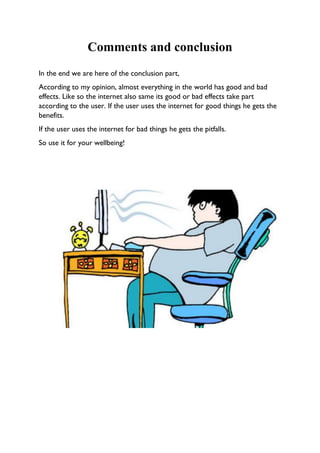
Too much time in front of the computer can also be the cause of:
• eyestrain
• obesity
• RSI
• social isolation
Children on a steady diet of inappropriately violent material via TV, computer
games, movies and the internet, can be negatively affected by:
• mimicking violent behavior
• becoming desensitized to violence and believing that it’s acceptable.
• becoming easily frightened in their familiar surroundings.
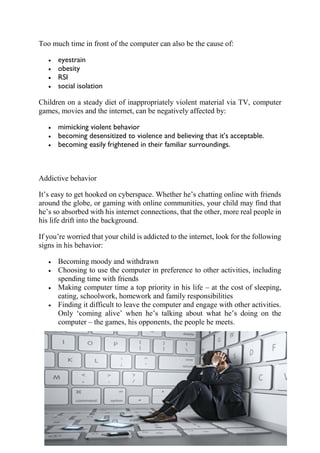
Addictive behavior
It’s easy to get hooked on cyberspace. Whether he’s chatting online with friends
around the globe, or gaming with online communities, your child may find that
he’s so absorbed with his internet connections, that the other, more real people in
his life drift into the background.
If you’re worried that your child is addicted to the internet, look for the following
signs in his behavior:
• Becoming moody and withdrawn
• Choosing to use the computer in preference to other activities, including
spending time with friends
• Making computer time a top priority in his life – at the cost of sleeping,
eating, schoolwork, homework and family responsibilities
• Finding it difficult to leave the computer and engage with other activities.
Only ‘coming alive’ when he’s talking about what he’s doing on the
computer – the games, his opponents, the people he meets.
Comments and conclusion
In the end we are here of the conclusion part,
According to my opinion, almost everything in the world has good and bad
effects. Like so the internet also same its good or bad effects take part
according to the user. If the user uses the internet for good things he gets the
benefits.
If the user uses the internet for bad things he gets the pitfalls.
So use it for your wellbeing!

Internet - benefits and pitfalls

  • 1.
    INTERNET –BENEFITS &PITFALLS ICT1113 S.K.H.R.S KUMARA
  • 2.
    Table of Contents Whatis internet.........................................................................................................................................................2 History of internet....................................................................................................................................................3 Definitions for internet ...........................................................................................................................................4 General usage of internet.......................................................................................................................................5 Personal usage of internet......................................................................................................................................6 Befits of internet........................................................................................................................................................7 Information, knowledge, and learning...............................................................................................................7 Connectivity, communication, and sharing ......................................................................................................7 Address, mapping, and contact information....................................................................................................7 Banking, bills, and shopping..................................................................................................................................7 Pitfalls of internet.....................................................................................................................................................8 Addictive behavior................................................................................Error! Bookmark not defined. Comments and conclusion...................................................................................................................................10
  • 3.
    What is internet TheInternet links are computer networks all over the world so that users can share resources and communicate with each other. Some computers, have direct access to all the facilities on the Internet such as the universities. And other computers, e.g. privately-owned ones, have indirect links through a commercial service provider, who offers some or all of the Internet facilities. In order to be connected to Internet, you must go through service suppliers. Many options are offered with monthly rates. Depending on the option chosen, access time may vary. The Internet is what we call a met network, that is, a network of networks that spans the globe. It's impossible to give an exact count of the number of networks or users that comprise the Internet, but it is easily in the thousands and millions respectively. The Internet employs a set of standardized protocols which allow for the sharing of resources among different kinds of computers that communicate with each other on the network. These standards, sometimes referred to as the Internet Protocol Suite, are the rules that developers adhere to when creating new functions for the Internet. The Internet is also what we call a distributed system; there is no central archives. Technically, no one runs the Internet. Rather, the Internet is made up of thousands of smaller networks. The Internet thrives and develops as its many users find new ways to create, display and retrieve the information that constitutes the Internet.
  • 4.
    History of internet Inits infancy, the Internet was originally conceived by the Department of Defense as a way to protect government communications systems in the event of a military strike. The original network, dubbed ARPANet (for the Advanced Research Projects Agency that developed it) evolved into a communications channel among contractors, military personnel, and university researchers who were contributing to ARPA projects. The network employed a set of standard protocols to create an effective way for these people to communicate and share data with each other. ARPAnet's popularity continued to spread among researchers, and in the 1980's the National Science Foundation, whose NSFNet, linked several high speed computers, took charge of the what had come to be known as the Internet. By the late 1980's, thousands of cooperating networks were participating in the Internet. In 1991, the U.S. High Performance Computing Act established the NREN (National Research & Education Network). NREN's goal was to develop and maintain high-speed networks for research and education, and to investigate commercial uses for the Internet. The rest, as they say, is history in the making. The Internet has been improved through the developments of such services as Gopher and the World Wide Web. Even though the Internet is predominantly thought of as a research oriented network, it continues to grow as an informational, creative, and commercial resource every day and all over the world.
  • 5.
    Definitions for internet anelectronic communications network that connects computer networks and organizational computer facilities around the world —used with the except when being used attributively a global computer network providing a variety of information and communication facilities, consisting of interconnected networks using standardized communication protocols. The Internet is the global system of interconnected computer networks that use the Internet protocol suite (TCP/IP) to link devices worldwide. A collection of computers speaks a common language protocol. The network of physical objects that contain embedded technology communicate and interact with their internal states or the external environment.
  • 6.
    General usage ofinternet The Internet allows greater flexibility in working hours and location, especially with the spread of unmetered high-speed connections. The Internet can be accessed almost anywhere by numerous means, including through mobile Internet devices. Mobile phones, data cards, handheld game consoles and cellular routers allow users to connect to the Internet wirelessly Within the limitations imposed by small screens and other limited facilities of such pocket-sized devices, the services of the Internet, including email and the web, may be available. Service providers may restrict the services offered and mobile data charges may be significantly higher than other access methods. Educational material at all levels from pre-school to post-doctoral is available from websites. Examples range from CBeebies, through school and high-school revision guides and virtual universities, to access to top-end scholarly literature through the likes of Google Scholar. For distance education, help with homework and other assignments, self-guided learning, whiling away spare time, or just looking up more detail on an interesting fact, it has never been easier for people to access educational information at any level from anywhere. The Internet in general and the World Wide Web in particular are important enablers of both formal and informal education. Further, the Internet allows universities, in particular, researchers from the social and behavioral sciences, to conduct research remotely via virtual laboratories, with profound changes in reach and generalizability of findings as well as in communication between scientists and in the publication of results
  • 7.
    Personal usage ofinternet I use the internet at most all the time. especially when its come to educational purposes internet is the main source of information.in my leisure time I spend most of time surfing the internet, watching tutorials and songs, Facebooking and etc. According to my view internet took a major part in my life and other people too. Now a day everyone has smartphones because of that everyone always surfing in the internet and doing their office work, school work, university work and etc. Because of internet sharing and learning things become so easy. For example, we have social media to connect with our friends and family, google drive, icloud, OneDrive like cloud storage services give us access to our data & information anywhere in the world. According to my experience map service is the most useful thing I ever used. Because of maps I can go to any place and find any route. Not only that we can find our current location and send a gaps signals tour
  • 8.
    Befits of internet Information,knowledge, and learning The Internet contains an endless supply of knowledge and information that allows you to learn about almost any topic or question you may have. Using a search engine like Google, you can ask virtually any question and find a web page with an answer to that question. There are also millions of videos on sites like YouTube that help explain various topics and even online courses that can be taken to help teach you about many different subjects Connectivity, communication, and sharing In the past, it would take days and sometimes even months to receive a letter from someone else. Today, with the Internet, you can send an e-mail to anyone in the world and often have it delivered in less than a minute. Other forms of communication, such as chat and VOIP, also allow you to have instant communication with anyone in the world. Online forums are also places where people who share common interests can connect with each other and talk about what they enjoy or ask other experts in the field questions. Address, mapping, and contact information l Banking, bills, and shopping The Internet gives you access to your bank account to view your balance, make transactions, and send money. Also, many services enable you to view and pay your bills electronically. Online shopping is another huge advantage of the Internet, giving anyone with Internet access the ability to find products that interest them and buy them without having to visit a store. The Internet gives everyone easy access to compare prices
  • 9.
    between companies andeven see what others think about a product through online reviews to help make better purchasing decisions. Pitfalls of internet While there are millions of kid’s sites on the internet that are appropriate for playing games, researching school projects and finding out about the world, the very ‘openness’ of the internet means that much of the material is unregulated, so remember: • Anyone can write anything on the internet, so if you are using material as research, confirm the information with another source before you use it if you are doubtful of its authenticity. • If you meet someone on the internet, they may not be who they say they are – it’s easy to lie on the internet. • Pedophiles use the internet as a way of making ‘friends’ with children. Never let your child physically meet someone he’s met on the internet alone. • Email can be used as powerful tool to harass, intimidate or bully others. • Your child may be provided with inappropriate information via the internet – bomb or drug making. • Be sure you are using a secure and reputable site before disclosing your credit card details to make a purchase. • On-line gambling is big business – and it’s possible to use a credit card to do it. • It is possible to innocently find inappropriate sites when you are searching for something quite different! Health issues Properly monitored by an adult, the internet should be a fun activity for children. But without the suitable supervision, there are ways that your child can be exploited, harassed or intimidated which can have an extremely detrimental effect on his self-esteem as well as inter-family relations.
  • 10.
    Too much timein front of the computer can also be the cause of: • eyestrain • obesity • RSI • social isolation Children on a steady diet of inappropriately violent material via TV, computer games, movies and the internet, can be negatively affected by: • mimicking violent behavior • becoming desensitized to violence and believing that it’s acceptable. • becoming easily frightened in their familiar surroundings. Addictive behavior It’s easy to get hooked on cyberspace. Whether he’s chatting online with friends around the globe, or gaming with online communities, your child may find that he’s so absorbed with his internet connections, that the other, more real people in his life drift into the background. If you’re worried that your child is addicted to the internet, look for the following signs in his behavior: • Becoming moody and withdrawn • Choosing to use the computer in preference to other activities, including spending time with friends • Making computer time a top priority in his life – at the cost of sleeping, eating, schoolwork, homework and family responsibilities • Finding it difficult to leave the computer and engage with other activities. Only ‘coming alive’ when he’s talking about what he’s doing on the computer – the games, his opponents, the people he meets.
  • 11.
    Comments and conclusion Inthe end we are here of the conclusion part, According to my opinion, almost everything in the world has good and bad effects. Like so the internet also same its good or bad effects take part according to the user. If the user uses the internet for good things he gets the benefits. If the user uses the internet for bad things he gets the pitfalls. So use it for your wellbeing!