ESSAY
in the discipline "English for Professional Purposes" (III year) on the subject
“Origins of Internet”
Revych Maksym IK-73 - FICT
cathedra of TechnicalCybernetics
KYIV 2020
Abstract
Short essay about origins,
usage and importance
of an Internet in our everyday life
Ministry of Education and Science, Youth and Sports
National Technical University of Ukraine
“Kyiv Polytechnic Institute”
Page | 1
Internet
Created by Maksym Revych IK-73
It is hard to deny the importance of Internet nowadays. This global system of interconnected
networks has entered nearly everyone’s life and holds several billions of users worldwide.
Internet helps not only to communicate, but offers infinite possibilities for business and
education.
It's like the Wild West, The Internet. There are no rules – Steven Wright
What is an Internet
The Internet is the global system of interconnected
computer networks that uses the Internet protocol
suite (TCP/IP) to communicate between networks
and devices. It is a network of networks that
consists of private, public, academic, business, and
government networks of local to global scope,
linked by a broad array of electronic, wireless, and
optical networking technologies.
The Internet carries a vast range of information
resources and services, such as the inter-linked hypertext documents and applications of the
World Wide Web (WWW), electronicmail, telephony, and file sharing.
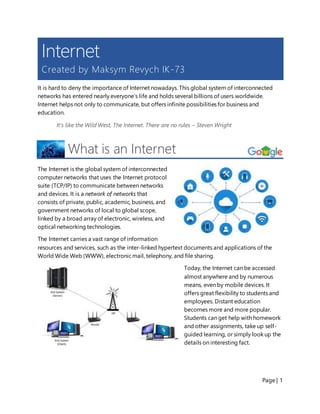
Today, the Internet can be accessed
almost anywhere and by numerous
means, even by mobile devices. It
offers great flexibility to students and
employees. Distant education
becomes more and more popular.
Students can get help with homework
and other assignments, take up self-
guided learning, or simply look up the
details on interesting fact.
Page | 2
Origin
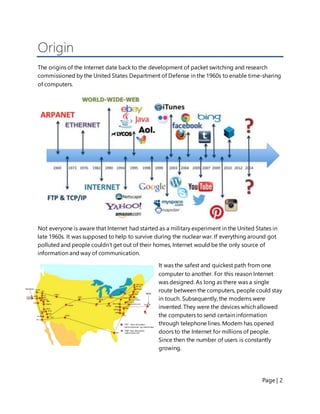
The origins of the Internet date back to the development of packet switching and research
commissioned by the United States Department of Defense in the 1960s to enable time-sharing
of computers.
Not everyone is aware that Internet had started as a military experiment in the United States in
late 1960s. It was supposed to help to survive during the nuclear war. If everything around got
polluted and people couldn’t get out of their homes, Internet would be the only source of
information and way of communication.
It was the safest and quickest path from one
computer to another. For this reason Internet
was designed. As long as there was a single
route between the computers, people could stay
in touch. Subsequently, the modems were
invented. They were the devices which allowed
the computers to send certain information
through telephone lines. Modem has opened
doors to the Internet for millions of people.
Since then the number of users is constantly
growing.
Page | 3
The primary precursor network, the ARPANET, initially served as a backbone for interconnection
of regional academic and military networks in the 1970s. The funding of the National Science
Foundation Network as a new backbone in the 1980s, as well as private funding for other
commercial extensions, led to worldwide participation in the development of new networking
technologies, and the merger of many networks. The linking of commercial networks and
enterprises by the early 1990s marked the beginning of the transition to the modern Internet,
and generated a sustained exponential growth as generations of institutional, personal, and
mobile computers were connected to the network. Although the Internet was widely used by
academia in the 1980s, commercialization incorporated its services and technologies into
virtually every aspect of modern life.
Infrastructure
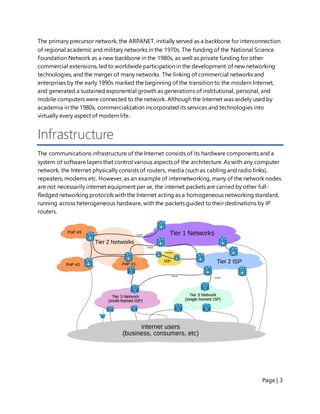
The communications infrastructure of the Internet consists of its hardware components and a
system of software layers that control various aspects of the architecture. As with any computer
network, the Internet physically consists of routers, media (such as cabling and radio links),
repeaters, modems etc. However, as an example of internetworking, many of the network nodes
are not necessarily internet equipment per se, the internet packets are carried by other full-
fledged networking protocols with the Internet acting as a homogeneous networking standard,
running across heterogeneous hardware, with the packets guided to their destinations by IP
routers.
Page | 4
Internet service providers (ISPs) establish the worldwide connectivity between individual
networks at various levels of scope. End-users who only access the Internet when needed to
perform a function or obtain information, represent the bottom of the routing hierarchy. At the
top of the routing hierarchy are the tier 1 networks, large telecommunication companies that
exchange traffic directly with each other via very high speed fibre optic cables and governed by
peering agreements. Tier 2 and lower level networks buy Internet transit from other providers to
reach at least some parties on the global Internet, though they may also engage in peering. An
ISP may use a single upstream provider for connectivity, or implement multihoming to achieve
redundancy and load balancing.
Social impact
From 2000 to 2009, the number of Internet users globally rose from 394 million to 1.858 billion.
By 2010, 22 percent of the world's population had access to computers with 1 billion Google
searches every day, 300 million Internet users reading blogs, and 2 billion videos viewed daily on
YouTube.
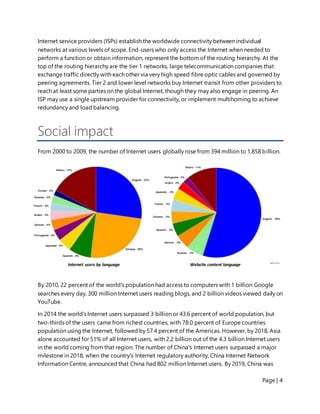
In 2014 the world's Internet users surpassed 3 billion or 43.6 percent of world population, but
two-thirds of the users came from richest countries, with 78.0 percent of Europe countries
population using the Internet, followed by 57.4 percent of the Americas. However, by 2018, Asia
alone accounted for 51% of all Internet users, with 2.2 billion out of the 4.3 billion Internet users
in the world coming from that region. The number of China's Internet users surpassed a major
milestone in 2018, when the country's Internet regulatory authority, China Internet Network
Information Centre, announced that China had 802 million Internet users. By 2019, China was
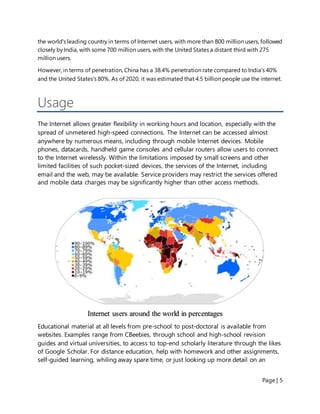
Internet users by language Website content language
Page | 5
the world's leading country in terms of Internet users, with more than 800 million users, followed
closely by India, with some 700 million users, with the United States a distant third with 275
million users.
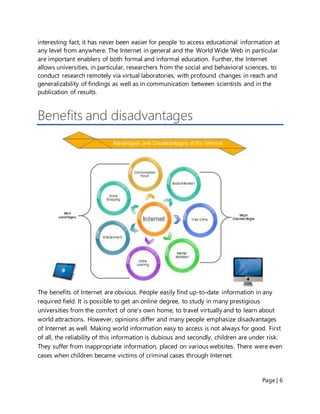
However, in terms of penetration, China has a 38.4% penetration rate compared to India's 40%
and the United States's 80%. As of 2020, it was estimated that 4.5 billion people use the internet.
Usage
The Internet allows greater flexibility in working hours and location, especially with the
spread of unmetered high-speed connections. The Internet can be accessed almost
anywhere by numerous means, including through mobile Internet devices. Mobile
phones, datacards, handheld game consoles and cellular routers allow users to connect
to the Internet wirelessly. Within the limitations imposed by small screens and other
limited facilities of such pocket-sized devices, the services of the Internet, including
email and the web, may be available. Service providers may restrict the services offered
and mobile data charges may be significantly higher than other access methods.
Educational material at all levels from pre-school to post-doctoral is available from
websites. Examples range from CBeebies, through school and high-school revision
guides and virtual universities, to access to top-end scholarly literature through the likes
of Google Scholar. For distance education, help with homework and other assignments,
self-guided learning, whiling away spare time, or just looking up more detail on an
Internet users around the world in percentages
Page | 6
interesting fact, it has never been easier for people to access educational information at
any level from anywhere. The Internet in general and the World Wide Web in particular
are important enablers of both formal and informal education. Further, the Internet
allows universities, in particular, researchers from the social and behavioral sciences, to
conduct research remotely via virtual laboratories, with profound changes in reach and
generalizability of findings as well as in communication between scientists and in the
publication of results.
Benefits and disadvantages
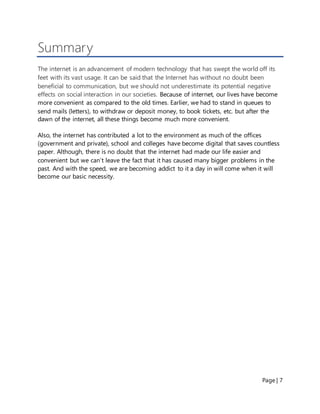
The benefits of Internet are obvious. People easily find up-to-date information in any
required field. It is possible to get an online degree, to study in many prestigious
universities from the comfort of one’s own home, to travel virtually and to learn about
world attractions. However, opinions differ and many people emphasize disadvantages
of Internet as well. Making world information easy to access is not always for good. First
of all, the reliability of this information is dubious and secondly, children are under risk.
They suffer from inappropriate information, placed on various websites. There were even
cases when children became victims of criminal cases through Internet.
Page | 7
Summary
The internet is an advancement of modern technology that has swept the world off its
feet with its vast usage. It can be said that the Internet has without no doubt been
beneficial to communication, but we should not underestimate its potential negative
effects on social interaction in our societies. Because of internet, our lives have become
more convenient as compared to the old times. Earlier, we had to stand in queues to
send mails (letters), to withdraw or deposit money, to book tickets, etc. but after the
dawn of the internet, all these things become much more convenient.
Also, the internet has contributed a lot to the environment as much of the offices
(government and private), school and colleges have become digital that saves countless
paper. Although, there is no doubt that the internet had made our life easier and
convenient but we can’t leave the fact that it has caused many bigger problems in the
past. And with the speed, we are becoming addict to it a day in will come when it will
become our basic necessity.
Page | 8
Contents
1 – Introduction _____________________________________________________________________1
2 – Origin ___________________________________________________________________________2
3 – Infrastructure ____________________________________________________________________3
4 – Social Impact ____________________________________________________________________4
5 – Usage ___________________________________________________________________________5
6 – Benefits and disadvantages _______________________________________________________6
7 – Summary ________________________________________________________________________7
References
1 – Washington Post - https://www.washingtonpost.com/sf/business/2015/05/30/net-
of-insecurity-part-1/
2 – Internet History - http://www.livinginternet.com/i/ii_summary.htm
3 – “Who owns the Internet” - http://computer.howstuffworks.com/internet/basics/who-
owns-internet.htm
4 – Terms like ‘web’ and “Internet” -
http://www.chicagomanualofstyle.org/16/ch07/ch07_sec076.html?para=
5 – “Roads and Crossroads of the Internet - http://www.netvalley.com/intval.html
6 – “Brief History of Internet: The Initial Internetting Concepts” -
http://www.internetsociety.org/internet/what-internet/history-internet/brief-history-
internet#concepts
7 – “Internet history in Asia” - http://www.apan.net/meetings/busan03/cs-history.htm

Internet

  • 1.
    ESSAY in the discipline"English for Professional Purposes" (III year) on the subject “Origins of Internet” Revych Maksym IK-73 - FICT cathedra of TechnicalCybernetics KYIV 2020 Abstract Short essay about origins, usage and importance of an Internet in our everyday life Ministry of Education and Science, Youth and Sports National Technical University of Ukraine “Kyiv Polytechnic Institute”
  • 2.
    Page | 1 Internet Createdby Maksym Revych IK-73 It is hard to deny the importance of Internet nowadays. This global system of interconnected networks has entered nearly everyone’s life and holds several billions of users worldwide. Internet helps not only to communicate, but offers infinite possibilities for business and education. It's like the Wild West, The Internet. There are no rules – Steven Wright What is an Internet The Internet is the global system of interconnected computer networks that uses the Internet protocol suite (TCP/IP) to communicate between networks and devices. It is a network of networks that consists of private, public, academic, business, and government networks of local to global scope, linked by a broad array of electronic, wireless, and optical networking technologies. The Internet carries a vast range of information resources and services, such as the inter-linked hypertext documents and applications of the World Wide Web (WWW), electronicmail, telephony, and file sharing. Today, the Internet can be accessed almost anywhere and by numerous means, even by mobile devices. It offers great flexibility to students and employees. Distant education becomes more and more popular. Students can get help with homework and other assignments, take up self- guided learning, or simply look up the details on interesting fact.
  • 3.
    Page | 2 Origin Theorigins of the Internet date back to the development of packet switching and research commissioned by the United States Department of Defense in the 1960s to enable time-sharing of computers. Not everyone is aware that Internet had started as a military experiment in the United States in late 1960s. It was supposed to help to survive during the nuclear war. If everything around got polluted and people couldn’t get out of their homes, Internet would be the only source of information and way of communication. It was the safest and quickest path from one computer to another. For this reason Internet was designed. As long as there was a single route between the computers, people could stay in touch. Subsequently, the modems were invented. They were the devices which allowed the computers to send certain information through telephone lines. Modem has opened doors to the Internet for millions of people. Since then the number of users is constantly growing.
  • 4.
    Page | 3 Theprimary precursor network, the ARPANET, initially served as a backbone for interconnection of regional academic and military networks in the 1970s. The funding of the National Science Foundation Network as a new backbone in the 1980s, as well as private funding for other commercial extensions, led to worldwide participation in the development of new networking technologies, and the merger of many networks. The linking of commercial networks and enterprises by the early 1990s marked the beginning of the transition to the modern Internet, and generated a sustained exponential growth as generations of institutional, personal, and mobile computers were connected to the network. Although the Internet was widely used by academia in the 1980s, commercialization incorporated its services and technologies into virtually every aspect of modern life. Infrastructure The communications infrastructure of the Internet consists of its hardware components and a system of software layers that control various aspects of the architecture. As with any computer network, the Internet physically consists of routers, media (such as cabling and radio links), repeaters, modems etc. However, as an example of internetworking, many of the network nodes are not necessarily internet equipment per se, the internet packets are carried by other full- fledged networking protocols with the Internet acting as a homogeneous networking standard, running across heterogeneous hardware, with the packets guided to their destinations by IP routers.
  • 5.
    Page | 4 Internetservice providers (ISPs) establish the worldwide connectivity between individual networks at various levels of scope. End-users who only access the Internet when needed to perform a function or obtain information, represent the bottom of the routing hierarchy. At the top of the routing hierarchy are the tier 1 networks, large telecommunication companies that exchange traffic directly with each other via very high speed fibre optic cables and governed by peering agreements. Tier 2 and lower level networks buy Internet transit from other providers to reach at least some parties on the global Internet, though they may also engage in peering. An ISP may use a single upstream provider for connectivity, or implement multihoming to achieve redundancy and load balancing. Social impact From 2000 to 2009, the number of Internet users globally rose from 394 million to 1.858 billion. By 2010, 22 percent of the world's population had access to computers with 1 billion Google searches every day, 300 million Internet users reading blogs, and 2 billion videos viewed daily on YouTube. In 2014 the world's Internet users surpassed 3 billion or 43.6 percent of world population, but two-thirds of the users came from richest countries, with 78.0 percent of Europe countries population using the Internet, followed by 57.4 percent of the Americas. However, by 2018, Asia alone accounted for 51% of all Internet users, with 2.2 billion out of the 4.3 billion Internet users in the world coming from that region. The number of China's Internet users surpassed a major milestone in 2018, when the country's Internet regulatory authority, China Internet Network Information Centre, announced that China had 802 million Internet users. By 2019, China was Internet users by language Website content language
  • 6.
    Page | 5 theworld's leading country in terms of Internet users, with more than 800 million users, followed closely by India, with some 700 million users, with the United States a distant third with 275 million users. However, in terms of penetration, China has a 38.4% penetration rate compared to India's 40% and the United States's 80%. As of 2020, it was estimated that 4.5 billion people use the internet. Usage The Internet allows greater flexibility in working hours and location, especially with the spread of unmetered high-speed connections. The Internet can be accessed almost anywhere by numerous means, including through mobile Internet devices. Mobile phones, datacards, handheld game consoles and cellular routers allow users to connect to the Internet wirelessly. Within the limitations imposed by small screens and other limited facilities of such pocket-sized devices, the services of the Internet, including email and the web, may be available. Service providers may restrict the services offered and mobile data charges may be significantly higher than other access methods. Educational material at all levels from pre-school to post-doctoral is available from websites. Examples range from CBeebies, through school and high-school revision guides and virtual universities, to access to top-end scholarly literature through the likes of Google Scholar. For distance education, help with homework and other assignments, self-guided learning, whiling away spare time, or just looking up more detail on an Internet users around the world in percentages
  • 7.
    Page | 6 interestingfact, it has never been easier for people to access educational information at any level from anywhere. The Internet in general and the World Wide Web in particular are important enablers of both formal and informal education. Further, the Internet allows universities, in particular, researchers from the social and behavioral sciences, to conduct research remotely via virtual laboratories, with profound changes in reach and generalizability of findings as well as in communication between scientists and in the publication of results. Benefits and disadvantages The benefits of Internet are obvious. People easily find up-to-date information in any required field. It is possible to get an online degree, to study in many prestigious universities from the comfort of one’s own home, to travel virtually and to learn about world attractions. However, opinions differ and many people emphasize disadvantages of Internet as well. Making world information easy to access is not always for good. First of all, the reliability of this information is dubious and secondly, children are under risk. They suffer from inappropriate information, placed on various websites. There were even cases when children became victims of criminal cases through Internet.
  • 8.
    Page | 7 Summary Theinternet is an advancement of modern technology that has swept the world off its feet with its vast usage. It can be said that the Internet has without no doubt been beneficial to communication, but we should not underestimate its potential negative effects on social interaction in our societies. Because of internet, our lives have become more convenient as compared to the old times. Earlier, we had to stand in queues to send mails (letters), to withdraw or deposit money, to book tickets, etc. but after the dawn of the internet, all these things become much more convenient. Also, the internet has contributed a lot to the environment as much of the offices (government and private), school and colleges have become digital that saves countless paper. Although, there is no doubt that the internet had made our life easier and convenient but we can’t leave the fact that it has caused many bigger problems in the past. And with the speed, we are becoming addict to it a day in will come when it will become our basic necessity.
  • 9.
    Page | 8 Contents 1– Introduction _____________________________________________________________________1 2 – Origin ___________________________________________________________________________2 3 – Infrastructure ____________________________________________________________________3 4 – Social Impact ____________________________________________________________________4 5 – Usage ___________________________________________________________________________5 6 – Benefits and disadvantages _______________________________________________________6 7 – Summary ________________________________________________________________________7 References 1 – Washington Post - https://www.washingtonpost.com/sf/business/2015/05/30/net- of-insecurity-part-1/ 2 – Internet History - http://www.livinginternet.com/i/ii_summary.htm 3 – “Who owns the Internet” - http://computer.howstuffworks.com/internet/basics/who- owns-internet.htm 4 – Terms like ‘web’ and “Internet” - http://www.chicagomanualofstyle.org/16/ch07/ch07_sec076.html?para= 5 – “Roads and Crossroads of the Internet - http://www.netvalley.com/intval.html 6 – “Brief History of Internet: The Initial Internetting Concepts” - http://www.internetsociety.org/internet/what-internet/history-internet/brief-history- internet#concepts 7 – “Internet history in Asia” - http://www.apan.net/meetings/busan03/cs-history.htm