THE EXPERIMENTAL STUDY ON THE EFFECT OF
INTERNET-BASED MATERIALS IN
TEACHING LISTENING COMPREHENSION VIEWED
FROM STUDENTS’ LEARNING INTEREST
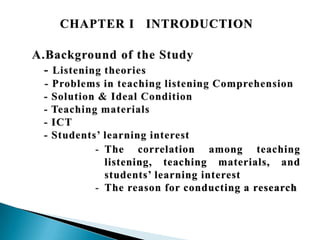
CHAPTER I INTRODUCTION

- The correlation among teaching
listening, teaching materials, and
students’ learning interest
- The reason for conducting a research
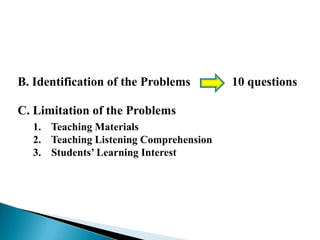
B. Identification of the Problems
C. Limitation of the Problems
1. Teaching Materials
2. Teaching Listening Comprehension
3. Students’ Learning Interest

10 questions
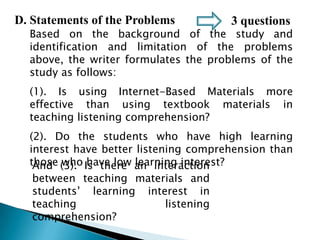
D. Statements of the Problems

3 questions

Based on the background of the study and
identification and limitation of the problems
above, the writer formulates the problems of the
study as follows:
(1). Is using Internet-Based Materials more
effective than using textbook materials in
teaching listening comprehension?
(2). Do the students who have high learning
interest have better listening comprehension than
those (3). Is there an interaction
And who have low learning interest?
between teaching materials and
students’ learning interest in
teaching
listening
comprehension?
E. The Benefit of the Study
1. One theoretical benefit
Theoretically, the research can be used to
develop instructional material used by the
teacher in teaching listening comprehension. It
is expected to be an additional reference for
materials developments.

2. Four practical benefits
a. Students
b. English Teachers
c. Institutional Administrator of Education
d. Other Researchers
CHAPTER II
LITERATURE REVIEWED
A. Listening Comprehension

6 points: The General Concepts of Listening Comprehension, Models of the
Listening Process, Micro and Macro-Skills of Listening , Potential Listening
Comprehension Problems, Teaching Materials in Listening Comprehension,
Teaching Procedures Using Internet-Based Materials
Mendelsohn (1994) defines listening comprehension as “the ability to
understand the spoken language of native speakers.‘‘It means that the listener
tries to make sense out of what is heard by utilizing his different knowledge
sources. These knowledge sources will facilitate him to understand the
messages.
Construct:
it can be concluded that listening comprehension, although a receptive skill, is
a very active process of making sense or paying attention of what is heard by
utilizing him/her to understand the messages which is constructed based on a
number of different knowledge sources. It is trying to not only to understand
what words and sentences mean, but also to what the speaker actually mean.
In teaching listening comprehension, the lessons should be supported by the
appropriate material.
B. Internet-Based Materials
3 points: The General Concepts of Internet-Based Materials, The
Advantages of Internet-Based Materials, and The Disadvantages
of Internet-Based Materials
Internet-based material is a kind of instructional materials which
is taken from the internet. It can be in form of printed materials
or non-printed materials. The internet makes it possible to seek,
find, and communicate information that might otherwise have
been impossibly out of reach. We can use the internet as a basis
of activities to accompany your textbook.
Construct:
It can be concluded that internet-based material is one kind of
instructional materials from the internet as a source. It can be in
form of printed or non-printed materials. It allows the teachers to
find information which is out of reach. It is suitable for the lesson
materials. It provides teachers with many opportunities for
increased productivity, efficiency, and personal and professional
knowledge.
The writer in this research will use both ESL-Lab site and Effortless
English Podcast.
C. Textbook Materials
3 points: The General Concepts of Textbook Materials, The
Advantages of Textbook Materials , and The Disadvantages of
Textbook Materials.
The textbook has been the most frequently used in instructional
material at all levels beyond the primary grades, and in some cases
it the only one used by the teacher. Textbook is a manual of
instruction or a standard book in any branch of study.
In many cases teachers and students depend heavily on textbooks,
and textbooks determine the component and methods of learning,
that is, they control the content, methods, and procedures of
Construct:
learning.
It can be concluded that textbook is a manual of instruction or a
standard book in any branch of study which can serve different
purposes for teachers. It has a strong influence on nature and
sequences of a course and thus profoundly affects students’ learning
experiences. It determines the component and methods of learning,
that is, they control the content, methods, and procedures of
learning.
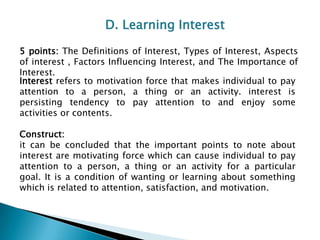
D. Learning Interest
5 points: The Definitions of Interest, Types of Interest, Aspects
of interest , Factors Influencing Interest, and The Importance of
Interest.
Interest refers to motivation force that makes individual to pay
attention to a person, a thing or an activity. interest is
persisting tendency to pay attention to and enjoy some
activities or contents.
Construct:
it can be concluded that the important points to note about
interest are motivating force which can cause individual to pay
attention to a person, a thing or an activity for a particular
goal. It is a condition of wanting or learning about something
which is related to attention, satisfaction, and motivation.
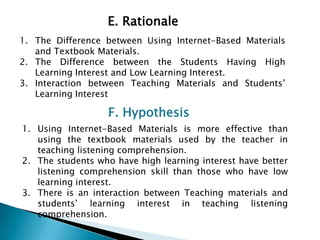
E. Rationale
1. The Difference between Using Internet-Based Materials
and Textbook Materials.
2. The Difference between the Students Having High
Learning Interest and Low Learning Interest.
3. Interaction between Teaching Materials and Students’
Learning Interest

F. Hypothesis
1. Using Internet-Based Materials is more effective than
using the textbook materials used by the teacher in
teaching listening comprehension.
2. The students who have high learning interest have better
listening comprehension skill than those who have low
learning interest.
3. There is an interaction between Teaching materials and
students’ learning interest in teaching listening
comprehension.
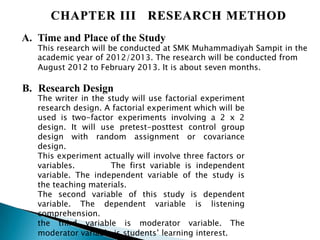
CHAPTER III RESEARCH METHOD
A. Time and Place of the Study

This research will be conducted at SMK Muhammadiyah Sampit in the
academic year of 2012/2013. The research will be conducted from
August 2012 to February 2013. It is about seven months.

B. Research Design

The writer in the study will use factorial experiment
research design. A factorial experiment which will be
used is two-factor experiments involving a 2 x 2
design. It will use pretest-posttest control group
design with random assignment or covariance
design.
This experiment actually will involve three factors or
variables.
The first variable is independent
variable. The independent variable of the study is
the teaching materials.
The second variable of this study is dependent
variable. The dependent variable is listening
comprehension.
the third variable is moderator variable. The
moderator variable is students’ learning interest.
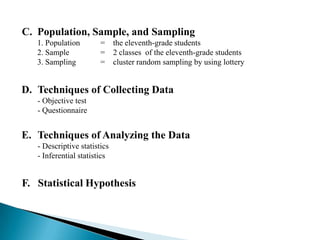
C. Population, Sample, and Sampling
1. Population
2. Sample
3. Sampling

=
=
=

the eleventh-grade students
2 classes of the eleventh-grade students
cluster random sampling by using lottery

D. Techniques of Collecting Data
- Objective test
- Questionnaire

E. Techniques of Analyzing the Data
- Descriptive statistics
- Inferential statistics

F. Statistical Hypothesis
Internet based materials

Internet based materials

  • 1.
    THE EXPERIMENTAL STUDYON THE EFFECT OF INTERNET-BASED MATERIALS IN TEACHING LISTENING COMPREHENSION VIEWED FROM STUDENTS’ LEARNING INTEREST
  • 2.
    CHAPTER I INTRODUCTION -The correlation among teaching listening, teaching materials, and students’ learning interest - The reason for conducting a research
  • 3.
    B. Identification ofthe Problems C. Limitation of the Problems 1. Teaching Materials 2. Teaching Listening Comprehension 3. Students’ Learning Interest 10 questions
  • 4.
    D. Statements ofthe Problems 3 questions Based on the background of the study and identification and limitation of the problems above, the writer formulates the problems of the study as follows: (1). Is using Internet-Based Materials more effective than using textbook materials in teaching listening comprehension? (2). Do the students who have high learning interest have better listening comprehension than those (3). Is there an interaction And who have low learning interest? between teaching materials and students’ learning interest in teaching listening comprehension?
  • 5.
    E. The Benefitof the Study 1. One theoretical benefit Theoretically, the research can be used to develop instructional material used by the teacher in teaching listening comprehension. It is expected to be an additional reference for materials developments. 2. Four practical benefits a. Students b. English Teachers c. Institutional Administrator of Education d. Other Researchers
  • 6.
    CHAPTER II LITERATURE REVIEWED A.Listening Comprehension 6 points: The General Concepts of Listening Comprehension, Models of the Listening Process, Micro and Macro-Skills of Listening , Potential Listening Comprehension Problems, Teaching Materials in Listening Comprehension, Teaching Procedures Using Internet-Based Materials Mendelsohn (1994) defines listening comprehension as “the ability to understand the spoken language of native speakers.‘‘It means that the listener tries to make sense out of what is heard by utilizing his different knowledge sources. These knowledge sources will facilitate him to understand the messages. Construct: it can be concluded that listening comprehension, although a receptive skill, is a very active process of making sense or paying attention of what is heard by utilizing him/her to understand the messages which is constructed based on a number of different knowledge sources. It is trying to not only to understand what words and sentences mean, but also to what the speaker actually mean. In teaching listening comprehension, the lessons should be supported by the appropriate material.
  • 7.
    B. Internet-Based Materials 3points: The General Concepts of Internet-Based Materials, The Advantages of Internet-Based Materials, and The Disadvantages of Internet-Based Materials Internet-based material is a kind of instructional materials which is taken from the internet. It can be in form of printed materials or non-printed materials. The internet makes it possible to seek, find, and communicate information that might otherwise have been impossibly out of reach. We can use the internet as a basis of activities to accompany your textbook. Construct: It can be concluded that internet-based material is one kind of instructional materials from the internet as a source. It can be in form of printed or non-printed materials. It allows the teachers to find information which is out of reach. It is suitable for the lesson materials. It provides teachers with many opportunities for increased productivity, efficiency, and personal and professional knowledge. The writer in this research will use both ESL-Lab site and Effortless English Podcast.
  • 8.
    C. Textbook Materials 3points: The General Concepts of Textbook Materials, The Advantages of Textbook Materials , and The Disadvantages of Textbook Materials. The textbook has been the most frequently used in instructional material at all levels beyond the primary grades, and in some cases it the only one used by the teacher. Textbook is a manual of instruction or a standard book in any branch of study. In many cases teachers and students depend heavily on textbooks, and textbooks determine the component and methods of learning, that is, they control the content, methods, and procedures of Construct: learning. It can be concluded that textbook is a manual of instruction or a standard book in any branch of study which can serve different purposes for teachers. It has a strong influence on nature and sequences of a course and thus profoundly affects students’ learning experiences. It determines the component and methods of learning, that is, they control the content, methods, and procedures of learning.
  • 9.
    D. Learning Interest 5points: The Definitions of Interest, Types of Interest, Aspects of interest , Factors Influencing Interest, and The Importance of Interest. Interest refers to motivation force that makes individual to pay attention to a person, a thing or an activity. interest is persisting tendency to pay attention to and enjoy some activities or contents. Construct: it can be concluded that the important points to note about interest are motivating force which can cause individual to pay attention to a person, a thing or an activity for a particular goal. It is a condition of wanting or learning about something which is related to attention, satisfaction, and motivation.
  • 10.
    E. Rationale 1. TheDifference between Using Internet-Based Materials and Textbook Materials. 2. The Difference between the Students Having High Learning Interest and Low Learning Interest. 3. Interaction between Teaching Materials and Students’ Learning Interest F. Hypothesis 1. Using Internet-Based Materials is more effective than using the textbook materials used by the teacher in teaching listening comprehension. 2. The students who have high learning interest have better listening comprehension skill than those who have low learning interest. 3. There is an interaction between Teaching materials and students’ learning interest in teaching listening comprehension.
  • 11.
    CHAPTER III RESEARCHMETHOD A. Time and Place of the Study This research will be conducted at SMK Muhammadiyah Sampit in the academic year of 2012/2013. The research will be conducted from August 2012 to February 2013. It is about seven months. B. Research Design The writer in the study will use factorial experiment research design. A factorial experiment which will be used is two-factor experiments involving a 2 x 2 design. It will use pretest-posttest control group design with random assignment or covariance design. This experiment actually will involve three factors or variables. The first variable is independent variable. The independent variable of the study is the teaching materials. The second variable of this study is dependent variable. The dependent variable is listening comprehension. the third variable is moderator variable. The moderator variable is students’ learning interest.
  • 12.
    C. Population, Sample,and Sampling 1. Population 2. Sample 3. Sampling = = = the eleventh-grade students 2 classes of the eleventh-grade students cluster random sampling by using lottery D. Techniques of Collecting Data - Objective test - Questionnaire E. Techniques of Analyzing the Data - Descriptive statistics - Inferential statistics F. Statistical Hypothesis