Walker, Christopher
The purpose of this chapter is to discuss the structure and
functions of the internet and describe the many ways it can
be used in a distance education environment
Describe how the physical structure of the internet facilities the
delivery of distance education to learners in a wide variety of
locations and at varying educational levels
Discuss why the internet relates well to transformations taking place
in the general paradigms for teaching and learning
Discuss the advantages and limitations of internet based learning
Discuss the evolution of the internet and its functions that most
directly relate to distance education, such as electronic mail, mailing
list and the world wide web
Identify the typical components of a course management system and
their functions in internet-based distance education
Describe ways in which a course management system can be
enhanced with third-party products
Select course activities that maximize active learning opportunities
Describe the potential of web 2.0 for promoting learning in a
distance education setting
Describe trends in internet based distance education and their
implications for educational programs
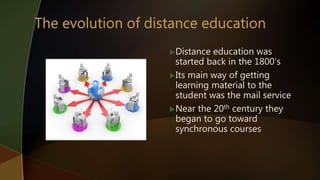
Distance education was
started back in the 1800’s
Its main way of getting
learning material to the
student was the mail service
Near the 20th century they
began to go toward
synchronous courses
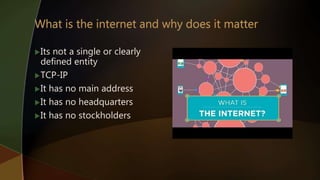
Its not a single or clearly
defined entity
TCP-IP
It has no main address
It has no headquarters
It has no stockholders
 Tier 1 – Backbone Networks and Internet Exchange Points
 Tier 2 – Regional Networks
 Tier 3 – Internet Service Providers
 Tier 4 – Organizational and Home Networks
 Is the internet and world wide web interchangeable? NO
Lecturing to coaching
Taking attendance to logging on
Distribution requirements to
connected learning
Credit hours to performance
standards
Competing to collaborating
Library collections to network
connections
Course work always available unless the internet is down
Asynchronous course components available 24 hours
Students can work at their own pace
Course work and course material is available via the web
Technology is relatively easy for students to use
Learning material us always available across the entire web
Course material can always be updated to be current
Digital divide is real
Online course may emphasize the technology rather than the
content of learning
Well-designed internet-based courses may be quite intensive
Some instructors have difficulty adjusting to the students
Copyright violations on course web pages
Some students still use dial-up connection
Course management
Readings
Content presentations
Course communications
Group projects space
Student assessment
Digital drop-box for assignment submission
Course evaluation tools
Course and system statistics
Walker, Christopher

Internet based distance education

  • 1.
  • 2.
    The purpose ofthis chapter is to discuss the structure and functions of the internet and describe the many ways it can be used in a distance education environment
  • 3.
    Describe how thephysical structure of the internet facilities the delivery of distance education to learners in a wide variety of locations and at varying educational levels Discuss why the internet relates well to transformations taking place in the general paradigms for teaching and learning Discuss the advantages and limitations of internet based learning Discuss the evolution of the internet and its functions that most directly relate to distance education, such as electronic mail, mailing list and the world wide web
  • 4.
    Identify the typicalcomponents of a course management system and their functions in internet-based distance education Describe ways in which a course management system can be enhanced with third-party products Select course activities that maximize active learning opportunities Describe the potential of web 2.0 for promoting learning in a distance education setting Describe trends in internet based distance education and their implications for educational programs
  • 5.
    Distance education was startedback in the 1800’s Its main way of getting learning material to the student was the mail service Near the 20th century they began to go toward synchronous courses
  • 6.
    Its not asingle or clearly defined entity TCP-IP It has no main address It has no headquarters It has no stockholders
  • 7.
     Tier 1– Backbone Networks and Internet Exchange Points  Tier 2 – Regional Networks  Tier 3 – Internet Service Providers  Tier 4 – Organizational and Home Networks  Is the internet and world wide web interchangeable? NO
  • 8.
    Lecturing to coaching Takingattendance to logging on Distribution requirements to connected learning Credit hours to performance standards Competing to collaborating Library collections to network connections
  • 9.
    Course work alwaysavailable unless the internet is down Asynchronous course components available 24 hours Students can work at their own pace Course work and course material is available via the web Technology is relatively easy for students to use Learning material us always available across the entire web Course material can always be updated to be current
  • 10.
    Digital divide isreal Online course may emphasize the technology rather than the content of learning Well-designed internet-based courses may be quite intensive Some instructors have difficulty adjusting to the students Copyright violations on course web pages Some students still use dial-up connection
  • 11.
    Course management Readings Content presentations Coursecommunications Group projects space Student assessment Digital drop-box for assignment submission Course evaluation tools Course and system statistics
  • 12.