Handouts, Study
Guides, and Visuals
Christopher Walker
APT 502
Chapter Objectives
• Develop a distance education course syllabus
• Use interactive study guides
• Apply graphic design principles
• Develop word pictures
• Use visual mnemonics
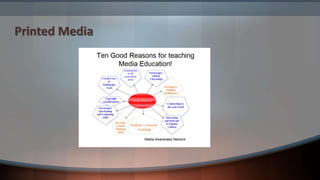
Printed Media
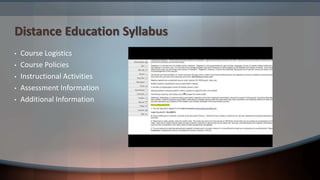
Distance Education Syllabus
• Course Logistics
• Course Policies
• Instructional Activities
• Assessment Information
• Additional Information
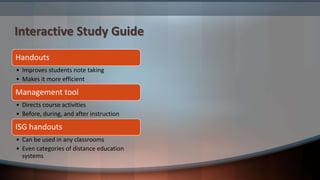
Interactive Study Guide
Handouts
• Improves students note taking
• Makes it more efficient
Management tool
• Directs course activities
• Before, during, and after instruction
ISG handouts
• Can be used in any classrooms
• Even categories of distance education
systems
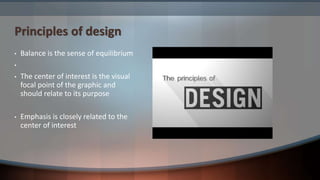
Principles of design
• Balance is the sense of equilibrium
•
• The center of interest is the visual
focal point of the graphic and
should relate to its purpose
• Emphasis is closely related to the
center of interest
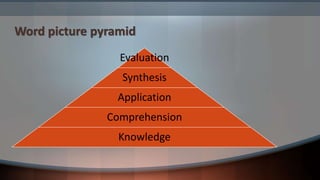
Word picture pyramid
Evaluation
Synthesis
Application
Comprehension
Knowledge
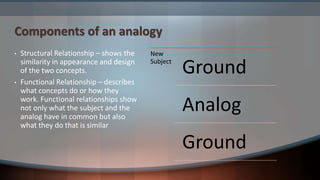
Components of an analogy
New
Subject
Ground
Analog
Ground
• Structural Relationship – shows the
similarity in appearance and design
of the two concepts.
• Functional Relationship – describes
what concepts do or how they
work. Functional relationships show
not only what the subject and the
analog have in common but also
what they do that is similar
Summary
• Printed handouts and teaching learning material is
critically important to the practice of distance education
• The course syllabus is the glue that brings it all together
• The syllabus can be expanded
• The ISG is also very important and it provides the distant
learner with a logical sequence for the distance education
lesson
Handouts, Study
Guides, and Visuals
Christopher Walker
APT 502

Handouts, study guides, and visuals

  • 1.
    Handouts, Study Guides, andVisuals Christopher Walker APT 502
  • 2.
    Chapter Objectives • Developa distance education course syllabus • Use interactive study guides • Apply graphic design principles • Develop word pictures • Use visual mnemonics
  • 3.
  • 4.
    Distance Education Syllabus •Course Logistics • Course Policies • Instructional Activities • Assessment Information • Additional Information
  • 5.
    Interactive Study Guide Handouts •Improves students note taking • Makes it more efficient Management tool • Directs course activities • Before, during, and after instruction ISG handouts • Can be used in any classrooms • Even categories of distance education systems
  • 6.
    Principles of design •Balance is the sense of equilibrium • • The center of interest is the visual focal point of the graphic and should relate to its purpose • Emphasis is closely related to the center of interest
  • 7.
  • 8.
    Components of ananalogy New Subject Ground Analog Ground • Structural Relationship – shows the similarity in appearance and design of the two concepts. • Functional Relationship – describes what concepts do or how they work. Functional relationships show not only what the subject and the analog have in common but also what they do that is similar
  • 9.
    Summary • Printed handoutsand teaching learning material is critically important to the practice of distance education • The course syllabus is the glue that brings it all together • The syllabus can be expanded • The ISG is also very important and it provides the distant learner with a logical sequence for the distance education lesson
  • 10.
    Handouts, Study Guides, andVisuals Christopher Walker APT 502